From Individual Demand to Consumer Surplus Today Deriving
- Slides: 25
From Individual Demand to Consumer Surplus Today: Deriving market demand from individual demand; using reservation prices to derive consumer surplus
Previously… n n n 7 core principles Thinking like economists Introduction to supply and demand Equilibrium A route choice experiment and its equilibrium Deriving individual demand
Today n n n Using individual demands to derive market demand Reservation price Consumer surplus
Recall individual demand n n Last time, we went through the assumptions that gave us a downwardsloping individual demand curve We will use “horizontal addition” to derive market demand from all individual demands
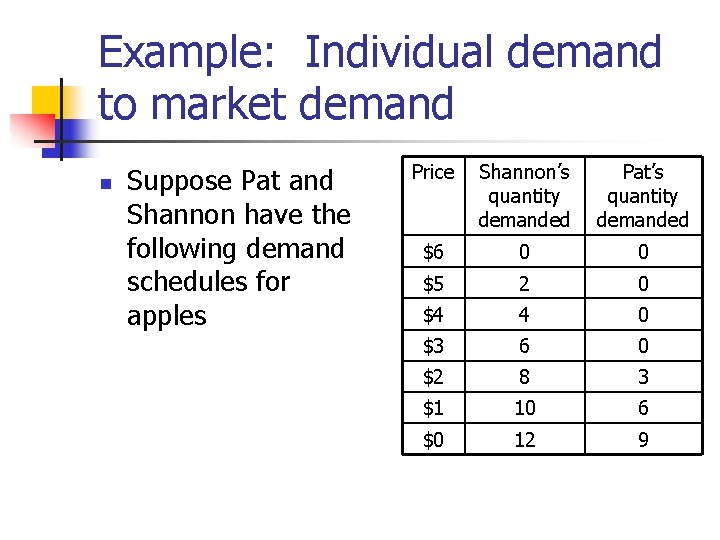
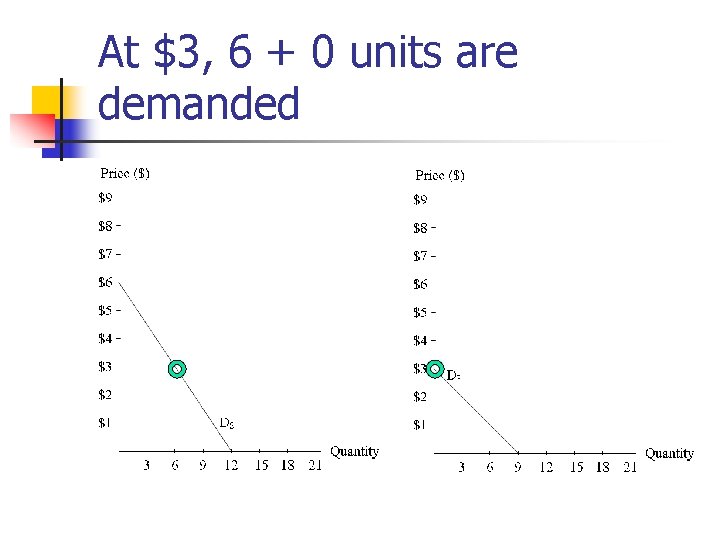
Example: Individual demand to market demand n Suppose Pat and Shannon have the following demand schedules for apples Price Shannon’s quantity demanded Pat’s quantity demanded $6 0 0 $5 2 0 $4 4 0 $3 6 0 $2 8 3 $1 10 6 $0 12 9
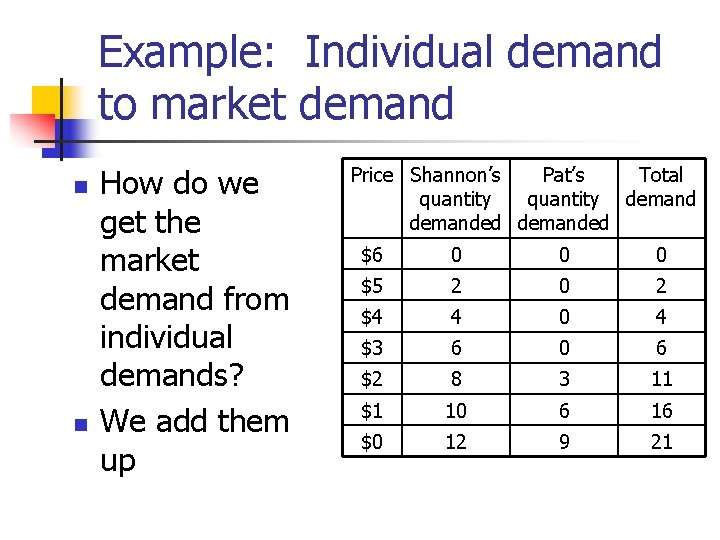
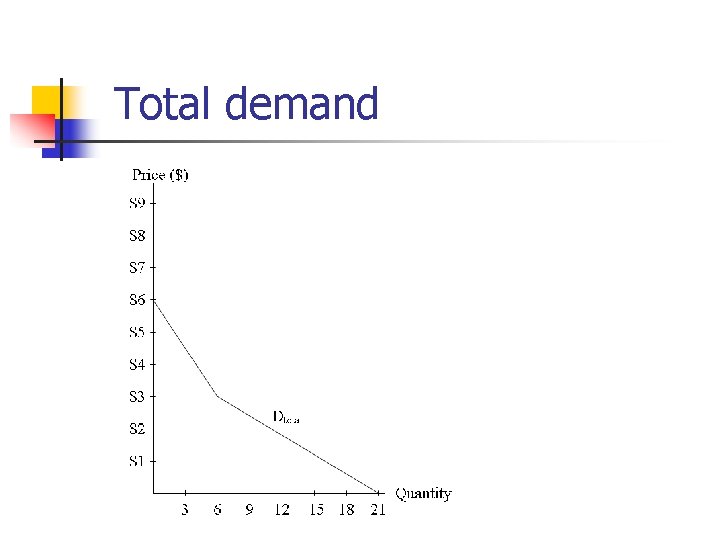
Example: Individual demand to market demand n n How do we get the market demand from individual demands? We add them up Price Shannon’s Pat’s Total quantity demanded $6 0 0 0 $5 2 0 2 $4 4 0 4 $3 6 0 6 $2 8 3 11 $1 10 6 16 $0 12 9 21
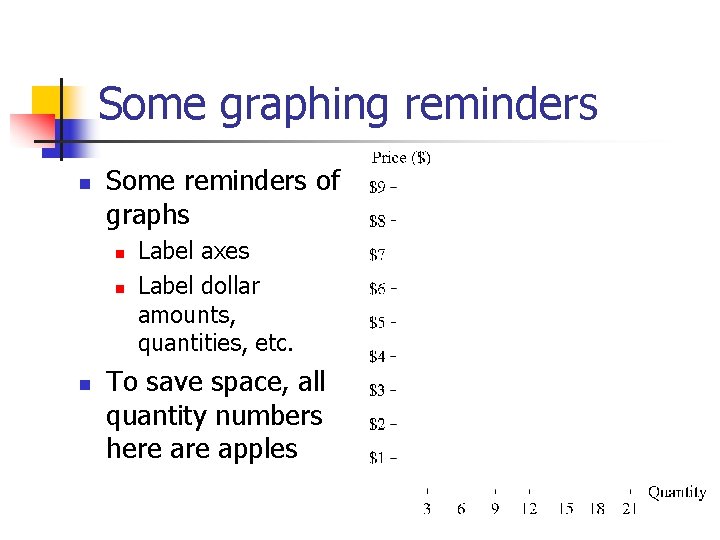
Some graphing reminders n Some reminders of graphs n n n Label axes Label dollar amounts, quantities, etc. To save space, all quantity numbers here apples
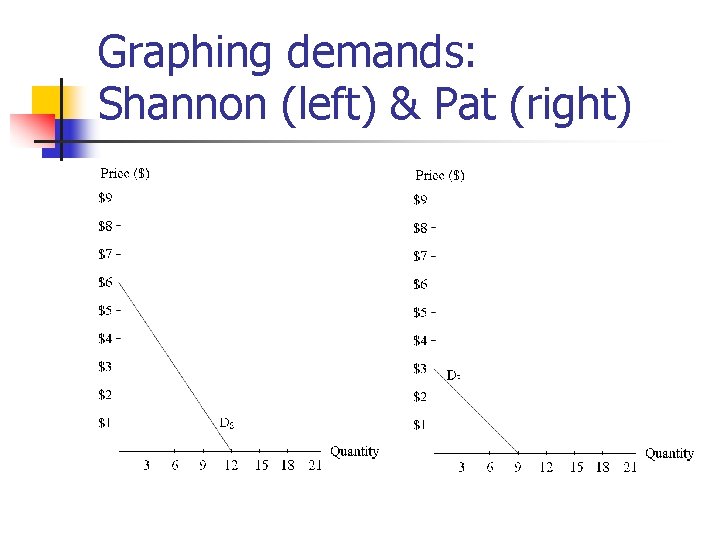
Graphing demands: Shannon (left) & Pat (right)
Total demand
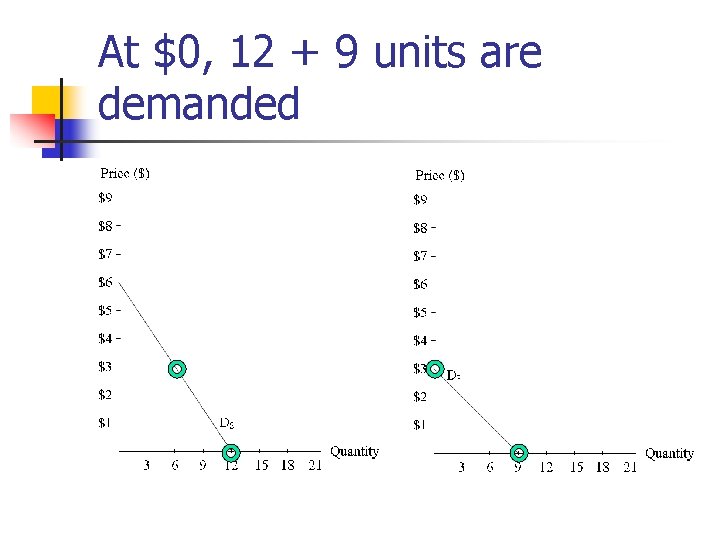
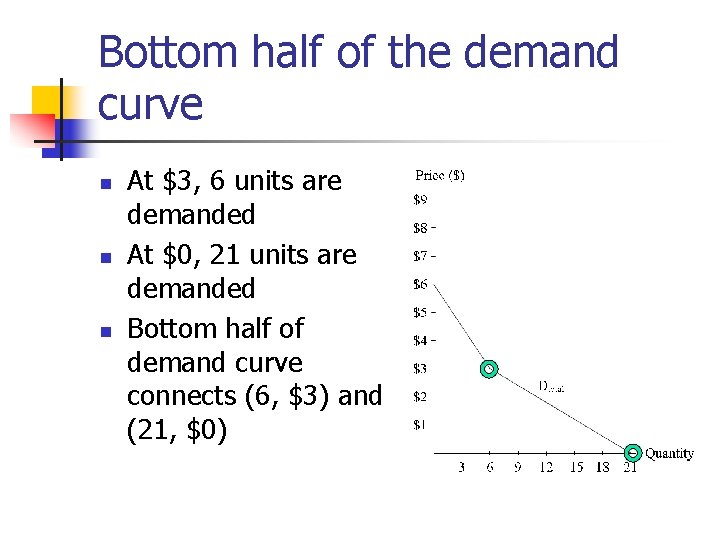
How can we graph demand with only the graphs? n n Another method of graphing total demand from individual demand is a method called horizontal addition We horizontally add quantities demanded from each person AT A GIVEN PRICE
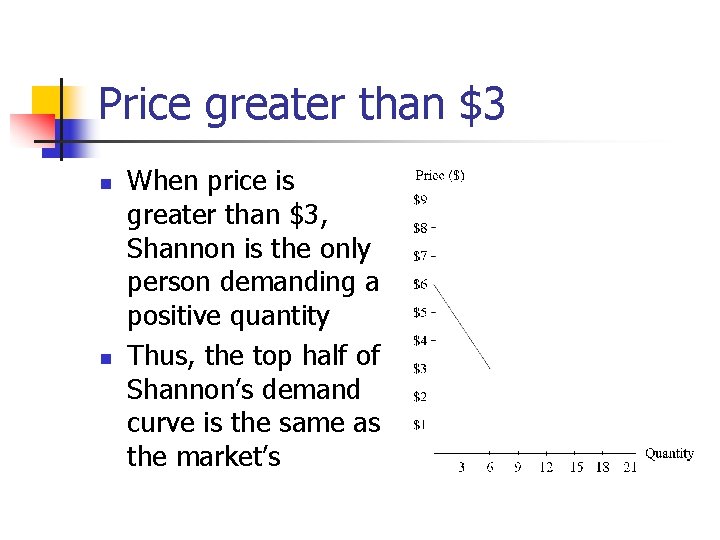
Price greater than $3 n n When price is greater than $3, Shannon is the only person demanding a positive quantity Thus, the top half of Shannon’s demand curve is the same as the market’s
At $3, 6 + 0 units are demanded
At $0, 12 + 9 units are demanded
Bottom half of the demand curve n n n At $3, 6 units are demanded At $0, 21 units are demanded Bottom half of demand curve connects (6, $3) and (21, $0)
Reservation price and consumer surplus n n How “well off” are we when we buy something? Calculate consumer surplus by using demand curve and reservation price
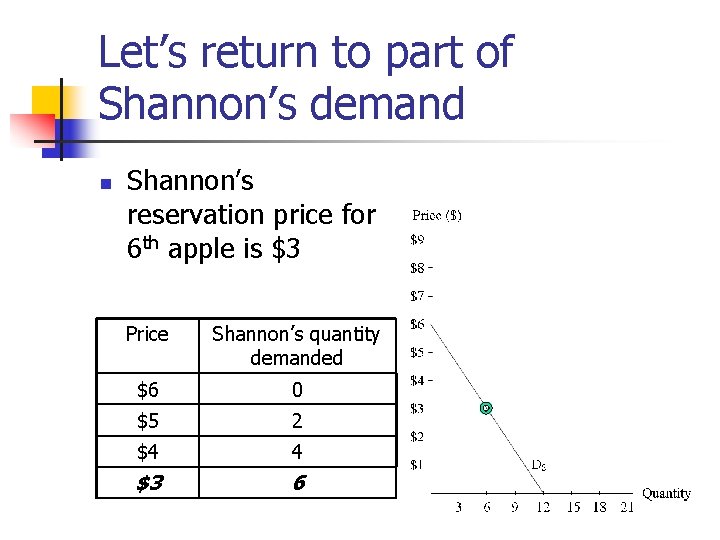
Reservation price n n Reservation price is the highest price a person is willing to pay for a good or service Note that reservation price for the nth unit corresponds to a particular point of a demand curve
Let’s return to part of Shannon’s demand n Shannon’s reservation price for 6 th apple is $3 Price Shannon’s quantity demanded $6 0 $5 2 $4 4 $3 6
Core principle: Efficiency n Today, we calculate consumer surplus to help on our quest to efficiency
Calculating consumer surplus n n Consumer surplus (CS) for the nth unit is the vertical difference between the demand curve and the price paid We will calculate CS two ways n n Discretely Approximate using area under demand curve
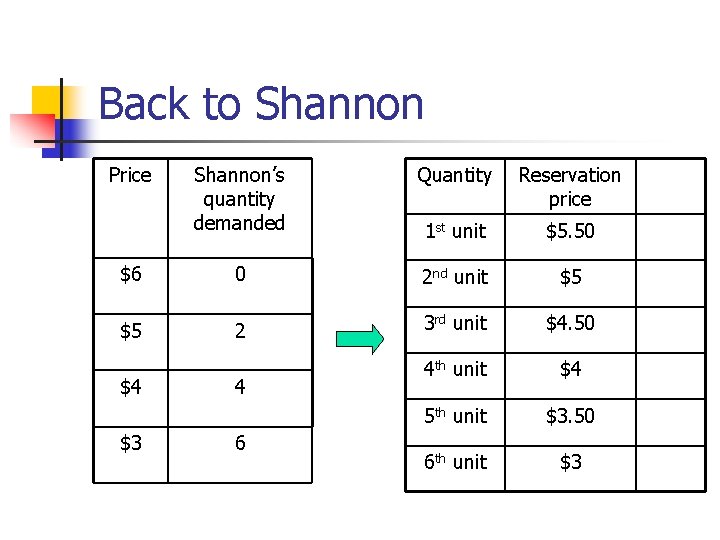
Back to Shannon Price Shannon’s quantity demanded Quantity Reservation price 1 st unit $5. 50 $6 0 2 nd unit $5 $5 2 3 rd unit $4. 50 4 th unit $4 5 th unit $3. 50 6 th unit $3 $4 $3 4 6
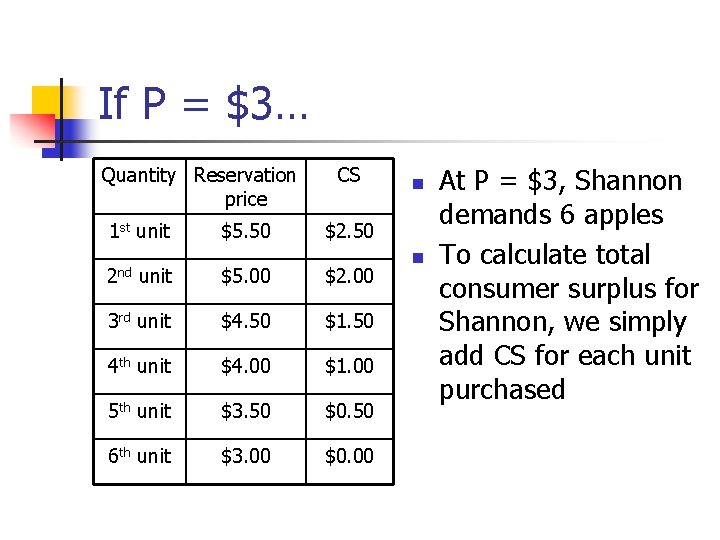
If P = $3… Quantity Reservation price 1 st unit 2 nd $5. 50 CS n $2. 50 unit $5. 00 $2. 00 3 rd unit $4. 50 $1. 50 4 th unit $4. 00 $1. 00 5 th unit $3. 50 $0. 50 6 th unit $3. 00 $0. 00 n At P = $3, Shannon demands 6 apples To calculate total consumer surplus for Shannon, we simply add CS for each unit purchased
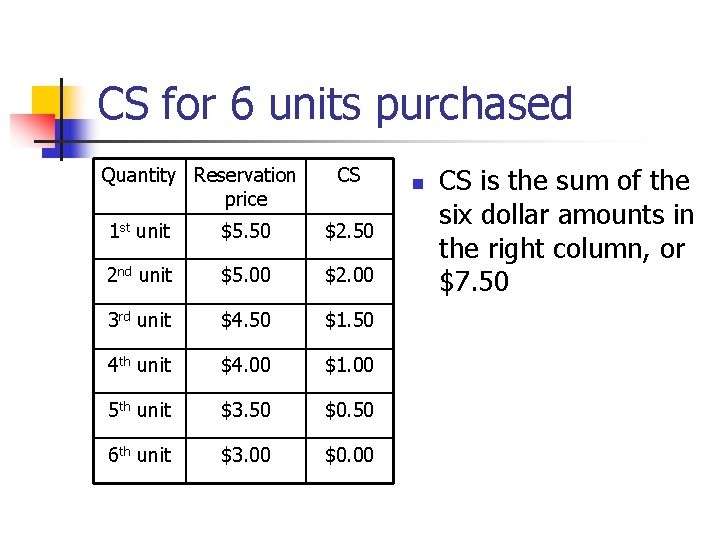
CS for 6 units purchased Quantity Reservation price CS 1 st unit $5. 50 $2. 50 2 nd unit $5. 00 $2. 00 3 rd unit $4. 50 $1. 50 4 th unit $4. 00 $1. 00 5 th unit $3. 50 $0. 50 6 th unit $3. 00 $0. 00 n CS is the sum of the six dollar amounts in the right column, or $7. 50
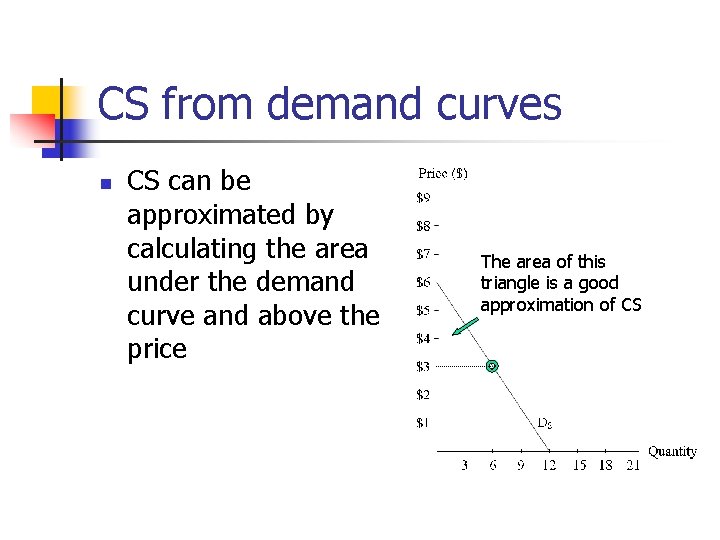
CS from demand curves n CS can be approximated by calculating the area under the demand curve and above the price The area of this triangle is a good approximation of CS
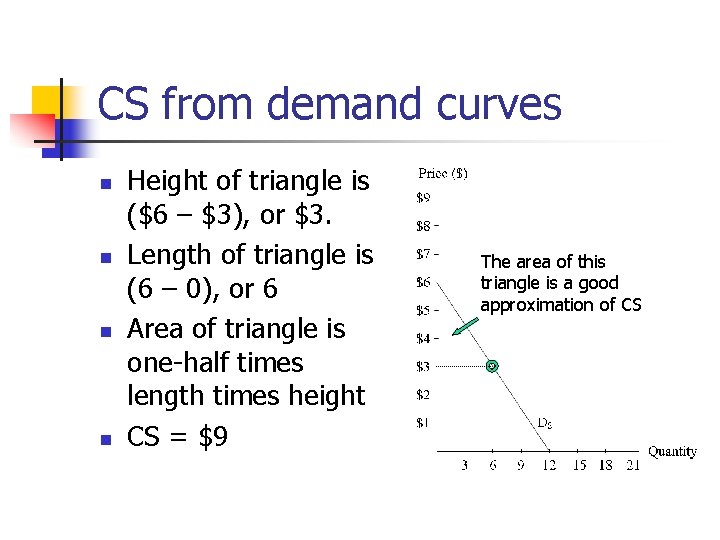
CS from demand curves n n Height of triangle is ($6 – $3), or $3. Length of triangle is (6 – 0), or 6 Area of triangle is one-half times length times height CS = $9 The area of this triangle is a good approximation of CS
This concludes demand n What have we learned? n n n How individual demand is derived Utility The rational spending rule Deriving market demand from individual demand Consumer surplus