Form Words Word Classes and Phrases 1412074 1


- Slides: 29
Form: Words, Word Classes and Phrases 1412074 엄윤호 1
Contexts The Notion ‘Word’ Nouns and Determinatives Adjectives 2
The Notion ‘Word’ Q. Are they the same words? (1) dog vs dogs (2) eat vs eats -> They belong to the same lexeme, but are different word-forms and orthographic words. 단어의 의미를 이루는 최소단위(lexeme)는 같지만 단어의 철자가 다르다. 3
The Notion ‘Word’ Q. Is it a word, or two words? (3) duty-free -> It seems like two words, but acts like one word hence the hyphen. Ex) duty-free shop, duty-free alcohol -> Morphology에서 다루는 방식! 4
The Notion ‘Word’ Q. How many words are in this sentence? The President regularly eats big doughnuts in his limousine. -> Why 9? -> Syntax적인 측면에서 검증해 보자!! 이번 단원 학습목표니까 잘 봐두세요~ 5
The Notion ‘Word’ <Words classification in Syntax> Noun (명사) Determinative (한정사) Adjective (형용사) Verb (동사) Preposition (전치사) Adverb (부사) Conjunction (접속사) Interjection (감탄사) 6
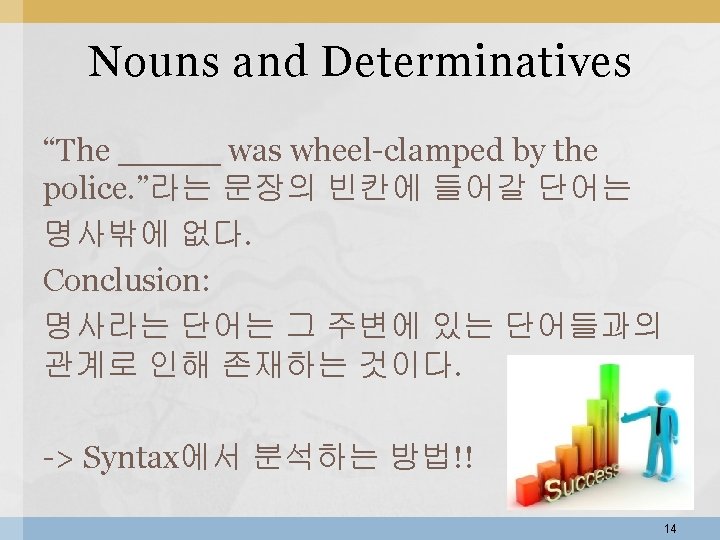
Nouns and Determinatives The President regularly eats big doughnuts in his limousine. Q. How many nouns are in this sentence? -> Why? How did you know? Why are they nouns? 학습 목표!! 7
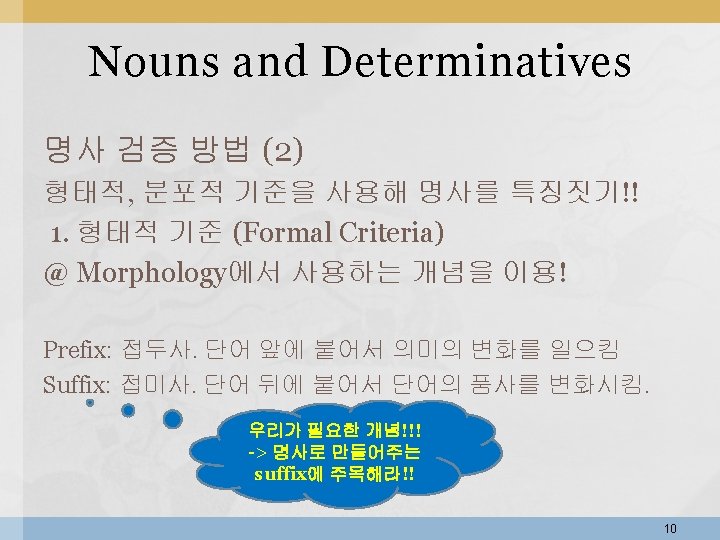
Nouns and Determinatives 명사 검증 방법 (1) 명사의 Notional Definition 이용하기! -> Nouns are defined as words that denote people, animals, things, or places. Ex) Jim, dog, aeroplane, teacher, chair, London, Seoul, student, etc. 8
Nouns and Determinatives Notional Definition에 대한 반박 -> Notional Definition만 으로는 abstract ideas or concepts (success, death) emotional states (love, happiness) bodily sensation (dizziness, tiredness) 등이 명사라는 것을 설명 불가능! -> 게다가 우리의 학습목표인 명사인 이유를 이 정의로는 밝혀낼 수 없다!! 9
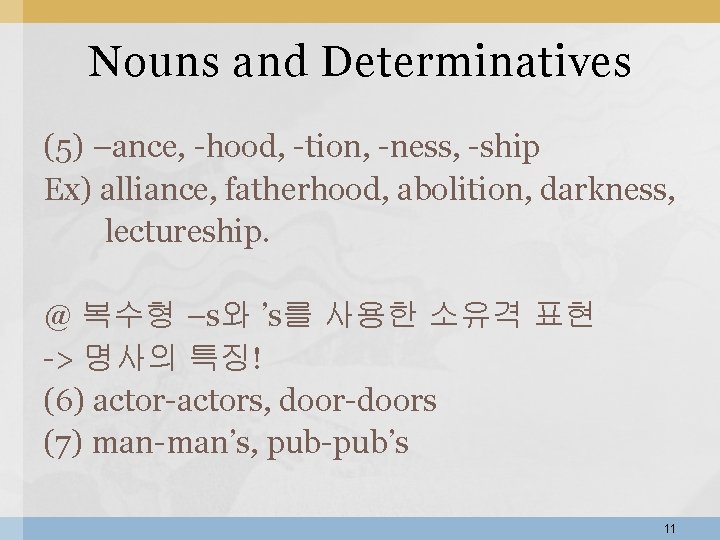
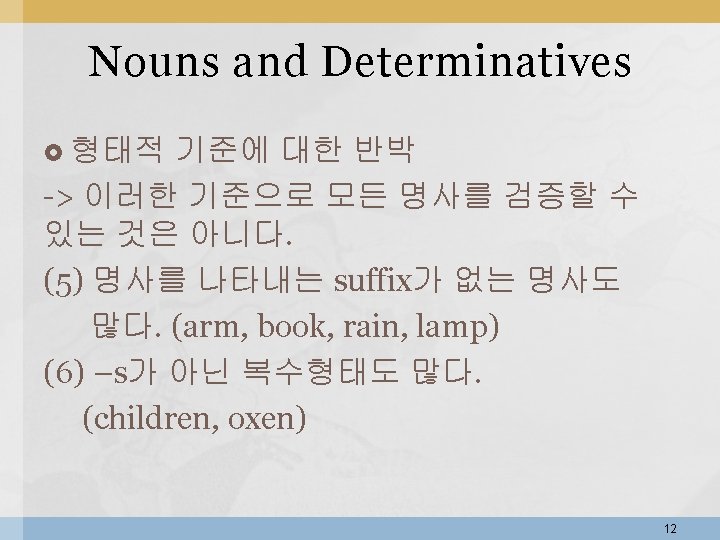
Nouns and Determinatives (5) –ance, -hood, -tion, -ness, -ship Ex) alliance, fatherhood, abolition, darkness, lectureship. @ 복수형 –s와 ’s를 사용한 소유격 표현 -> 명사의 특징! (6) actor-actors, door-doors (7) man-man’s, pub-pub’s 11
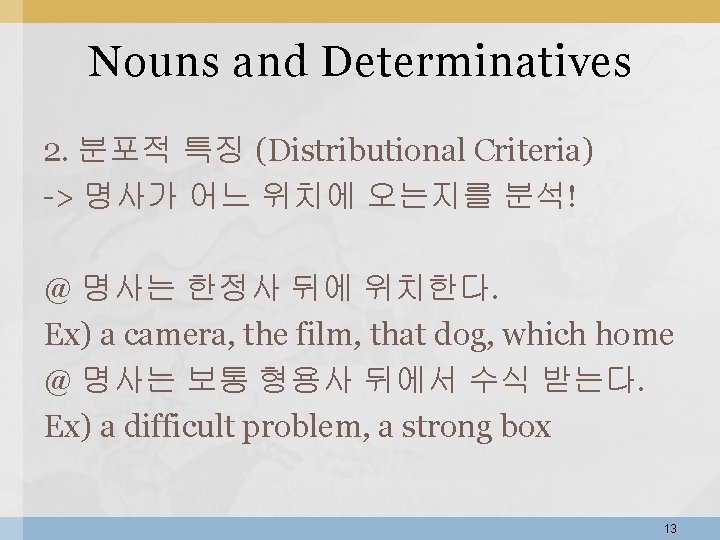
Nouns and Determinatives 2. 분포적 특징 (Distributional Criteria) -> 명사가 어느 위치에 오는지를 분석! @ 명사는 한정사 뒤에 위치한다. Ex) a camera, the film, that dog, which home @ 명사는 보통 형용사 뒤에서 수식 받는다. Ex) a difficult problem, a strong box 13
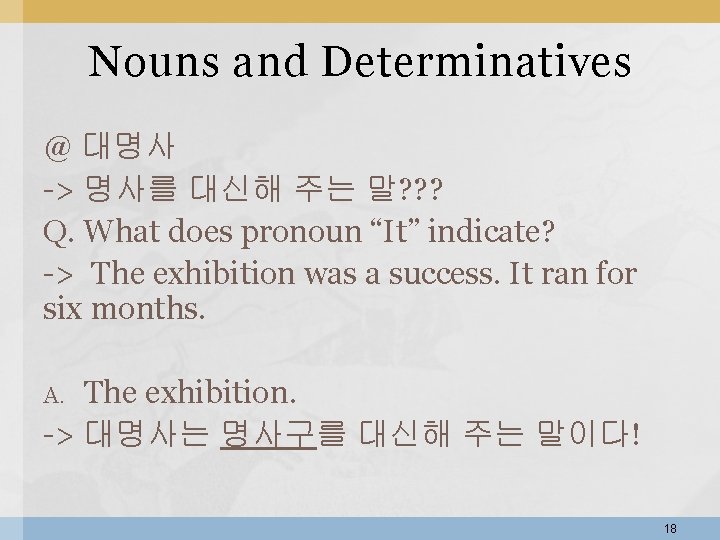
Nouns and Determinatives @ 대명사 -> 명사를 대신해 주는 말? ? ? Q. What does pronoun “It” indicate? -> The exhibition was a success. It ran for six months. The exhibition. -> 대명사는 명사구를 대신해 주는 말이다! A. 18
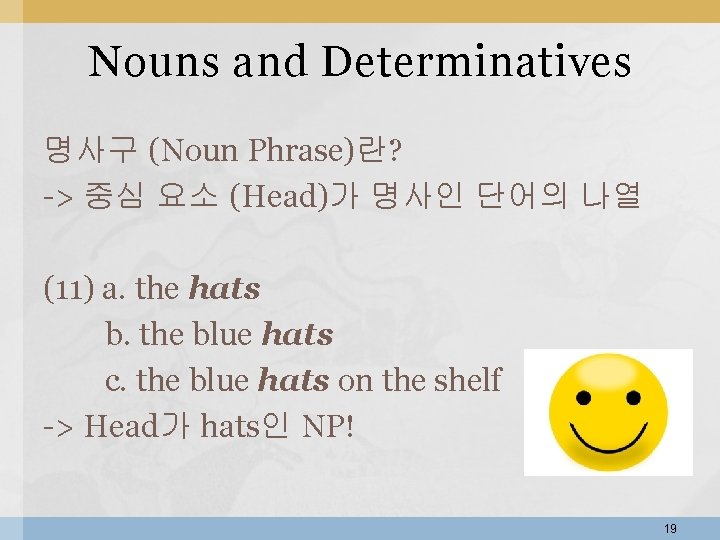
Nouns and Determinatives 명사구 (Noun Phrase)란? -> 중심 요소 (Head)가 명사인 단어의 나열 (11) a. the hats b. the blue hats c. the blue hats on the shelf -> Head가 hats인 NP! 19
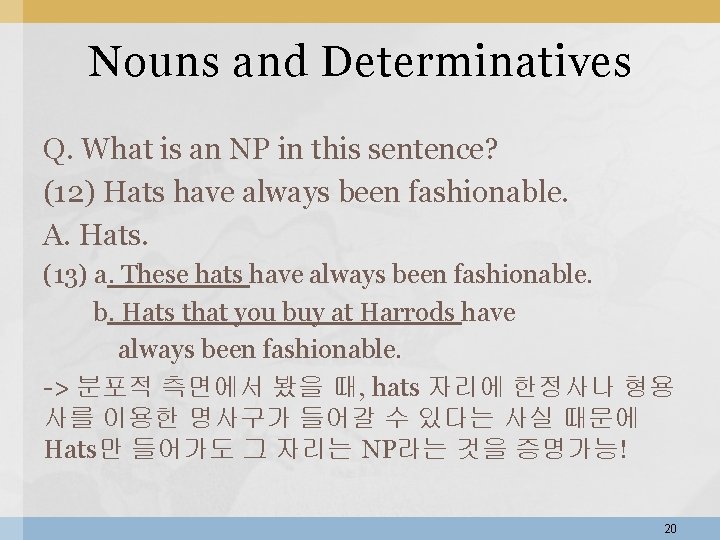
Nouns and Determinatives Q. What is an NP in this sentence? (12) Hats have always been fashionable. A. Hats. (13) a. These hats have always been fashionable. b. Hats that you buy at Harrods have always been fashionable. -> 분포적 측면에서 봤을 때, hats 자리에 한정사나 형용 사를 이용한 명사구가 들어갈 수 있다는 사실 때문에 Hats만 들어가도 그 자리는 NP라는 것을 증명가능! 20
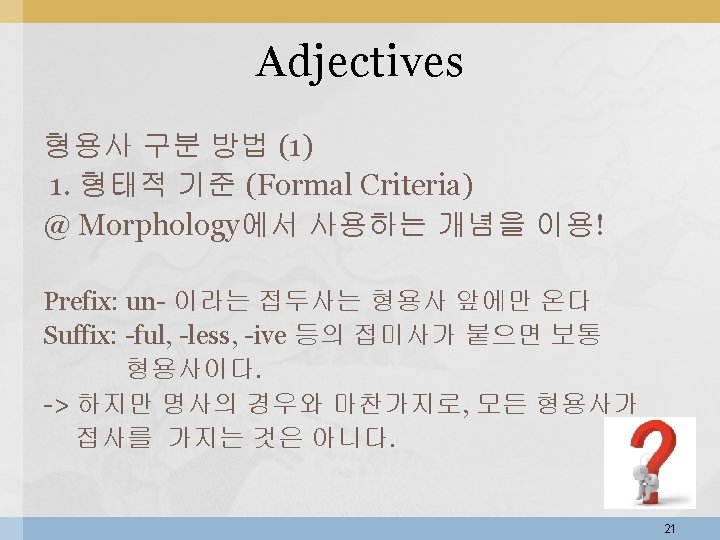
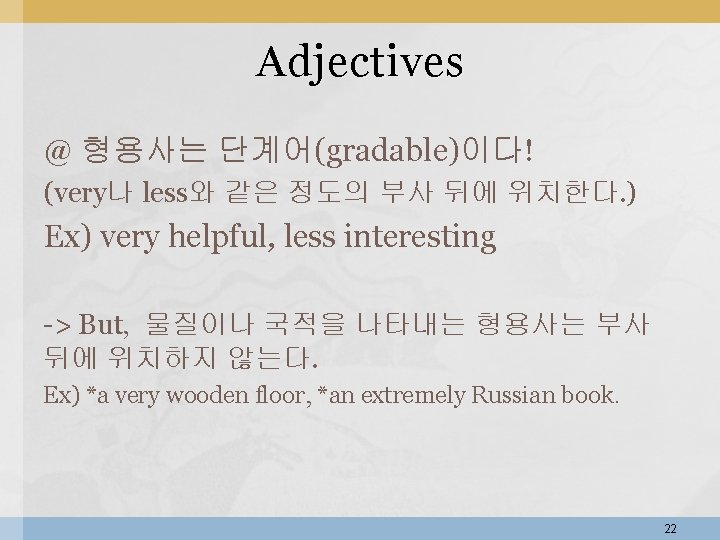
Adjectives @ 형용사는 단계어(gradable)이다! (very나 less와 같은 정도의 부사 뒤에 위치한다. ) Ex) very helpful, less interesting -> But, 물질이나 국적을 나타내는 형용사는 부사 뒤에 위치하지 않는다. Ex) *a very wooden floor, *an extremely Russian book. 22
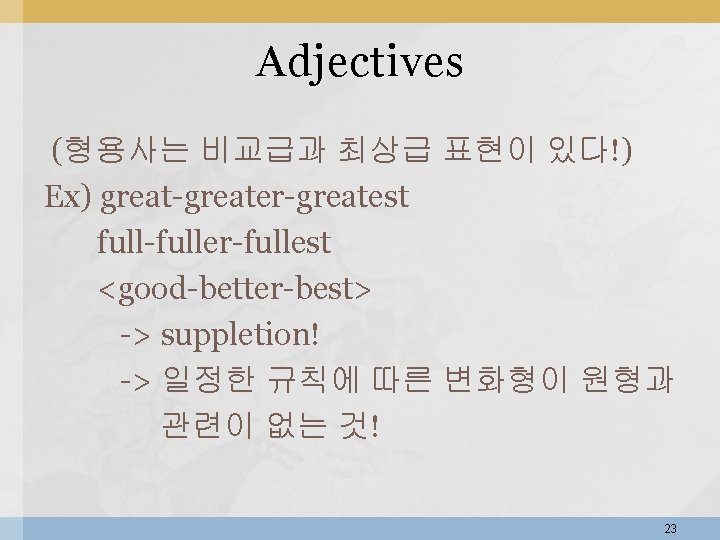
Adjectives (형용사는 비교급과 최상급 표현이 있다!) Ex) great-greater-greatest full-fuller-fullest <good-better-best> -> suppletion! -> 일정한 규칙에 따른 변화형이 원형과 관련이 없는 것! 23
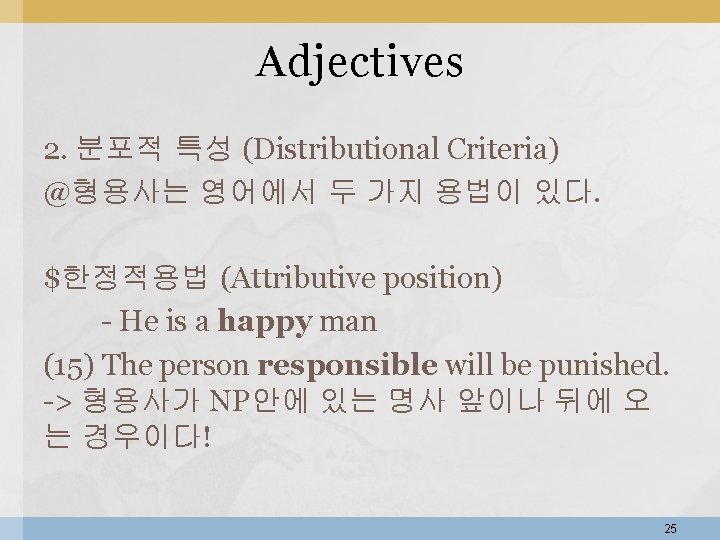
Adjectives 2. 분포적 특성 (Distributional Criteria) @형용사는 영어에서 두 가지 용법이 있다. $한정적용법 (Attributive position) - He is a happy man (15) The person responsible will be punished. -> 형용사가 NP안에 있는 명사 앞이나 뒤에 오 는 경우이다! 25
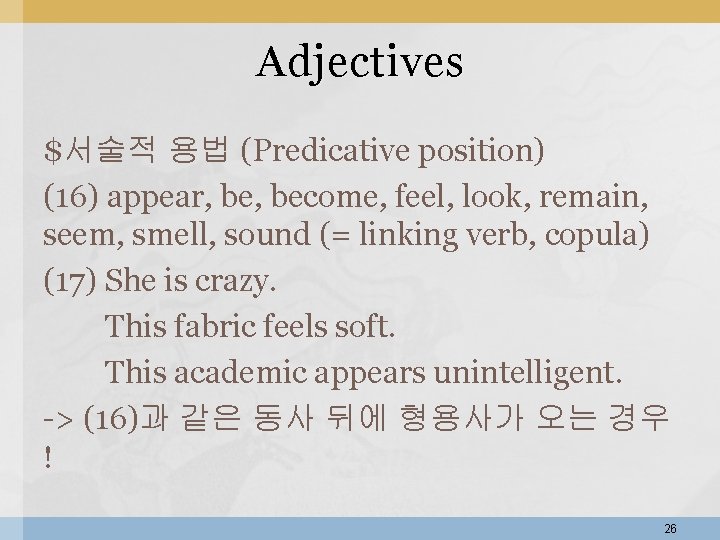
Adjectives $서술적 용법 (Predicative position) (16) appear, become, feel, look, remain, seem, smell, sound (= linking verb, copula) (17) She is crazy. This fabric feels soft. This academic appears unintelligent. -> (16)과 같은 동사 뒤에 형용사가 오는 경우 ! 26
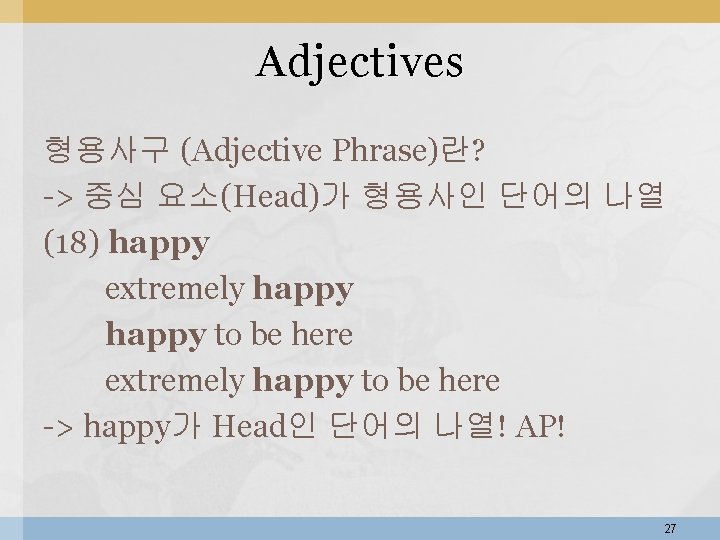
Adjectives 형용사구 (Adjective Phrase)란? -> 중심 요소(Head)가 형용사인 단어의 나열 (18) happy extremely happy to be here -> happy가 Head인 단어의 나열! AP! 27
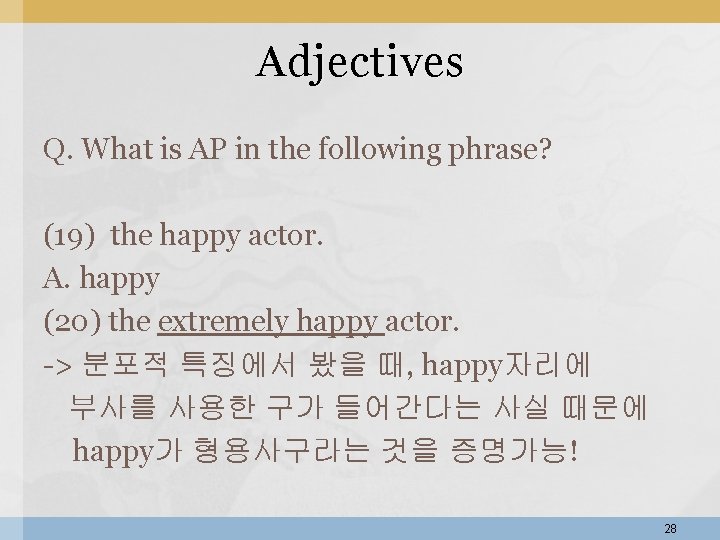
Adjectives Q. What is AP in the following phrase? (19) the happy actor. A. happy (20) the extremely happy actor. -> 분포적 특징에서 봤을 때, happy자리에 부사를 사용한 구가 들어간다는 사실 때문에 happy가 형용사구라는 것을 증명가능! 28
Thank you! 29