Financial Accounting Fourteenth Edition Williams Mc GrawHillIrwin Haka


- Slides: 25
Financial Accounting Fourteenth Edition Williams Mc. Graw-Hill/Irwin Haka Bettner Carcello Copyright © 2010 by The Mc. Graw-Hill Companies, Inc. All
Accounting: Information for Decision Making Chapter 1 1 -2
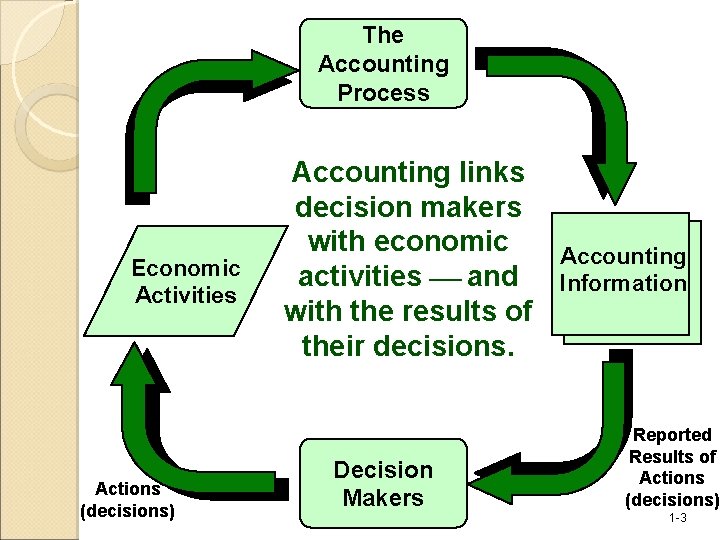
The Accounting Process Economic Activities Actions (decisions) Accounting links decision makers with economic activities ¾ and with the results of their decisions. Decision Makers Accounting Information Reported Results of Actions (decisions) 1 -3
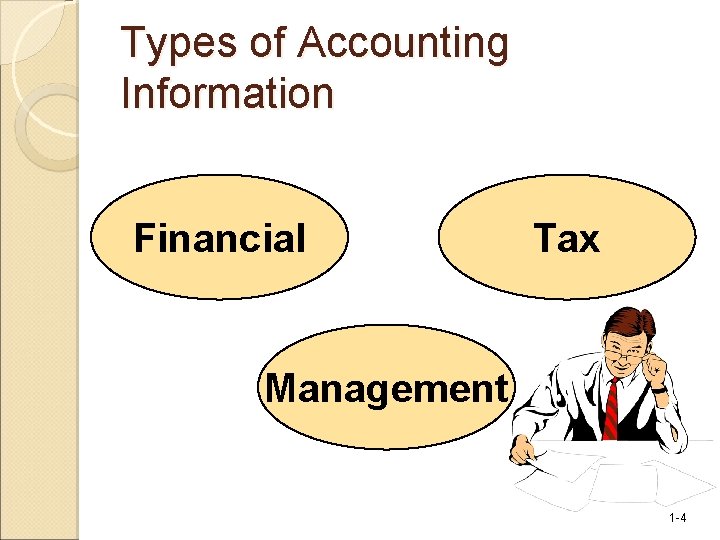
Types of Accounting Information Financial Tax Management 1 -4
Accounting Systems An accounting system consists of the personnel, procedures, technology, and records used by an organization to develop accounting information and to communicate this information to decision makers. 1 -5
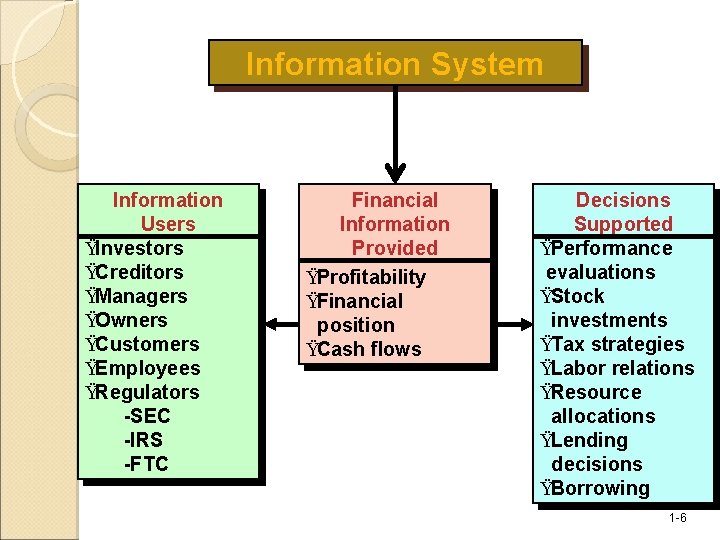
Information System Information Users ŸInvestors ŸCreditors ŸManagers ŸOwners ŸCustomers ŸEmployees ŸRegulators -SEC -IRS -FTC Financial Information Provided ŸProfitability ŸFinancial position ŸCash flows Decisions Supported ŸPerformance evaluations ŸStock investments ŸTax strategies ŸLabor relations ŸResource allocations ŸLending decisions ŸBorrowing 1 -6
Determining Information Needs Although much accounting information clearly is essential to business operations, management still has many choices as to the types and amount of accounting information to be developed. 1 -7
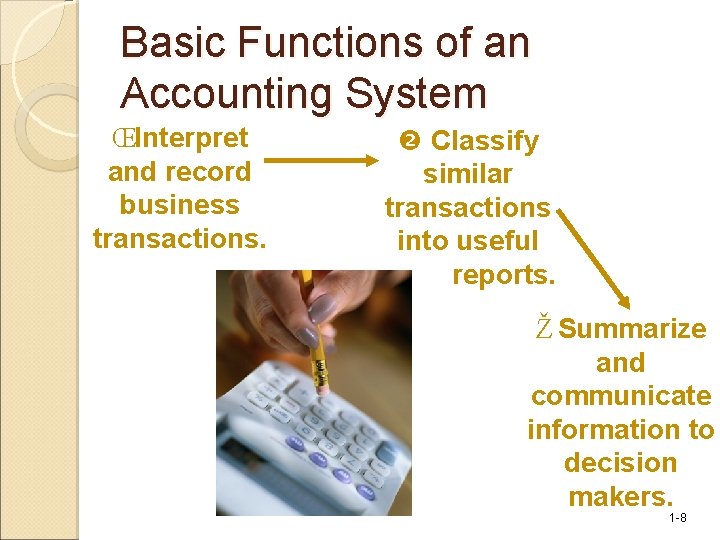
Basic Functions of an Accounting System ŒInterpret and record business transactions. Classify similar transactions into useful reports. Ž Summarize and communicate information to decision makers. 1 -8
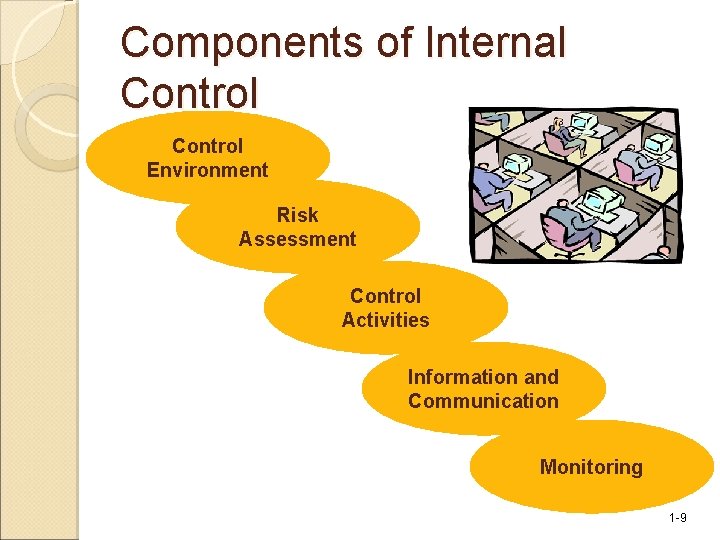
Components of Internal Control Environment Risk Assessment Control Activities Information and Communication Monitoring 1 -9
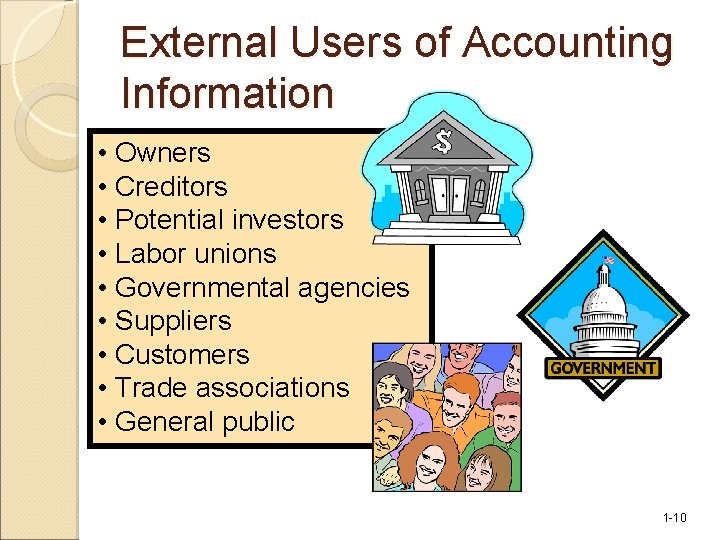
External Users of Accounting Information • Owners • Creditors • Potential investors • Labor unions • Governmental agencies • Suppliers • Customers • Trade associations • General public 1 -10
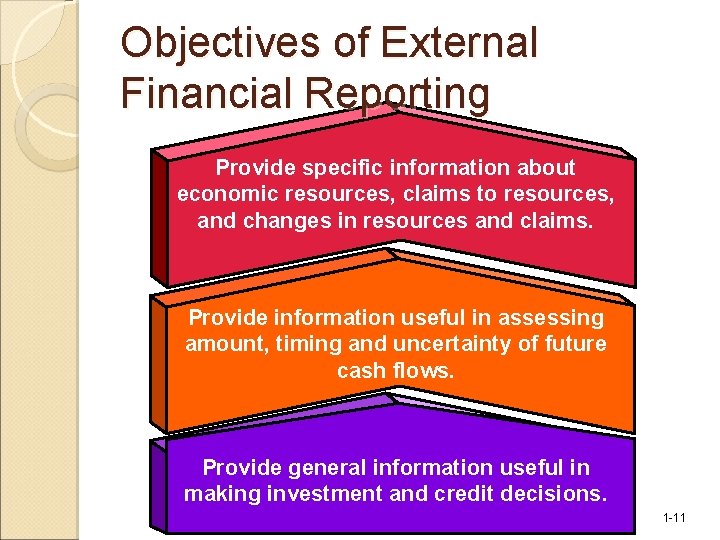
Objectives of External Financial Reporting Provide specific information about economic resources, claims to resources, and changes in resources and claims. Provide information useful in assessing amount, timing and uncertainty of future cash flows. Provide general information useful in making investment and credit decisions. 1 -11
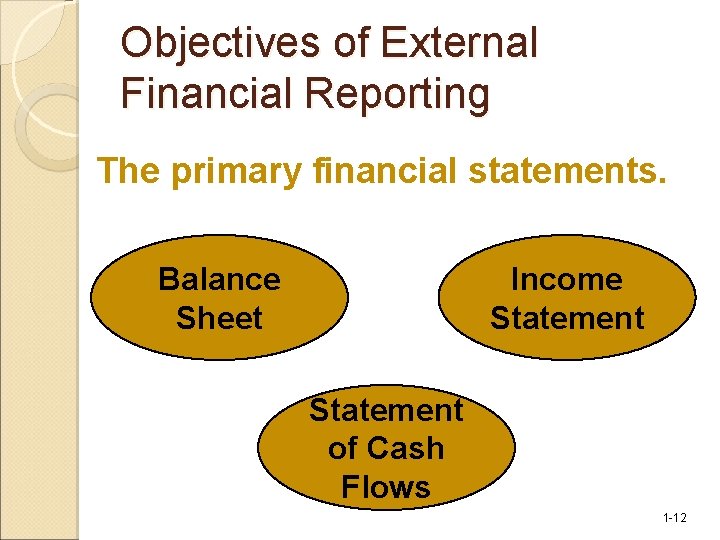
Objectives of External Financial Reporting The primary financial statements. Balance Sheet Income Statement of Cash Flows 1 -12
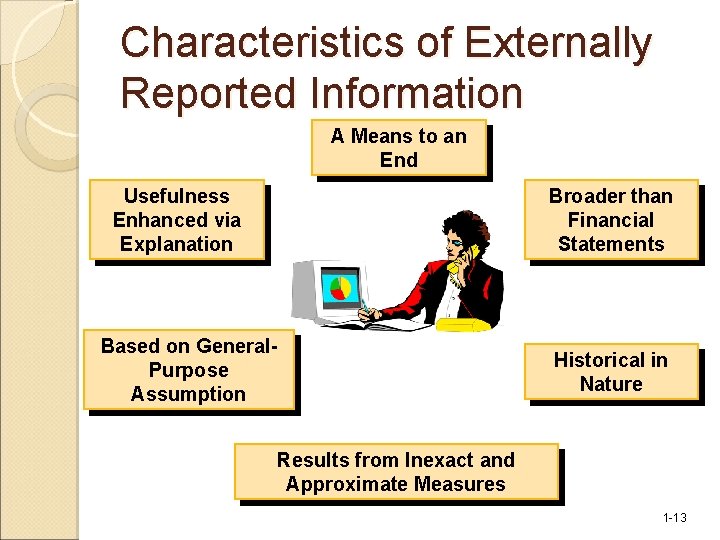
Characteristics of Externally Reported Information A Means to an End Usefulness Enhanced via Explanation Broader than Financial Statements Based on General. Purpose Assumption Historical in Nature Results from Inexact and Approximate Measures 1 -13
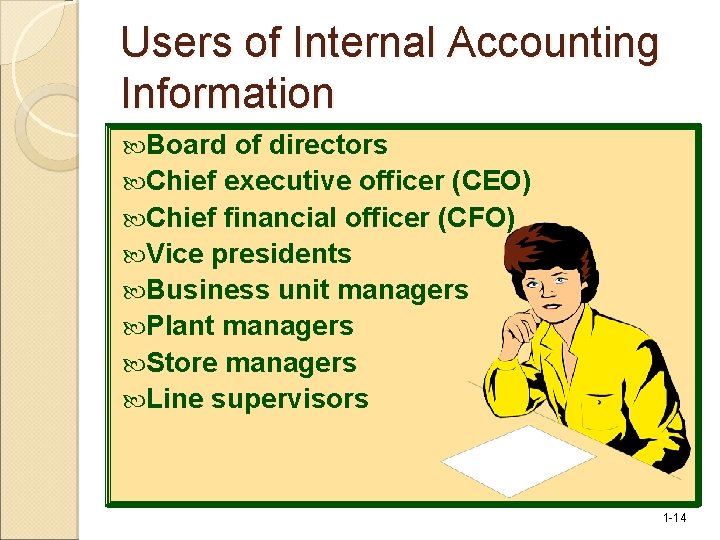
Users of Internal Accounting Information Board of directors Chief executive officer (CEO) Chief financial officer (CFO) Vice presidents Business unit managers Plant managers Store managers Line supervisors 1 -14
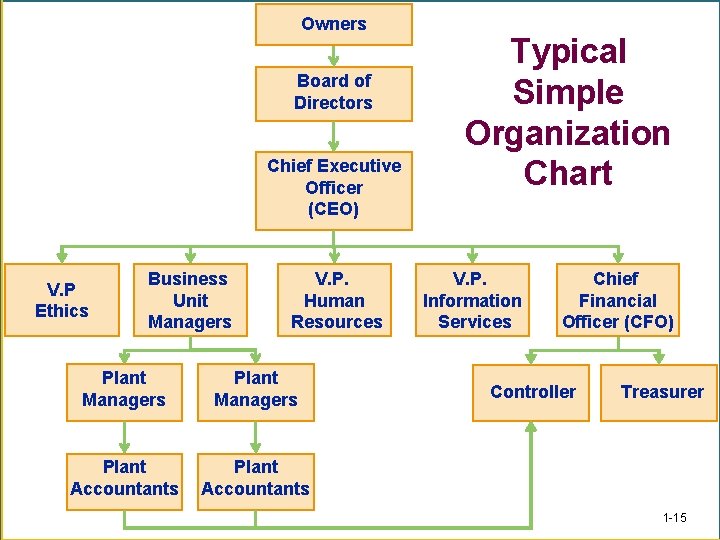
Owners Board of Directors Chief Executive Officer (CEO) V. P Ethics Business Unit Managers V. P. Human Resources Plant Managers Plant Accountants Typical Simple Organization Chart V. P. Information Services Chief Financial Officer (CFO) Controller Treasurer 1 -15
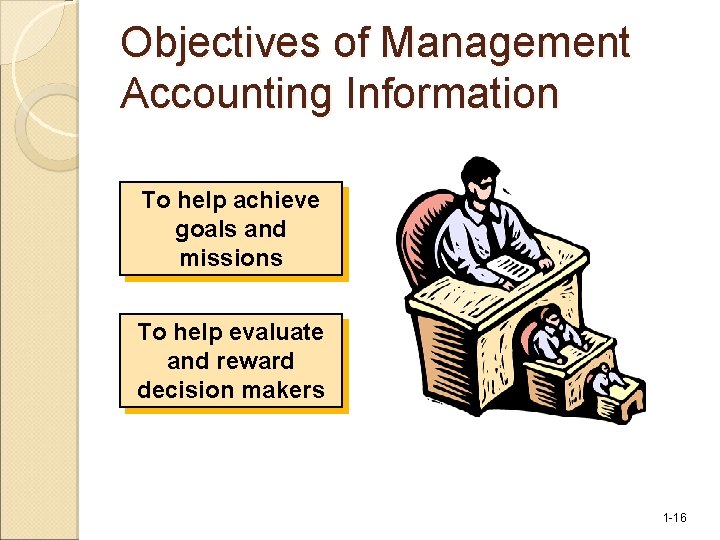
Objectives of Management Accounting Information To help achieve goals and missions To help evaluate and reward decision makers 1 -16
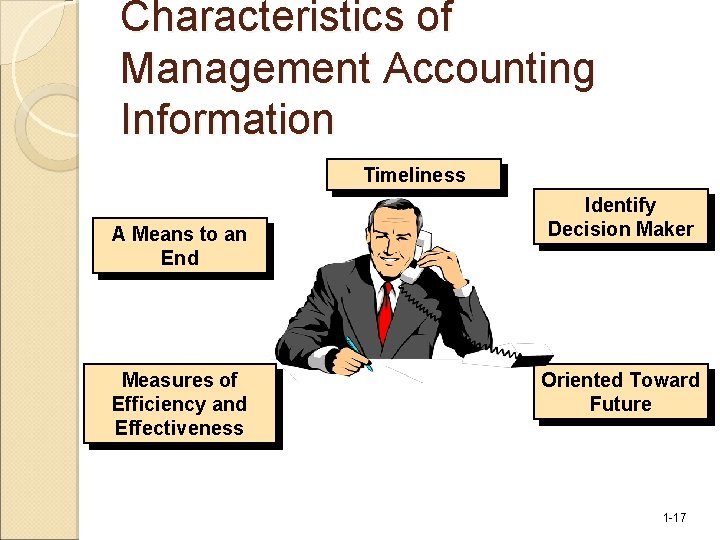
Characteristics of Management Accounting Information Timeliness A Means to an End Measures of Efficiency and Effectiveness Identify Decision Maker Oriented Toward Future 1 -17
Institutional Features ŸGenerally Accepted Accounting Principles (GAAP) ŸFinancial Accounting Standards Board ŸInternational Accounting Standards Board ŸSecurities and Exchange Commission ŸPublic Company Accounting Oversight Board ŸAudits of Financial Statements ŸLegislation 1 -18
Professional Organizations Ÿ American Institute of Certified Public Accountants Ÿ Institute of Management Accountants Ÿ Institute of Internal Auditors Ÿ American Accounting Association Ÿ Committee of Sponsoring Organizations of the Treadway Commission (COSO) 1 -19
Competence, Judgment and Ethical Behavior Ÿ Certified Public Accountant (CPA) Ÿ Certified Management Accountant (CMA) Ÿ Certified Internal Auditor (CIA) Ethical behavior is the cornerstone of the accounting profession. 1 -20
Careers in Accounting Ÿ Public Accounting Ÿ Management Accounting Ÿ Governmental Accounting Ÿ Accounting Education 1 -21
What About Bookkeeping? Bookkeeping is the clerical side of accounting— the recording of routine transactions and day-today record keeping. Professional accountants are involved more with the interpretation and use of accounting information than with its actual preparation. 1 -22
I’m Not An Accounting Major Accounting is the language of business, and trying to run a business without understanding accounting information is analogous to trying to play sports without understanding the rules. 1 -23
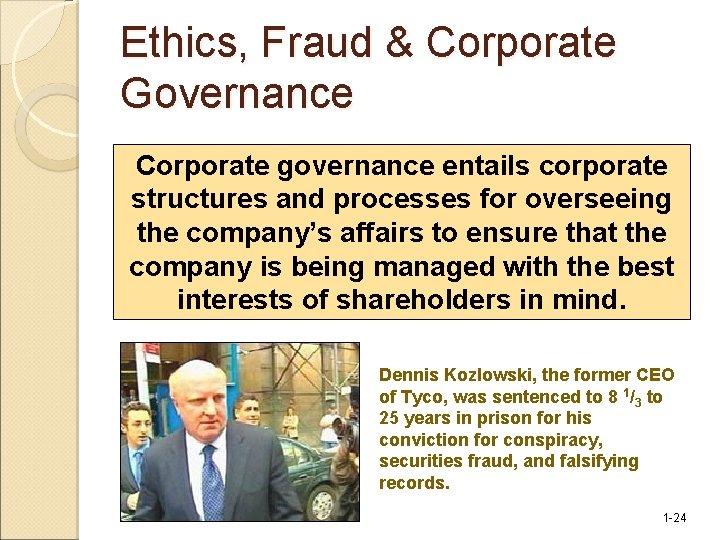
Ethics, Fraud & Corporate Governance Corporate governance entails corporate structures and processes for overseeing the company’s affairs to ensure that the company is being managed with the best interests of shareholders in mind. Dennis Kozlowski, the former CEO of Tyco, was sentenced to 8 1/3 to 25 years in prison for his conviction for conspiracy, securities fraud, and falsifying records. 1 -24
End of Chapter 1 1 -25