Exploiting Wikipedia as External Knowledge for Document Clustering



- Slides: 27
Exploiting Wikipedia as External Knowledge for Document Clustering Xiaohua Hu, Xiaodan Zhang, Caimei Lu, E. K. Park, and Xiaohua Zhou Proceeding of International Conference on Knowledge Discovery and Data Mining, ACM SIGKDD, 2009 2020/11/3 報告人: 吳建良 1
Outline n n Motivation Framework of Wikipedia-based clustering n n n Concept mapping schemes Category mapping Document clustering Experiments Conclusions 2
Motivation n Traditional text clustering algorithm n n Based on BOW (Bag of Word) Ignore the semantic relationship among words n n Synonym or semantically associated in other forms One way to resolve this problem n n n Use background knowledge to enrich document representation Background knowledge is described by an ontology Ontology: concepts, attributes, relationships 3
Motivation (cont. ) n Problem of this approach based on an ontology n n Difficult to find a comprehensive ontology to cover all the concepts Previous works has adopted Word. Net and Mesh n Replace original content with ontology term n n Information loss Add ontology term to original document vector n Bring data noise into the dataset 4
Goal n Adopt more comprehensive ontology n n n Wikipedia Fully leverage ontology terms and relations without introducing more noise Two matching methods n n Exact-match Relatedness-match 5
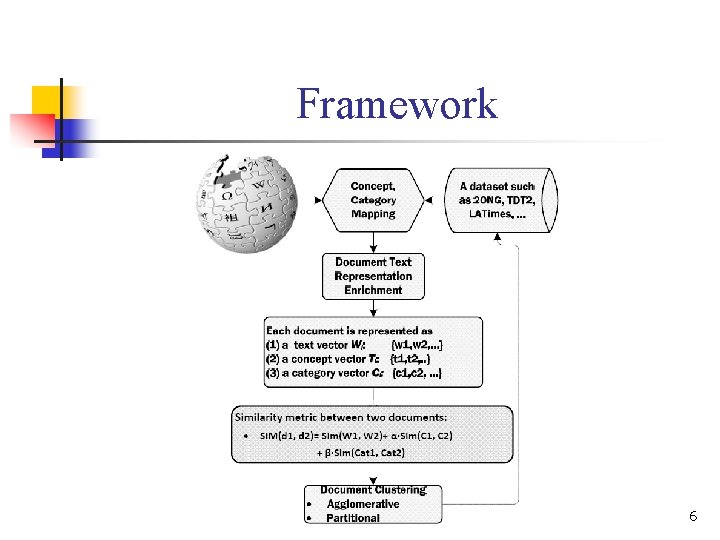
Framework 6
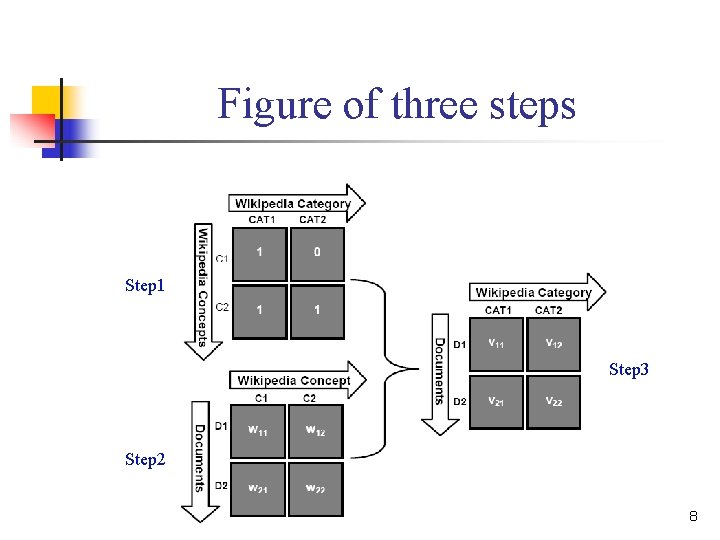
Mapping Document to Wikipedia Concepts and Categories n Mapping process includes three steps: 1. 2. 3. Build the connection between Wikipedia concepts and categories Map each document into a vector of Wikipedia concepts Match each document to a set of Wikipedia categories 7
Figure of three steps Step 1 Step 3 Step 2 8
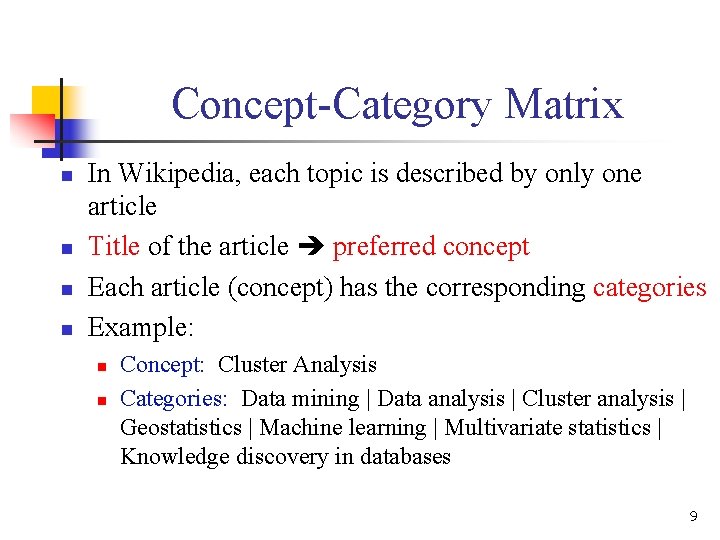
Concept-Category Matrix n n In Wikipedia, each topic is described by only one article Title of the article preferred concept Each article (concept) has the corresponding categories Example: n n Concept: Cluster Analysis Categories: Data mining | Data analysis | Cluster analysis | Geostatistics | Machine learning | Multivariate statistics | Knowledge discovery in databases 9
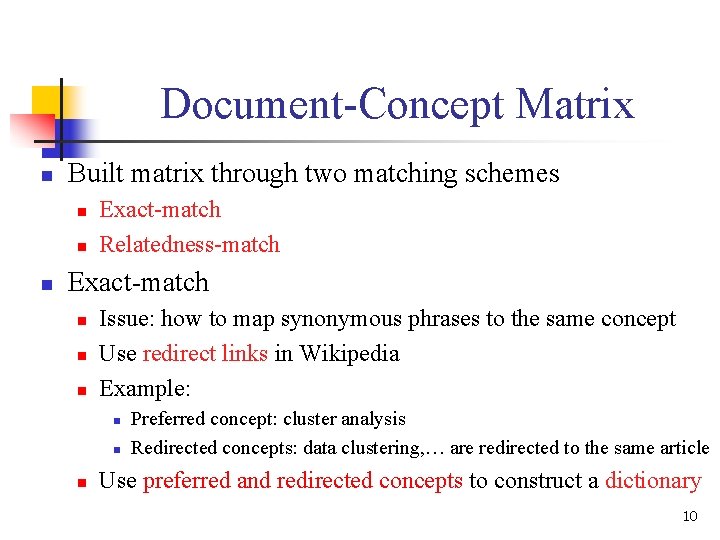
Document-Concept Matrix n Built matrix through two matching schemes n n n Exact-match Relatedness-match Exact-match n n n Issue: how to map synonymous phrases to the same concept Use redirect links in Wikipedia Example: n n n Preferred concept: cluster analysis Redirected concepts: data clustering, … are redirected to the same article Use preferred and redirected concepts to construct a dictionary 10
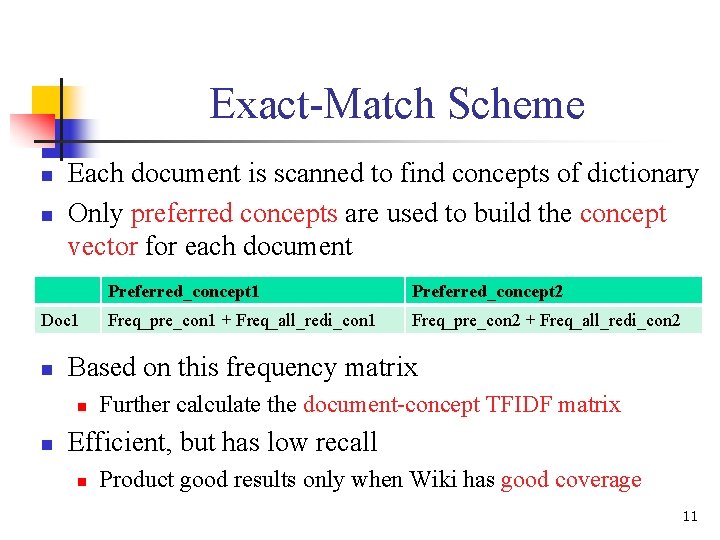
Exact-Match Scheme n n Each document is scanned to find concepts of dictionary Only preferred concepts are used to build the concept vector for each document Doc 1 n Preferred_concept 2 Freq_pre_con 1 + Freq_all_redi_con 1 Freq_pre_con 2 + Freq_all_redi_con 2 Based on this frequency matrix n n Preferred_concept 1 Further calculate the document-concept TFIDF matrix Efficient, but has low recall n Product good results only when Wiki has good coverage 11
Relatedness-Match Scheme n Consist of two steps First, create Wikipedia term-concept matrix from Wikipedia article collection 1. n n n Each word token is represented by a concept vector Values of the vector are TFIDF scores For each word, only choose top k=5 concepts with highest TFIDF scores 12
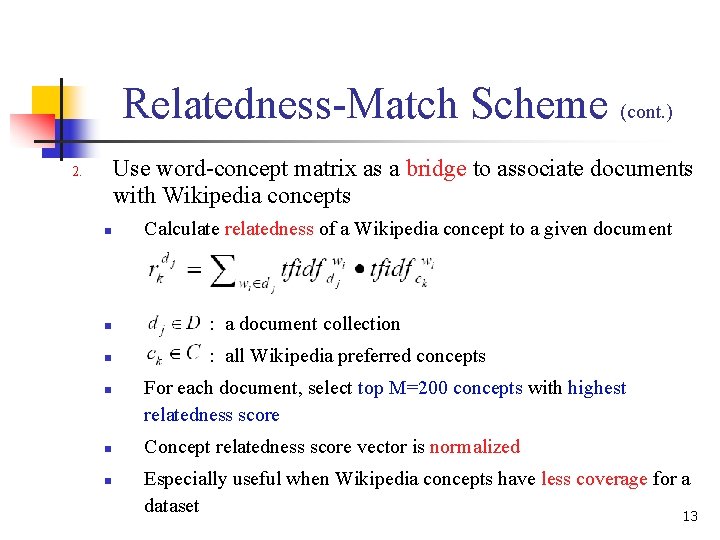
Relatedness-Match Scheme (cont. ) Use word-concept matrix as a bridge to associate documents with Wikipedia concepts 2. n Calculate relatedness of a Wikipedia concept to a given document n : a document collection n : all Wikipedia preferred concepts n n n For each document, select top M=200 concepts with highest relatedness score Concept relatedness score vector is normalized Especially useful when Wikipedia concepts have less coverage for a dataset 13
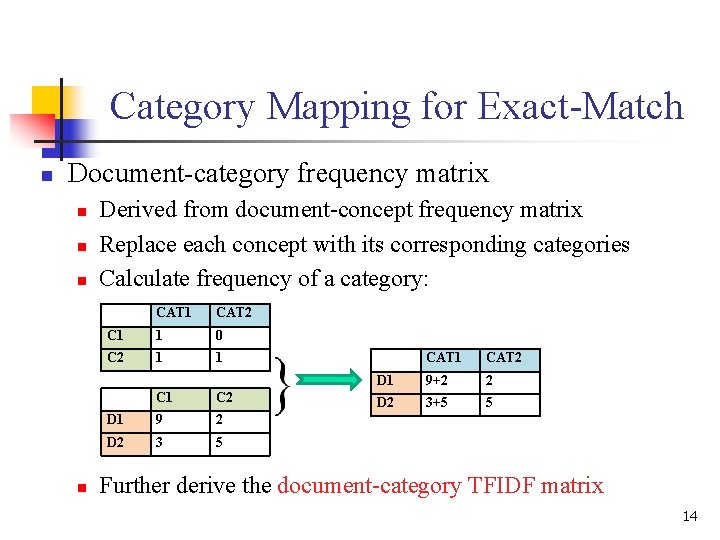
Category Mapping for Exact-Match n Document-category frequency matrix n n Derived from document-concept frequency matrix Replace each concept with its corresponding categories Calculate frequency of a category: CAT 1 CAT 2 C 1 1 0 C 2 1 1 C 2 D 1 9 2 D 2 3 5 CAT 1 CAT 2 D 1 9+2 2 D 2 3+5 5 Further derive the document-category TFIDF matrix 14
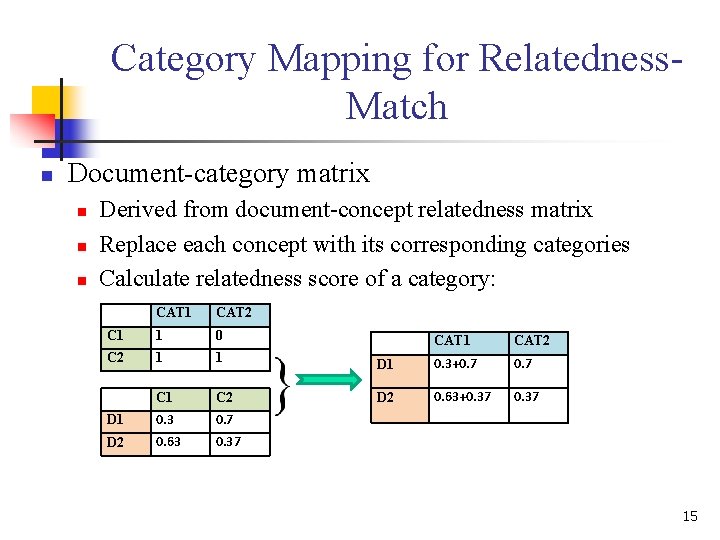
Category Mapping for Relatedness. Match n Document-category matrix n n n Derived from document-concept relatedness matrix Replace each concept with its corresponding categories Calculate relatedness score of a category: CAT 1 CAT 2 C 1 1 0 C 2 1 1 C 2 D 1 0. 3 0. 7 D 2 0. 63 0. 37 CAT 1 CAT 2 D 1 0. 3+0. 7 D 2 0. 63+0. 37 15
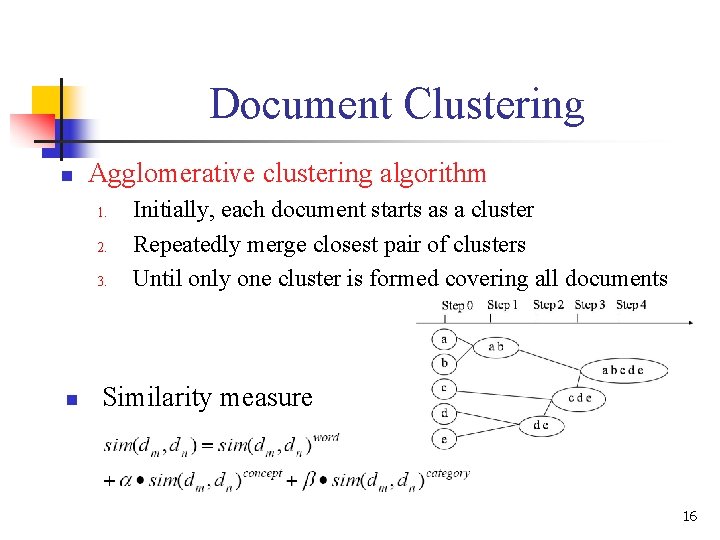
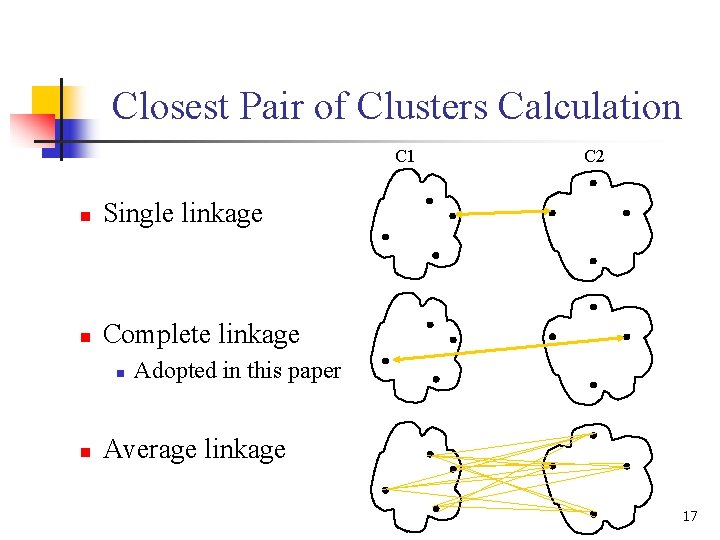
Document Clustering n Agglomerative clustering algorithm 1. 2. 3. n Initially, each document starts as a cluster Repeatedly merge closest pair of clusters Until only one cluster is formed covering all documents Similarity measure 16
Closest Pair of Clusters Calculation C 1 n Single linkage n Complete linkage n n C 2 Adopted in this paper Average linkage 17
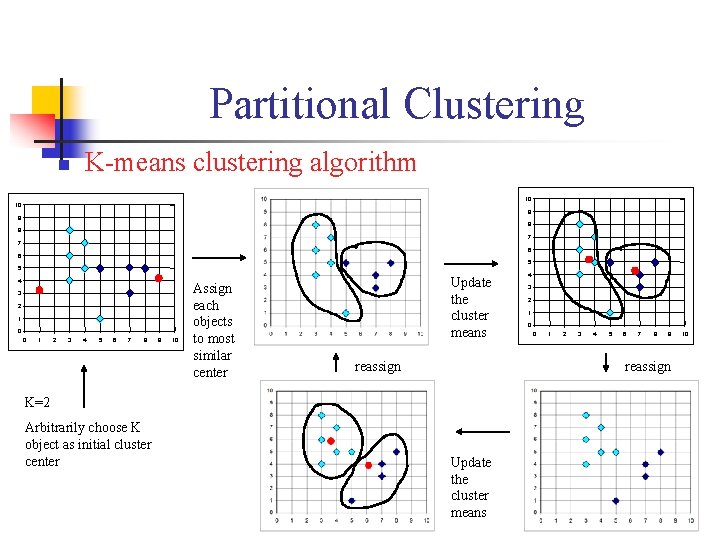
Partitional Clustering n K-means clustering algorithm 10 10 9 9 8 8 7 7 6 6 5 5 4 3 2 1 0 0 1 2 3 4 5 6 7 8 9 10 Assign each objects to most similar center Update the cluster means reassign 4 3 2 1 0 0 1 2 3 4 5 6 7 8 9 10 reassign K=2 Arbitrarily choose K object as initial cluster center Update the cluster means 18
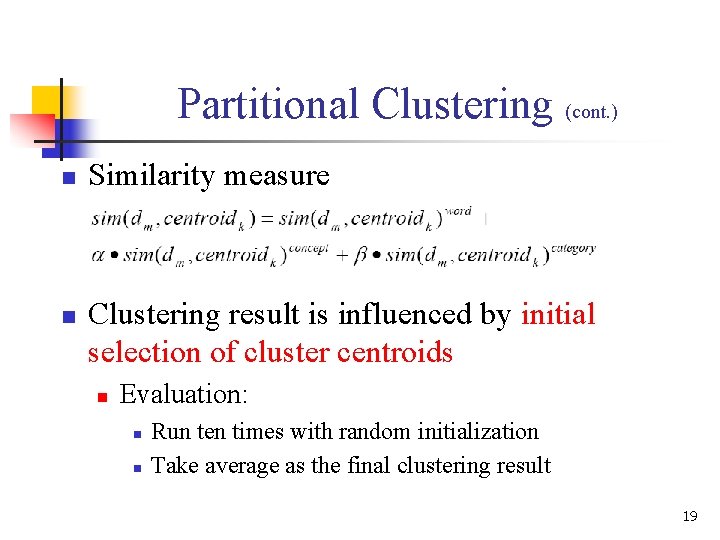
Partitional Clustering (cont. ) n n Similarity measure Clustering result is influenced by initial selection of cluster centroids n Evaluation: n n Run ten times with random initialization Take average as the final clustering result 19
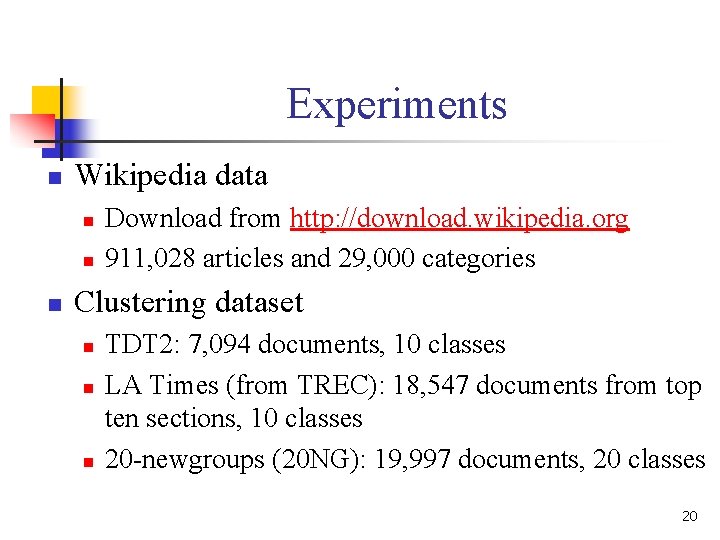
Experiments n Wikipedia data n n n Download from http: //download. wikipedia. org 911, 028 articles and 29, 000 categories Clustering dataset n n n TDT 2: 7, 094 documents, 10 classes LA Times (from TREC): 18, 547 documents from top ten sections, 10 classes 20 -newgroups (20 NG): 19, 997 documents, 20 classes 20
Experiments (cont. ) n For each dataset, five small datasets are created n Method: n n For each small dataset, randomly pick 100 documents from each selected class of a given dataset Merge them into a big pool Cluster each small dataset separately Average result is viewed as the clustering result for whole dataset 21
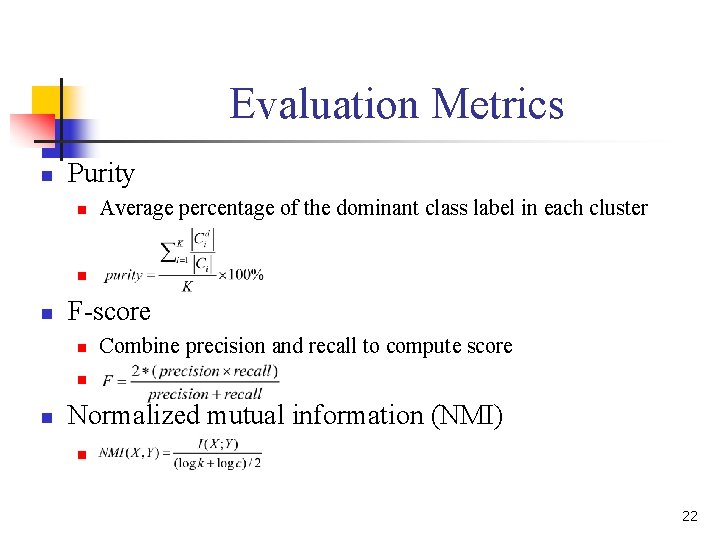
Evaluation Metrics n Purity n Average percentage of the dominant class label in each cluster n n F-score n Combine precision and recall to compute score n n Normalized mutual information (NMI) n 22
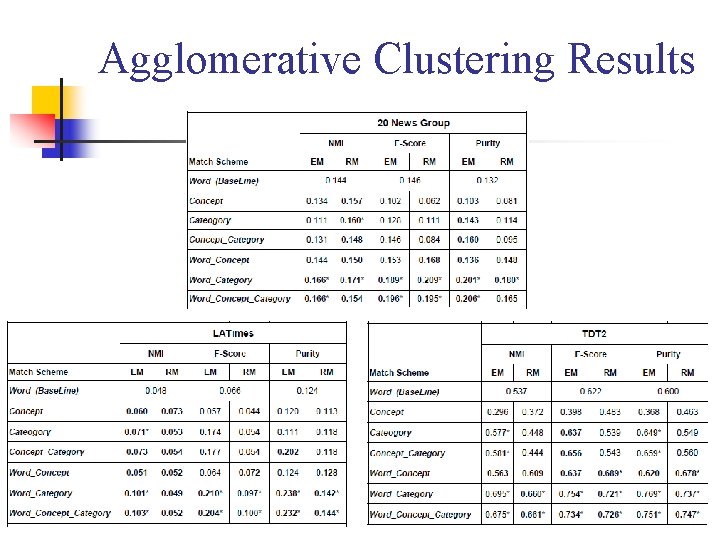
Agglomerative Clustering Results 23
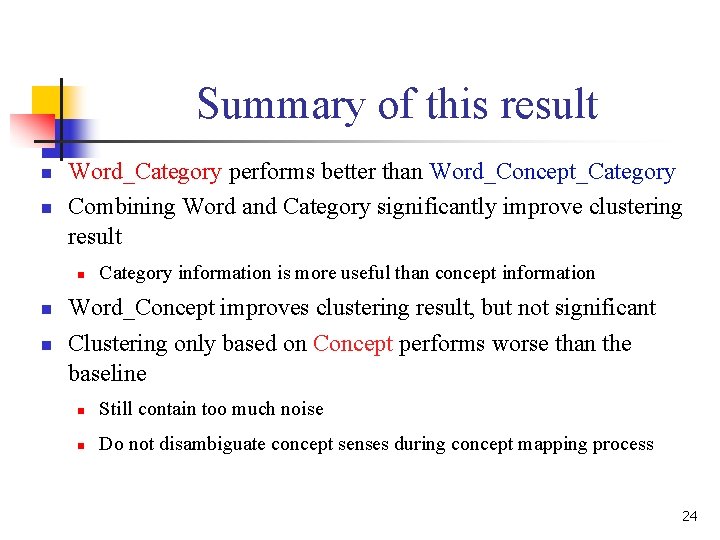
Summary of this result n n Word_Category performs better than Word_Concept_Category Combining Word and Category significantly improve clustering result n n n Category information is more useful than concept information Word_Concept improves clustering result, but not significant Clustering only based on Concept performs worse than the baseline n Still contain too much noise n Do not disambiguate concept senses during concept mapping process 24
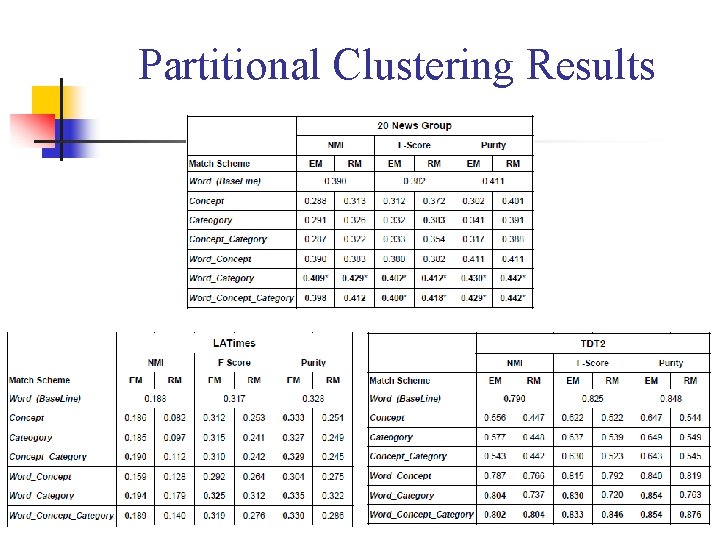
Partitional Clustering Results 25
Summary of this result n n For 20 Newsgroup, Word_Category scheme still significantly improve clustering result F-Score and Purity of Word_Concept_Category based clustering are significantly improved For 20 Newsgroup , RM always produces better result than EM For LATimes and TDT 2, EM always outperforms RM 26
Conclusion n A framework n n Mapping Schemes n n n Leverage Wikipedia concept and category information to improve text clustering performance Exact-Match and Relatedness-Match Concept vector and Category vector Two clustering approaches on three datasets n Agglomerative and partitional clustering 27