Exam 3 Tuesday April 18 5 00 6
- Slides: 31
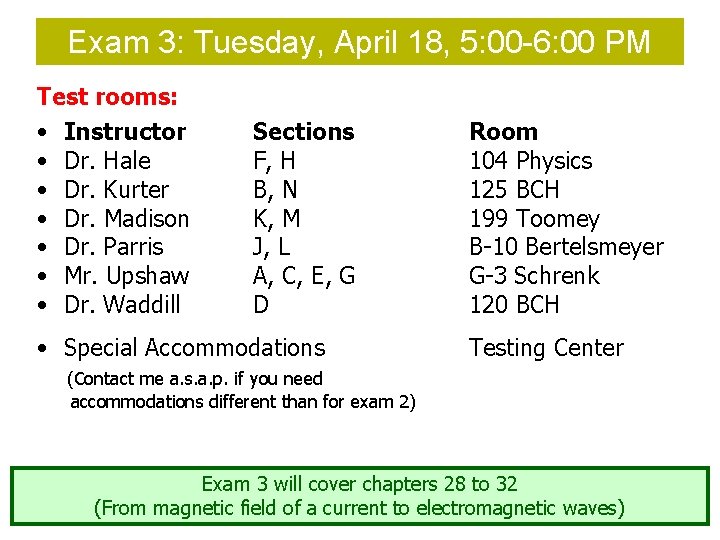
Exam 3: Tuesday, April 18, 5: 00 -6: 00 PM Test rooms: • Instructor • Dr. Hale • Dr. Kurter • Dr. Madison • Dr. Parris • Mr. Upshaw • Dr. Waddill Sections F, H B, N K, M J, L A, C, E, G D • Special Accommodations Room 104 Physics 125 BCH 199 Toomey B-10 Bertelsmeyer G-3 Schrenk 120 BCH Testing Center (Contact me a. s. a. p. if you need accommodations different than for exam 2) Exam 3 will cover chapters 28 to 32 (From magnetic field of a current to electromagnetic waves)
Today’s agenda: Electromagnetic Waves. Energy Carried by Electromagnetic Waves. Momentum and Radiation Pressure of an Electromagnetic Wave.
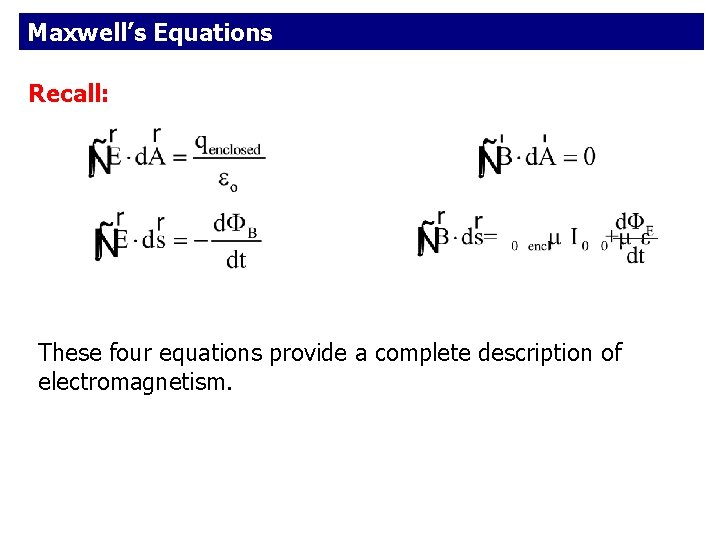
Maxwell’s Equations Recall: These four equations provide a complete description of electromagnetism.
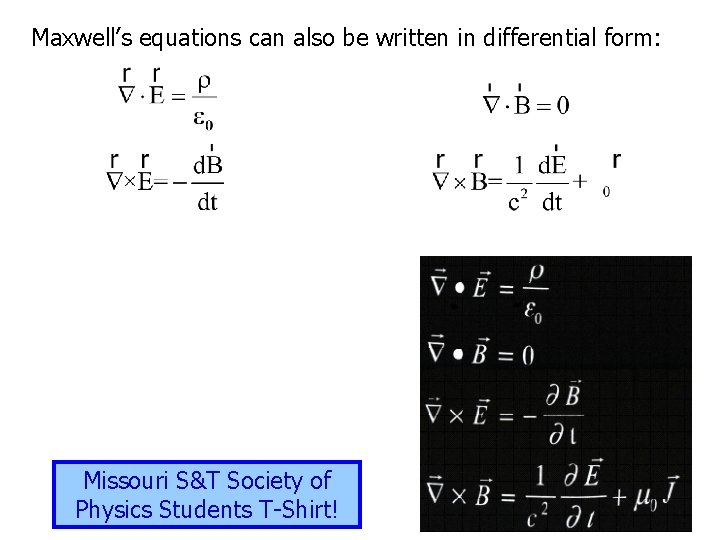
Maxwell’s equations can also be written in differential form: Missouri S&T Society of Physics Students T-Shirt!
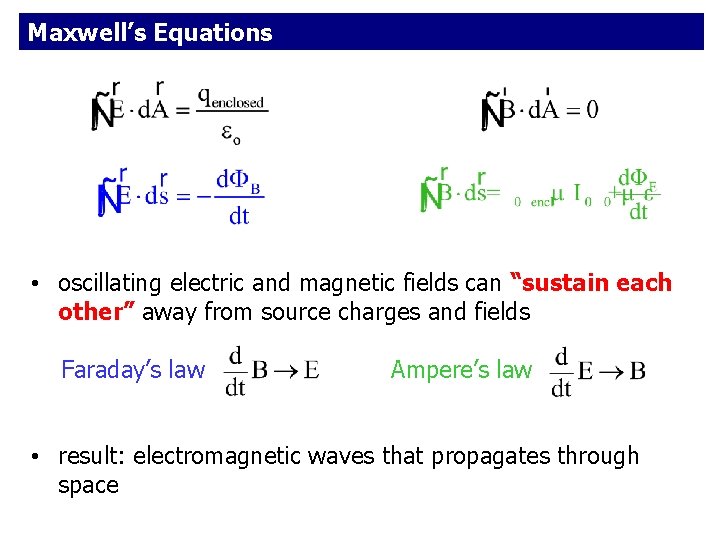
Maxwell’s Equations • oscillating electric and magnetic fields can “sustain each other” away from source charges and fields Faraday’s law Ampere’s law • result: electromagnetic waves that propagates through space
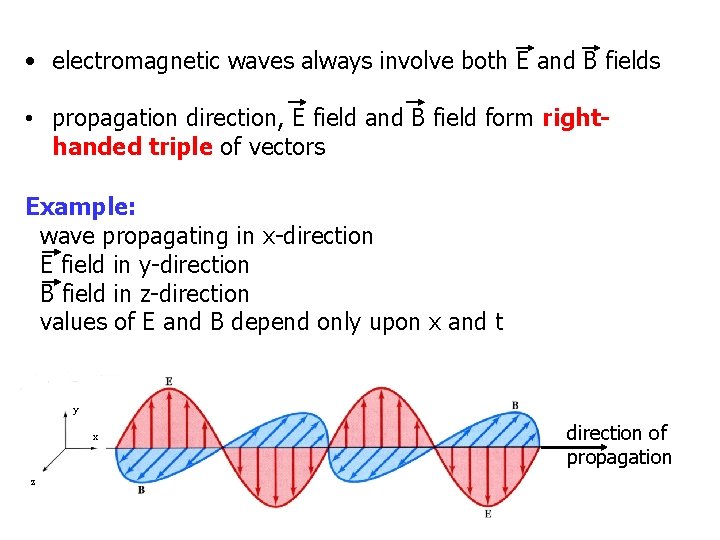
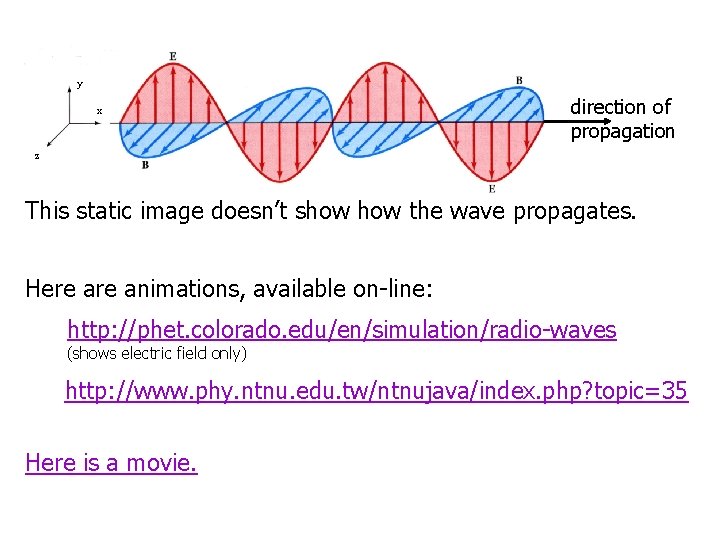
• electromagnetic waves always involve both E and B fields • propagation direction, E field and B field form righthanded triple of vectors Example: wave propagating in x-direction E field in y-direction B field in z-direction values of E and B depend only upon x and t y x z direction of propagation
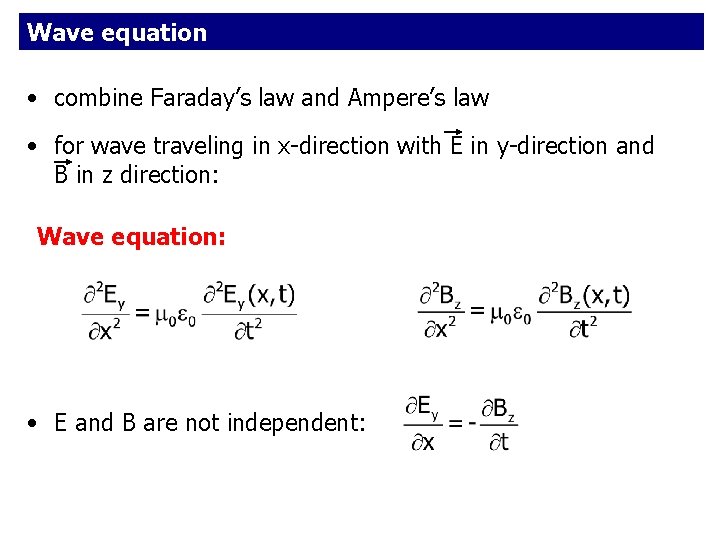
Wave equation • combine Faraday’s law and Ampere’s law • for wave traveling in x-direction with E in y-direction and B in z direction: Wave equation: • E and B are not independent:
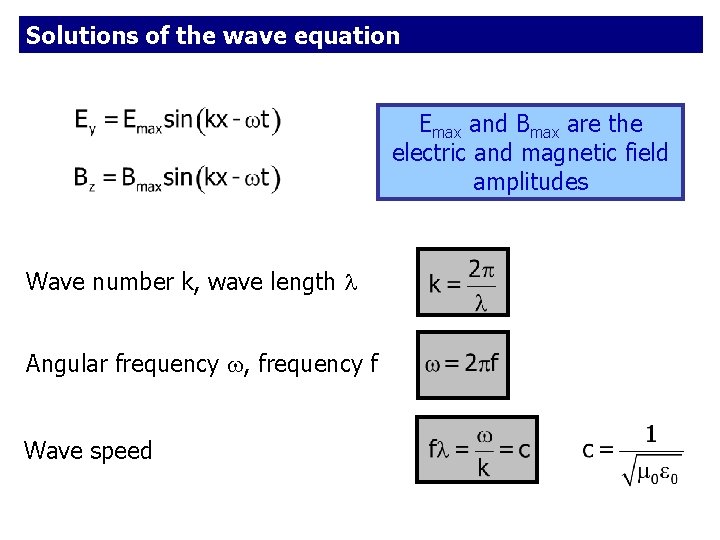
Solutions of the wave equation Emax and Bmax are the electric and magnetic field amplitudes Wave number k, wave length Angular frequency , frequency f Wave speed
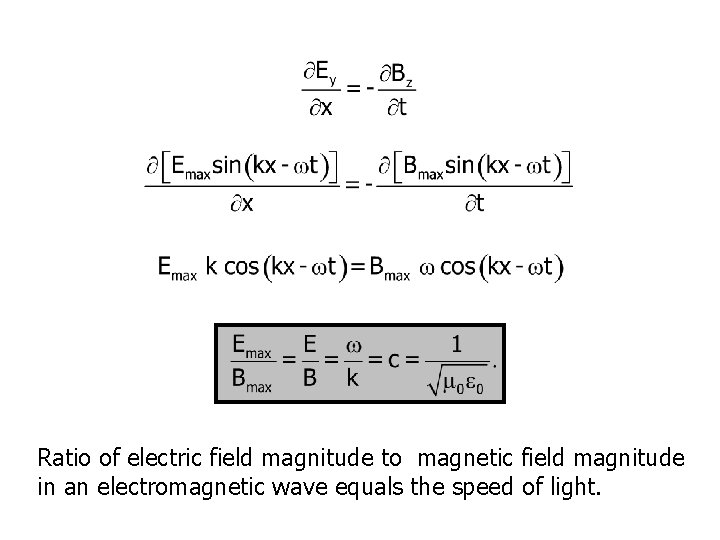
Ratio of electric field magnitude to magnetic field magnitude in an electromagnetic wave equals the speed of light.
y x direction of propagation z This static image doesn’t show the wave propagates. Here animations, available on-line: http: //phet. colorado. edu/en/simulation/radio-waves (shows electric field only) http: //www. phy. ntnu. edu. tw/ntnujava/index. php? topic=35 Here is a movie.
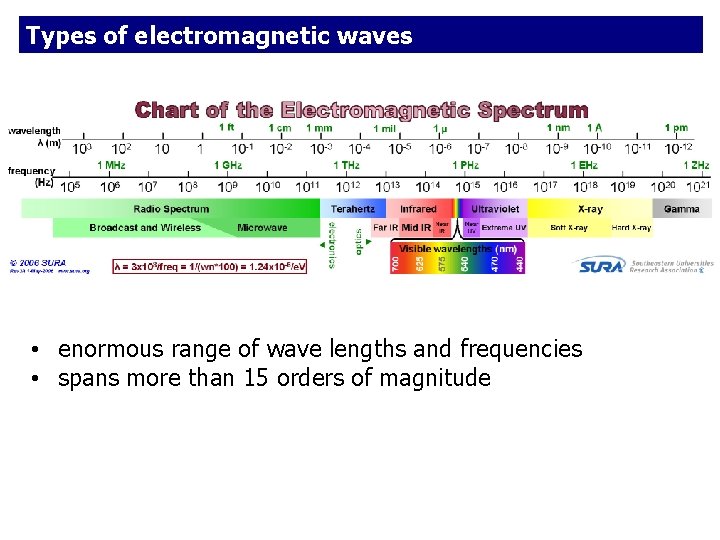
Types of electromagnetic waves • enormous range of wave lengths and frequencies • spans more than 15 orders of magnitude
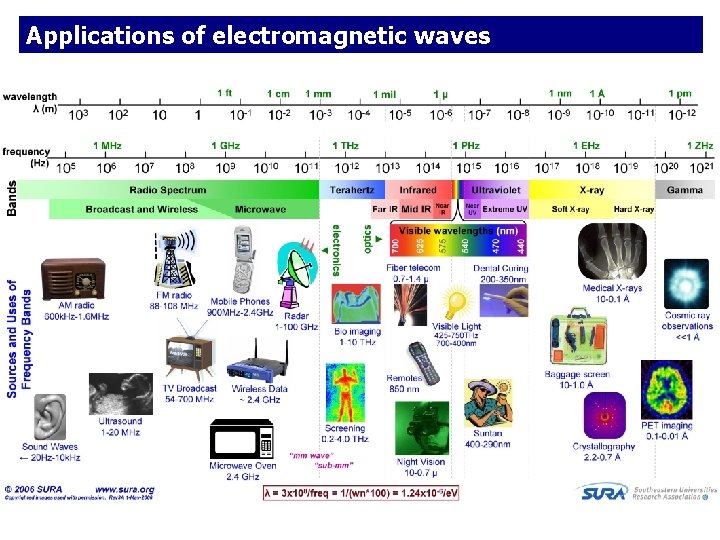
Applications of electromagnetic waves
Today’s agenda: Electromagnetic Waves. Energy Carried by Electromagnetic Waves. Momentum and Radiation Pressure of an Electromagnetic Wave.
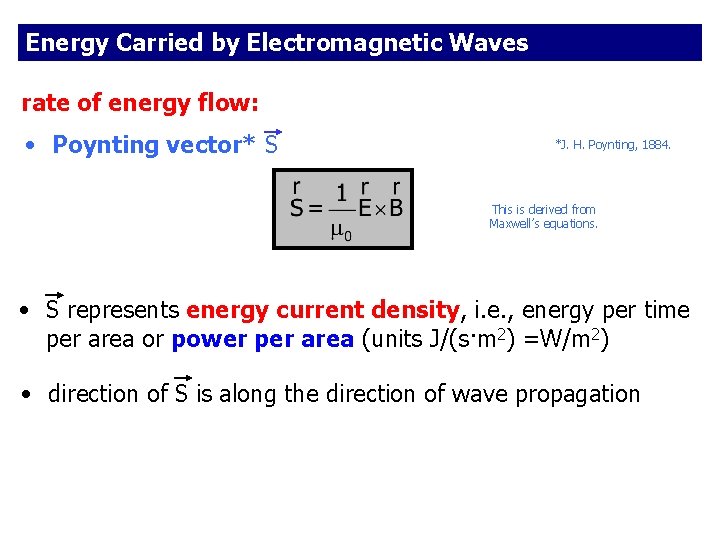
Energy Carried by Electromagnetic Waves rate of energy flow: • Poynting vector* S *J. H. Poynting, 1884. This is derived from Maxwell’s equations. • S represents energy current density, i. e. , energy per time per area or power per area (units J/(s·m 2) =W/m 2) • direction of S is along the direction of wave propagation
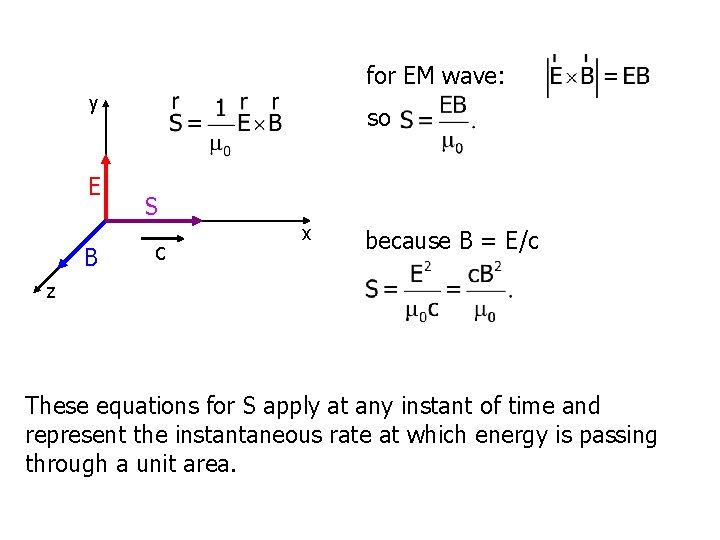
for EM wave: y E B so S c x because B = E/c z These equations for S apply at any instant of time and represent the instantaneous rate at which energy is passing through a unit area.
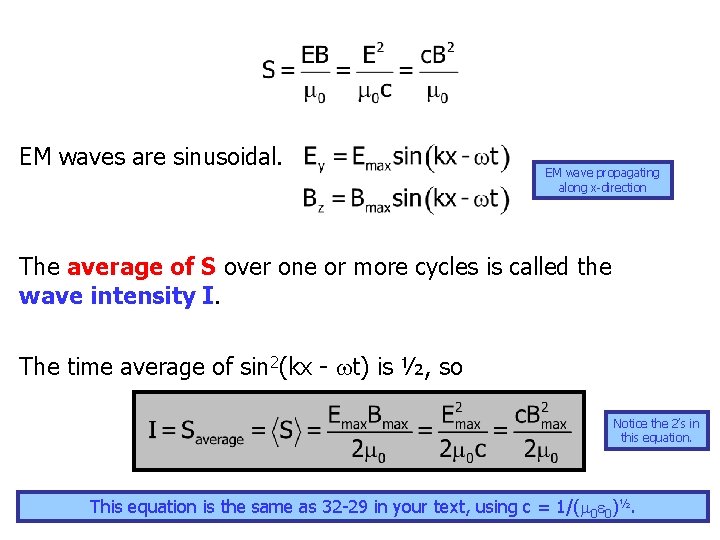
EM waves are sinusoidal. EM wave propagating along x-direction The average of S over one or more cycles is called the wave intensity I. The time average of sin 2(kx - t) is ½, so Notice the 2’s in this equation. This equation is the same as 32 -29 in your text, using c = 1/( 0 0)½.
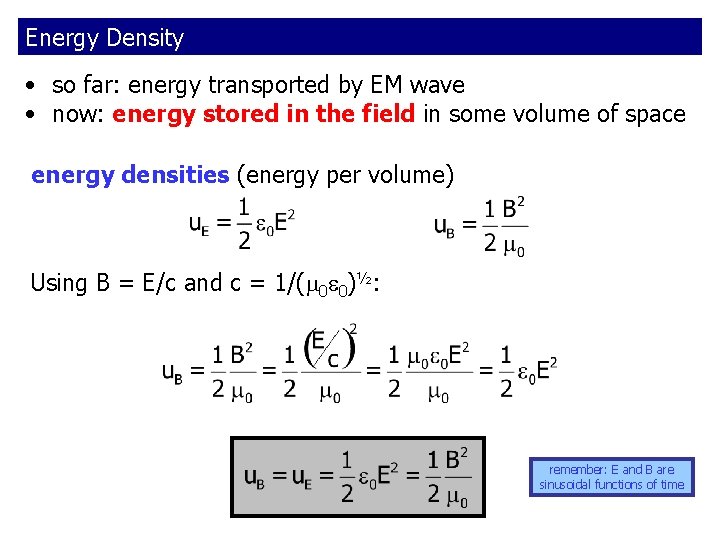
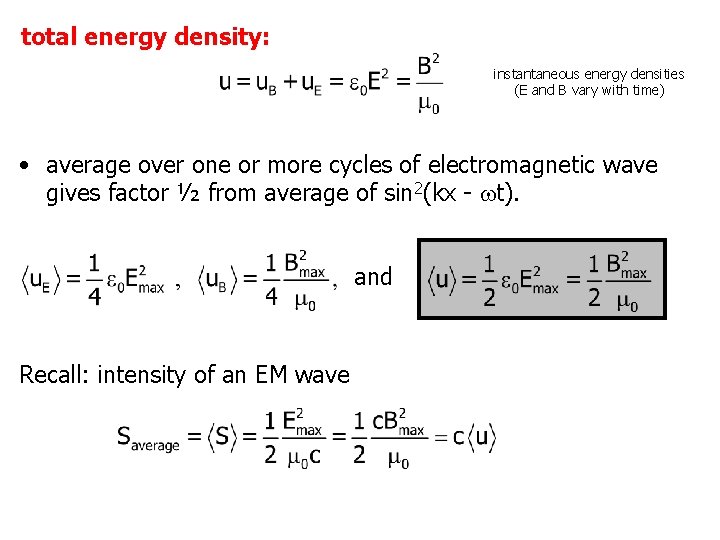
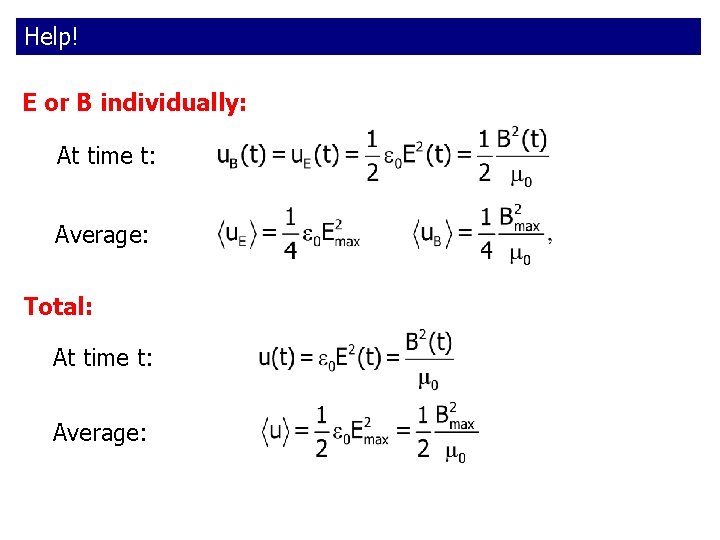
Energy Density • so far: energy transported by EM wave • now: energy stored in the field in some volume of space energy densities (energy per volume) Using B = E/c and c = 1/( 0 0)½: remember: E and B are sinusoidal functions of time
total energy density: instantaneous energy densities (E and B vary with time) • average over one or more cycles of electromagnetic wave gives factor ½ from average of sin 2(kx - t). and Recall: intensity of an EM wave
Help! E or B individually: At time t: Average: Total: At time t: Average:
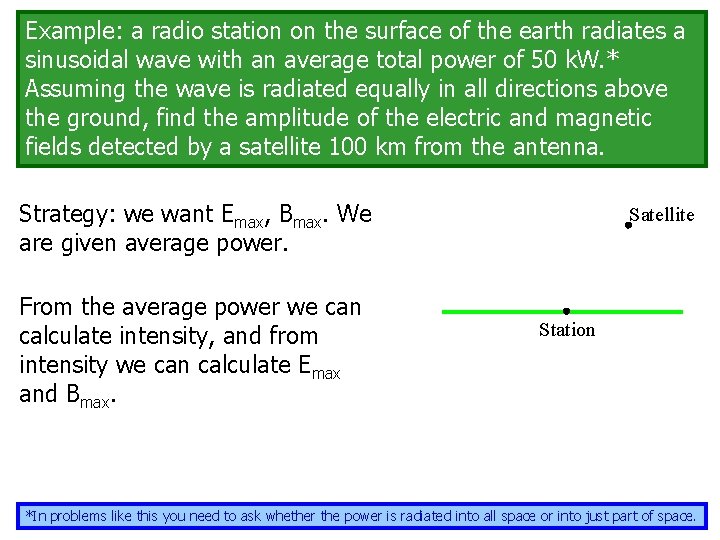
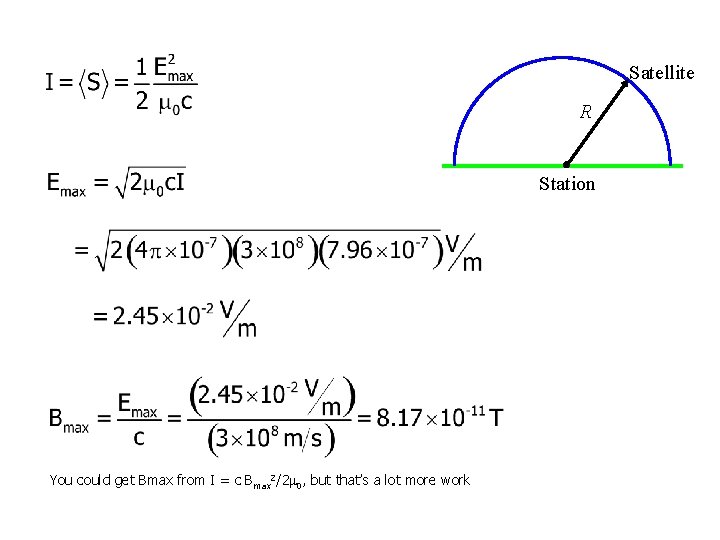
Example: a radio station on the surface of the earth radiates a sinusoidal wave with an average total power of 50 k. W. * Assuming the wave is radiated equally in all directions above the ground, find the amplitude of the electric and magnetic fields detected by a satellite 100 km from the antenna. Strategy: we want Emax, Bmax. We are given average power. From average power we can calculate intensity, and frompower intensity From the average we we cancan calculate max and Band max. from calculate E intensity, Satellite Station intensity we can calculate Emax and Bmax. *In problems like this you need to ask whether the power is radiated into all space or into just part of space.
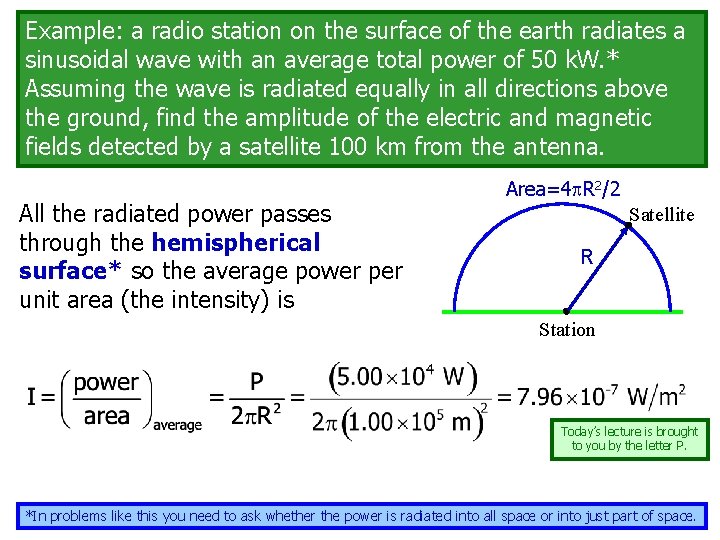
Example: a radio station on the surface of the earth radiates a sinusoidal wave with an average total power of 50 k. W. * Assuming the wave is radiated equally in all directions above the ground, find the amplitude of the electric and magnetic fields detected by a satellite 100 km from the antenna. All the radiated power passes through the hemispherical surface* so the average power per unit area (the intensity) is Area=4 R 2/2 Satellite R Station Today’s lecture is brought to you by the letter P. *In problems like this you need to ask whether the power is radiated into all space or into just part of space.
Satellite R Station You could get Bmax from I = c Bmax 2/2 0, but that’s a lot more work
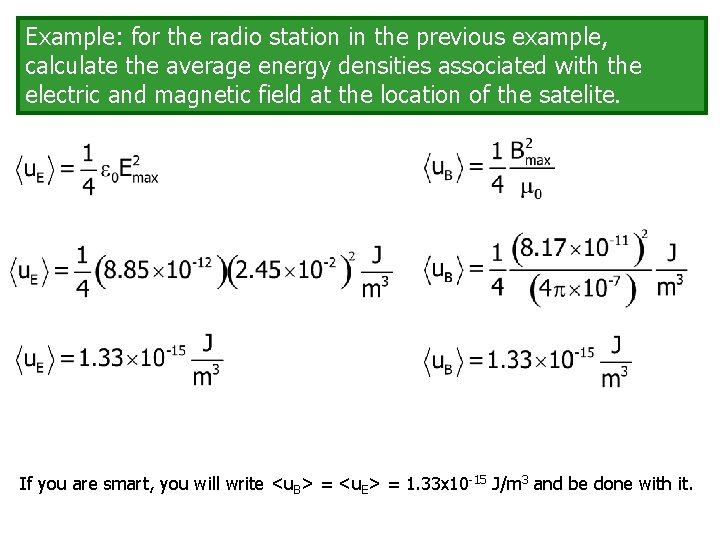
Example: for the radio station in the previous example, calculate the average energy densities associated with the electric and magnetic field at the location of the satelite. If you are smart, you will write <u. B> = <u. E> = 1. 33 x 10 -15 J/m 3 and be done with it.
Today’s agenda: Electromagnetic Waves. Energy Carried by Electromagnetic Waves. Momentum and Radiation Pressure of an Electromagnetic Wave.
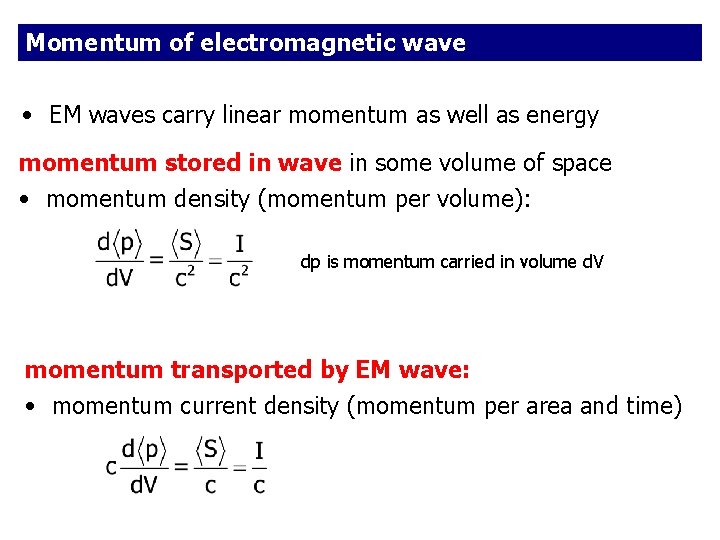
Momentum of electromagnetic wave • EM waves carry linear momentum as well as energy momentum stored in wave in some volume of space • momentum density (momentum per volume): dp is momentum carried in volume d. V momentum transported by EM wave: • momentum current density (momentum per area and time)
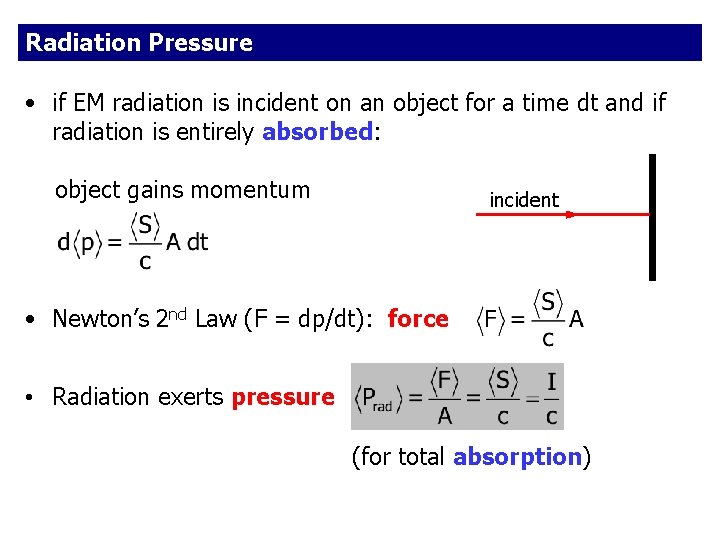
Radiation Pressure • if EM radiation is incident on an object for a time dt and if radiation is entirely absorbed: object gains momentum incident • Newton’s 2 nd Law (F = dp/dt): force • Radiation exerts pressure (for total absorption)
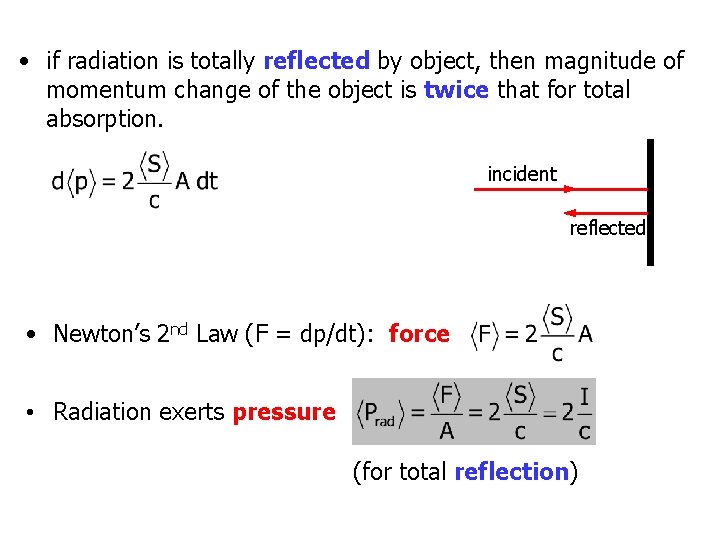
• if radiation is totally reflected by object, then magnitude of momentum change of the object is twice that for total absorption. incident reflected • Newton’s 2 nd Law (F = dp/dt): force • Radiation exerts pressure (for total reflection)
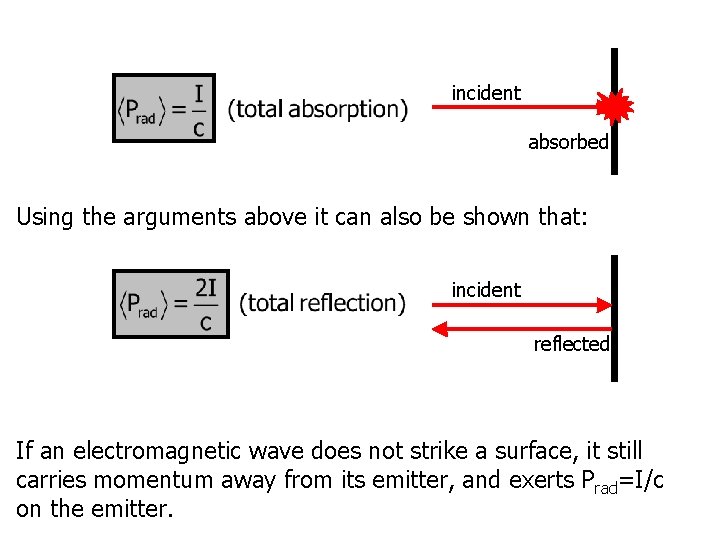
incident absorbed Using the arguments above it can also be shown that: incident reflected If an electromagnetic wave does not strike a surface, it still carries momentum away from its emitter, and exerts Prad=I/c on the emitter.
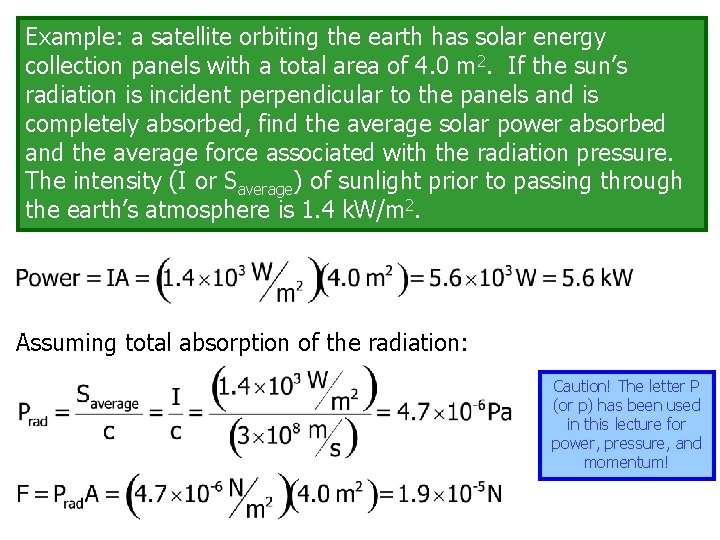
Example: a satellite orbiting the earth has solar energy collection panels with a total area of 4. 0 m 2. If the sun’s radiation is incident perpendicular to the panels and is completely absorbed, find the average solar power absorbed and the average force associated with the radiation pressure. The intensity (I or Saverage) of sunlight prior to passing through the earth’s atmosphere is 1. 4 k. W/m 2. Assuming total absorption of the radiation: Caution! The letter P (or p) has been used in this lecture for power, pressure, and momentum!
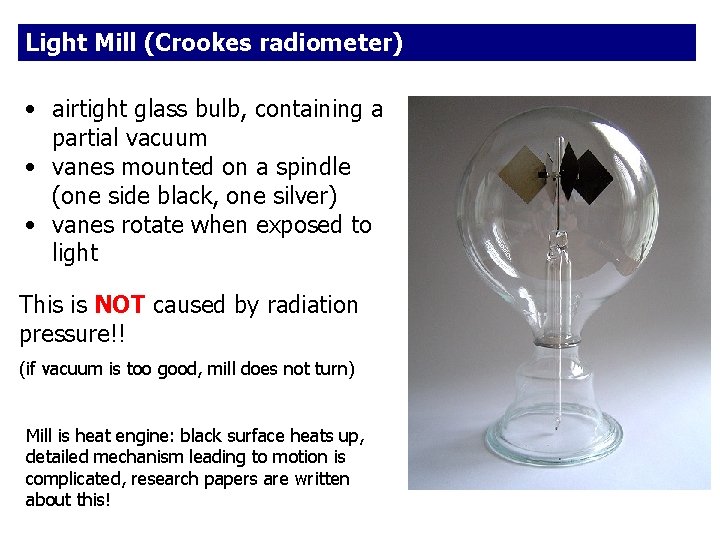
Light Mill (Crookes radiometer) • airtight glass bulb, containing a partial vacuum • vanes mounted on a spindle (one side black, one silver) • vanes rotate when exposed to light This is NOT caused by radiation pressure!! (if vacuum is too good, mill does not turn) Mill is heat engine: black surface heats up, detailed mechanism leading to motion is complicated, research papers are written about this!
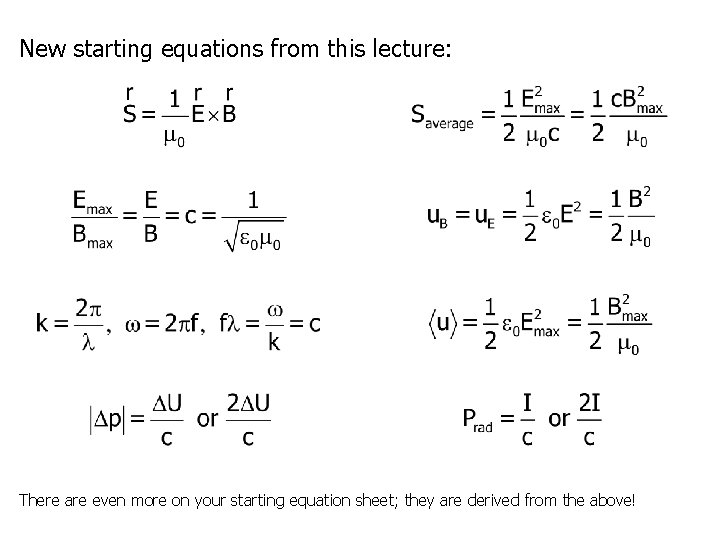
New starting equations from this lecture: There are even more on your starting equation sheet; they are derived from the above!