Evaluation Horizon 2020 Ian Devine European Advisor UK

- Slides: 37
Evaluation Horizon 2020 Ian Devine European Advisor – UK Research Office University of Manchester, 11 September 2014
Session Overview � Initial Data from 2014 Calls � Proposal • • Evaluation New type of calls and proposals More emphasis on innovation Cross-cutting issues Impact of time to grant on evaluation � Role � The of independent experts evaluation procedure
Initial Data on 2014 Calls Horizon 2020
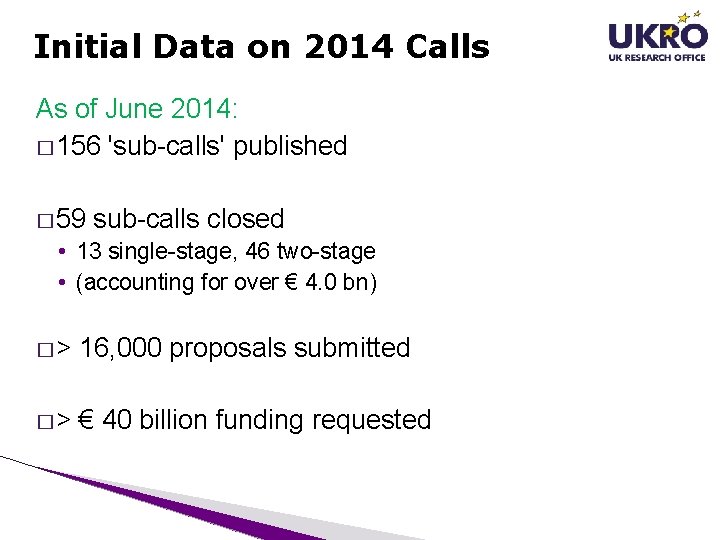
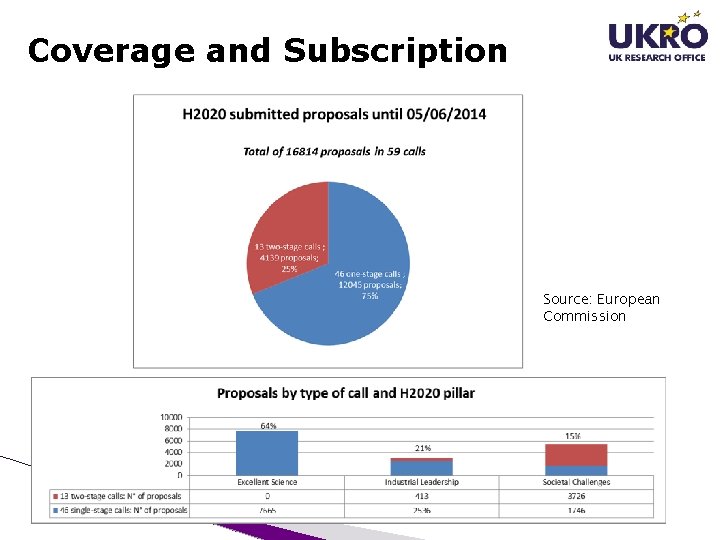
Initial Data on 2014 Calls As of June 2014: � 156 'sub-calls' published � 59 sub-calls closed • 13 single-stage, 46 two-stage • (accounting for over € 4. 0 bn) �> 16, 000 proposals submitted �> € 40 billion funding requested
Coverage and Subscription Source: European Commission
Proposal Evaluation Horizon 2020
New Types of Calls and Proposals � Calls are open and challenge based • Less prescription • Applicants invited to propose their innovative solutions � Emphasis on impact – through impact statements • Applicants to describe how they meet expected impacts • Evaluators will assess impact � Emphasis on innovation • Horizon 2020 supports all stages in the research and innovation chain including non-technological and social innovation and activities closer to the market � Interdisciplinary encouraged and cross-sectoral approaches
Innovation � A balanced approach to research and innovation • not only limited to the development of new products and services on the basis of scientific and technological breakthroughs • but also incorporating aspects such as the use of existing technologies in novel applications and continuous improvements � Activities closer to the market emphasise the widest possible use of knowledge generated by the supported activities up to the commercial exploitation of that knowledge � For Societal Challenges and LEITs, there is a particular emphasis on activities operating close to the end-users and the market, such as demonstration, piloting or proof-of-concept • can also include support to social innovation, and support to demand side approaches (standardisation, innovation procurement, user-centred measures …) to help accelerate the deployment and diffusion of innovative products and services into the market Horizon 2020 reference terms: http: //ec. europa. eu/research/participants/portal/desktop/en/support /reference_terms. html
Cross-cutting Issues � Social Sciences and Humanities (SSH) are integrated across all Horizon 2020 activities to successfully address European challenges � Gender dimension in the content of R&I - a question on the relevance of sex/gender analysis is included in proposal templates � The new strategic approach to international cooperation consists of a general opening of the WP and targeted activities across all relevant Horizon 2020 parts • The approach to providing 'automatic funding' to third country participants is restricted – see annex A of the WP � Other cross-cutting issues may also be included in the WP such as science education, open access to scientific publications, ethics, standardisation, climate & sustainable development … Evaluator Guidance: http: //ec. europa. eu/research/participants/data/ref/h 2 020/grants_manual/pse/h 2020 -evaluation-faq_en. pdf
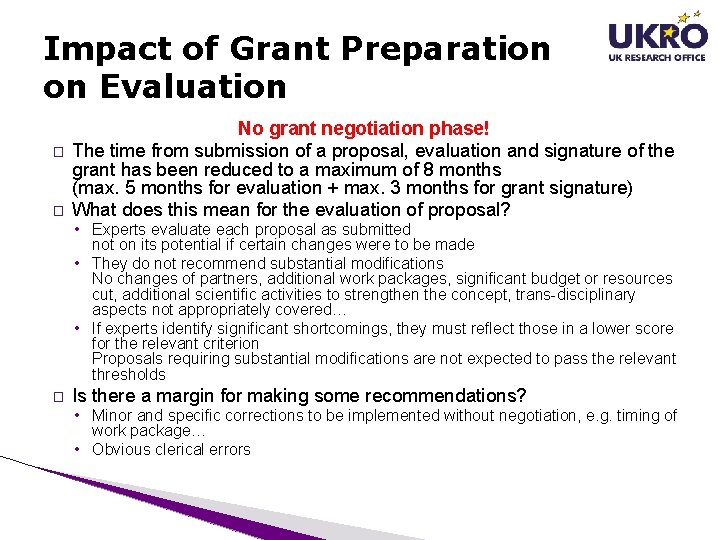
Impact of Grant Preparation on Evaluation � � No grant negotiation phase! The time from submission of a proposal, evaluation and signature of the grant has been reduced to a maximum of 8 months (max. 5 months for evaluation + max. 3 months for grant signature) What does this mean for the evaluation of proposal? • Experts evaluate each proposal as submitted not on its potential if certain changes were to be made • They do not recommend substantial modifications No changes of partners, additional work packages, significant budget or resources cut, additional scientific activities to strengthen the concept, trans-disciplinary aspects not appropriately covered… • If experts identify significant shortcomings, they must reflect those in a lower score for the relevant criterion Proposals requiring substantial modifications are not expected to pass the relevant thresholds � Is there a margin for making some recommendations? • Minor and specific corrections to be implemented without negotiation, e. g. timing of work package… • Obvious clerical errors
Role of Independent Experts Horizon 2020
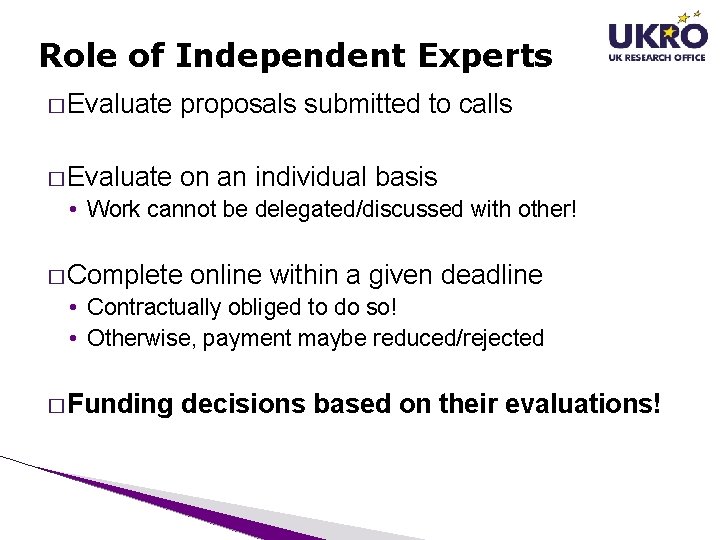
Role of Independent Experts � Evaluate proposals submitted to calls � Evaluate on an individual basis • Work cannot be delegated/discussed with other! � Complete online within a given deadline • Contractually obliged to do so! • Otherwise, payment maybe reduced/rejected � Funding decisions based on their evaluations!
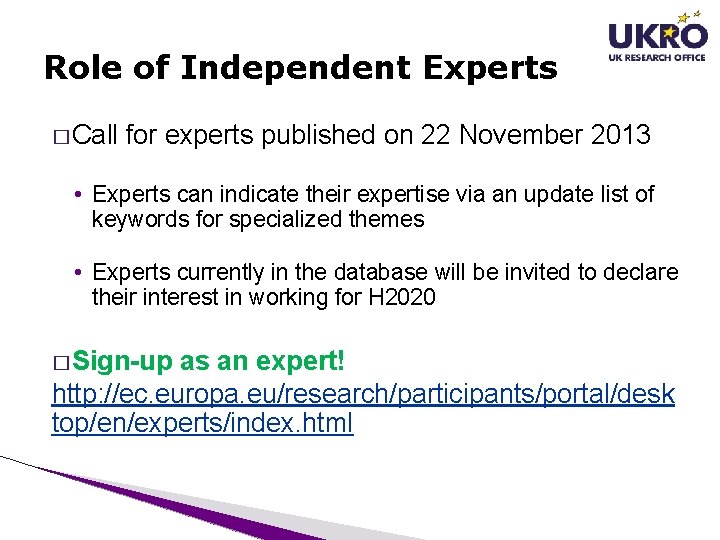
Role of Independent Experts � Call for experts published on 22 November 2013 • Experts can indicate their expertise via an update list of keywords for specialized themes • Experts currently in the database will be invited to declare their interest in working for H 2020 � Sign-up as an expert! http: //ec. europa. eu/research/participants/portal/desk top/en/experts/index. html
Role of Independent Experts � Appropriately qualified individuals may apply to work as independent experts in H 2020 evaluations � Application via Participant Portal � Experts invited to assess proposals for each call • A broad range will be selected • Conflicts of interest will be managed
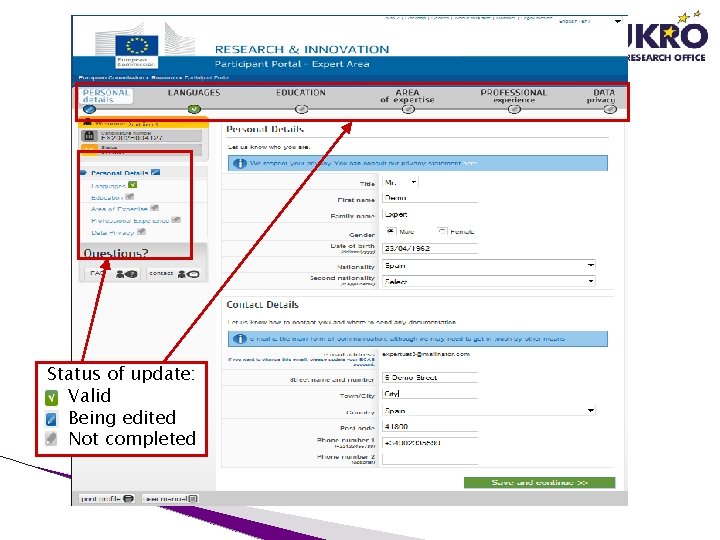
Demo Expert Status of update: Valid Being edited Not completed
Ensure Expert Profile Updated � Experts should regularly update their profile to ensure that the European Commission can find the best match of assignments in the future. Pay particular attention to the new list of keywords defining specialist themes
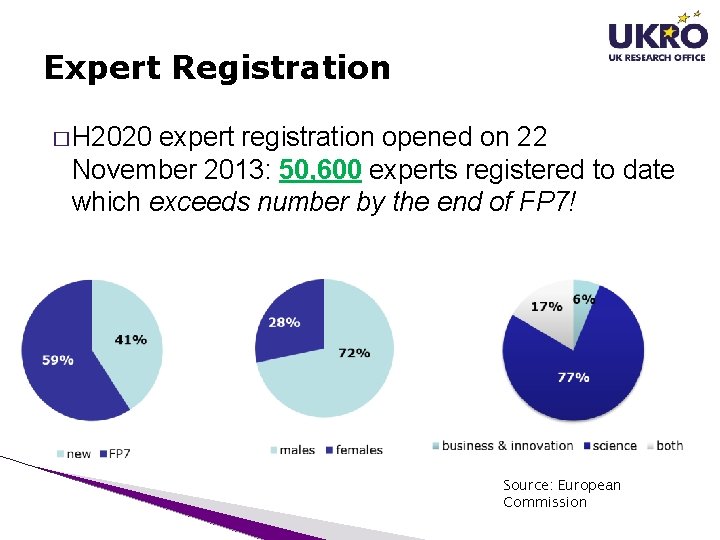
Expert Registration � H 2020 expert registration opened on 22 November 2013: 50, 600 experts registered to date which exceeds number by the end of FP 7! Source: European Commission
The Evaluation Procedure Horizon 2020
Guiding Principles � Independence • The experts are evaluating in a personal capacity • They represent neither their employer, nor their country! � Impartiality • The experts must treat all proposals equally and evaluate them impartially on their merits, irrespective of their origin or the identity of the applicants � Objectivity • They evaluate each proposal as submitted; meaning on its own merit, not its potential if certain changes were to be made � Accuracy • The experts make their judgment against the official evaluation criteria and the call or topic the proposal addresses, and nothing else � Consistency • They apply the same standard of judgment to all proposals
Conflicts of Interest Experts have a COI if they: � Were involved in the preparation of the proposal � Stand to benefit directly/indirectly if the proposal is successful � Have a close family/personal relationship with someone involved in the proposal � Are a director/trustee/partner of an applicant or involved in the management of an applicant's organisation � Are employed or contracted by an applicant or a named subcontractor � Are a member of a Horizon 2020 Advisory Group or Programme Committee � Are a National Contact Point or are directly working for the Enterprise Europe Network
Conflicts of Interest In the following situations, the Commission/Agency will decide whether a COI exists � Were employed by an applicant or sub-contractor in the last 3 years � Were involved in a grant agreement/decision, the membership of management structures or a research collaboration with an applicant in the last 3 years � Are in any other situation that casts doubt on their impartiality or that could reasonably appear to do so COI conditions are spelled out in their contract and in the Code of Conduct (Annex 1)
Conflicts of Interest � Experts must inform the Commission/Agency as soon as they become aware of a COI • Before the signature of the contract • Upon receipt of proposals, or • During the course of their work � If there is a COI for a certain proposal they cannot evaluate it at any of the evaluation stages (individual, consensus, panel) • The Commission/Agency will determine if there is a COI on a case-by-case basis and decide the course of action to follow � If the experts conceal COI, they will be excluded from the evaluation and their work declared null and void • The allowance/expenses they claimed may be reduced, rejected or recovered • Their contract may be terminated
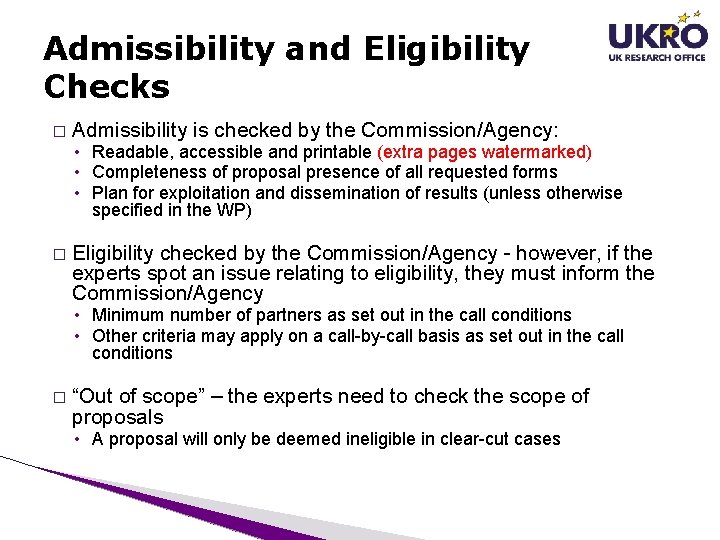
Admissibility and Eligibility Checks � Admissibility is checked by the Commission/Agency: • Readable, accessible and printable (extra pages watermarked) • Completeness of proposal presence of all requested forms • Plan for exploitation and dissemination of results (unless otherwise specified in the WP) � Eligibility checked by the Commission/Agency - however, if the experts spot an issue relating to eligibility, they must inform the Commission/Agency • Minimum number of partners as set out in the call conditions • Other criteria may apply on a call-by-call basis as set out in the call conditions � “Out of scope” – the experts need to check the scope of proposals • A proposal will only be deemed ineligible in clear-cut cases
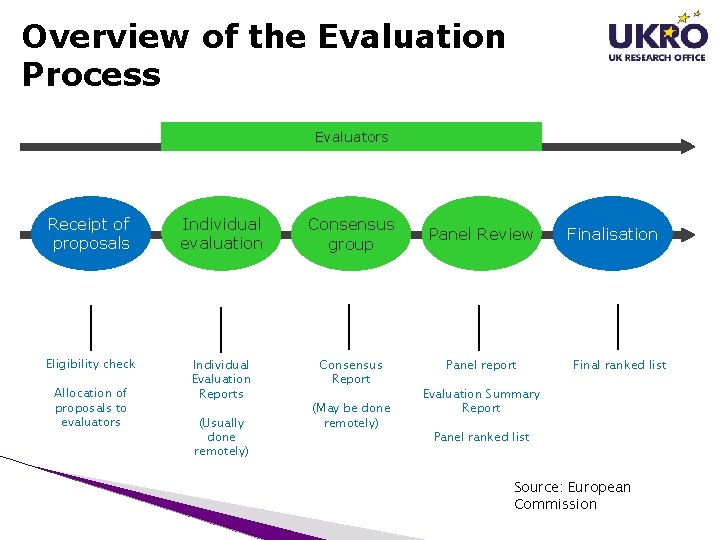
Overview of the Evaluation Process Evaluators Receipt of proposals Individual evaluation Consensus group Eligibility check Individual Evaluation Reports Consensus Report Allocation of proposals to evaluators (Usually done remotely) (May be done remotely) Panel Review Panel report Finalisation Final ranked list Evaluation Summary Report Panel ranked list Source: European Commission
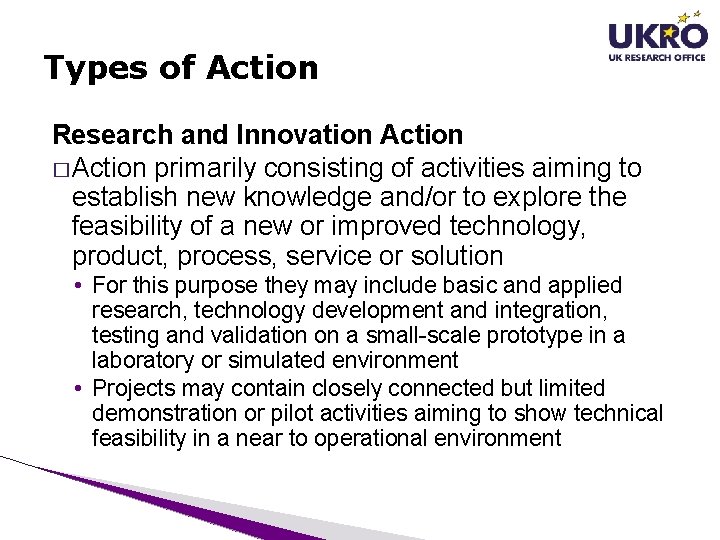
Types of Action Research and Innovation Action � Action primarily consisting of activities aiming to establish new knowledge and/or to explore the feasibility of a new or improved technology, product, process, service or solution • For this purpose they may include basic and applied research, technology development and integration, testing and validation on a small-scale prototype in a laboratory or simulated environment • Projects may contain closely connected but limited demonstration or pilot activities aiming to show technical feasibility in a near to operational environment
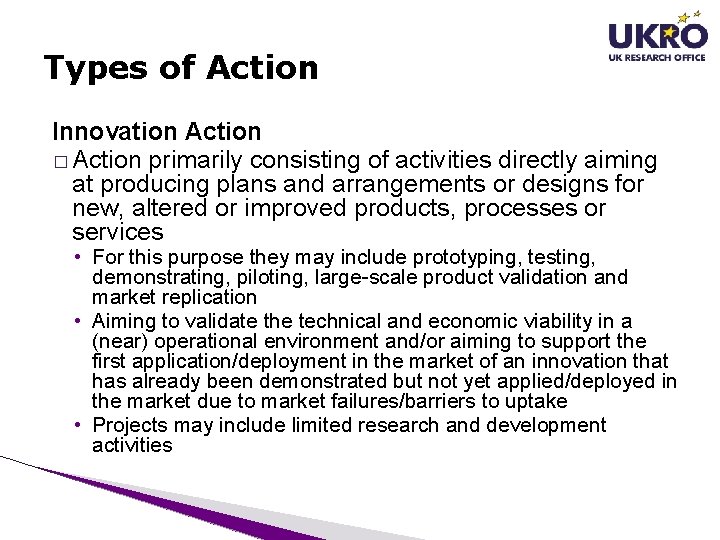
Types of Action Innovation Action � Action primarily consisting of activities directly aiming at producing plans and arrangements or designs for new, altered or improved products, processes or services • For this purpose they may include prototyping, testing, demonstrating, piloting, large-scale product validation and market replication • Aiming to validate the technical and economic viability in a (near) operational environment and/or aiming to support the first application/deployment in the market of an innovation that has already been demonstrated but not yet applied/deployed in the market due to market failures/barriers to uptake • Projects may include limited research and development activities
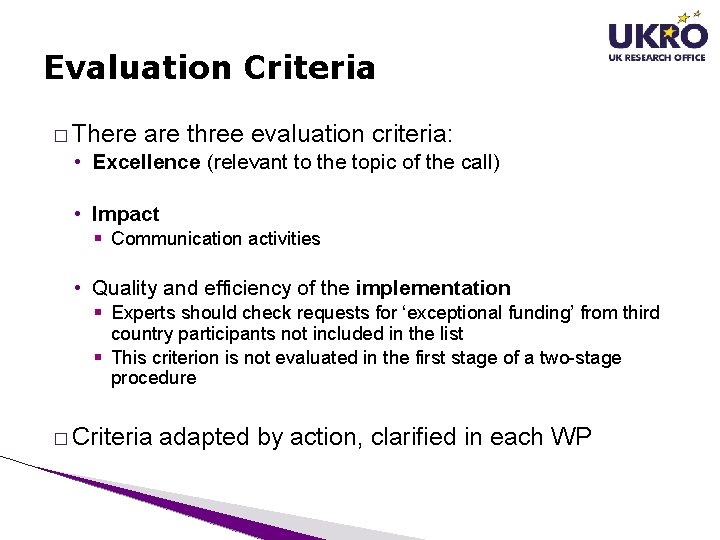
Evaluation Criteria � There are three evaluation criteria: • Excellence (relevant to the topic of the call) • Impact § Communication activities • Quality and efficiency of the implementation § Experts should check requests for ‘exceptional funding’ from third country participants not included in the list § This criterion is not evaluated in the first stage of a two-stage procedure � Criteria adapted by action, clarified in each WP
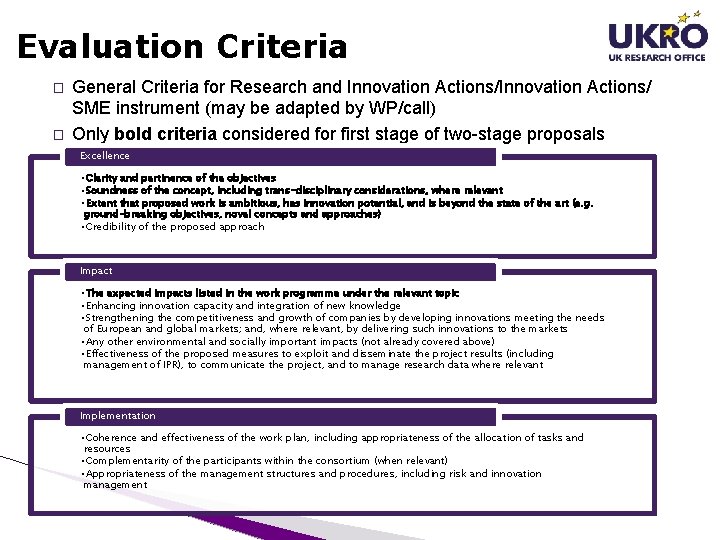
Evaluation Criteria � � General Criteria for Research and Innovation Actions/ SME instrument (may be adapted by WP/call) Only bold criteria considered for first stage of two-stage proposals Excellence • Clarity and pertinence of the objectives • Soundness of the concept, including trans-disciplinary considerations, where relevant • Extent that proposed work is ambitious, has innovation potential, and is beyond the state of the art (e. g. ground-breaking objectives, novel concepts and approaches) • Credibility of the proposed approach Impact • The expected impacts listed in the work programme under the relevant topic • Enhancing innovation capacity and integration of new knowledge • Strengthening the competitiveness and growth of companies by developing innovations meeting the needs of European and global markets; and, where relevant, by delivering such innovations to the markets • Any other environmental and socially important impacts (not already covered above) • Effectiveness of the proposed measures to exploit and disseminate the project results (including management of IPR), to communicate the project, and to manage research data where relevant Implementation • Coherence and effectiveness of the work plan, including appropriateness of the allocation of tasks and resources • Complementarity of the participants within the consortium (when relevant) • Appropriateness of the management structures and procedures, including risk and innovation management
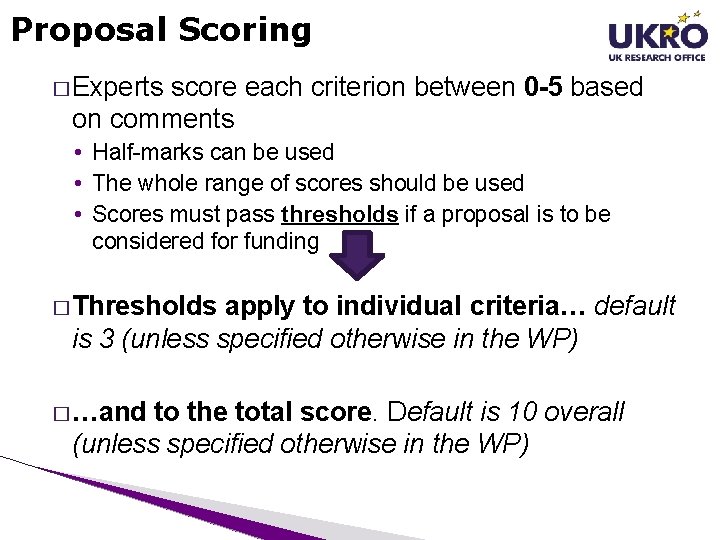
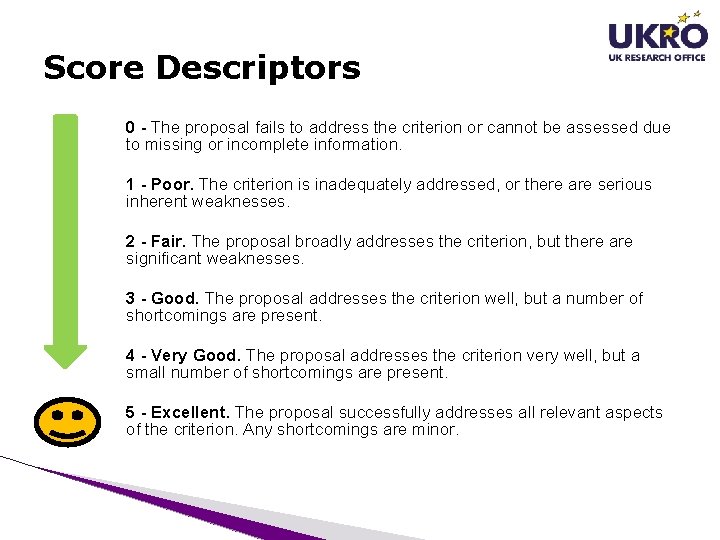
Proposal Scoring � Experts score each criterion between 0 -5 based on comments • Half-marks can be used • The whole range of scores should be used • Scores must pass thresholds if a proposal is to be considered for funding � Thresholds apply to individual criteria… default is 3 (unless specified otherwise in the WP) � …and to the total score. Default is 10 overall (unless specified otherwise in the WP)
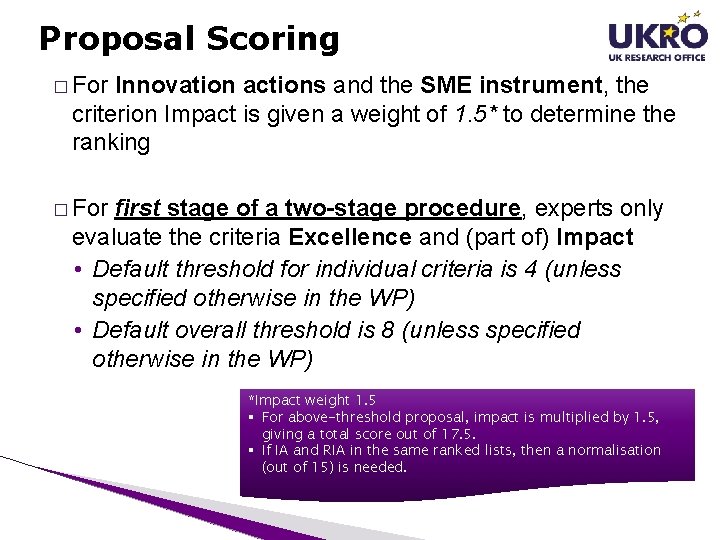
Proposal Scoring � For Innovation actions and the SME instrument, the criterion Impact is given a weight of 1. 5* to determine the ranking � For first stage of a two-stage procedure, experts only evaluate the criteria Excellence and (part of) Impact • Default threshold for individual criteria is 4 (unless specified otherwise in the WP) • Default overall threshold is 8 (unless specified otherwise in the WP) *Impact weight 1. 5 § For above-threshold proposal, impact is multiplied by 1. 5, giving a total score out of 17. 5. § If IA and RIA in the same ranked lists, then a normalisation (out of 15) is needed.
Score Descriptors 0 - The proposal fails to address the criterion or cannot be assessed due to missing or incomplete information. 1 - Poor. The criterion is inadequately addressed, or there are serious inherent weaknesses. 2 - Fair. The proposal broadly addresses the criterion, but there are significant weaknesses. 3 - Good. The proposal addresses the criterion well, but a number of shortcomings are present. 4 - Very Good. The proposal addresses the criterion very well, but a small number of shortcomings are present. 5 - Excellent. The proposal successfully addresses all relevant aspects of the criterion. Any shortcomings are minor.
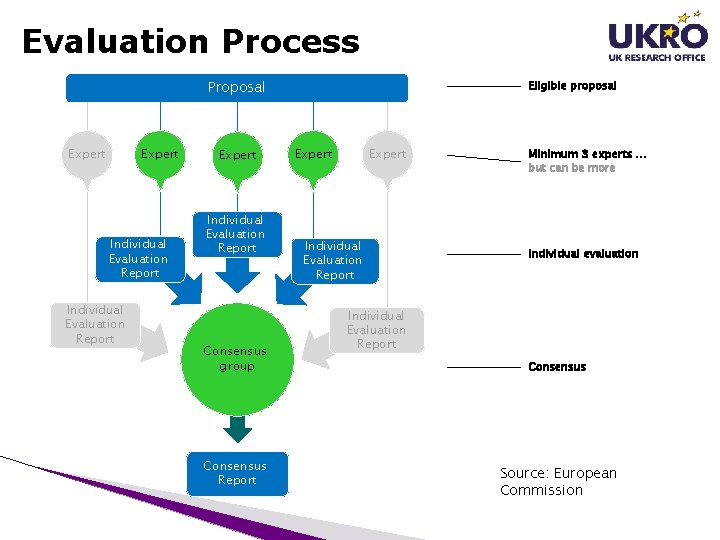
Evaluation Process Proposal Expert Individual Evaluation Report Consensus group Consensus Report Eligible proposal Expert Individual Evaluation Report Minimum 3 experts … but can be more Individual evaluation Individual Evaluation Report Consensus Source: European Commission
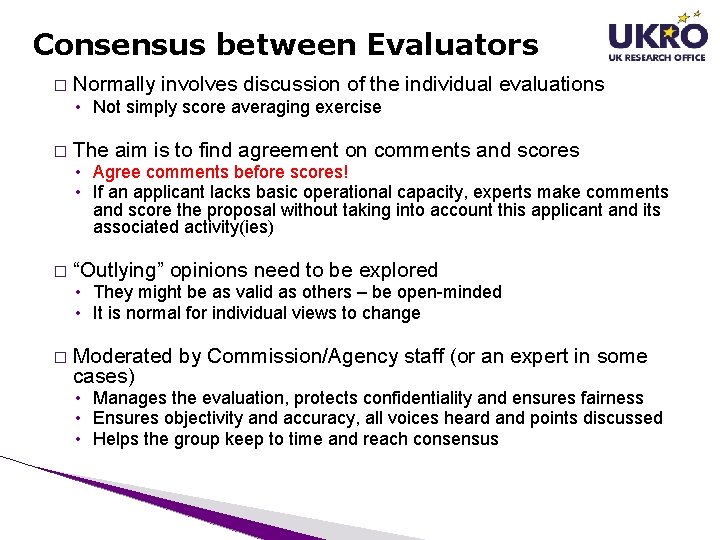
Consensus between Evaluators � Normally involves discussion of the individual evaluations • Not simply score averaging exercise � The aim is to find agreement on comments and scores • Agree comments before scores! • If an applicant lacks basic operational capacity, experts make comments and score the proposal without taking into account this applicant and its associated activity(ies) � “Outlying” opinions need to be explored • They might be as valid as others – be open-minded • It is normal for individual views to change � Moderated by Commission/Agency staff (or an expert in some cases) • Manages the evaluation, protects confidentiality and ensures fairness • Ensures objectivity and accuracy, all voices heard and points discussed • Helps the group keep to time and reach consensus
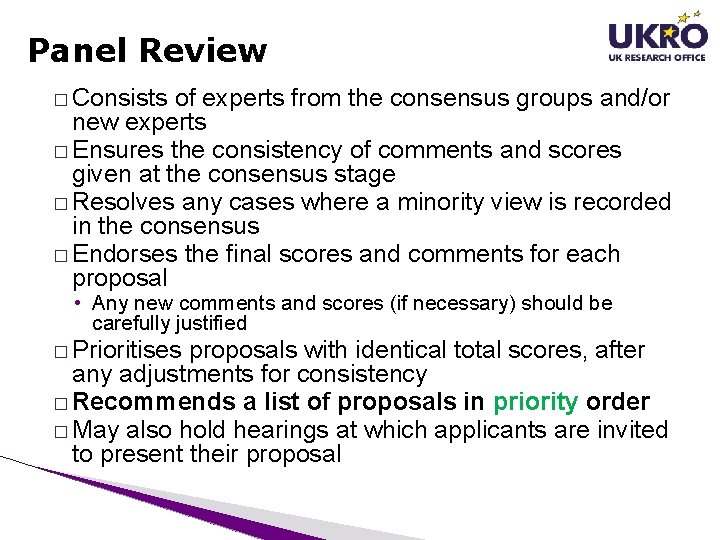
Panel Review � Consists of experts from the consensus groups and/or new experts � Ensures the consistency of comments and scores given at the consensus stage � Resolves any cases where a minority view is recorded in the consensus � Endorses the final scores and comments for each proposal • Any new comments and scores (if necessary) should be carefully justified � Prioritises proposals with identical total scores, after any adjustments for consistency � Recommends a list of proposals in priority order � May also hold hearings at which applicants are invited to present their proposal
Proposals with Identical Scores � The panel first considers proposals that address topics that are not already covered by more highly-ranked proposals � The panel then orders them according to: • First, their score for Excellence, • And second, their score for Impact � The reverse approach for Innovation Actions If proposals are tied, the panel takes into account the following factors: • First, the size of the budget allocated to SMEs • Second, the gender balance of personnel carrying out the research and/or innovation activities � If still tied, the panel agrees further factors to consider: • e. g. synergies between projects or contribution to the objectives of the call or of Horizon 2020 � The same method is then applied to proposals that address topics that are already covered by more highly-ranked proposals
Useful Links � Model Contract for experts http: //ec. europa. eu/research/participants/data/ref/h 202 0/experts_manual/h 2020 -experts-monocontract_en. pdf � Guidance on evaluating http: //ec. europa. eu/research/participants/data/ref/h 202 0/grants_manual/pse/h 2020 -evaluation-faq_en. pdf � Guide on proposal submission and evaluation http: //ec. europa. eu/research/participants/data/ref/h 202 0/grants_manual/pse/h 2020 -guide-pse_en. pdf � Participant Portal expert area http: //ec. europa. eu/research/participants/portal/deskto p/en/experts/index. html Sign-up as an expert!
Thank you Questions? Ian. Devine@BBSRC. ac. uk