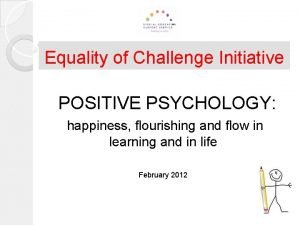
Equality of Challenge Initiative POSITIVE PSYCHOLOGY happiness flourishing

- Slides: 36
Equality of Challenge Initiative POSITIVE PSYCHOLOGY: happiness, flourishing and flow in learning and in life February 2012
Positive Psychology v Martin Seligman launched Positive Psychology in 1998 when he became President of the American Psychological Association v. Positive Psychology identifies and studies the factors that create well-being rather than at cures for psychological illnesses v It proposes to make people happier and more fulfilled by using and developing their strengths v. It is based on scientific research that has been carried out through controlled experiments and longitudinal studies 2
The Importance of Happiness/Well-Being Why is this important to us as L/S or SEN teachers? What difficulties do our students face? What effects can these difficulties have?
Difficulties that Students Face v Mental Health Difficulties: 8% of students – 83, 083 in number (Epsen Implementation Report: p. 72) v Adolescent ‘depressive episodes’ affect between 5 -10% of young people (Buckley, Gavin and Mc. Nicholas: 2009) v Depression is now ten times as prevalent as it was in 1960 in developed countries – forty years ago, the mean age of first episode was 29. 5 yearsnow it is 14. 5 years (Seligman: 2003) 4
Intensity of Emotion Added to other difficulties for highly able students, is the intensity or overexcitability of emotion that Dabrowsky and others identified. Leaves exceptionally able adolescents more vulnerable to mental/emotional distress
Mental/Emotional Health v In an analysis of well-being (using measures of emotional well- being, psychological well-being and social well-being), Keyes found that “children without mental illness are not necessarily mentally healthy” (Keyes, 2006) v. Indicators for individual positive mental health currently include the following key elements: Ø Ø Ø Ø life satisfaction optimism/hope self-esteem resilience/coping social integration spirituality emotional well-being Scottish Association for Mental Health (2006) 6
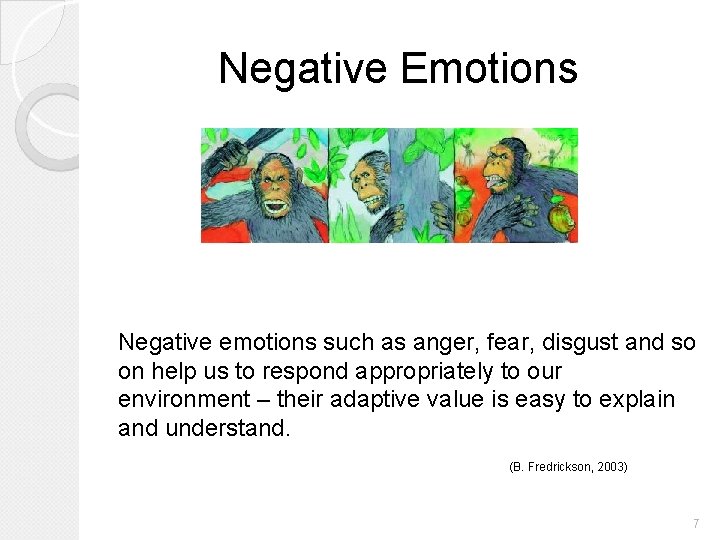
Negative Emotions Negative emotions such as anger, fear, disgust and so on help us to respond appropriately to our environment – their adaptive value is easy to explain and understand. (B. Fredrickson, 2003) 7
Fredrickson 2003 Barbara Fredrickson (2003) developed the Broaden-and-Build Theory of positive emotions. It explained that positive emotions are important to survival. They: v broaden and build cognitive processes v expand cognition and behavioural tendencies v increase the number of potential behavioural options v Fredrickson found that the expanded cognitive flexibility that is evident during positive emotional states results in resource building that becomes useful over time . 8
Emotional Chemistry ‘The brain is a supremely flexible organ that changes its chemistry in adaptive response to what is going around it. ‘ ( Nettle, 2005) Every feeling we have is a ‘neuro-chemical event’ v Danger, stress and anxiety trigger the release of adrenalin and cortisol Ø These narrow your focus, sharpen your thinking and temporarily increase your strength to enable you to run away fast v. Dopamine is the ‘motivation chemical’ Ø Ø Its release into the bloodstream is energising It increases our ability to focus v Serotonin is the ‘feel good’ chemical and is calming and rewarding (Mac. Conville 2008) 9
Emotional Chemistry(cont. ) v Endorphins are small neuropeptides produced by the body Ø They are natural opiates (endogenous morphine) Ø They are released every time you laugh, relax and exercise Ø Each release makes more connections in the brain, creating new neural pathways Ø Ø They create more bonding in the brain so they expand cognitive processes They enable broader, more flexible, more creative thinking (Mac. Conville 2008) v v We can increase our well-being by choosing to do activities that produce endorphins In the same way, we can also make our thinking broader and more flexible 10
Research The concepts and claims of Positive Psychology are supported by research evidence which includes: v physiological evidence v neurological evidence v psychological evidence 11
Happiness • Increases positive emotions. • Reduces the impact of negative emotions Nettle, Happiness: The science behind your smile (2005) 12
What Happiness is Good For Briefly, happiness/positivity v Increases our engagement in our everyday lives v Broadens our mindset, our actions and our social resources v Enables creative and more flexible, global thinking v Improves attention, short term memory and problemsolving v Allows us to build up intellectual and psychological reserves v Undoes negative feelings v Increases resilience and tolerance Sonja Lyubomirsky: http: //thesciencenetwork. org/search? topics+Human+Flourishing 13
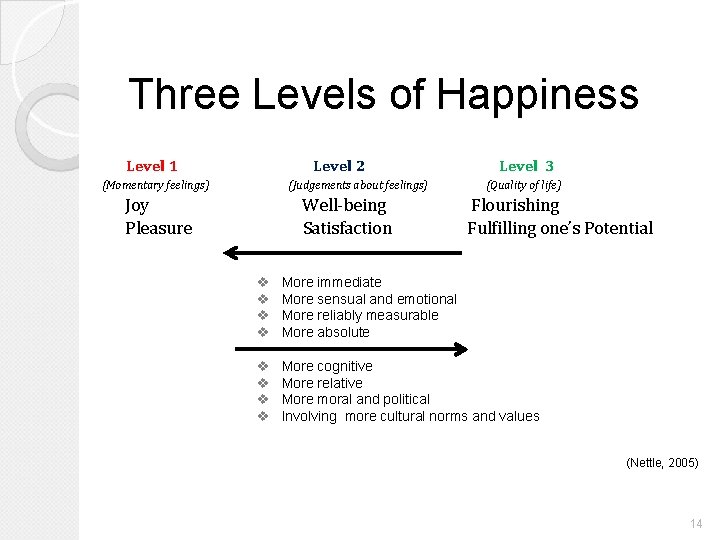
Three Levels of Happiness Level 1 Level 2 Level 3 (Momentary feelings) (Judgements about feelings) (Quality of life) Joy Well-being Flourishing Pleasure Satisfaction Fulfilling one’s Potential v v More immediate More sensual and emotional More reliably measurable More absolute v v More cognitive More relative More moral and political Involving more cultural norms and values (Nettle, 2005) 14
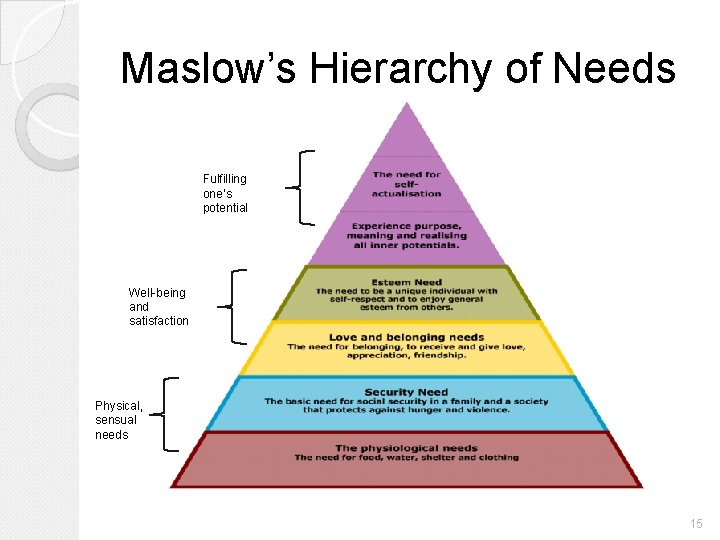
Maslow’s Hierarchy of Needs Fulfilling one’s potential Well-being and satisfaction Physical, sensual needs 15
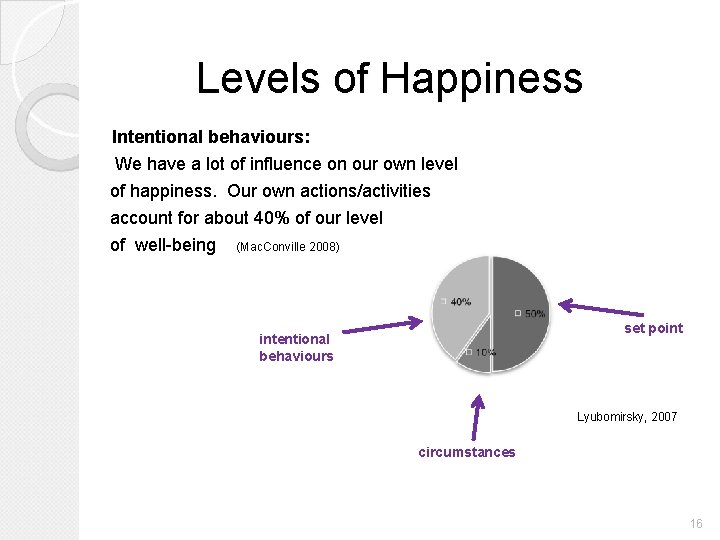
Levels of Happiness Intentional behaviours: We have a lot of influence on our own level of happiness. Our own actions/activities account for about 40% of our level of well-being (Mac. Conville 2008) set point intentional behaviours Lyubomirsky, 2007 circumstances 16
Approaches that Promote Happiness and Learning The following strategies have been found to develop positive emotions that are based on the exercise of strengths– a happiness that Seligman calls ‘authentic’. 17
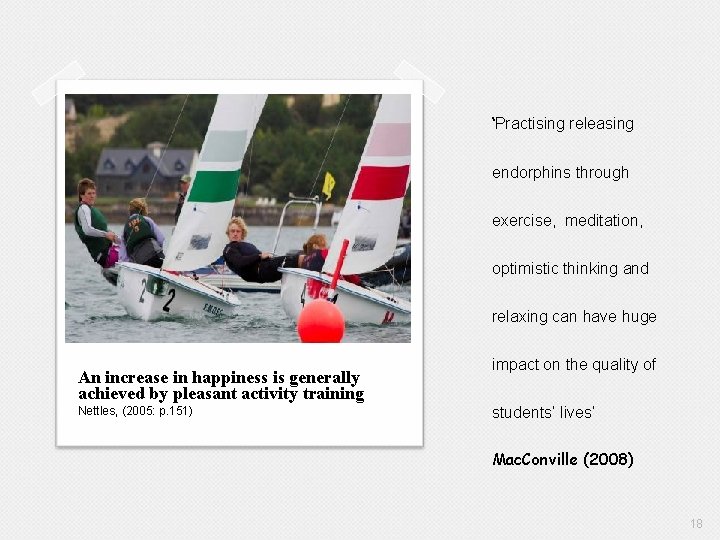
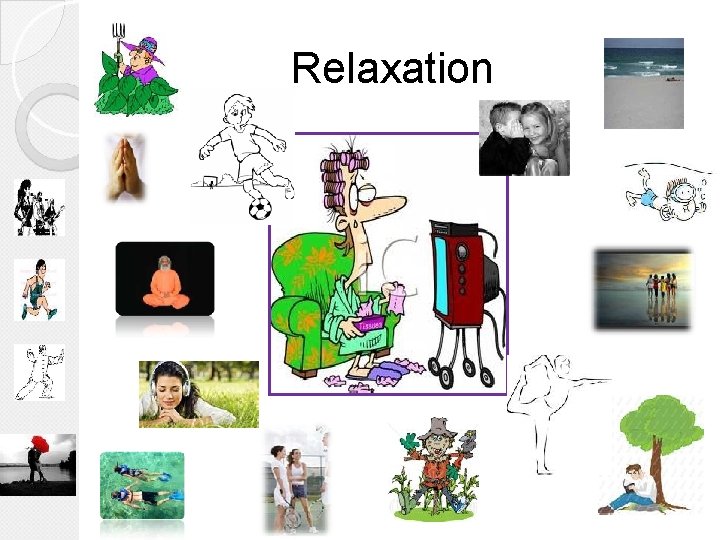
‘Practising releasing endorphins through exercise, meditation, optimistic thinking and relaxing can have huge An increase in happiness is generally achieved by pleasant activity training Nettles, (2005: p. 151) impact on the quality of students’ lives’ Mac. Conville (2008) 18
Effects of Exercise • Production of serotonin and endorphins • Self-Esteem and Mastery • ‘Time-Out’ from stress – potential for • • engagement/Flow/meditation Provides opportunities for social contact and reinforcing friendships SMILES - the Standard Medical Intervention and Longterm Exercise Study (Archives of Internal Medicine 1999: 159, 2349 -2356)
Exercise Younger children do not always get opportunities for outdoor play ◦ Restrictions at home and in school As students get older, many exercise less and less, girls in particular ◦ Many students opt out because of the competitive nature of sport 20
Meditation/Reflection/ Mindfulness Half an hour’s meditation each day is essential, except when you are busy. Then a full hour is needed. St Francis de Sales 1567 -1622 v Meditation actually comprises a family of techniques that go by different names (Zen, transcendental, Vipassana etc. ) and different categories (concentrative, mindfulness, contemplative) v The core ingredient that underlies them all is the cultivation of attention v An avalanche of studies has shown that meditation has multiple positive effects on a person’s happiness and positive emotions, on physiology, stress, cognitive abilities and physical health as well as on other harder-to-assess attributes, like ‘self-actualisation’ and moral maturity (Sonja Lyubomirsky, 2007: 250 -251)
Relaxation
Optimistic Thinking Research shows that optimists are more likely to persevere in the face of difficulty PRACTICE Identify barrier thoughts Visualize a future where everything is as you wanted it to be – you’ve tried your best, worked hard and achieved your goals. Describe in writing what you imagine. Identify long-term goals and break them into subgoals – if barriers come into your mind, generate resolutions
OPTIMISM Optimism is not about providing a recipe for self-deception. The world can be a horrible and cruel place, and at the same time it can be wonderful and abundant. These are both truths. There is not a halfway point – there is only choosing which truth to put in your personal foreground (Lee Ross, quoted by Sonja Lyubomirsky, 2007: 110)
Signature Strengths Chris Peterson and Martin Seligman devised a classification system for character strengths This classification is based on strengths that are traditionally acknowledged as representing what is best in humanity Seligman referred to these as signature strengths and described their classification as “ a classification of the sanities” They provide a counterbalance to classifications of psychological illnesses 25
Happiness Challenge Three Good Things v Wishing Others Well v Feeling and Communicating Gratitude v Practising Mindfulness v 26
Three Good Things / WWW The student keeps a daily record of three good things that have happened during the course of the day. The events may be small, but the student recalls what happened and perhaps records her/his contribution to the event. v This foregrounds positive feelings in the student’s mind 27
WOW! Wishing Others Well Give opportunity for students to: share good news choose a ‘person to be kind to this week’ write a letter to a prisoner of conscience FEELING GRATITUDE Suggest that they might: Write a letter, visit or email someone to whom you are grateful for some thing and tell him/her how you feel 28
Random Acts of Kindness v v v Closely related to WWW and to ‘Three Good Things’ is the idea of doing one unsolicited ‘Good Deed’ for another person each day. It could be: Clearing the table Picking up something that someone has dropped Holding open the door Washing the car Putting out the wheelie bin Doing the shopping – or one of thousands of other small but significant acts that make other people’s lives just a little bit more pleasant 29
Mindfulness We engage all the time in ‘future-mindedness’, or what Seligman calls ‘mindlessness’ Activity In order to bring our minds into the present, a simple breathing exercise for a few moments can help to focus the mind on the present. This is done by simply sitting quietly breathing in and out, watching the breathing and thinking simply of the breathing. If the mind strays away from the breathing, observe that it has happened and just return to concentrate on the breathing This has the effect of slowing down, relaxing and opening the mind 30
Writing the Self v Writing regularly about oneself is extremely effective in boosting positive emotions v The writing does not need to be about happy events v Nettle (2005) believes that it is effective because writing gives us space to be more mindful of our thoughts 31
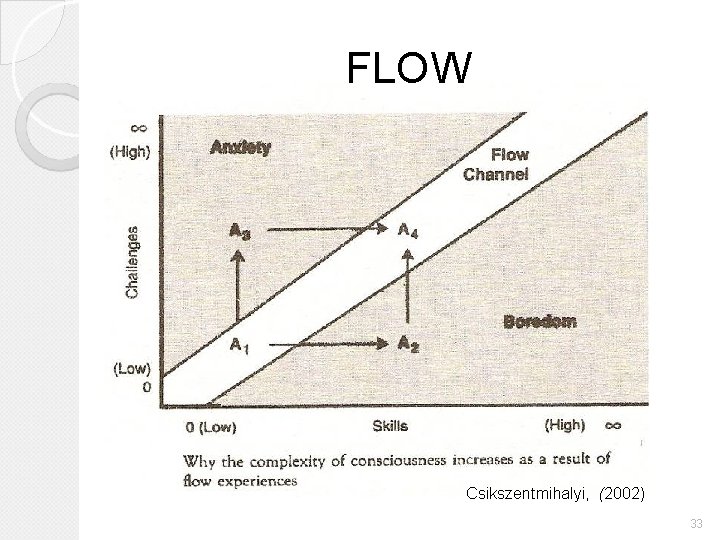
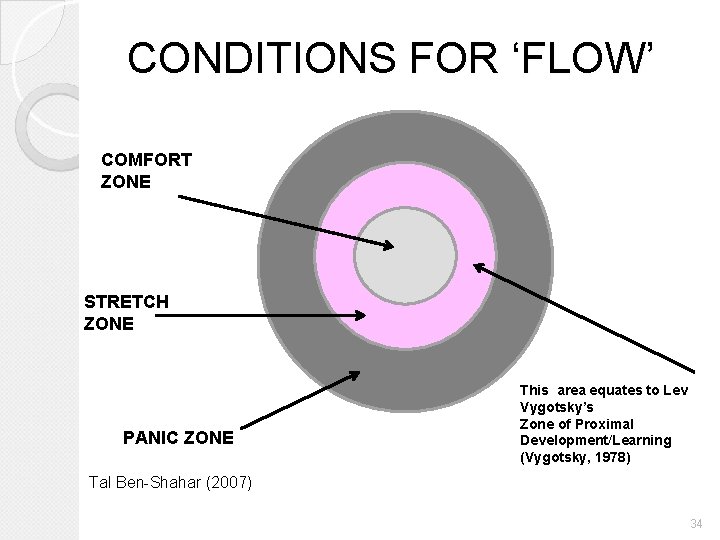
Flow v Flow is a term coined by the psychologist Dr Mihaly Csikszentmihalyi, an associate of Martin Seligman v It describes a state of optimal experience and involvement in an activity during which we are performing at our best v During flow individuals are completely involved in what they are doing; our skill level matches the challenges of the task, we feel compelled to persist at what we are doing until we get it right and we lose track of time v Flow provides an important pathway to happiness as it provides the deep satisfaction of successful engagement (Ruth Mac. Conville, 2008) 32
FLOW Csikszentmihalyi, (2002) 33
CONDITIONS FOR ‘FLOW’ COMFORT ZONE STRETCH ZONE PANIC ZONE This area equates to Lev Vygotsky’s Zone of Proximal Development/Learning (Vygotsky, 1978) Tal Ben-Shahar (2007) 34
Setting Goals v Csikszentmihalyi (1990) explains that having meaningful goals and a clear sense of purpose is essential to attaining flow v Achievement of flow may be assisted in the classroom by: Ø the provision of clear goals and success criteria for all tasks that are set Ø Providing challenges that are matched to the students’ skills Ø allowing adequate time for the students to engage with each task 35
References and Further Reading Books Csikszentmihalyi, M. Finding Flow (1997) Csikszentmihalyi, M. Flow {2 nd Edition} (2002) Frederickson, B. Positivity (2009) Lyubomirsky, S. The How of Happiness (2007) Mac. Conville , R. , Teaching Happiness (2008) Nettle, D. , Happiness: The science behind your smile (2005) Seligman, M. , Authentic Happiness (2003) Seligman, M. , Flourish (2011) Thich Nhat Hanh, Happiness (2009) Websites http: //www. evenhappier. com/docs/broaden-and-build. pdf http: //www. fredrickson. socialpsychology. org http: //www. positivityratio. com http: //www. bbc. co. uk/2/shared/bsp/hi/pdfs/24_01_11_happiness_challenge_final http: //www. actionforhappiness. org http: //www. icepe. ie (Teaching Happiness: Positive Psychology for behaviour and learning) http: //www. authentichappiness. sas. upenn. edu/questionnaires. aspx 36