
Life Above Zero Lesson of Positive Psychology Happiness

Life Above Zero Lesson of Positive Psychology Happiness & health are more than the absence of unhappiness and disease. Traditional Psych. - much about life below zero & what goes wrong. � Positive Psych. - about life above zero - i. e. , presence of positive, not just absence of negative. What we need to do to be happy, healthy, & live a good life or have a happy marriage is independent of & different than just not doing “bad” things. Keyes - Mental health looks very different when measured directly rather than inferred from absence of illness. Copyright © 2009 Pearson Education, Inc. , Upper Saddle River, NJ 07458. All rights reserved.
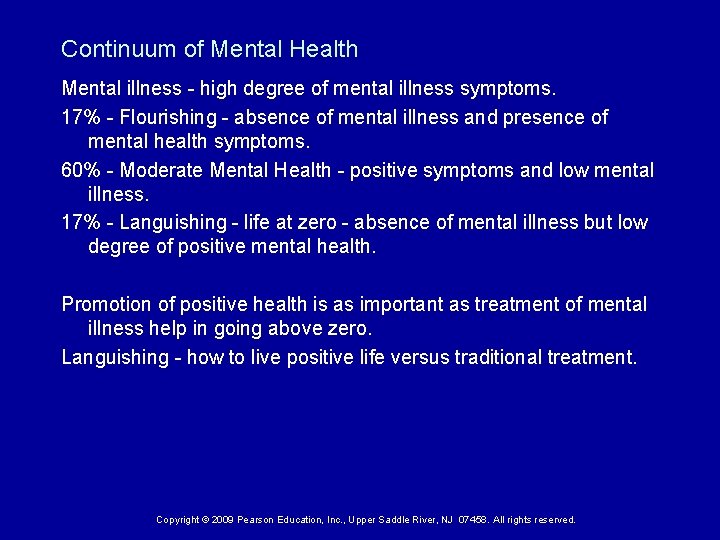
Continuum of Mental Health Mental illness - high degree of mental illness symptoms. 17% - Flourishing - absence of mental illness and presence of mental health symptoms. 60% - Moderate Mental Health - positive symptoms and low mental illness. 17% - Languishing - life at zero - absence of mental illness but low degree of positive mental health. Promotion of positive health is as important as treatment of mental illness help in going above zero. Languishing - how to live positive life versus traditional treatment. Copyright © 2009 Pearson Education, Inc. , Upper Saddle River, NJ 07458. All rights reserved.

Contours of Positive Life Meaning Good life is shaped by cultural and developmental context. Yet describe general features - comparative picture of kinds of life choice, personal goals, strengths, traits, involvements that increase, have temporary effects, or decrease well-being. Seligman 1. Pleasant Life positive emotional experiences & happiness - few negative Broaden & Build Theory - Positive emotions & physical, psychological, & social resources. Cultivating positive emotions for health & well-being. Copyright © 2009 Pearson Education, Inc. , Upper Saddle River, NJ 07458. All rights reserved.

2. Engaged Life Active involvement in need fulfilling and personally expressive activities & life goals. Personal goal research - choosing “right goals” Goals that are freely chosen, match needs and talents - increase well-being. Self-awareness - avoid traps of materialism and need substitutions. 3. Meaningful Life Finding purpose, direction, coherence, transcendent understandings. Higher order meanings most satisfying - purpose of life. Philosophy of life whatever it may be. Copyright © 2009 Pearson Education, Inc. , Upper Saddle River, NJ 07458. All rights reserved.
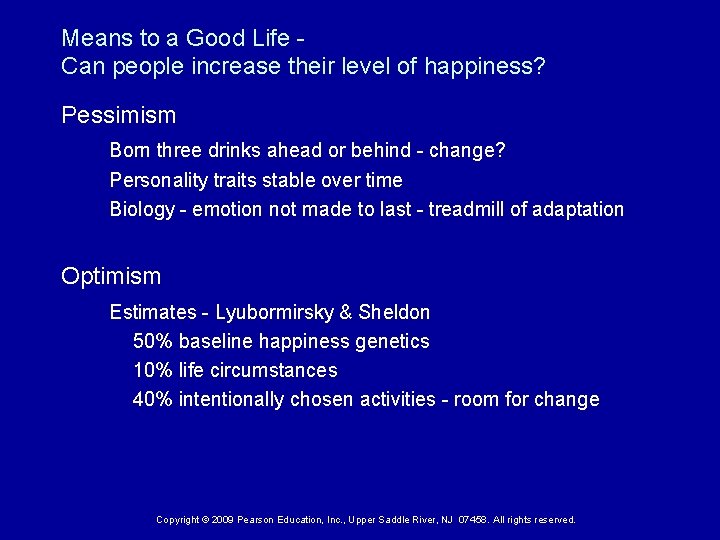
Means to a Good Life - Can people increase their level of happiness? Pessimism Born three drinks ahead or behind - change? Personality traits stable over time Biology - emotion not made to last - treadmill of adaptation Optimism Estimates - Lyubormirsky & Sheldon 50% baseline happiness genetics 10% life circumstances 40% intentionally chosen activities - room for change Copyright © 2009 Pearson Education, Inc. , Upper Saddle River, NJ 07458. All rights reserved.

Examples of Increasing Happiness & Well-Being 1. Practicing Happiness Fordyce instruction on tactics to increase 14 aspects of life 1. Become more active 2. More time socializing with others 3. More productive at meaningful work 4. Organized & planning 5. Worry less 6. Lower expectations/aspirations 7. Be more optimistic & positive 8. More present-oriented 9. Develop healthier personality 10. Develop more outgoing personality 11. Be yourself 12. Reduce negative feelings 13. Recognize close relations as critical to happiness 14. Make happiness life priority Copyright © 2009 Pearson Education, Inc. , Upper Saddle River, NJ 07458. All rights reserved.
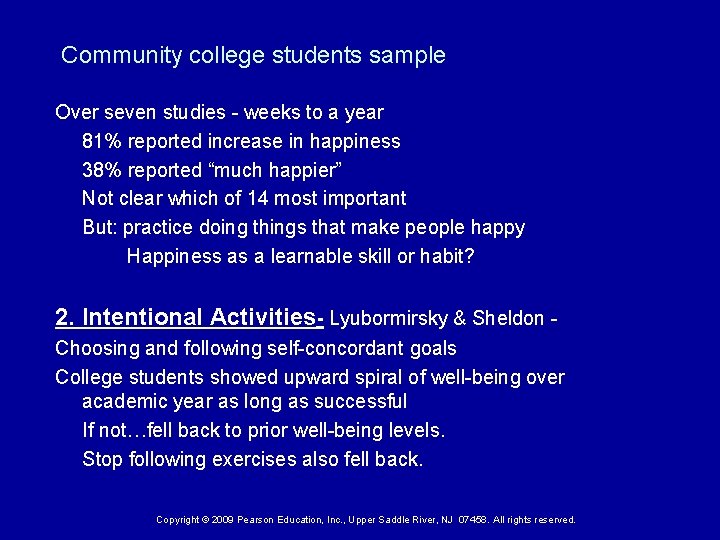
Community college students sample Over seven studies - weeks to a year 81% reported increase in happiness 38% reported “much happier” Not clear which of 14 most important But: practice doing things that make people happy Happiness as a learnable skill or habit? 2. Intentional Activities- Lyubormirsky & Sheldon - Choosing and following self-concordant goals College students showed upward spiral of well-being over academic year as long as successful If not…fell back to prior well-being levels. Stop following exercises also fell back. Copyright © 2009 Pearson Education, Inc. , Upper Saddle River, NJ 07458. All rights reserved.
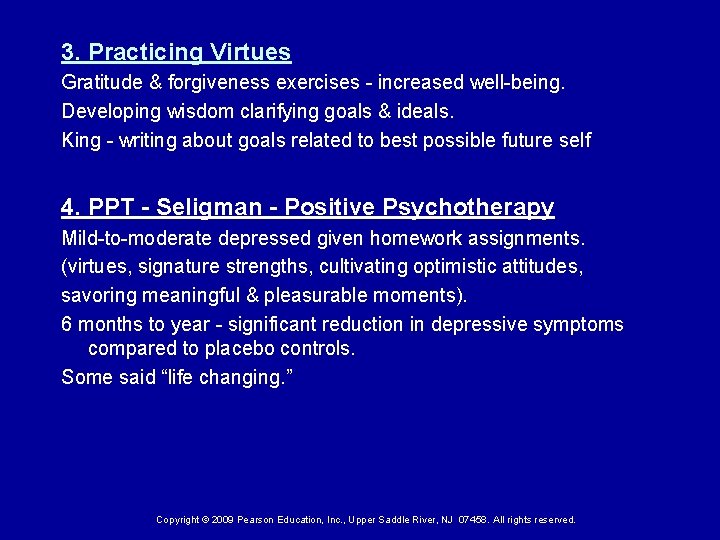
3. Practicing Virtues Gratitude & forgiveness exercises - increased well-being. Developing wisdom clarifying goals & ideals. King - writing about goals related to best possible future self 4. PPT - Seligman - Positive Psychotherapy Mild-to-moderate depressed given homework assignments. (virtues, signature strengths, cultivating optimistic attitudes, savoring meaningful & pleasurable moments). 6 months to year - significant reduction in depressive symptoms compared to placebo controls. Some said “life changing. ” Copyright © 2009 Pearson Education, Inc. , Upper Saddle River, NJ 07458. All rights reserved.

5. Well-Being Therapy (WBT) Diverse clinical populations - 8 week sessions - 30 to 50 minutes Worked on improved functioning on each of Ryff’s six dimensions of well-being: 1. Self-acceptance 2. Personal growth 3. Purpose in life 4. Environmental mastery 5. Autonomy 6. Positive relations with others Preliminary self-reports, diaries, spouse reports - encouraging. Use well-being to counteract distress. Copyright © 2009 Pearson Education, Inc. , Upper Saddle River, NJ 07458. All rights reserved.

6. Minding Close Relationships Quality relationships central to well-being. Harvey & Omarzu 5 behaviors important to develop & sustain intimate relations…. garden analogy - don’t just plant. Copyright © 2009 Pearson Education, Inc. , Upper Saddle River, NJ 07458. All rights reserved.
Mindfulness & Well-Being More general, encompassing, lasting, and “deeper” approach. Origins in Eastern religious meditative practices (Buddhist zazen). Widely used in clinical interventions - pain & psychotherapy. Major research reviews -populations with problems. Mindfulness meditation associated improved mental & physical health and relieving symptoms of disease: e. g. , hypertension, chronic pain, asthma, anxiety etc…. Only last few years…systematic study, measures & effects within non-clinical populations. Copyright © 2009 Pearson Education, Inc. , Upper Saddle River, NJ 07458. All rights reserved.
What is mindfulness? 1. Antidote to mindlessness “lights are on but nobody home” Not paying attention State governed by rules & routine - automatic responses Efficient, but mindless Copyright © 2009 Pearson Education, Inc. , Upper Saddle River, NJ 07458. All rights reserved.
2. Present-centered attention & awareness Focus on here & now - in present not for present Observing what is in front of us - not evaluating Increasing sensitivity of radar without scanning for particular object - see more and see more clearly Getting to life’s bottom line- for many not until “too late” Awareness of own death - Cossolino & colleagues Copyright © 2009 Pearson Education, Inc. , Upper Saddle River, NJ 07458. All rights reserved.
Mindfulness Meditation Becoming aware of what matters without confronting own death. Definition & Purpose Variety of meditative self-regulation practices focus on training attention & awareness to bring them under greater voluntary control & foster well-being & development of calm, clear concentration. Not religion - don’t need to believe in anything to accept self. Copyright © 2009 Pearson Education, Inc. , Upper Saddle River, NJ 07458. All rights reserved.

Basic idea: Everyday consciousness is filled with unexamined thoughts & feelings that take on life of their own. See present through future & past…give thoughts reality they don’t deserve. What is difference between casual versus trained observer - seeing more - what is beautiful sunset - baseball - trout fishing Copyright © 2009 Pearson Education, Inc. , Upper Saddle River, NJ 07458. All rights reserved.
Mindfulness Training: Seeing More of Self How much time do you spend observing your own mind? How it works - what it holds on to - recurring thoughts? When do we “see” our mind at work? Setting time aside each day to observe, not evaluate, own thought patterns (15 to 30 minutes): Sit - pillow straight-backed chair - alert - aligned Focus on breath - follow in & out - not control Attention wanders - note & back to breath just a thought Discover Mind wells up endless thoughts - seem not to control Copyright © 2009 Pearson Education, Inc. , Upper Saddle River, NJ 07458. All rights reserved.
Cultivating 7 Attitudes - spill over into life 1. Non-judging - good & bad versus as it is new ways 2. Patience - let things unfold - not rush to judgment 3. Beginner’s Mind - see things for first time rather than through established categories, memories, & experiences - boredom 4. Trust - trust in own perceptions not others’ - be yourself 5. Non-striving - eliminate effects of wishes, desires - let go of preconceived ideas about outcomes 6. Acceptance - being yourself rather than denying unpleasant thoughts - let go of comparisons “are” vs. “wish to be” 7. Letting go - non-attachment not giving up - seeing what mind wants to hold on to - cultivate detachment - neutral observer of self Copyright © 2009 Pearson Education, Inc. , Upper Saddle River, NJ 07458. All rights reserved.
Mindfulness Research • Shaprio, et. al. - Even brief mindfulness training related to improved well-being, self-esteem, happiness, daily positive affect, extraversion, better relations with others, trust, empathy - Enhances physiological, psychological, & transpersonal wellbeing Ryan & Brown - Individual Differences Approach Mindful; Attention Awareness Scale (MAAS) Mindfulness as present-centered attention Measured indirectly as absence of mindfulness (best statistics) Copyright © 2009 Pearson Education, Inc. , Upper Saddle River, NJ 07458. All rights reserved.

MAAS Items I could be experiencing some emotion and not be conscious of it until some time later. I find it difficult to stay focused on what’s happening in the present. I tend not to notice feelings of physical tension or discomfort until they really grab my attention. It seems I am running on automatic without much awareness of what I’m doing. I rush through activities without really being attentive to them. I get so focused on a goal I want to achieve that I lose touch with what I am doing right here and now. I find myself listening to someone with one ear, doing something else at the same time. I find myself preoccupied with the future or the past. I snack without being aware that I’m eating. Copyright © 2009 Pearson Education, Inc. , Upper Saddle River, NJ 07458. All rights reserved.

Reliability & Validity Negative correlation with - self-consciousness, rumination, absorption. Positive correlations with attention, clarity of experience, & active life engagement. + r’s with measures of well-being both SWB and eudaimonic measures. Practicing Zen students score high. Higher levels of autonomy. Self-concordant actions. Consistency between conscious & intuitive, implicit reactions. Higher positive affect & lower mood disturbances. Copyright © 2009 Pearson Education, Inc. , Upper Saddle River, NJ 07458. All rights reserved.
Mindfulness & Psychotherapy Why does mindfulness improve well-being? Mickey - mindfulness key ingredient in all psychotherapy. refined awareness of emotions, reactions, self see through defensive reactions psychotherapy as “mindfulness coaching” Copyright © 2009 Pearson Education, Inc. , Upper Saddle River, NJ 07458. All rights reserved.
Aaron Beck - Cognitive therapy Mindful of automatic, habitual & destructive reactions Overcome through increased attention - i. e. , being mindful East & West Psychology Basic structure versus piece-meal Bottom line of improved well-being in today’s hectic world Lose sight of idea of good life Pay attention!!!!!! Copyright © 2009 Pearson Education, Inc. , Upper Saddle River, NJ 07458. All rights reserved.
A Final Puzzle Make a list of all the aspects of your life and self that contribute to your present sense of security and happiness. Now imagine that all the external supports for security and happiness disappear. Buddhism - Eastern Philosophy Whatever is left is authentic well-being, i. e. , not dependent on external supports that may come and go. External support = false sense of security and illusionary happiness. - Not true or stable security or happiness. - Money, relationships, achievements - fade, temporary - Ultimately have to live with well-being within self not propped up by stimulus-driven desires. How much of well-being is inside and how much outside the self? Copyright © 2009 Pearson Education, Inc. , Upper Saddle River, NJ 07458. All rights reserved.
- Slides: 23