Environment Management in Rwanda Policy practice and lesson

- Slides: 38
Environment Management in Rwanda: Policy, practice and lesson learnt Djuma Nsanzimana Environmental Education Officer Rwanda Environment Management Authority (REMA)
Outline • Introduction: Environment and its importance to humankind • Env nd Sustainable Development • Current issues in environmental Management • Policies, strategies and laws related to environment, climate change issues and sustainable development
Introduction Why should we manage the environment?
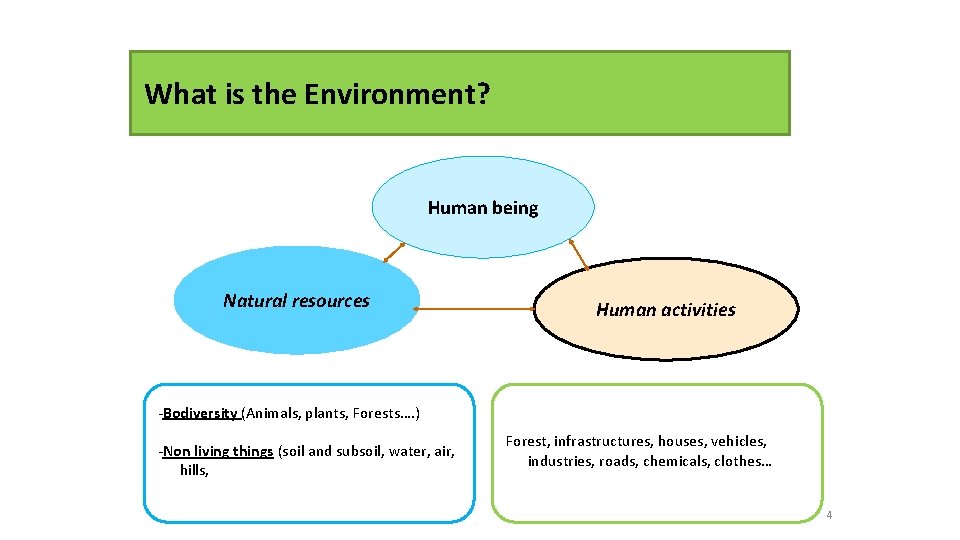
What is the Environment? Human being Natural resources Human activities -Bodiversity (Animals, plants, Forests…. ) -Non living things (soil and subsoil, water, air, hills, Forest, infrastructures, houses, vehicles, industries, roads, chemicals, clothes… 4
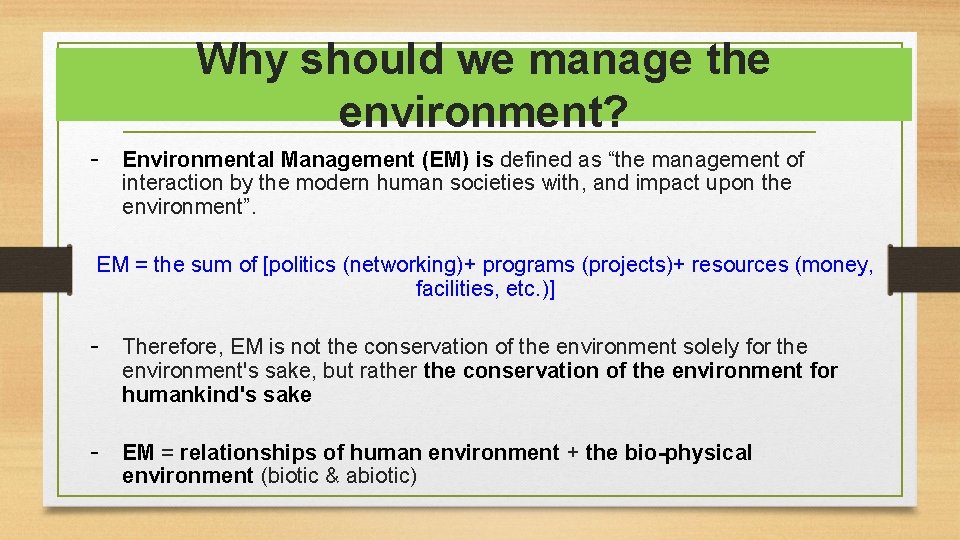
Why should we manage the environment? Environmental Management (EM) is defined as “the management of interaction by the modern human societies with, and impact upon the environment”. EM = the sum of [politics (networking)+ programs (projects)+ resources (money, facilities, etc. )] Therefore, EM is not the conservation of the environment solely for the environment's sake, but rather the conservation of the environment for humankind's sake EM = relationships of human environment + the bio-physical environment (biotic & abiotic)
“Interdependent and mutually reinforcing pillars" of sustainable development
Current Issues in Environmental Management in Rwanda
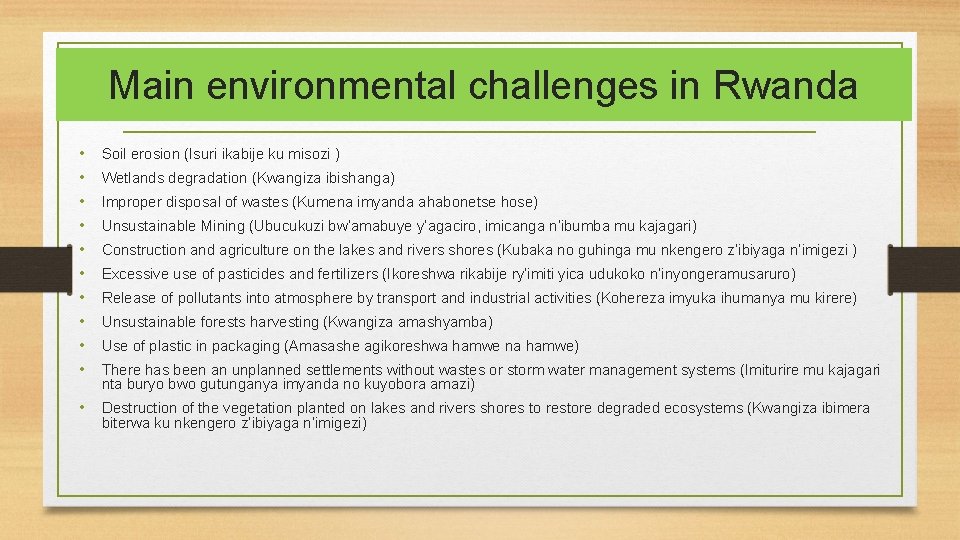
Main environmental challenges in Rwanda • • • Soil erosion (Isuri ikabije ku misozi ) Wetlands degradation (Kwangiza ibishanga) Improper disposal of wastes (Kumena imyanda ahabonetse hose) Unsustainable Mining (Ubucukuzi bw’amabuye y’agaciro, imicanga n’ibumba mu kajagari) Construction and agriculture on the lakes and rivers shores (Kubaka no guhinga mu nkengero z’ibiyaga n’imigezi ) Excessive use of pasticides and fertilizers (Ikoreshwa rikabije ry’imiti yica udukoko n’inyongeramusaruro) Release of pollutants into atmosphere by transport and industrial activities (Kohereza imyuka ihumanya mu kirere) Unsustainable forests harvesting (Kwangiza amashyamba) Use of plastic in packaging (Amasashe agikoreshwa hamwe na hamwe) There has been an unplanned settlements without wastes or storm water management systems (Imiturire mu kajagari nta buryo bwo gutunganya imyanda no kuyobora amazi) • Destruction of the vegetation planted on lakes and rivers shores to restore degraded ecosystems (Kwangiza ibimera biterwa ku nkengero z’ibiyaga n’imigezi)
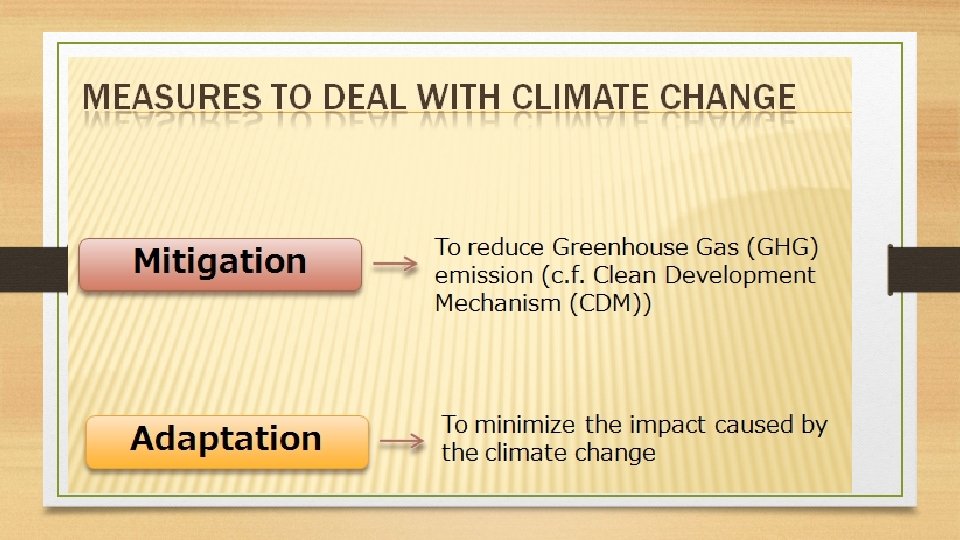
Climate Change
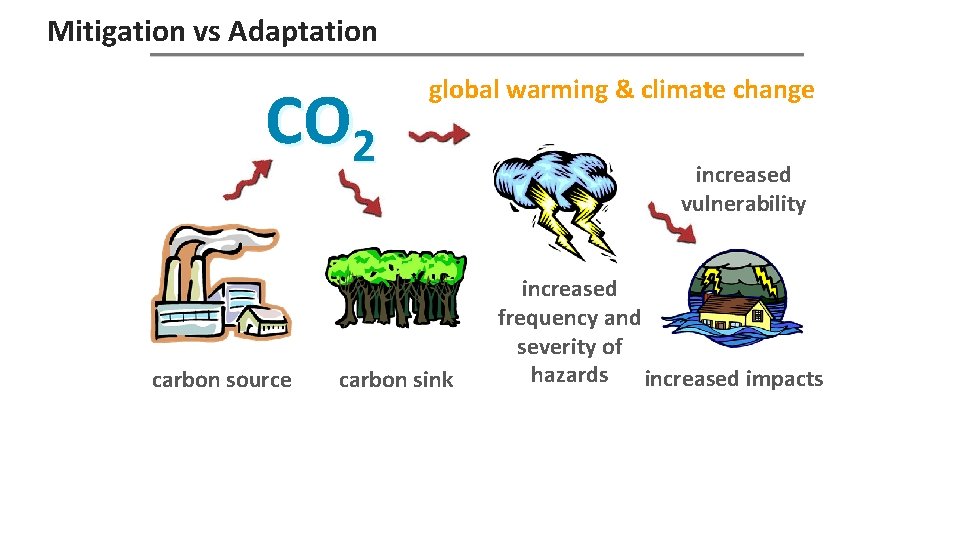
Mitigation vs Adaptation CO 2 carbon source global warming & climate change carbon sink increased vulnerability increased frequency and severity of hazards increased impacts
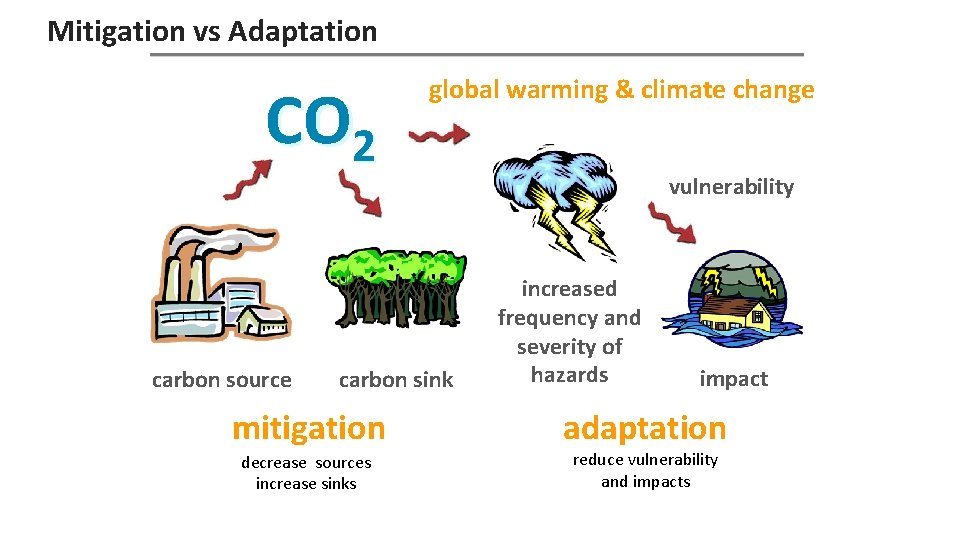
Mitigation vs Adaptation CO 2 carbon source global warming & climate change carbon sink mitigation decrease sources increase sinks vulnerability increased frequency and severity of hazards impact adaptation reduce vulnerability and impacts
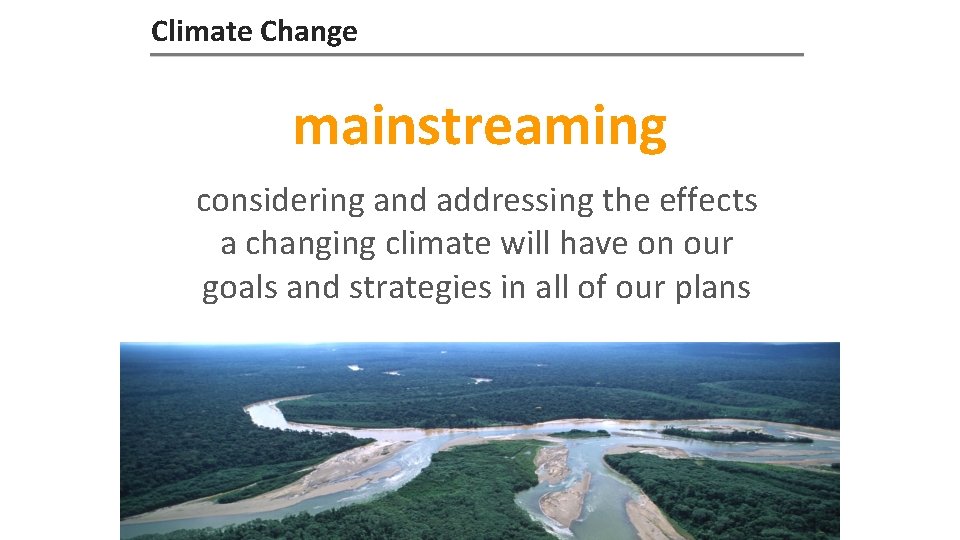
Climate Change mainstreaming considering and addressing the effects a changing climate will have on our goals and strategies in all of our plans
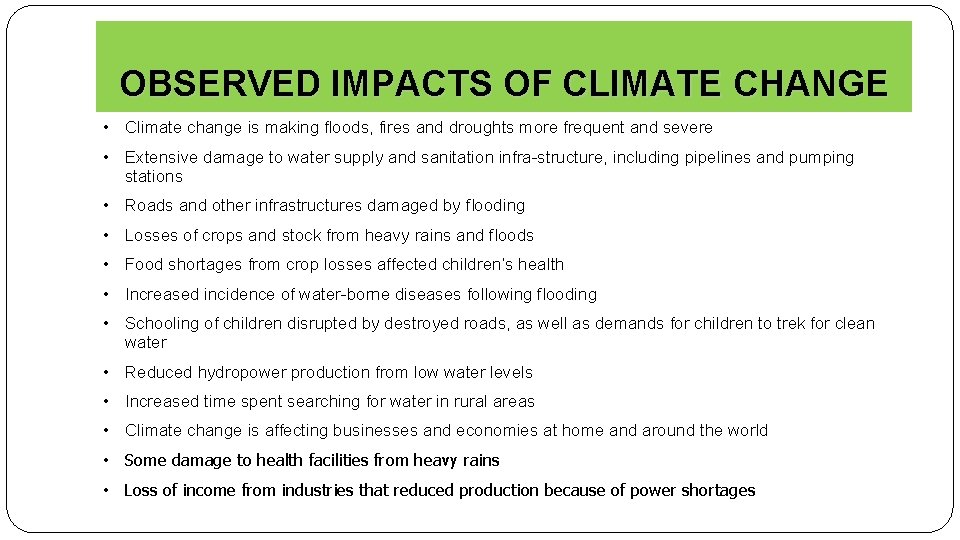
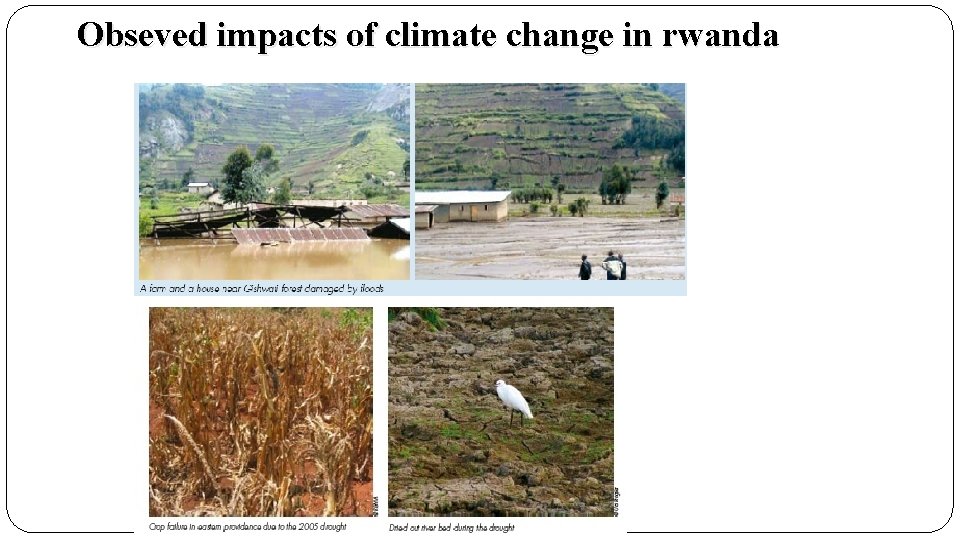
OBSERVED IMPACTS OF CLIMATE CHANGE • Climate change is making floods, fires and droughts more frequent and severe • Extensive damage to water supply and sanitation infra structure, including pipelines and pumping stations • Roads and other infrastructures damaged by flooding • Losses of crops and stock from heavy rains and floods • Food shortages from crop losses affected children’s health • Increased incidence of water borne diseases following flooding • Schooling of children disrupted by destroyed roads, as well as demands for children to trek for clean water • Reduced hydropower production from low water levels • Increased time spent searching for water in rural areas • Climate change is affecting businesses and economies at home and around the world • Some damage to health facilities from heavy rains • Loss of income from industries that reduced production because of power shortages
Obseved impacts of climate change in rwanda
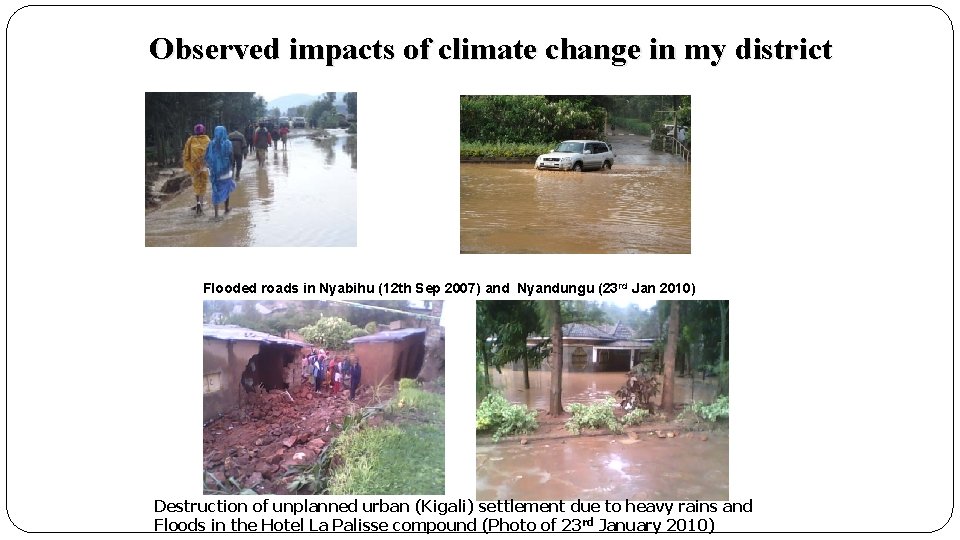
Observed impacts of climate change in my district Flooded roads in Nyabihu (12 th Sep 2007) and Nyandungu (23 rd Jan 2010) Destruction of unplanned urban (Kigali) settlement due to heavy rains and Floods in the Hotel La Palisse compound (Photo of 23 rd January 2010)
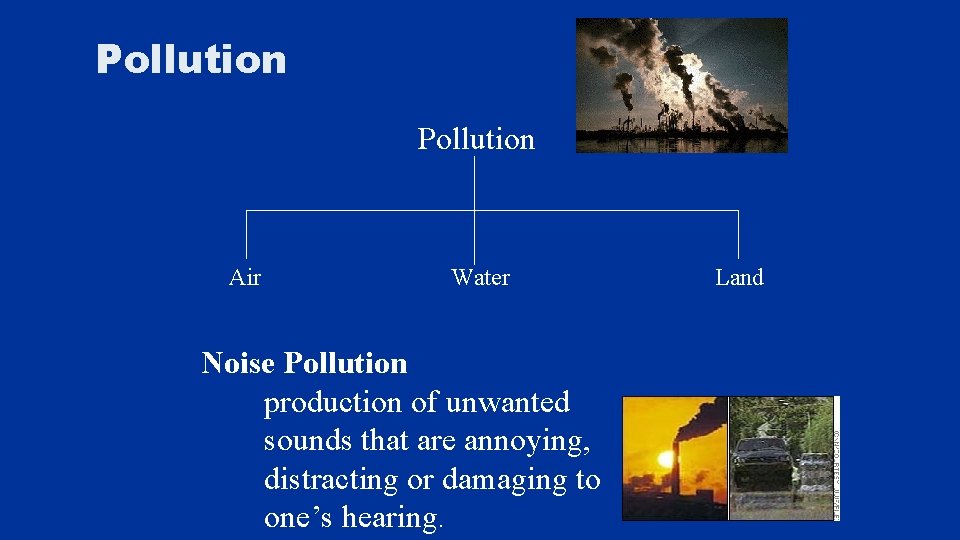
Pollution Air Water Noise Pollution production of unwanted sounds that are annoying, distracting or damaging to one’s hearing. Land
What is noise pollution? • Any unwanted sound that penetrates the environment is noise pollution. • In general, noise pollution refers to any noise irritating to one's ear which comes from an external source. • Sound becomes undesirable when it disturbs the normal activities such as working, sleeping, and during conversations.
Sources of noise pollution • Transportation systems are the main source of noise pollution in urban areas. • Construction of buildings, highways, and streets cause a lot of noise, due to the usage of air compressors, bulldozers, loaders, dump trucks, and pavement breakers. • Industrial noise also adds to the already unfavorable state of noise pollution. • Loud speakers, plumbing, boilers, generators, air conditioners, fans, and vacuum cleaners add to the existing noise pollution
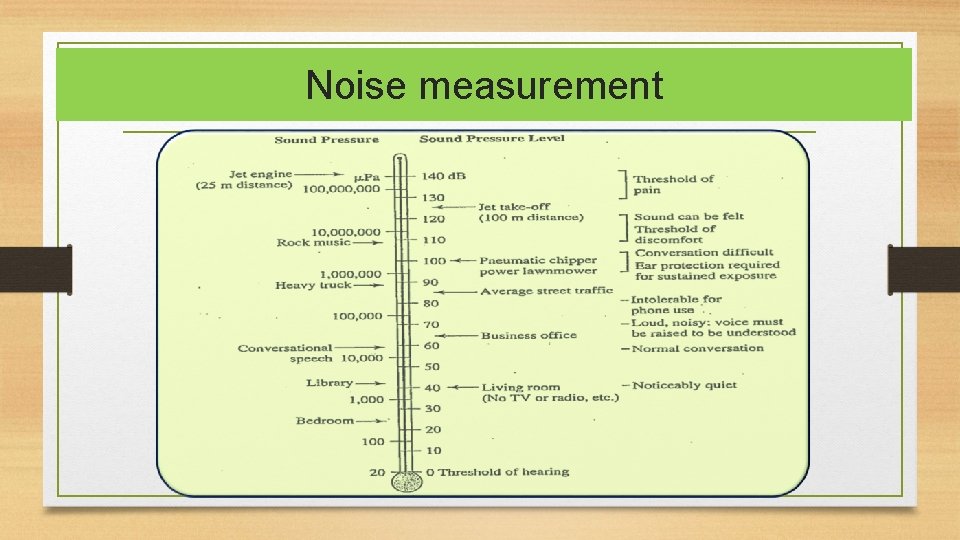
Noise measurement
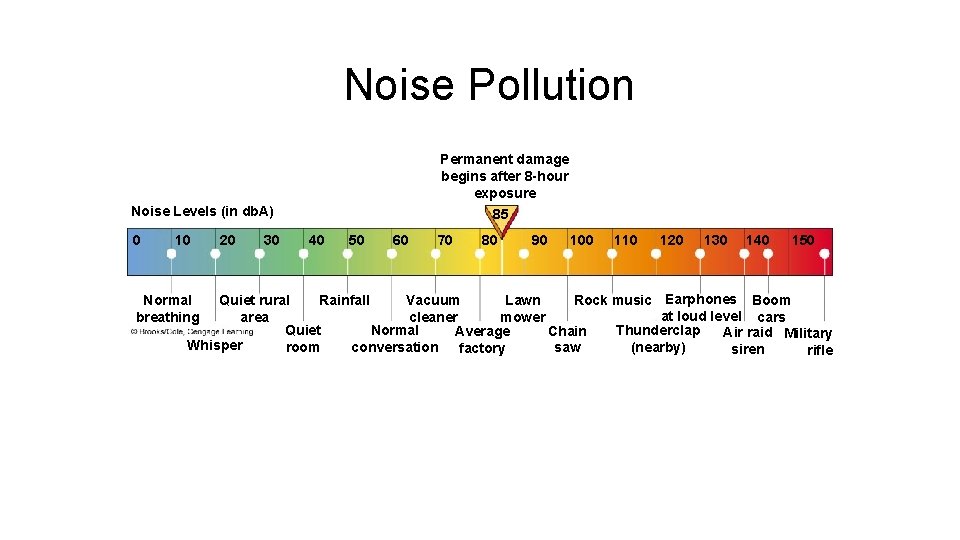
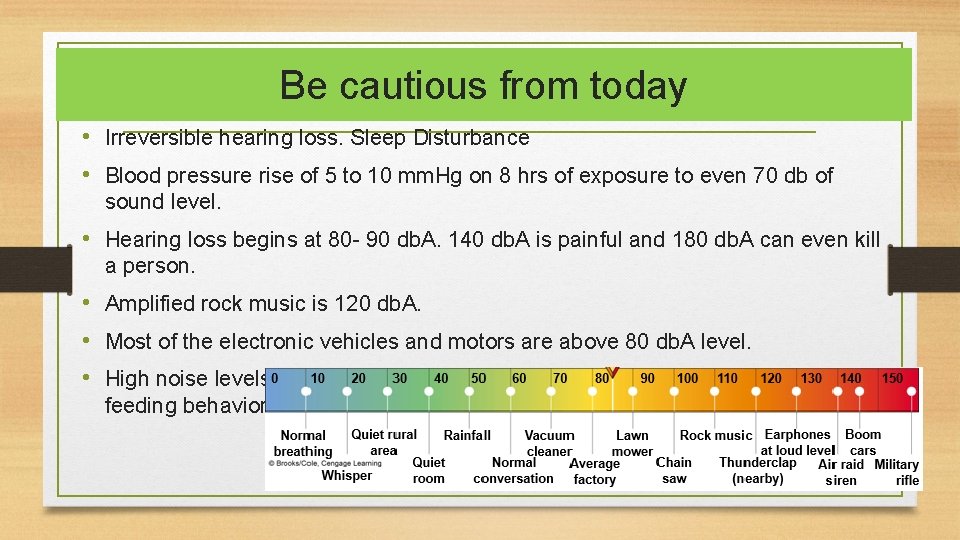
Noise Pollution Permanent damage begins after 8 -hour exposure Noise Levels (in db. A) 0 10 20 30 85 40 50 60 70 80 90 100 110 120 130 140 150 Quiet rural Rainfall Vacuum Lawn Rock music Earphones Boom at loud level cars area cleaner mower Normal Quiet Thunderclap Chain Average Air raid Military Whisper conversation room (nearby) saw factory siren rifle Normal breathing
Level of tolerance • Normal level of tolerance is 80 db. A. • Sound level below and above this is considered to be as noise pollution.
Effects of noise pollution • There about 25000 hair cells in our ear which create wave in our ear, responding to different levels of frequencies. • With increasing levels of sound the cells get destroyed decreasing our ability to hear the high frequency sound (even the Hearing Loss)
Be cautious from today • Irreversible hearing loss. Sleep Disturbance • Blood pressure rise of 5 to 10 mm. Hg on 8 hrs of exposure to even 70 db of sound level. • Hearing loss begins at 80 90 db. A. 140 db. A is painful and 180 db. A can even kill a person. • Amplified rock music is 120 db. A. • Most of the electronic vehicles and motors are above 80 db. A level. • High noise levels may interfere with the natural cycles of animals, including feeding behavior, breeding rituals and migration paths.
Symptoms of occupational hearing loss • • • Feeling of fullness in the ear. Sounds may seem muffled. Cannot hear high frequency sounds. Ringing in the ears while listening to the high frequency sounds. Loud noise for a long period of time, or sudden burst of sound can cause occupational hearing loss. • Hearing that does not return after an acute noise injury is called a permanent threshold shift.
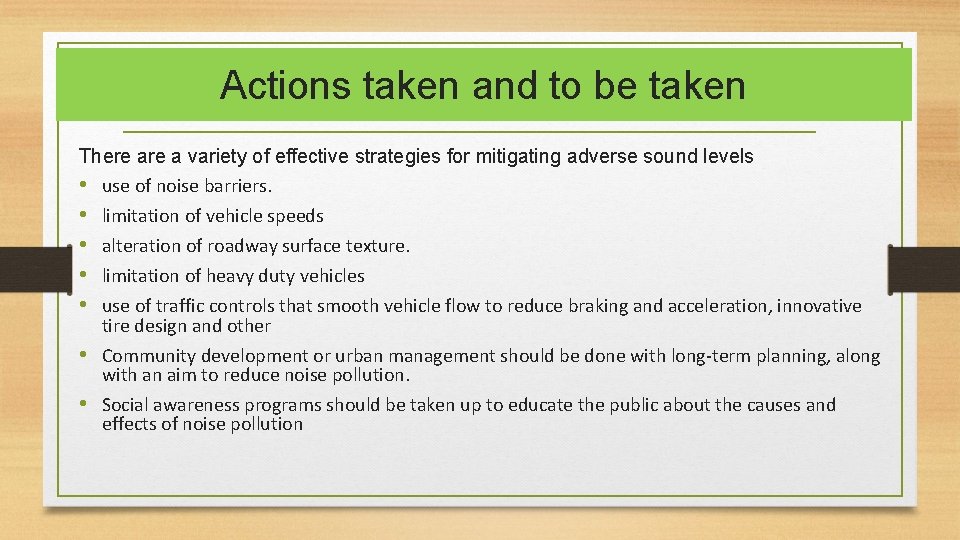
Actions taken and to be taken There a variety of effective strategies for mitigating adverse sound levels • use of noise barriers. • limitation of vehicle speeds • alteration of roadway surface texture. • limitation of heavy duty vehicles • use of traffic controls that smooth vehicle flow to reduce braking and acceleration, innovative tire design and other • Community development or urban management should be done with long-term planning, along with an aim to reduce noise pollution. • Social awareness programs should be taken up to educate the public about the causes and effects of noise pollution
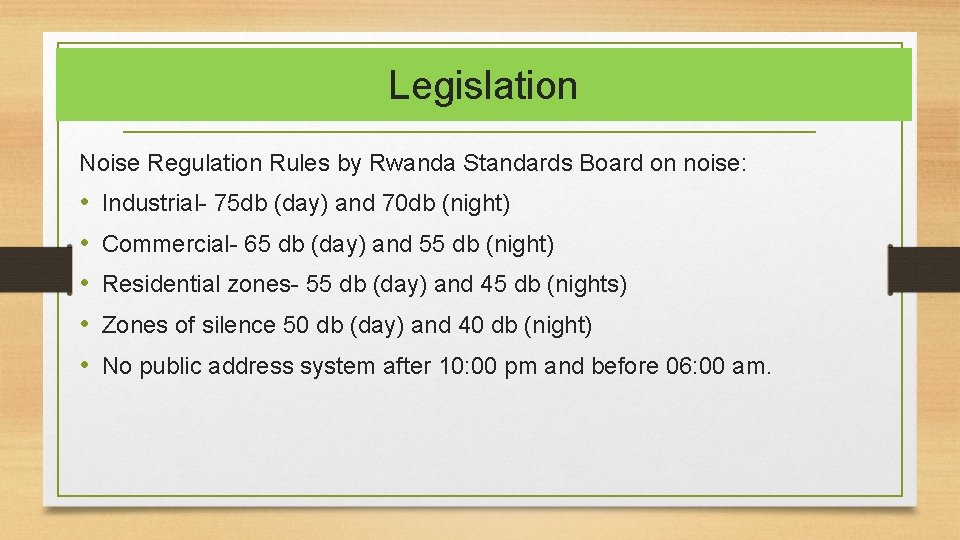
Legislation Noise Regulation Rules by Rwanda Standards Board on noise: • • • Industrial 75 db (day) and 70 db (night) Commercial 65 db (day) and 55 db (night) Residential zones 55 db (day) and 45 db (nights) Zones of silence 50 db (day) and 40 db (night) No public address system after 10: 00 pm and before 06: 00 am.
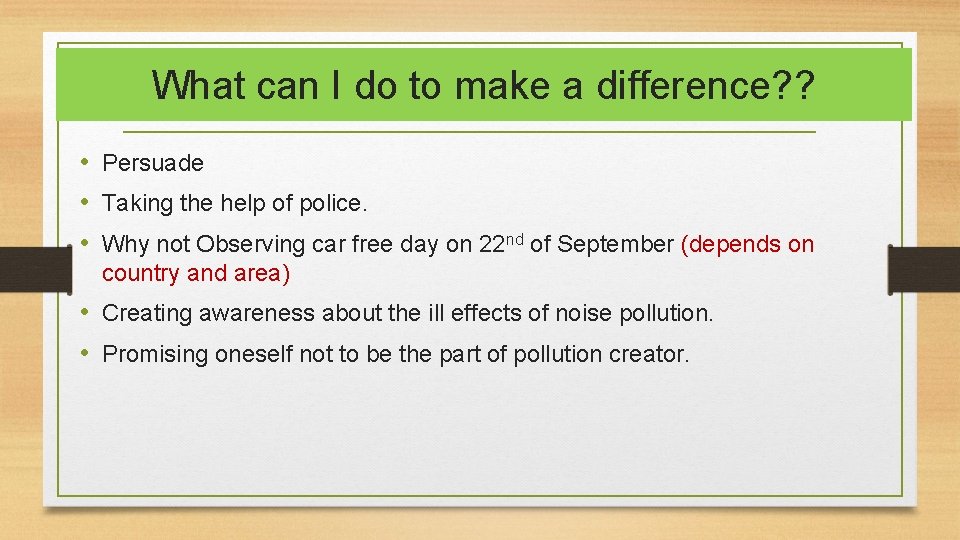
What can I do to make a difference? ? • Persuade • Taking the help of police. • Why not Observing car free day on 22 nd of September (depends on country and area) • Creating awareness about the ill effects of noise pollution. • Promising oneself not to be the part of pollution creator.
Policies, strategies and laws for environment, climate change and sustainable development
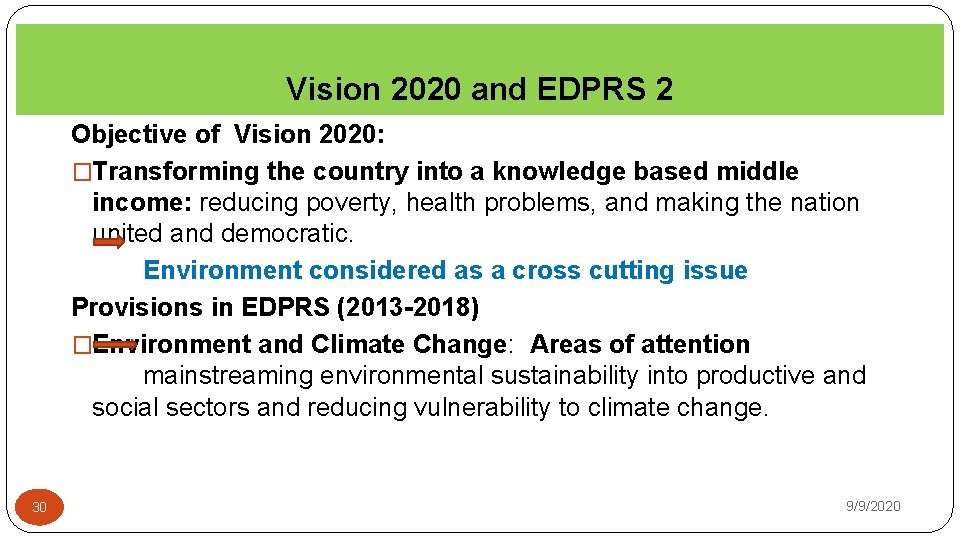
Vision 2020 and EDPRS 2 Objective of Vision 2020: �Transforming the country into a knowledge based middle income: reducing poverty, health problems, and making the nation united and democratic. Environment considered as a cross cutting issue Provisions in EDPRS (2013 -2018) �Environment and Climate Change: Areas of attention mainstreaming environmental sustainability into productive and social sectors and reducing vulnerability to climate change. 30 9/9/2020
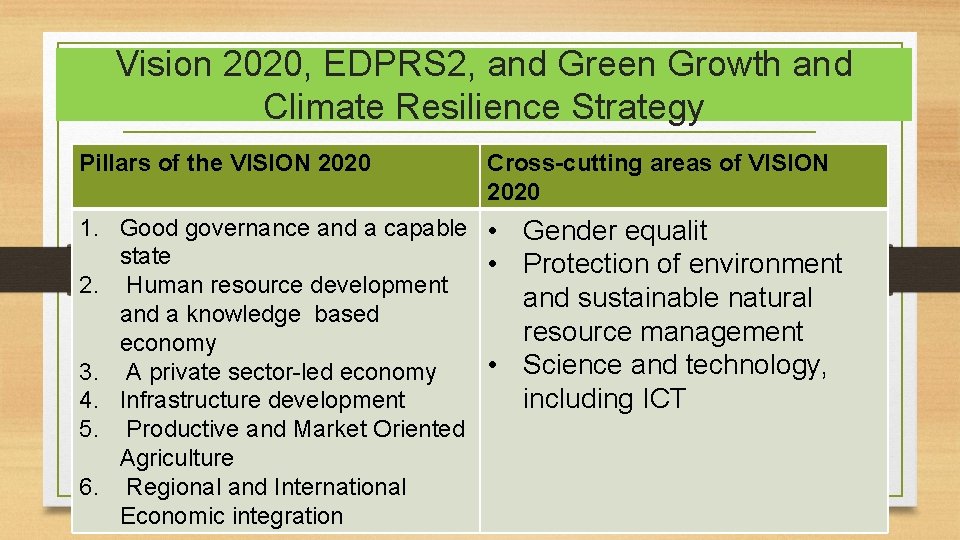
Vision 2020, EDPRS 2, and Green Growth and Climate Resilience Strategy Pillars of the VISION 2020 Cross-cutting areas of VISION 2020 1. Good governance and a capable • state • 2. Human resource development and a knowledge based economy • 3. A private sector led economy 4. Infrastructure development 5. Productive and Market Oriented Agriculture 6. Regional and International Economic integration Gender equalit Protection of environment and sustainable natural resource management Science and technology, including ICT
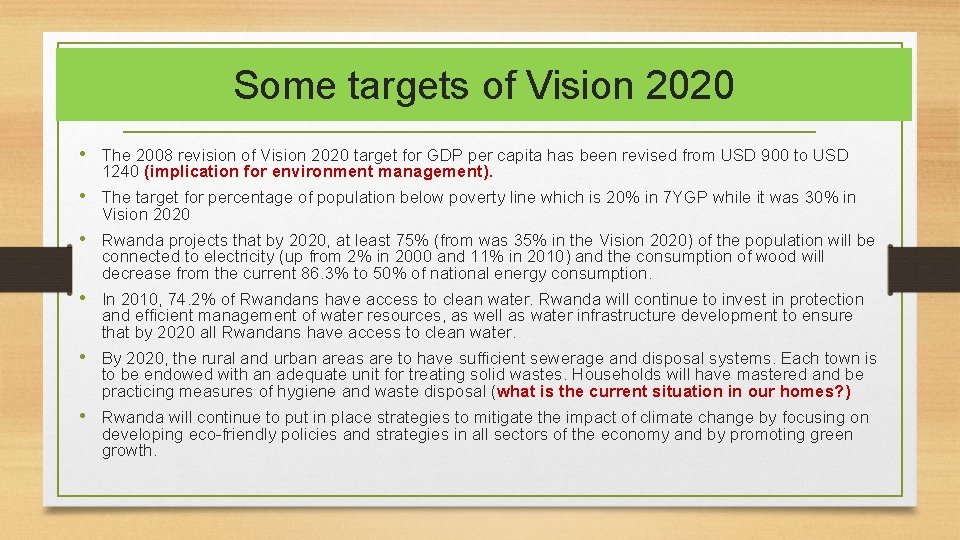
Some targets of Vision 2020 • The 2008 revision of Vision 2020 target for GDP per capita has been revised from USD 900 to USD 1240 (implication for environment management). • The target for percentage of population below poverty line which is 20% in 7 YGP while it was 30% in Vision 2020 • Rwanda projects that by 2020, at least 75% (from was 35% in the Vision 2020) of the population will be connected to electricity (up from 2% in 2000 and 11% in 2010) and the consumption of wood will decrease from the current 86. 3% to 50% of national energy consumption. • In 2010, 74. 2% of Rwandans have access to clean water. Rwanda will continue to invest in protection and efficient management of water resources, as well as water infrastructure development to ensure that by 2020 all Rwandans have access to clean water. • By 2020, the rural and urban areas are to have sufficient sewerage and disposal systems. Each town is to be endowed with an adequate unit for treating solid wastes. Households will have mastered and be practicing measures of hygiene and waste disposal (what is the current situation in our homes? ) • Rwanda will continue to put in place strategies to mitigate the impact of climate change by focusing on developing eco friendly policies and strategies in all sectors of the economy and by promoting green growth.
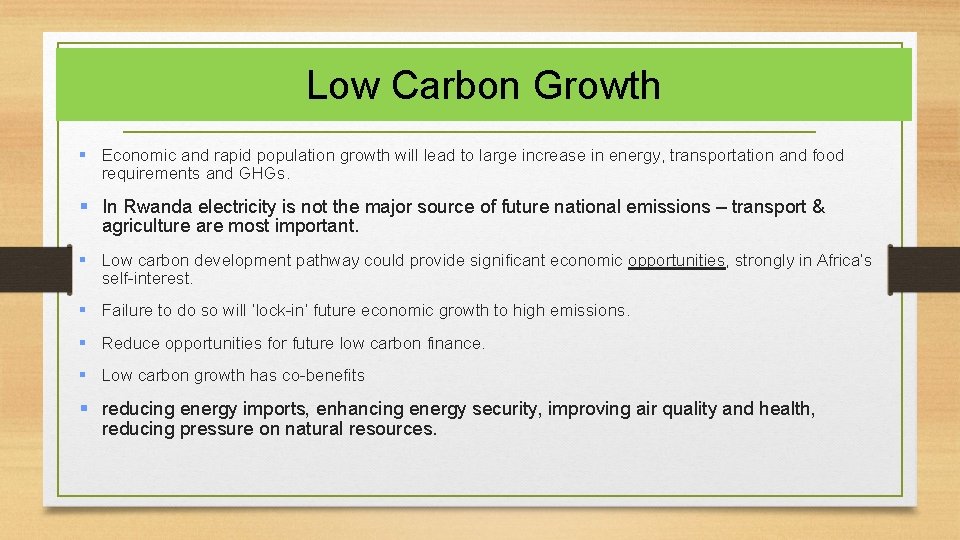
Low Carbon Growth § Economic and rapid population growth will lead to large increase in energy, transportation and food requirements and GHGs. § In Rwanda electricity is not the major source of future national emissions – transport & agriculture are most important. § Low carbon development pathway could provide significant economic opportunities, strongly in Africa’s self interest. § Failure to do so will ‘lock in’ future economic growth to high emissions. § Reduce opportunities for future low carbon finance. § Low carbon growth has co benefits § reducing energy imports, enhancing energy security, improving air quality and health, reducing pressure on natural resources.
The National Green Growth and Climate Resilience Strategy: 14 programmes of action • • Sustainable intensification of small scale farming Agricultural diversity for local and export markets Integrated Water Resource Management and Planning Sustainable Land Use Management and Planning Low carbon mix of power generation for national grid Sustainable small scale energy installations in rural areas Green industry and private sector investment
The National Green Growth and Climate Resilience Strategy: 14 programmes of action • Climate compatible mining • Efficient resilient transport systems • Low carbon urban settlements • • Ecotourism, Conservation and PES Promotion • Sustainable forestry, agroforestry and biomass energy • Disaster Management and Disease Prevention • Climate data and projections
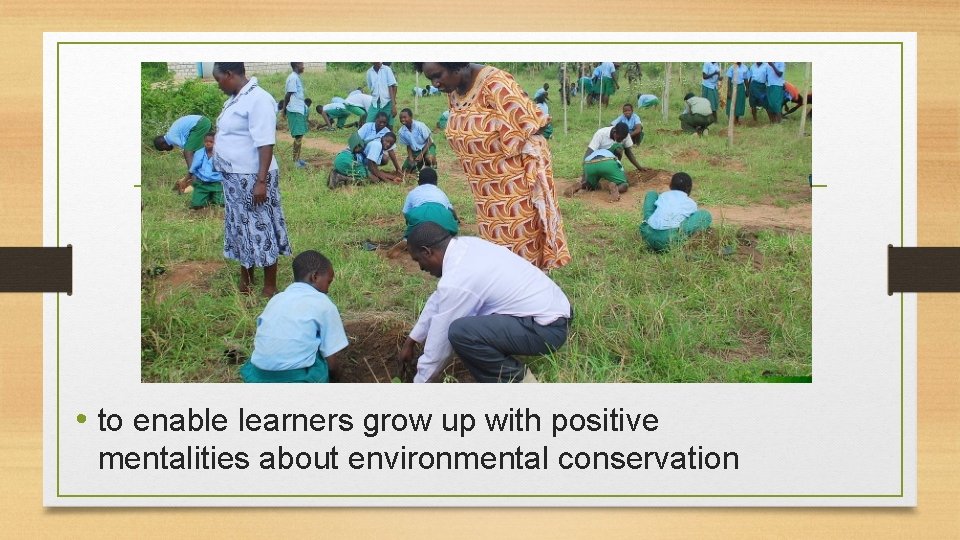
Some initiatives, achievements and lesson learnt • Policies and regulations coupled with law enforcement (inspections/audits) • • • Environment and Climate Change Fund Habitat restoration (esp fragile ecosystems eg Rugezi wetland) Green Villages Some projects eg NYEP, PEI, DEMP Greening schools
• to enable learners grow up with positive mentalities about environmental conservation
Thanks for your partnership in Environment Protection in Rwanda For more info, log on www. rema. gov. rw