
Enhancing the learning content through the aggregation of

![JSON Activity Streams Property Type actor Object content JSON [RFC 4627] String generator Object](https://slidetodoc.com/presentation_image_h/2b2e5740aef4feb915496b5be8d952bc/image-7.jpg "JSON Activity Streams Property Type actor Object content JSON [RFC 4627] String generator Object")


![Lang. String "description": [ { "lang": "text": }, { "lang": "text": } ] "en",](https://slidetodoc.com/presentation_image_h/2b2e5740aef4feb915496b5be8d952bc/image-16.jpg "Lang. String \"description\": [ { \"lang\": \"text\": }, { \"lang\": \"text\": } ] \"en\",")
![Vocabulary Term "subjects": [ "508", "974" ], "categories": [ "expert", "teacher" ] A simple](https://slidetodoc.com/presentation_image_h/2b2e5740aef4feb915496b5be8d952bc/image-17.jpg "Vocabulary Term \"subjects\": [ \"508\", \"974\" ], \"categories\": [ \"expert\", \"teacher\" ] A simple")
![Vocabulary Term "subjects": [ "508", "974" ], "categories": [ "expert", "teacher" ] Full Vocabulary](https://slidetodoc.com/presentation_image_h/2b2e5740aef4feb915496b5be8d952bc/image-20.jpg "Vocabulary Term \"subjects\": [ \"508\", \"974\" ], \"categories\": [ \"expert\", \"teacher\" ] Full Vocabulary")


- Slides: 32
Enhancing the learning content through the aggregation of social data. Frans Van Assche University of Leuven President of the ARIADNE Foundation
Paradata • What users say about a resource; example: a rating of a Learning Object • What users do with a resource: Usage Data; example a user edits metadata
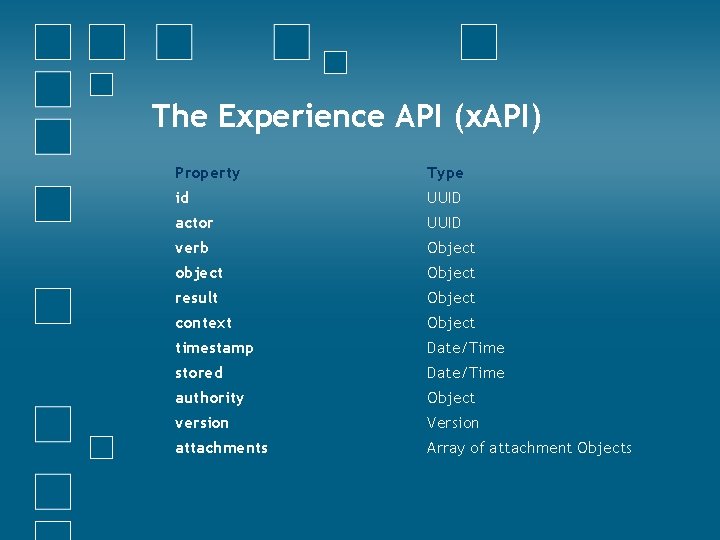
The Experience API (x. API) Property Type id UUID actor UUID verb Object object Object result Object context Object timestamp Date/Time stored Date/Time authority Object version Version attachments Array of attachment Objects
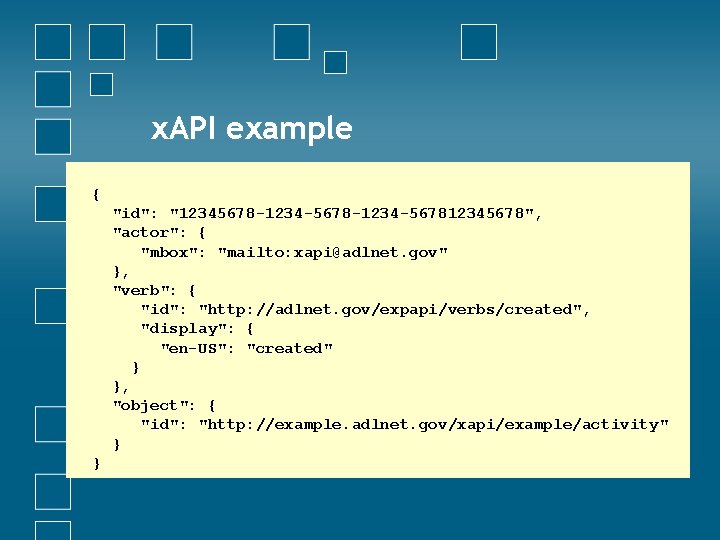
x. API example { "id": "12345678 -1234 -567812345678", "actor": { "mbox": "mailto: xapi@adlnet. gov" }, "verb": { "id": "http: //adlnet. gov/expapi/verbs/created", "display": { "en-US": "created" } }, "object": { "id": "http: //example. adlnet. gov/xapi/example/activity" } }
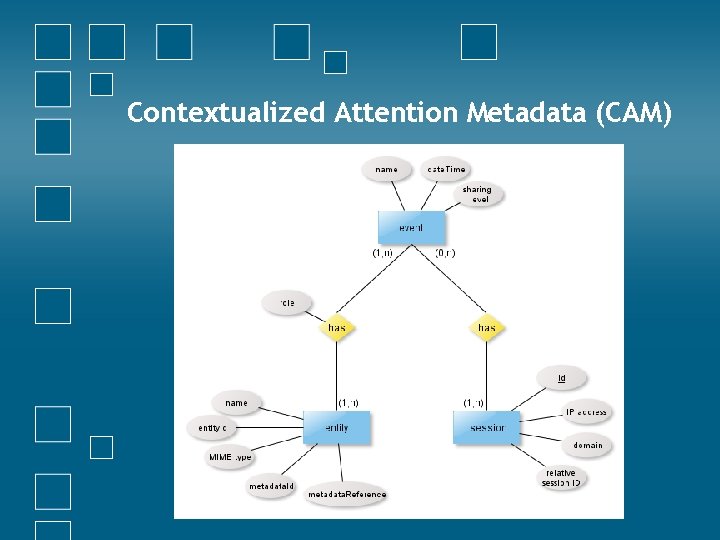
Contextualized Attention Metadata (CAM)
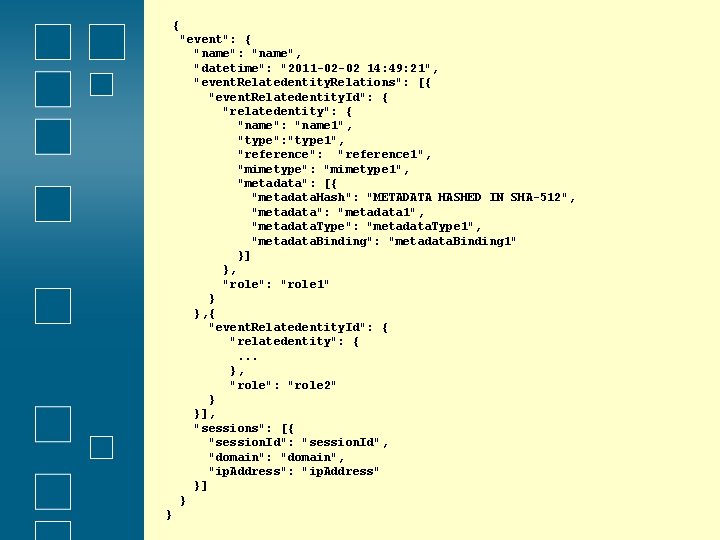
{ "event": { "name": "name", "datetime": "2011 -02 -02 14: 49: 21", "event. Relatedentity. Relations": [{ "event. Relatedentity. Id": { "relatedentity": { "name": "name 1", "type": "type 1", "reference": "reference 1", "mimetype": "mimetype 1", "metadata": [{ "metadata. Hash": "METADATA HASHED IN SHA-512", "metadata": "metadata 1", "metadata. Type": "metadata. Type 1", "metadata. Binding": "metadata. Binding 1" }] }, "role": "role 1" } }, { "event. Relatedentity. Id": { "relatedentity": {. . . }, "role": "role 2" } }], "sessions": [{ "session. Id": "session. Id", "domain": "domain", "ip. Address": "ip. Address" }] } x. API example }
JSON Activity Streams Property Type actor Object content JSON [RFC 4627] String generator Object icon Media Link id JSON [RFC 4627] String object Object published [RFC 3339] date-time provider Object target Object title JSON [RFC 4627] String updated [RFC 3339] date-time url JSON [RFC 4627] String verb JSON [RFC 4627] String
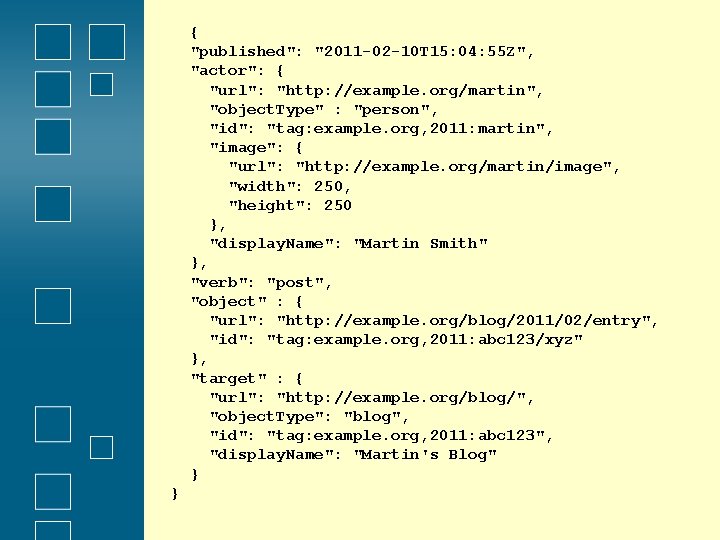
{ "published": "2011 -02 -10 T 15: 04: 55 Z", "actor": { "url": "http: //example. org/martin", "object. Type" : "person", "id": "tag: example. org, 2011: martin", "image": { "url": "http: //example. org/martin/image", "width": 250, "height": 250 }, "display. Name": "Martin Smith" }, "verb": "post", "object" : { "url": "http: //example. org/blog/2011/02/entry", "id": "tag: example. org, 2011: abc 123/xyz" }, "target" : { "url": "http: //example. org/blog/", "object. Type": "blog", "id": "tag: example. org, 2011: abc 123", "display. Name": "Martin's Blog" } x. API example }
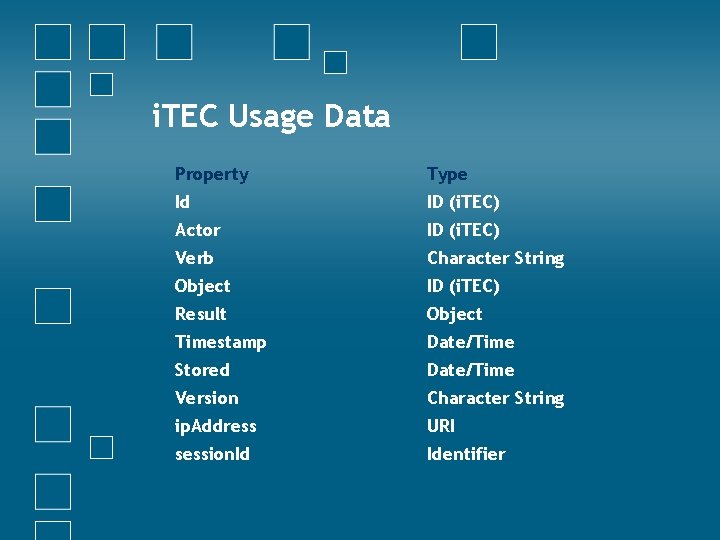
i. TEC Usage Data Property Type Id ID (i. TEC) Actor ID (i. TEC) Verb Character String Object ID (i. TEC) Result Object Timestamp Date/Time Stored Date/Time Version Character String ip. Address URI session. Id Identifier
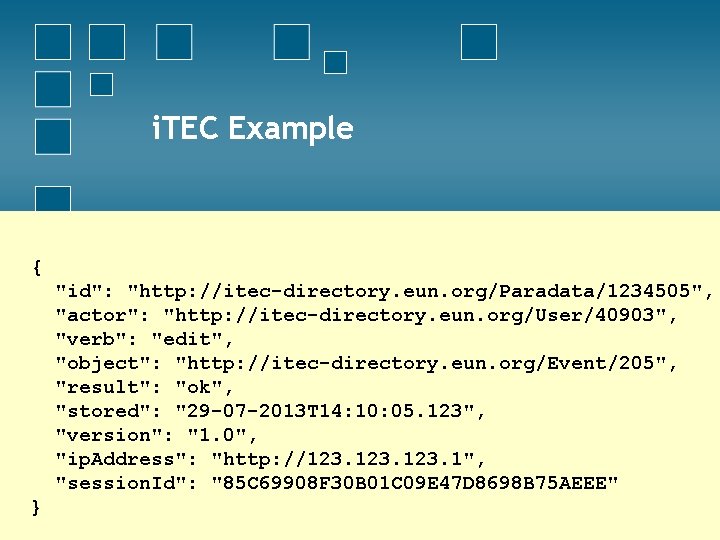
i. TEC Example { "id": "http: //itec-directory. eun. org/Paradata/1234505", "actor": "http: //itec-directory. eun. org/User/40903", "verb": "edit", "object": "http: //itec-directory. eun. org/Event/205", "result": "ok", "stored": "29 -07 -2013 T 14: 10: 05. 123", "version": "1. 0", "ip. Address": "http: //123. 1", "session. Id": "85 C 69908 F 30 B 01 C 09 E 47 D 8698 B 75 AEEE" }
Recommended JSON Binding Practice WHY • Make it easier to build front-ends • On top of multiple back ends − Interoperability • This is an invitation to technical people for collaboration
Recommended JSON Binding Practice WHAT • Element names • Identifiers • Date/Time & Period • Lang. String • Vocabulary. Term • Vocabularies
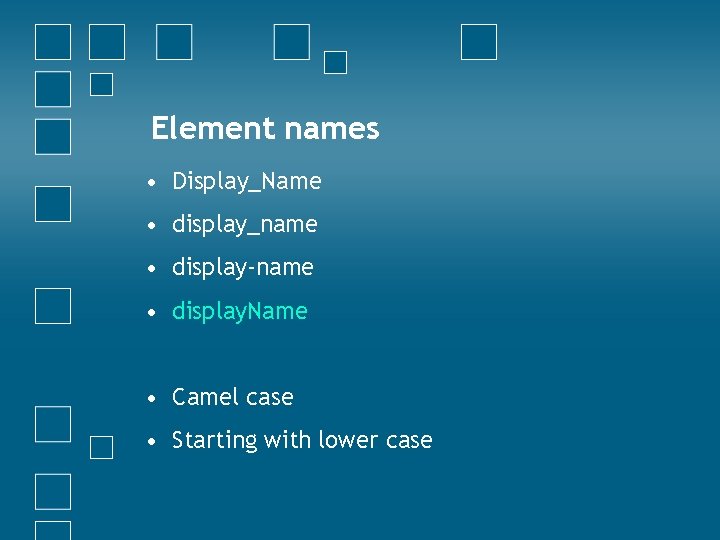
Element names • Display_Name • display_name • display-name • display. Name • Camel case • Starting with lower case
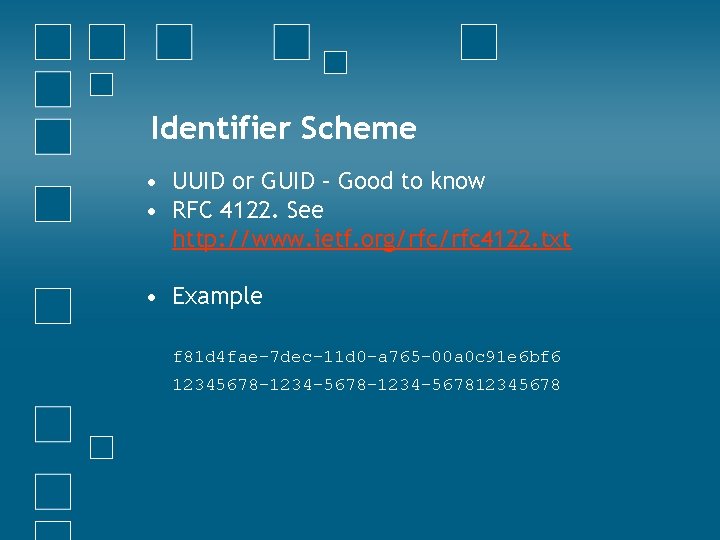
Identifier Scheme • UUID or GUID – Good to know • RFC 4122. See http: //www. ietf. org/rfc 4122. txt • Example f 81 d 4 fae-7 dec-11 d 0 -a 765 -00 a 0 c 91 e 6 bf 6 12345678 -1234 -567812345678
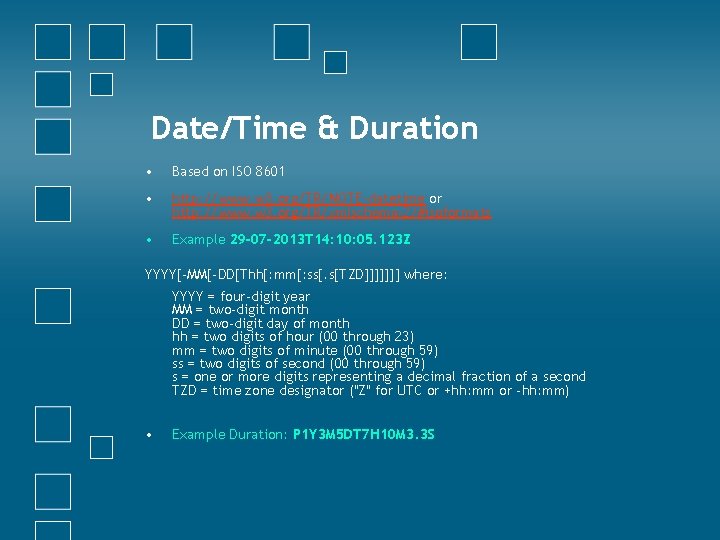
Date/Time & Duration • Based on ISO 8601 • http: //www. w 3. org/TR/NOTE-datetime or http: //www. w 3. org/TR/xmlschema-2/#isoformats • Example 29 -07 -2013 T 14: 10: 05. 123 Z YYYY[-MM[-DD[Thh[: mm[: ss[. s[TZD]]]]]]] where: YYYY = four-digit year MM = two-digit month DD = two-digit day of month hh = two digits of hour (00 through 23) mm = two digits of minute (00 through 59) ss = two digits of second (00 through 59) s = one or more digits representing a decimal fraction of a second TZD = time zone designator ("Z" for UTC or +hh: mm or -hh: mm) • Example Duration: P 1 Y 3 M 5 DT 7 H 10 M 3. 3 S
Lang. String "description": [ { "lang": "text": }, { "lang": "text": } ] "en", "This learning object. . . " "nl", "Dit leerobject. . . " "description": [ { "en": "This learning object. . . " }, { "nl": "Dit leerobject. . . " } ]
Vocabulary Term "subjects": [ "508", "974" ], "categories": [ "expert", "teacher" ] A simple Token or identifier
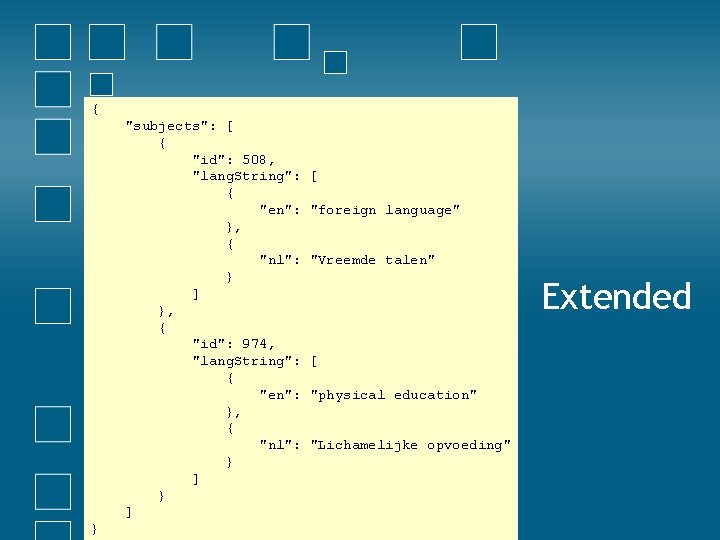
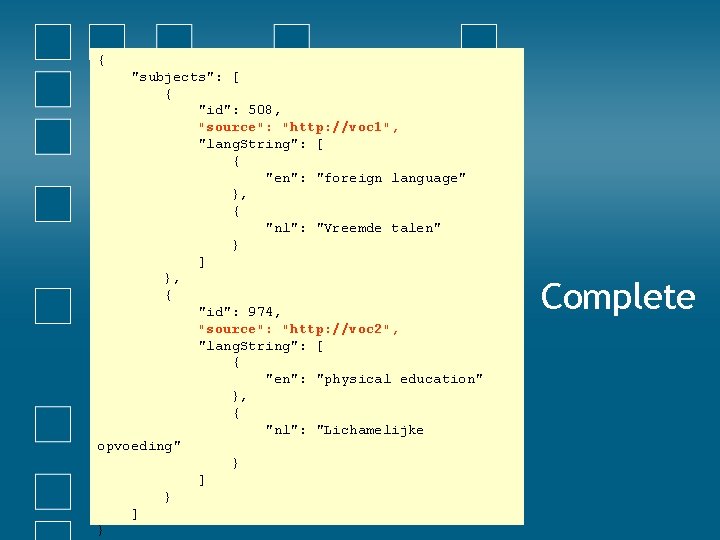
{ "subjects": [ { "id": 508, "lang. String": { "en": }, { "nl": } ] }, { "id": 974, "lang. String": { "en": }, { "nl": } ] } [ "foreign language" "Vreemde talen" Extended [ "physical education" "Lichamelijke opvoeding"
{ "subjects": [ { "id": 508, "source": "http: //voc 1", "lang. String": [ { "en": "foreign language" }, { "nl": "Vreemde talen" } ] }, { "id": 974, "source": "http: //voc 2", "lang. String": [ { "en": "physical education" }, { "nl": "Lichamelijke opvoeding" } ] } Complete
Vocabulary Term "subjects": [ "508", "974" ], "categories": [ "expert", "teacher" ] Full Vocabulary needed
Enhancing the learning content through the aggregation of social data. GRNET and Ariadne Nikos Manolis
Open Discovery Space − A large-scale pilot project that tries to increase the adoption of digital learning resources by European schools − An infrastructure to allow existing learning portals and repositories to be connected
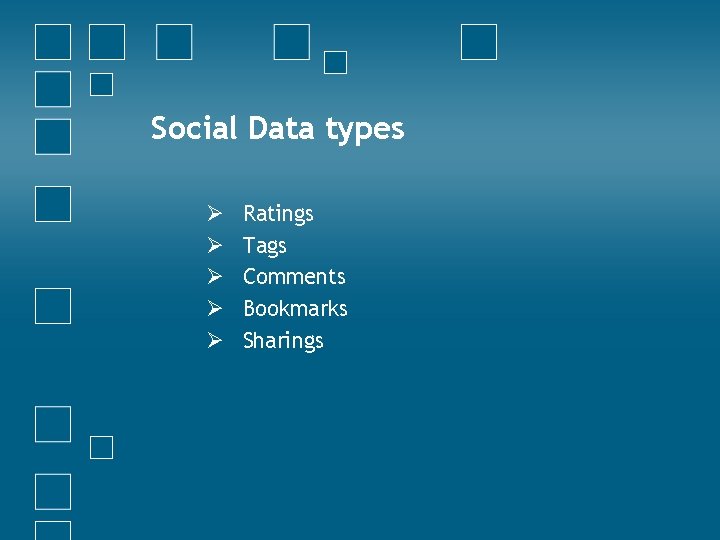
Social Data types Ø Ø Ø Ratings Tags Comments Bookmarks Sharings
The need for aggregating • An important information source to provide additional and more personalized access to learning objects • Provide the opportunity to filter and recommend tailored information to a target user based on their social data profile
Developing a Social Data Management Layer • Method: − A questionnaire was circulated among data providers − Cross analysis of the questionnaire results − Analysis of the various social data exposure protocols and interfaces − Social Data schema definition (existing efforts from Organic Edunet, LRE and NSDL)
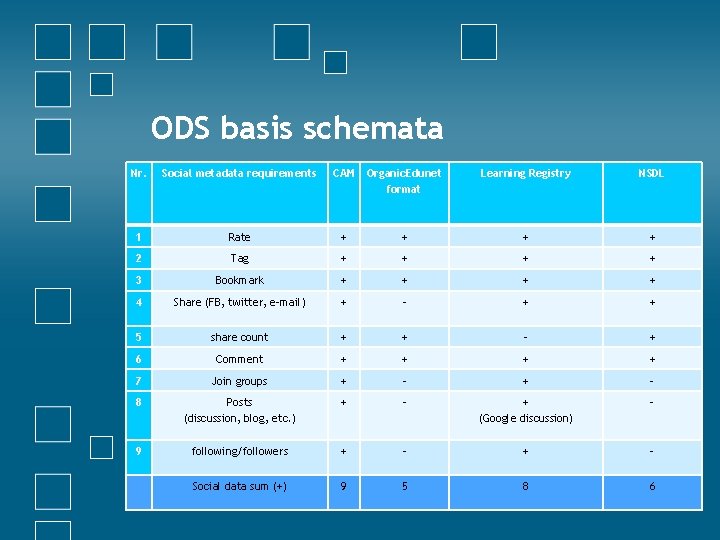
ODS basis schemata Nr. Social metadata requirements CAM Organic. Edunet format Learning Registry NSDL 1 Rate + + 2 Tag + + 3 Bookmark + + 4 Share (FB, twitter, e-mail) + - + + 5 share count + + - + 6 Comment + + 7 Join groups + - 8 Posts (discussion, blog, etc. ) + - + (Google discussion) - 9 following/followers + - Social data sum (+) 9 5 8 6
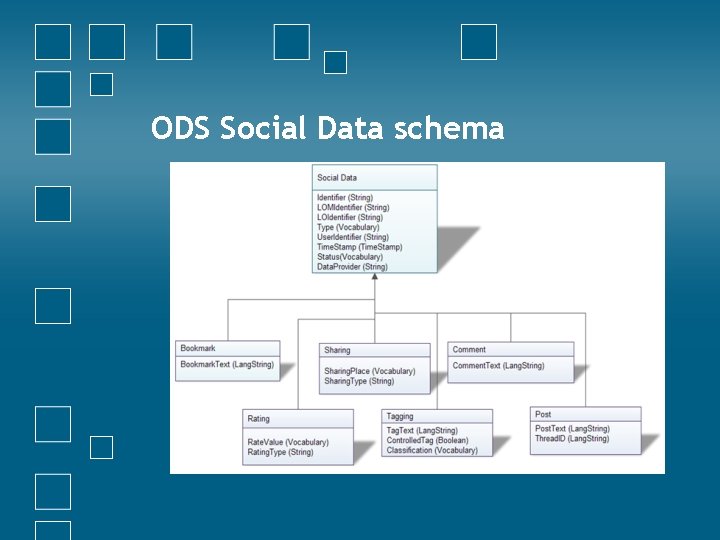
ODS Social Data schema
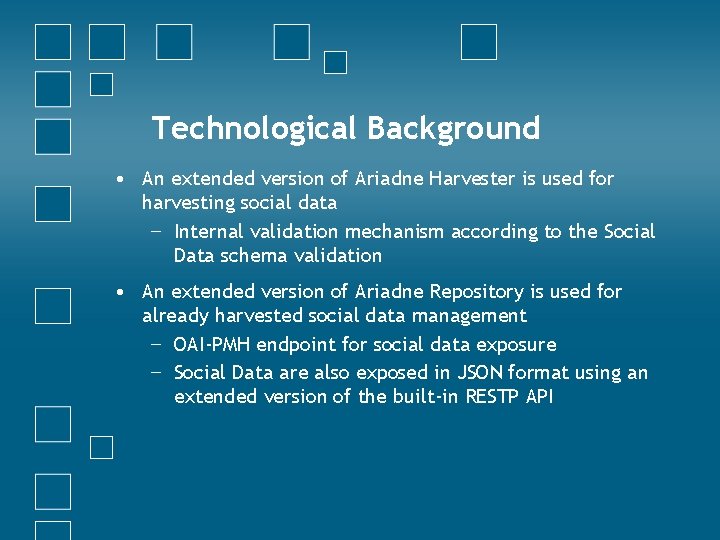
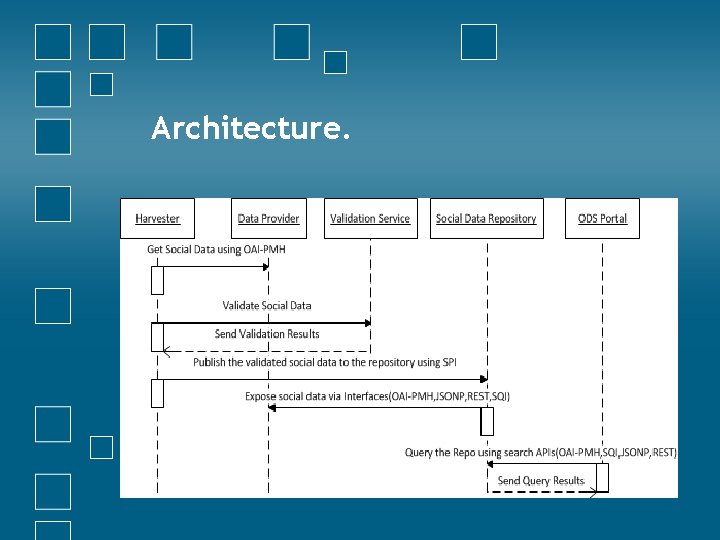
Technological Background • An extended version of Ariadne Harvester is used for harvesting social data − Internal validation mechanism according to the Social Data schema validation • An extended version of Ariadne Repository is used for already harvested social data management − OAI-PMH endpoint for social data exposure − Social Data are also exposed in JSON format using an extended version of the built-in RESTP API
Architecture.
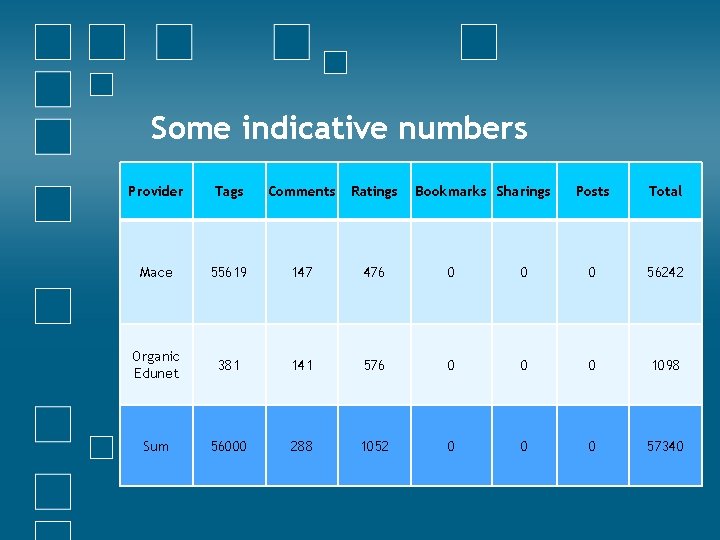
Some indicative numbers Provider Tags Comments Ratings Bookmarks Sharings Posts Total Mace 55619 147 476 0 0 0 56242 Organic Edunet 381 141 576 0 0 0 1098 Sum 56000 288 1052 0 0 0 57340
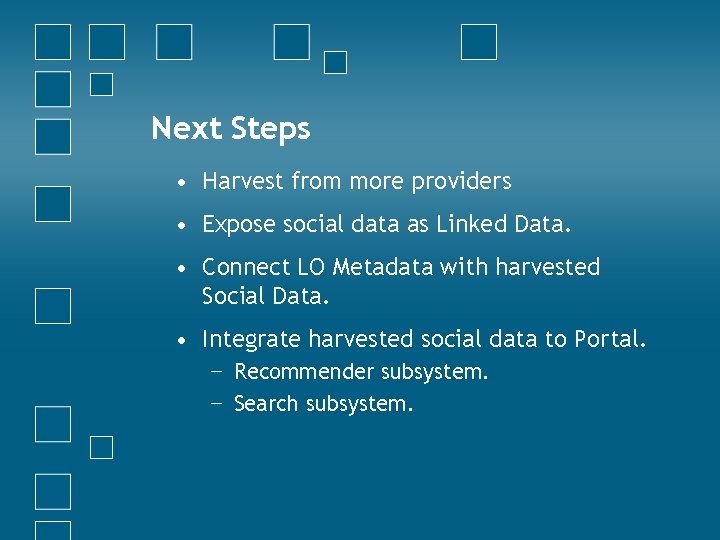
Next Steps • Harvest from more providers • Expose social data as Linked Data. • Connect LO Metadata with harvested Social Data. • Integrate harvested social data to Portal. − Recommender subsystem. − Search subsystem.
Thank you!