
Nanomaterial Synthesis Methods Emergence of Nano In our

- Slides: 69
Nanomaterial Synthesis Methods
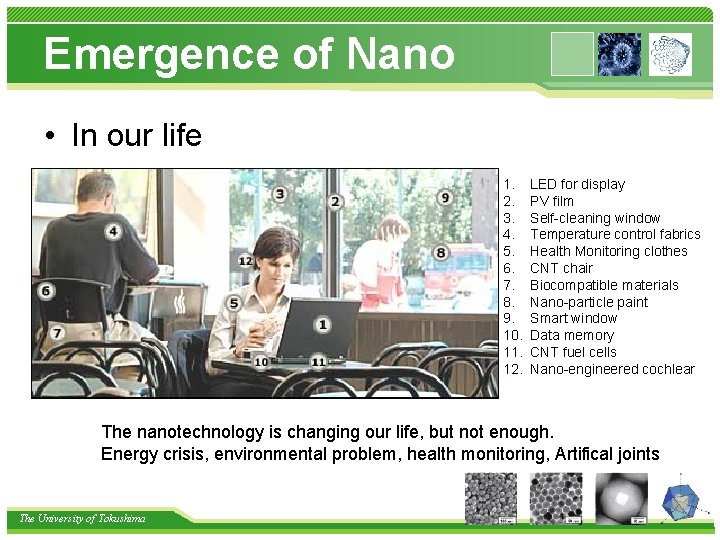
Emergence of Nano • In our life 1. 2. 3. 4. 5. 6. 7. 8. 9. 10. 11. 12. LED for display PV film Self-cleaning window Temperature control fabrics Health Monitoring clothes CNT chair Biocompatible materials Nano-particle paint Smart window Data memory CNT fuel cells Nano-engineered cochlear The nanotechnology is changing our life, but not enough. Energy crisis, environmental problem, health monitoring, Artifical joints The University of Tokushima
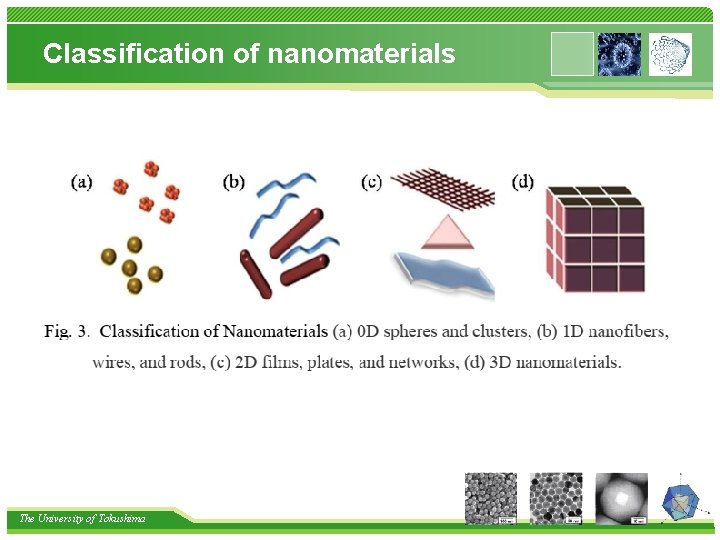
Classification of nanomaterials The University of Tokushima
www. nano 4 me. org © 2018 The Pennsylvania State University Nanoparticle Synthesis and Applications 4
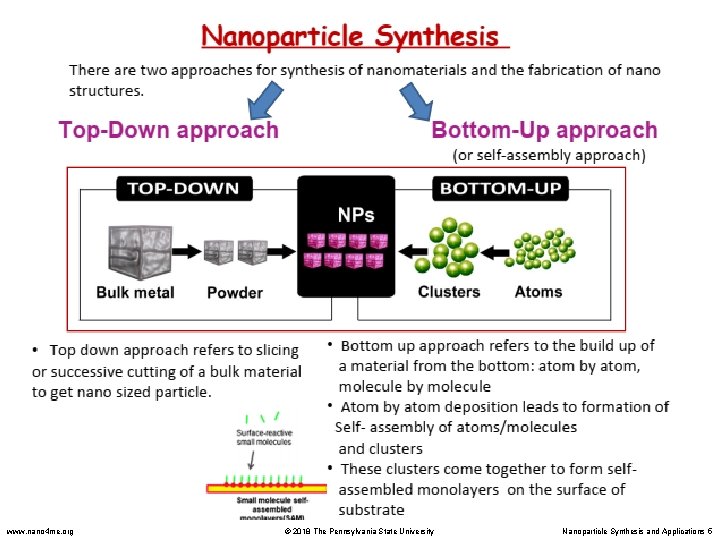
www. nano 4 me. org © 2018 The Pennsylvania State University Nanoparticle Synthesis and Applications 5
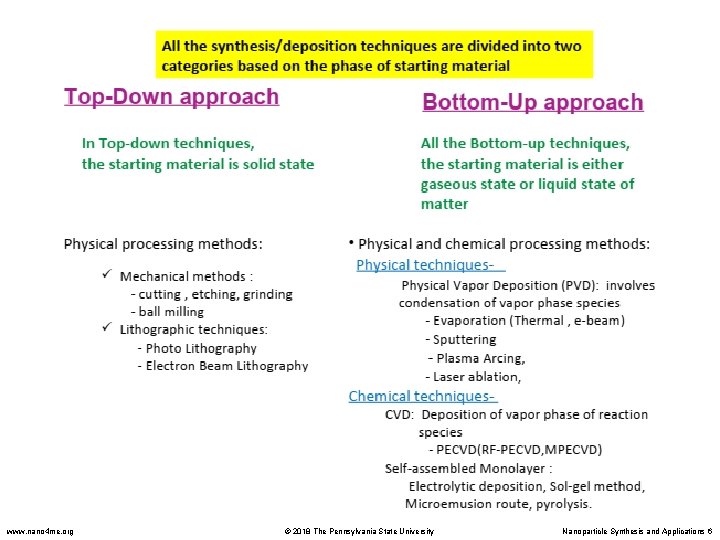
www. nano 4 me. org © 2018 The Pennsylvania State University Nanoparticle Synthesis and Applications 6
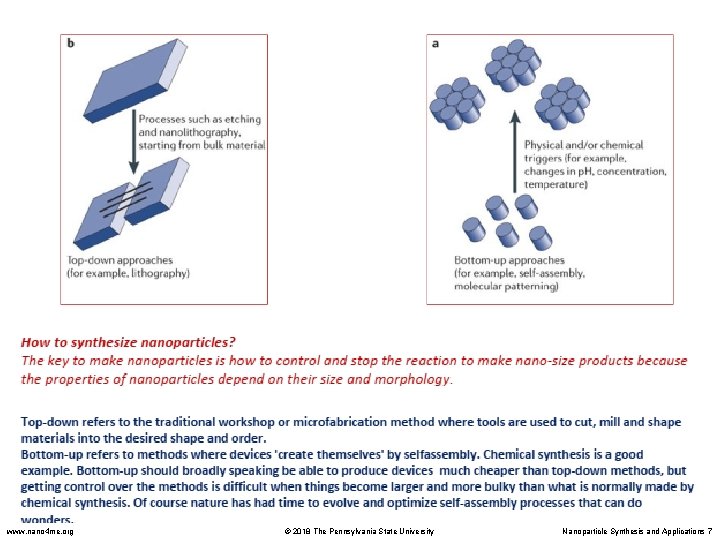
www. nano 4 me. org © 2018 The Pennsylvania State University Nanoparticle Synthesis and Applications 7
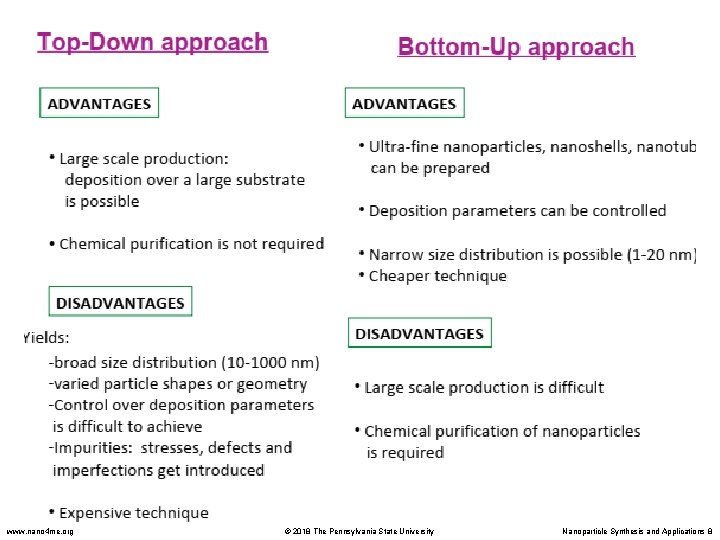
www. nano 4 me. org © 2018 The Pennsylvania State University Nanoparticle Synthesis and Applications 8
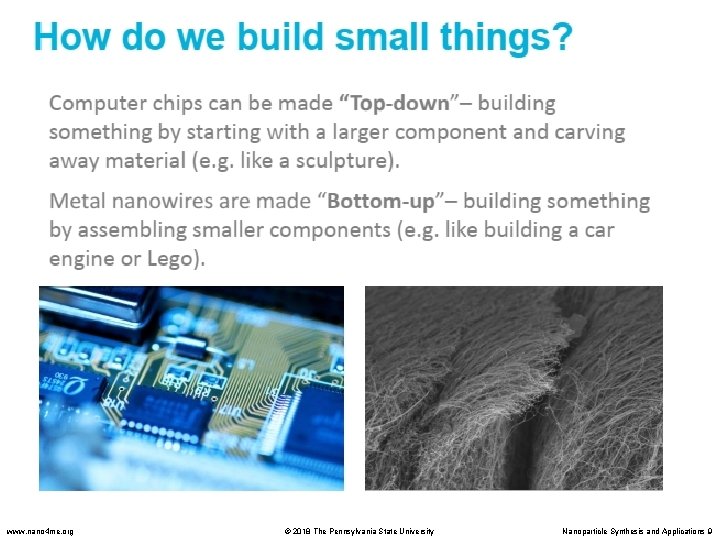
www. nano 4 me. org © 2018 The Pennsylvania State University Nanoparticle Synthesis and Applications 9
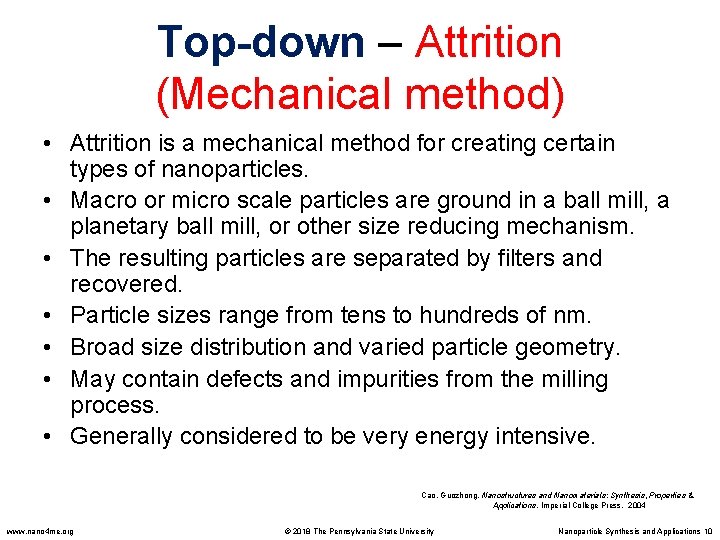
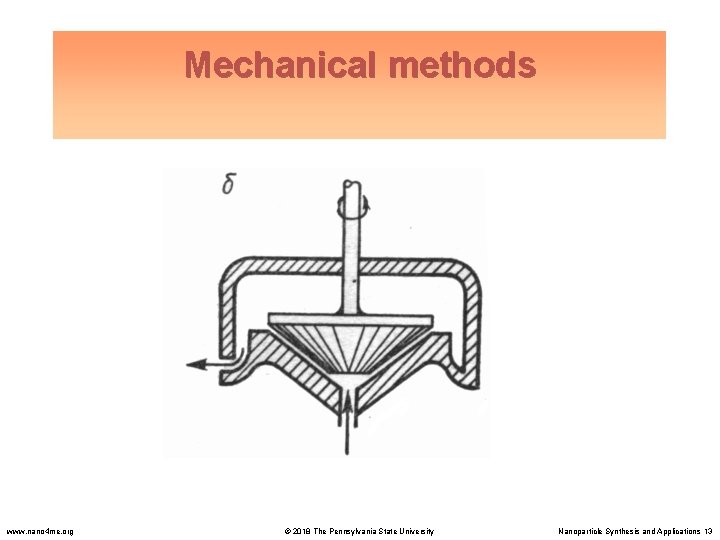
Top-down – Attrition (Mechanical method) • Attrition is a mechanical method for creating certain types of nanoparticles. • Macro or micro scale particles are ground in a ball mill, a planetary ball mill, or other size reducing mechanism. • The resulting particles are separated by filters and recovered. • Particle sizes range from tens to hundreds of nm. • Broad size distribution and varied particle geometry. • May contain defects and impurities from the milling process. • Generally considered to be very energy intensive. Cao, Guozhong. Nanostructures and Nanomaterials: Synthesis, Properties & Applications. Imperial College Press. 2004 www. nano 4 me. org © 2018 The Pennsylvania State University Nanoparticle Synthesis and Applications 10
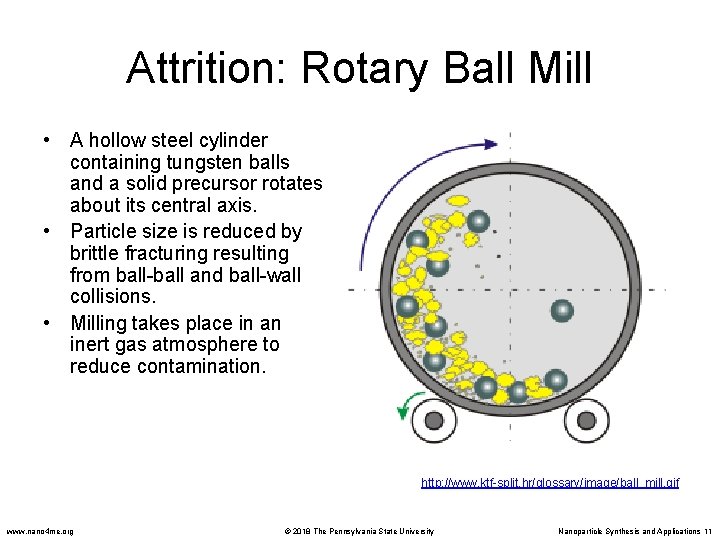
Attrition: Rotary Ball Mill • A hollow steel cylinder containing tungsten balls and a solid precursor rotates about its central axis. • Particle size is reduced by brittle fracturing resulting from ball-ball and ball-wall collisions. • Milling takes place in an inert gas atmosphere to reduce contamination. http: //www. ktf-split. hr/glossary/image/ball_mill. gif www. nano 4 me. org © 2018 The Pennsylvania State University Nanoparticle Synthesis and Applications 11
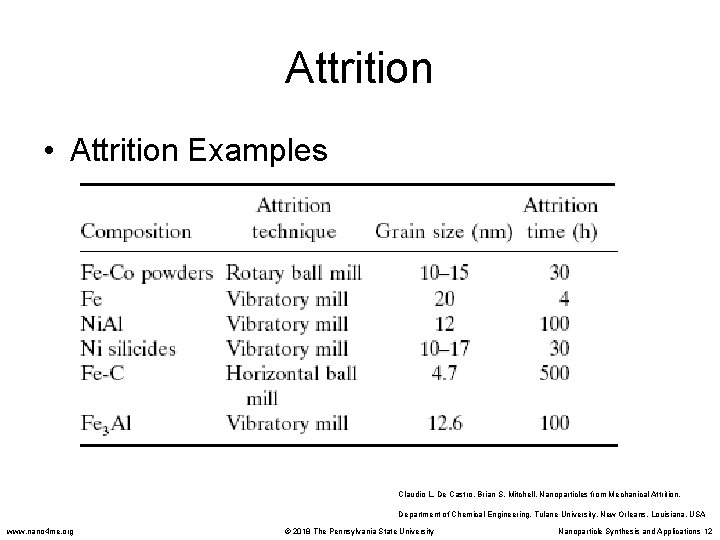
Attrition • Attrition Examples Claudio L. De Castro, Brian S. Mitchell. Nanoparticles from Mechanical Attrition. Department of Chemical Engineering, Tulane University, New Orleans, Louisiana, USA www. nano 4 me. org © 2018 The Pennsylvania State University Nanoparticle Synthesis and Applications 12
Mechanical methods www. nano 4 me. org © 2018 The Pennsylvania State University Nanoparticle Synthesis and Applications 13
What is Lithography? • Lithography is a process that uses focused radiant energy and chemical films that are affected by this energy to create precise temporary patterns in silicon wafers or other materials. • Lithography is an important part of the topdown manufacturing process, since these temporary patterns can be used to add or remove material from a given area. The University of Tokushima
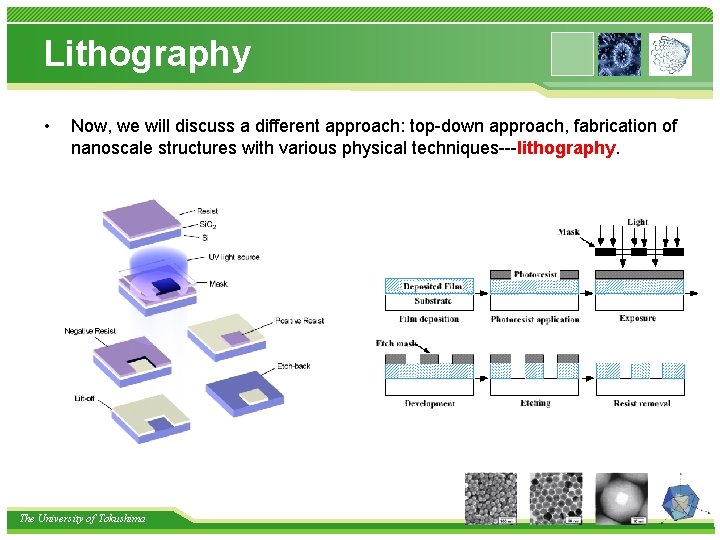
Lithography • Now, we will discuss a different approach: top-down approach, fabrication of nanoscale structures with various physical techniques---lithography. The University of Tokushima
Lithography Ø Lithographic techniques (a)Photolithography (b)Phase shifting opitcal lithography (c)Electron beam lithography (e)Focused ion beam lithography (f) Neutral atomic beam lithography Ø Nanomanipulation and nanolithography (a)Scanning tunneling microscopy (b)Atomic force microscopy (c)Near-field scnning optical microscopy (d)Nanomanipulation (e)Nanolithography The University of Tokushima
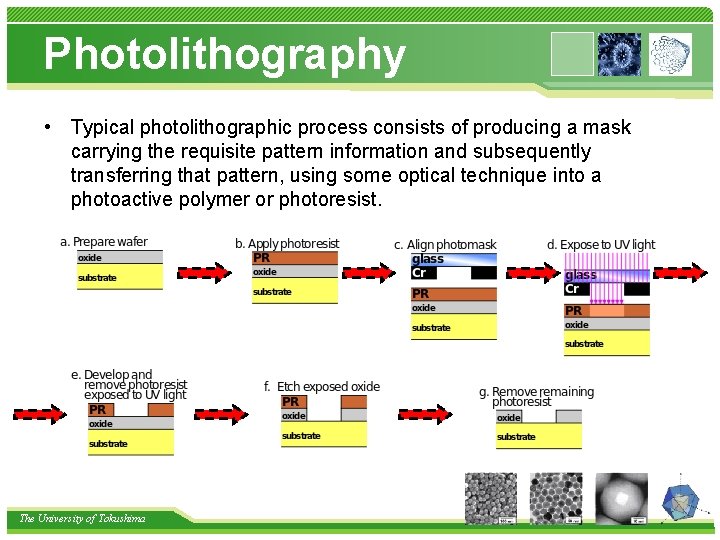
Photolithography • Typical photolithographic process consists of producing a mask carrying the requisite pattern information and subsequently transferring that pattern, using some optical technique into a photoactive polymer or photoresist. The University of Tokushima
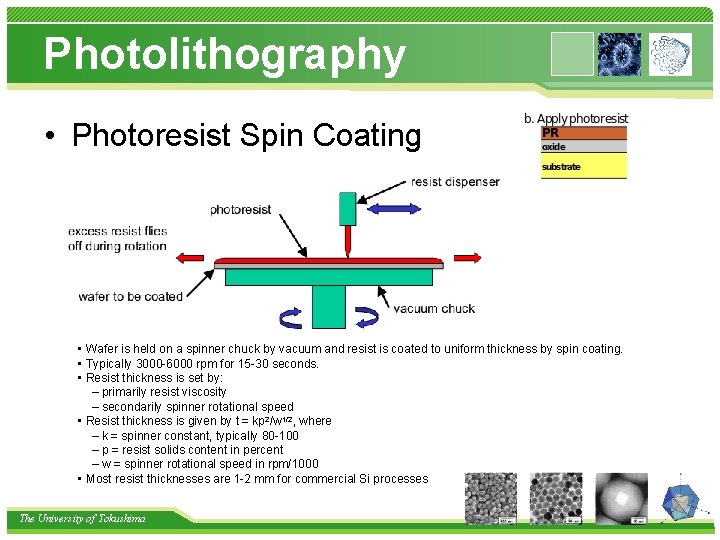
Photolithography • Photoresist Spin Coating • Wafer is held on a spinner chuck by vacuum and resist is coated to uniform thickness by spin coating. • Typically 3000 -6000 rpm for 15 -30 seconds. • Resist thickness is set by: – primarily resist viscosity – secondarily spinner rotational speed • Resist thickness is given by t = kp 2/w 1/2, where – k = spinner constant, typically 80 -100 – p = resist solids content in percent – w = spinner rotational speed in rpm/1000 • Most resist thicknesses are 1 -2 mm for commercial Si processes The University of Tokushima
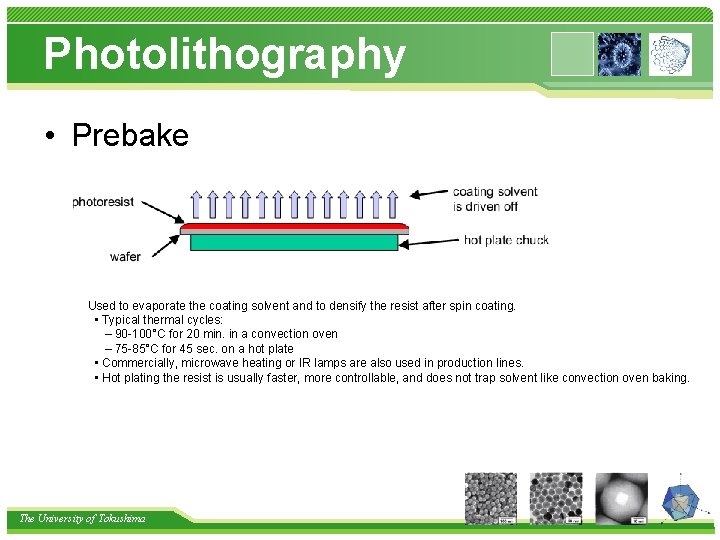
Photolithography • Prebake Used to evaporate the coating solvent and to densify the resist after spin coating. • Typical thermal cycles: – 90 -100°C for 20 min. in a convection oven – 75 -85°C for 45 sec. on a hot plate • Commercially, microwave heating or IR lamps are also used in production lines. • Hot plating the resist is usually faster, more controllable, and does not trap solvent like convection oven baking. The University of Tokushima
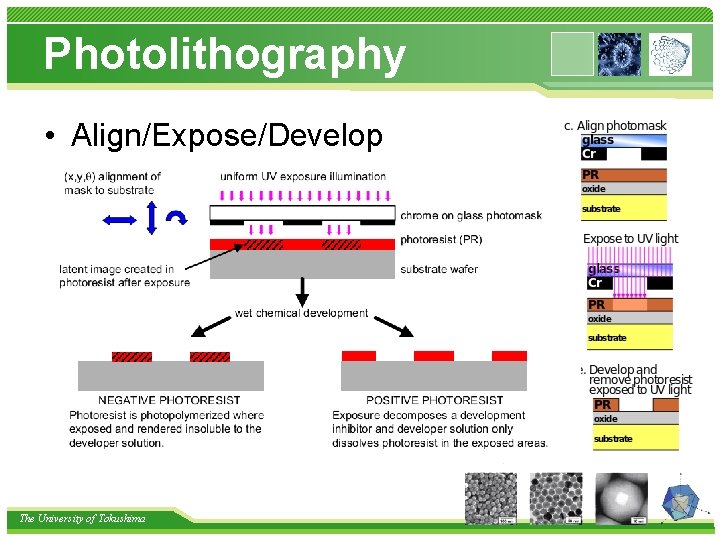
Photolithography • Align/Expose/Develop The University of Tokushima
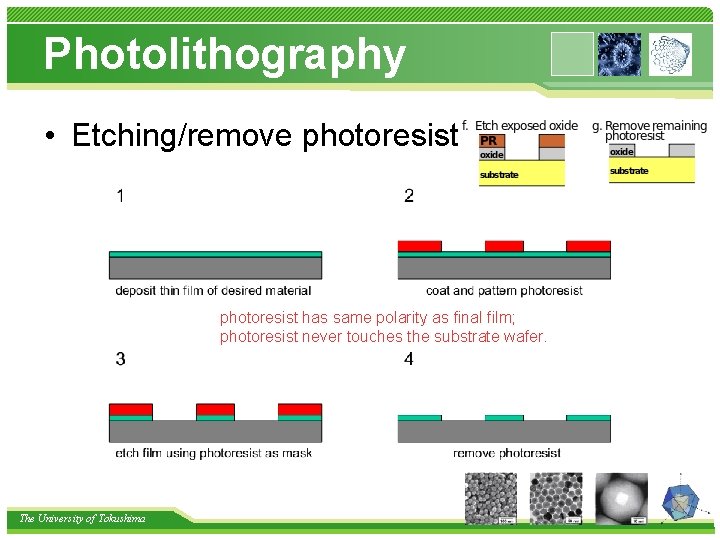
Photolithography • Etching/remove photoresist has same polarity as final film; photoresist never touches the substrate wafer. The University of Tokushima
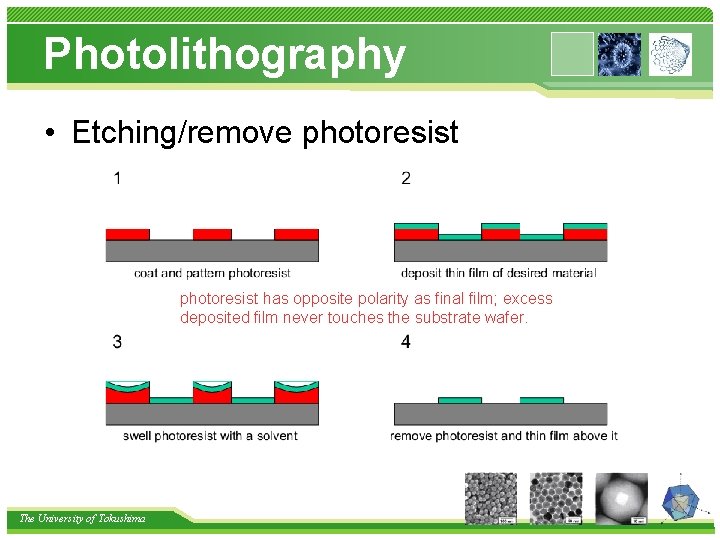
Photolithography • Etching/remove photoresist has opposite polarity as final film; excess deposited film never touches the substrate wafer. The University of Tokushima
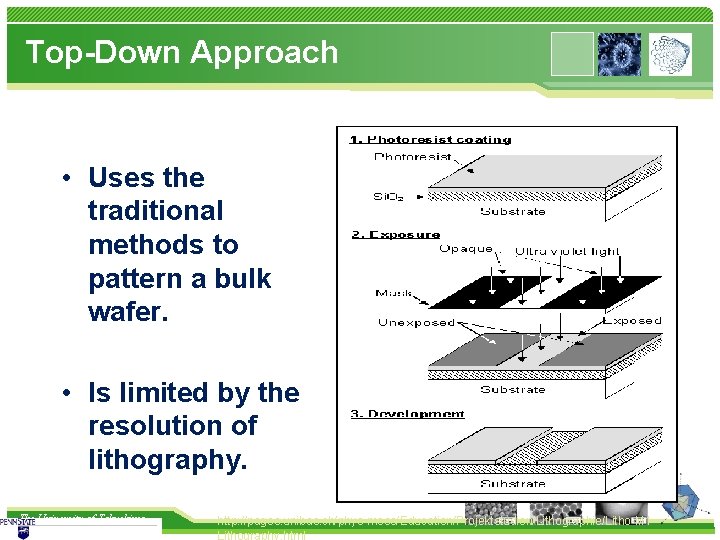
Top-Down Approach • Uses the traditional methods to pattern a bulk wafer. • Is limited by the resolution of lithography. The University of Tokushima http: //pages. unibas. ch/phys-meso/Education/Projektstudien/Lithographie/Litho-M 1 Lithography. html
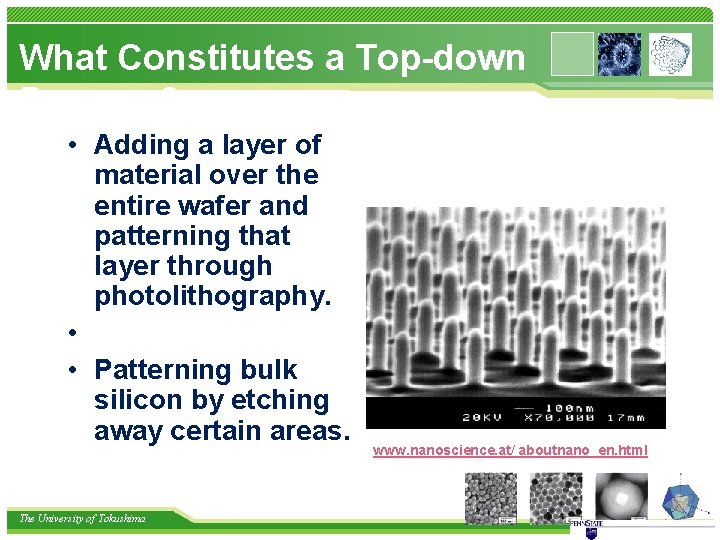
What Constitutes a Top-down Process? • Adding a layer of material over the entire wafer and patterning that layer through photolithography. • • Patterning bulk silicon by etching away certain areas. The University of Tokushima www. nanoscience. at/ aboutnano_en. html
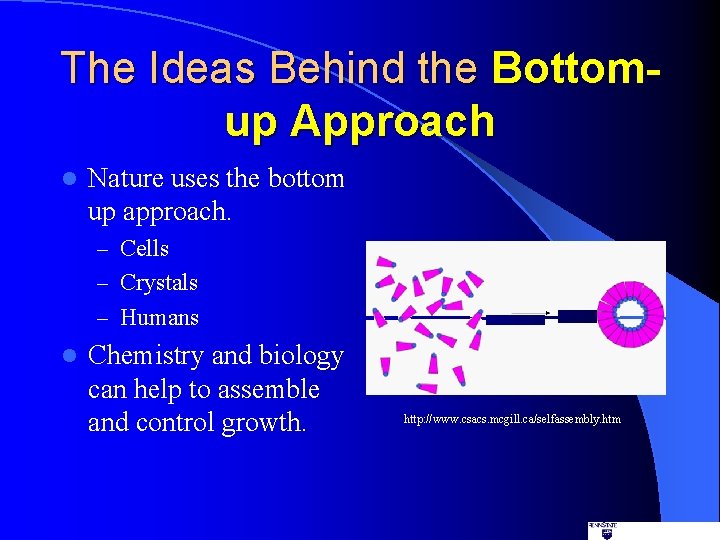
The Ideas Behind the Bottomup Approach l Nature uses the bottom up approach. – Cells – Crystals – Humans l Chemistry and biology can help to assemble and control growth. http: //www. csacs. mcgill. ca/selfassembly. htm
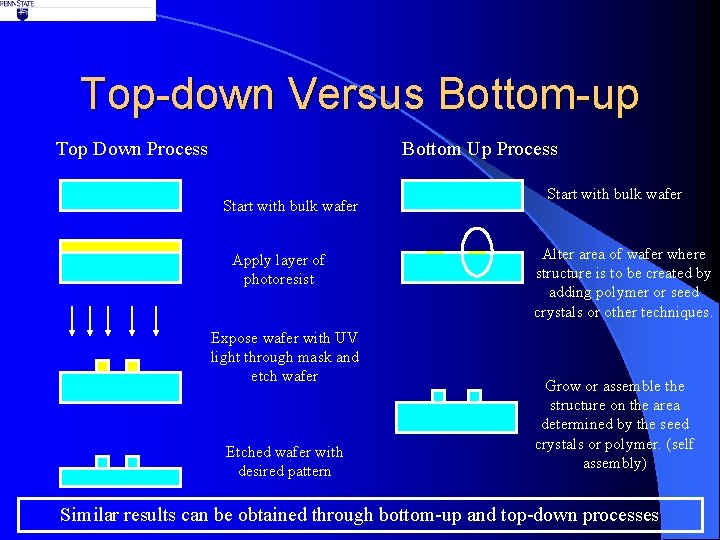
Top-down Versus Bottom-up Top Down Process Bottom Up Process Start with bulk wafer Apply layer of photoresist Expose wafer with UV light through mask and etch wafer Etched wafer with desired pattern Start with bulk wafer Alter area of wafer where structure is to be created by adding polymer or seed crystals or other techniques. Grow or assemble the structure on the area determined by the seed crystals or polymer. (self assembly) Similar results can be obtained through bottom-up and top-down processes
Why is Bottom-Up Processing Needed? l l l Allows smaller geometries than photolithography. Certain structures such as Carbon Nanotubes and Si nanowires are grown through a bottom-up process. New technologies such as organic semiconductors employ bottom-up processes to pattern them. Can make formation of films and structures much easier. Is more economical than top-down in that it does not waste material to etching.
Self Assembly l The principle behind bottom-up processing. l Self assembly is the coordinated action of independent entities to produce larger, ordered structures or achieve a desired shape. l Found in nature. l Start on the atomic scale.
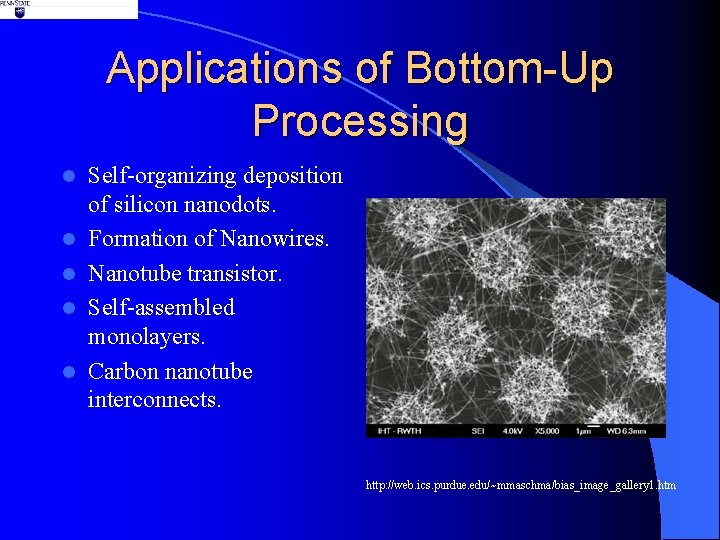
Applications of Bottom-Up Processing l l l Self-organizing deposition of silicon nanodots. Formation of Nanowires. Nanotube transistor. Self-assembled monolayers. Carbon nanotube interconnects. http: //web. ics. purdue. edu/~mmaschma/bias_image_gallery 1. htm
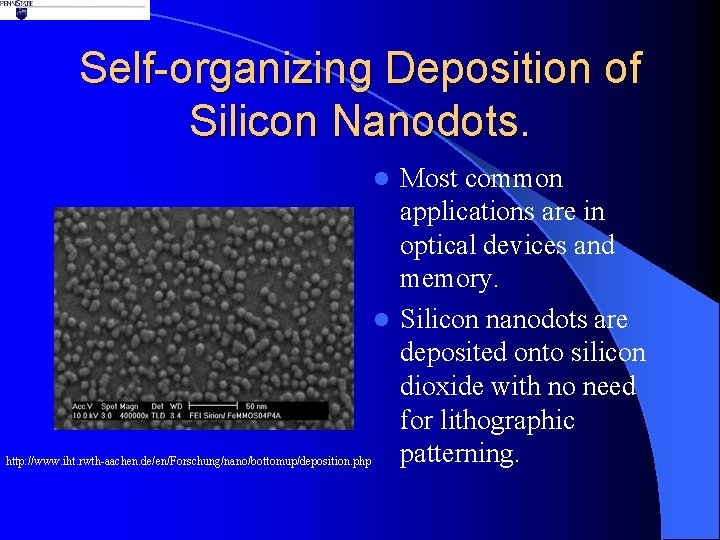
Self-organizing Deposition of Silicon Nanodots. Most common applications are in optical devices and memory. l Silicon nanodots are deposited onto silicon dioxide with no need for lithographic patterning. http: //www. iht. rwth-aachen. de/en/Forschung/nano/bottomup/deposition. php l
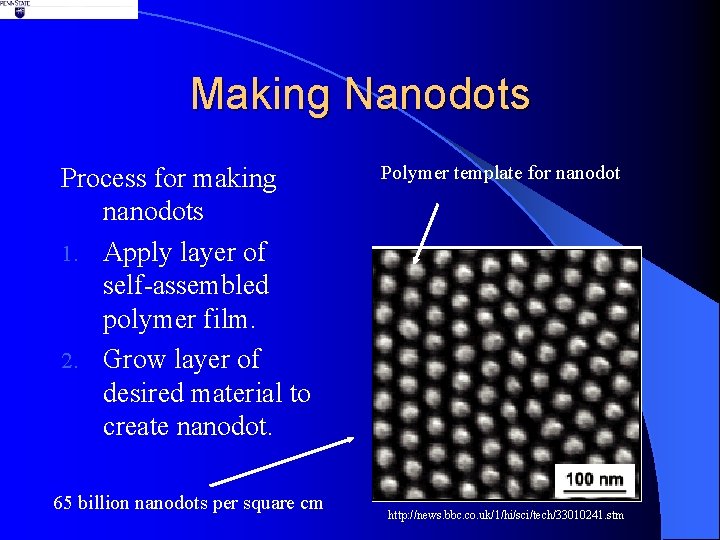
Making Nanodots Process for making nanodots 1. Apply layer of self-assembled polymer film. 2. Grow layer of desired material to create nanodot. 65 billion nanodots per square cm Polymer template for nanodot http: //news. bbc. co. uk/1/hi/sci/tech/33010241. stm
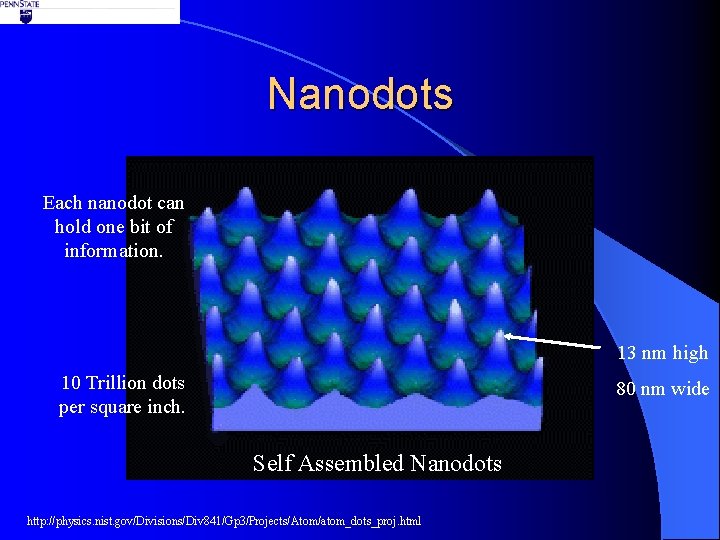
Nanodots Each nanodot can hold one bit of information. 13 nm high 10 Trillion dots per square inch. 80 nm wide Self Assembled Nanodots http: //physics. nist. gov/Divisions/Div 841/Gp 3/Projects/Atom/atom_dots_proj. html
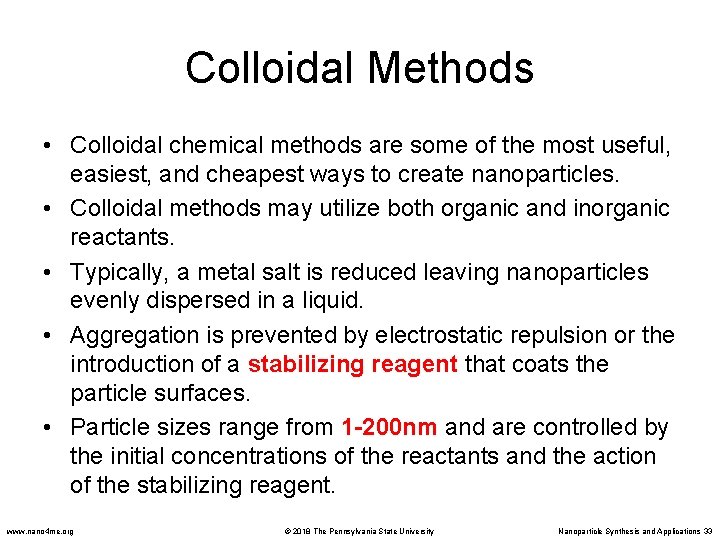
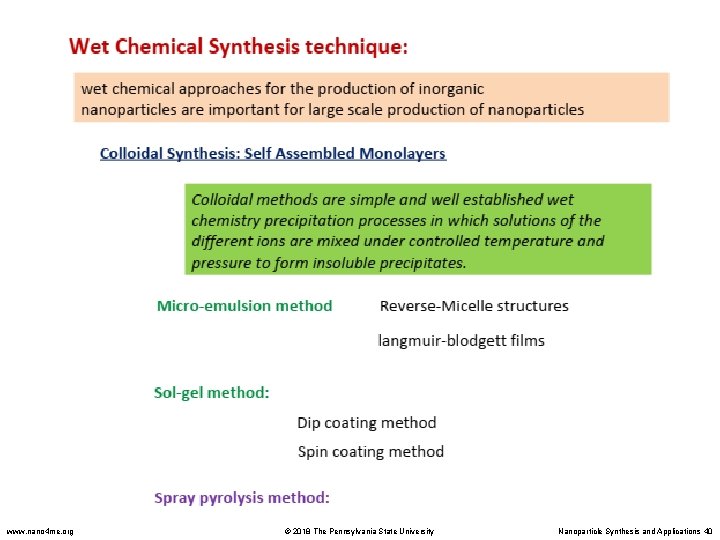
Colloidal Methods • Colloidal chemical methods are some of the most useful, easiest, and cheapest ways to create nanoparticles. • Colloidal methods may utilize both organic and inorganic reactants. • Typically, a metal salt is reduced leaving nanoparticles evenly dispersed in a liquid. • Aggregation is prevented by electrostatic repulsion or the introduction of a stabilizing reagent that coats the particle surfaces. • Particle sizes range from 1 -200 nm and are controlled by the initial concentrations of the reactants and the action of the stabilizing reagent. www. nano 4 me. org © 2018 The Pennsylvania State University Nanoparticle Synthesis and Applications 33
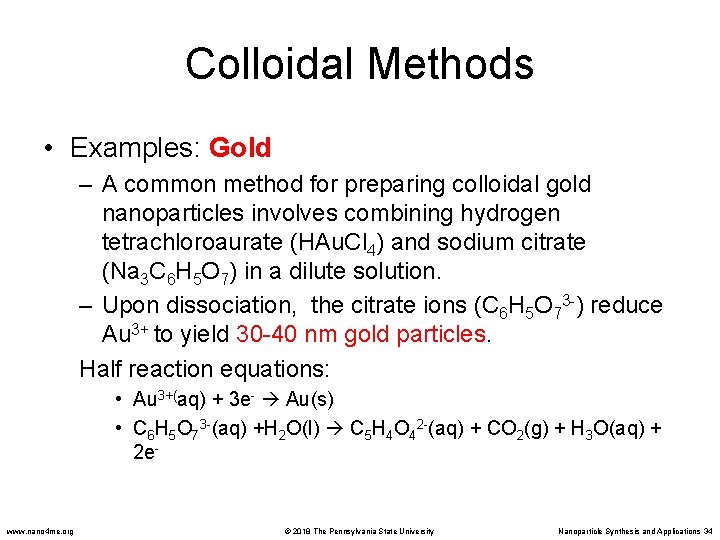
Colloidal Methods • Examples: Gold – A common method for preparing colloidal gold nanoparticles involves combining hydrogen tetrachloroaurate (HAu. Cl 4) and sodium citrate (Na 3 C 6 H 5 O 7) in a dilute solution. – Upon dissociation, the citrate ions (C 6 H 5 O 73 -) reduce Au 3+ to yield 30 -40 nm gold particles. Half reaction equations: • Au 3+(aq) + 3 e- Au(s) • C 6 H 5 O 73 -(aq) +H 2 O(l) C 5 H 4 O 42 -(aq) + CO 2(g) + H 3 O(aq) + 2 e- www. nano 4 me. org © 2018 The Pennsylvania State University Nanoparticle Synthesis and Applications 34
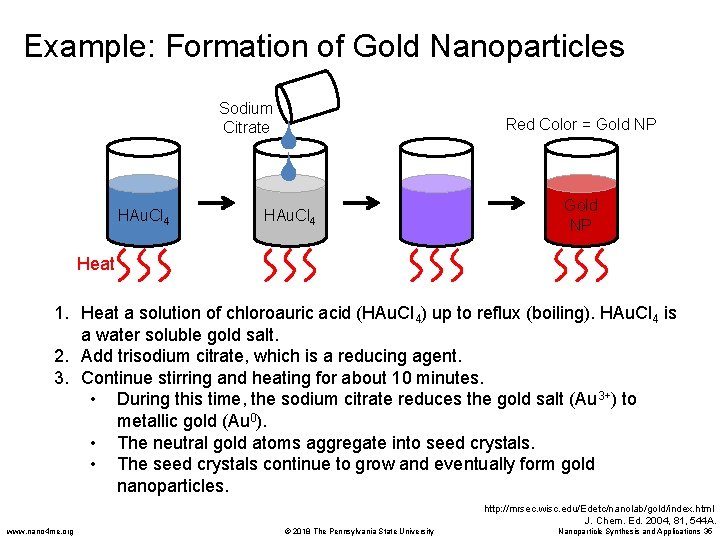
Example: Formation of Gold Nanoparticles Sodium Citrate HAu. Cl 4 Red Color = Gold NP HAu. Cl 4 Gold NP Heat 1. Heat a solution of chloroauric acid (HAu. Cl 4) up to reflux (boiling). HAu. Cl 4 is a water soluble gold salt. 2. Add trisodium citrate, which is a reducing agent. 3. Continue stirring and heating for about 10 minutes. • During this time, the sodium citrate reduces the gold salt (Au 3+) to metallic gold (Au 0). • The neutral gold atoms aggregate into seed crystals. • The seed crystals continue to grow and eventually form gold nanoparticles. http: //mrsec. wisc. edu/Edetc/nanolab/gold/index. html J. Chem. Ed. 2004, 81, 544 A. www. nano 4 me. org © 2018 The Pennsylvania State University Nanoparticle Synthesis and Applications 35
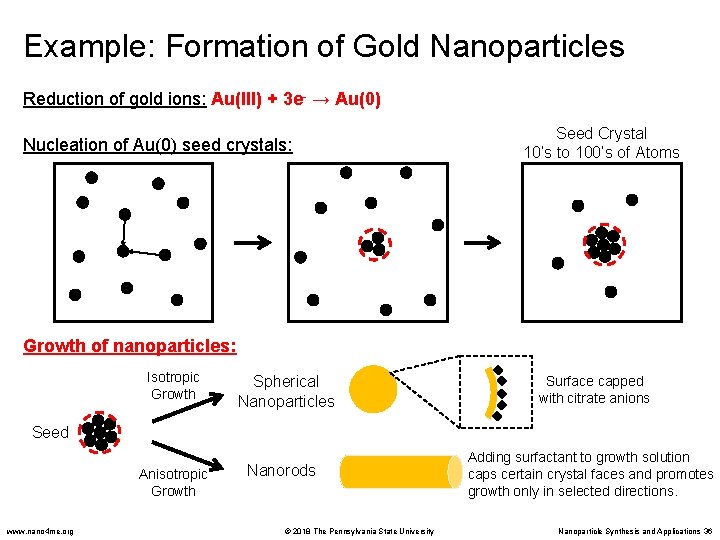
Example: Formation of Gold Nanoparticles Reduction of gold ions: Au(III) + 3 e- → Au(0) Nucleation of Au(0) seed crystals: Seed Crystal 10’s to 100’s of Atoms Growth of nanoparticles: Isotropic Growth Spherical Nanoparticles Surface capped with citrate anions Seed Anisotropic Growth www. nano 4 me. org Nanorods © 2018 The Pennsylvania State University Adding surfactant to growth solution caps certain crystal faces and promotes growth only in selected directions. Nanoparticle Synthesis and Applications 36
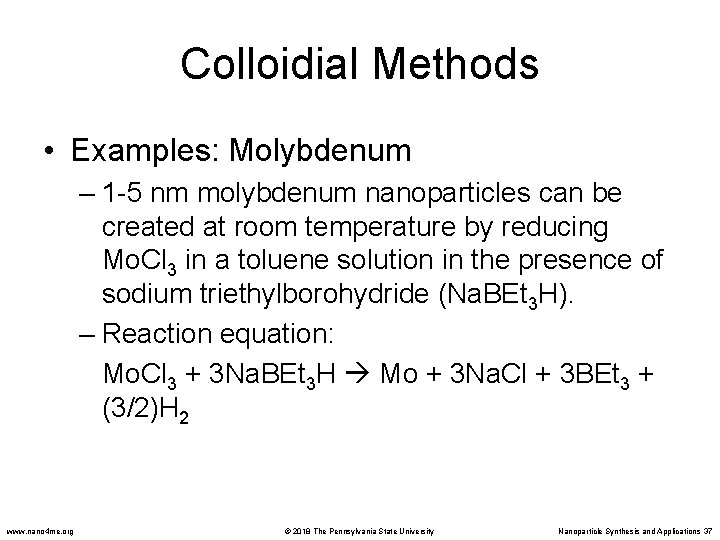
Colloidial Methods • Examples: Molybdenum – 1 -5 nm molybdenum nanoparticles can be created at room temperature by reducing Mo. Cl 3 in a toluene solution in the presence of sodium triethylborohydride (Na. BEt 3 H). – Reaction equation: Mo. Cl 3 + 3 Na. BEt 3 H Mo + 3 Na. Cl + 3 BEt 3 + (3/2)H 2 www. nano 4 me. org © 2018 The Pennsylvania State University Nanoparticle Synthesis and Applications 37
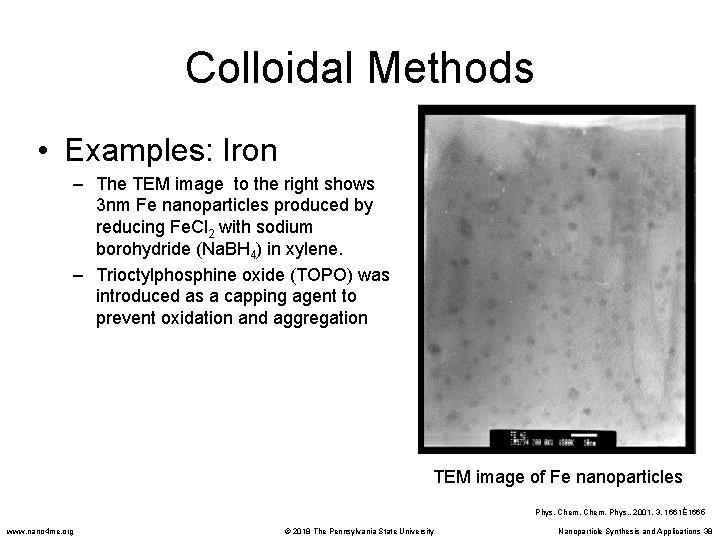
Colloidal Methods • Examples: Iron – The TEM image to the right shows 3 nm Fe nanoparticles produced by reducing Fe. Cl 2 with sodium borohydride (Na. BH 4) in xylene. – Trioctylphosphine oxide (TOPO) was introduced as a capping agent to prevent oxidation and aggregation TEM image of Fe nanoparticles Phys. Chem. Phys. , 2001, 3, 1661È1665 www. nano 4 me. org © 2018 The Pennsylvania State University Nanoparticle Synthesis and Applications 38
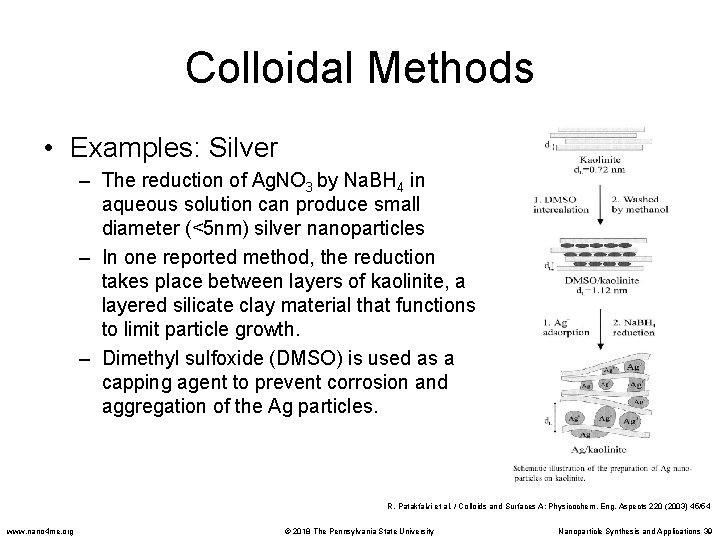
Colloidal Methods • Examples: Silver – The reduction of Ag. NO 3 by Na. BH 4 in aqueous solution can produce small diameter (<5 nm) silver nanoparticles – In one reported method, the reduction takes place between layers of kaolinite, a layered silicate clay material that functions to limit particle growth. – Dimethyl sulfoxide (DMSO) is used as a capping agent to prevent corrosion and aggregation of the Ag particles. R. Patakfalvi et al. / Colloids and Surfaces A: Physicochem. Eng. Aspects 220 (2003) 45/54 www. nano 4 me. org © 2018 The Pennsylvania State University Nanoparticle Synthesis and Applications 39
www. nano 4 me. org © 2018 The Pennsylvania State University Nanoparticle Synthesis and Applications 40
www. nano 4 me. org © 2018 The Pennsylvania State University Nanoparticle Synthesis and Applications 41
www. nano 4 me. org © 2018 The Pennsylvania State University Nanoparticle Synthesis and Applications 42
www. nano 4 me. org © 2018 The Pennsylvania State University Nanoparticle Synthesis and Applications 43
www. nano 4 me. org © 2018 The Pennsylvania State University Nanoparticle Synthesis and Applications 44
www. nano 4 me. org © 2018 The Pennsylvania State University Nanoparticle Synthesis and Applications 45
www. nano 4 me. org © 2018 The Pennsylvania State University Nanoparticle Synthesis and Applications 46
www. nano 4 me. org © 2018 The Pennsylvania State University Nanoparticle Synthesis and Applications 47
www. nano 4 me. org © 2018 The Pennsylvania State University Nanoparticle Synthesis and Applications 48
www. nano 4 me. org © 2018 The Pennsylvania State University Nanoparticle Synthesis and Applications 49
www. nano 4 me. org © 2018 The Pennsylvania State University Nanoparticle Synthesis and Applications 50
www. nano 4 me. org © 2018 The Pennsylvania State University Nanoparticle Synthesis and Applications 51
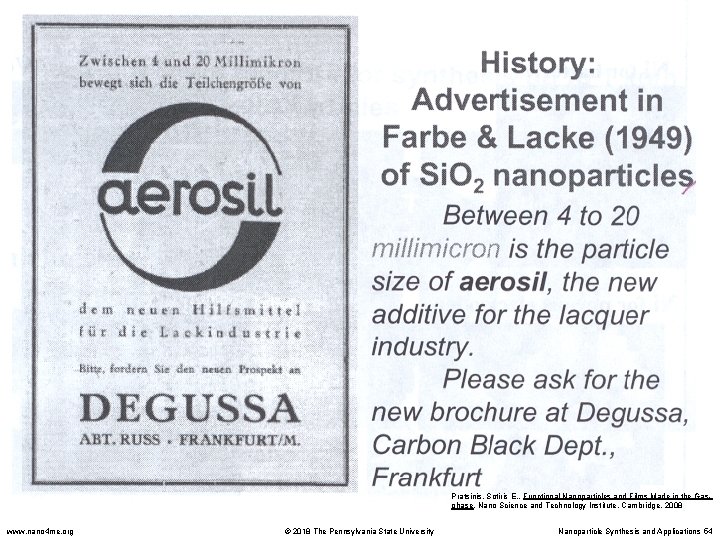
Pyrolysis • History • System Overview • Aggregation and agglomeration www. nano 4 me. org © 2018 The Pennsylvania State University Nanoparticle Synthesis and Applications 52
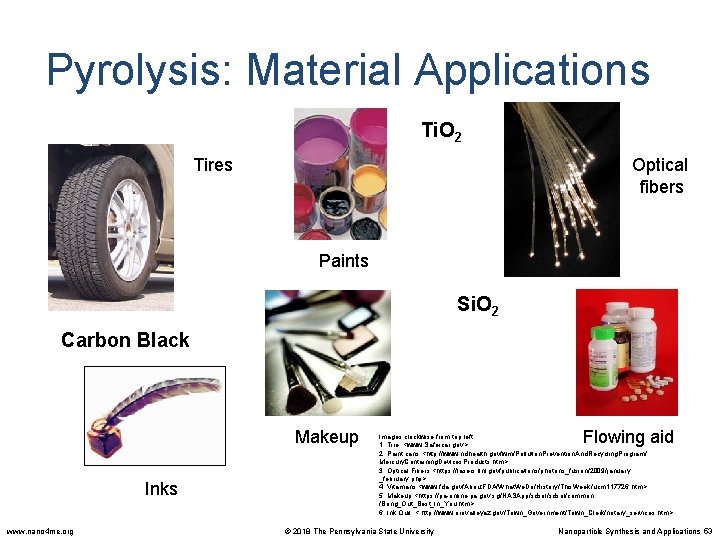
Pyrolysis: Material Applications Ti. O 2 Tires Optical fibers Paints Si. O 2 Carbon Black Makeup Inks www. nano 4 me. org Flowing aid Images clockwise from top left: 1. Tire <www. Safercar. gov> 2. Paint cans <http: //www. ndhealth. gov/wm/Pollution. Prevention. And. Recycling. Program/ Mercury. Containing. Devices. Products. htm> 3. Optical Fibers <https: //lasers. llnl. gov/publications/photons_fusion/2009/january _february. php> 4. Vitamans <www. fda. gov/About. FDA/What. We. Do/History/This. Week/ucm 117726. htm> 5. Makeup <https: //pa-online. pa. gov. sg/NASApp/sdsol/common /Bring_Out_Best_In_You. htm> 6. Ink Quil < http: //www. orovalleyaz. gov/Town_Government/Town_Clerk/notary_services. htm> © 2018 The Pennsylvania State University Nanoparticle Synthesis and Applications 53
Pratsinis, Sotiris E. , Functional Nanoparticles and Films Made in the Gasphase. Nano Science and Technology Institute, Cambridge. 2008 www. nano 4 me. org © 2018 The Pennsylvania State University Nanoparticle Synthesis and Applications 54
Pyrolysis • Pyrolysis is a popular method for creating nanoparticles, especially oxides. A precursor (liquid or gas) is forced through an orifice at high pressure and burned. • The resulting ash is collected to recover the nanoparticles. • Large volume of gas leads to high rate of material synthesis www. nano 4 me. org © 2018 The Pennsylvania State University Nanoparticle Synthesis and Applications 55
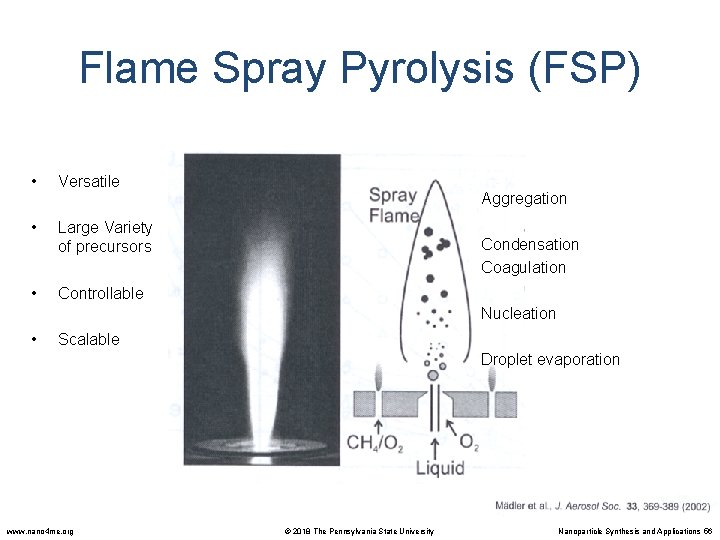
Flame Spray Pyrolysis (FSP) • Versatile • Large Variety of precursors • Controllable Aggregation Condensation Coagulation Nucleation • Scalable Droplet evaporation www. nano 4 me. org © 2018 The Pennsylvania State University Nanoparticle Synthesis and Applications 56
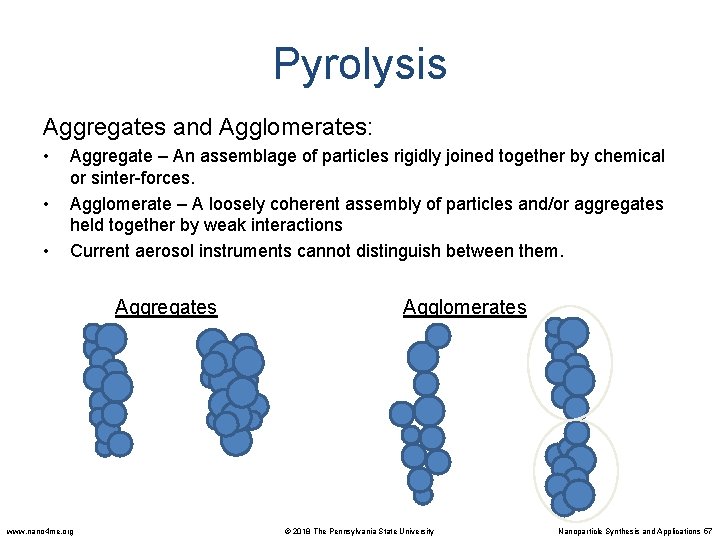
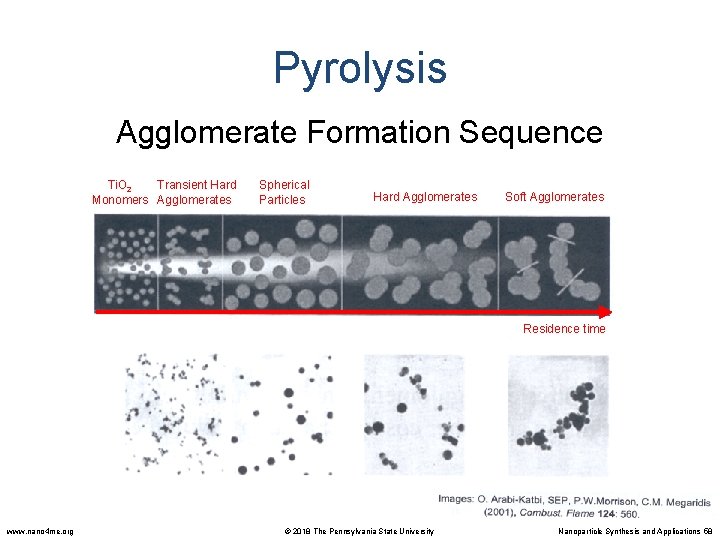
Pyrolysis Aggregates and Agglomerates: • • • Aggregate – An assemblage of particles rigidly joined together by chemical or sinter-forces. Agglomerate – A loosely coherent assembly of particles and/or aggregates held together by weak interactions Current aerosol instruments cannot distinguish between them. Aggregates www. nano 4 me. org Agglomerates © 2018 The Pennsylvania State University Nanoparticle Synthesis and Applications 57
Pyrolysis Agglomerate Formation Sequence Ti. O 2 Transient Hard Monomers Agglomerates Spherical Particles Hard Agglomerates Soft Agglomerates Residence time www. nano 4 me. org © 2018 The Pennsylvania State University Nanoparticle Synthesis and Applications 58
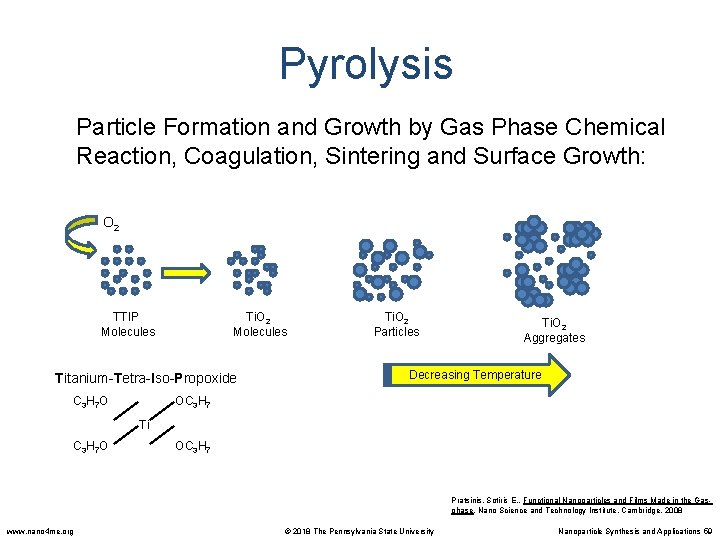
Pyrolysis Particle Formation and Growth by Gas Phase Chemical Reaction, Coagulation, Sintering and Surface Growth: O 2 TTIP Molecules Ti. O 2 Molecules Titanium-Tetra-Iso-Propoxide C 3 H 7 O Ti. O 2 Particles Ti. O 2 Aggregates Decreasing Temperature OC 3 H 7 Ti C 3 H 7 O OC 3 H 7 Pratsinis, Sotiris E. , Functional Nanoparticles and Films Made in the Gasphase. Nano Science and Technology Institute, Cambridge. 2008 www. nano 4 me. org © 2018 The Pennsylvania State University Nanoparticle Synthesis and Applications 59
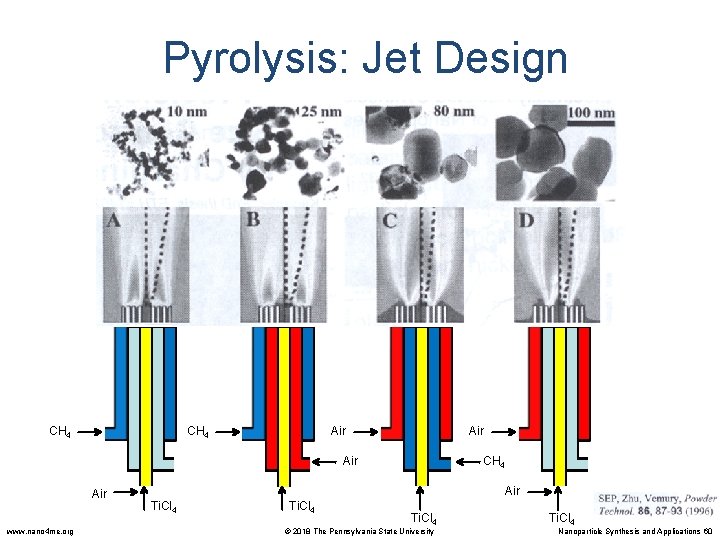
Pyrolysis: Jet Design CH 4 Air Air www. nano 4 me. org Air CH 4 Air Ti. Cl 4 © 2018 The Pennsylvania State University Ti. Cl 4 Nanoparticle Synthesis and Applications 60
Pyrolysis: Advantages & Disadvantages • Pyrolysis is a high yield method that can fulfill the strong demand for nanoparticles. • Can be customized to produce unique nanoparticles. • Broad distribution of particle sizes and morphology. www. nano 4 me. org © 2018 The Pennsylvania State University Nanoparticle Synthesis and Applications 61
Nanoparticle Applications: Zn. O • Zinc Oxide has opaque and antifungal properties. • Used as UV blocking pigments in sunscreens, cosmetics, varnishes, and fabrics • Incorporated in foot powders and garden supplies as an antifungal. • Zn. O nanowires can improve the elastic toughness of bulk materials www. nano 4 me. org © 2018 The Pennsylvania State University Nanoparticle Synthesis and Applications 62
Nanoparticle Applications: Ti. O 2 • Titanium Dioxide is used as an inorganic white pigment for paper, paints, plastics, and whitening agents. • Ti. O 2 nanoparticles are used as UV blocking pigments in sunscreens, cosmetics, varnishes, and fabrics. • Ti. O 2 has unique photocatalytic properties that make it suitable for a number of advanced applications: – – Self-cleaning glass and antifogging coatings Photoelectrochemical cells (PECs) Detoxification of waste water Hydrolysis www. nano 4 me. org © 2018 The Pennsylvania State University Nanoparticle Synthesis and Applications 63
Nanoparticle Applications: Fe • 50 -100 nm Iron nanoparticles are used in magnetic recording devices for both digital and analog data. • Decreasing the diameter to 30 -40 nm increases the magnetic recording capacity by 5 -10 times per unit. www. nano 4 me. org © 2018 The Pennsylvania State University Nanoparticle Synthesis and Applications 64
Nanoparticle Applications: Iron Oxide • Iron Oxide nanoparticles have unique magnetic and optical properties. • Iron oxide nanoparticles can be translucent to visible light while being opaque to UV light. • Applications include UV protective coatings, various electromagnetic uses, electro-optic uses, and data storage. www. nano 4 me. org © 2018 The Pennsylvania State University Nanoparticle Synthesis and Applications 65
Nanoparticle Applications: Iron Alloys • Iron-platinum nanoparticles have increased magnetism and it is predicted that 3 nm particle can increase the data storage capacity by 10 times per unit area. • Iron-palladium nanoparticles 100 -200 nm in diameter have been shown to reduce toxic chlorinated hydrocarbons to nontoxic hydrocarbon and chloride compounds. SCIENCE VOL 287 17 MARCH 2000 www. nano 4 me. org © 2018 The Pennsylvania State University Nanoparticle Synthesis and Applications 66
Nanoparticle Applications: Alumina • Alumina (Aluminum Oxide) is used in Chemical Mechanical Polishing (CMP) slurries, as well as ceramic filters. • Nano-alumina is used in light bulb and fluorescent tube coatings because it emits light more uniformly and allows for better flow of fluorescent materials. www. nano 4 me. org © 2018 The Pennsylvania State University Nanoparticle Synthesis and Applications 67
Nanoparticle Applications: Ag • Silver has excellent conductivity and has been used as an antimicrobial material for thousands of years. • Silver’s anti-microbial potential increase with increased surface area. • Applications include biocides, transparent conductive inks, and antimicrobial plastics, and bandages. www. nano 4 me. org © 2018 The Pennsylvania State University Nanoparticle Synthesis and Applications 68
Nanoparticle Applications: Gold • Gold nanoparticles are relatively easy to produce compared to other types of nanoparticles due to its high chemical stability. • Uses for gold nanoparticles are typically catalytic and include DNA detection and the oxidation of carbon monoxide. • Gold has superior conductivity allowing gold nanoparticles to be used in various probes, sensors, and optical applications. www. nano 4 me. org © 2018 The Pennsylvania State University Nanoparticle Synthesis and Applications 69