Energy Power Unit 5 Lesson 1 Explanation Presentation
- Slides: 19
Energy & Power Unit 5, Lesson 1 Explanation Presentation 5. 1. 1 © 2011 International Technology and Engineering Educators Association, STEM Center for Teaching and Learning™ Foundations of Technology
The Unit Big Idea The designed world is the product of a design process, which provides ways to turn resources - materials, tools and machines, people, information, energy, capital, and time - into products and services. © 2011 International Technology and Engineering Educators Association, STEM Center for Teaching and Learning™ Foundations of Technology
The Lesson Big Idea Advancements in the processing and controlling of energy resources have been an enabling factor in the development of technology. © 2011 International Technology and Engineering Educators Association, STEM Center for Teaching and Learning™ Foundations of Technology
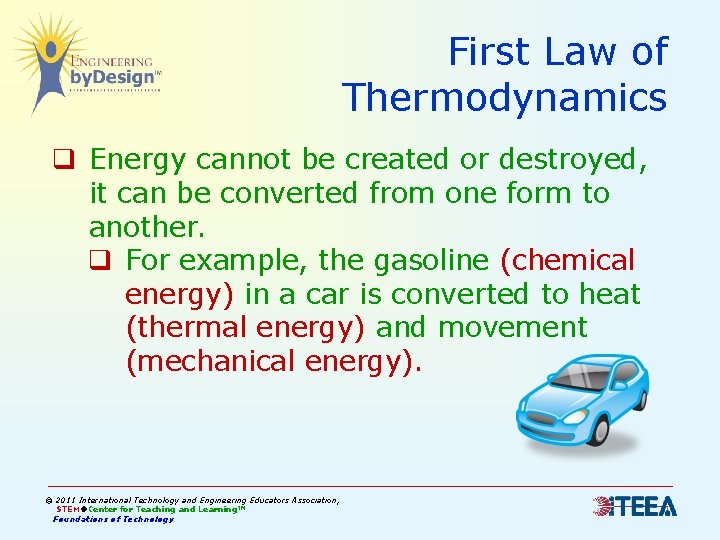
First Law of Thermodynamics q Energy cannot be created or destroyed, it can be converted from one form to another. q For example, the gasoline (chemical energy) in a car is converted to heat (thermal energy) and movement (mechanical energy). © 2011 International Technology and Engineering Educators Association, STEM Center for Teaching and Learning™ Foundations of Technology
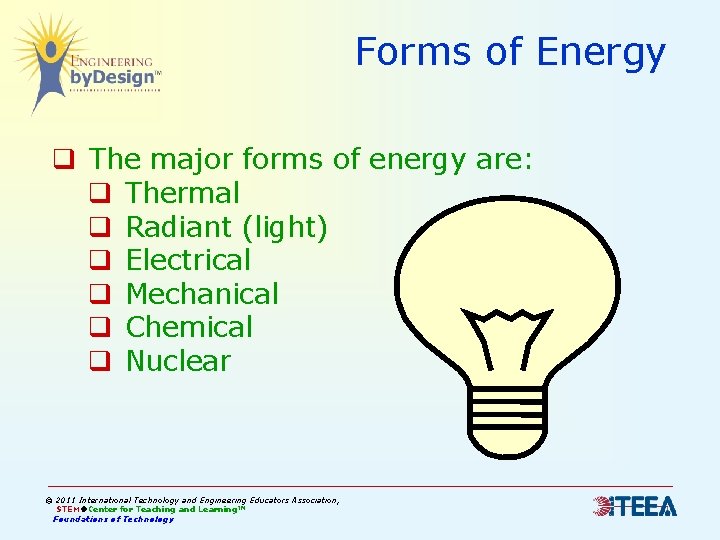
Forms of Energy q The major forms of energy are: q Thermal q Radiant (light) q Electrical q Mechanical q Chemical q Nuclear © 2011 International Technology and Engineering Educators Association, STEM Center for Teaching and Learning™ Foundations of Technology
Forms of Energy Defined q Thermal energy: or heat, is the vibration and movement of the atoms and molecules within substances q Radiant energy (light): is electromagnetic energy that travels in transverse waves q Electrical energy: energy made available by the flow of electric charge through a conductor. © 2011 International Technology and Engineering Educators Association, STEM Center for Teaching and Learning™ Foundations of Technology
Forms of Energy Defined q Mechanical energy: energy stored in the movement of objects q Chemical energy: is energy stored in the bonds of atoms and molecules. Biomass, petroleum, natural gas, and coal are examples of stored chemical energy. q Nuclear energy: is energy stored in the nucleus of an atom — the energy that holds the nucleus together. © 2011 International Technology and Engineering Educators Association, STEM Center for Teaching and Learning™ Foundations of Technology
Power Plants q Power plants generate electricity from various energy resources. These resources can be classified as: Renewable Solar Wind Water © 2011 International Technology and Engineering Educators Association, STEM Center for Teaching and Learning™ Foundations of Technology Non Renewable Fossil Fuels Uranium
Non Renewable q Non renewable resources include fossil fuels such as coal, oil, and natural gas. These nonrenewable resources are forms of chemical energy created from natural occurring elements. q Fossil fuels provide around 66% of the world’s electrical power and meet 95% of the world’s total energy demands. q Oil and Coal power plants produce harmful environmental emissions. © 2011 International Technology and Engineering Educators Association, STEM Center for Teaching and Learning™ Foundations of Technology
Non Renewable q Nuclear power is also considered a non renewable energy resource. q Nuclear power is generated using uranium and produces around 11% of the world’s energy needs. q The heat required to produce steam, which turns the turbine is created using a process called fission, where atoms split and release energy in the form of heat. © 2011 International Technology and Engineering Educators Association, STEM Center for Teaching and Learning™ Foundations of Technology
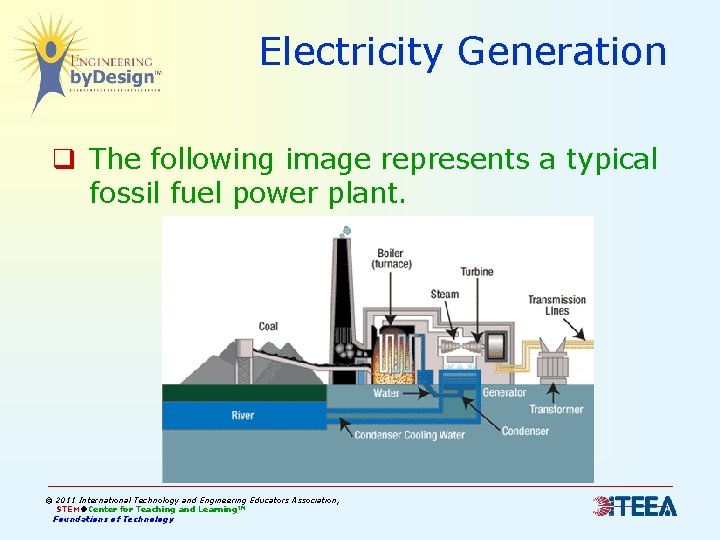
Electricity Generation q The following image represents a typical fossil fuel power plant. © 2011 International Technology and Engineering Educators Association, STEM Center for Teaching and Learning™ Foundations of Technology
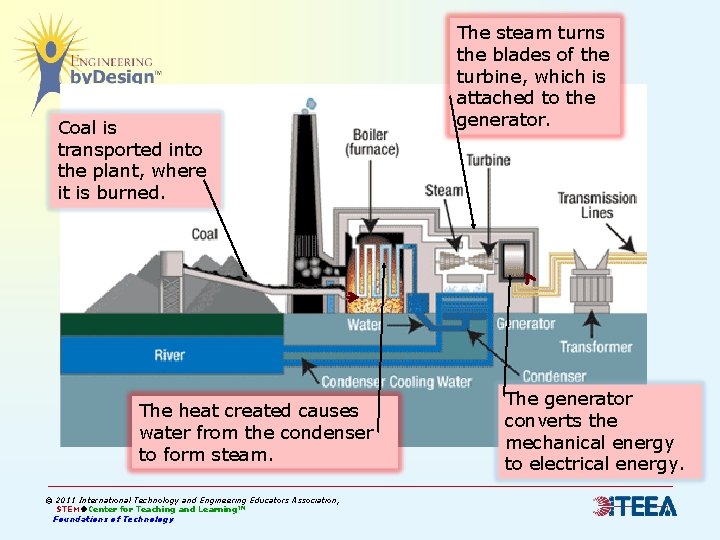
Coal is transported into the plant, where it is burned. The heat created causes water from the condenser to form steam. © 2011 International Technology and Engineering Educators Association, STEM Center for Teaching and Learning™ Foundations of Technology The steam turns the blades of the turbine, which is attached to the generator. The generator converts the mechanical energy to electrical energy.
Renewable q Renewable energy resources include water, solar and wind. q Hydroelectric power plants take advantage of the downward flow of water to turn the blades of a turbine. q Wind works similarly, the wind blows and turns the blades of the turbine. q Solar power plants generate electricity by converting the radiant energy from sunlight to electrical using specific materials within the solar panel. © 2011 International Technology and Engineering Educators Association, STEM Center for Teaching and Learning™ Foundations of Technology
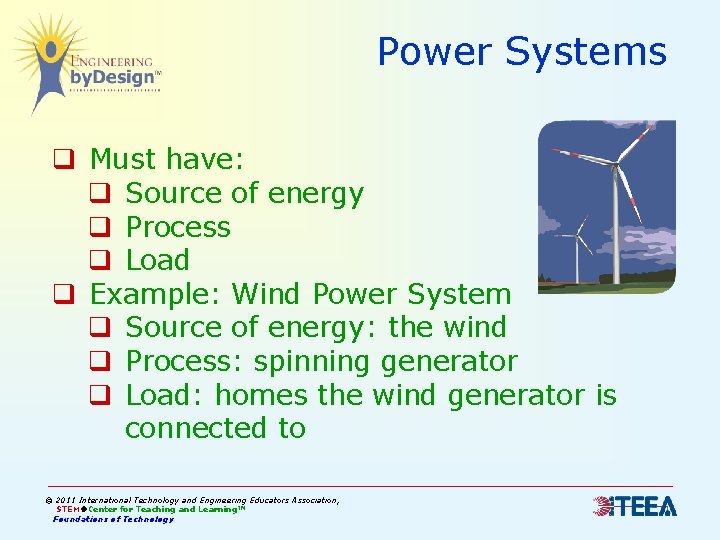
Power Systems q Must have: q Source of energy q Process q Load q Example: Wind Power System q Source of energy: the wind q Process: spinning generator q Load: homes the wind generator is connected to © 2011 International Technology and Engineering Educators Association, STEM Center for Teaching and Learning™ Foundations of Technology
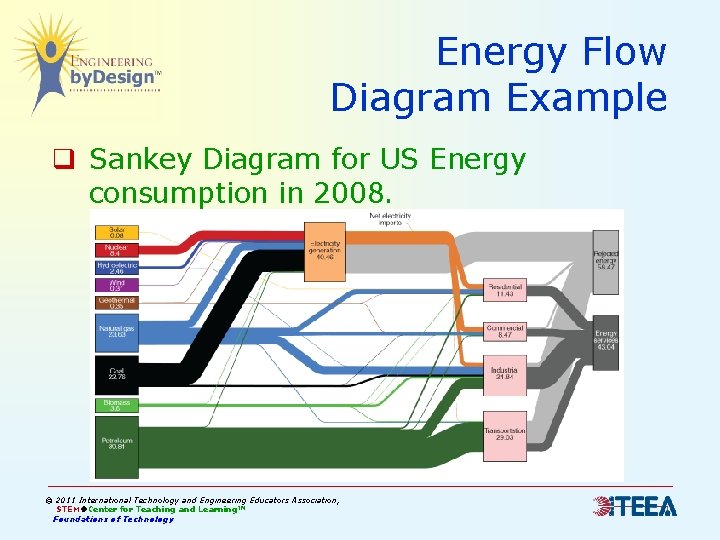
Energy Flow Diagrams q The flow of energy within any system can be documented using energy flow diagrams. q Energy flow diagrams show what is happening to a particular type of energy as it is used or changed in some process or situation. q One type of energy flow diagrams are called Sankey Diagrams. © 2011 International Technology and Engineering Educators Association, STEM Center for Teaching and Learning™ Foundations of Technology
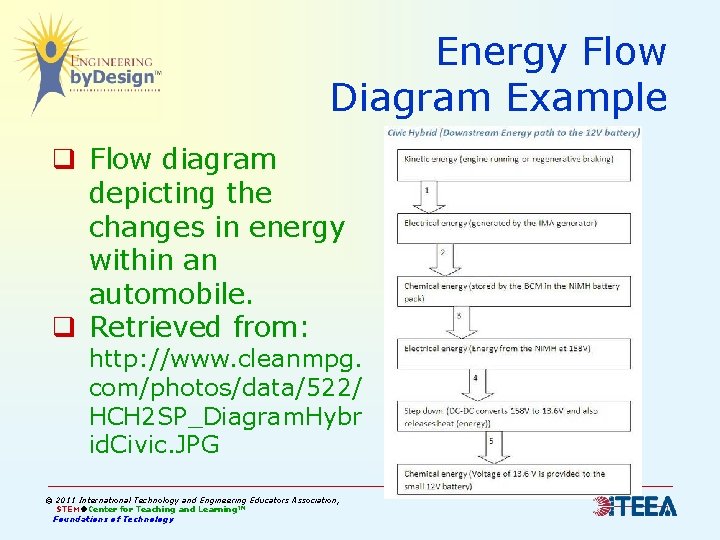
Energy Flow Diagram Example q Flow diagram depicting the changes in energy within an automobile. q Retrieved from: http: //www. cleanmpg. com/photos/data/522/ HCH 2 SP_Diagram. Hybr id. Civic. JPG © 2011 International Technology and Engineering Educators Association, STEM Center for Teaching and Learning™ Foundations of Technology
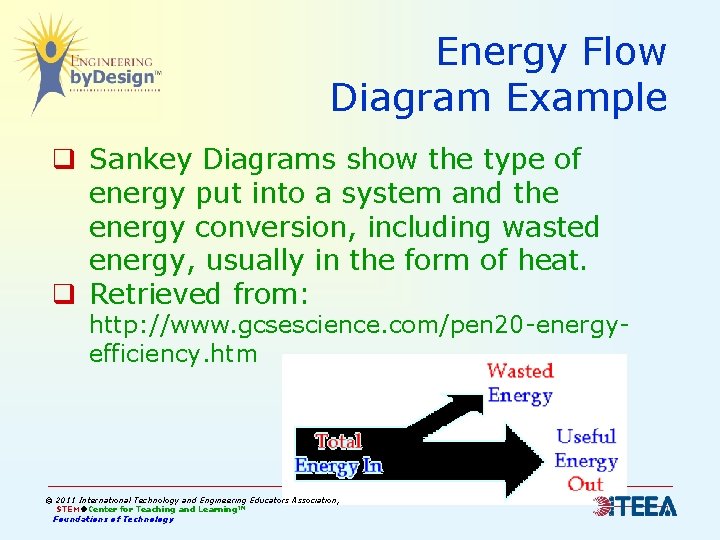
Energy Flow Diagram Example q Sankey Diagrams show the type of energy put into a system and the energy conversion, including wasted energy, usually in the form of heat. q Retrieved from: http: //www. gcsescience. com/pen 20 -energyefficiency. htm © 2011 International Technology and Engineering Educators Association, STEM Center for Teaching and Learning™ Foundations of Technology
Energy Flow Diagram Example q Sankey Diagram for US Energy consumption in 2008. © 2011 International Technology and Engineering Educators Association, STEM Center for Teaching and Learning™ Foundations of Technology
Reflection q What would an energy flow diagram of a coal power plant look like? q Create an energy flow diagram (following either the first example or a Sankey diagram). Display your diagram in the classroom. © 2011 International Technology and Engineering Educators Association, STEM Center for Teaching and Learning™ Foundations of Technology