ELENA Vacuum System R Kersevan TEVSCIVM R Kersevan
- Slides: 25
ELENA Vacuum System R. Kersevan, TE-VSC-IVM R. Kersevan, “ELENA Vacuum System”, - ELENA Project Review, Oct 14 -15, 2013, CERN
Agenda 1. Machine physics vacuum requirements 2. Materials, requirements 3. Expected gas loads and pumping speeds 4. Lattice Design and Integration Issues 5. Vacuum Sectoring and Pumping Conclusions R. Kersevan, “ELENA Vacuum System”, - ELENA Project Review, Oct 14 -15, 2013, CERN
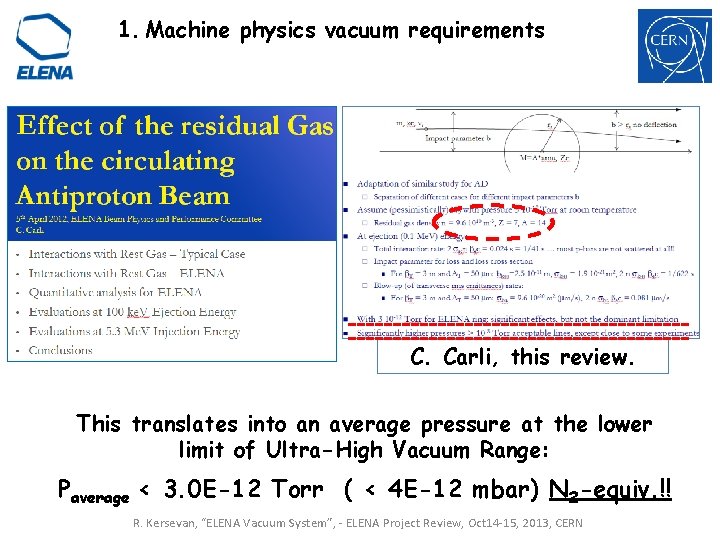
1. Machine physics vacuum requirements C. Carli, this review. This translates into an average pressure at the lower limit of Ultra-High Vacuum Range: Paverage < 3. 0 E-12 Torr ( < 4 E-12 mbar) N 2 -equiv. !! R. Kersevan, “ELENA Vacuum System”, - ELENA Project Review, Oct 14 -15, 2013, CERN
2. Materials Requirements: 1. Availability, Cost 2. Known Cleaning Procedures 3. Low Magnetic Permeability 4. Weldability 5. Low Outgassing Rate 6. Capable to Sustain Bake-Out up to 250 ºC 7. Reliable Sealing Techniques Requirements 1 through 7 identify 316 LN Stainless. Steel as the Material of Choice, With Con. FLat Flanges to be Used Anywhere Possible R. Kersevan, “ELENA Vacuum System”, - ELENA Project Review, Oct 14 -15, 2013, CERN
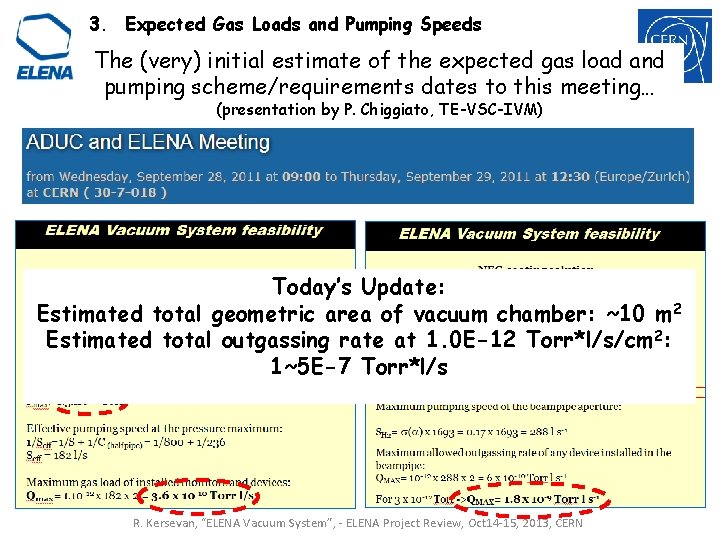
3. Expected Gas Loads and Pumping Speeds The (very) initial estimate of the expected gas load and pumping scheme/requirements dates to this meeting… (presentation by P. Chiggiato, TE-VSC-IVM) Today’s Update: Estimated total geometric area of vacuum chamber: ~10 m 2 Estimated total outgassing rate at 1. 0 E-12 Torr*l/s/cm 2: 1~5 E-7 Torr*l/s R. Kersevan, “ELENA Vacuum System”, - ELENA Project Review, Oct 14 -15, 2013, CERN
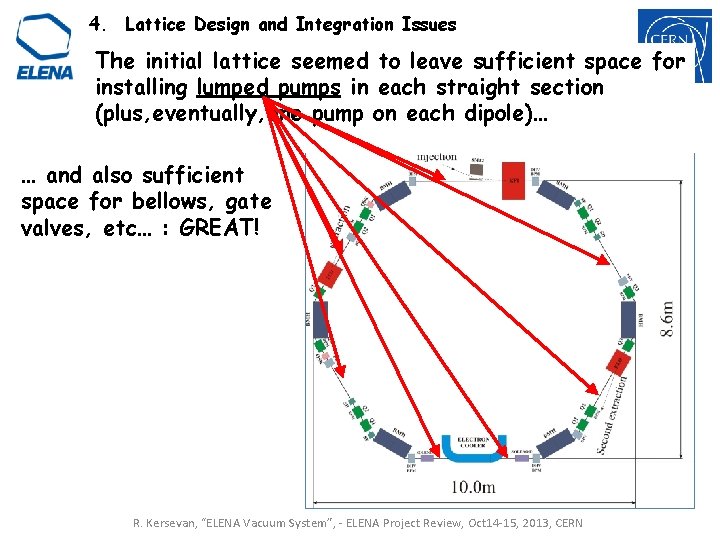
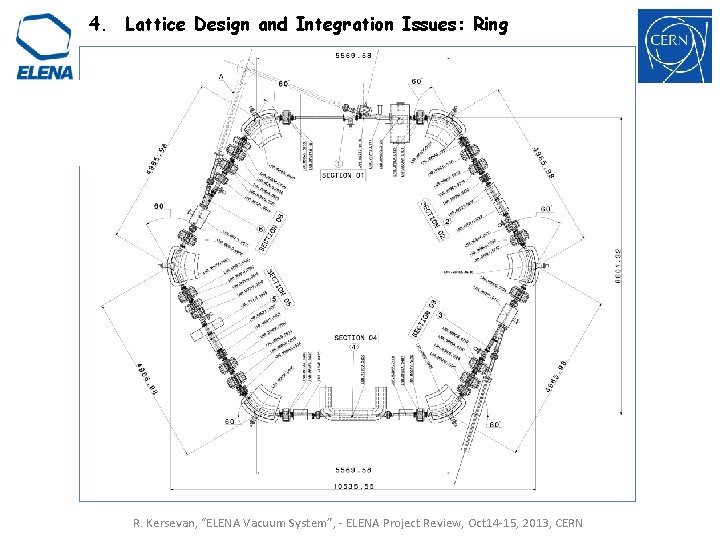
4. Lattice Design and Integration Issues The initial lattice seemed to leave sufficient space for installing lumped pumps in each straight section (plus, eventually, one pump on each dipole)… … and also sufficient space for bellows, gate valves, etc… : GREAT! R. Kersevan, “ELENA Vacuum System”, - ELENA Project Review, Oct 14 -15, 2013, CERN
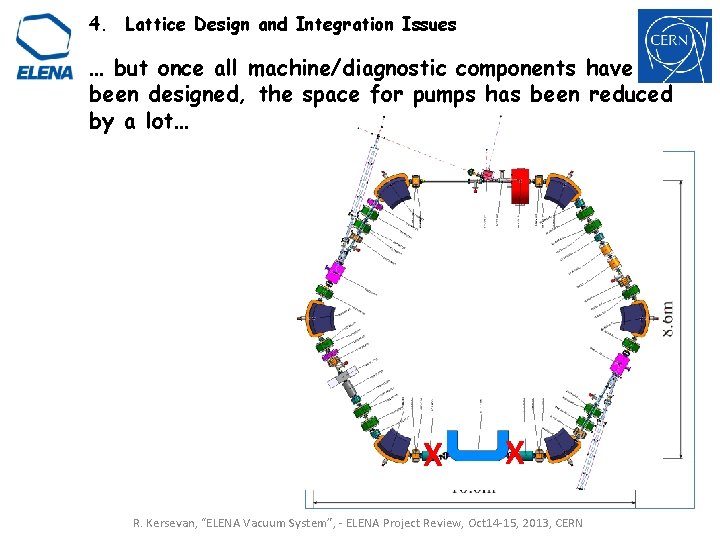
4. Lattice Design and Integration Issues … but once all machine/diagnostic components have been designed, the space for pumps has been reduced by a lot… X X R. Kersevan, “ELENA Vacuum System”, - ELENA Project Review, Oct 14 -15, 2013, CERN
4. Lattice Design and Integration Issues: Ring R. Kersevan, “ELENA Vacuum System”, - ELENA Project Review, Oct 14 -15, 2013, CERN
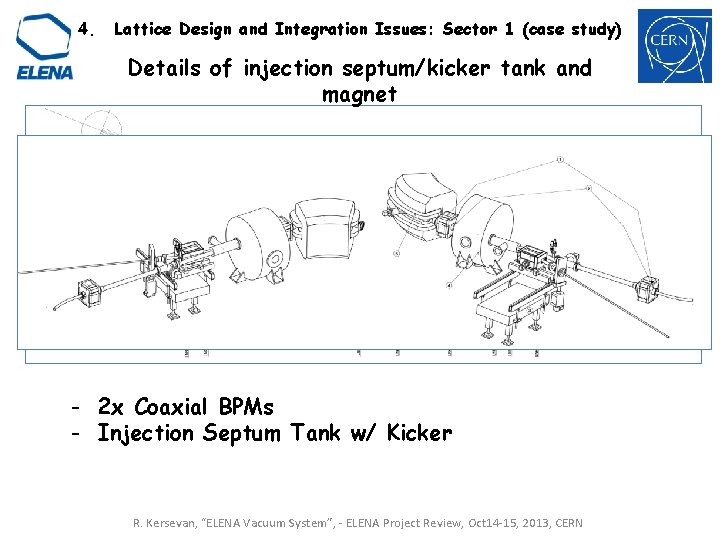
4. Lattice Design and Integration Issues: Sector 1 (case study) Details of injection septum/kicker tank and magnet - 2 x Coaxial BPMs - Injection Septum Tank w/ Kicker R. Kersevan, “ELENA Vacuum System”, - ELENA Project Review, Oct 14 -15, 2013, CERN
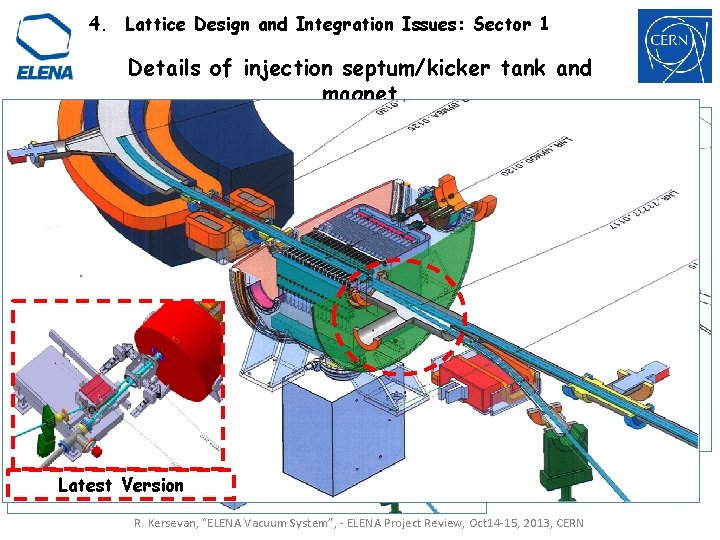
4. Lattice Design and Integration Issues: Sector 1 Details of injection septum/kicker tank and magnet Latest Version R. Kersevan, “ELENA Vacuum System”, - ELENA Project Review, Oct 14 -15, 2013, CERN
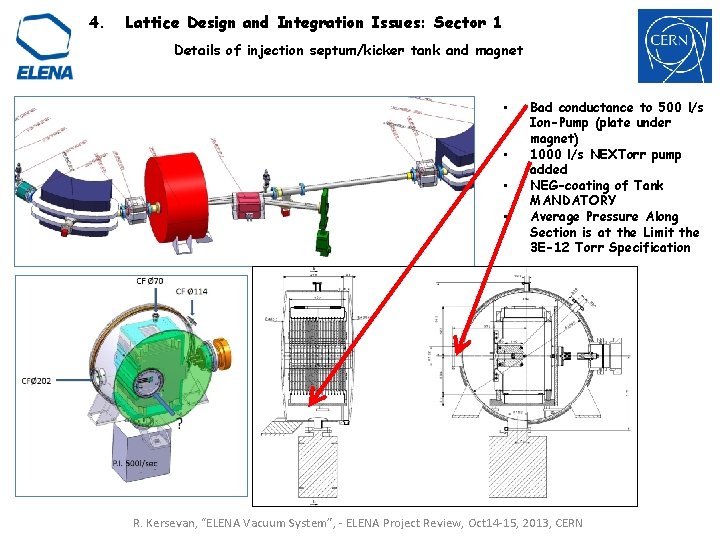
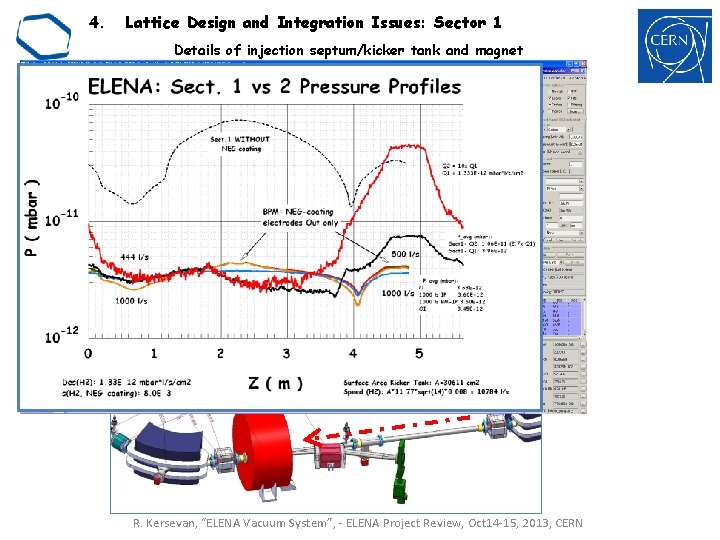
4. Lattice Design and Integration Issues: Sector 1 Details of injection septum/kicker tank and magnet • • Bad conductance to 500 l/s Ion-Pump (plate under magnet) 1000 l/s NEXTorr pump added NEG-coating of Tank MANDATORY Average Pressure Along Section is at the Limit the 3 E-12 Torr Specification R. Kersevan, “ELENA Vacuum System”, - ELENA Project Review, Oct 14 -15, 2013, CERN
4. Lattice Design and Integration Issues: Sector 1 Details of injection septum/kicker tank and magnet R. Kersevan, “ELENA Vacuum System”, - ELENA Project Review, Oct 14 -15, 2013, CERN
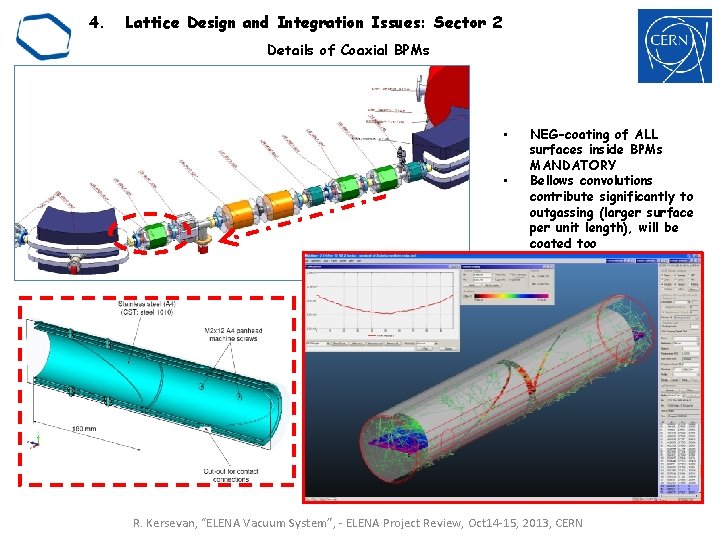
4. Lattice Design and Integration Issues: Sector 2 Details of Coaxial BPMs • • NEG-coating of ALL surfaces inside BPMs MANDATORY Bellows convolutions contribute significantly to outgassing (larger surface per unit length), will be coated too R. Kersevan, “ELENA Vacuum System”, - ELENA Project Review, Oct 14 -15, 2013, CERN
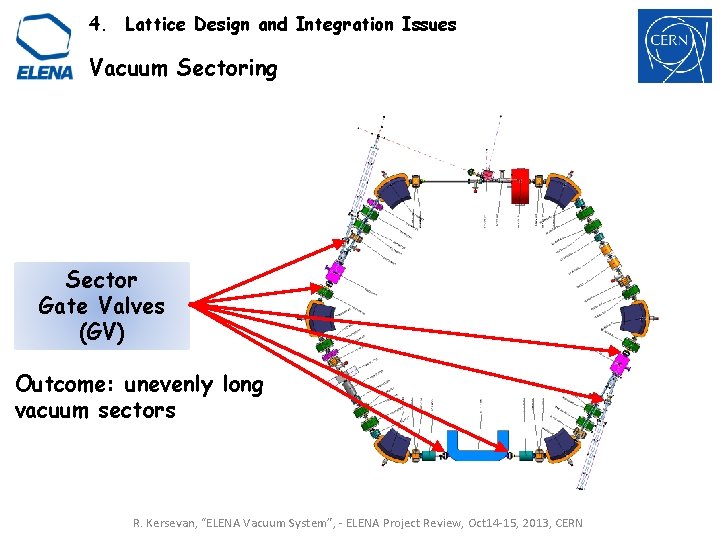
4. Lattice Design and Integration Issues Vacuum Sectoring Sector Gate Valves (GV) Outcome: unevenly long vacuum sectors R. Kersevan, “ELENA Vacuum System”, - ELENA Project Review, Oct 14 -15, 2013, CERN
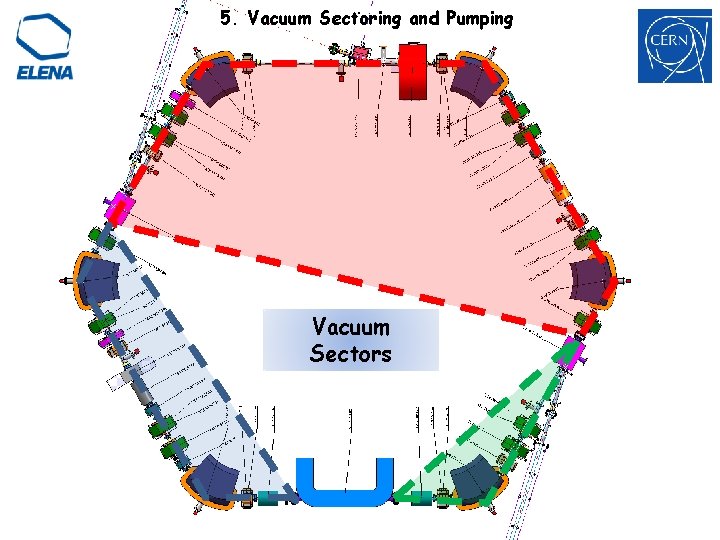
5. Vacuum Sectoring Pumping 2. Expected Gas Loads and Pumpingand Speeds Vacuum Sectors R. Kersevan, “ELENA Vacuum System”, - ELENA Project Review, Oct 14 -15, 2013, CERN
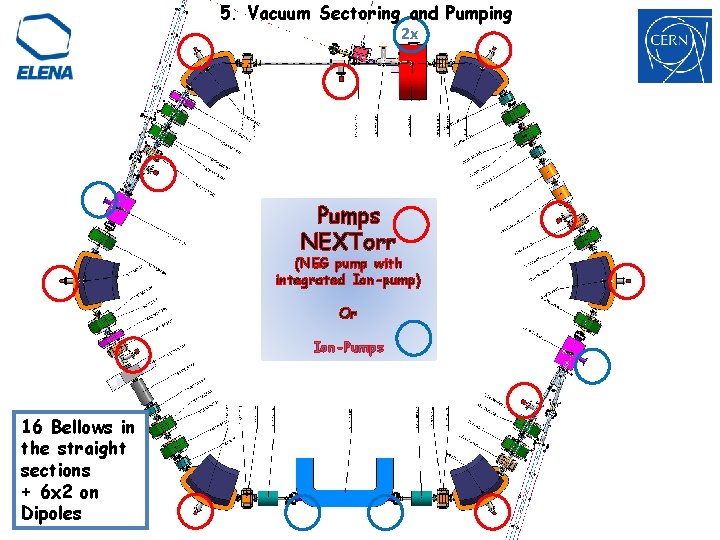
5. Vacuum Sectoring and Pumping 2. Expected Gas Loads and Pumping 2 x Speeds Pumps NEXTorr (NEG pump with integrated Ion-pump) Or Ion-Pumps 16 Bellows in the straight sections + 6 x 2 on Dipoles R. Kersevan, “ELENA Vacuum System”, - ELENA Project Review, Oct 14 -15, 2013, CERN
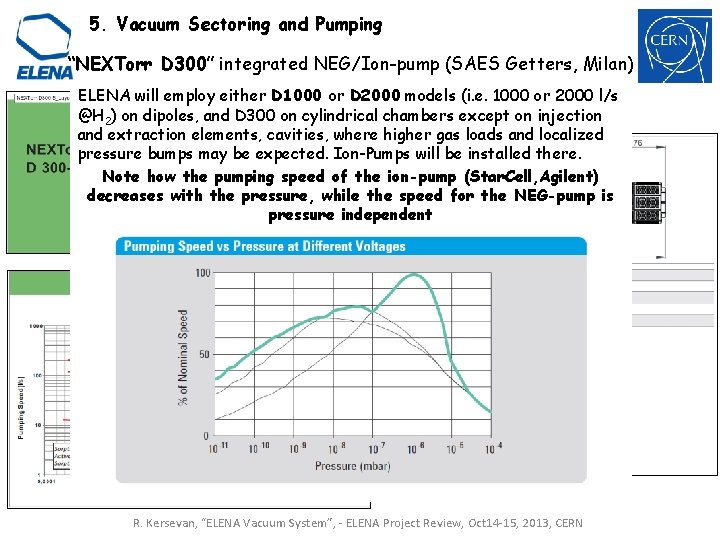
5. Vacuum Sectoring and Pumping “NEXTorr D 300” integrated NEG/Ion-pump (SAES Getters, Milan) ELENA will employ either D 1000 or D 2000 models (i. e. 1000 or 2000 l/s @H 2) on dipoles, and D 300 on cylindrical chambers except on injection and extraction elements, cavities, where higher gas loads and localized pressure bumps may be expected. Ion-Pumps will be installed there. Note how the pumping speed of the ion-pump (Star. Cell, Agilent) decreases with the pressure, while the speed for the NEG-pump is pressure independent R. Kersevan, “ELENA Vacuum System”, - ELENA Project Review, Oct 14 -15, 2013, CERN
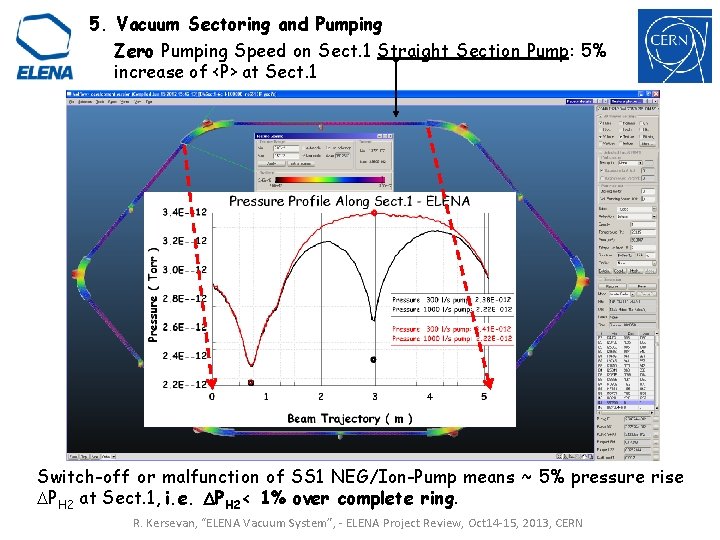
5. Vacuum Sectoring and Pumping Zero Pumping Speed on Sect. 1 Straight Section Pump: 5% increase of <P> at Sect. 1 Switch-off or malfunction of SS 1 NEG/Ion-Pump means ~ 5% pressure rise DPH 2 at Sect. 1, i. e. DPH 2< 1% over complete ring. R. Kersevan, “ELENA Vacuum System”, - ELENA Project Review, Oct 14 -15, 2013, CERN
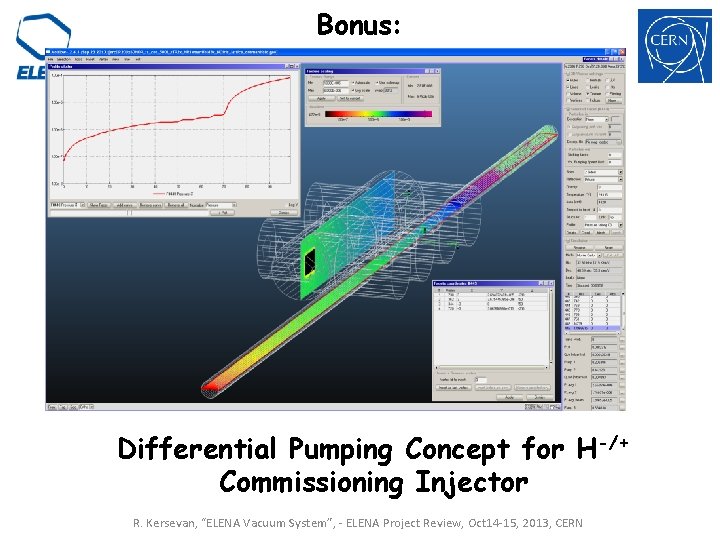
Conclusions: 1. The design of the vacuum system of the ELENA ring is being finalised. 2. All major integration issues (but 1, refer to 7 below) have been solved 3. The material chosen for the vacuum chambers is 316 LN stainlesssteel 4. Conical Con. Flat flanges (PS-type geometry) with collar are implemented everywhere except on gate valves, cavities, and injection/extraction devices. This saves us some space, longitudinally, as they do not need to have available the length of the screws 5. NEG-coating will be applied as much as possible 6. Extensive numerical modeling of the pressure distributions show that the pressure specification compatible with the operation of the machine will be met (Paverage < 3. 0 E-12 Torr) 7. Only notable vacuum issue not solved yet is the reduction of H 2 gas leaking out of the H+/- commissioning source (see talk by T. Eriksson on Tue 15/10). A dedicated differential pumping system is under study. R. Kersevan, “ELENA Vacuum System”, - ELENA Project Review, Oct 14 -15, 2013, CERN
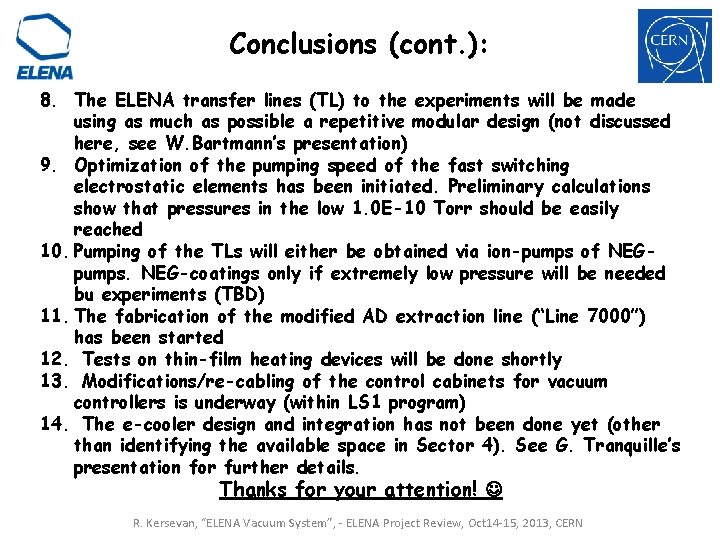
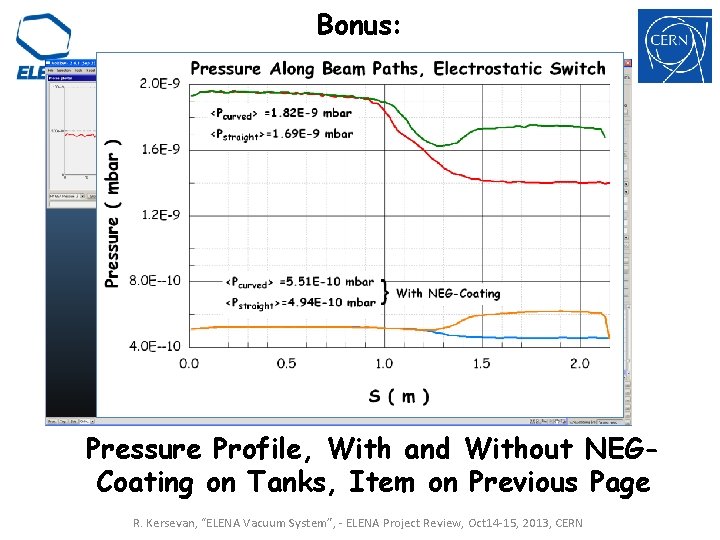
Conclusions (cont. ): 8. The ELENA transfer lines (TL) to the experiments will be made using as much as possible a repetitive modular design (not discussed here, see W. Bartmann’s presentation) 9. Optimization of the pumping speed of the fast switching electrostatic elements has been initiated. Preliminary calculations show that pressures in the low 1. 0 E-10 Torr should be easily reached 10. Pumping of the TLs will either be obtained via ion-pumps of NEGpumps. NEG-coatings only if extremely low pressure will be needed bu experiments (TBD) 11. The fabrication of the modified AD extraction line (“Line 7000”) has been started 12. Tests on thin-film heating devices will be done shortly 13. Modifications/re-cabling of the control cabinets for vacuum controllers is underway (within LS 1 program) 14. The e-cooler design and integration has not been done yet (other than identifying the available space in Sector 4). See G. Tranquille’s presentation for further details. Thanks for your attention! R. Kersevan, “ELENA Vacuum System”, - ELENA Project Review, Oct 14 -15, 2013, CERN
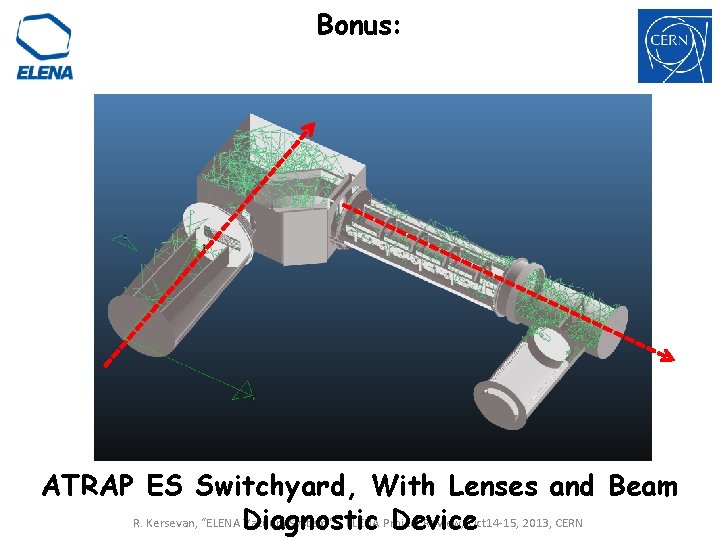
Bonus: ATRAP ES Switchyard, With Lenses and Beam R. Kersevan, “ELENA Diagnostic Vacuum System”, - ELENA Project Review, Oct 14 -15, 2013, CERN Device
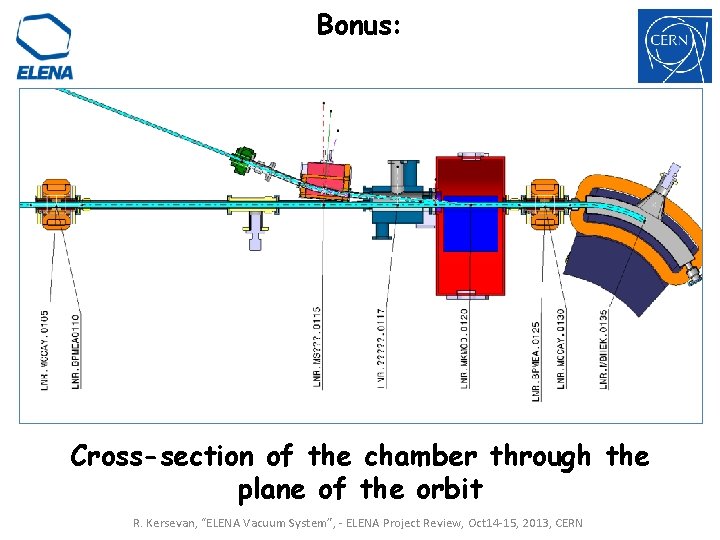
Bonus: Cross-section of the chamber through the plane of the orbit R. Kersevan, “ELENA Vacuum System”, - ELENA Project Review, Oct 14 -15, 2013, CERN
Bonus: Pressure Profile, With and Without NEGCoating on Tanks, Item on Previous Page R. Kersevan, “ELENA Vacuum System”, - ELENA Project Review, Oct 14 -15, 2013, CERN
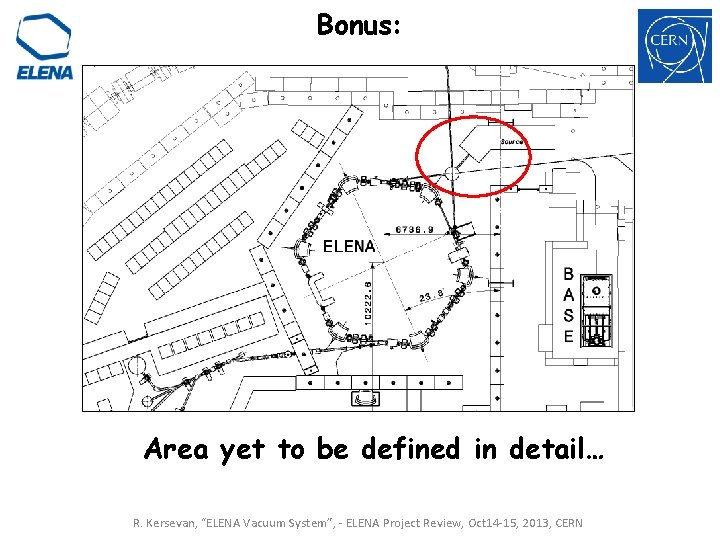
Bonus: Area yet to be defined in detail… R. Kersevan, “ELENA Vacuum System”, - ELENA Project Review, Oct 14 -15, 2013, CERN
Bonus: Differential Pumping Concept for H-/+ Commissioning Injector R. Kersevan, “ELENA Vacuum System”, - ELENA Project Review, Oct 14 -15, 2013, CERN