Vacuum System Failures at HERA M Seidel DESY
- Slides: 15
Vacuum System Failures at HERA M. Seidel, DESY OLAV Workshop, CERN, April 12, 2005
Categorization of Failures Non-Interrupting Failures n n n getter pump power supply failure cable failure; radiation damage pump address or location error (software) NEG pump heating circuit – shortcut to ground! vacuum interlock electronics failure (dangerous!) collimator damage by beam (hard to diagnose)
Categorization (2) Interrupting Failures (Leaks!) n n n beam induced leaks by heating/thermal shock leaks by electrical failure in feedthroughts water-vacuum leaks at brazing joint RF window breaks by heat load (after long term metallization) fatigue failure at bellows (wire scanner, collimator) (not discussed here → systematic problems)
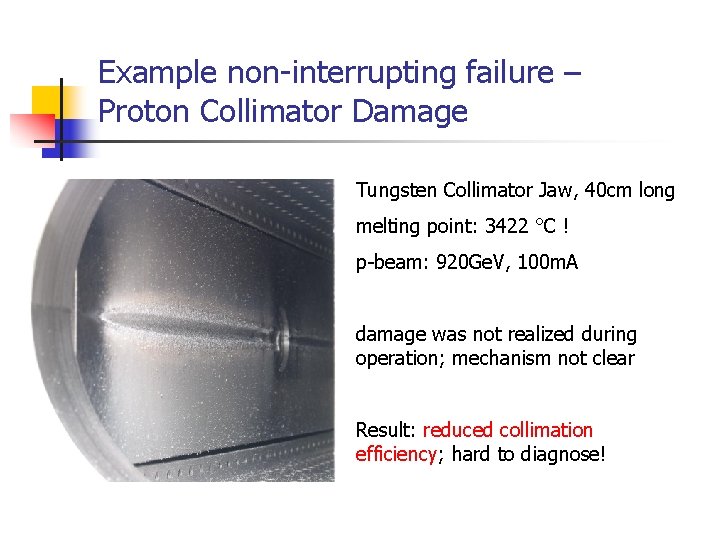
Example non-interrupting failure – Proton Collimator Damage Tungsten Collimator Jaw, 40 cm long melting point: 3422 °C ! p-beam: 920 Ge. V, 100 m. A damage was not realized during operation; mechanism not clear Result: reduced collimation efficiency; hard to diagnose!
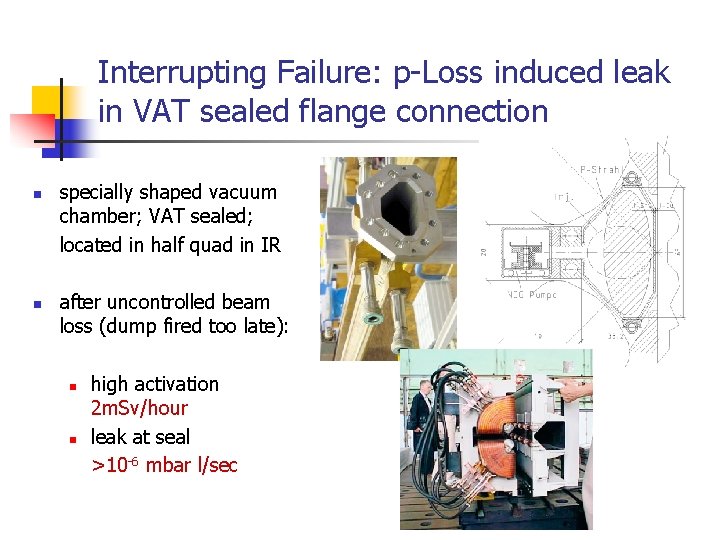
Interrupting Failure: p-Loss induced leak in VAT sealed flange connection n n specially shaped vacuum chamber; VAT sealed; located in half quad in IR after uncontrolled beam loss (dump fired too late): n n high activation 2 m. Sv/hour leak at seal >10 -6 mbar l/sec
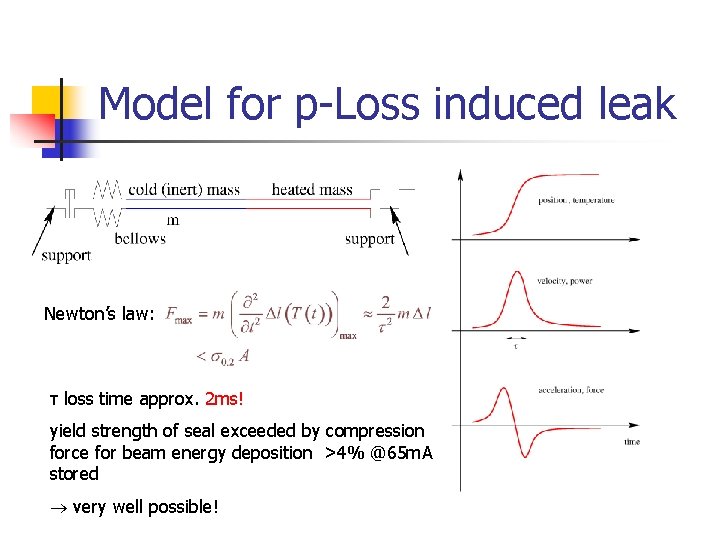
Model for p-Loss induced leak Newton’s law: τ loss time approx. 2 ms! yield strength of seal exceeded by compression force for beam energy deposition >4% @65 m. A stored very well possible!
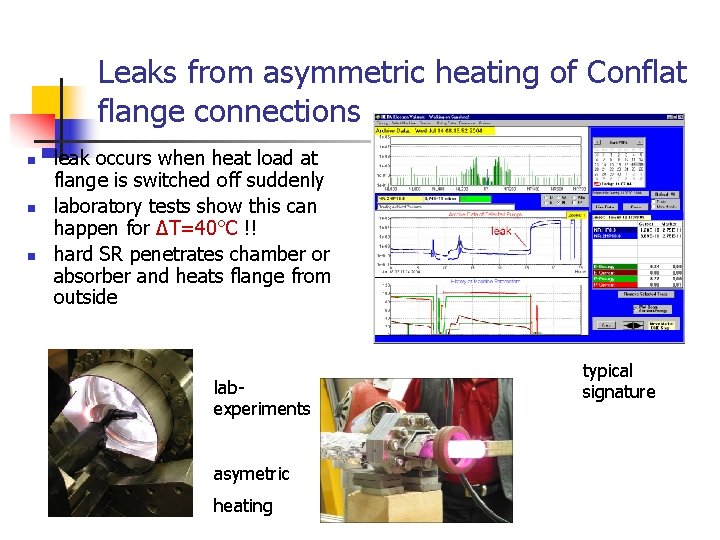
Leaks from asymmetric heating of Conflat flange connections n n n leak occurs when heat load at flange is switched off suddenly laboratory tests show this can happen for ΔT=40°C !! hard SR penetrates chamber or absorber and heats flange from outside labexperiments asymetric heating typical signature
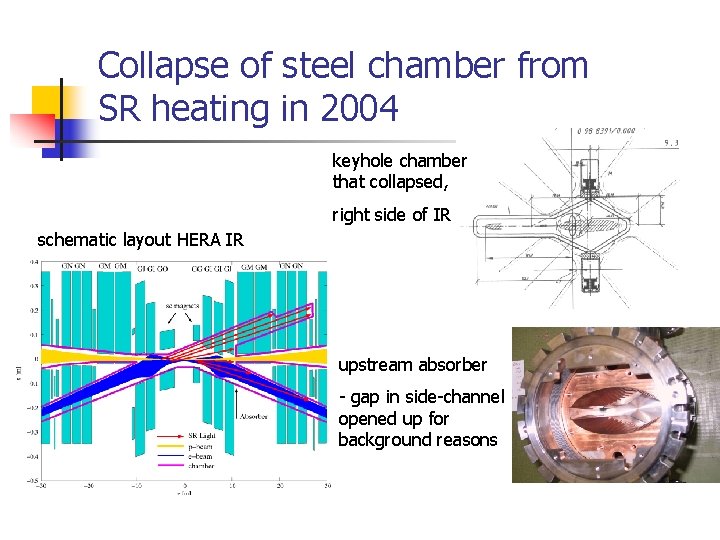
Collapse of steel chamber from SR heating in 2004 keyhole chamber that collapsed, right side of IR schematic layout HERA IR upstream absorber - gap in side-channel opened up for background reasons
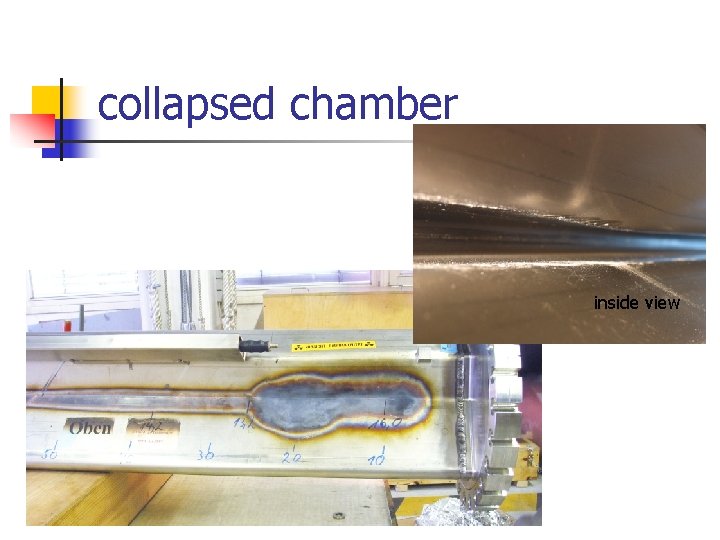
collapsed chamber inside view n n n chamber collapsed from heating by mis-steered SR fan Temperature more than 1000°C orbit feedback failed
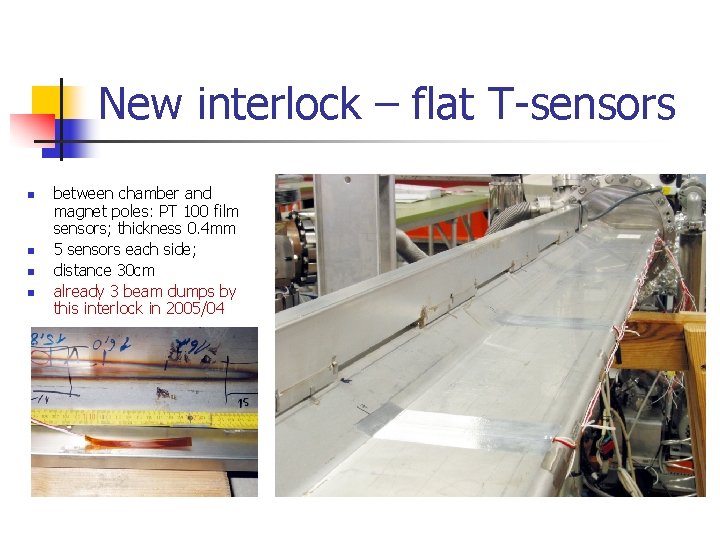
New interlock – flat T-sensors n n between chamber and magnet poles: PT 100 film sensors; thickness 0. 4 mm 5 sensors each side; distance 30 cm already 3 beam dumps by this interlock in 2005/04
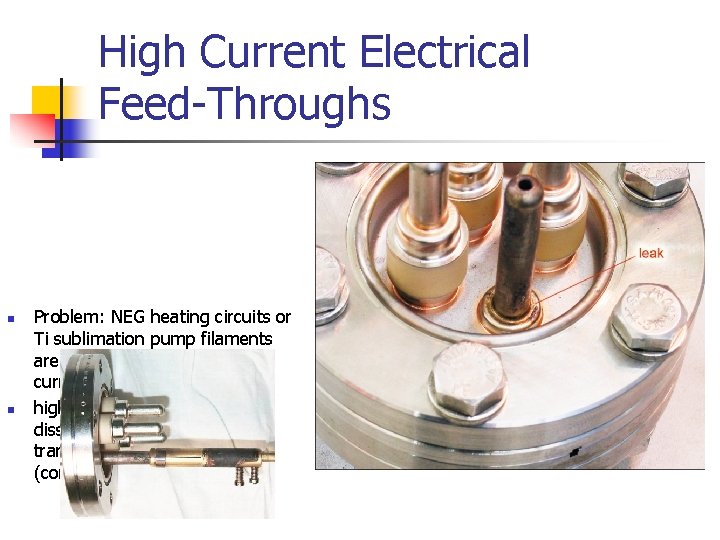
High Current Electrical Feed-Throughs n n Problem: NEG heating circuits or Ti sublimation pump filaments are operated at relatively high currents – 30 -50 Amps high electrical power can be dissipated at shortcuts or transitional resistance (connectors)
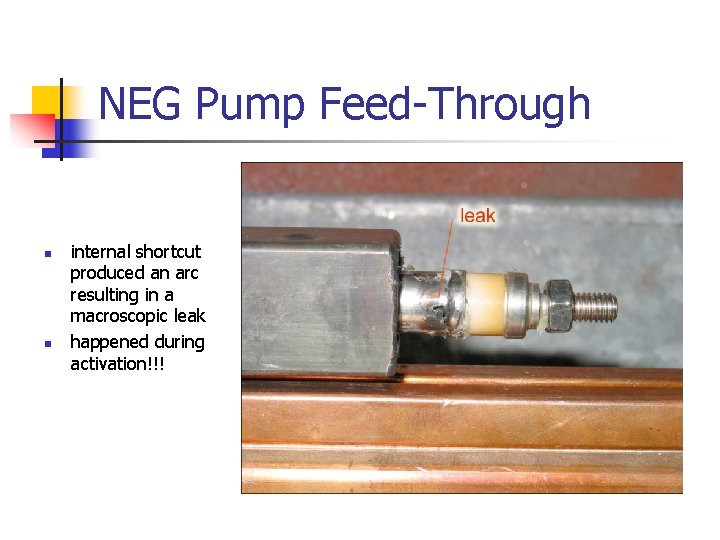
NEG Pump Feed-Through n n internal shortcut produced an arc resulting in a macroscopic leak happened during activation!!!
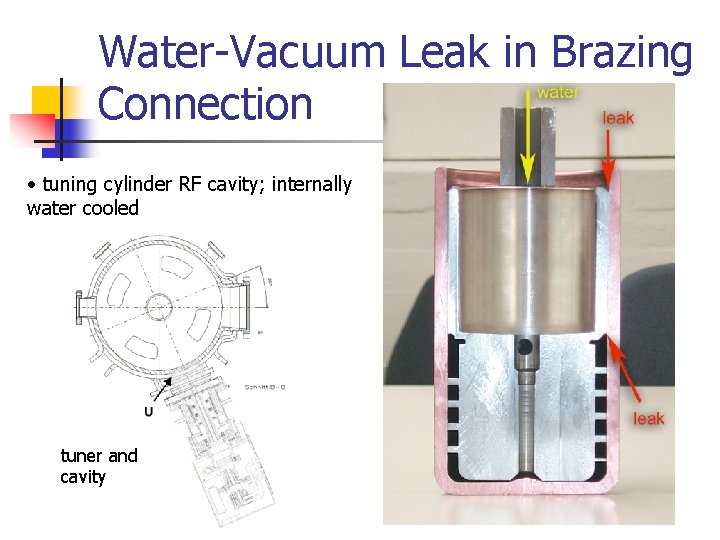
Water-Vacuum Leak in Brazing Connection • tuning cylinder RF cavity; internally water cooled tuner and cavity
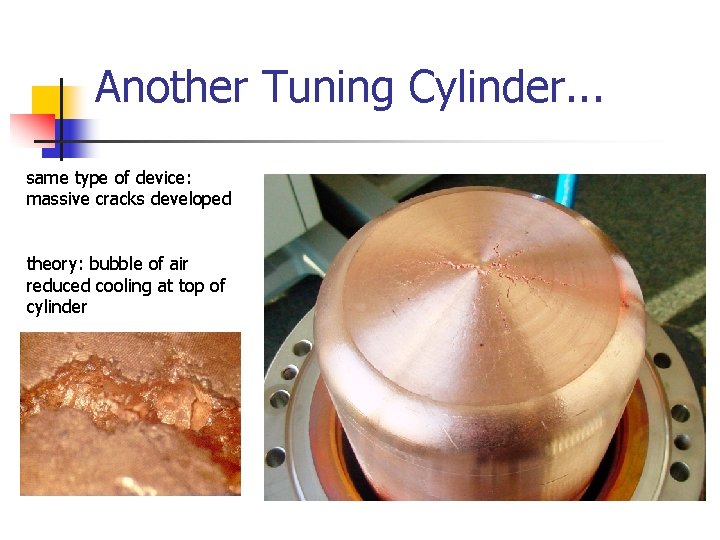
Another Tuning Cylinder. . . same type of device: massive cracks developed theory: bubble of air reduced cooling at top of cylinder
Summary n n n most serious trouble happened with heating by particle beam or SR → build your system passively safe if possible; any orbit that circulates will occur! high current electrical feed-throughs are problematic; especially with a large number of components power supplies and electronics fail most often; however, this does not interrupt operation (mostly)