EER Model Chapter 4 1 4 3 Why
- Slides: 30
EER Model – Chapter 4. 1 -4. 3
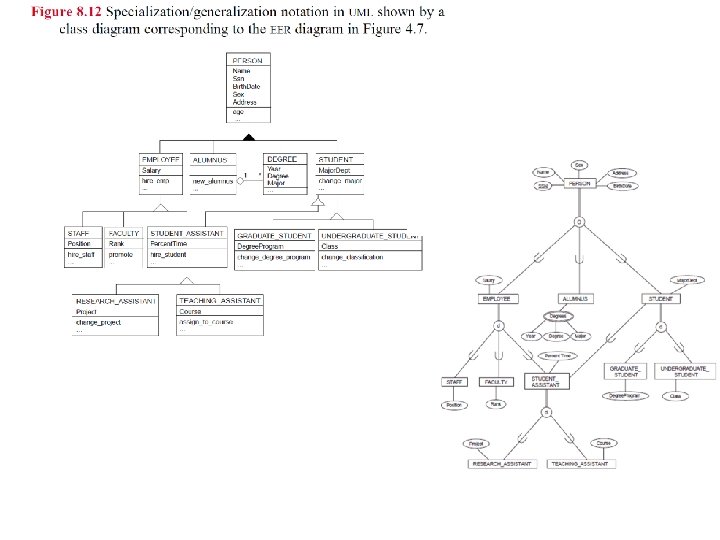
Why EER? -- Enhanced Entity Relationship • There are limitations to the ER model • ER model enhanced (EER) to include: – superclass/subclass relationships – type inheritance – specialization and generalization – constraints
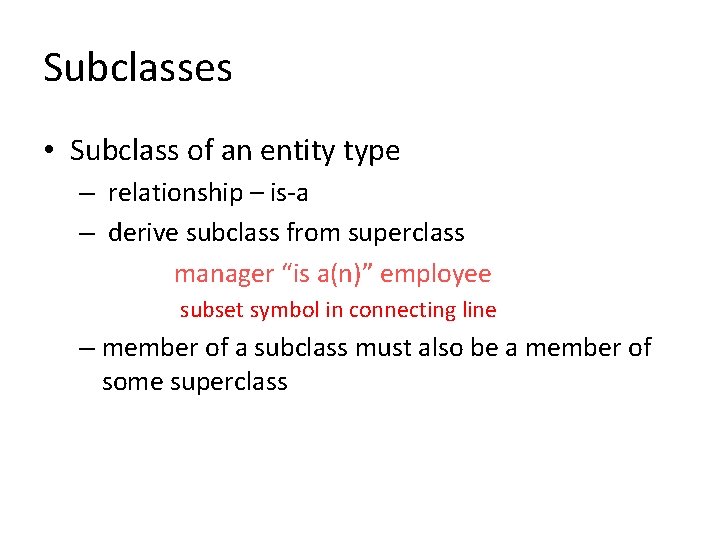
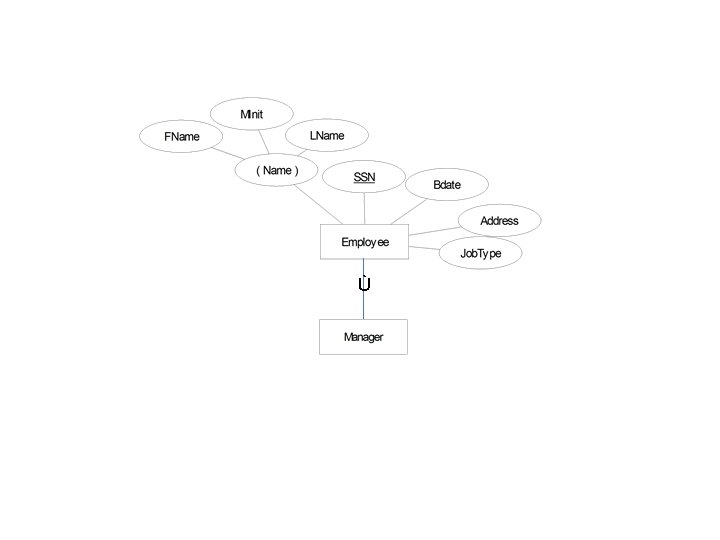
Subclasses • Subclass of an entity type – relationship – is-a – derive subclass from superclass manager “is a(n)” employee subset symbol in connecting line – member of a subclass must also be a member of some superclass
Type inheritance • inherit all attributes of superclass • useful for modeling, convenience
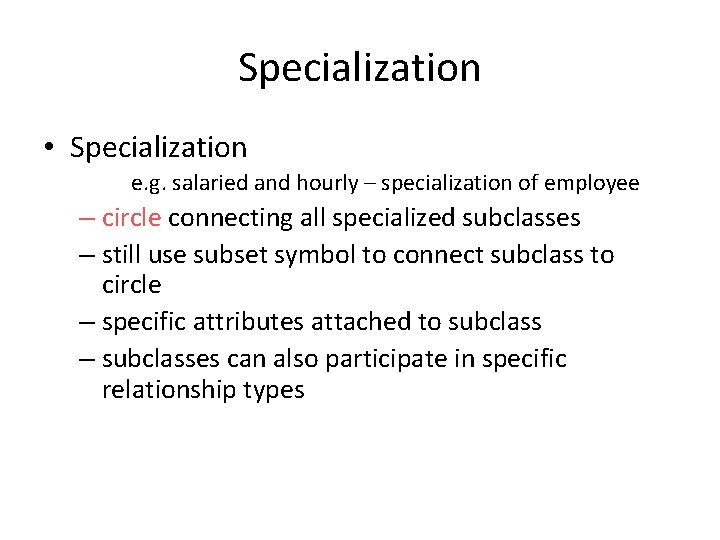
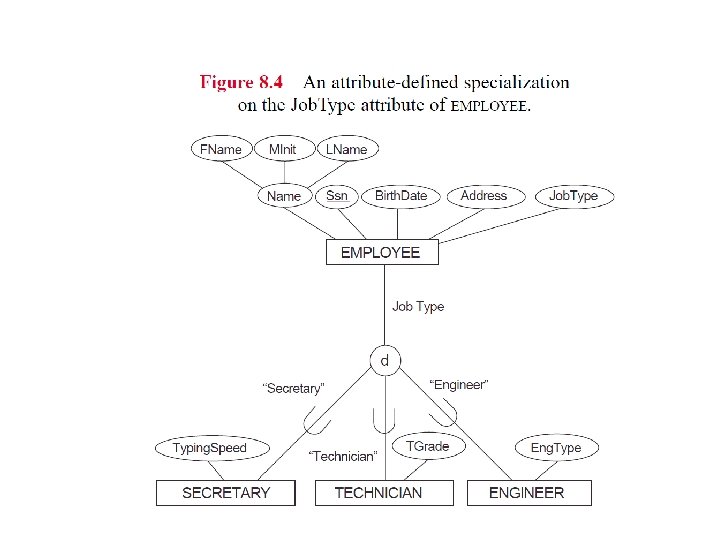
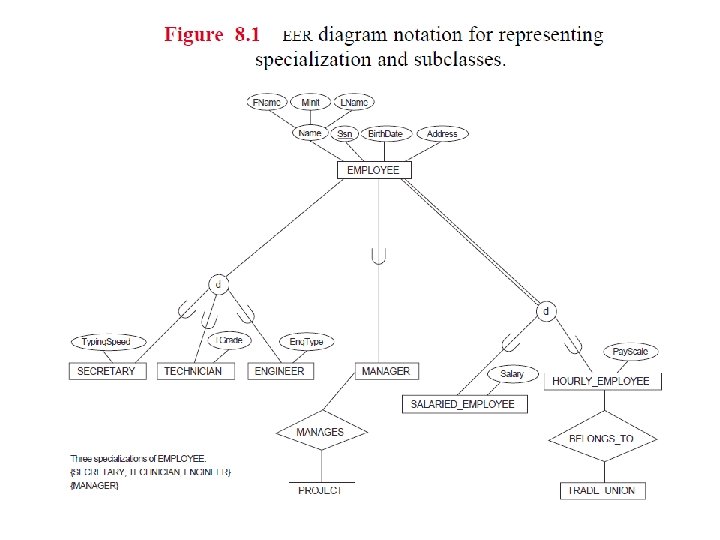
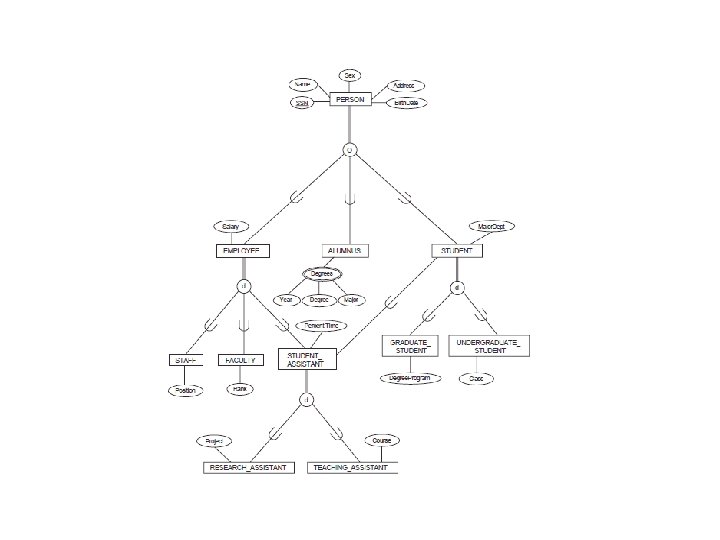
Specialization • Specialization e. g. salaried and hourly – specialization of employee – circle connecting all specialized subclasses – still use subset symbol to connect subclass to circle – specific attributes attached to subclass – subclasses can also participate in specific relationship types
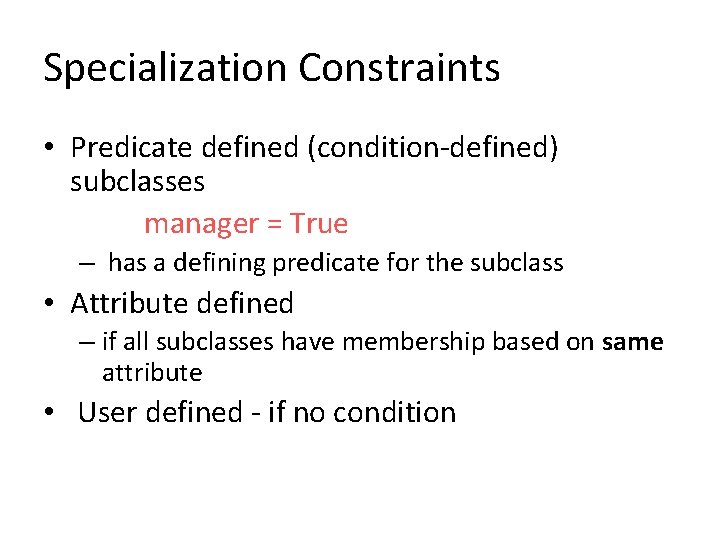
Specialization Constraints • Predicate defined (condition-defined) subclasses manager = True – has a defining predicate for the subclass • Attribute defined – if all subclasses have membership based on same attribute • User defined - if no condition
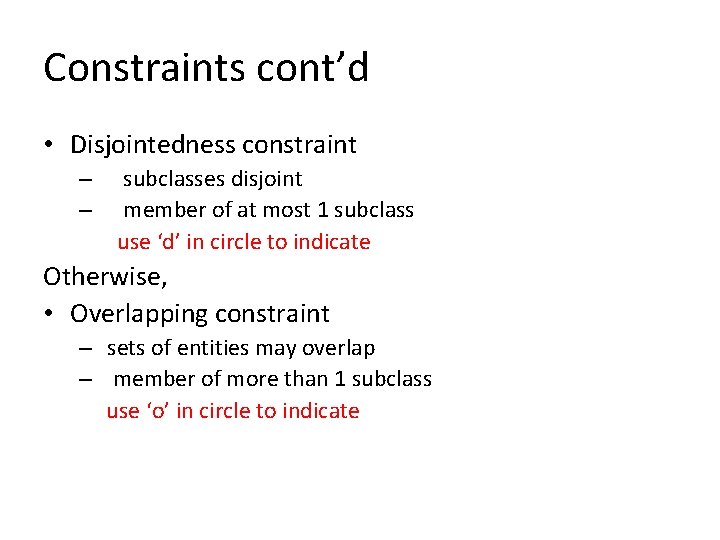
Constraints cont’d • Disjointedness constraint – subclasses disjoint – member of at most 1 subclass use ‘d’ in circle to indicate Otherwise, • Overlapping constraint – sets of entities may overlap – member of more than 1 subclass use ‘o’ in circle to indicate
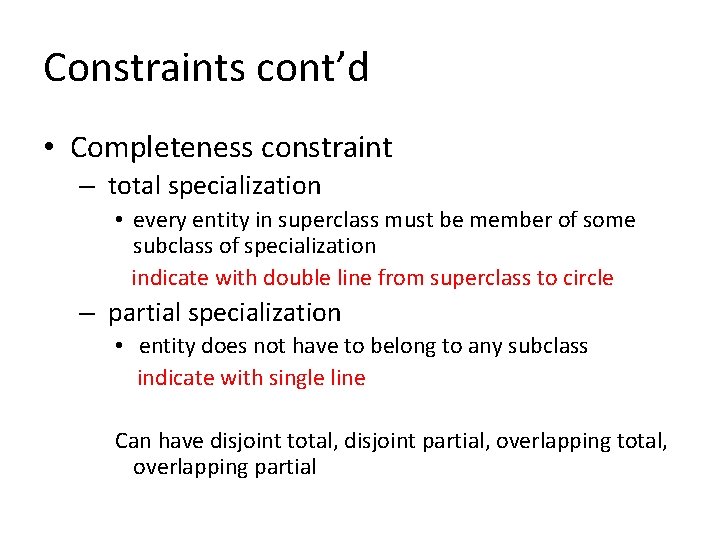
Constraints cont’d • Completeness constraint – total specialization • every entity in superclass must be member of some subclass of specialization indicate with double line from superclass to circle – partial specialization • entity does not have to belong to any subclass indicate with single line Can have disjoint total, disjoint partial, overlapping total, overlapping partial
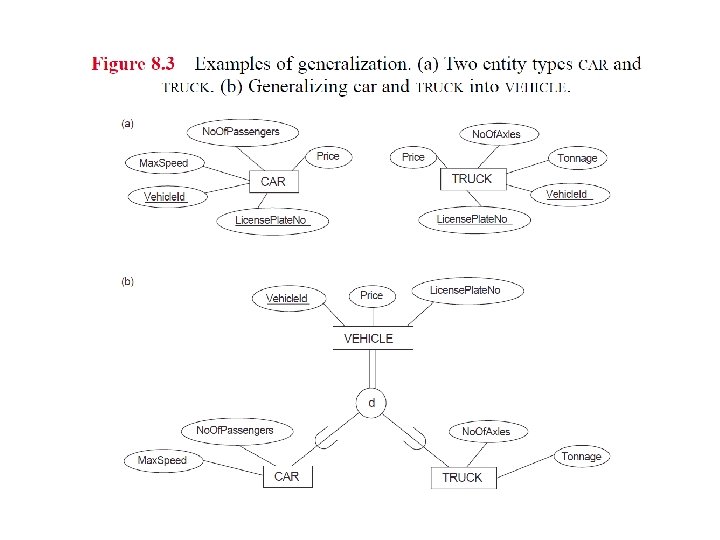
Generalization • Generalization of entity types into a single superclass vehicle is generalization of car, truck
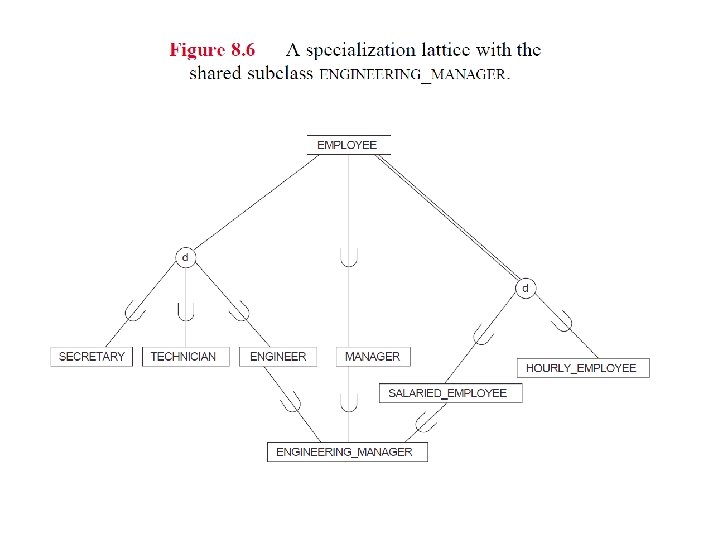
Specialization/Generalization Lattice • a class can be a subclass in more then one class/subclass relationship • an entity may exist in several leaf nodes • multiple inheritance
• Add subclasses to employee – Manager, supervisor
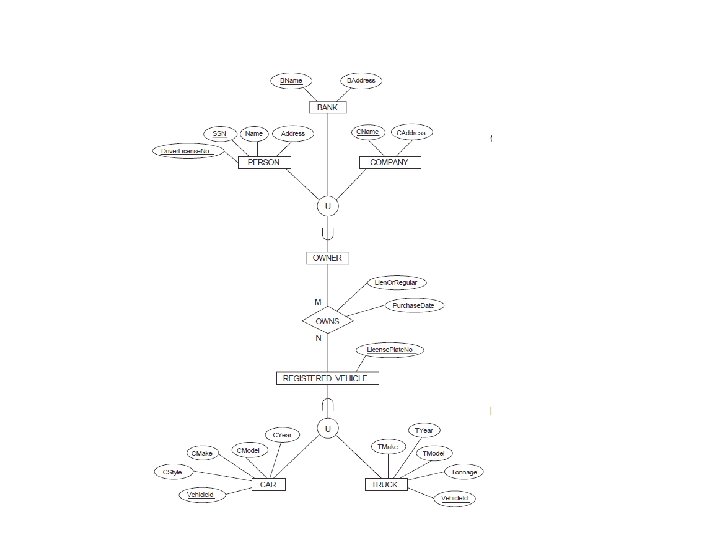
Union Types Union of objects of different entity types (superclasses) • Union type is a subclass of a collection of objects that is a subset of the union of its superclasses – Union means can only be a member of one of the superclasses • Different from multiple inheritance, which was subset of intersection of superclasses, e. g. was an engineer and a manager and a salaried employee – Can only inherit attributes from one superclass, not all – Can even have different key attributes, depending on which inherit from
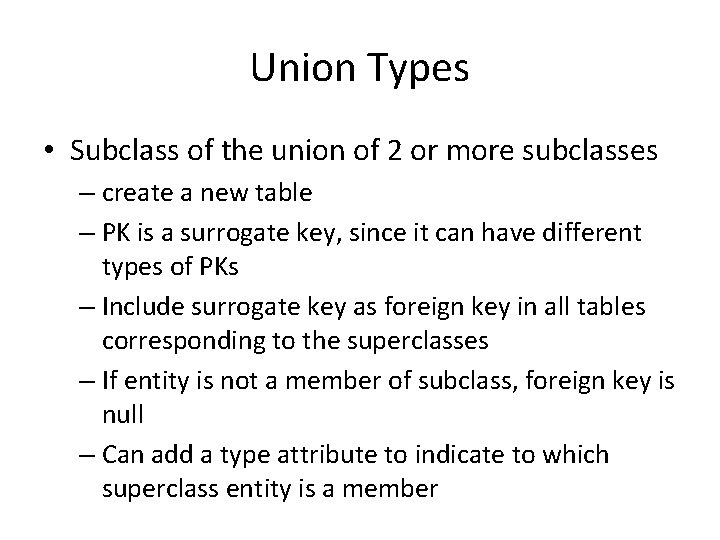
Union Types • Subclass of the union of 2 or more subclasses – create a new table – PK is a surrogate key, since it can have different types of PKs – Include surrogate key as foreign key in all tables corresponding to the superclasses – If entity is not a member of subclass, foreign key is null – Can add a type attribute to indicate to which superclass entity is a member
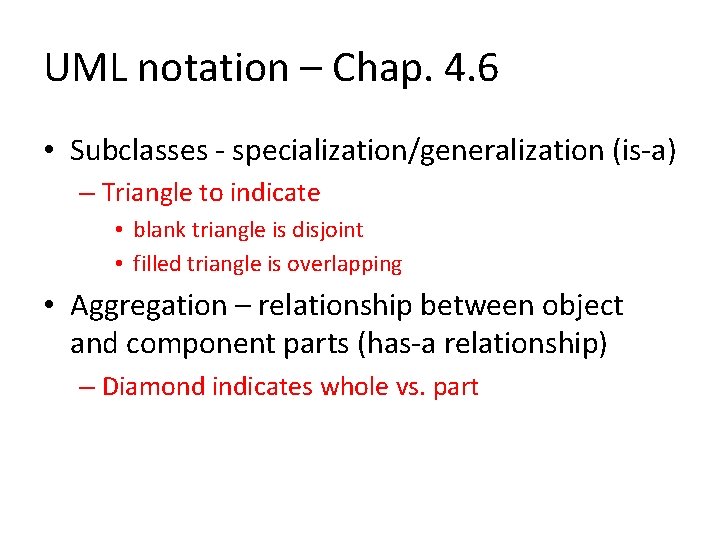
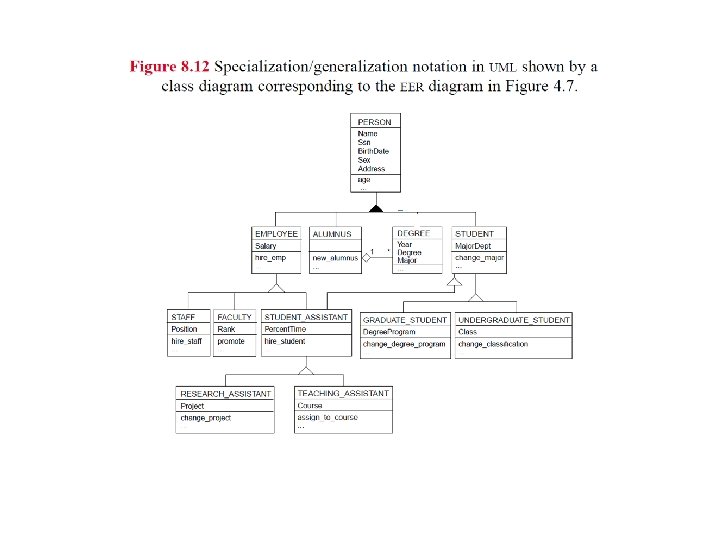
UML notation – Chap. 4. 6 • Subclasses - specialization/generalization (is-a) – Triangle to indicate • blank triangle is disjoint • filled triangle is overlapping • Aggregation – relationship between object and component parts (has-a relationship) – Diamond indicates whole vs. part
• The remaining slides will be discussed later
Step 8 - Mapping EER model concepts to Relations • Superclass/Subclass and Specialization/Generalization – Convert each specialization with m subclasses • {S 1, S 2, . . Sm} – and superclass C where attributes of C are: • {PK, A 1, . . . An} – Using 1 of the following options:
Option 1 (Option A in book) • Create a new relation L with attributes of C • Create new relations Li for each subclass Si with attributes {PK} U {attr. of Si}
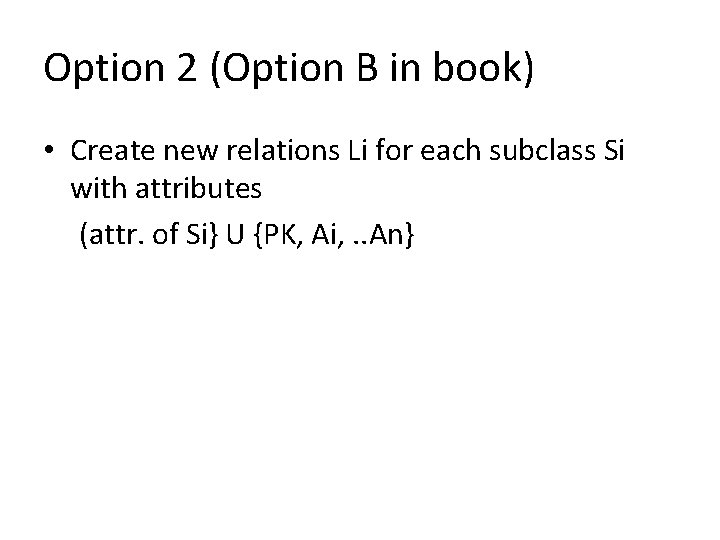
Option 2 (Option B in book) • Create new relations Li for each subclass Si with attributes (attr. of Si} U {PK, Ai, . . An}
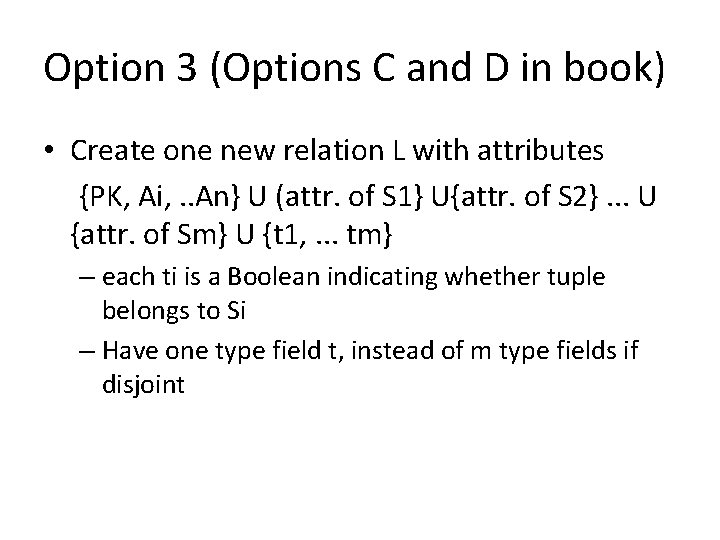
Option 3 (Options C and D in book) • Create one new relation L with attributes {PK, Ai, . . An} U (attr. of S 1} U{attr. of S 2}. . . U {attr. of Sm} U {t 1, . . . tm} – each ti is a Boolean indicating whether tuple belongs to Si – Have one type field t, instead of m type fields if disjoint
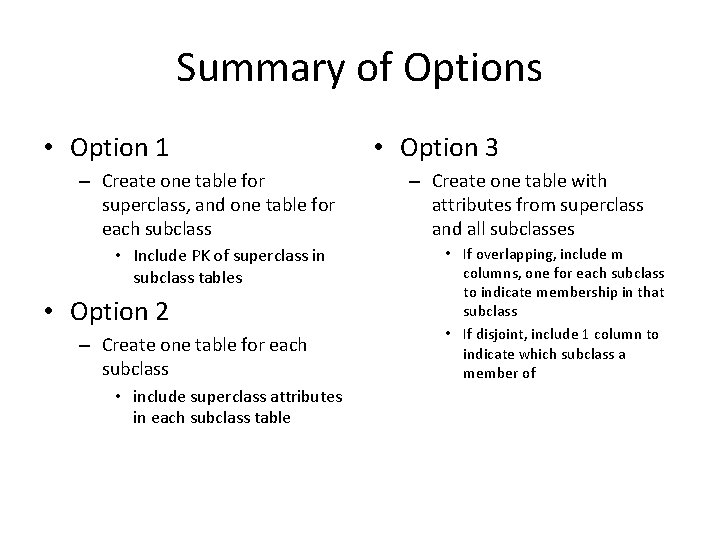
Summary of Options • Option 1 – Create one table for superclass, and one table for each subclass • Include PK of superclass in subclass tables • Option 2 – Create one table for each subclass • include superclass attributes in each subclass table • Option 3 – Create one table with attributes from superclass and all subclasses • If overlapping, include m columns, one for each subclass to indicate membership in that subclass • If disjoint, include 1 column to indicate which subclass a member of
• Which option is better/worse under which circumstances?