
MEASUREMENT OF ENERGY REQUIREMENTS Kartika Nugraheni The total
![BAYI – rumus cepat UMUR (bulan) EER (kcal/hari) 0 -3 (89 x BB [kg])](https://slidetodoc.com/presentation_image/523fe73b87a9bb7e59743bd2b8dcb34f/image-13.jpg "BAYI – rumus cepat UMUR (bulan) EER (kcal/hari) 0 -3 (89 x BB [kg])")
![LAKI-LAKI TEE = 114 - (50, 9 x umur [tahun]) + PA x (19,](https://slidetodoc.com/presentation_image/523fe73b87a9bb7e59743bd2b8dcb34f/image-20.jpg "LAKI-LAKI TEE = 114 - (50, 9 x umur [tahun]) + PA x (19,")
![LAKI-LAKI BEE = 420 - (33, 5 x umur [tahun]) + 418, 9 x](https://slidetodoc.com/presentation_image/523fe73b87a9bb7e59743bd2b8dcb34f/image-21.jpg "LAKI-LAKI BEE = 420 - (33, 5 x umur [tahun]) + 418, 9 x")
- Slides: 46
MEASUREMENT OF ENERGY REQUIREMENTS Kartika Nugraheni
• The total amount of energy required by an individual consists of three basic components: 1. basal energy expenditure (BEE) or basal metabolic rate (BMR) 2. energy for physical activity or excercise (PA) 3. thermic effect of food (TEF) • Basal enery expenditure accounts for approximately 60% of an individual’s energy requirement
• Resting Metabolic Rate (RMR) and Basal Metabolic Rate (BMR) are measures of resting energy expenditure, which can be helpful in assisting patients with weight loss. BMR and RMR represent the minimum amount of energy required to keep your body functioning, including your heart beating, lungs breathing, and maintaining normal body temperature. Although the terms BMR and RMR are sometimes used interchangeably, they are measured under different conditions and have slightly different interpretation.
• Both BMR, and RMR, estimate the number of calories you burn at rest, but RMR takes additional factors into consideration when determining needs. • BMR measures your basal energy expenditure, or BEE. The BEE is a 24 hour estimation of the number of calories you burn maintaining your most basic bodily functions, such as breathing, circulating blood and growing and repairing cells. • RMR measures your resting energy expenditure. REE determines the number of calories you burn in a 24 hour period maintaining basic bodily functions, but also includes the number of calories burned eating and conducting small amounts of activity. • When comparing calorie estimations, RMR is slightly higher than BMR, but the difference is less than 10 percent (National Research Council). • The Harris-Benedict equation is used to estimate BMR, while the Mifflin-St Jeor equation is used to estimate RMR.
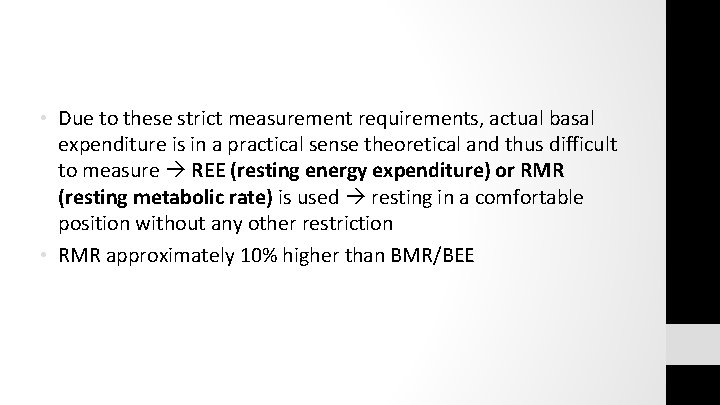
• Due to these strict measurement requirements, actual basal expenditure is in a practical sense theoretical and thus difficult to measure REE (resting energy expenditure) or RMR (resting metabolic rate) is used resting in a comfortable position without any other restriction • RMR approximately 10% higher than BMR/BEE
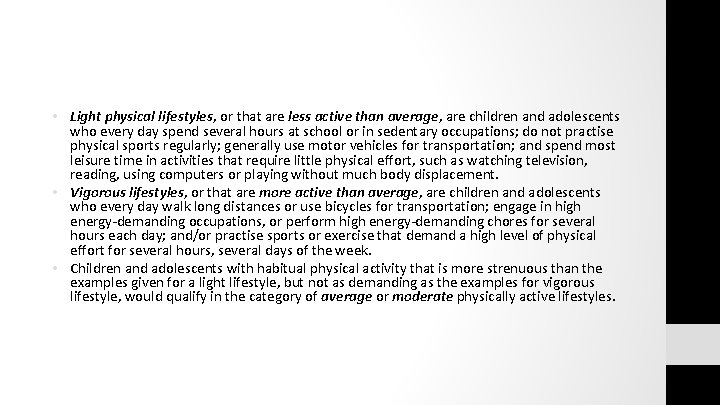
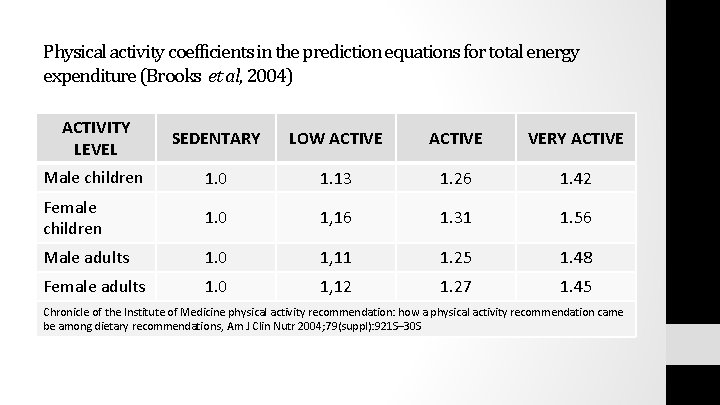
• Light physical lifestyles, or that are less active than average, are children and adolescents who every day spend several hours at school or in sedentary occupations; do not practise physical sports regularly; generally use motor vehicles for transportation; and spend most leisure time in activities that require little physical effort, such as watching television, reading, using computers or playing without much body displacement. • Vigorous lifestyles, or that are more active than average, are children and adolescents who every day walk long distances or use bicycles for transportation; engage in high energy-demanding occupations, or perform high energy-demanding chores for several hours each day; and/or practise sports or exercise that demand a high level of physical effort for several hours, several days of the week. • Children and adolescents with habitual physical activity that is more strenuous than the examples given for a light lifestyle, but not as demanding as the examples for vigorous lifestyle, would qualify in the category of average or moderate physically active lifestyles.
Physical activity coefficients in the prediction equations for total energy expenditure (Brooks et al, 2004) ACTIVITY LEVEL SEDENTARY LOW ACTIVE VERY ACTIVE Male children 1. 0 1. 13 1. 26 1. 42 Female children 1. 0 1, 16 1. 31 1. 56 Male adults 1. 0 1, 11 1. 25 1. 48 Female adults 1. 0 1, 12 1. 27 1. 45 Chronicle of the Institute of Medicine physical activity recommendation: how a physical activity recommendation came be among dietary recommendations, Am J Clin Nutr 2004; 79(suppl): 921 S– 30 S
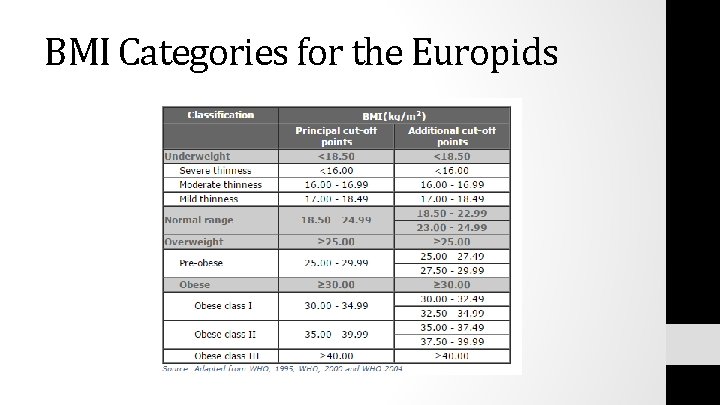
BMI Categories for the Europids
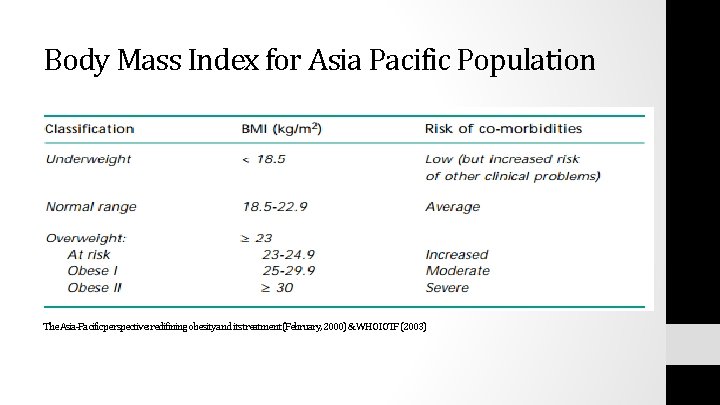
Body Mass Index for Asia Pacific Population The Asia-Pacific perspective: redifining obesity and its treatment (February, 2000) & WHO IOTF (2003)
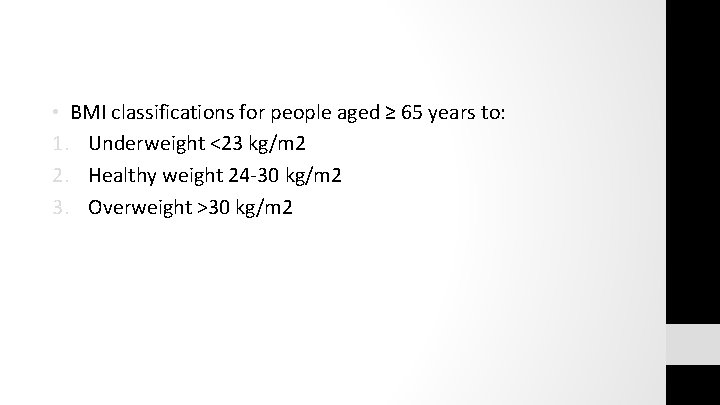
• BMI classifications for people aged ≥ 65 years to: 1. Underweight <23 kg/m 2 2. Healthy weight 24 -30 kg/m 2 3. Overweight >30 kg/m 2
1. BAYI 2. ANAK & REMAJA 3. DEWASA 4. LANSIA
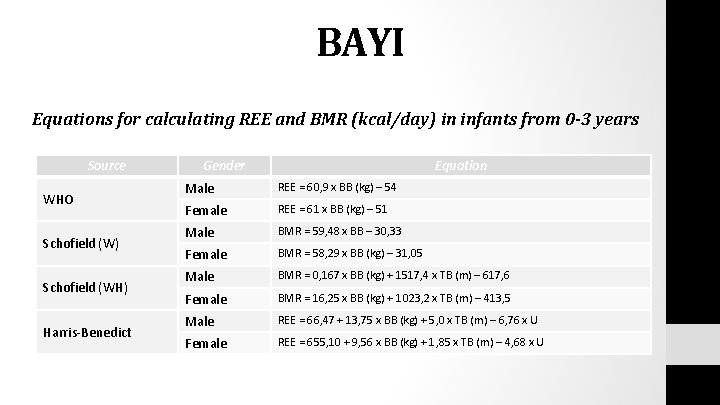
BAYI Equations for calculating REE and BMR (kcal/day) in infants from 0 -3 years Source WHO Schofield (W) Schofield (WH) Harris-Benedict Gender Equation Male REE = 60, 9 x BB (kg) – 54 Female REE = 61 x BB (kg) – 51 Male BMR = 59, 48 x BB – 30, 33 Female BMR = 58, 29 x BB (kg) – 31, 05 Male BMR = 0, 167 x BB (kg) + 1517, 4 x TB (m) – 617, 6 Female BMR = 16, 25 x BB (kg) + 1023, 2 x TB (m) – 413, 5 Male REE = 66, 47 + 13, 75 x BB (kg) + 5, 0 x TB (m) – 6, 76 x U Female REE = 655, 10 + 9, 56 x BB (kg) + 1, 85 x TB (m) – 4, 68 x U
BAYI – rumus cepat UMUR (bulan) EER (kcal/hari) 0 -3 (89 x BB [kg]) + 75 4 -6 (89 x BB [kg]) + 44 7 -12 (89 x BB [kg]) + 78 13 -36 (89 x BB [kg]) - 80
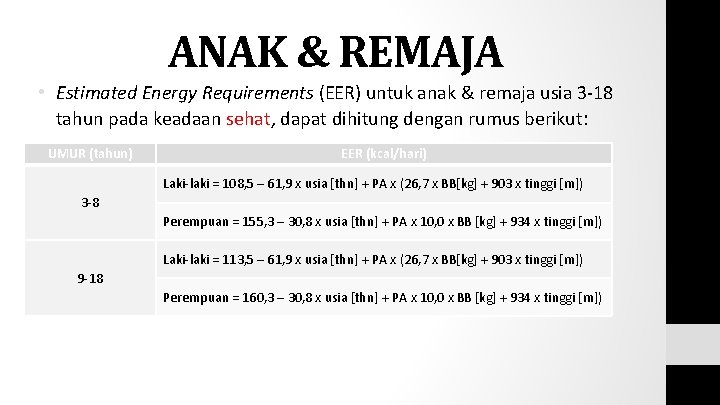
ANAK & REMAJA • Estimated Energy Requirements (EER) untuk anak & remaja usia 3 -18 tahun pada keadaan sehat, dapat dihitung dengan rumus berikut: UMUR (tahun) EER (kcal/hari) Laki-laki = 108, 5 – 61, 9 x usia [thn] + PA x (26, 7 x BB[kg] + 903 x tinggi [m]) 3 -8 Perempuan = 155, 3 – 30, 8 x usia [thn] + PA x 10, 0 x BB [kg] + 934 x tinggi [m]) Laki-laki = 113, 5 – 61, 9 x usia [thn] + PA x (26, 7 x BB[kg] + 903 x tinggi [m]) 9 -18 Perempuan = 160, 3 – 30, 8 x usia [thn] + PA x 10, 0 x BB [kg] + 934 x tinggi [m])
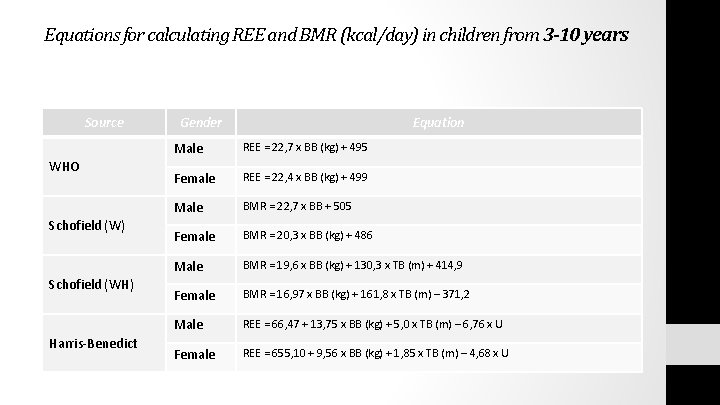
Equations for calculating REE and BMR (kcal/day) in children from 3 -10 years Source WHO Schofield (W) Schofield (WH) Harris-Benedict Gender Equation Male REE = 22, 7 x BB (kg) + 495 Female REE = 22, 4 x BB (kg) + 499 Male BMR = 22, 7 x BB + 505 Female BMR = 20, 3 x BB (kg) + 486 Male BMR = 19, 6 x BB (kg) + 130, 3 x TB (m) + 414, 9 Female BMR = 16, 97 x BB (kg) + 161, 8 x TB (m) – 371, 2 Male REE = 66, 47 + 13, 75 x BB (kg) + 5, 0 x TB (m) – 6, 76 x U Female REE = 655, 10 + 9, 56 x BB (kg) + 1, 85 x TB (m) – 4, 68 x U
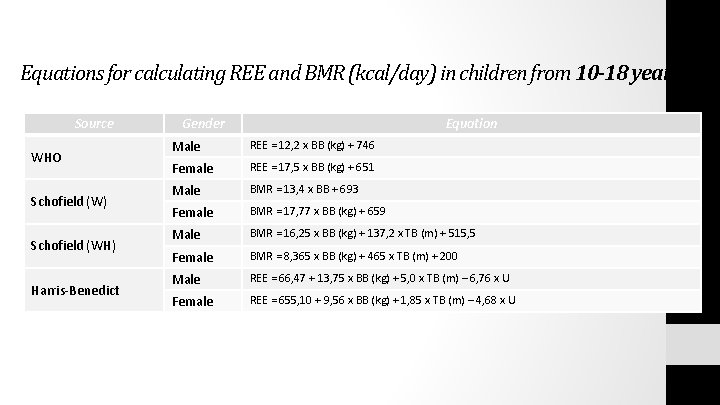
Equations for calculating REE and BMR (kcal/day) in children from 10 -18 years Source WHO Schofield (W) Schofield (WH) Harris-Benedict Gender Equation Male REE = 12, 2 x BB (kg) + 746 Female REE = 17, 5 x BB (kg) + 651 Male BMR = 13, 4 x BB + 693 Female BMR = 17, 77 x BB (kg) + 659 Male BMR = 16, 25 x BB (kg) + 137, 2 x TB (m) + 515, 5 Female BMR = 8, 365 x BB (kg) + 465 x TB (m) + 200 Male REE = 66, 47 + 13, 75 x BB (kg) + 5, 0 x TB (m) – 6, 76 x U Female REE = 655, 10 + 9, 56 x BB (kg) + 1, 85 x TB (m) – 4, 68 x U
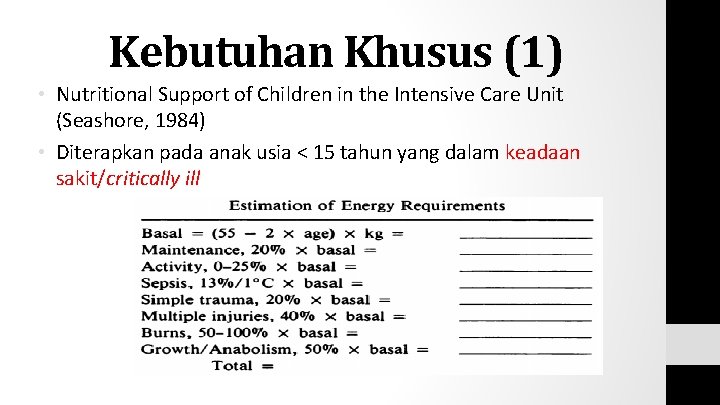
Kebutuhan Khusus (1) • Nutritional Support of Children in the Intensive Care Unit (Seashore, 1984) • Diterapkan pada anak usia < 15 tahun yang dalam keadaan sakit/critically ill
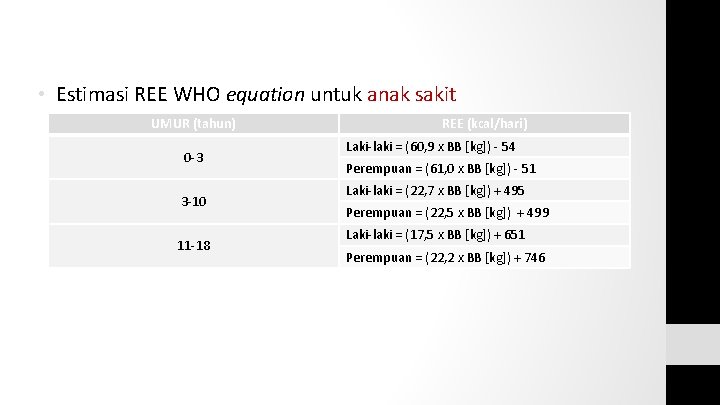
• Estimasi REE WHO equation untuk anak sakit UMUR (tahun) 0 -3 3 -10 11 -18 REE (kcal/hari) Laki-laki = (60, 9 x BB [kg]) - 54 Perempuan = (61, 0 x BB [kg]) - 51 Laki-laki = (22, 7 x BB [kg]) + 495 Perempuan = (22, 5 x BB [kg]) + 499 Laki-laki = (17, 5 x BB [kg]) + 651 Perempuan = (22, 2 x BB [kg]) + 746
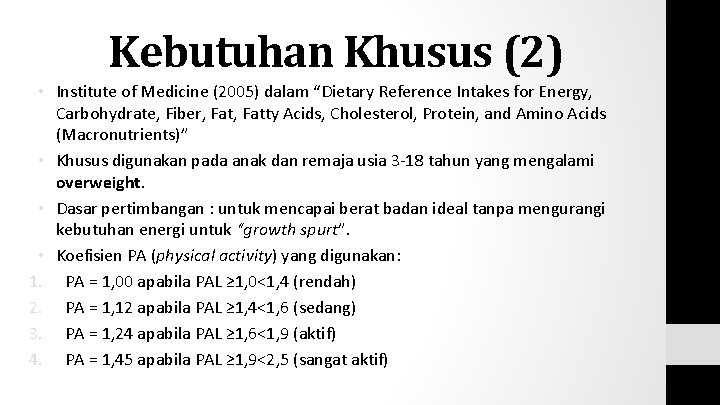
Kebutuhan Khusus (2) • Institute of Medicine (2005) dalam “Dietary Reference Intakes for Energy, Carbohydrate, Fiber, Fatty Acids, Cholesterol, Protein, and Amino Acids (Macronutrients)” • Khusus digunakan pada anak dan remaja usia 3 -18 tahun yang mengalami overweight. • Dasar pertimbangan : untuk mencapai berat badan ideal tanpa mengurangi kebutuhan energi untuk “growth spurt”. • Koefisien PA (physical activity) yang digunakan: 1. PA = 1, 00 apabila PAL ≥ 1, 0<1, 4 (rendah) 2. PA = 1, 12 apabila PAL ≥ 1, 4<1, 6 (sedang) 3. PA = 1, 24 apabila PAL ≥ 1, 6<1, 9 (aktif) 4. PA = 1, 45 apabila PAL ≥ 1, 9<2, 5 (sangat aktif)
LAKI-LAKI TEE = 114 - (50, 9 x umur [tahun]) + PA x (19, 5 x BB [kg] + 1161, 4 x TB [m]) PEREMPUAN TEE = 389 - (41, 2 x umur [tahun]) + PA x (15 x BB [kg] + 701, 6 x TB [m]) TEE = Total Energy Expenditure
LAKI-LAKI BEE = 420 - (33, 5 x umur [tahun]) + 418, 9 x TB [m] + 16, 7 x BB [kg] PEREMPUAN BEE = 516 - (26, 8 x umur [tahun]) + 347 x TB [m] + 12, 4 x BB [kg] BEE = Basal Energy Expenditure
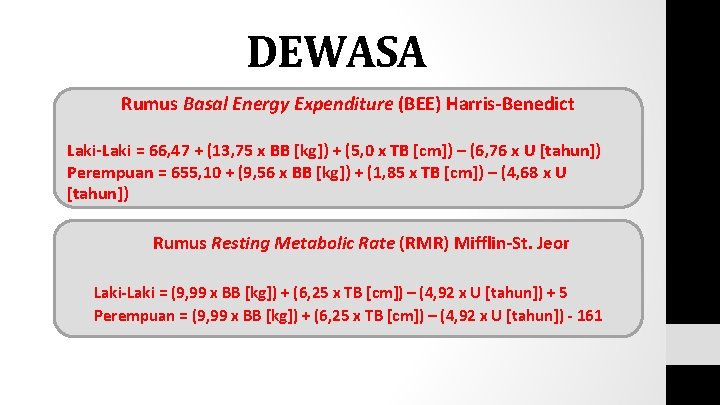
DEWASA Rumus Basal Energy Expenditure (BEE) Harris-Benedict Laki-Laki = 66, 47 + (13, 75 x BB [kg]) + (5, 0 x TB [cm]) – (6, 76 x U [tahun]) Perempuan = 655, 10 + (9, 56 x BB [kg]) + (1, 85 x TB [cm]) – (4, 68 x U [tahun]) • Rumus Resting Metabolic Rate (RMR) Mifflin-St. Jeor • Laki-Laki = (9, 99 x BB [kg]) + (6, 25 x TB [cm]) – (4, 92 x U [tahun]) + 5 • Perempuan = (9, 99 x BB [kg]) + (6, 25 x TB [cm]) – (4, 92 x U [tahun]) - 161
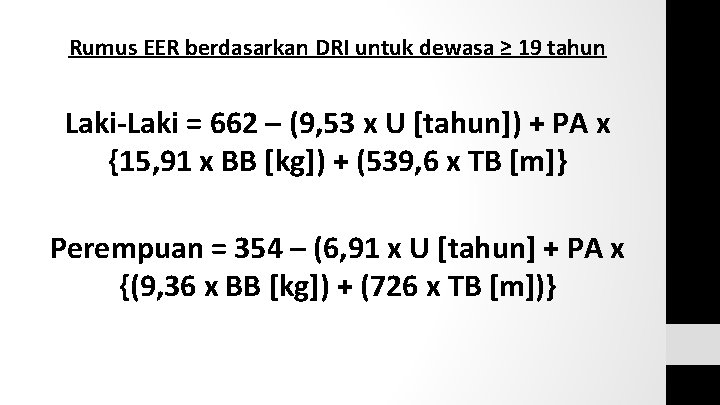
Rumus EER berdasarkan DRI untuk dewasa ≥ 19 tahun Laki-Laki = 662 – (9, 53 x U [tahun]) + PA x {15, 91 x BB [kg]) + (539, 6 x TB [m]} Perempuan = 354 – (6, 91 x U [tahun] + PA x {(9, 36 x BB [kg]) + (726 x TB [m])}
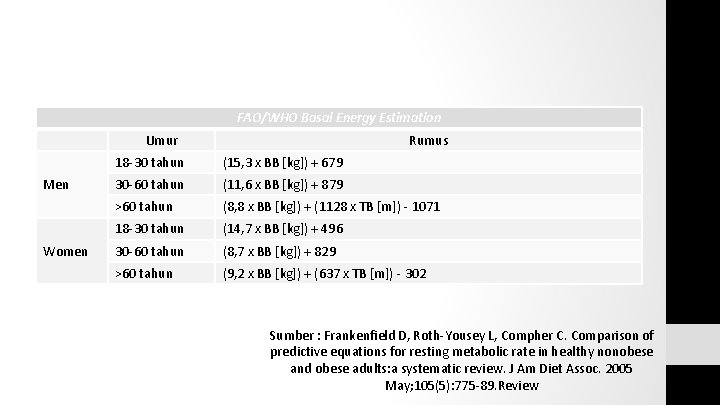
FAO/WHO Basal Energy Estimation Umur Men Women Rumus 18 -30 tahun (15, 3 x BB [kg]) + 679 30 -60 tahun (11, 6 x BB [kg]) + 879 >60 tahun (8, 8 x BB [kg]) + (1128 x TB [m]) - 1071 18 -30 tahun (14, 7 x BB [kg]) + 496 30 -60 tahun (8, 7 x BB [kg]) + 829 >60 tahun (9, 2 x BB [kg]) + (637 x TB [m]) - 302 Sumber : Frankenfield D, Roth-Yousey L, Compher C. Comparison of predictive equations for resting metabolic rate in healthy nonobese and obese adults: a systematic review. J Am Diet Assoc. 2005 May; 105(5): 775 -89. Review
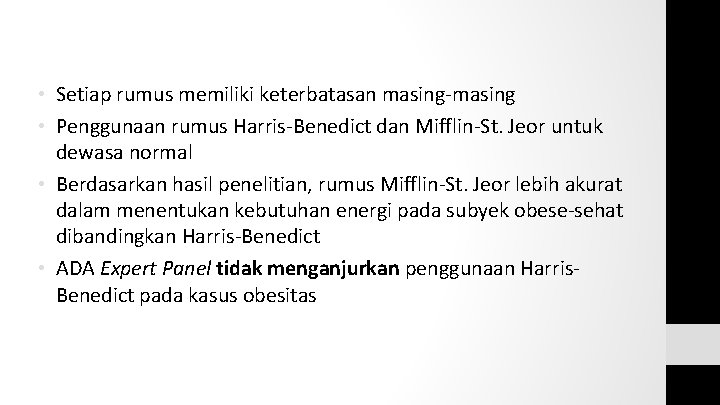
• Setiap rumus memiliki keterbatasan masing-masing • Penggunaan rumus Harris-Benedict dan Mifflin-St. Jeor untuk dewasa normal • Berdasarkan hasil penelitian, rumus Mifflin-St. Jeor lebih akurat dalam menentukan kebutuhan energi pada subyek obese-sehat dibandingkan Harris-Benedict • ADA Expert Panel tidak menganjurkan penggunaan Harris. Benedict pada kasus obesitas
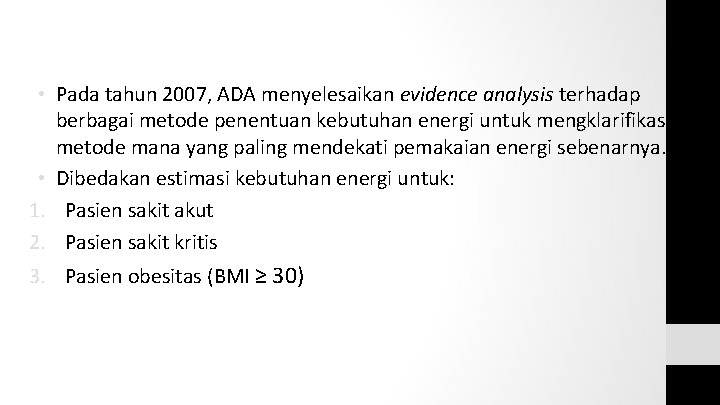
• Pada tahun 2007, ADA menyelesaikan evidence analysis terhadap berbagai metode penentuan kebutuhan energi untuk mengklarifikasi metode mana yang paling mendekati pemakaian energi sebenarnya. • Dibedakan estimasi kebutuhan energi untuk: 1. Pasien sakit akut 2. Pasien sakit kritis 3. Pasien obesitas (BMI ≥ 30)
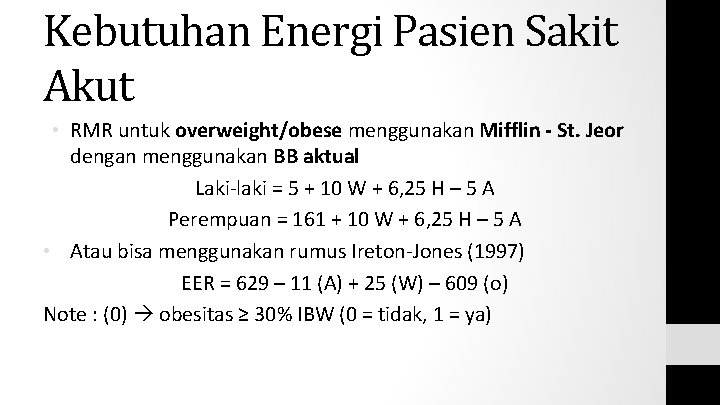
Kebutuhan Energi Pasien Sakit Akut • RMR untuk overweight/obese menggunakan Mifflin - St. Jeor dengan menggunakan BB aktual Laki-laki = 5 + 10 W + 6, 25 H – 5 A Perempuan = 161 + 10 W + 6, 25 H – 5 A • Atau bisa menggunakan rumus Ireton-Jones (1997) EER = 629 – 11 (A) + 25 (W) – 609 (o) Note : (0) obesitas ≥ 30% IBW (0 = tidak, 1 = ya)
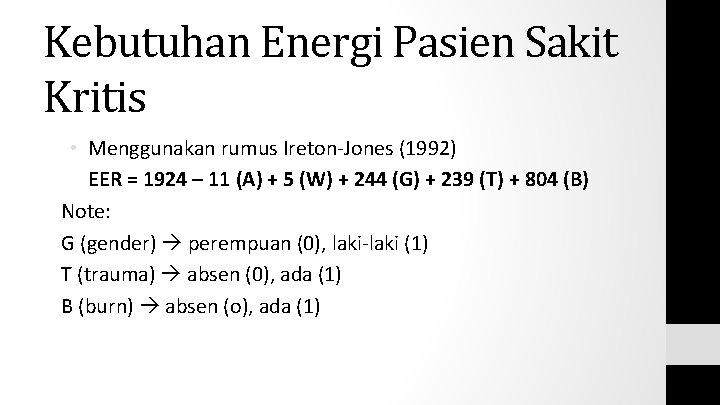
Kebutuhan Energi Pasien Sakit Kritis • Menggunakan rumus Ireton-Jones (1992) EER = 1924 – 11 (A) + 5 (W) + 244 (G) + 239 (T) + 804 (B) Note: G (gender) perempuan (0), laki-laki (1) T (trauma) absen (0), ada (1) B (burn) absen (o), ada (1)
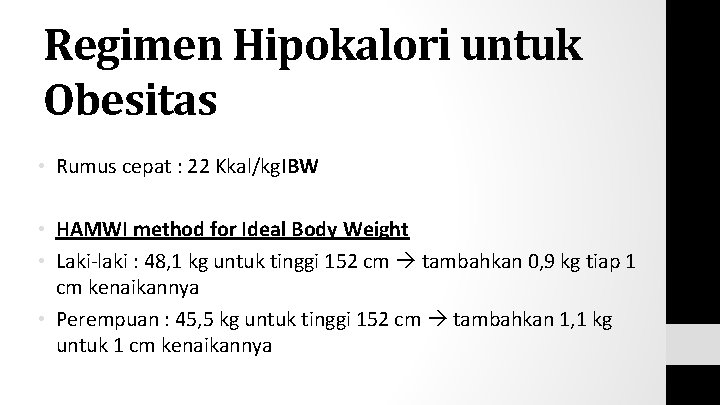
Regimen Hipokalori untuk Obesitas • Rumus cepat : 22 Kkal/kg. IBW • HAMWI method for Ideal Body Weight • Laki-laki : 48, 1 kg untuk tinggi 152 cm tambahkan 0, 9 kg tiap 1 cm kenaikannya • Perempuan : 45, 5 kg untuk tinggi 152 cm tambahkan 1, 1 kg untuk 1 cm kenaikannya
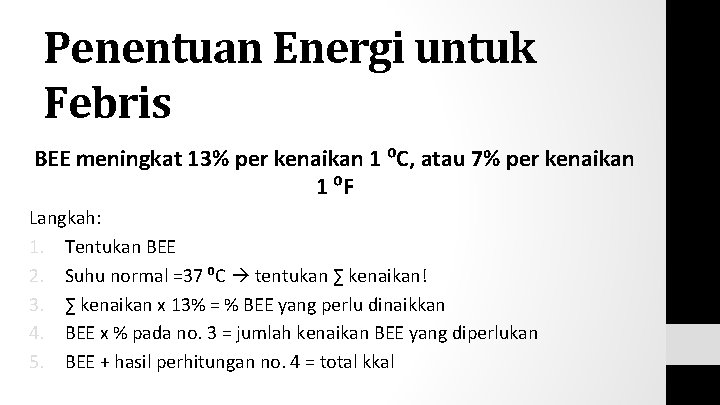
Penentuan Energi untuk Febris BEE meningkat 13% per kenaikan 1 ⁰C, atau 7% per kenaikan 1 ⁰F Langkah: 1. Tentukan BEE 2. Suhu normal =37 ⁰C tentukan ∑ kenaikan! 3. ∑ kenaikan x 13% = % BEE yang perlu dinaikkan 4. BEE x % pada no. 3 = jumlah kenaikan BEE yang diperlukan 5. BEE + hasil perhitungan no. 4 = total kkal
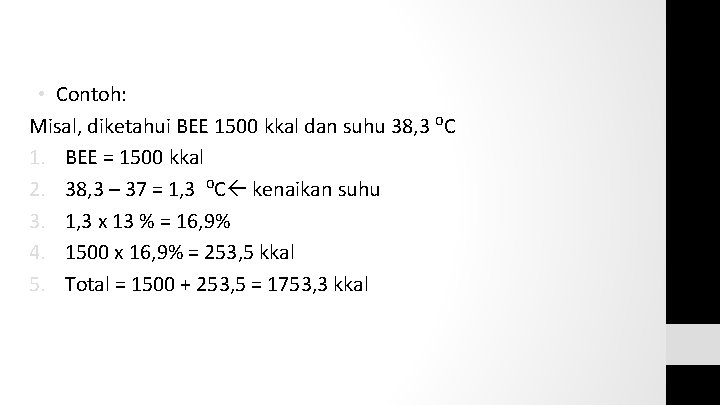
• Contoh: Misal, diketahui BEE 1500 kkal dan suhu 38, 3 ⁰C 1. BEE = 1500 kkal 2. 38, 3 – 37 = 1, 3 ⁰C kenaikan suhu 3. 1, 3 x 13 % = 16, 9% 4. 1500 x 16, 9% = 253, 5 kkal 5. Total = 1500 + 253, 5 = 1753, 3 kkal
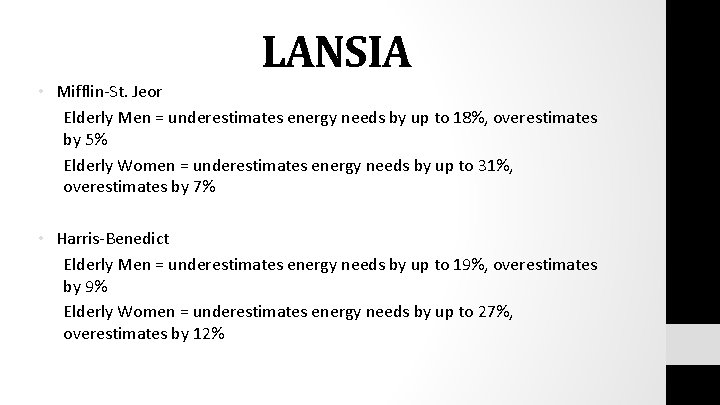
LANSIA • Mifflin-St. Jeor Elderly Men = underestimates energy needs by up to 18%, overestimates by 5% Elderly Women = underestimates energy needs by up to 31%, overestimates by 7% • Harris-Benedict Elderly Men = underestimates energy needs by up to 19%, overestimates by 9% Elderly Women = underestimates energy needs by up to 27%, overestimates by 12%
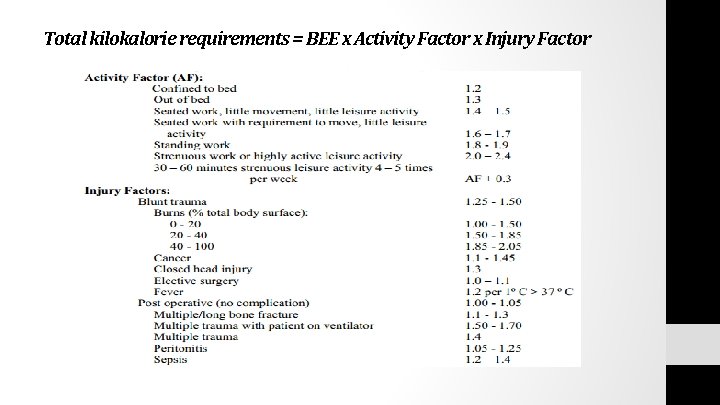
Total kilokalorie requirements = BEE x Activity Factor x Injury Factor
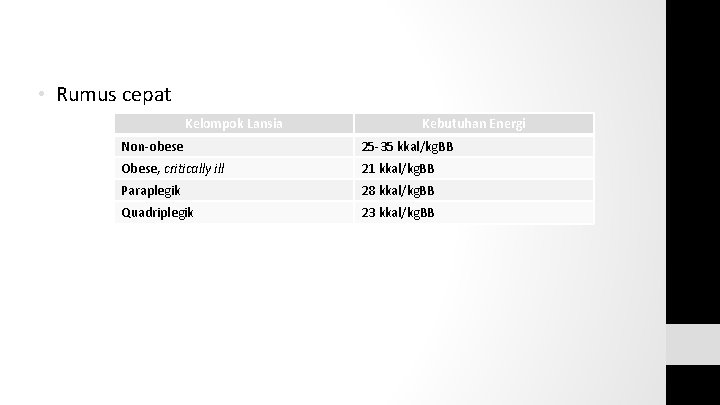
• Rumus cepat Kelompok Lansia Kebutuhan Energi Non-obese 25 -35 kkal/kg. BB Obese, critically ill 21 kkal/kg. BB Paraplegik 28 kkal/kg. BB Quadriplegik 23 kkal/kg. BB
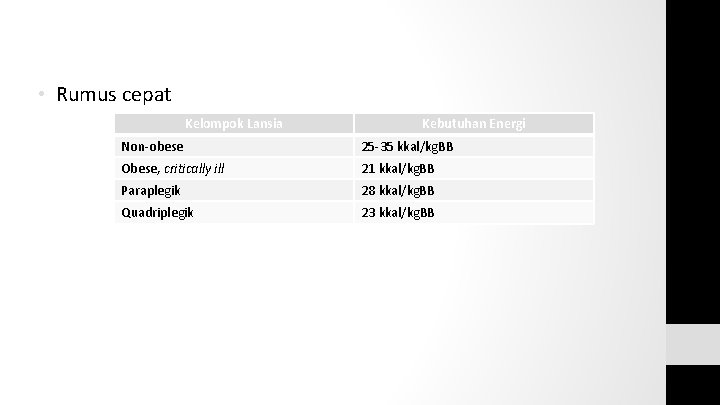
• Rumus cepat Kelompok Lansia Kebutuhan Energi Non-obese 25 -35 kkal/kg. BB Obese, critically ill 21 kkal/kg. BB Paraplegik 28 kkal/kg. BB Quadriplegik 23 kkal/kg. BB
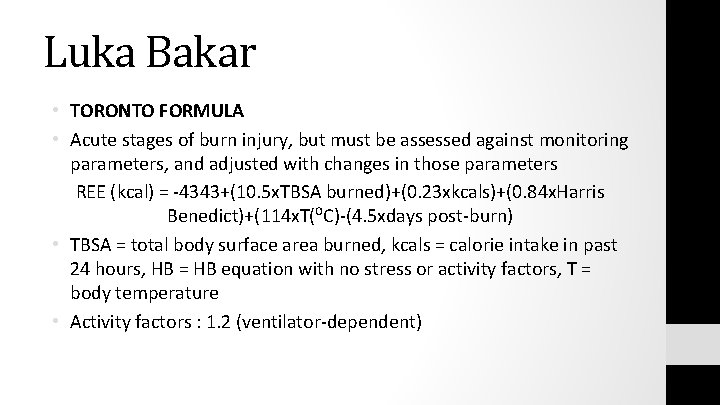
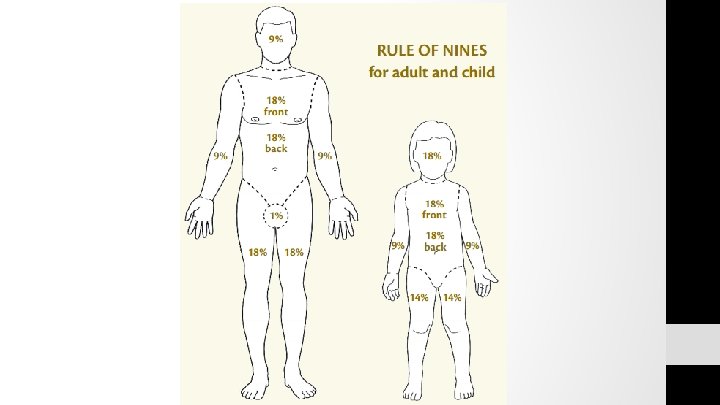
Luka Bakar • TORONTO FORMULA • Acute stages of burn injury, but must be assessed against monitoring parameters, and adjusted with changes in those parameters REE (kcal) = -4343+(10. 5 x. TBSA burned)+(0. 23 xkcals)+(0. 84 x. Harris Benedict)+(114 x. T(⁰C)-(4. 5 xdays post-burn) • TBSA = total body surface area burned, kcals = calorie intake in past 24 hours, HB = HB equation with no stress or activity factors, T = body temperature • Activity factors : 1. 2 (ventilator-dependent)
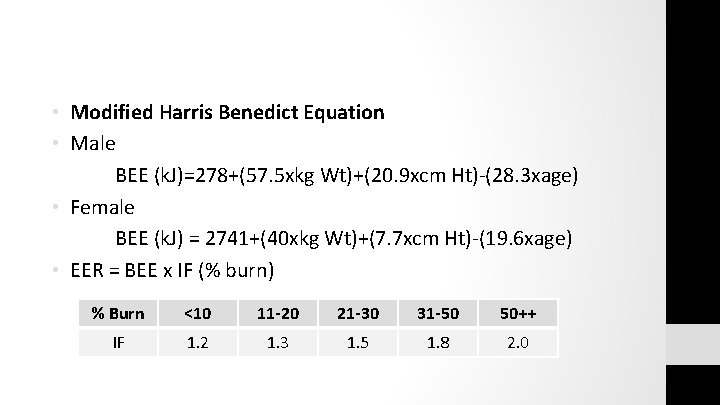
• Modified Harris Benedict Equation • Male BEE (k. J)=278+(57. 5 xkg Wt)+(20. 9 xcm Ht)-(28. 3 xage) • Female BEE (k. J) = 2741+(40 xkg Wt)+(7. 7 xcm Ht)-(19. 6 xage) • EER = BEE x IF (% burn) % Burn <10 11 -20 21 -30 31 -50 50++ IF 1. 2 1. 3 1. 5 1. 8 2. 0
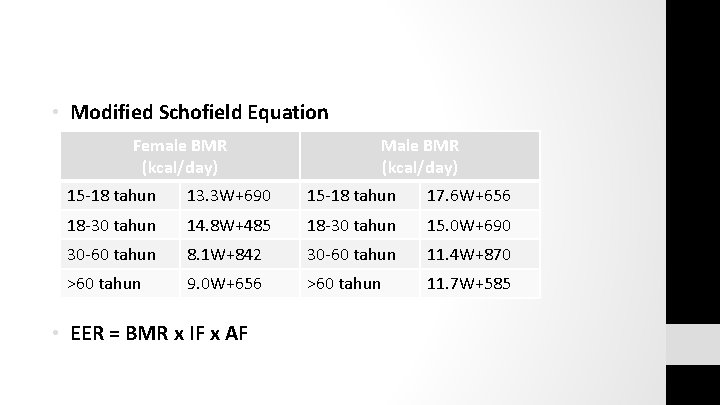
• Modified Schofield Equation Female BMR (kcal/day) Male BMR (kcal/day) 15 -18 tahun 13. 3 W+690 15 -18 tahun 17. 6 W+656 18 -30 tahun 14. 8 W+485 18 -30 tahun 15. 0 W+690 30 -60 tahun 8. 1 W+842 30 -60 tahun 11. 4 W+870 >60 tahun 9. 0 W+656 >60 tahun 11. 7 W+585 • EER = BMR x IF x AF
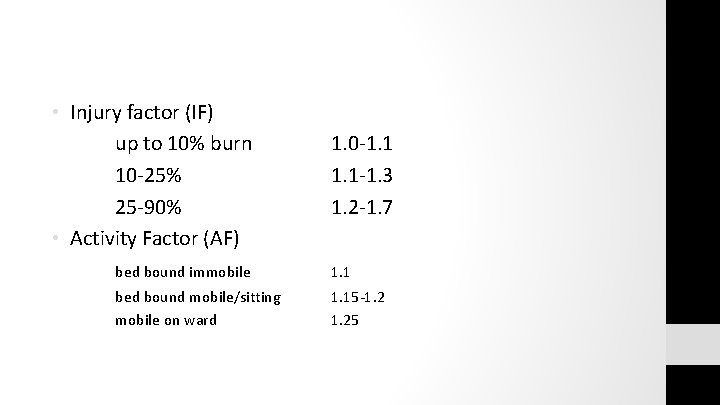
• Injury factor (IF) up to 10% burn 10 -25% 25 -90% • Activity Factor (AF) 1. 0 -1. 1 -1. 3 1. 2 -1. 7 bed bound immobile 1. 1 bed bound mobile/sitting mobile on ward 1. 15 -1. 25
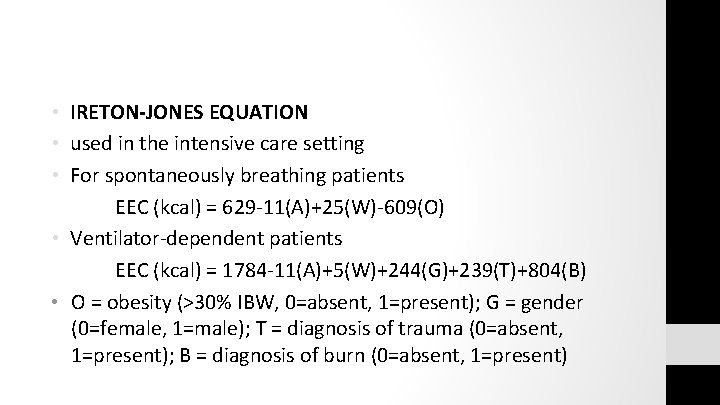
• IRETON-JONES EQUATION • used in the intensive care setting • For spontaneously breathing patients EEC (kcal) = 629 -11(A)+25(W)-609(O) • Ventilator-dependent patients EEC (kcal) = 1784 -11(A)+5(W)+244(G)+239(T)+804(B) • O = obesity (>30% IBW, 0=absent, 1=present); G = gender (0=female, 1=male); T = diagnosis of trauma (0=absent, 1=present); B = diagnosis of burn (0=absent, 1=present)
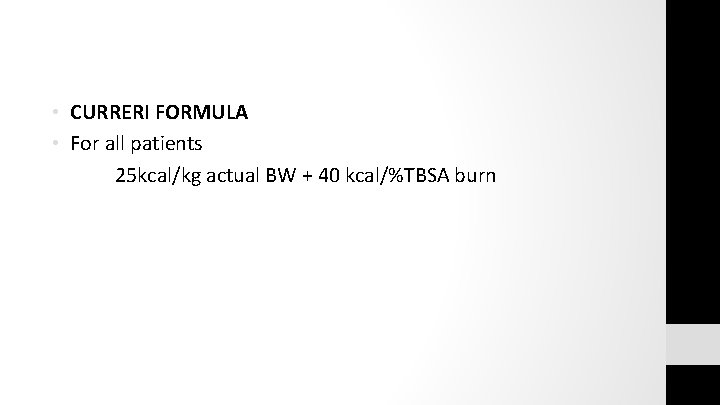
• CURRERI FORMULA • For all patients 25 kcal/kg actual BW + 40 kcal/%TBSA burn
Kasus 1 • James has been gaining weight over the last five years in his group home and his doctor has said that he needs to exercise more or he will become obese. James is 62, a large man weighing around 200 pounds, who really doesn't want to be told that he needs to exercise for his health. When James first came to the group home he was much more active than currently. He would go for walks in Sunrise Park by himself when the weather was good and he seemed to enjoy that. He also bowled every week with the other men in the group home and was very good at it. A year later James climbed Mt. Clemons with one of the staff. Unfortunately, the staff person left his job at the group home about three months later and no one else was interested in taking him hiking. He worked out at the YMCA for a period of time but he didn't find other people to workout with him and he quit. We think that James started eating more food within the next year as he started to gain weight.
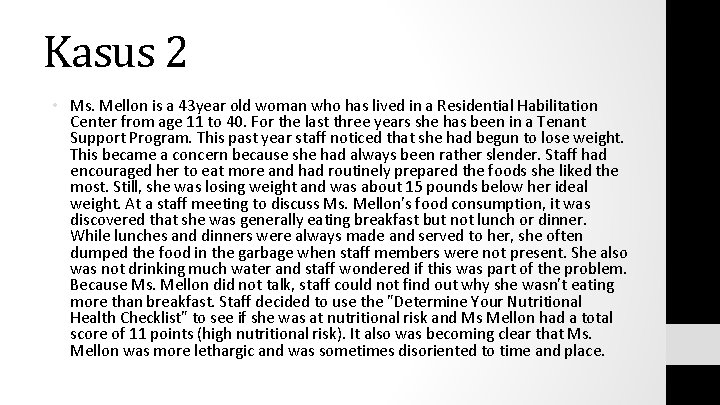
Kasus 2 • Ms. Mellon is a 43 year old woman who has lived in a Residential Habilitation Center from age 11 to 40. For the last three years she has been in a Tenant Support Program. This past year staff noticed that she had begun to lose weight. This became a concern because she had always been rather slender. Staff had encouraged her to eat more and had routinely prepared the foods she liked the most. Still, she was losing weight and was about 15 pounds below her ideal weight. At a staff meeting to discuss Ms. Mellon's food consumption, it was discovered that she was generally eating breakfast but not lunch or dinner. While lunches and dinners were always made and served to her, she often dumped the food in the garbage when staff members were not present. She also was not drinking much water and staff wondered if this was part of the problem. Because Ms. Mellon did not talk, staff could not find out why she wasn't eating more than breakfast. Staff decided to use the "Determine Your Nutritional Health Checklist" to see if she was at nutritional risk and Ms Mellon had a total score of 11 points (high nutritional risk). It also was becoming clear that Ms. Mellon was more lethargic and was sometimes disoriented to time and place.
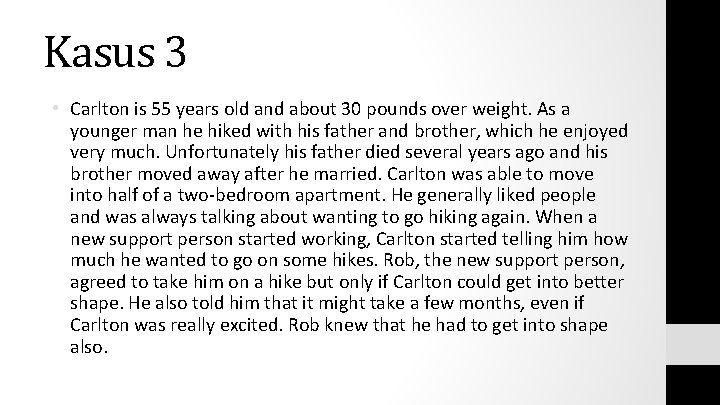
Kasus 3 • Carlton is 55 years old and about 30 pounds over weight. As a younger man he hiked with his father and brother, which he enjoyed very much. Unfortunately his father died several years ago and his brother moved away after he married. Carlton was able to move into half of a two-bedroom apartment. He generally liked people and was always talking about wanting to go hiking again. When a new support person started working, Carlton started telling him how much he wanted to go on some hikes. Rob, the new support person, agreed to take him on a hike but only if Carlton could get into better shape. He also told him that it might take a few months, even if Carlton was really excited. Rob knew that he had to get into shape also.
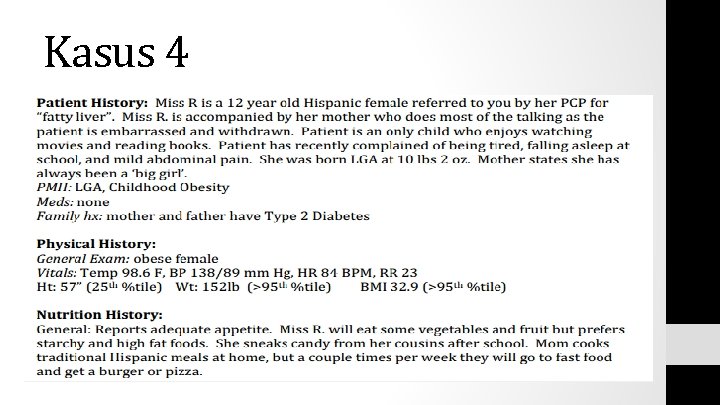
Kasus 4