EDFGC 5809 Teacher as a Professional TUESDAY 13















- Slides: 31
EDFGC 5809 Teacher as a Professional TUESDAY 13 T H JUNE 2017
Overview of Day 9. 30 am: Welcome/Introduction and overview of unit. 10. 00 am - 11. 00 am: Post-placement Reflection with Sharon Davis 11. 00 am - 12. 30 pm: Assessment Tasks 12. 30 pm - 1. 30 pm: Lunch 1. 30 pm - 4. 30 pm: Teacher as a Professional – what does this mean? The social, political and cultural dimensions of teaching as a profession-ethics Developing a teacher identity – teachers as culturally reflective professionals
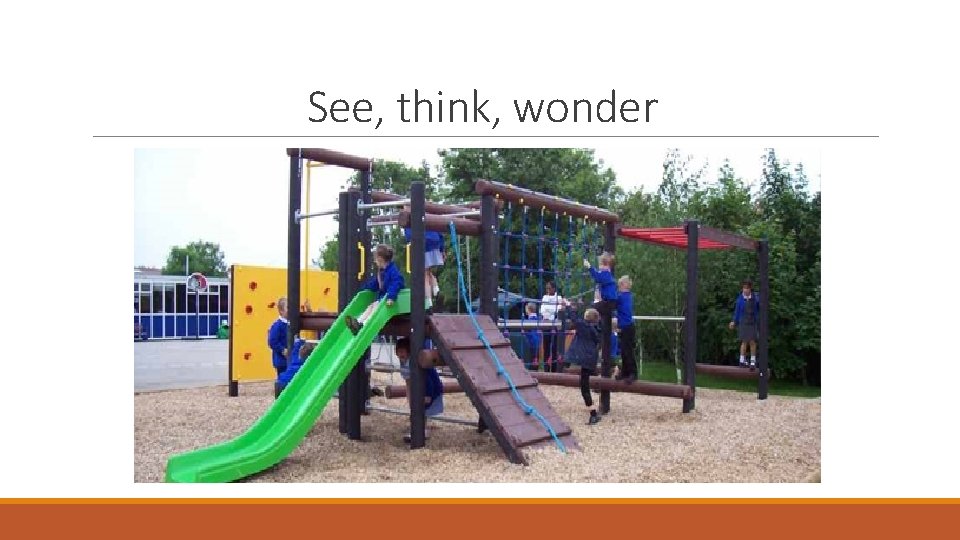
See, think, wonder
See, think, wonder
See, think, wonder
Unpacking the Australian Professional Standards for Teachers https: //www. aitsl. edu. au/australian-professional-standards-for-teachers
What are the Australian Professional Standards for Teachers? A public statement that: • constitutes teacher quality • defines the work of teachers • makes explicit high quality effective teaching That will improve educational outcomes for students.
What are the Australian Professional Standards for Teachers? The Standards describe what is expected of teachers across three domains: • Professional Knowledge • Professional Practice • Professional Engagement and across four career stages: • Graduate, • Proficient, • Highly Accomplished • Lead
What are the Australian Professional Standards for Teachers? The Standards present a common understanding and language for professional discussions and reflections on: • teacher preparation • Practice • improvement. The Standards are a useful framework for teachers, school leaders, teacher educators, teacher organisations, professional associations and the public.
Why were the Australian Professional Standards for Teachers developed? The Standards form the basis for national consistency in: • accrediting initial teacher education programs • registration at the Proficient career stage • certification of exemplary teacher practice at the Highly Accomplished and Lead career stages • performance and development.
Why were the Australian Professional Standards for Teachers developed? The Standards support the performance and development and professional learning of all teachers, as they provide consistent benchmarks to help teachers to: • reflect on and discuss their practice and the practice of their colleagues • identify further learning requirements • evidence and assess improvements in their practice.
How do the Australian Professional Standards for Teachers benefit teachers? The Standards help teachers understand improve their practice by: • describing what high quality teaching practice looks like at Graduate, Proficient, Highly Accomplished and Lead career stages, • providing a language for professional discussions about teacher preparation, practice, improvement and impact. • providing a benchmark to define the knowledge and skill levels required of teachers throughout their career. • contributing to the professionalization of teaching and raising the professional status of teachers nationally.
Professional Knowledge • Know students and how they learn • Know the content and how to teach it
Professional Practice • Plan for and implement effective teaching and learning • Create and maintain supportive and safe learning environments • Assess, provide feedback and report on student learning
Professional Engagement • Engage in professional learning • Engage professionally with colleagues, parents/carers and the community
Jigsaw Activity Work in a small group to look at the professional standards across all career levels Discussion
Jigsaw Activity Work in a small group to look at the professional standards for graduate teachers Discussion
Illustrations of Practice Go to www. aitsl. edu. au/Australian-professional-standards Look at the illustrations of Practice – by career stage view all 39 Discussion
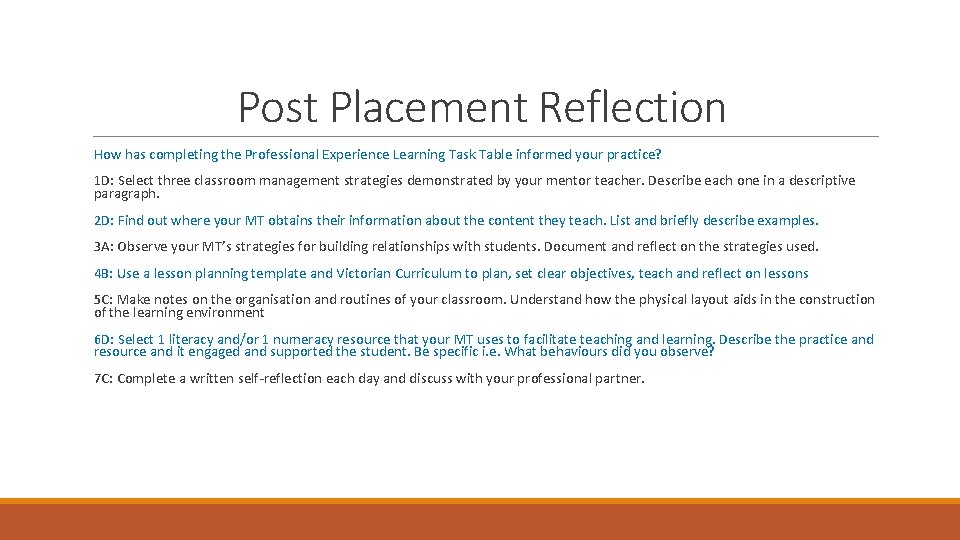
Post Placement Reflection How has completing the Professional Experience Learning Task Table informed your practice? 1 D: Select three classroom management strategies demonstrated by your mentor teacher. Describe each one in a descriptive paragraph. 2 D: Find out where your MT obtains their information about the content they teach. List and briefly describe examples. 3 A: Observe your MT’s strategies for building relationships with students. Document and reflect on the strategies used. 4 B: Use a lesson planning template and Victorian Curriculum to plan, set clear objectives, teach and reflect on lessons 5 C: Make notes on the organisation and routines of your classroom. Understand how the physical layout aids in the construction of the learning environment 6 D: Select 1 literacy and/or 1 numeracy resource that your MT uses to facilitate teaching and learning. Describe the practice and resource and it engaged and supported the student. Be specific i. e. What behaviours did you observe? 7 C: Complete a written self-reflection each day and discuss with your professional partner.
Assessment Tasks Assessment Task 1 (critical incident) Assessment Task 2 (Make groups of three, choose topic) Assessment Task 3 (Preparing for Employment)
Teaching Quick write: Is teaching a profession or an occupation? Share Report https: //www. youtube. com/watch? v=m 6 nyz 1 Jdz. XQ Discuss
Characteristics of the Teaching Profession Involves intellectual activities and techniques Has a code of ethics Requires extended specialised preparation Demands continual service and growth Sets its own standards and monitors professional performance with independence judgement Affords a life career within a structure Is a social service (Sellars, 2014, p. 23) Can you add any more characteristics?
Reading: Chapter 3 Hattie (2014) ‘Teachers’ beliefs and commitments are the greatest influence on student achievement over which we can have some control’ p 22 What does this mean? What is the difference between high-effect teachers and low-effect teachers? ‘Visible learning inside: passionate and inspired teachers’ (p. 23) What does Table 3. 1 highlight? In groups of 4 discuss chapter/report
Characteristics of an Effective Ethical Teacher ◦ High standards of honesty and integrity ◦ Ethical teachers understand the laws, rules, policies and guidelines that have to be followed inside and outside of school ◦ Always maintain the highest possible standards of behaviour in their interactions with students, parents and colleagues. ◦ They respect and protect the rights of learners, including the right to privacy in matters such as test results. ◦ (Killen, R. (2014) Effective Teaching Strategies. Cengage Learning Australia)
Characteristics of an Effective Ethical Teacher Reflection: Teachers routinely think about what, how and why they are teachers. Are there aspects listed here that you feel you fall short on? It does not necessarily mean that you cannot be an effective teacher but perhaps it means that you need to work on your readiness for teaching.
The Victorian Teaching Profession Code of Conduct http: //www. vit. vic. edu. au/professional-responsibilities/conduct-and-ethics Read the Victorian Teachers Professional Code of Conduct How does it link to the AITSL Standards? Discuss/Report
Conversation Articles Improving student teachers’ in-school experiences is a smart move. Is teaching still a profession? What are the main challenges facing teacher education in Australia? What is the role of a teacher? Read article/discuss in small group/report to group
Developing a Teacher Identity As teachers we are culturally reflective professionals. Quick Write: What characteristics identify you as a teacher? Discuss
Reading for Week 2 Loughran, J. (2002) Effective Reflective Practice: In Search of Meaning in Learning and Teaching. Journal of Teacher Education.
Reflection What have we learnt today?
References ◦ Loughran, J. (2002) Effective Reflective Practice: In Search of Meaning in Learning and Teaching. Journal of Teacher Education. ◦ Killen, R. (2014) Effective Teaching Strategies. Cengage Learning Australia)