DURING MOULTING OF SILK WORM MOULTING Sloughing shedding

- Slides: 19
DURING MOULTING OF SILK WORM MOULTING? ? ? • Sloughing, shedding, or in many invertebrates , Ecdysis • Manner in which an animal routinely casts off a part of its body often an outer layering or covering either at specific times of the year, or at specific points in its life cycle
MOULTING(CONTD) � Moulting can involve shedding the epidermis (skin), pelage (hair, feathers, fur, wool), or other body parts may be shed, for example, wings in some insects or the entire exoskeleton in arthropods � In insects moulting is regular in larvae, when the exoskeleton is outgrown � During embryonic development all insects shed and replace old cuticle
(A) APOLYSIS � There is an increase the size and number of epidermal cell due to repeated mitotic division � The growing epidermal cell exert marked tension at the cuticular surface and as a result separate themselves from the cuticle, forming a sub cuticular space, where modified epidermal or modified moulting gland discharge moulting fluid � The later has enzyme protienase and kitenase which digest the endocuticle of old cuticle, thereby increasing the sub cuticular space
APOLYSIS (CONTD) � Initially the moulting fluid is inactive but as soon as cuticulin layer of new cuticle is secreted it becomes active � The indigested material of old cuticle by moulting fluid becomes ecdycial membrane � The oenocytes secret the cuticulin layer of new cuticle which is impermeable to the moulting fluid � The other epicuticular layer like wax, polyphenol and cement layer are formed from the epidermal cells through pore canals
(B)ECDYSIS � The shedding of old cuticle is called ecdysis � When the endocuticle is digested by the enzyme protienase and kitenase, the ecdysial lines are developed on old cuticle � By muscular activity of developing insect the exusivae splits along the ecdysial lines simultaneously � The gut is distended by swallowing air, by which pressure is created on haemolymph; which is pumped from abdomen into thorax; where in blood pressure increases causing the splitting of old cuticle through which the new instar comes out protruding first head and thorax followed by the abdomen
ECDYSIS(CONTD) � The new cuticle is milky white, very soft and cannot support. � The mechanical support to the insect body or sclerotization is the last process of moulting � Also called tanning, which involves differentiation of the procuticle into outer hard exocuticle and inner endocuticle � The exocuticle is tanned part of the cuticle
(C) TANNING OR SCLEROTIZATION � Sclerotization is a conversion of the protein arthropodin into sclerotin by the formation of crosslink’s between the adjacent protein molecules � The crosslink’s are formed by the “quinones” � The concentration of tyrosine increases � It moves in the haemolymph just before ecdysis � Tyrosine is converted into dihydroxy phenyl alkalinedopamine –to N acetyl –dopamine(biphenyl) and then to quinones
TANNING OR SCLEROTIZATION(CONTD) � N –acetyl-dopamine is transported through pore canals to outer part of the epicuticle where it is oxidized to a quinones by an enzyme phenol oxidase � This quinone diffuses into the part of procuticle and forms the crosslinks between the protein molecules producing sclerotin of exocuticle
MOULTING IN SILKWORM � The life stage of bombyx mori is holometabolous � Egg of silk worm is very small and hard structure; about the pin head and resembling a poppy seed � A fertile ovum darkens to a blue gray within a few days. The egg lay in summer remains dormant until spring arrives � The warmth of the spring stimulates the egg to hatch � The silk worm, upon hatching, is about 1/8 th of an inch and extremely hairy. Young silkworms can only feed on tender mulberry leaves as well
MOULTING OF SILKWORM(CONTD) � The larval stage lasts for 27 days and the silkworm goes through five growth stages called instars, during this time � During the first moulting , the silkworm sheds all its hair and gains a smooth skin � It passes through five instars and the worms upto stage two stage are called young age worms or chwaki � The serial progressions of four distinct stages of development complete one generation of the species; egg (ova), larvae, pupa and imago � The first moulting takes place 3 days after hatching
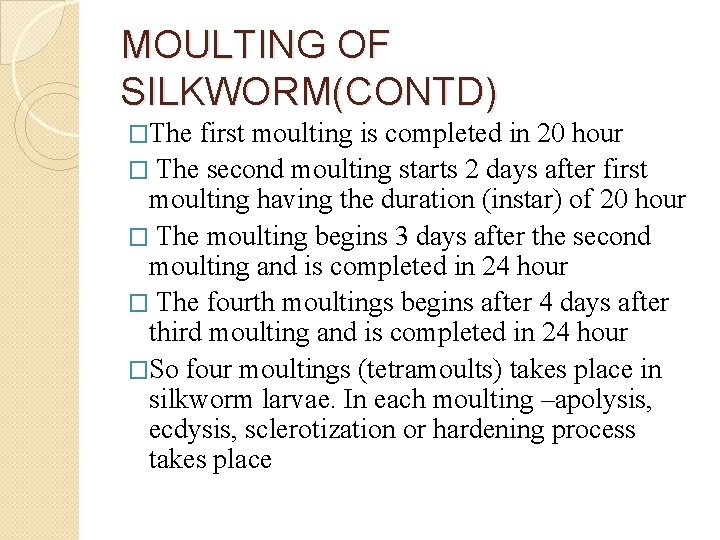
MOULTING OF SILKWORM(CONTD) �The first moulting is completed in 20 hour � The second moulting starts 2 days after first moulting having the duration (instar) of 20 hour � The moulting begins 3 days after the second moulting and is completed in 24 hour � The fourth moultings begins after 4 days after third moulting and is completed in 24 hour �So four moultings (tetramoults) takes place in silkworm larvae. In each moulting –apolysis, ecdysis, sclerotization or hardening process takes place
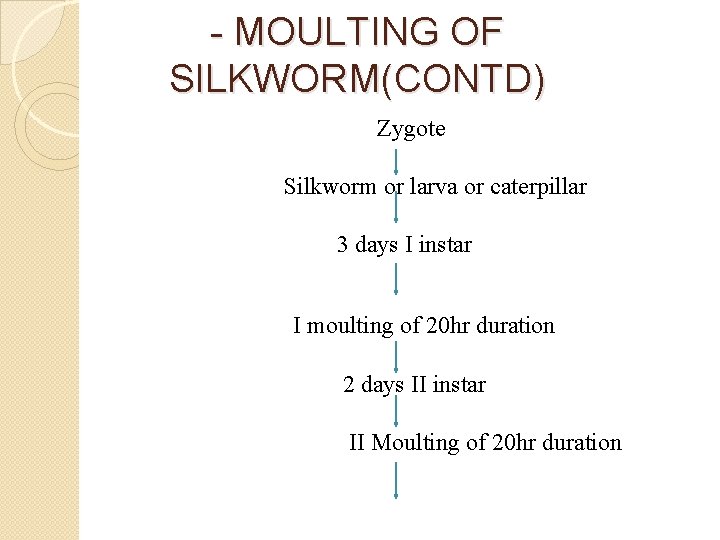
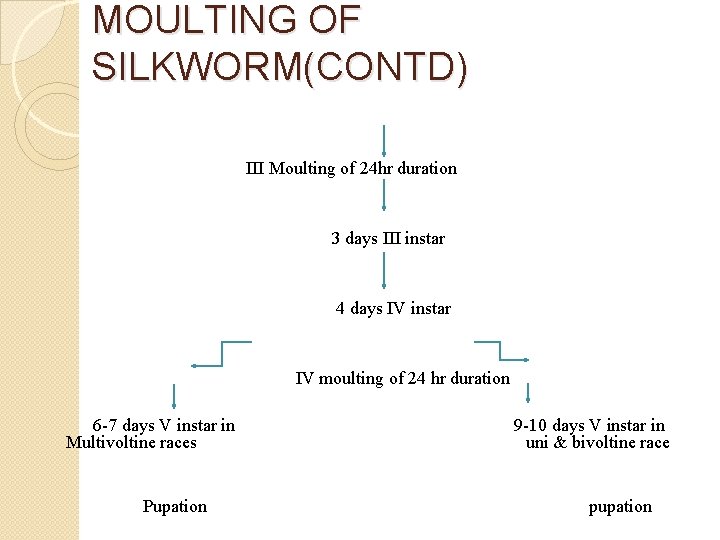
- MOULTING OF SILKWORM(CONTD) Zygote Silkworm or larva or caterpillar 3 days I instar I moulting of 20 hr duration 2 days II instar II Moulting of 20 hr duration
MOULTING OF SILKWORM(CONTD) III Moulting of 24 hr duration 3 days III instar 4 days IV instar IV moulting of 24 hr duration 6 -7 days V instar in 9 -10 days V instar in Multivoltine races uni & bivoltine race Pupation pupation
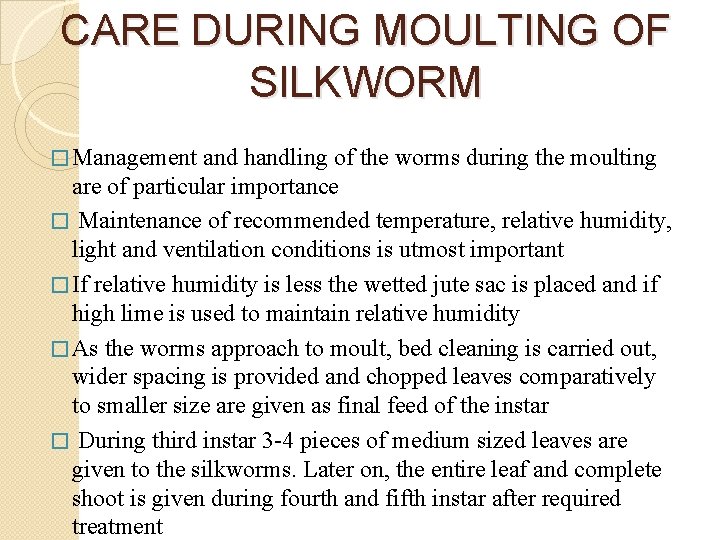
CARE DURING MOULTING OF SILKWORM � Management and handling of the worms during the moulting are of particular importance � Maintenance of recommended temperature, relative humidity, light and ventilation conditions is utmost important � If relative humidity is less the wetted jute sac is placed and if high lime is used to maintain relative humidity � As the worms approach to moult, bed cleaning is carried out, wider spacing is provided and chopped leaves comparatively to smaller size are given as final feed of the instar � During third instar 3 -4 pieces of medium sized leaves are given to the silkworms. Later on, the entire leaf and complete shoot is given during fourth and fifth instar after required treatment
CARE DURING MOULTING OF SILKWORM(contd) � It is very important that the rearing bed be as dry as possible when the worms are at moult and the feeding of the new instarts only after almost all the worms have come out of moult � During the intervening moulting stage of 24 hour each between two instars, temperature of 20 -26 degree Celsius and relative humidity 60% is recommended for the smooth integument change over � Bed cleaning is an important process to ensure hygiene in the immediate vicinity of silkworms in order to protect them from infection � Four different mesh sized bed cleaning nets are used for cleaning the rearing beds
CARE DURING MOULTING OF SILKWORM(contd) � Bed cleaning is done once in first instar, twice in second instar and preferably daily in third, fourth and fifth instar � Bed cleaning nets are spreads just before the morning feed. Before the afternoon feed, nets with the silkworms are shifted to new beds and feeding is then resumed. � The litter, leftover food and dead silkworm, if any, are removed carefully and disposed off away from rearing house. � Moulting is the process when silkworms seized feeding, becomes immobile and prepare themselves for shedding their old skin to accommodate the fast growth.
POINTS TO BE REMEMBERED DURING MOULTING � Remove the paraffin papers 30 minutes before feeding and after feeding the rearing beds are again covered with polythene sheets. � The size of the leaf fed should be 1. 5 sq. cm in first stage and increased to 3 sq. cm as worm advances in age. � Size of the leaf should be reduced when worms start settling for moult. � Stop feeding when 90%nworms settle for moult and resume when 95% worms comes out of moult � Evenly spread the larvae in the rearing bed 6 -8 hr before settling for moult � Provide air circulation to avoid excess humidity inside the room
POINTS TO BE REMEMBERED DURING MOULTING(CONTD) Provide charcoal stove/heaters to raise the room temperature during winter � Temperature should be kept 26 degree Celsius and RH 65 -70%. � Apply lime powder at 60 minutes before resumption of feeding daily during rainy/winter seasons to reduce the dampness in bamboo trays. � Keep the bed dry and disinfected either by dusting *Resham Kit Oushad (RKO), formulated by CSR and TI, Mysore or by spraying Labex. � *RKO is a bed disinfectant which can be applied on the silkworm rearing bed to inactivate pathogenic microbes responsible for Muscardine, Grasserie, and NPV diseases in silkworm. The use of RKO increases the coccon yield on an average 7 kg per 100 disease free layings (dfls). The quantity of RKO required for treating 100 dfl’s is 3. 25 kg. RKO is produced from locally available chemicals. �
REFERENCES Hari Om Agrawal & M. K. Seth Sericulture in India vol II http: //www. everythingsilkworm. com http: //www. noteszoology. com/sericultur e http: //www. ndrcindia. com http: //en. m. wikipedia. org/wiki/sericulture www. kssrdi. org