
WEAVING III UNIT 1 DOBBY SHEDDING What is
WEAVING III • UNIT 1 DOBBY SHEDDING What is Dobby? • Dobby is a shedding device attached to the loom for producing a variety of small motifs. The capacity of a dobby system is more than that of a tappet system in terms of numbers of heald shafts that can be operated and the numbers of picks that can be inserted per repeat of the design.
Design Possibilities of a Dobby System • • Twill Satin Crept Honey Comb Huck-a-Back Mock leno Bedford Cord Double Cloth
Classification of Dobby System can be classified as following • Single lift and Double lift
NEGATIVE AND POSITIVE DOBBY • A NEGATIVE DOBBY activates the healdshafts in one direction only , that means the upward or downward movement of the healdshafts in the reverse direction is done by using some additional device like dead wt. , spring elastic bands etc. A negative dobby is used for producing light or medium weight fabrics like cotton, silk or synthetic. • A POSITIVE DOBBY activates the healdshafts in both the directions , upward and downward. It is used for producing heavy fabrics like woollen and worsted. •
LEFT HANDED AND RIGHT HANDED DOBBY • A RIGHT HANDED DOBBY is the one which is placed at the left side of a right hand loom. It gets its drive from the left hand end of the loom. • A LEFT HANDED DOBBY is the one which is placed at the Right Hand end of a Left Hand Loom. It gets its drive from right hand end of the loom.

SINGLE LIFT AND DOUBLE LIFT DOBBBY In a Single Lift Dobby the selection of hooks takes place once for every pick. Each healdshaft has its own individual hooks that can be used for raising the healdshafts. • The single lift dobby is generally used in the weaving of silk and rayon fabrics and also certain gauge fabrics. In this dobby the weft is beaten up in a closed shed which is essential for silk weaving because it ensures minimum friction in the warp. •
DOUBLE LIFT DOBBY • In Double Lift Dobby a pair of hooks control every healdshaft independently. • Double lift dobby is mostly used in cotton weaving.
FEATURES OF SINGLE LIFT DOBBY • It forms Bottom Closed Shed. • The weft is beaten up in closed shed. • Each heald shaft is controlled by its individual hook in every pick. • Drive from the crank shaft of the loom activates the dobby.
FEATURES OF DOUBLE LIFT DOBBY • A double lift dobby forms an open shed. • Weft is beaten up in crossed shed. • Each healdshaft is controlled independently by a pair of hooks. • Drive from the Bottom shaft of the loom activates the dobby. •
CLIMAX DOBBY • Climax dobby can be classified as a horizontal, negative, double-lift, double jack, lever dobby. It is placed at one end of the loom at a suitable height for the conventional handling by the weaver.
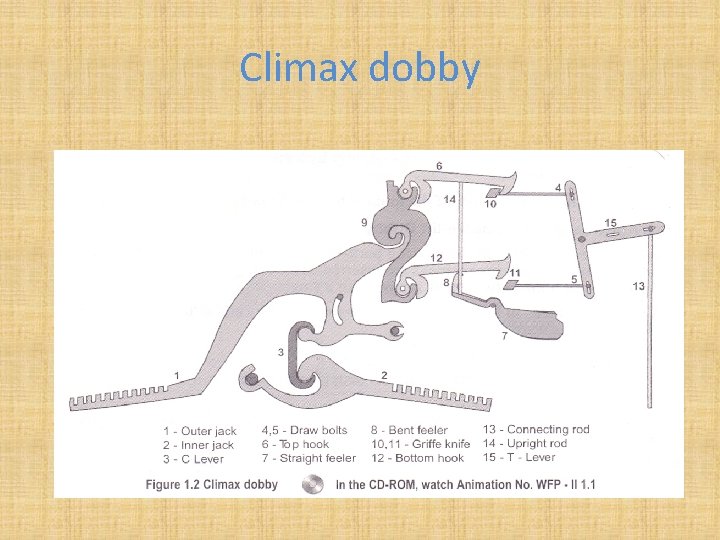
Climax dobby
DEFECTS OF DOBBY • A defect related to all the dobby system and a common defect is Jack Missing. • It is the failure of a heald shaft to lift as and when required. • When Jack Missing occurs the weft may be seen as a float yarn running across the warp and gives rise to a fabric defect called stitching.
CAUSES OF JACK-MISSING • • 1. A bent peg on a leg may not be able to move the filler to drop the corresponding hook onto its knife. • 2. Wooden pegs may get damaged due to frequent use an may not serve their purpose efficiently. • 3. Jack-missing may cause if the leg are not equally spaced. • 4. The pattern cylinder may tend to move in a lateral direction and move pegs away from their own position. • 5. The needle operating the hook may get stuck. This can be avoided by using a good quality oil and keeping the parts away from grease. • 6. A stout or a broken peg may also be responsible from jack-missing. • 7. In the middle of the stroke the hook may engage the knife incompletely and slip off.
ADVANTAGES OF MODERN CAM DOBBY • • The elements of a cam dobby constitute a precise assembly of moving parts that work smoothly and accurately with less vibration than lever type dobby. The dobby is placed at one side of the loom and hence allow maximum light on the fabric. Here oil dropping problem is not encountered. Drive is derived from the crankshaft by means of a reduction gear arrangement which makes for smooth running. A suitable pick- finding mechanism controlled by a clutch arrangement is also there to remove fabric defects. Modern cam dobby is provided with a heald leveling attachment to bring all the heald shafts level for piecing up. Modern cam dobby is provided with a mechanism for operating the heald shafts using endless paper rolls which can be stored and reused if required.
JACQUARD SHEDDING
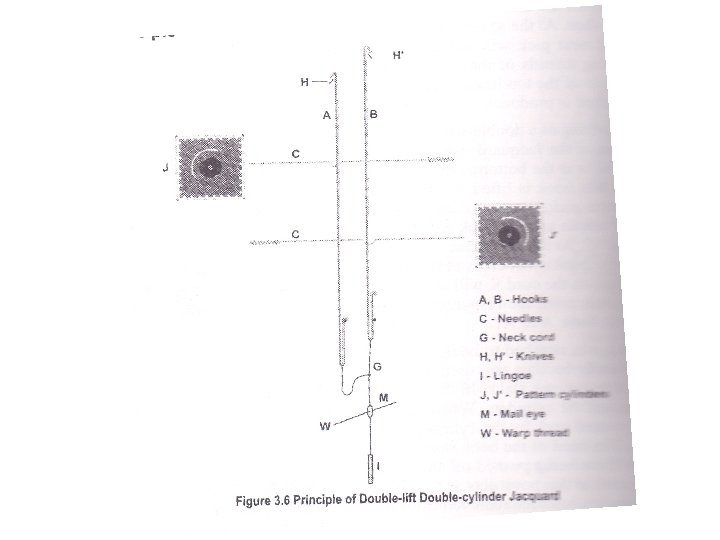
TYPES OF JACQUARD SHEDDING Single lift jacquard Double lift single cylinder jacquard Double lift Double Cylinder Jacquard Double lift Single Cylinder Single Hook Jacquard for high speed loom • Electronic Jacquard • Jacquard for special use like cross border jacquard , leno jacquard, etc. • • •
Characteristics of Single Lift Jacquard Simple in construction. Suitable for handloom weaving. It is not suitable for high speed loom. It forms bottom closed shed and beat up is done in a closed shed. • It is suitable for silk weaving and leno weaving. • •
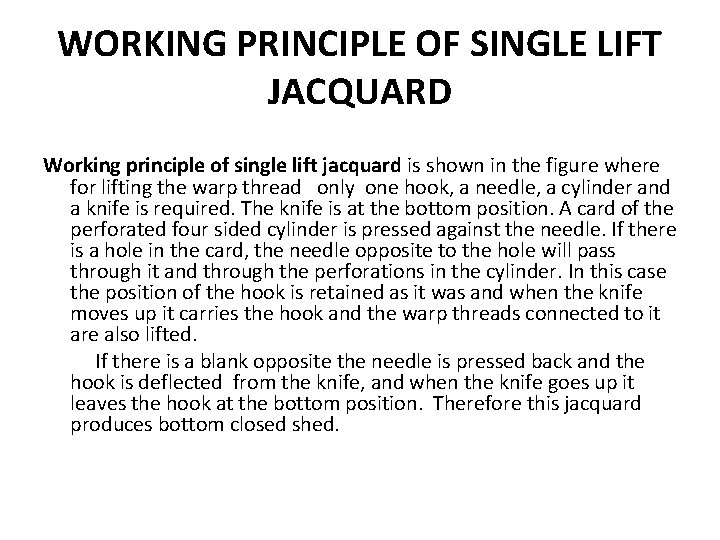
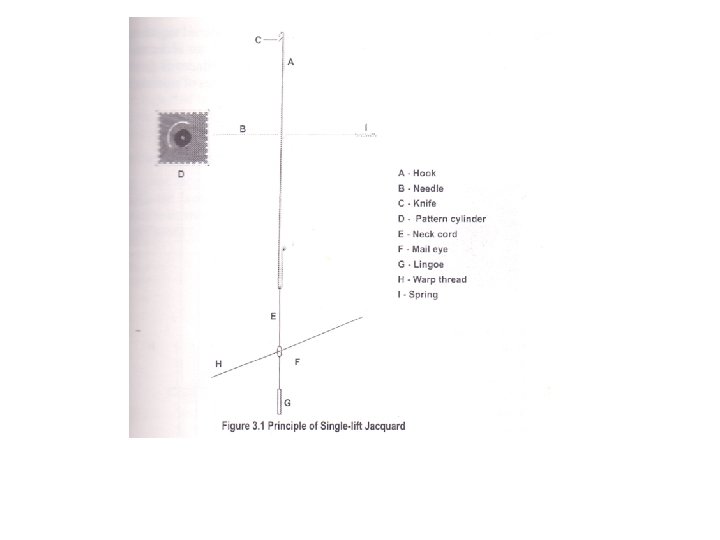
WORKING PRINCIPLE OF SINGLE LIFT JACQUARD Working principle of single lift jacquard is shown in the figure where for lifting the warp thread only one hook, a needle, a cylinder and a knife is required. The knife is at the bottom position. A card of the perforated four sided cylinder is pressed against the needle. If there is a hole in the card, the needle opposite to the hole will pass through it and through the perforations in the cylinder. In this case the position of the hook is retained as it was and when the knife moves up it carries the hook and the warp threads connected to it are also lifted. If there is a blank opposite the needle is pressed back and the hook is deflected from the knife, and when the knife goes up it leaves the hook at the bottom position. Therefore this jacquard produces bottom closed shed.
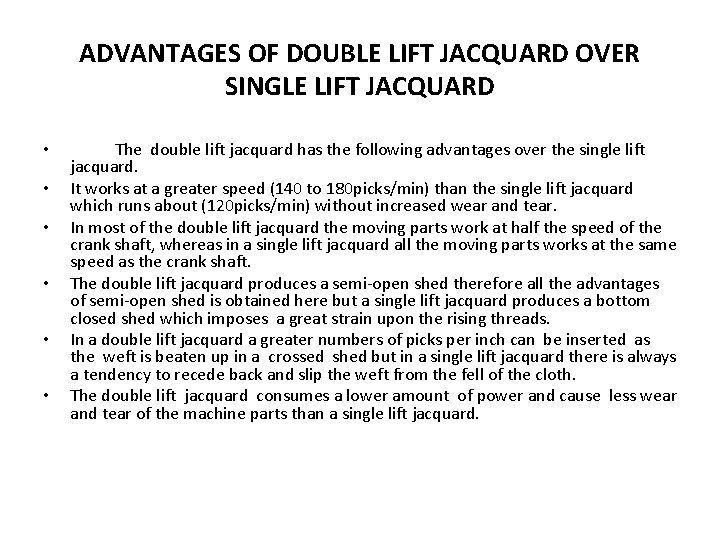
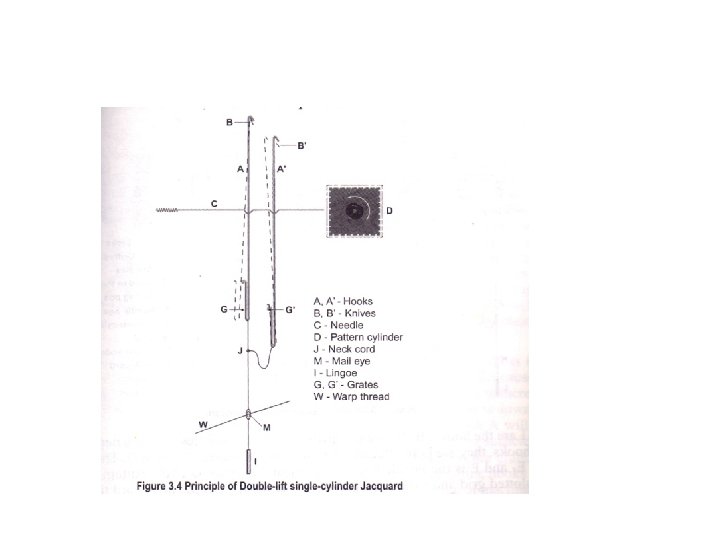
ADVANTAGES OF DOUBLE LIFT JACQUARD OVER SINGLE LIFT JACQUARD • • • The double lift jacquard has the following advantages over the single lift jacquard. It works at a greater speed (140 to 180 picks/min) than the single lift jacquard which runs about (120 picks/min) without increased wear and tear. In most of the double lift jacquard the moving parts work at half the speed of the crank shaft, whereas in a single lift jacquard all the moving parts works at the same speed as the crank shaft. The double lift jacquard produces a semi-open shed therefore all the advantages of semi-open shed is obtained here but a single lift jacquard produces a bottom closed shed which imposes a great strain upon the rising threads. In a double lift jacquard a greater numbers of picks per inch can be inserted as the weft is beaten up in a crossed shed but in a single lift jacquard there is always a tendency to recede back and slip the weft from the fell of the cloth. The double lift jacquard consumes a lower amount of power and cause less wear and tear of the machine parts than a single lift jacquard.
Harness mounting system and their merits and demerits • There are two methods of harness mounting, they are • Norwich system • London or French system
Merits of Norwich system are- üNorwich system has best used for ordinary designs, as the harness is straight. Demerits of Norwich system isüThe cylinder and cards interface with the lighting on the cloth and the warp.
London or French system Merits of London and French system- This system is convenient for a weaver as he can see and control the cards from his seat. Demits of London or French system- The harness receives a quarter twist in passing from the hooks the comber board and then through it, causing excessive friction.
– Different harness ties • Straight through tie-up • Centre ties • Mixed ties • Border and middle tie ups
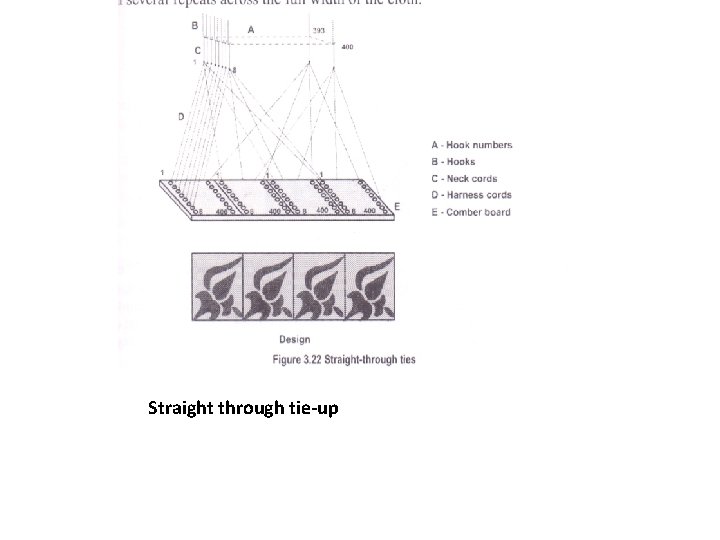
Straight through tie-up
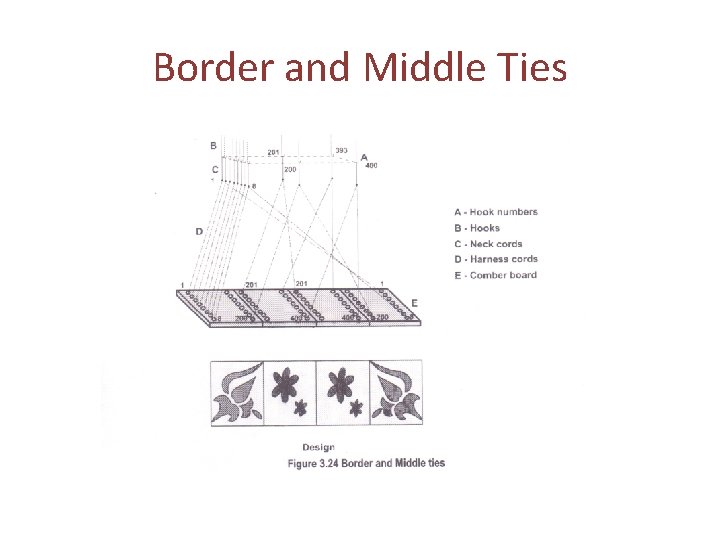
Border and Middle Ties
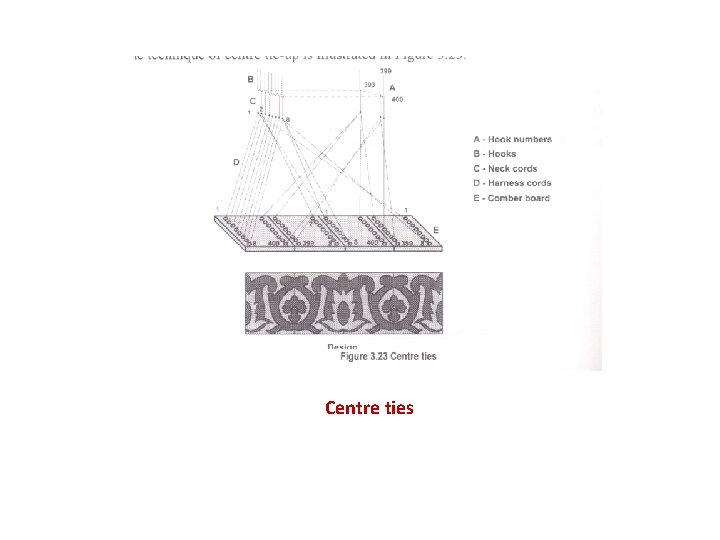
Centre ties
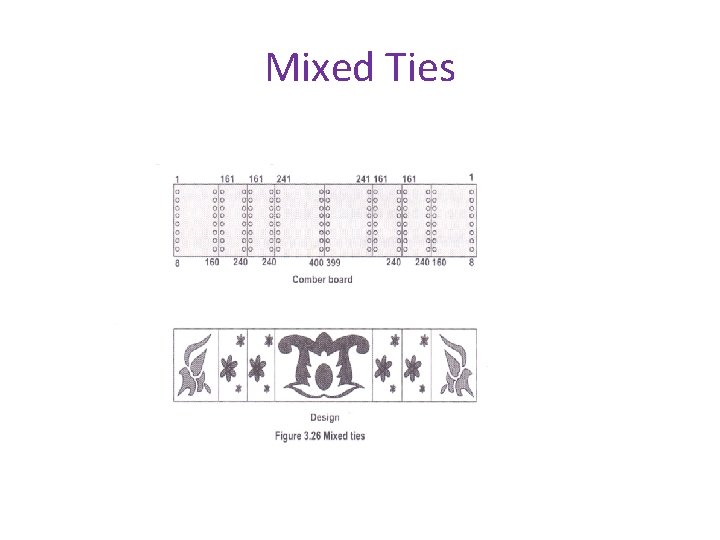
Mixed Ties
- Slides: 30