
Immunization Module 2 Vaccination of Contacts A Pediatric


- Slides: 45
Immunization Module 2: Vaccination of Contacts A Pediatric Transplant Infectious Diseases Learning Module
Using the interactive modules – I l l l The modules work best if accessed using Google Chrome as your browser ¾ Suggest avoiding Internet Explorer Some slides contain a code designation tied to the American Board of Pediatrics Content Outline for Pediatric Infectious Diseases ¾ e. g. , 3. E. 6 in upper left hand corner of slide ¾ https: //www. abp. org/sites/abp/files/pdf/idis_latest. pdf The basic modules are designed to take about 45 minutes to complete ¾ You may take longer, especially if you choose to investigate all of the information provided
Using the interactive modules - II l l l The modules are case-based, with decision points (branches) containing questions ¾ Many questions don’t have right or wrong answers ¾ Click on a response (e. g. a diagnostic test), and you will find out more about it Multiple “action buttons” help you navigate Take your time and enjoy!
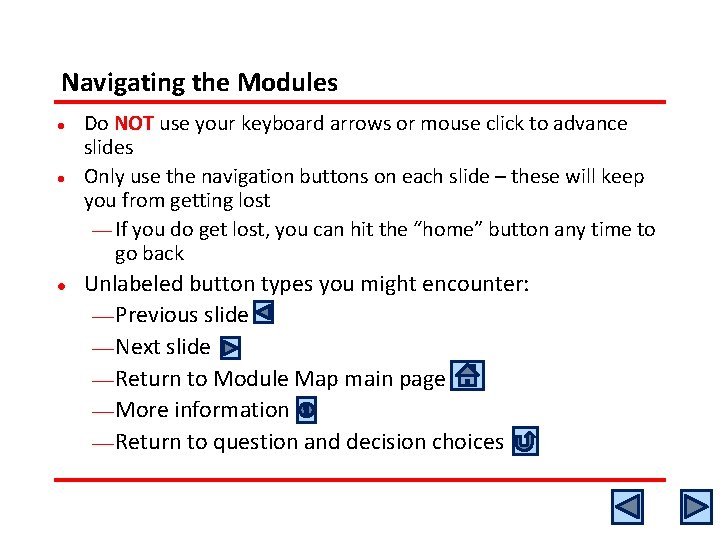
Navigating the Modules l l l Do NOT use your keyboard arrows or mouse click to advance slides Only use the navigation buttons on each slide – these will keep you from getting lost ¾ If you do get lost, you can hit the “home” button any time to go back Unlabeled button types you might encounter: ¾ Previous slide ¾ Next slide ¾ Return to Module Map main page ¾ More information ¾ Return to question and decision choices
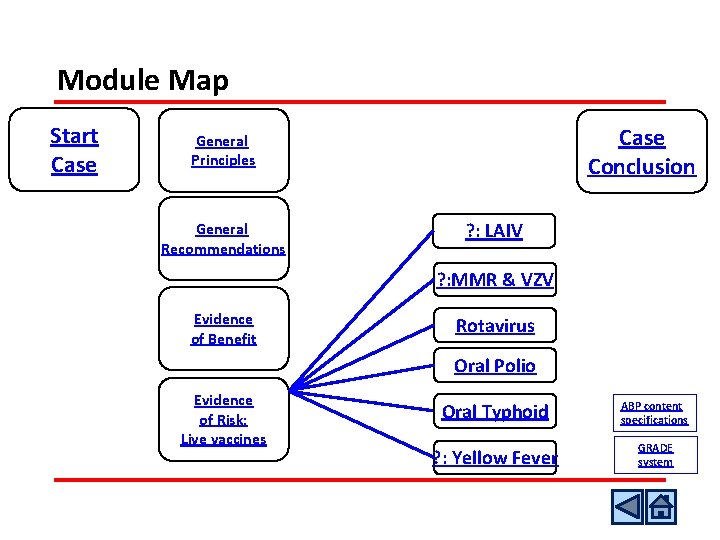
Module Map Start Case Conclusion General Principles General Recommendations ? : LAIV ? : MMR & VZV Evidence of Benefit Rotavirus Oral Polio Evidence of Risk: Live vaccines Oral Typhoid ABP content specifications ? : Yellow Fever GRADE system
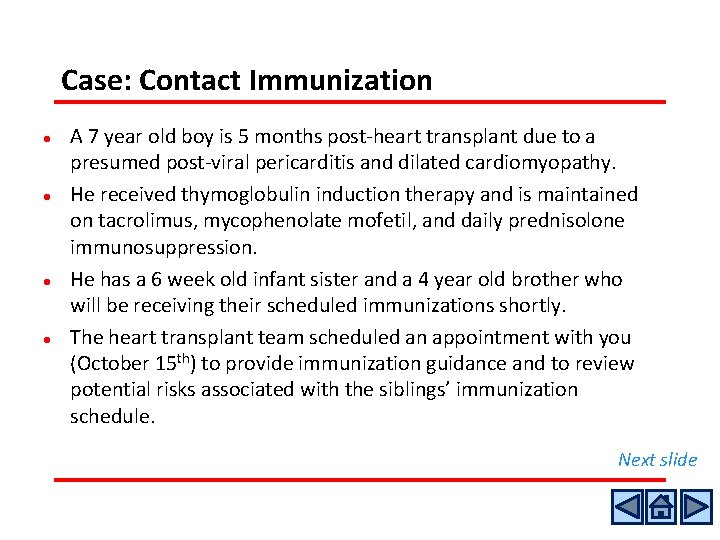
Case: Contact Immunization l l A 7 year old boy is 5 months post-heart transplant due to a presumed post-viral pericarditis and dilated cardiomyopathy. He received thymoglobulin induction therapy and is maintained on tacrolimus, mycophenolate mofetil, and daily prednisolone immunosuppression. He has a 6 week old infant sister and a 4 year old brother who will be receiving their scheduled immunizations shortly. The heart transplant team scheduled an appointment with you (October 15 th) to provide immunization guidance and to review potential risks associated with the siblings’ immunization schedule. Next slide
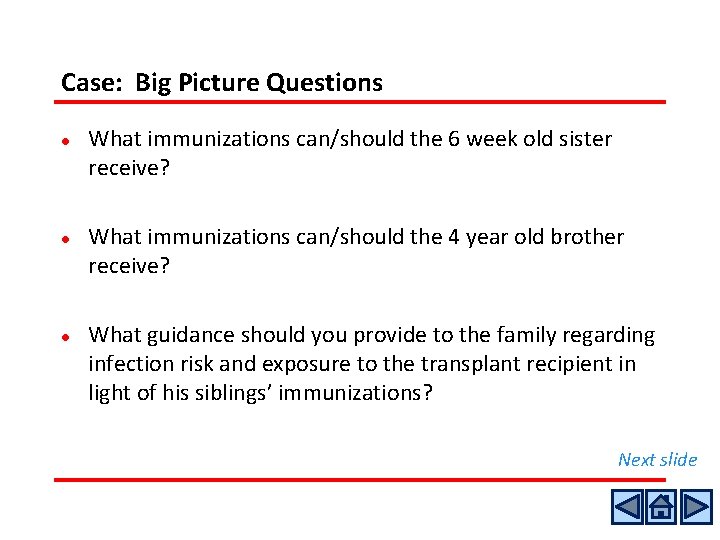
Case: Big Picture Questions l l l What immunizations can/should the 6 week old sister receive? What immunizations can/should the 4 year old brother receive? What guidance should you provide to the family regarding infection risk and exposure to the transplant recipient in light of his siblings’ immunizations? Next slide
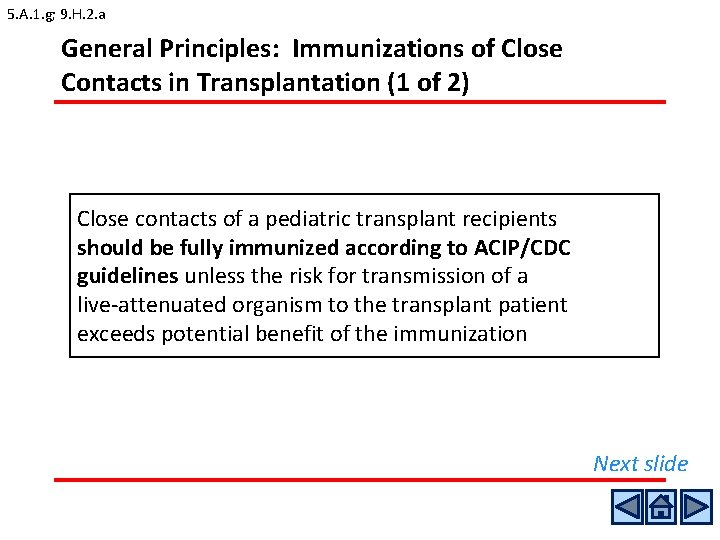
5. A. 1. g; 9. H. 2. a General Principles: Immunizations of Close Contacts in Transplantation (1 of 2) Close contacts of a pediatric transplant recipients should be fully immunized according to ACIP/CDC guidelines unless the risk for transmission of a live-attenuated organism to the transplant patient exceeds potential benefit of the immunization Next slide
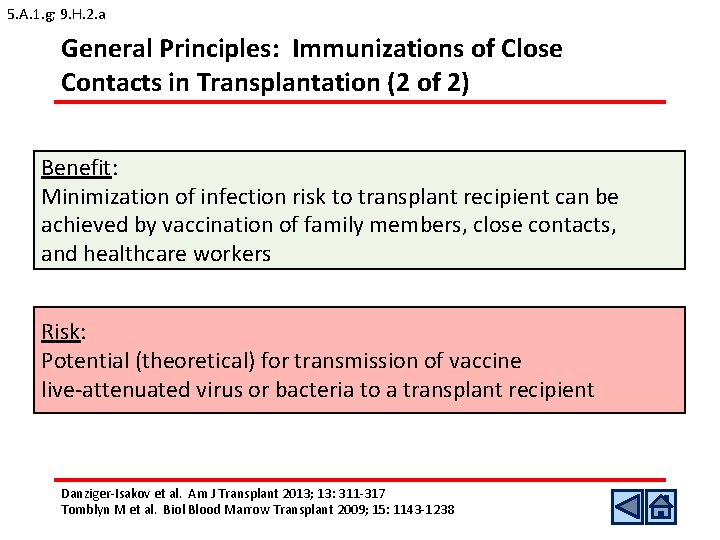
5. A. 1. g; 9. H. 2. a General Principles: Immunizations of Close Contacts in Transplantation (2 of 2) Benefit: Minimization of infection risk to transplant recipient can be achieved by vaccination of family members, close contacts, and healthcare workers Risk: Potential (theoretical) for transmission of vaccine live-attenuated virus or bacteria to a transplant recipient Danziger-Isakov et al. Am J Transplant 2013; 13: 311 -317 Tomblyn M et al. Biol Blood Marrow Transplant 2009; 15: 1143 -1238
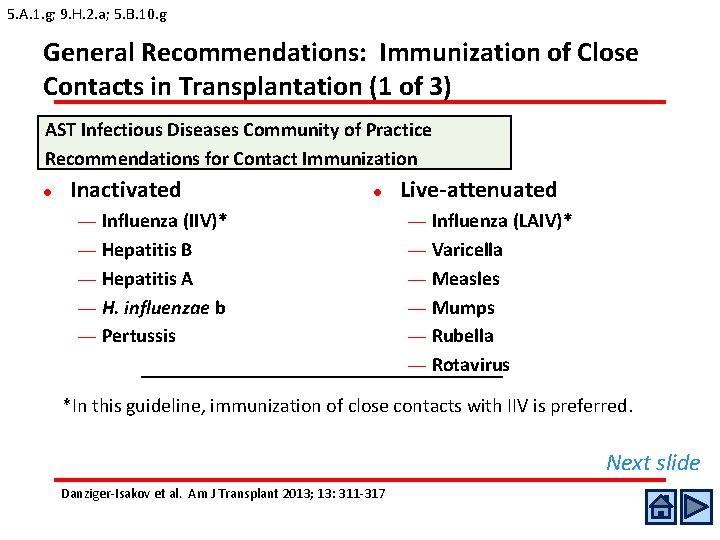
5. A. 1. g; 9. H. 2. a; 5. B. 10. g General Recommendations: Immunization of Close Contacts in Transplantation (1 of 3) AST Infectious Diseases Community of Practice Recommendations for Contact Immunization l Inactivated ¾ ¾ ¾ l Influenza (IIV)* Hepatitis B Hepatitis A H. influenzae b Pertussis Live-attenuated ¾ ¾ ¾ Influenza (LAIV)* Varicella Measles Mumps Rubella Rotavirus *In this guideline, immunization of close contacts with IIV is preferred. Next slide Danziger-Isakov et al. Am J Transplant 2013; 13: 311 -317
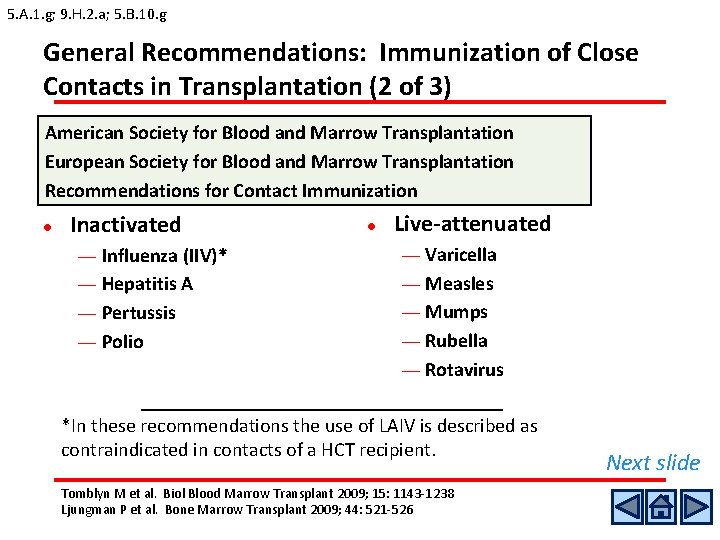
5. A. 1. g; 9. H. 2. a; 5. B. 10. g General Recommendations: Immunization of Close Contacts in Transplantation (2 of 3) American Society for Blood and Marrow Transplantation European Society for Blood and Marrow Transplantation Recommendations for Contact Immunization l Inactivated Influenza (IIV)* ¾ Hepatitis A ¾ Pertussis ¾ Polio ¾ l Live-attenuated ¾ ¾ ¾ Varicella Measles Mumps Rubella Rotavirus *In these recommendations the use of LAIV is described as contraindicated in contacts of a HCT recipient. Tomblyn M et al. Biol Blood Marrow Transplant 2009; 15: 1143 -1238 Ljungman P et al. Bone Marrow Transplant 2009; 44: 521 -526 Next slide
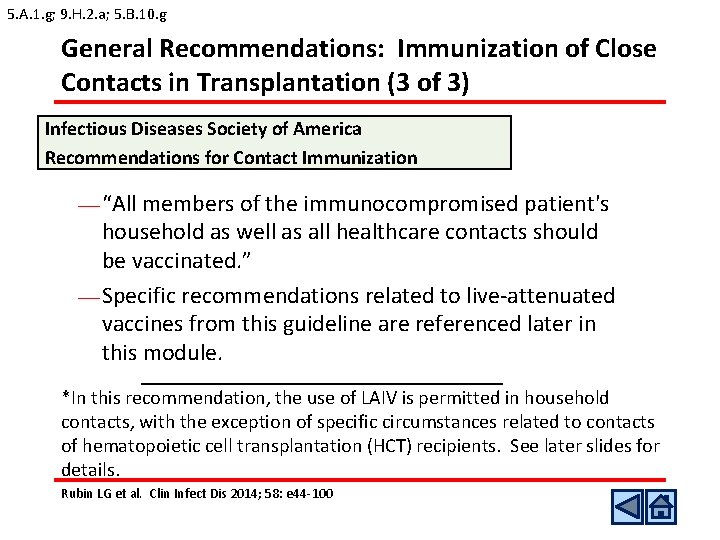
5. A. 1. g; 9. H. 2. a; 5. B. 10. g General Recommendations: Immunization of Close Contacts in Transplantation (3 of 3) Infectious Diseases Society of America Recommendations for Contact Immunization ¾ “All members of the immunocompromised patient's household as well as all healthcare contacts should be vaccinated. ” ¾ Specific recommendations related to live-attenuated vaccines from this guideline are referenced later in this module. *In this recommendation, the use of LAIV is permitted in household contacts, with the exception of specific circumstances related to contacts of hematopoietic cell transplantation (HCT) recipients. See later slides for details. Rubin LG et al. Clin Infect Dis 2014; 58: e 44 -100
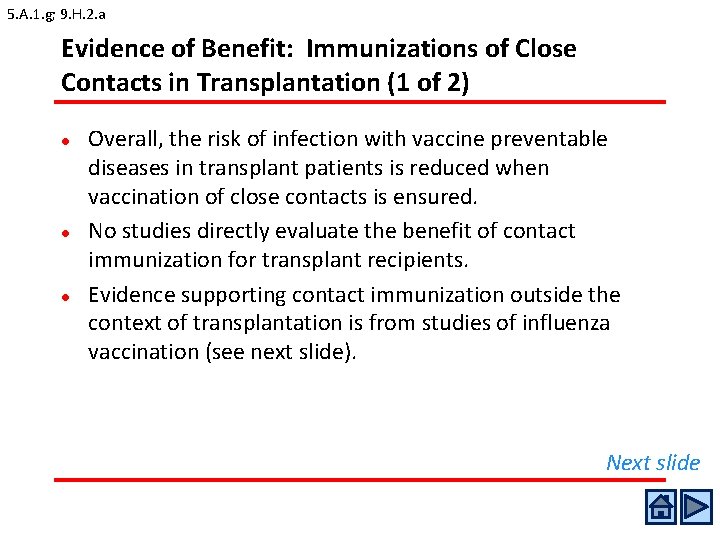
5. A. 1. g; 9. H. 2. a Evidence of Benefit: Immunizations of Close Contacts in Transplantation (1 of 2) l l l Overall, the risk of infection with vaccine preventable diseases in transplant patients is reduced when vaccination of close contacts is ensured. No studies directly evaluate the benefit of contact immunization for transplant recipients. Evidence supporting contact immunization outside the context of transplantation is from studies of influenza vaccination (see next slide). Next slide
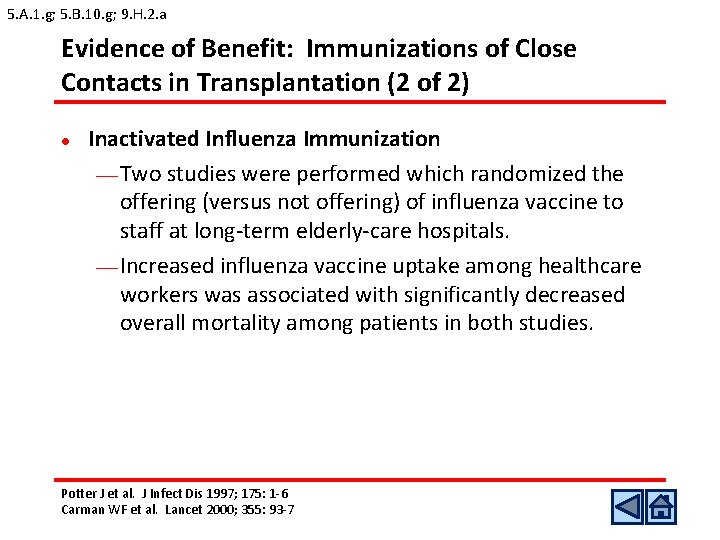
5. A. 1. g; 5. B. 10. g; 9. H. 2. a Evidence of Benefit: Immunizations of Close Contacts in Transplantation (2 of 2) l Inactivated Influenza Immunization ¾ Two studies were performed which randomized the offering (versus not offering) of influenza vaccine to staff at long-term elderly-care hospitals. ¾ Increased influenza vaccine uptake among healthcare workers was associated with significantly decreased overall mortality among patients in both studies. Potter J et al. J Infect Dis 1997; 175: 1 -6 Carman WF et al. Lancet 2000; 355: 93 -7
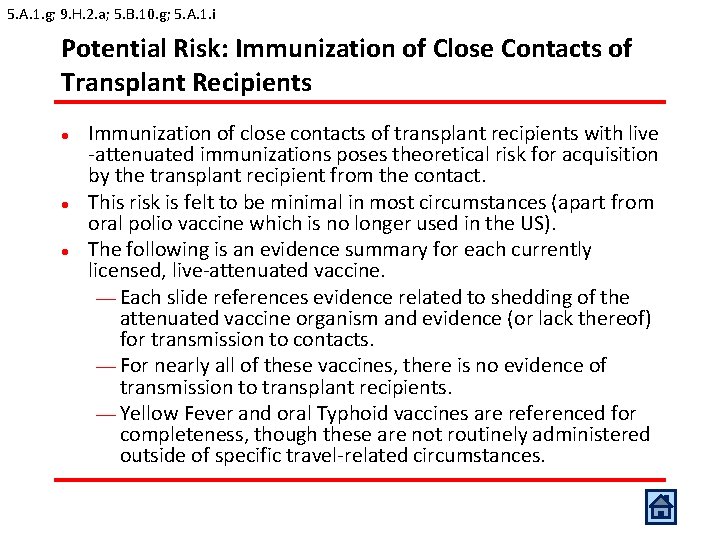
5. A. 1. g; 9. H. 2. a; 5. B. 10. g; 5. A. 1. i Potential Risk: Immunization of Close Contacts of Transplant Recipients l l l Immunization of close contacts of transplant recipients with live -attenuated immunizations poses theoretical risk for acquisition by the transplant recipient from the contact. This risk is felt to be minimal in most circumstances (apart from oral polio vaccine which is no longer used in the US). The following is an evidence summary for each currently licensed, live-attenuated vaccine. ¾ Each slide references evidence related to shedding of the attenuated vaccine organism and evidence (or lack thereof) for transmission to contacts. ¾ For nearly all of these vaccines, there is no evidence of transmission to transplant recipients. ¾ Yellow Fever and oral Typhoid vaccines are referenced for completeness, though these are not routinely administered outside of specific travel-related circumstances.
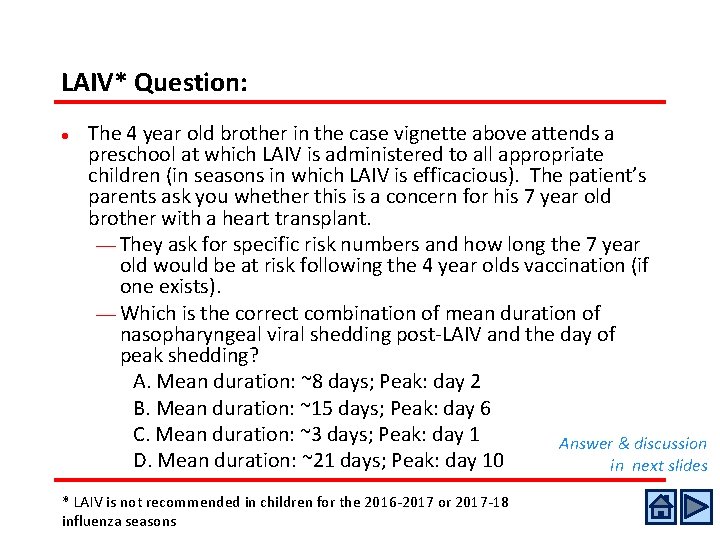
LAIV* Question: l The 4 year old brother in the case vignette above attends a preschool at which LAIV is administered to all appropriate children (in seasons in which LAIV is efficacious). The patient’s parents ask you whether this is a concern for his 7 year old brother with a heart transplant. ¾ They ask for specific risk numbers and how long the 7 year old would be at risk following the 4 year olds vaccination (if one exists). ¾ Which is the correct combination of mean duration of nasopharyngeal viral shedding post-LAIV and the day of peak shedding? A. Mean duration: ~8 days; Peak: day 2 B. Mean duration: ~15 days; Peak: day 6 C. Mean duration: ~3 days; Peak: day 1 Answer & discussion D. Mean duration: ~21 days; Peak: day 10 in next slides * LAIV is not recommended in children for the 2016 -2017 or 2017 -18 influenza seasons
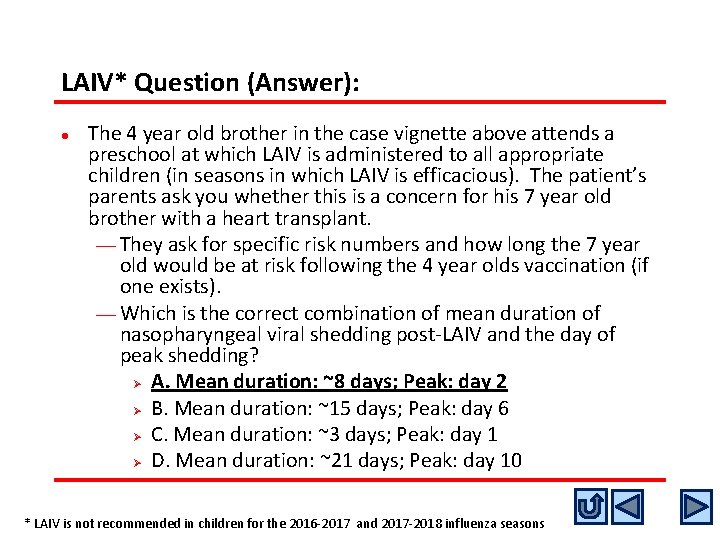
LAIV* Question (Answer): l The 4 year old brother in the case vignette above attends a preschool at which LAIV is administered to all appropriate children (in seasons in which LAIV is efficacious). The patient’s parents ask you whether this is a concern for his 7 year old brother with a heart transplant. ¾ They ask for specific risk numbers and how long the 7 year old would be at risk following the 4 year olds vaccination (if one exists). ¾ Which is the correct combination of mean duration of nasopharyngeal viral shedding post-LAIV and the day of peak shedding? Ø A. Mean duration: ~8 days; Peak: day 2 Ø B. Mean duration: ~15 days; Peak: day 6 Ø C. Mean duration: ~3 days; Peak: day 1 Ø D. Mean duration: ~21 days; Peak: day 10 * LAIV is not recommended in children for the 2016 -2017 and 2017 -2018 influenza seasons
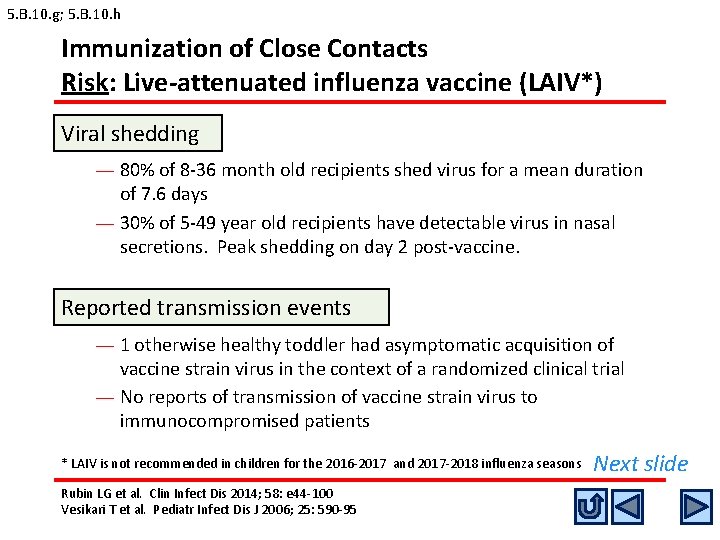
5. B. 10. g; 5. B. 10. h Immunization of Close Contacts Risk: Live-attenuated influenza vaccine (LAIV*) Viral shedding 80% of 8 -36 month old recipients shed virus for a mean duration of 7. 6 days ¾ 30% of 5 -49 year old recipients have detectable virus in nasal secretions. Peak shedding on day 2 post-vaccine. ¾ Reported transmission events 1 otherwise healthy toddler had asymptomatic acquisition of vaccine strain virus in the context of a randomized clinical trial ¾ No reports of transmission of vaccine strain virus to immunocompromised patients ¾ * LAIV is not recommended in children for the 2016 -2017 and 2017 -2018 influenza seasons Rubin LG et al. Clin Infect Dis 2014; 58: e 44 -100 Vesikari T et al. Pediatr Infect Dis J 2006; 25: 590 -95 Next slide
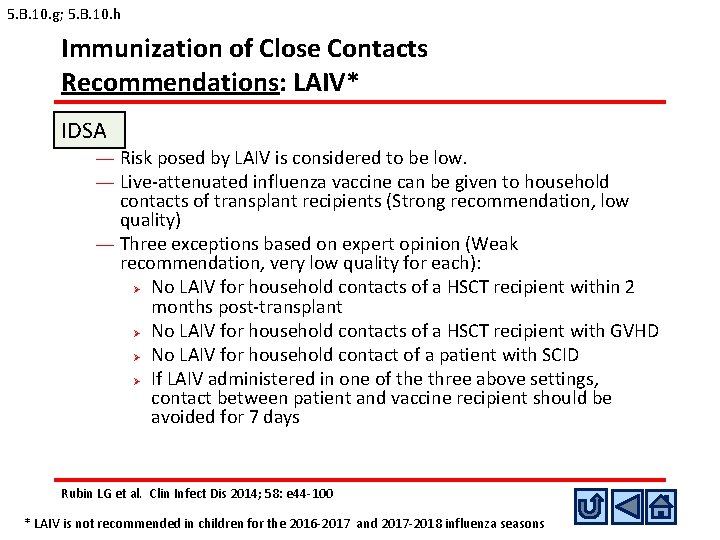
5. B. 10. g; 5. B. 10. h Immunization of Close Contacts Recommendations: LAIV* IDSA Risk posed by LAIV is considered to be low. Live-attenuated influenza vaccine can be given to household contacts of transplant recipients (Strong recommendation, low quality) ¾ Three exceptions based on expert opinion (Weak recommendation, very low quality for each): Ø No LAIV for household contacts of a HSCT recipient within 2 months post-transplant Ø No LAIV for household contacts of a HSCT recipient with GVHD Ø No LAIV for household contact of a patient with SCID Ø If LAIV administered in one of the three above settings, contact between patient and vaccine recipient should be avoided for 7 days ¾ ¾ Rubin LG et al. Clin Infect Dis 2014; 58: e 44 -100 * LAIV is not recommended in children for the 2016 -2017 and 2017 -2018 influenza seasons
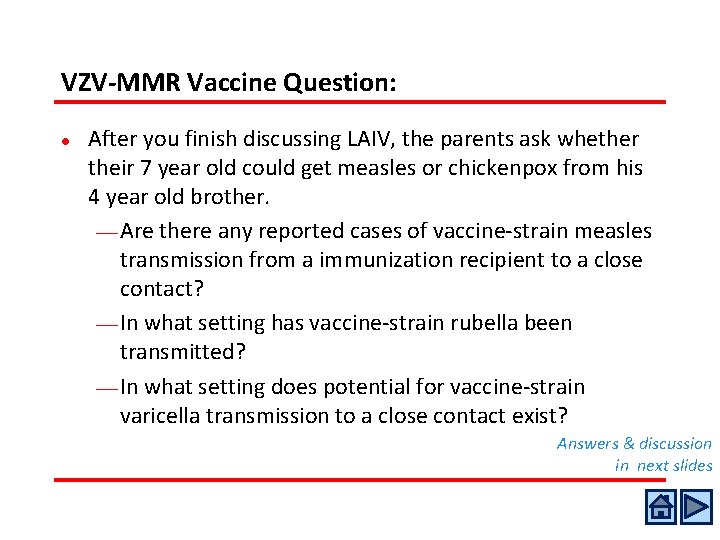
VZV-MMR Vaccine Question: l After you finish discussing LAIV, the parents ask whether their 7 year old could get measles or chickenpox from his 4 year old brother. ¾ Are there any reported cases of vaccine-strain measles transmission from a immunization recipient to a close contact? ¾ In what setting has vaccine-strain rubella been transmitted? ¾ In what setting does potential for vaccine-strain varicella transmission to a close contact exist? Answers & discussion in next slides
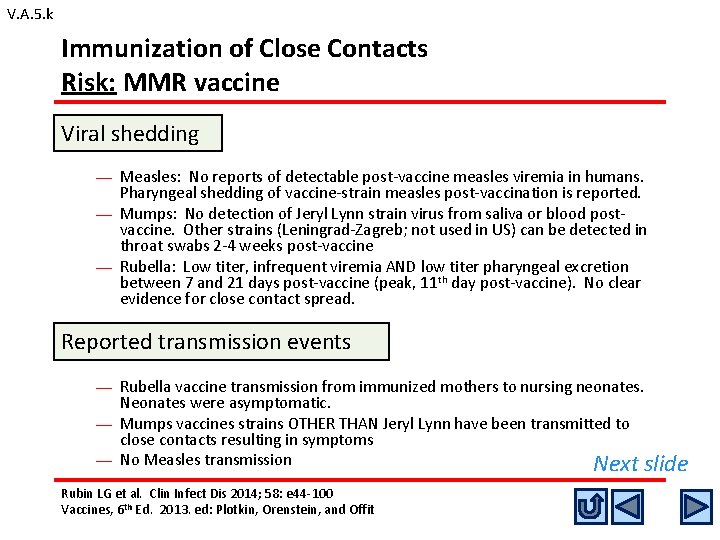
V. A. 5. k Immunization of Close Contacts Risk: MMR vaccine Viral shedding Measles: No reports of detectable post-vaccine measles viremia in humans. Pharyngeal shedding of vaccine-strain measles post-vaccination is reported. ¾ Mumps: No detection of Jeryl Lynn strain virus from saliva or blood postvaccine. Other strains (Leningrad-Zagreb; not used in US) can be detected in throat swabs 2 -4 weeks post-vaccine ¾ Rubella: Low titer, infrequent viremia AND low titer pharyngeal excretion between 7 and 21 days post-vaccine (peak, 11 th day post-vaccine). No clear evidence for close contact spread. ¾ Reported transmission events Rubella vaccine transmission from immunized mothers to nursing neonates. Neonates were asymptomatic. ¾ Mumps vaccines strains OTHER THAN Jeryl Lynn have been transmitted to close contacts resulting in symptoms ¾ No Measles transmission Next slide ¾ Rubin LG et al. Clin Infect Dis 2014; 58: e 44 -100 Vaccines, 6 th Ed. 2013. ed: Plotkin, Orenstein, and Offit
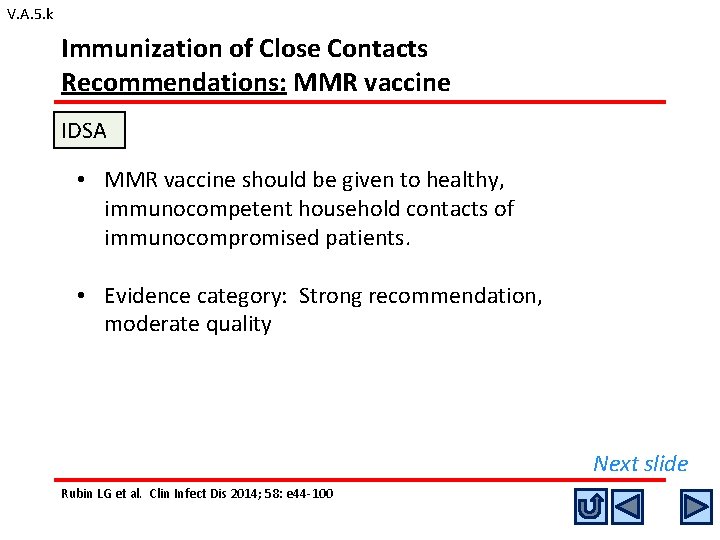
V. A. 5. k Immunization of Close Contacts Recommendations: MMR vaccine IDSA • MMR vaccine should be given to healthy, immunocompetent household contacts of immunocompromised patients. • Evidence category: Strong recommendation, moderate quality Next slide Rubin LG et al. Clin Infect Dis 2014; 58: e 44 -100
5. B. 16. e Immunization of Close Contacts Risk: Varicella vaccine Viral shedding ¾ Limited to vaccine recipients who develop a post-vaccination rash Reported transmission events Limited transmission from vaccine recipient to close contact IF rash develops ¾ One study (Diaz et al. ) with no transmission from vaccine recipient to pediatric leukemia patients who were close contacts of recipient ¾ Next slide Rubin LG et al. Clin Infect Dis 2014; 58: e 44 -100 Tsolia M et al. J Pediatr 1990; 116: 184 -189 Diaz PS et al. Pediatrics 1991; 87: 166 -170
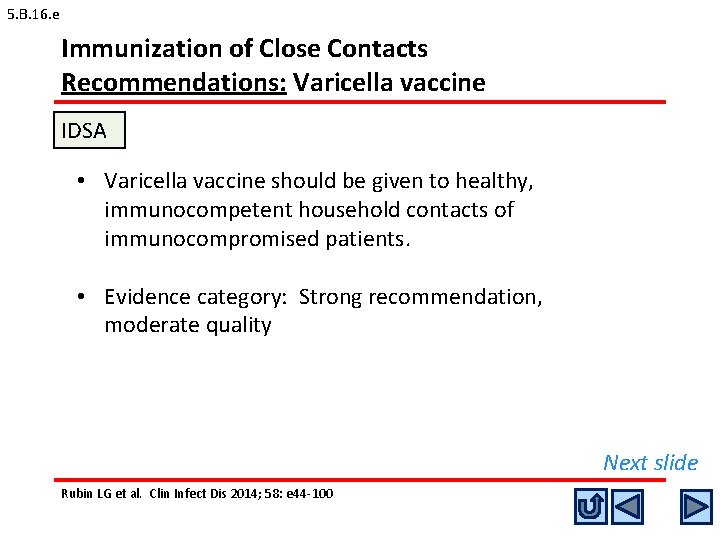
5. B. 16. e Immunization of Close Contacts Recommendations: Varicella vaccine IDSA A • Varicella vaccine should be given to healthy, immunocompetent household contacts of immunocompromised patients. • Evidence category: Strong recommendation, moderate quality Next slide Rubin LG et al. Clin Infect Dis 2014; 58: e 44 -100
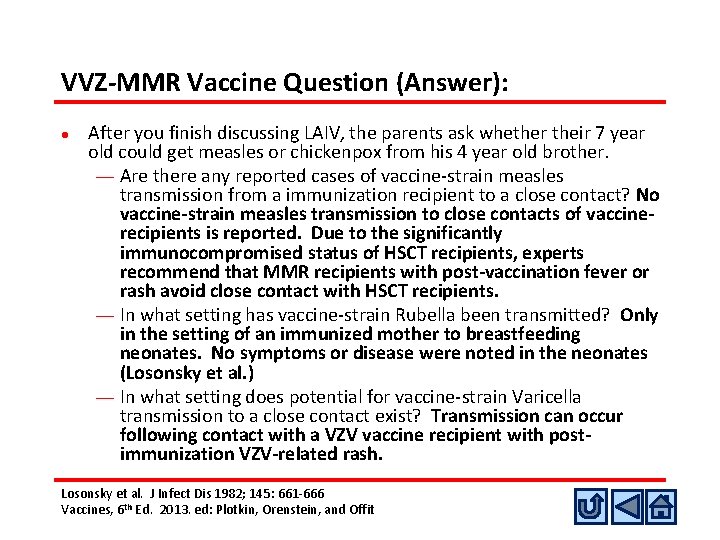
VVZ-MMR Vaccine Question (Answer): l After you finish discussing LAIV, the parents ask whether their 7 year old could get measles or chickenpox from his 4 year old brother. ¾ Are there any reported cases of vaccine-strain measles transmission from a immunization recipient to a close contact? No vaccine-strain measles transmission to close contacts of vaccinerecipients is reported. Due to the significantly immunocompromised status of HSCT recipients, experts recommend that MMR recipients with post-vaccination fever or rash avoid close contact with HSCT recipients. ¾ In what setting has vaccine-strain Rubella been transmitted? Only in the setting of an immunized mother to breastfeeding neonates. No symptoms or disease were noted in the neonates (Losonsky et al. ) ¾ In what setting does potential for vaccine-strain Varicella transmission to a close contact exist? Transmission can occur following contact with a VZV vaccine recipient with postimmunization VZV-related rash. Losonsky et al. J Infect Dis 1982; 145: 661 -666 Vaccines, 6 th Ed. 2013. ed: Plotkin, Orenstein, and Offit
5. B. 19. a Immunization of Close Contacts Risk: Rotavirus vaccine Viral shedding ¾ Viral shedding from stool for 2 -4 weeks post-vaccine ¾ 0 -76% of recipients depending on the study Reported transmission events ¾ 18. 8% transmission rate in one study of discordantly vaccinated twin infants (all asymptomatic) ¾ Rare symptomatic disease transmission (1 report) Next slide Rubin LG et al. Clin Infect Dis 2014; 58: e 44 -100 Anderson EJ. Lancet Infect Dis 2008; 8: 642 -9 Rivera L et al. Vaccine 2011; 51: 9508 -13
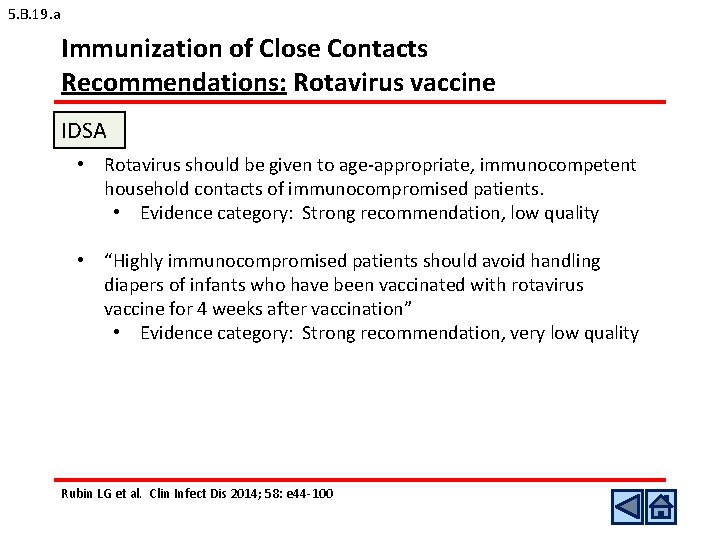
5. B. 19. a Immunization of Close Contacts Recommendations: Rotavirus vaccine IDSA • Rotavirus should be given to age-appropriate, immunocompetent household contacts of immunocompromised patients. • Evidence category: Strong recommendation, low quality • “Highly immunocompromised patients should avoid handling diapers of infants who have been vaccinated with rotavirus vaccine for 4 weeks after vaccination” • Evidence category: Strong recommendation, very low quality Rubin LG et al. Clin Infect Dis 2014; 58: e 44 -100
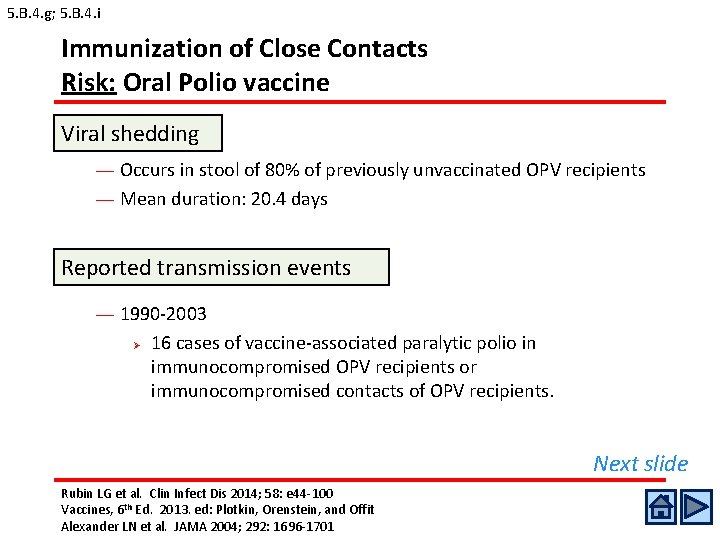
5. B. 4. g; 5. B. 4. i Immunization of Close Contacts Risk: Oral Polio vaccine Viral shedding Occurs in stool of 80% of previously unvaccinated OPV recipients ¾ Mean duration: 20. 4 days ¾ Reported transmission events ¾ 1990 -2003 Ø 16 cases of vaccine-associated paralytic polio in immunocompromised OPV recipients or immunocompromised contacts of OPV recipients. Next slide Rubin LG et al. Clin Infect Dis 2014; 58: e 44 -100 Vaccines, 6 th Ed. 2013. ed: Plotkin, Orenstein, and Offit Alexander LN et al. JAMA 2004; 292: 1696 -1701
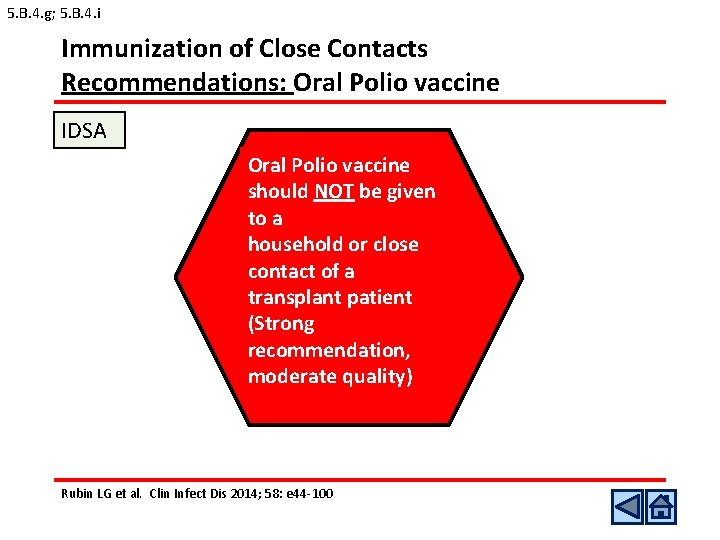
5. B. 4. g; 5. B. 4. i Immunization of Close Contacts Recommendations: Oral Polio vaccine IDSA Oral Polio vaccine should NOT be given to a household or close contact of a transplant patient (Strong recommendation, moderate quality) Rubin LG et al. Clin Infect Dis 2014; 58: e 44 -100
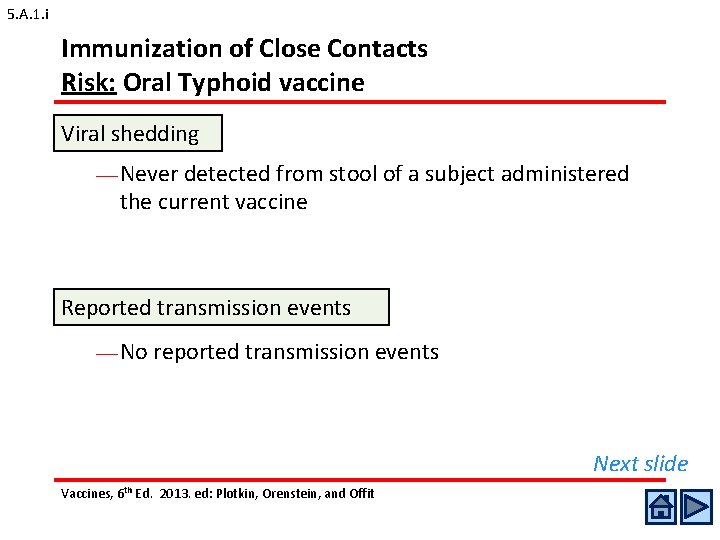
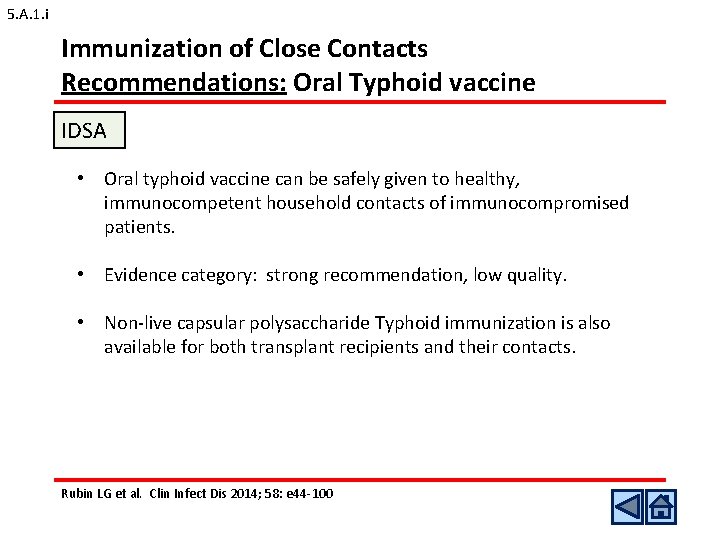
5. A. 1. i Immunization of Close Contacts Risk: Oral Typhoid vaccine Viral shedding ¾ Never detected from stool of a subject administered the current vaccine Reported transmission events ¾ No reported transmission events Next slide Vaccines, 6 th Ed. 2013. ed: Plotkin, Orenstein, and Offit
5. A. 1. i Immunization of Close Contacts Recommendations: Oral Typhoid vaccine IDSA • Oral typhoid vaccine can be safely given to healthy, immunocompetent household contacts of immunocompromised patients. • Evidence category: strong recommendation, low quality. • Non-live capsular polysaccharide Typhoid immunization is also available for both transplant recipients and their contacts. Rubin LG et al. Clin Infect Dis 2014; 58: e 44 -100
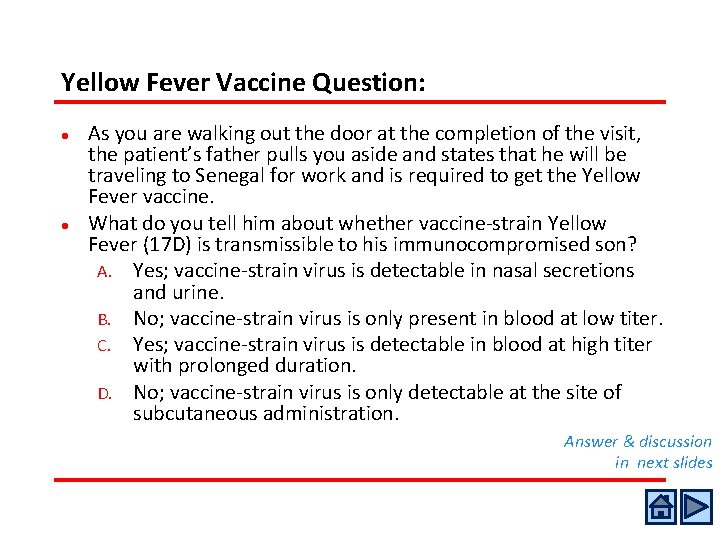
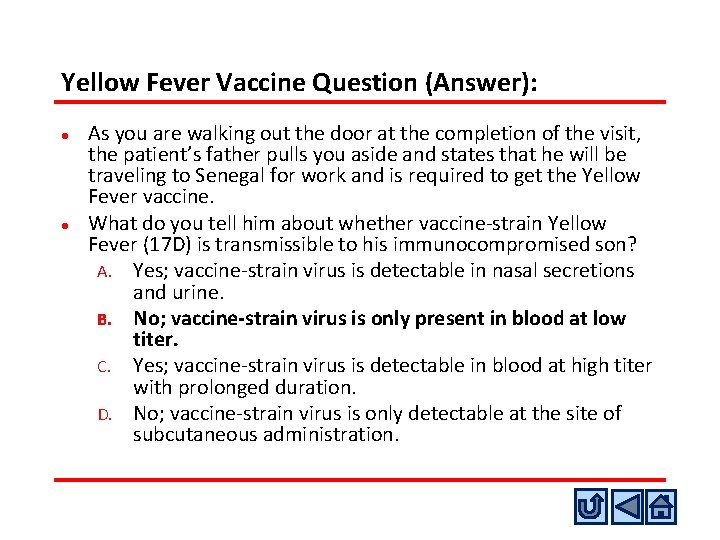
Yellow Fever Vaccine Question: l l As you are walking out the door at the completion of the visit, the patient’s father pulls you aside and states that he will be traveling to Senegal for work and is required to get the Yellow Fever vaccine. What do you tell him about whether vaccine-strain Yellow Fever (17 D) is transmissible to his immunocompromised son? A. Yes; vaccine-strain virus is detectable in nasal secretions and urine. B. No; vaccine-strain virus is only present in blood at low titer. C. Yes; vaccine-strain virus is detectable in blood at high titer with prolonged duration. D. No; vaccine-strain virus is only detectable at the site of subcutaneous administration. Answer & discussion in next slides
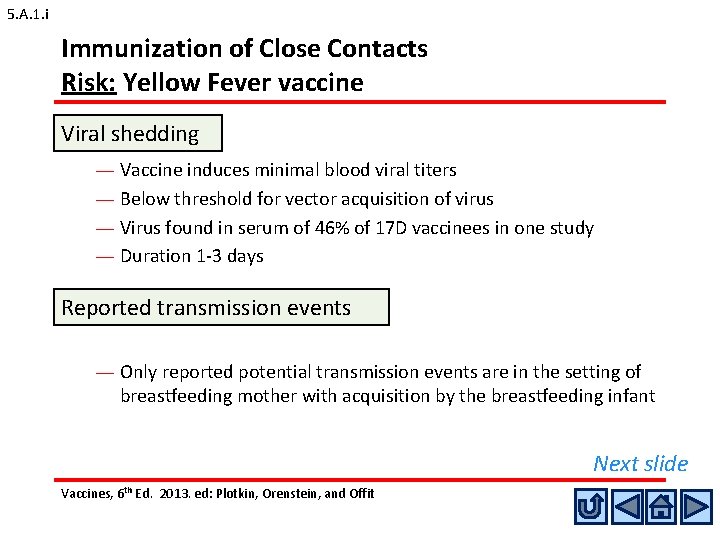
5. A. 1. i Immunization of Close Contacts Risk: Yellow Fever vaccine Viral shedding Vaccine induces minimal blood viral titers ¾ Below threshold for vector acquisition of virus ¾ Virus found in serum of 46% of 17 D vaccinees in one study ¾ Duration 1 -3 days ¾ Reported transmission events ¾ Only reported potential transmission events are in the setting of breastfeeding mother with acquisition by the breastfeeding infant Next slide Vaccines, 6 th Ed. 2013. ed: Plotkin, Orenstein, and Offit
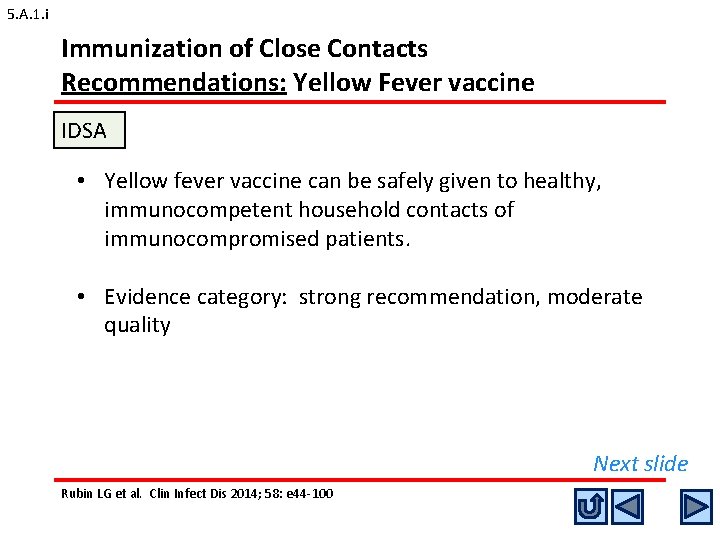
5. A. 1. i Immunization of Close Contacts Recommendations: Yellow Fever vaccine IDSA • Yellow fever vaccine can be safely given to healthy, immunocompetent household contacts of immunocompromised patients. • Evidence category: strong recommendation, moderate quality Next slide Rubin LG et al. Clin Infect Dis 2014; 58: e 44 -100
Yellow Fever Vaccine Question (Answer): l l As you are walking out the door at the completion of the visit, the patient’s father pulls you aside and states that he will be traveling to Senegal for work and is required to get the Yellow Fever vaccine. What do you tell him about whether vaccine-strain Yellow Fever (17 D) is transmissible to his immunocompromised son? A. Yes; vaccine-strain virus is detectable in nasal secretions and urine. B. No; vaccine-strain virus is only present in blood at low titer. C. Yes; vaccine-strain virus is detectable in blood at high titer with prolonged duration. D. No; vaccine-strain virus is only detectable at the site of subcutaneous administration.
Case 5. A. 1. g Case: Conclusion (Slide 1 of 4) l l l You emphasize the importance of all scheduled immunizations for both the 6 week old and the 4 year old siblings of the heart transplant patient. You strongly recommend administration of influenza vaccine (IIV) to the healthy 4 year old currently (as it is now influenza season). You strongly recommend administration of inactivated influenza vaccine to the 6 week old sister when she reaches 6 months of age. Next slide
Case: Conclusion (Slide 2 of 4) l l The patient’s 6 week old sister receives her age appropriate immunizations ¾ Hepatitis B, PCV 13, DTa. P, Hib, IPV, Rotavirus The patient’s 4 year old brother receives his age appropriate immunizations ¾ DTa. P, IPV, MMR, Varicella, Influenza Next slide
Case: Conclusion (Slide 3 of 4) l You advise the patient’s family to ensure that the patient does not handle the 6 week old sister’s diapers for 4 weeks following her receipt of rotavirus vaccination. ¾ All handlers of diapers should wash hands. ¾ Diapers should be disposed of in containers that will not allow contamination. ¾ Surfaces where diapers were changed should be cleaned. Next slide
Case 5. A. 1. g Case: Conclusion (Slide 4 of 4) l l You provide the following advice to the family regarding the 4 year old brother’s receipt of varicella and MMR vaccine. If a rash develops in the 4 year old following immunization, ¾ rash that results post-vaccine should be covered ¾ the heart transplant recipient should limit contact with the vaccinated sibling including avoiding contact with lesions, secretions, and other potentially contaminated surfaces ¾ heart transplant recipient should be seen by a physician as soon after the exposure is recognized, to evaluate the degree of exposure to potential vaccine-related skin lesions, to determine the need for prophylaxis or treatment (when pertinent), and to provide anticipatory guidance regarding signs and symptoms that would require further care
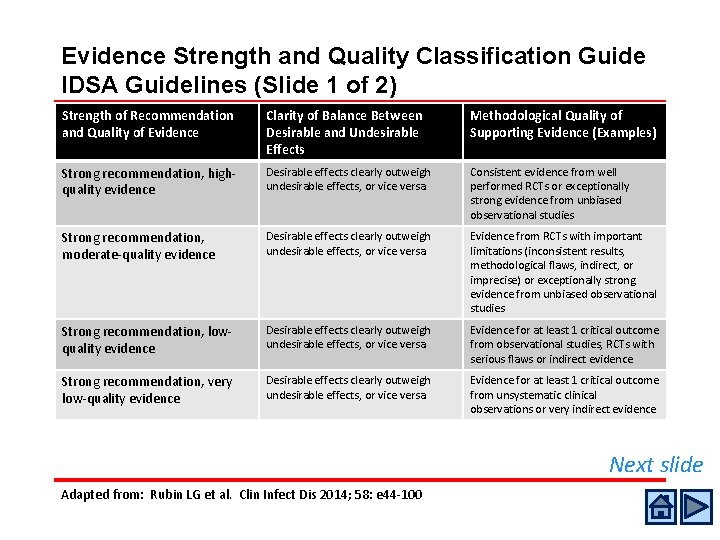
Evidence Strength and Quality Classification Guide IDSA Guidelines (Slide 1 of 2) Strength of Recommendation and Quality of Evidence Clarity of Balance Between Desirable and Undesirable Effects Methodological Quality of Supporting Evidence (Examples) Strong recommendation, highquality evidence Desirable effects clearly outweigh undesirable effects, or vice versa Consistent evidence from well performed RCTs or exceptionally strong evidence from unbiased observational studies Strong recommendation, moderate-quality evidence Desirable effects clearly outweigh undesirable effects, or vice versa Evidence from RCTs with important limitations (inconsistent results, methodological flaws, indirect, or imprecise) or exceptionally strong evidence from unbiased observational studies Strong recommendation, lowquality evidence Desirable effects clearly outweigh undesirable effects, or vice versa Evidence for at least 1 critical outcome from observational studies, RCTs with serious flaws or indirect evidence Strong recommendation, very low-quality evidence Desirable effects clearly outweigh undesirable effects, or vice versa Evidence for at least 1 critical outcome from unsystematic clinical observations or very indirect evidence Next slide Adapted from: Rubin LG et al. Clin Infect Dis 2014; 58: e 44 -100
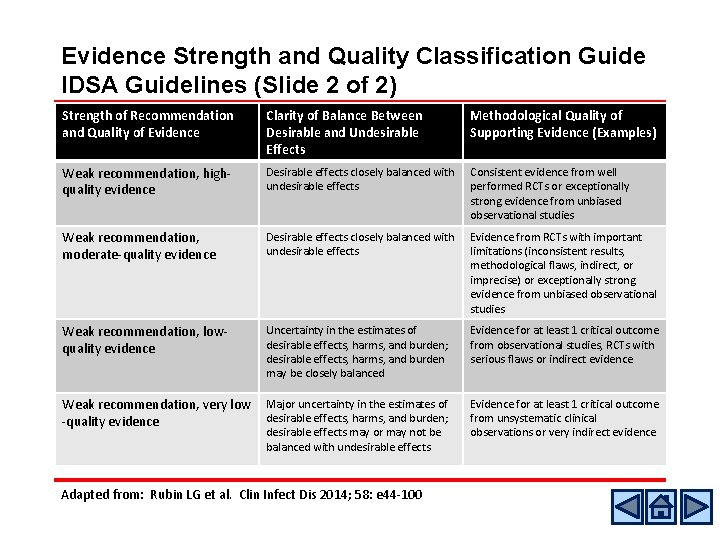
Evidence Strength and Quality Classification Guide IDSA Guidelines (Slide 2 of 2) Strength of Recommendation and Quality of Evidence Clarity of Balance Between Desirable and Undesirable Effects Methodological Quality of Supporting Evidence (Examples) Weak recommendation, highquality evidence Desirable effects closely balanced with undesirable effects Consistent evidence from well performed RCTs or exceptionally strong evidence from unbiased observational studies Weak recommendation, moderate-quality evidence Desirable effects closely balanced with undesirable effects Evidence from RCTs with important limitations (inconsistent results, methodological flaws, indirect, or imprecise) or exceptionally strong evidence from unbiased observational studies Weak recommendation, lowquality evidence Uncertainty in the estimates of desirable effects, harms, and burden; desirable effects, harms, and burden may be closely balanced Evidence for at least 1 critical outcome from observational studies, RCTs with serious flaws or indirect evidence Weak recommendation, very low -quality evidence Major uncertainty in the estimates of desirable effects, harms, and burden; desirable effects may or may not be balanced with undesirable effects Evidence for at least 1 critical outcome from unsystematic clinical observations or very indirect evidence Adapted from: Rubin LG et al. Clin Infect Dis 2014; 58: e 44 -100
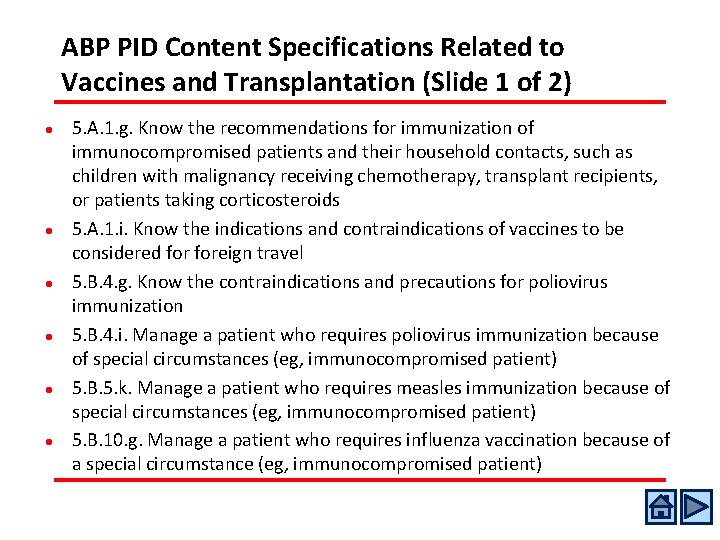
ABP PID Content Specifications Related to Vaccines and Transplantation (Slide 1 of 2) l l l 5. A. 1. g. Know the recommendations for immunization of immunocompromised patients and their household contacts, such as children with malignancy receiving chemotherapy, transplant recipients, or patients taking corticosteroids 5. A. 1. i. Know the indications and contraindications of vaccines to be considered foreign travel 5. B. 4. g. Know the contraindications and precautions for poliovirus immunization 5. B. 4. i. Manage a patient who requires poliovirus immunization because of special circumstances (eg, immunocompromised patient) 5. B. 5. k. Manage a patient who requires measles immunization because of special circumstances (eg, immunocompromised patient) 5. B. 10. g. Manage a patient who requires influenza vaccination because of a special circumstance (eg, immunocompromised patient)
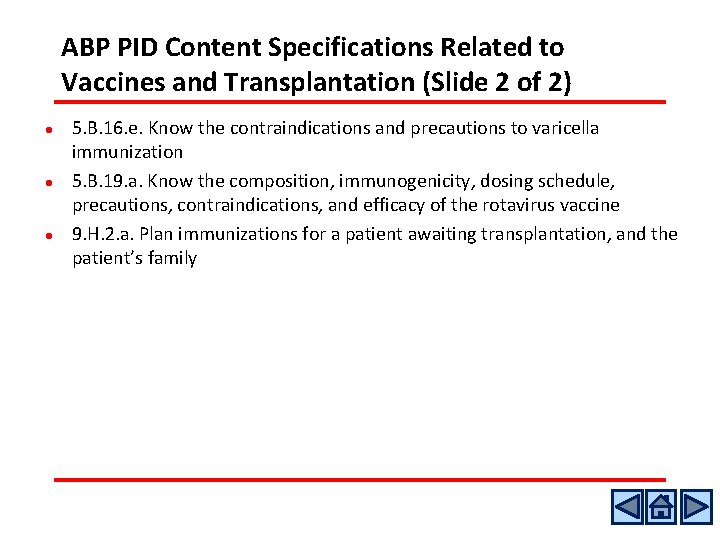
ABP PID Content Specifications Related to Vaccines and Transplantation (Slide 2 of 2) l l l 5. B. 16. e. Know the contraindications and precautions to varicella immunization 5. B. 19. a. Know the composition, immunogenicity, dosing schedule, precautions, contraindications, and efficacy of the rotavirus vaccine 9. H. 2. a. Plan immunizations for a patient awaiting transplantation, and the patient’s family
This module was developed by: l l Daniel Dulek, MD at Vanderbilt School of Medicine Flor Muñoz, MD at Baylor College of Medicine Original version date: June 20, 2016 Revised date: June 2018 Part of an educational effort through the PIDS Transplant Infectious Diseases working group and the AST ID Community of Practice
Evaluation of this module l l Please help us evaluate this module by completing a short evaluation on this link: https: //www. surveymonkey. com/r/PKT 96 V 9 Thank you!