The Production of Light Shedding some light on
- Slides: 13
The Production of Light Shedding some light on the world…
How We See • We see by light entering our eyes • This happens in 1 of 2 ways: – Luminous objects create their own light • Light bulb, Sun, TV – Non-Luminous objects only reflect light • Paper, planets, desks
How Light is Produced • Luminous Objects produce their own light in a variety of ways. For example: – – – – – Incandescence Electric Discharge Phosphorescence Fluorescence Chemiluminescence Bioluminescence Triboluminescence Light-Emmiting Diode (LED) LASER
Incandescence • Producing light from a glowing hot object • Colours produced depend on the temperature • As temperatures increase, colours change from red, to yellow, to white, to a blueishwhite. • Examples: – Stove, fire, incandescent light bulb
Electric Discharge • Producing light by passing electric current through a gas • Electrons are excited to higher orbits and then emit light when they fall back down • Different gasses produce different colours • Examples: – Lightening, neon lights
Phosphorescence • Producing light by absorbing UV light and emitting visible light over time • Phosphors store the energy until later • Examples: – Glow in the dark stickers, some watches
Fluorescence • Producing light by absorbing UV light and emitting visible light immediately • Examples: – Fluorescent lights, “black lights”, highlighters
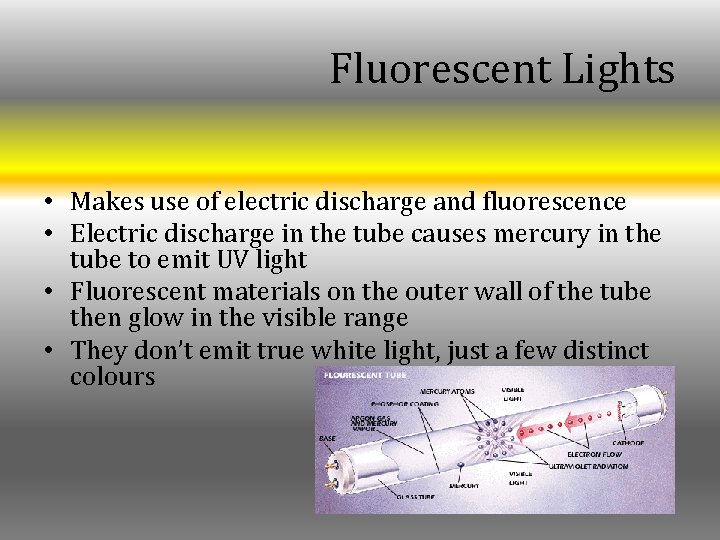
Fluorescent Lights • Makes use of electric discharge and fluorescence • Electric discharge in the tube causes mercury in the tube to emit UV light • Fluorescent materials on the outer wall of the tube then glow in the visible range • They don’t emit true white light, just a few distinct colours
Chemiluminescence • Production of light as the result of a chemical reaction • Little to no heat is produced • No electric current required • Examples: – Glow sticks
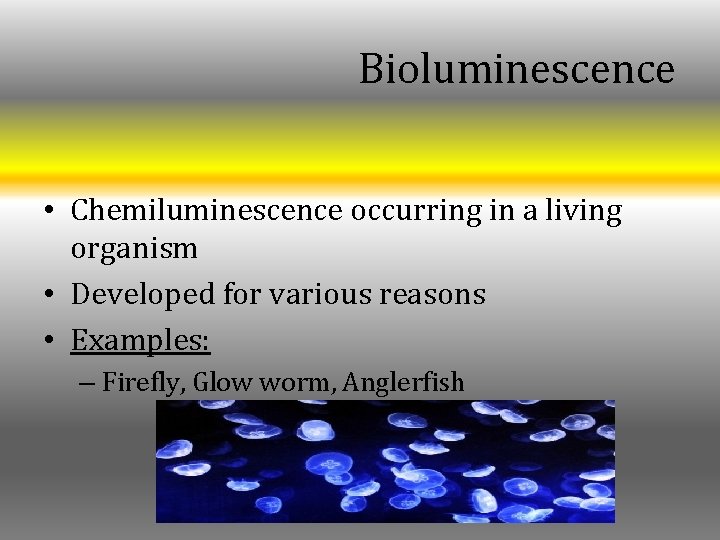
Bioluminescence • Chemiluminescence occurring in a living organism • Developed for various reasons • Examples: – Firefly, Glow worm, Anglerfish
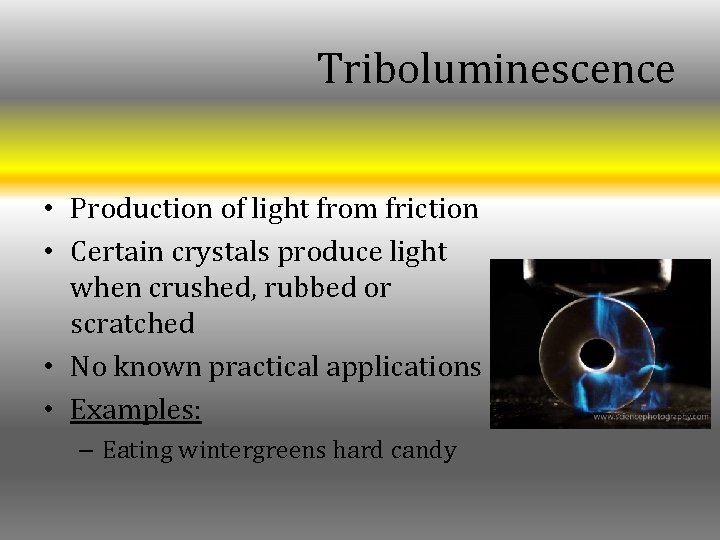
Triboluminescence • Production of light from friction • Certain crystals produce light when crushed, rubbed or scratched • No known practical applications • Examples: – Eating wintergreens hard candy
Light-Emitting Diode (LED) • Producing light by passing electricity through a semi-conductor • Semi-conductor: A material allowing electricity to pass in one direction only • Low heat produced and very energy efficient • Examples: – Glowing light on electronics, Christmas lights, traffic lights
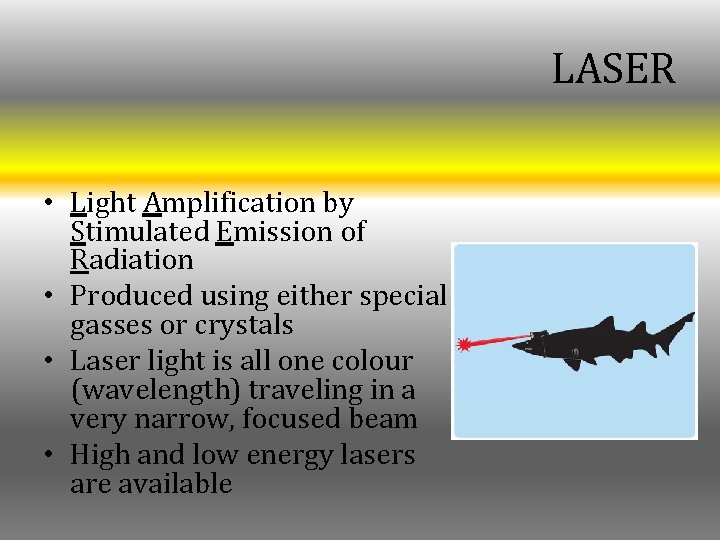
LASER • Light Amplification by Stimulated Emission of Radiation • Produced using either special gasses or crystals • Laser light is all one colour (wavelength) traveling in a very narrow, focused beam • High and low energy lasers are available