Distance Measures Tan et al From Chapter 2
- Slides: 14
Distance Measures Tan et al. From Chapter 2
Similarity and Dissimilarity • Similarity – Numerical measure of how alike two data objects are. – Is higher when objects are more alike. – Often falls in the range [0, 1] • Dissimilarity – Numerical measure of how different are two data objects – Lower when objects are more alike – Minimum dissimilarity is often 0 – Upper limit varies
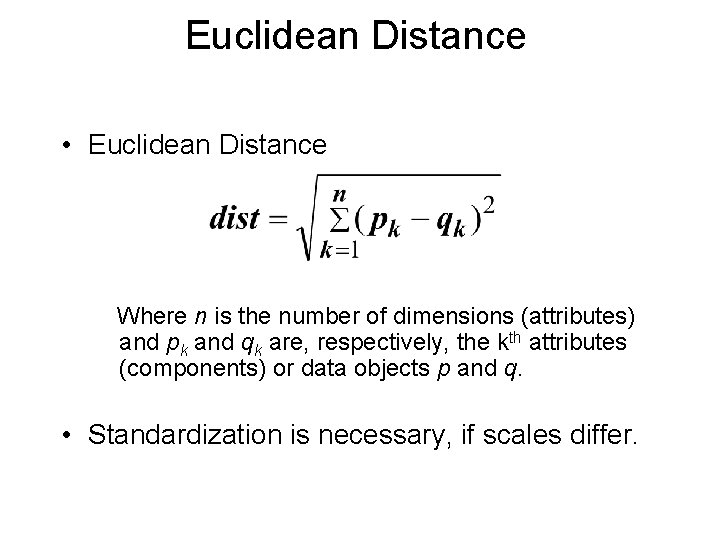
Euclidean Distance • Euclidean Distance Where n is the number of dimensions (attributes) and pk and qk are, respectively, the kth attributes (components) or data objects p and q. • Standardization is necessary, if scales differ.
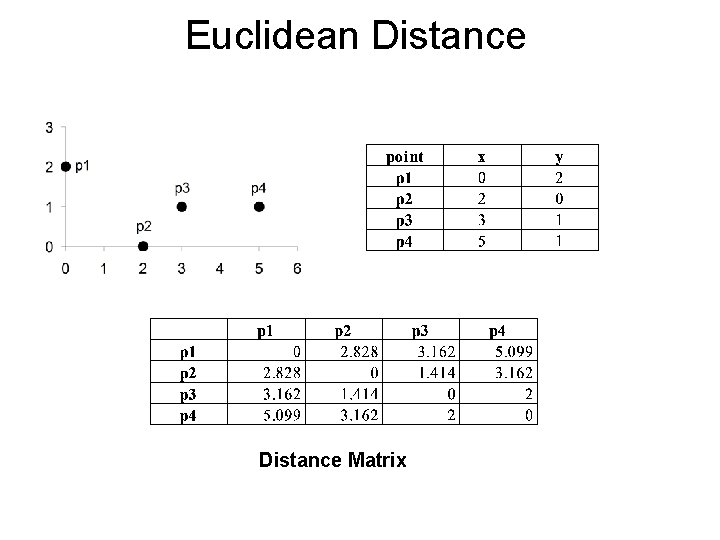
Euclidean Distance Matrix
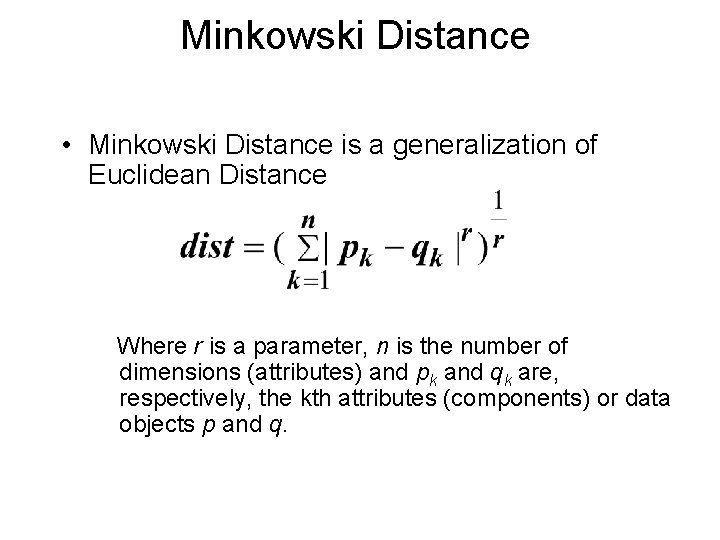
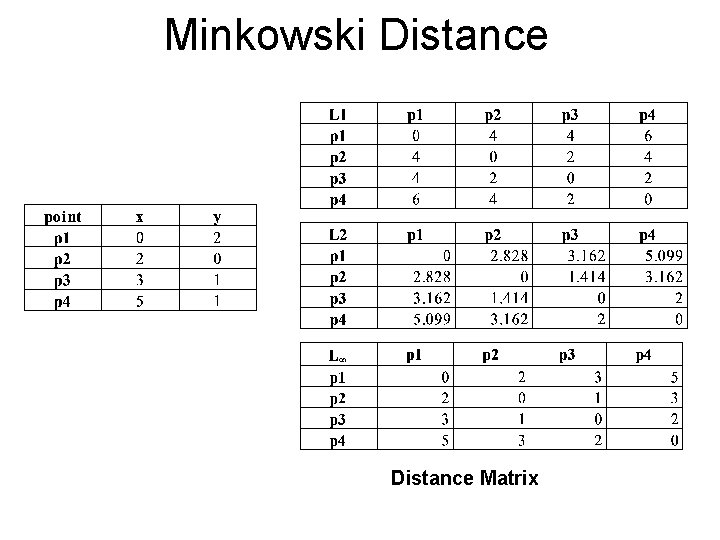
Minkowski Distance • Minkowski Distance is a generalization of Euclidean Distance Where r is a parameter, n is the number of dimensions (attributes) and pk and qk are, respectively, the kth attributes (components) or data objects p and q.
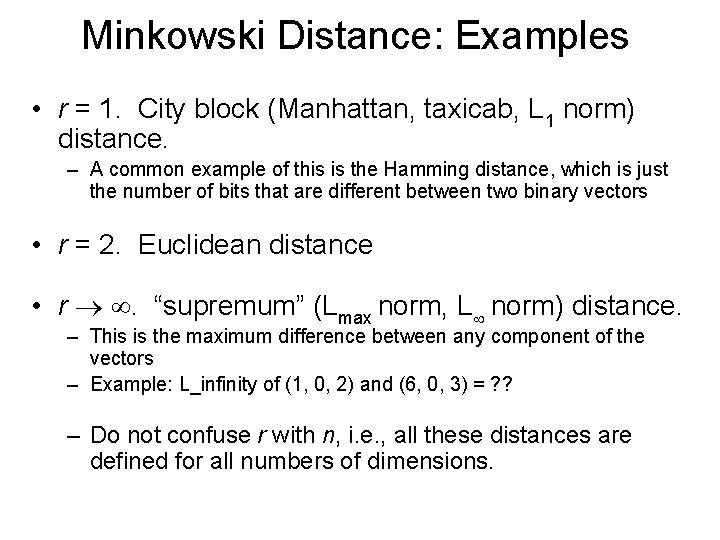
Minkowski Distance: Examples • r = 1. City block (Manhattan, taxicab, L 1 norm) distance. – A common example of this is the Hamming distance, which is just the number of bits that are different between two binary vectors • r = 2. Euclidean distance • r . “supremum” (Lmax norm, L norm) distance. – This is the maximum difference between any component of the vectors – Example: L_infinity of (1, 0, 2) and (6, 0, 3) = ? ? – Do not confuse r with n, i. e. , all these distances are defined for all numbers of dimensions.
Minkowski Distance Matrix
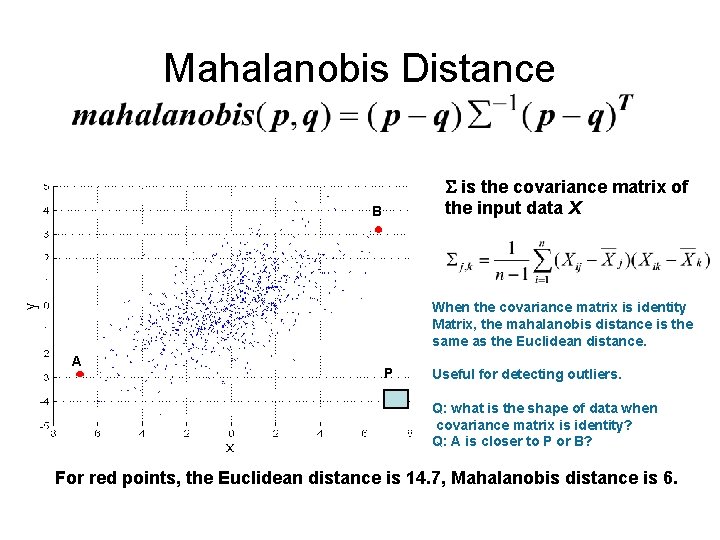
Mahalanobis Distance is the covariance matrix of the input data X B When the covariance matrix is identity Matrix, the mahalanobis distance is the same as the Euclidean distance. A P Useful for detecting outliers. Q: what is the shape of data when covariance matrix is identity? Q: A is closer to P or B? For red points, the Euclidean distance is 14. 7, Mahalanobis distance is 6.
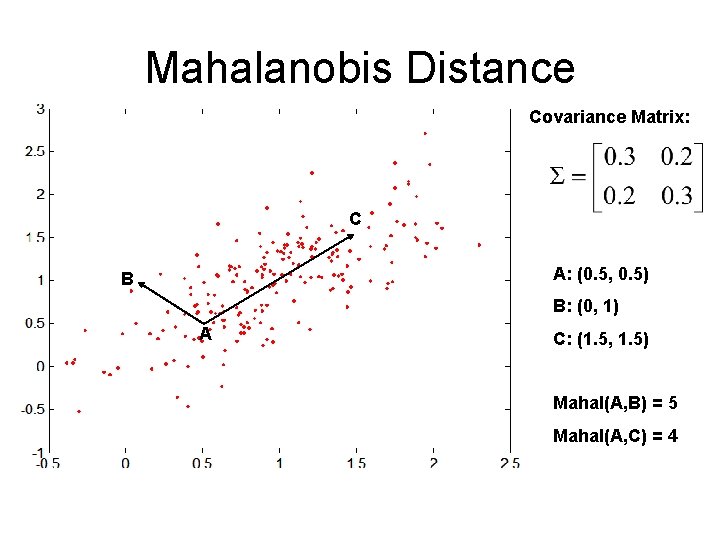
Mahalanobis Distance Covariance Matrix: C A: (0. 5, 0. 5) B B: (0, 1) A C: (1. 5, 1. 5) Mahal(A, B) = 5 Mahal(A, C) = 4
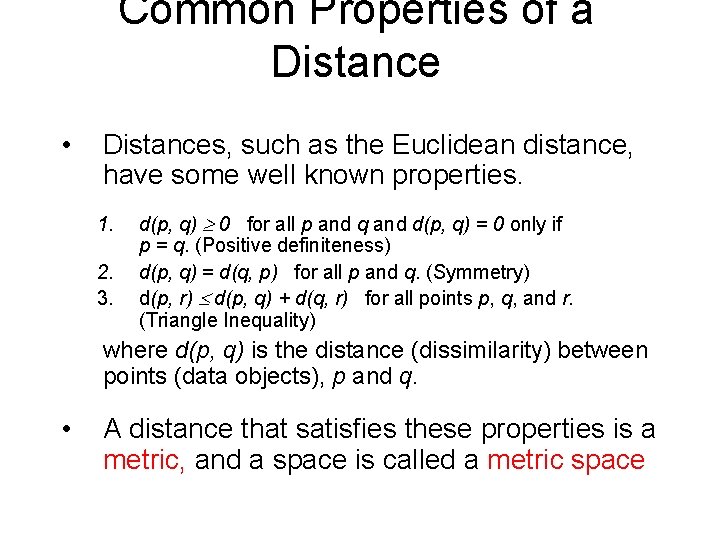
Common Properties of a Distance • Distances, such as the Euclidean distance, have some well known properties. 1. 2. 3. d(p, q) 0 for all p and q and d(p, q) = 0 only if p = q. (Positive definiteness) d(p, q) = d(q, p) for all p and q. (Symmetry) d(p, r) d(p, q) + d(q, r) for all points p, q, and r. (Triangle Inequality) where d(p, q) is the distance (dissimilarity) between points (data objects), p and q. • A distance that satisfies these properties is a metric, and a space is called a metric space
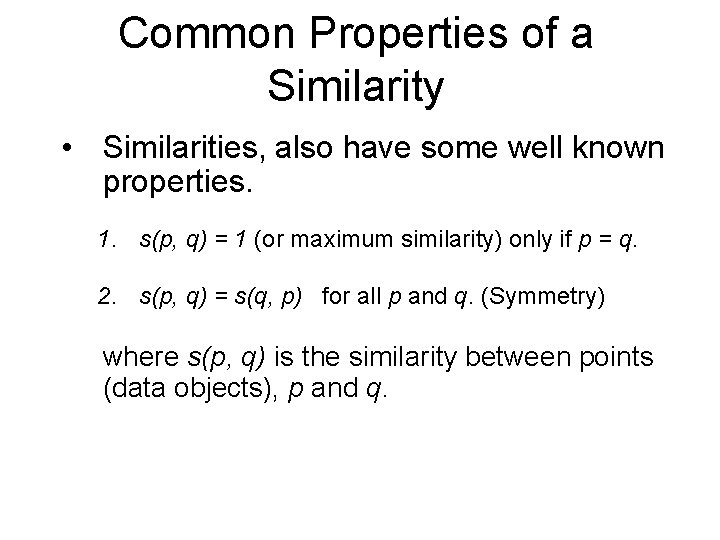
Common Properties of a Similarity • Similarities, also have some well known properties. 1. s(p, q) = 1 (or maximum similarity) only if p = q. 2. s(p, q) = s(q, p) for all p and q. (Symmetry) where s(p, q) is the similarity between points (data objects), p and q.
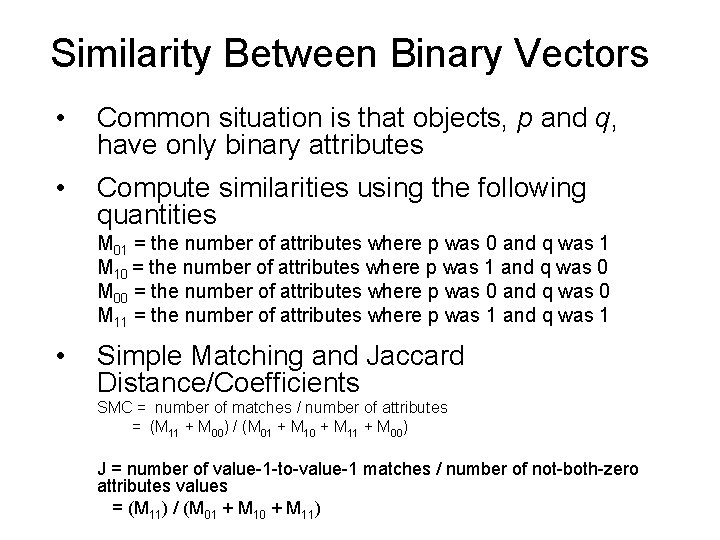
Similarity Between Binary Vectors • Common situation is that objects, p and q, have only binary attributes • Compute similarities using the following quantities M 01 = the number of attributes where p was 0 and q was 1 M 10 = the number of attributes where p was 1 and q was 0 M 00 = the number of attributes where p was 0 and q was 0 M 11 = the number of attributes where p was 1 and q was 1 • Simple Matching and Jaccard Distance/Coefficients SMC = number of matches / number of attributes = (M 11 + M 00) / (M 01 + M 10 + M 11 + M 00) J = number of value-1 -to-value-1 matches / number of not-both-zero attributes values = (M 11) / (M 01 + M 10 + M 11)
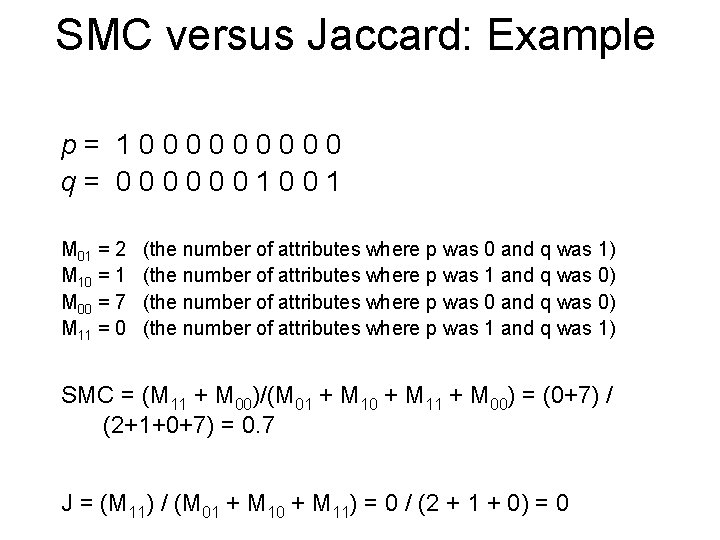
SMC versus Jaccard: Example p= 100000 q= 0000001001 M 01 = 2 M 10 = 1 M 00 = 7 M 11 = 0 (the number of attributes where p was 0 and q was 1) (the number of attributes where p was 1 and q was 0) (the number of attributes where p was 0 and q was 0) (the number of attributes where p was 1 and q was 1) SMC = (M 11 + M 00)/(M 01 + M 10 + M 11 + M 00) = (0+7) / (2+1+0+7) = 0. 7 J = (M 11) / (M 01 + M 10 + M 11) = 0 / (2 + 1 + 0) = 0
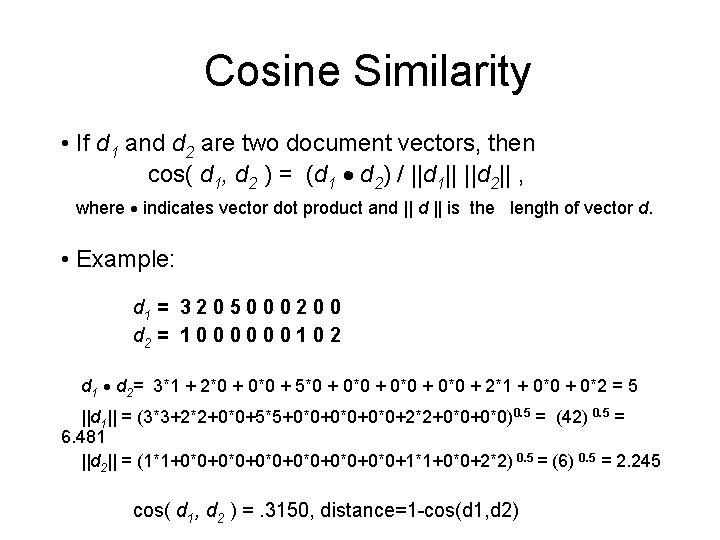
Cosine Similarity • If d 1 and d 2 are two document vectors, then cos( d 1, d 2 ) = (d 1 d 2) / ||d 1|| ||d 2|| , where indicates vector dot product and || is the length of vector d. • Example: d 1 = 3 2 0 5 0 0 0 2 0 0 d 2 = 1 0 0 0 1 0 2 d 1 d 2= 3*1 + 2*0 + 0*0 + 5*0 + 0*0 + 2*1 + 0*0 + 0*2 = 5 ||d 1|| = (3*3+2*2+0*0+5*5+0*0+0*0+2*2+0*0)0. 5 = (42) 0. 5 = 6. 481 ||d 2|| = (1*1+0*0+0*0+0*0+1*1+0*0+2*2) 0. 5 = (6) 0. 5 = 2. 245 cos( d 1, d 2 ) =. 3150, distance=1 -cos(d 1, d 2)