Dispersing Asymmetric DDo S Attacks with Split Stack
- Slides: 21
Dispersing Asymmetric DDo. S Attacks with Split. Stack Ang Chen, Akshay Sriraman, Tavish Vaidya+, Yuankai Zhang+ Andreas Haeberlen, Boon Thau Loo, Linh Thi Xuan Phan, Micah Sherr + Clay Shields+, and Wenchao Zhou+ University of Pennsylvania Georgetown University+
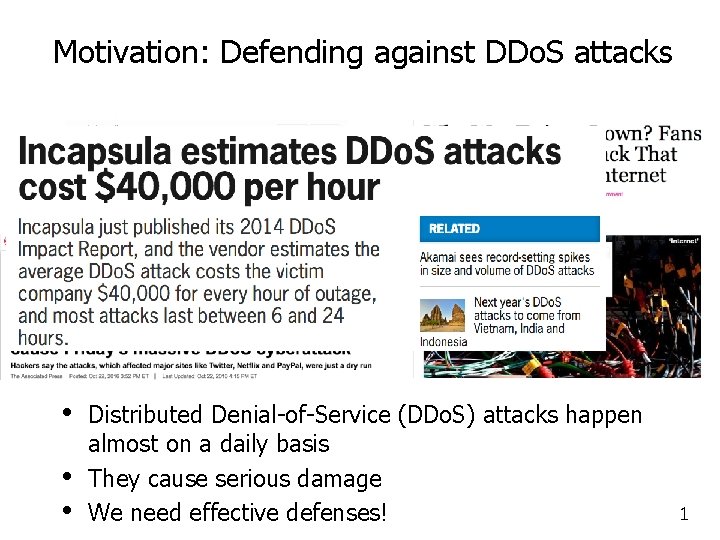
Motivation: Defending against DDo. S attacks • • • Distributed Denial-of-Service (DDo. S) attacks happen almost on a daily basis They cause serious damage We need effective defenses! 1
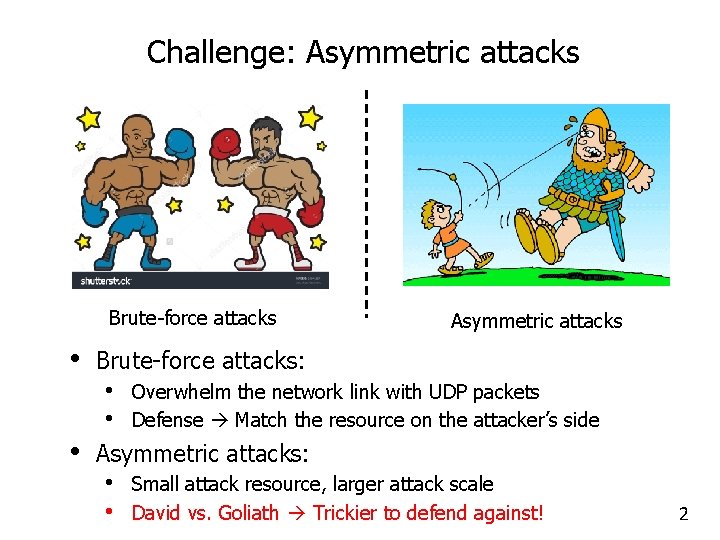
Challenge: Asymmetric attacks Brute-force attacks • • Asymmetric attacks Brute-force attacks: • • Overwhelm the network link with UDP packets Defense Match the resource on the attacker’s side Asymmetric attacks: • • Small attack resource, larger attack scale David vs. Goliath Trickier to defend against! 2
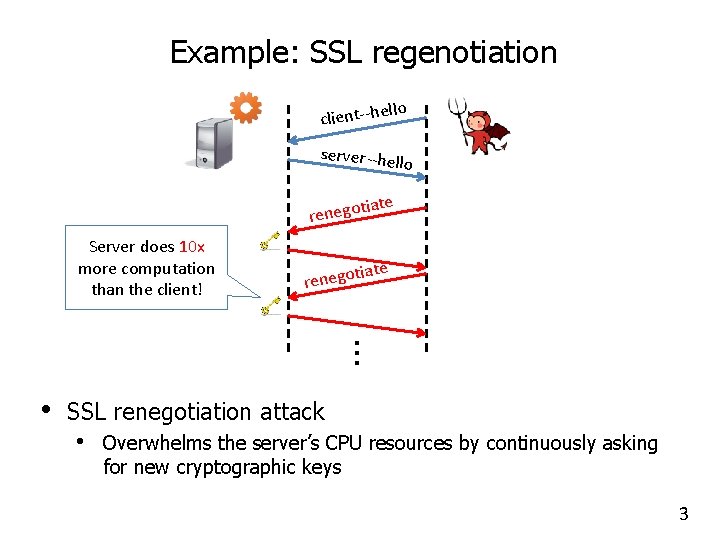
Example: SSL regenotiation llo client--he server--hell o tiate renego Server does 10 x more computation than the client! iate t renego . . . • SSL renegotiation attack • Overwhelms the server’s CPU resources by continuously asking for new cryptographic keys 3
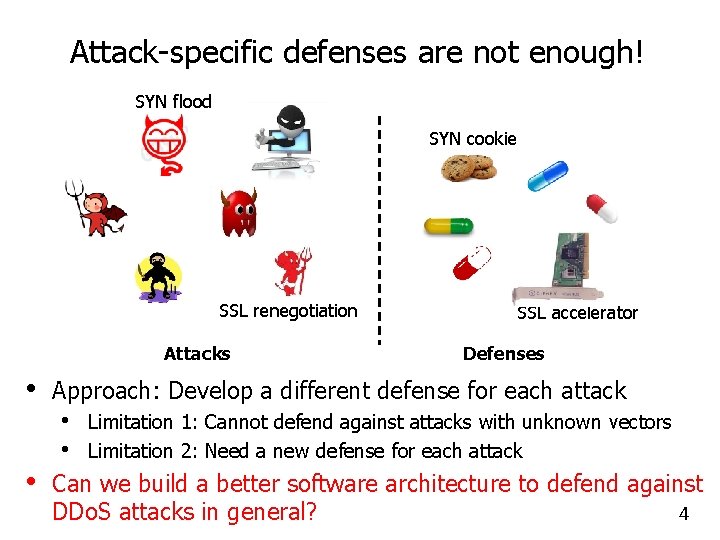
Attack-specific defenses are not enough! SYN flood SYN cookie SSL renegotiation Attacks • • SSL accelerator Defenses Approach: Develop a different defense for each attack • • Limitation 1: Cannot defend against attacks with unknown vectors Limitation 2: Need a new defense for each attack Can we build a better software architecture to defend against 4 DDo. S attacks in general?
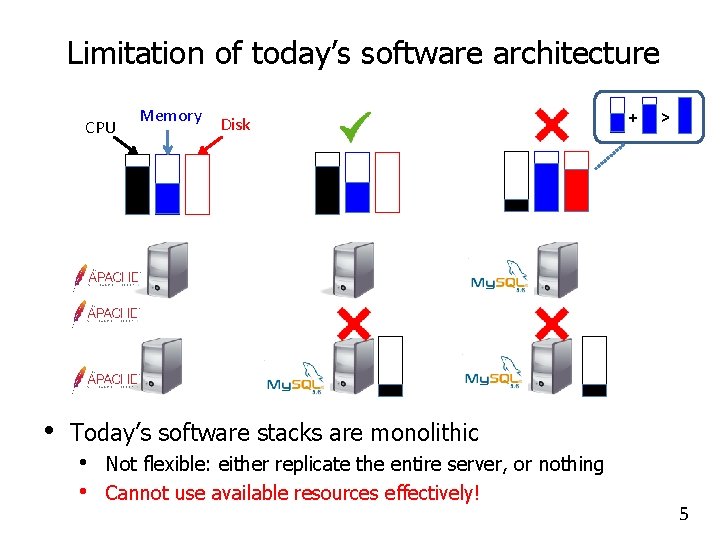
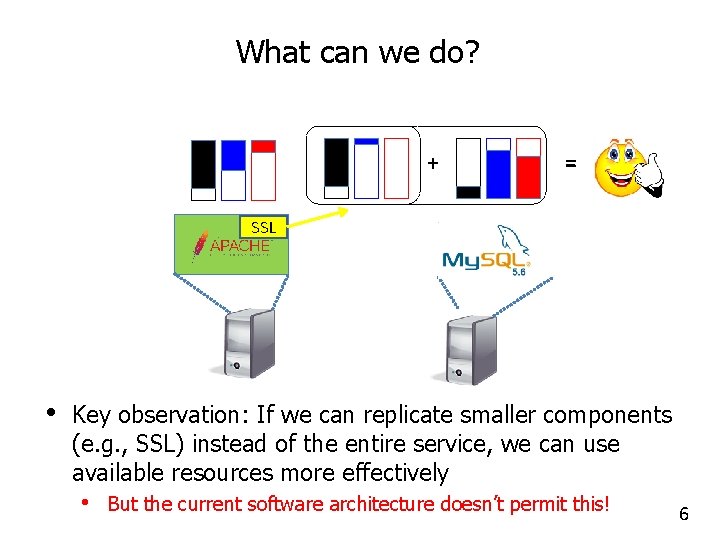
Limitation of today’s software architecture CPU • Memory Disk + > Today’s software stacks are monolithic • • Not flexible: either replicate the entire server, or nothing Cannot use available resources effectively! 5
What can we do? + = SSL • Key observation: If we can replicate smaller components (e. g. , SSL) instead of the entire service, we can use available resources more effectively • But the current software architecture doesn’t permit this! 6
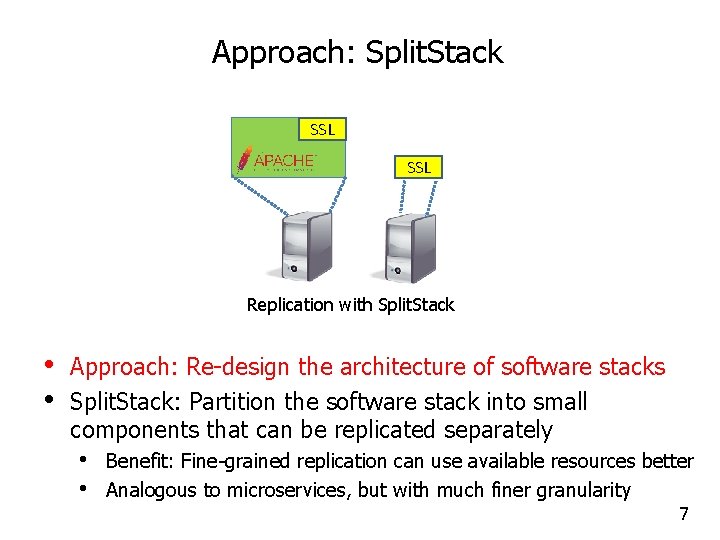
Approach: Split. Stack SSL Replication with Split. Stack • • Approach: Re-design the architecture of software stacks Split. Stack: Partition the software stack into small components that can be replicated separately • • Benefit: Fine-grained replication can use available resources better Analogous to microservices, but with much finer granularity 7
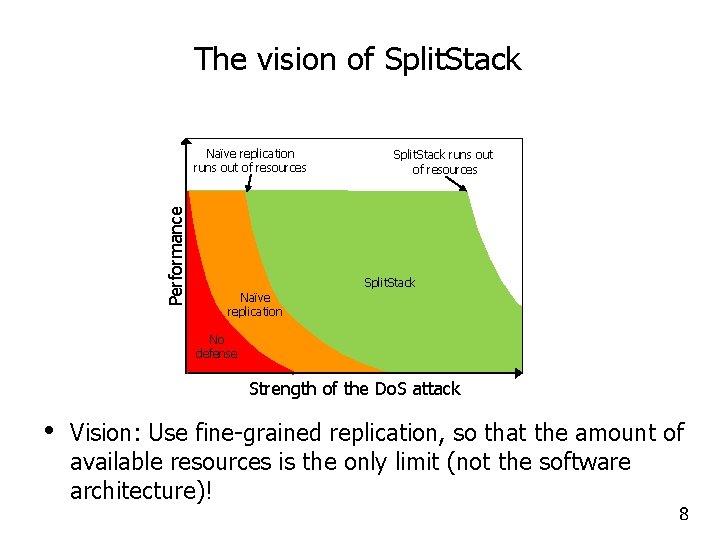
The vision of Split. Stack Performance Naïve replication runs out of resources Split. Stack Naïve replication No defense Strength of the Do. S attack • Vision: Use fine-grained replication, so that the amount of available resources is the only limit (not the software architecture)! 8
Outline - Motivation: Mitigating asymmetric DDo. S attacks Existing defenses Approach: Split. Stack architecture - How should the partitions look like? How should the MSUs interact? Dataflow transformation Routing tables The Split. Stack controller MSU scheduling - Case study: Mitigating SSL renegotiation attacks - Ongoing work - Conclusion 9
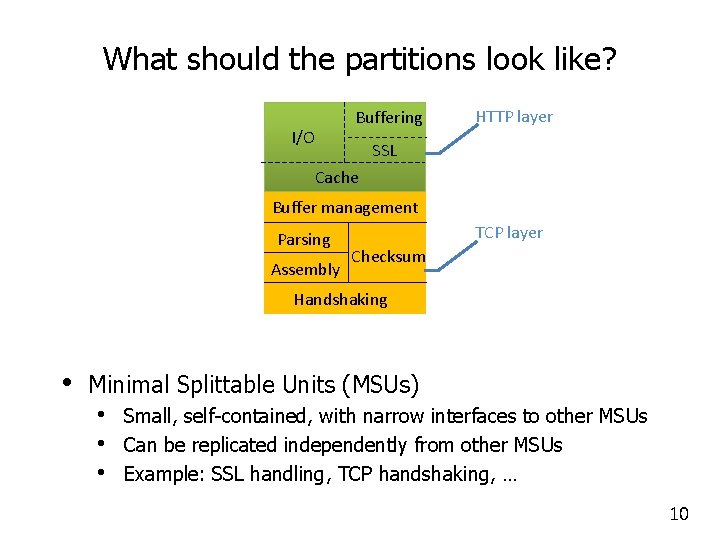
What should the partitions look like? Buffering I/O HTTP layer SSL Cache Buffer management Parsing Assembly TCP layer Checksum Handshaking • Minimal Splittable Units (MSUs) • • • Small, self-contained, with narrow interfaces to other MSUs Can be replicated independently from other MSUs Example: SSL handling, TCP handshaking, … 10
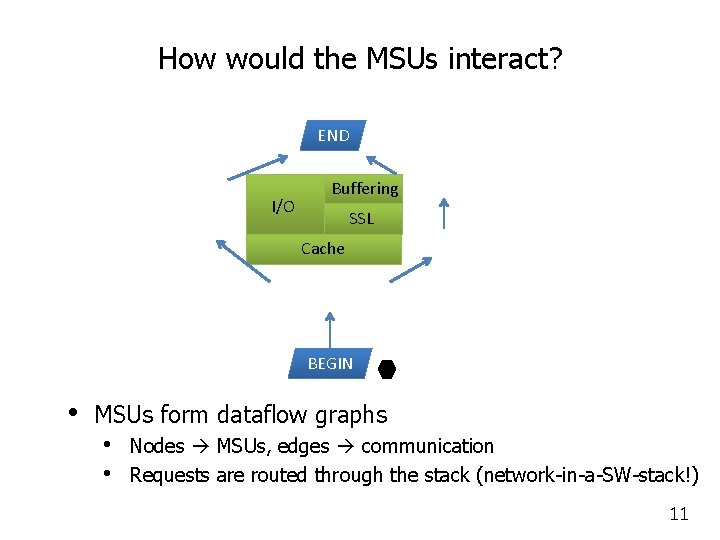
How would the MSUs interact? END I/O Buffering SSL Cache BEGIN • MSUs form dataflow graphs • • Nodes MSUs, edges communication Requests are routed through the stack (network-in-a-SW-stack!) 11
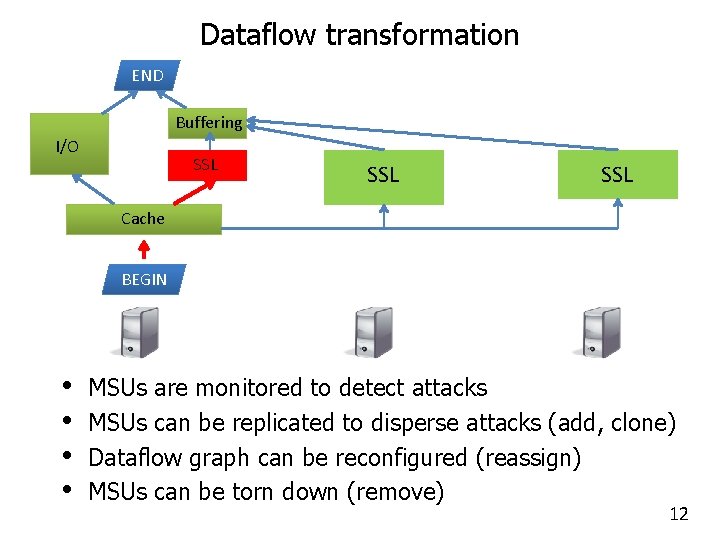
Dataflow transformation END Buffering I/O SSL SSL Cache BEGIN • • MSUs are monitored to detect attacks MSUs can be replicated to disperse attacks (add, clone) Dataflow graph can be reconfigured (reassign) MSUs can be torn down (remove) 12
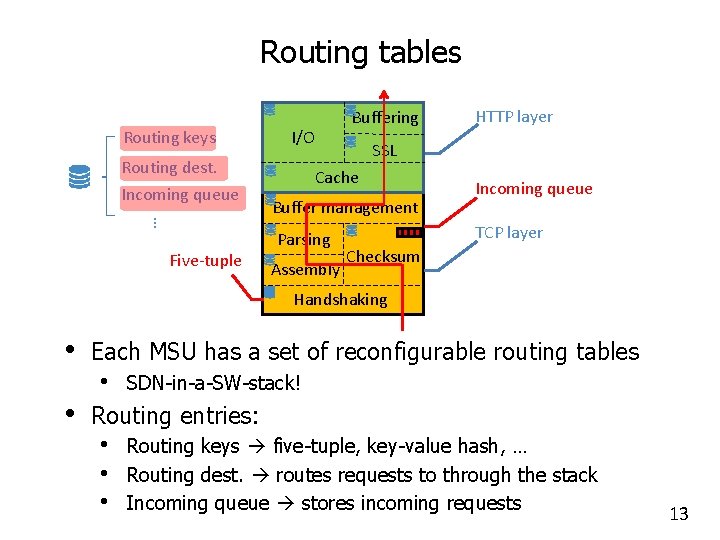
Routing tables Routing keys I/O Routing dest. Incoming queue … Five-tuple Buffering HTTP layer SSL Cache Buffer management Parsing Assembly Incoming queue TCP layer Checksum Handshaking • • Each MSU has a set of reconfigurable routing tables • SDN-in-a-SW-stack! Routing entries: • • • Routing keys five-tuple, key-value hash, … Routing dest. routes requests to through the stack Incoming queue stores incoming requests 13
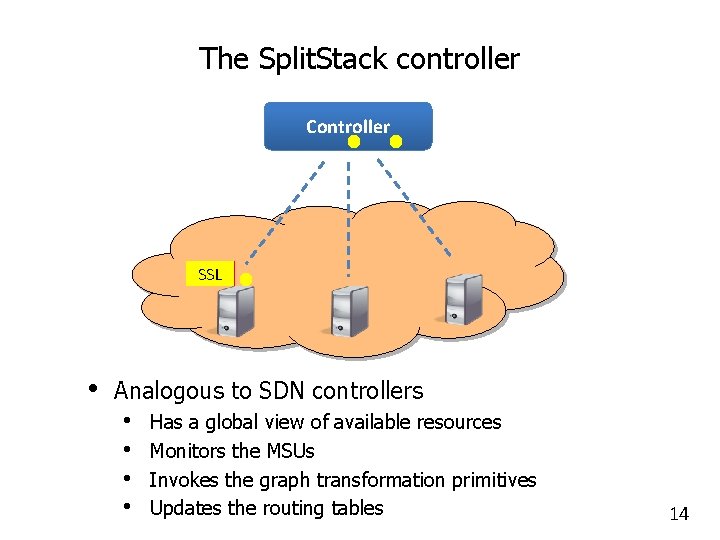
The Split. Stack controller Controller SSL • Analogous to SDN controllers • • Has a global view of available resources Monitors the MSUs Invokes the graph transformation primitives Updates the routing tables 14
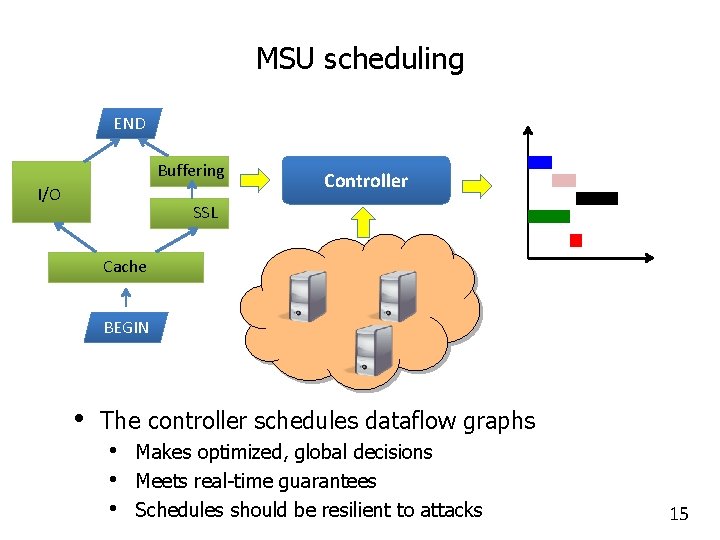
MSU scheduling END Buffering I/O Controller SSL Cache BEGIN • The controller schedules dataflow graphs • • • Makes optimized, global decisions Meets real-time guarantees Schedules should be resilient to attacks 15
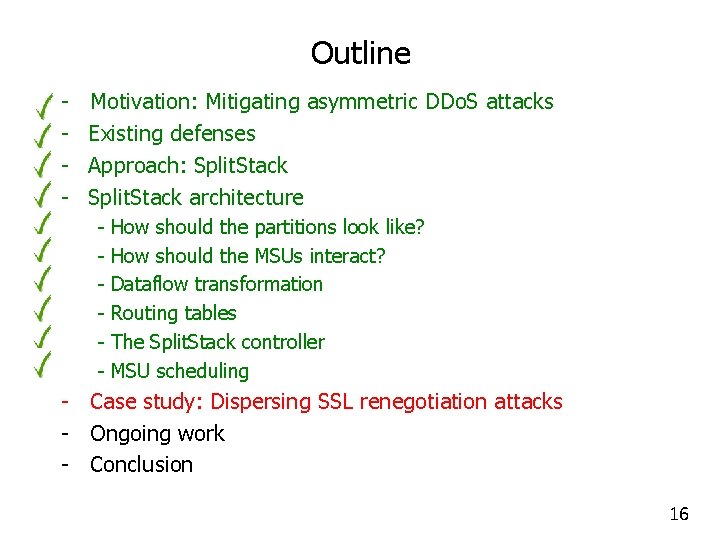
Outline - Motivation: Mitigating asymmetric DDo. S attacks Existing defenses Approach: Split. Stack architecture - How should the partitions look like? How should the MSUs interact? Dataflow transformation Routing tables The Split. Stack controller MSU scheduling - Case study: Dispersing SSL renegotiation attacks - Ongoing work - Conclusion 16
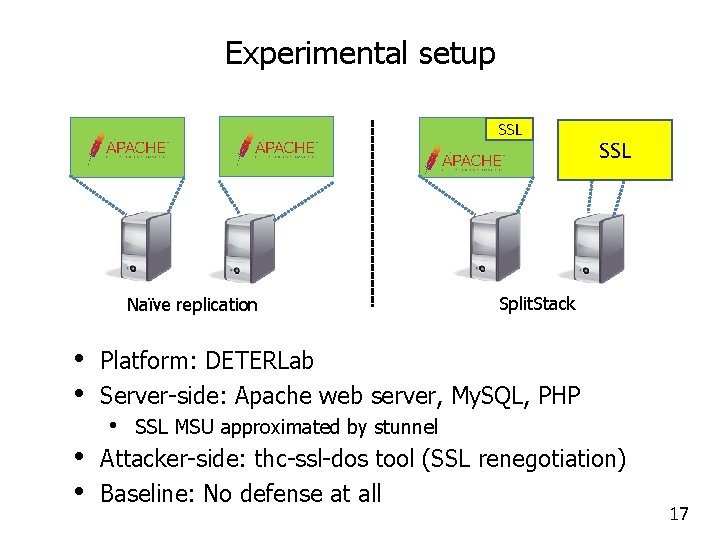
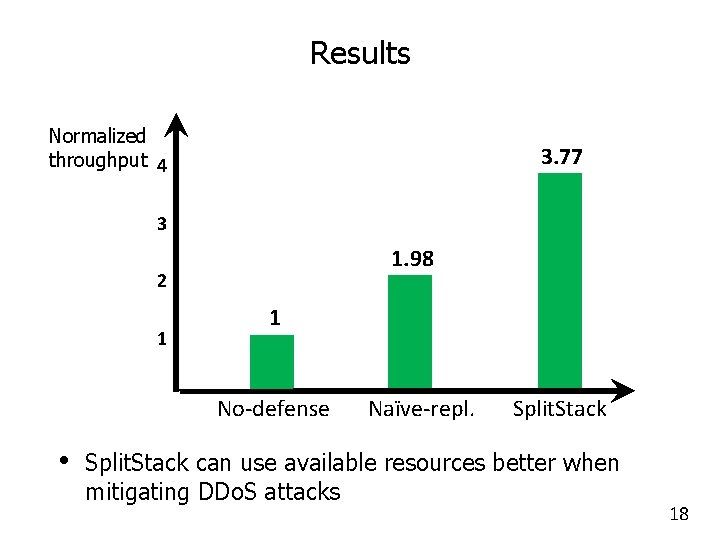
Experimental setup SSL Naïve replication • • SSL Split. Stack Platform: DETERLab Server-side: Apache web server, My. SQL, PHP • SSL MSU approximated by stunnel Attacker-side: thc-ssl-dos tool (SSL renegotiation) Baseline: No defense at all 17
Results Normalized throughput 4 3. 77 3 1. 98 2 1 1 No-defense • Naïve-repl. Split. Stack can use available resources better when mitigating DDo. S attacks 18
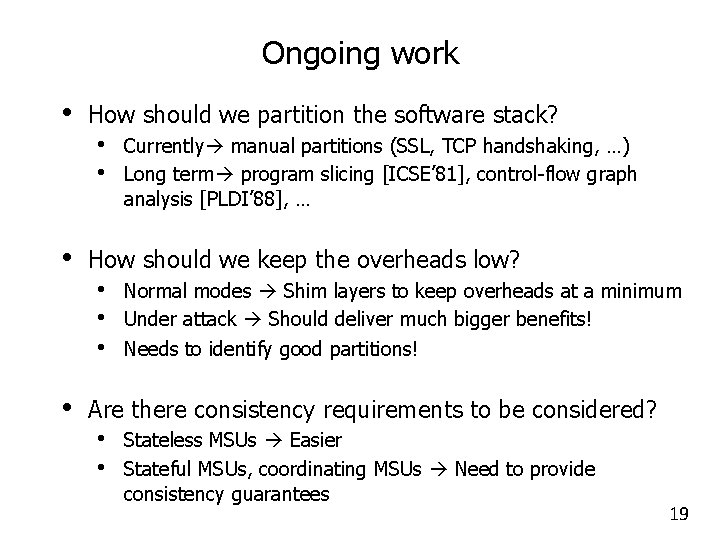
Ongoing work • • • How should we partition the software stack? • • Currently manual partitions (SSL, TCP handshaking, …) Long term program slicing [ICSE’ 81], control-flow graph analysis [PLDI’ 88], … How should we keep the overheads low? • • • Normal modes Shim layers to keep overheads at a minimum Under attack Should deliver much bigger benefits! Needs to identify good partitions! Are there consistency requirements to be considered? • • Stateless MSUs Easier Stateful MSUs, coordinating MSUs Need to provide consistency guarantees 19
Conclusion • • • Motivation: Mitigating asymmetric DDo. S attacks Existing approaches • • Attack-specific defenses All-or-nothing replication Problem: Existing software stacks are monolithic; they cannot use all the available resources! New software architecture: Split. Stack • Key approach: Split a monolithic software stack into MSUs to enable fine-grained replication Preliminary result: • Split. Stack can mitigate higher volume attacks (Project website: http: //dedos-project. net) Questions? 20