Discretionary Development Equalization Grant DDEG Guidelines for FY

- Slides: 41
Discretionary Development Equalization Grant (DDEG) Guidelines for FY 2021/22 Ministry of Local Government September /October 2020 1
Discretionary Development Equalization Grant: Origin and What is in it? The DDEG is a grant which started in FY 2016/17 after consolidating: q. The equalization grant; q. Local Government Management Service Delivery Program (LGMSDP); q. Peace Recovery and Development Plan (PRDP); q. Luweero-Rwenzori Development Program (LRDP); and q. Uganda Support to Municipal Infrastructure Development (USMID) The grant is being managed by the Ministry of Local Government which is a lead agency for implementation of Regional Development Programme under NDP 3. The DDEG is the only grant for LGs that : q. Is not earmarked to a particular programme; and q. Provides non-earmarked fiscal resources to the LGs to allow them to plan and prioritize their local needs. 2
Objectives of the DDEG The objectives of the DDEG are to: q. Enable LGs to allocate funds to priority local development needs that are within their mandate and are consistent with the National priorities by provision of discretionary development funding. q. Provide LGs with equitable access to development financing, ensuring that more disadvantaged LGs receive additional funding to enable them catch up with the rest of the country. In doing so, the grant is the Equalization Grant provided for in the Constitution Article 193 (4); q. Provide development financing which caters for the differing development needs of rural and urban areas. q. Improve LGs capacities and systems for provision of quality services. This is through rewarding good performance & sanctioning poor performance; coupled with performance improvement support to address areas where LGs have gaps. 3
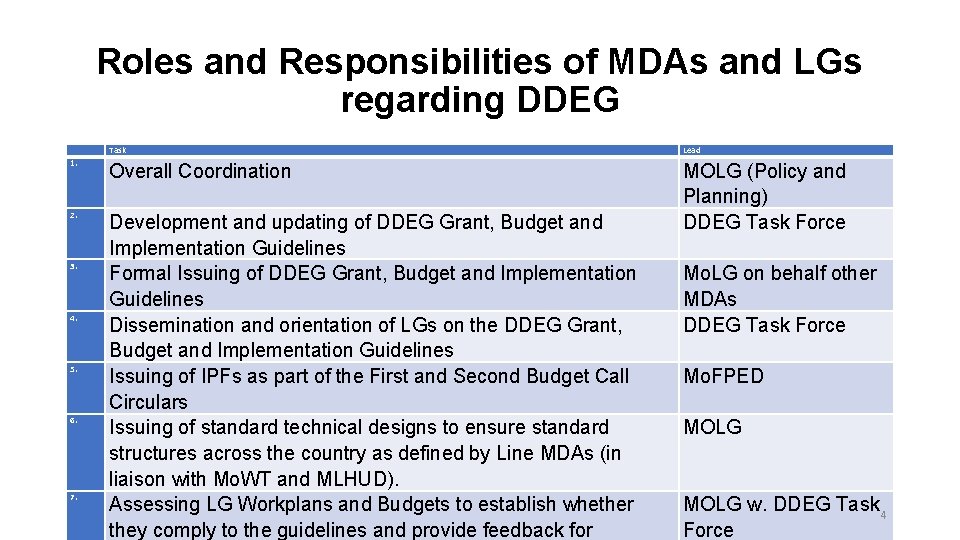
Roles and Responsibilities of MDAs and LGs regarding DDEG Task Lead 1. Overall Coordination 2. Development and updating of DDEG Grant, Budget and Implementation Guidelines Formal Issuing of DDEG Grant, Budget and Implementation Guidelines Dissemination and orientation of LGs on the DDEG Grant, Budget and Implementation Guidelines Issuing of IPFs as part of the First and Second Budget Call Circulars Issuing of standard technical designs to ensure standard structures across the country as defined by Line MDAs (in liaison with Mo. WT and MLHUD). Assessing LG Workplans and Budgets to establish whether they comply to the guidelines and provide feedback for MOLG (Policy and Planning) DDEG Task Force 3. 4. 5. 6. 7. Mo. LG on behalf other MDAs DDEG Task Force Mo. FPED MOLG w. DDEG Task 4 Force
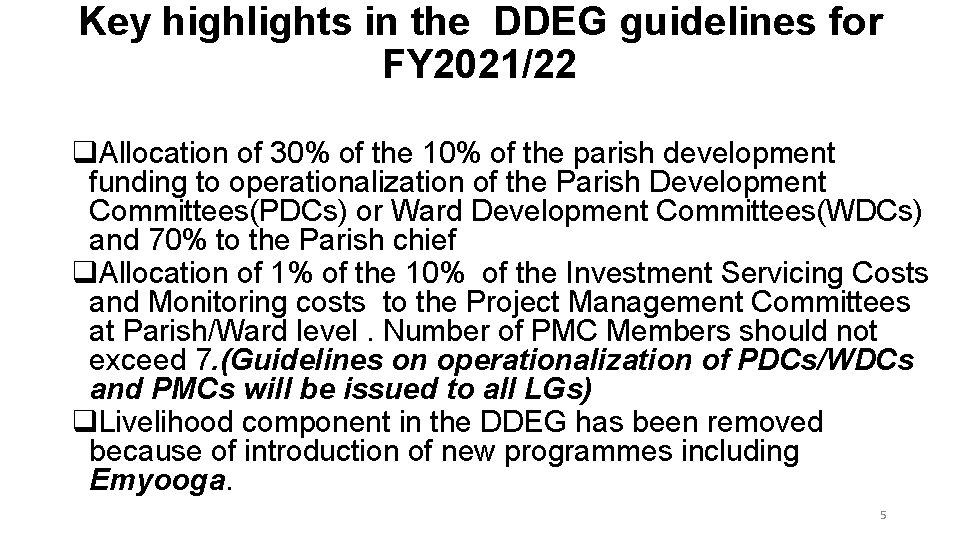
Key highlights in the DDEG guidelines for FY 2021/22 q. Allocation of 30% of the 10% of the parish development funding to operationalization of the Parish Development Committees(PDCs) or Ward Development Committees(WDCs) and 70% to the Parish chief q. Allocation of 1% of the 10% of the Investment Servicing Costs and Monitoring costs to the Project Management Committees at Parish/Ward level. Number of PMC Members should not exceed 7. (Guidelines on operationalization of PDCs/WDCs and PMCs will be issued to all LGs) q. Livelihood component in the DDEG has been removed because of introduction of new programmes including Emyooga. 5
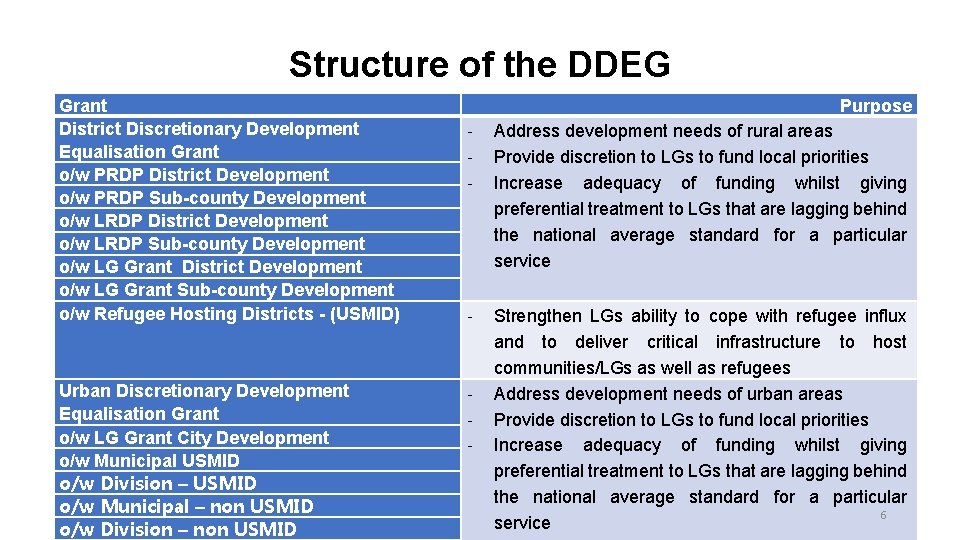
Structure of the DDEG Grant District Discretionary Development Equalisation Grant o/w PRDP District Development o/w PRDP Sub-county Development o/w LRDP District Development o/w LRDP Sub-county Development o/w LG Grant District Development o/w LG Grant Sub-county Development o/w Refugee Hosting Districts - (USMID) Urban Discretionary Development Equalisation Grant o/w LG Grant City Development o/w Municipal USMID o/w Division – USMID o/w Municipal – non USMID o/w Division – non USMID Purpose - Address development needs of rural areas Provide discretion to LGs to fund local priorities Increase adequacy of funding whilst giving preferential treatment to LGs that are lagging behind the national average standard for a particular service - Strengthen LGs ability to cope with refugee influx and to deliver critical infrastructure to host communities/LGs as well as refugees Address development needs of urban areas Provide discretion to LGs to fund local priorities Increase adequacy of funding whilst giving preferential treatment to LGs that are lagging behind the national average standard for a particular 6 service -
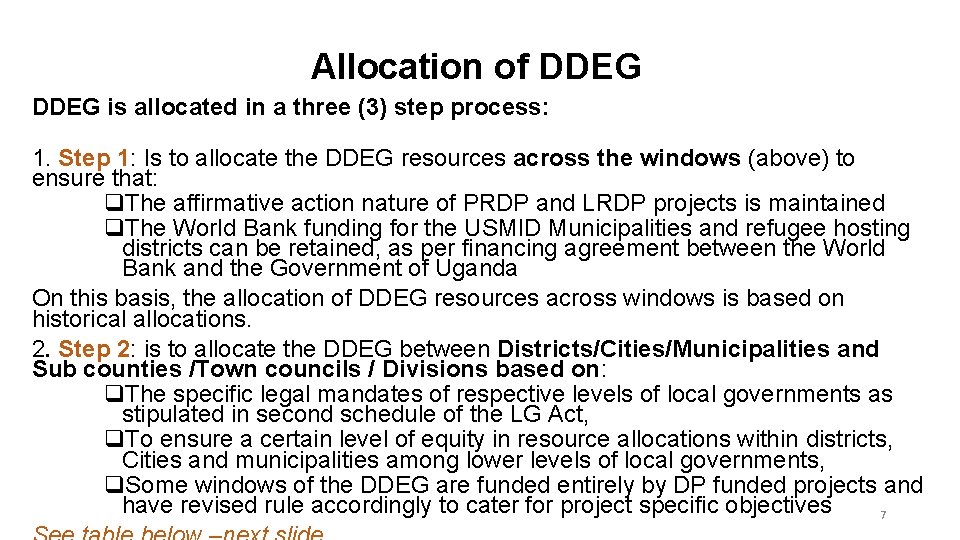
Allocation of DDEG is allocated in a three (3) step process: 1. Step 1: Is to allocate the DDEG resources across the windows (above) to ensure that: q. The affirmative action nature of PRDP and LRDP projects is maintained q. The World Bank funding for the USMID Municipalities and refugee hosting districts can be retained, as per financing agreement between the World Bank and the Government of Uganda On this basis, the allocation of DDEG resources across windows is based on historical allocations. 2. Step 2: is to allocate the DDEG between Districts/Cities/Municipalities and Sub counties /Town councils / Divisions based on: q. The specific legal mandates of respective levels of local governments as stipulated in second schedule of the LG Act, q. To ensure a certain level of equity in resource allocations within districts, Cities and municipalities among lower levels of local governments, q. Some windows of the DDEG are funded entirely by DP funded projects and have revised rule accordingly to cater for project specific objectives 7
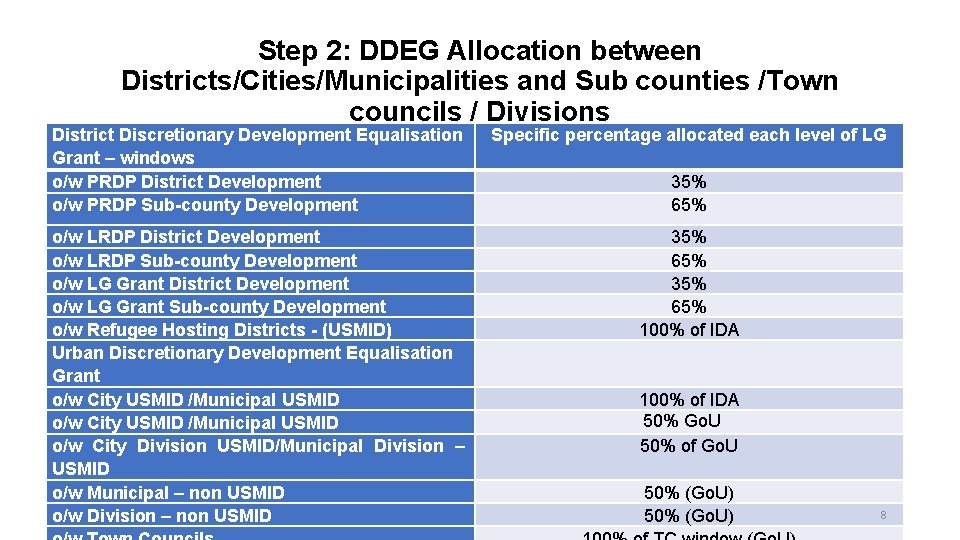
Step 2: DDEG Allocation between Districts/Cities/Municipalities and Sub counties /Town councils / Divisions District Discretionary Development Equalisation Grant – windows o/w PRDP District Development o/w PRDP Sub-county Development Specific percentage allocated each level of LG o/w LRDP District Development o/w LRDP Sub-county Development o/w LG Grant District Development o/w LG Grant Sub-county Development o/w Refugee Hosting Districts - (USMID) Urban Discretionary Development Equalisation Grant o/w City USMID /Municipal USMID o/w City Division USMID/Municipal Division – USMID o/w Municipal – non USMID o/w Division – non USMID 35% 65% 100% of IDA 50% Go. U 50% of Go. U 50% (Go. U) 8
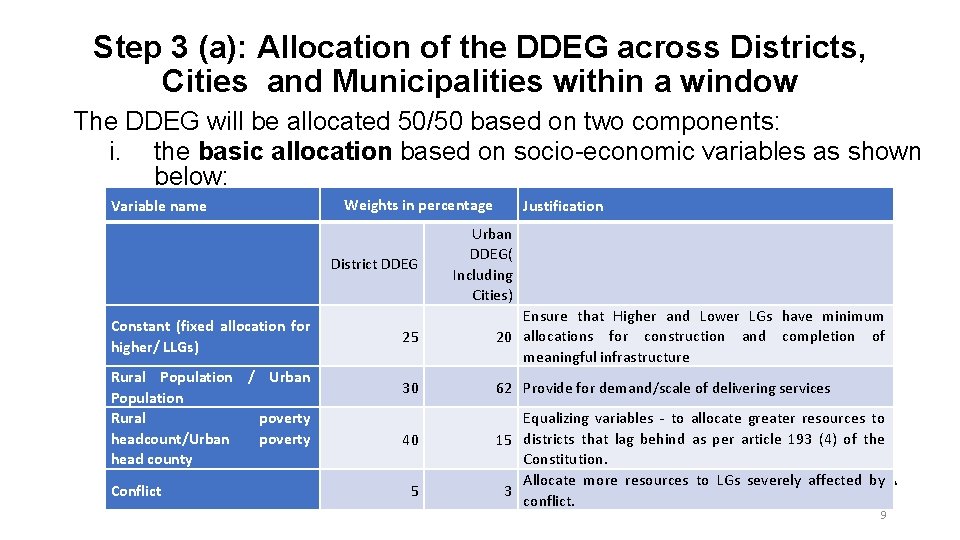
Step 3 (a): Allocation of the DDEG across Districts, Cities and Municipalities within a window The DDEG will be allocated 50/50 based on two components: i. the basic allocation based on socio-economic variables as shown below: Variable name Weights in percentage District DDEG Constant (fixed allocation for higher/ LLGs) Rural Population / Urban Population Rural poverty headcount/Urban poverty head county Justification Urban DDEG( Including Cities) 25 Ensure that Higher and Lower LGs have minimum 20 allocations for construction and completion of meaningful infrastructure 30 62 Provide for demand/scale of delivering services 40 Equalizing variables - to allocate greater resources to 15 districts that lag behind as per article 193 (4) of the Constitution. Allocate more resources to LGs severely affected by 3 conflict. ii. the performance component based on the results of the LGPA Conflict 5 9
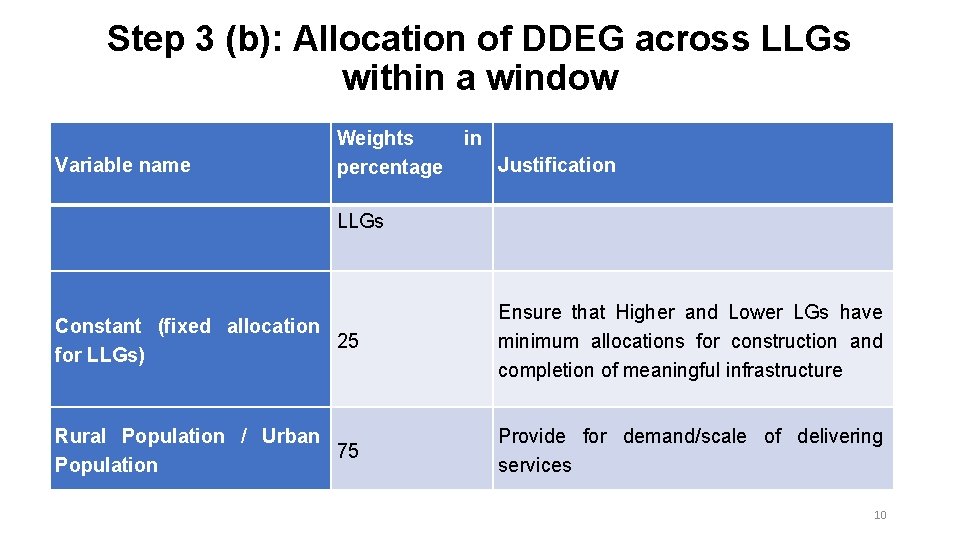
Step 3 (b): Allocation of DDEG across LLGs within a window Variable name Weights percentage in Justification LLGs Constant (fixed allocation 25 for LLGs) Ensure that Higher and Lower LGs have minimum allocations for construction and completion of meaningful infrastructure Rural Population / Urban 75 Population Provide for demand/scale of delivering services 10
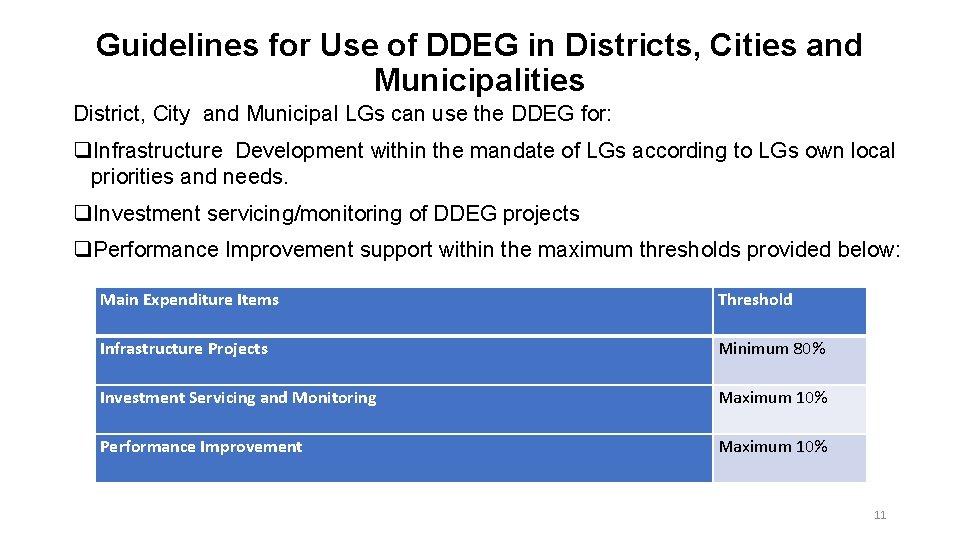
Guidelines for Use of DDEG in Districts, Cities and Municipalities District, City and Municipal LGs can use the DDEG for: q. Infrastructure Development within the mandate of LGs according to LGs own local priorities and needs. q. Investment servicing/monitoring of DDEG projects q. Performance Improvement support within the maximum thresholds provided below: Main Expenditure Items Threshold Infrastructure Projects Minimum 80% Investment Servicing and Monitoring Maximum 10% Performance Improvement Maximum 10% 11
Guidelines for Use of DDEG in Districts, Cities and Municipalities…. . q. Eligible and ineligible items have been specified in the guidelines q. The process and timelines for development of the Annual Work plan and budget, procurement, contract management and reporting for each of the activities has been clearly elaborated in the guidelines 12
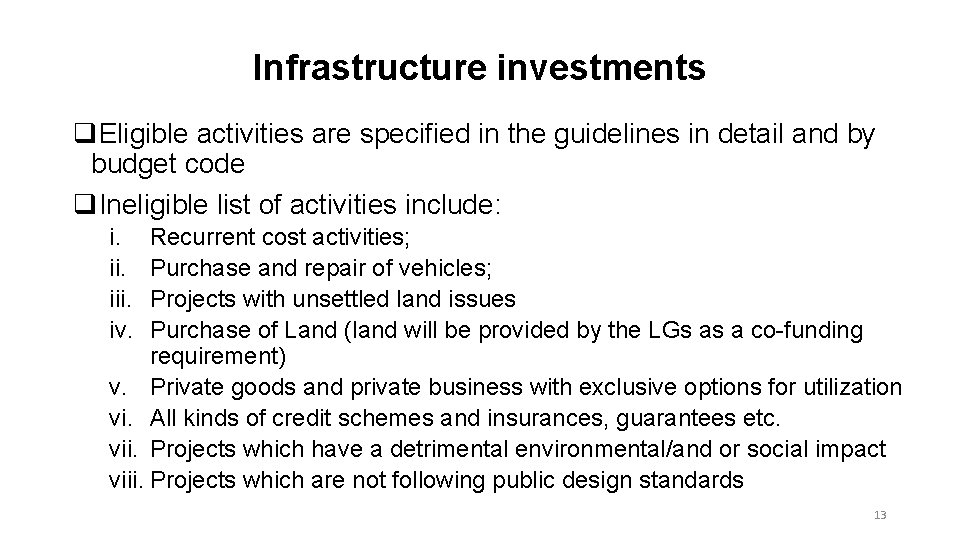
Infrastructure investments q. Eligible activities are specified in the guidelines in detail and by budget code q. Ineligible list of activities include: i. iii. iv. Recurrent cost activities; Purchase and repair of vehicles; Projects with unsettled land issues Purchase of Land (land will be provided by the LGs as a co-funding requirement) v. Private goods and private business with exclusive options for utilization vi. All kinds of credit schemes and insurances, guarantees etc. vii. Projects which have a detrimental environmental/and or social impact viii. Projects which are not following public design standards 13
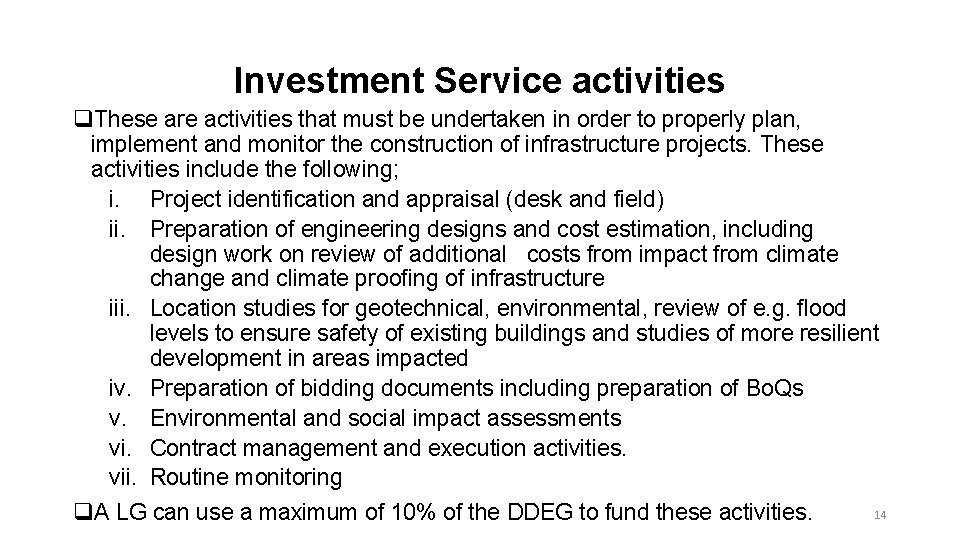
Investment Service activities q. These are activities that must be undertaken in order to properly plan, implement and monitor the construction of infrastructure projects. These activities include the following; i. Project identification and appraisal (desk and field) ii. Preparation of engineering designs and cost estimation, including design work on review of additional costs from impact from climate change and climate proofing of infrastructure iii. Location studies for geotechnical, environmental, review of e. g. flood levels to ensure safety of existing buildings and studies of more resilient development in areas impacted iv. Preparation of bidding documents including preparation of Bo. Qs v. Environmental and social impact assessments vi. Contract management and execution activities. vii. Routine monitoring 14 q. A LG can use a maximum of 10% of the DDEG to fund these activities.
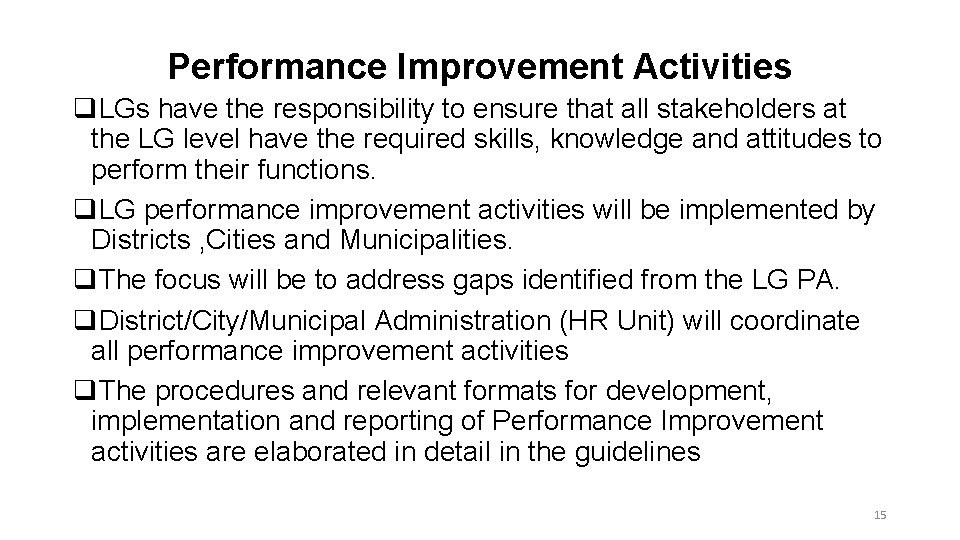
Performance Improvement Activities q. LGs have the responsibility to ensure that all stakeholders at the LG level have the required skills, knowledge and attitudes to perform their functions. q. LG performance improvement activities will be implemented by Districts , Cities and Municipalities. q. The focus will be to address gaps identified from the LG PA. q. District/City/Municipal Administration (HR Unit) will coordinate all performance improvement activities q. The procedures and relevant formats for development, implementation and reporting of Performance Improvement activities are elaborated in detail in the guidelines 15
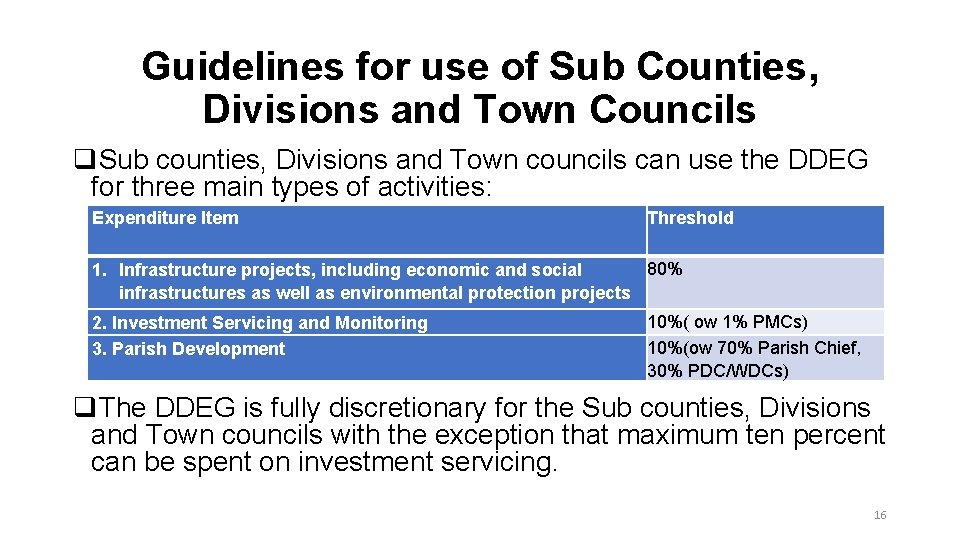
Guidelines for use of Sub Counties, Divisions and Town Councils q. Sub counties, Divisions and Town councils can use the DDEG for three main types of activities: Expenditure Item Threshold 80% 1. Infrastructure projects, including economic and social infrastructures as well as environmental protection projects 2. Investment Servicing and Monitoring 3. Parish Development 10%( ow 1% PMCs) 10%(ow 70% Parish Chief, 30% PDC/WDCs) q. The DDEG is fully discretionary for the Sub counties, Divisions and Town councils with the exception that maximum ten percent can be spent on investment servicing. 16
Determination of the balance between different types of development projects by LLGs Based on the annual planning process for Sub counties, Divisions and Town councils, the LLG Councils will determine: qshare of funding allocated for infrastructure projects q. LLGs are not obliged to either category, but should exercise discretion based on their local priorities q. The technical Planning Committee will review existing development plan and identify proposed priorities that can be funded with resources from DDEG. 17
LLG Infrastructure projects q. LLGs should forward larger infrastructure investment priorities to Districts, Cities and Municipalities where more substantive levels of funding for infrastructure is available q. Eligible activities under this are defined by the following: LLGs can only invest in infrastructure projects where: q. They can meet the recurrent cost implications. In case the recurrent costs are being met by the district or municipality, the LLG must have clear authorization prior to construction. q. They have sufficient funds to complete the investment within one financial year. q. In urban areas, infrastructure projects which are consistent with the physical plan. q. Ineligible activities include: q. Recurrent cost activities; q. Purchase and repair of vehicles and motorcycles; q. Purchase of Land (land will be provided by the LLG as a co-funding requirement) 18
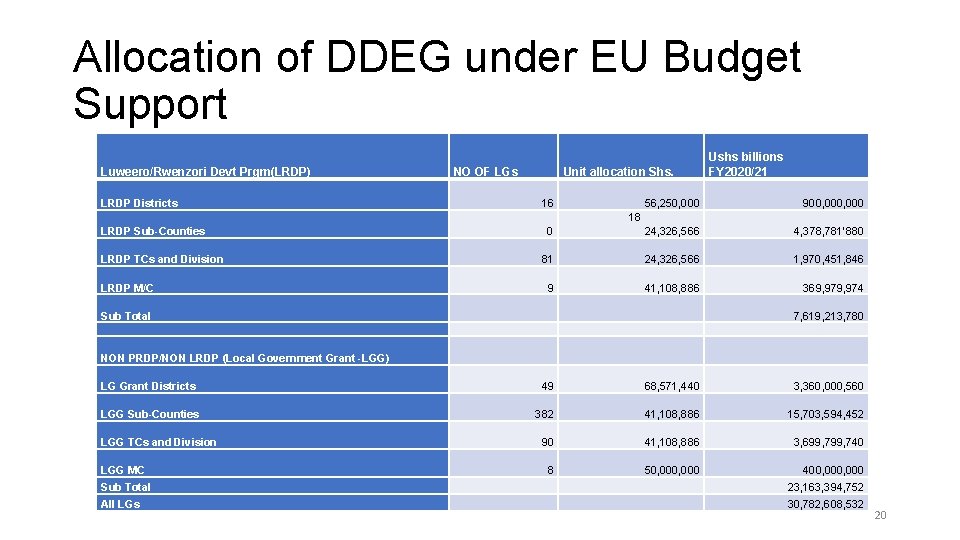
DDEG Additional Support-EU The Ministry has secured funding from EU to support LGs to increase percapita DDEG from Shs 1, 197 for Local Government Grant Districts and Shs 1, 868 to Shs. 2, 956 for Luweero-Rwenzori Development Grant beneficiary Districts and support implementation of Covid 19 interventions and preventive measures. PRDP Districts have a percapita of Ushs 5, 000. This funding is for 3 years starting with FY 2020/21. There are two windows for allocation of these funds. These are; q. Luweero/Rwenzori Development Program (LRDP) q. Non PRDP/Non LRDP (Local Government Grant - LGG) 19
Allocation of DDEG under EU Budget Support Luweero/Rwenzori Devt Prgm(LRDP) LRDP Districts NO OF LGs Unit allocation Shs. 16 Ushs billions FY 2020/21 56, 250, 000 900, 000 0 24, 326, 566 4, 378, 781’ 880 81 24, 326, 566 1, 970, 451, 846 9 41, 108, 886 369, 974 18 LRDP Sub-Counties LRDP TCs and Division LRDP M/C Sub Total 7, 619, 213, 780 NON PRDP/NON LRDP (Local Government Grant -LGG) LG Grant Districts 49 68, 571, 440 3, 360, 000, 560 LGG Sub-Counties 382 41, 108, 886 15, 703, 594, 452 90 41, 108, 886 3, 699, 740 8 50, 000 400, 000 LGG TCs and Division LGG MC Sub Total 23, 163, 394, 752 All LGs 30, 782, 608, 532 20
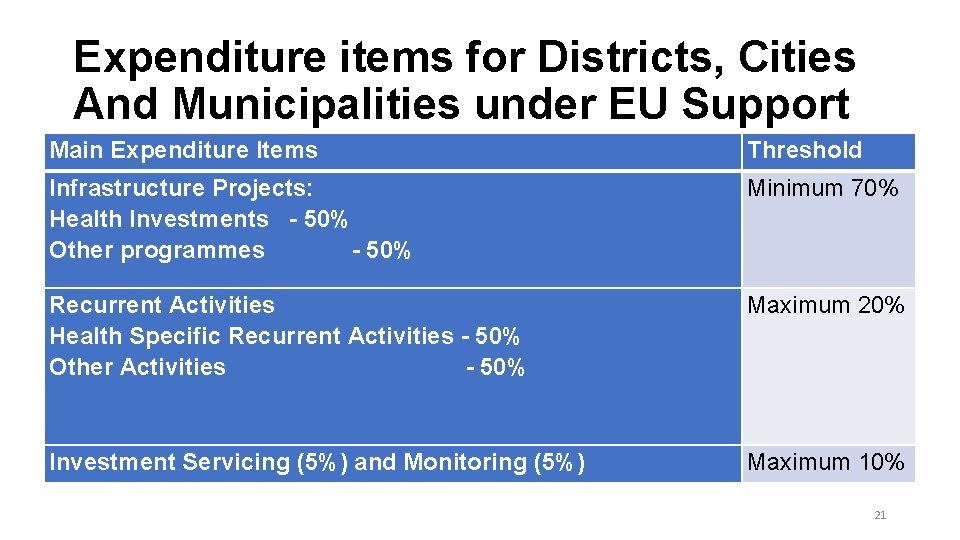
Expenditure items for Districts, Cities And Municipalities under EU Support Main Expenditure Items Threshold Infrastructure Projects: Health Investments - 50% Other programmes - 50% Minimum 70% Recurrent Activities Health Specific Recurrent Activities - 50% Other Activities - 50% Maximum 20% Investment Servicing (5%) and Monitoring (5%) Maximum 10% 21
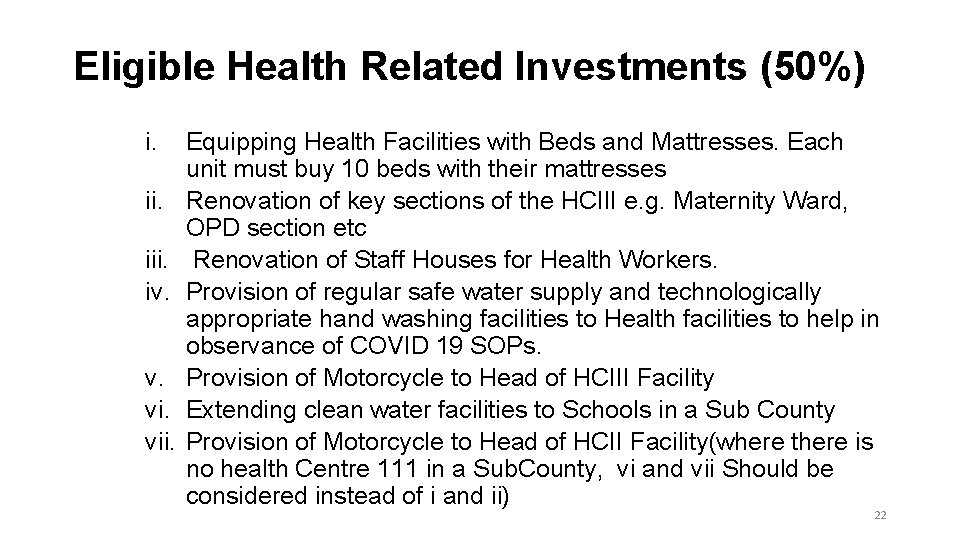
Eligible Health Related Investments (50%) i. iii. iv. v. vii. Equipping Health Facilities with Beds and Mattresses. Each unit must buy 10 beds with their mattresses Renovation of key sections of the HCIII e. g. Maternity Ward, OPD section etc Renovation of Staff Houses for Health Workers. Provision of regular safe water supply and technologically appropriate hand washing facilities to Health facilities to help in observance of COVID 19 SOPs. Provision of Motorcycle to Head of HCIII Facility Extending clean water facilities to Schools in a Sub County Provision of Motorcycle to Head of HCII Facility(where there is no health Centre 111 in a Sub. County, vi and vii Should be considered instead of i and ii) 22
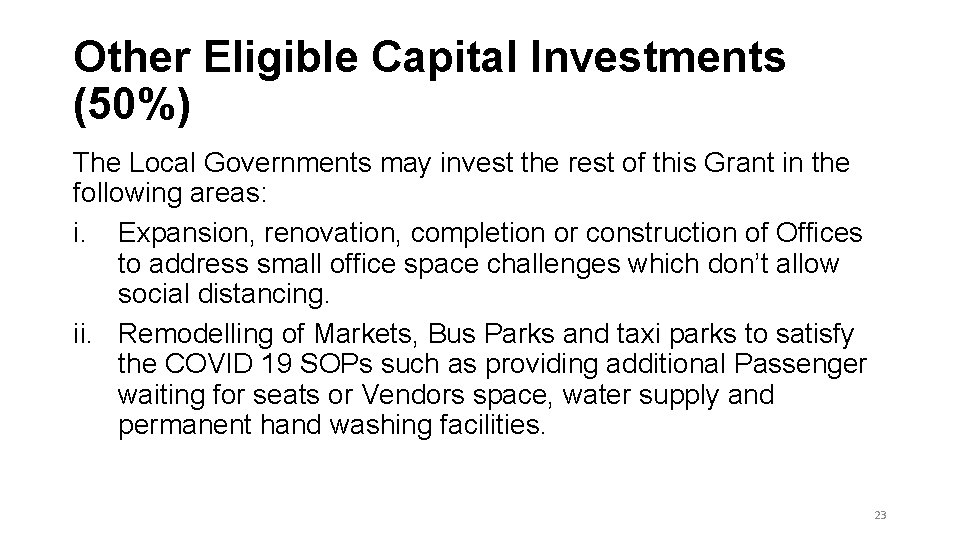
Other Eligible Capital Investments (50%) The Local Governments may invest the rest of this Grant in the following areas: i. Expansion, renovation, completion or construction of Offices to address small office space challenges which don’t allow social distancing. ii. Remodelling of Markets, Bus Parks and taxi parks to satisfy the COVID 19 SOPs such as providing additional Passenger waiting for seats or Vendors space, water supply and permanent hand washing facilities. 23
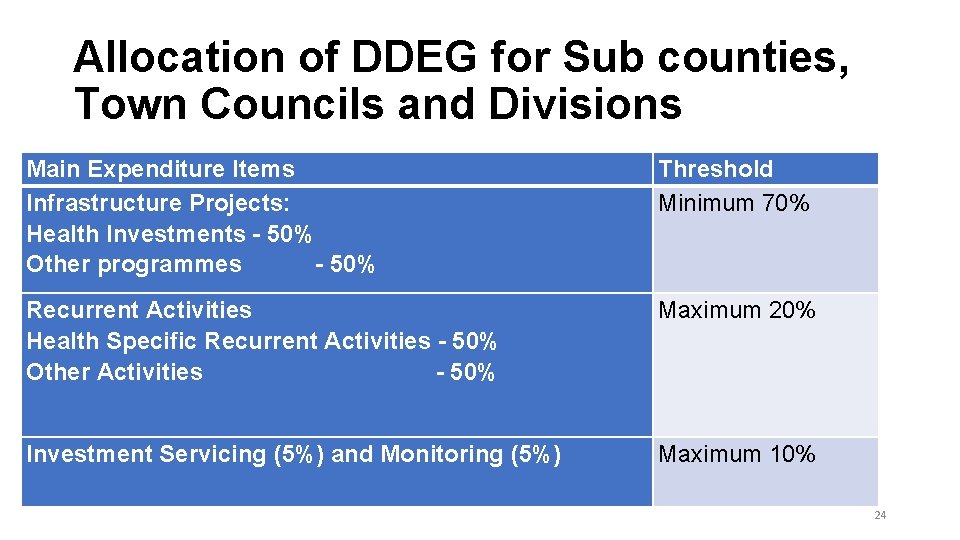
Allocation of DDEG for Sub counties, Town Councils and Divisions Main Expenditure Items Infrastructure Projects: Health Investments - 50% Other programmes - 50% Threshold Minimum 70% Recurrent Activities Health Specific Recurrent Activities - 50% Other Activities - 50% Maximum 20% Investment Servicing (5%) and Monitoring (5%) Maximum 10% 24
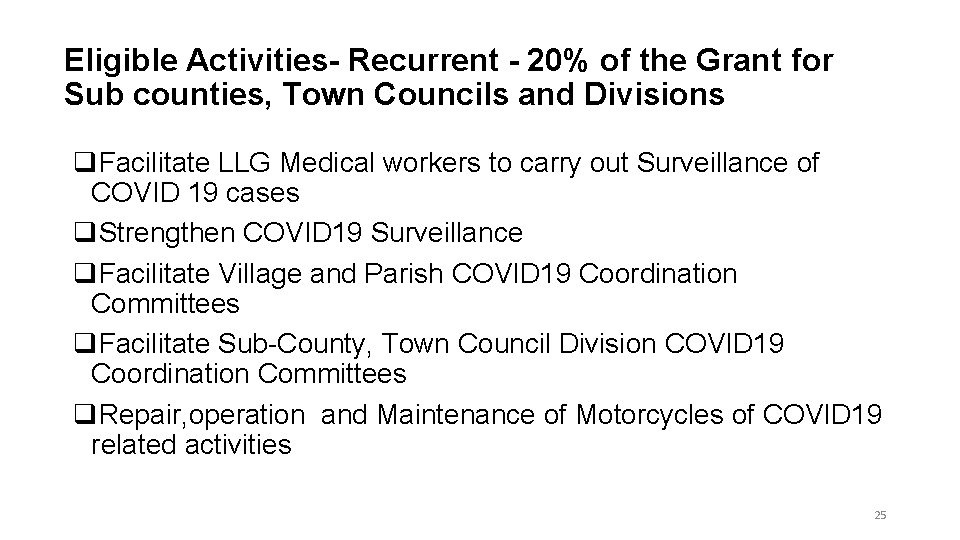
Eligible Activities- Recurrent - 20% of the Grant for Sub counties, Town Councils and Divisions q. Facilitate LLG Medical workers to carry out Surveillance of COVID 19 cases q. Strengthen COVID 19 Surveillance q. Facilitate Village and Parish COVID 19 Coordination Committees q. Facilitate Sub-County, Town Council Division COVID 19 Coordination Committees q. Repair, operation and Maintenance of Motorcycles of COVID 19 related activities 25
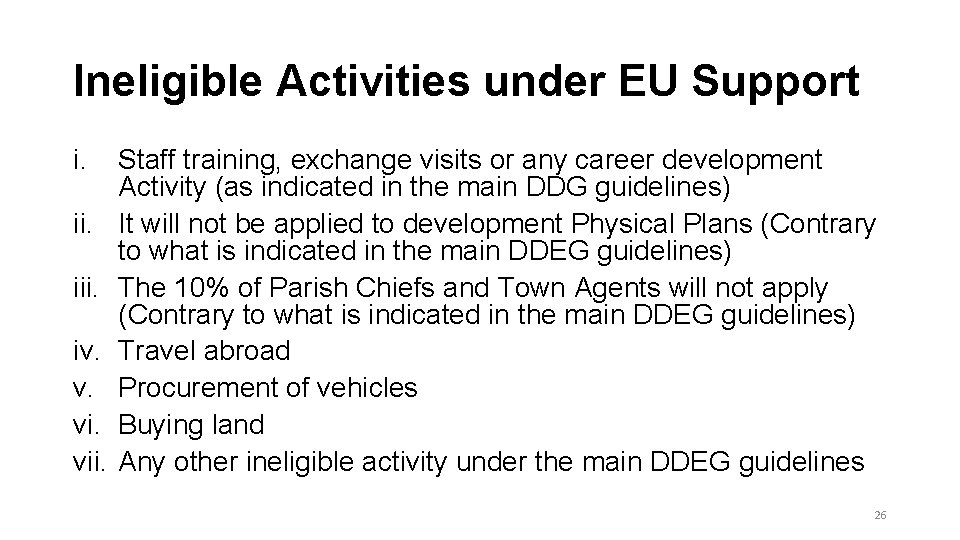
Ineligible Activities under EU Support i. iii. iv. v. vii. Staff training, exchange visits or any career development Activity (as indicated in the main DDG guidelines) It will not be applied to development Physical Plans (Contrary to what is indicated in the main DDEG guidelines) The 10% of Parish Chiefs and Town Agents will not apply (Contrary to what is indicated in the main DDEG guidelines) Travel abroad Procurement of vehicles Buying land Any other ineligible activity under the main DDEG guidelines 26
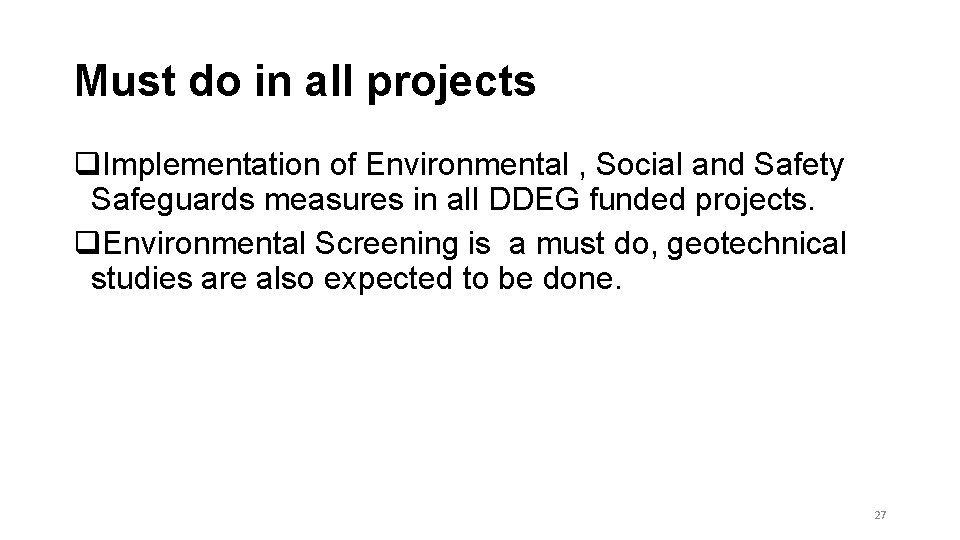
Must do in all projects q. Implementation of Environmental , Social and Safety Safeguards measures in all DDEG funded projects. q. Environmental Screening is a must do, geotechnical studies are also expected to be done. 27
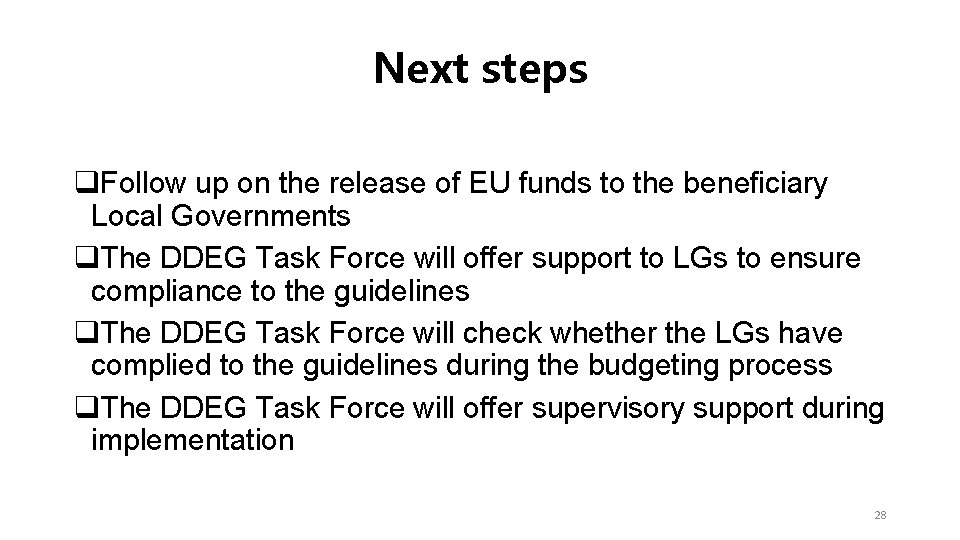
Next steps q. Follow up on the release of EU funds to the beneficiary Local Governments q. The DDEG Task Force will offer support to LGs to ensure compliance to the guidelines q. The DDEG Task Force will check whether the LGs have complied to the guidelines during the budgeting process q. The DDEG Task Force will offer supervisory support during implementation 28
Thank you! 29
Issues raised during the Consultations for FY 2020/21 q. Recruitment of critical staff: There was also concern over the staffing level of the local governments, Local governments noted that a number of them are understaffed and do not have critical staff such as Heads of Departments. They noted that this issue is also compounded by delay by the Ministry of Public Service to approve requests for clearance of recruitment submitted by the Local governments, cases of some Local governments preferring placing people under acting capacity rather than recruiting. Response: The Ministry of Local Government has taken stock of the current staffing gaps in the Local Governments , Critical Staffing levels currently stand at 52% other posts stand at 56%. Additional wage was provided to LGs in FY 2020/21 under Education and Health, LGs are requested to submit posts for recruitment using additional funds. The Ministry will support joint adverts and support the DSCs in the recruitment process. 30
Issues raised during the Consultations for FY 2020/21…. q. Narrow Tax Base to generate revenue for LGs : The ministry was tasked to Strengthen capacity of staff on NTR mobilization and collection Response: The Ministry has initiated a project Local Revenue Management Information System( LGRMIS) to Support urban Higher Local Governments to Mobilize Local Revenue. The project is at pre-feasibility stage. This will subsequently be rolled out to DLGs. 31
Issues raised during the Consultations for FY 2020/21…. q. Un updated data on administrative units : It was noted that LGs indicate new villages or parishes without detailing where the old village or Parish was curved from making some of these units to miss from the database. The Ministry and UBOS were asked to update LG statistics and other relevant information with regards to the administrative Units Response: LGs are requested to submit details of their new villages and parishes , information on old units should be submitted to the Ministry so that the Ministry can advise UBo. S accordingly. 32
Issues raised during the Consultations for FY 2020/21…. q. Role of Commercial Officers in LED Implementation: No clear guidance in defining the functions of Commercial Officers in the implementation of LED policy. Response: The Ministry has held interactions with and oriented Commercial Officers on LED Implementation in some LGs. Those not covered yet are to be covered in the remaining Quarters of this FY. 33
Issues raised during the Consultations for FY 2020/21…. q. Inconsistency of the Public Finance Management Act (PFMA-2015) with other Laws that disempower Local Government operations: Government should consider reviewing and harmonizing the PFM Act (2015) to address the inconsistencies with other laws especially the Local Government Councils in regards to financial matters. Response: The Ministry procured Consultants to support the harmonization process of not only laws but also planning and budgeting Processes. The report to guide the harmonization process will be shared before the end of this FY 34
Issues raised during the Consultations for FY 2020/21……. q. Operationalization of newly created administrative units ( Town Councils and Sub counties): In Financial Year 2017/18, Government halted the funding of the newly created Town Councils, largely because inadequate funding. however, in the same year, the Electoral Commission went ahead to organize the Election for Councilors for these Local Governments and the councilors are putting pressure upon the Accounting Officers to provide funding for the operationalization. Response: Engagements with Mo. FPED are on going on this matter 35
Issues raised during the Consultations for FY 2020/21…… q. Taxes on Councilors Allowance. There is persistent short fall on allowances for political leaders and URA taxes the existing pay which is double taxation. Response: Mo. LG issued a circular on taxation of allowances (See copy attached) 36
Issues raised during the Consultations for FY 2020/21…… q. Lack of Transport facilities for Local Governments: One of the key challenges faced by the Local governments is a lack of transportation, this impedes their access to monitor the implementation of government programmes. For instance, Municipal Mayors, City Mayors and Accounting Officers do not have transport services and yet they are in charge of implementing the programmes in the Local Governments, the Community Development Workers, Planners among others; Response: Government will provide transport equipment to Sub county Chiefs, Parish Chairpersons and LC 1 chairpersons in this FY. Other categories of Leaders and Officers will be considered in the medium Term. 37
Issues raised during the Consultations for FY 2020/21…… q. Lack of land ownership for some LG Administrative Offices: Buganda Question(Buganda has regained ownership of properties in all districts especially land) q. Response: LGs under this category are being supported to acquire land construct offices. 38
Issues raised during the Consultations for FY 2020/21…… q. Review of Assessment Indicators: It was recommended that the LGPA manual be revised. Response: The assessment manual has been revised, Local Governments were requested to provide input that has also been incorporated in the revised manual. Assessment for FY 2019/20 will be conducted using the revised manual. 39
Emerging Issues q. The LGA has been amended to provide for operationalization of Cities and planned creation of new Administrative units. q. The Parish model will be implemented and as such Parish/Ward Development Committees will be revitalized and Project Management Committees at Parish level will be constituted for every project to be implemented in a Parish q. Votes for the Cities have been created Currently the 10 Cities are financed under the Modalities of the Municipalities and the consolidated budgets of the annexed areas that formed the Total geographical boundaries of the Cities. 40
Emerging Issues q. The MATIP 2 Markets under construction, will be managed and maintained by Urban Councils, guidelines to resettle vendors, operate and maintain these markets have been finalized and shared with beneficiary urban councils. q. The management of the high level value addition facilities in the following markets Soroti, Busia and Arua will be tendered out to private operators under the PPP arrangement. 41