OVERVIEW OF THE DISCRETIONARY DEVELOPMENT EQUALISATION GRANT DDEG



- Slides: 25
OVERVIEW OF THE DISCRETIONARY DEVELOPMENT EQUALISATION GRANT (DDEG) Office of the Prime Minister September 2018
Presentation Outline 1. Background to the DDEG 2. Main Features of the DDEG 3. Frequently Asked Questions and Answers 4. Next steps
1. Background to the DDEG
Introduction • In the early 1990 s, the Government of Uganda (Go. U) adopted the Decentralization Policy; • Under this Policy, LGs have the primary mandate of providing basic services; while Central Government provides guidance through sector policies, standards, Sector Budget guidelines, technical supervision and support; • Article 193 of the Constitution therefore provides for three types of intergovernmental fiscal transfers to enable LGs achieve their mandates: • Unconditional grants; • Conditional grant • Equalization grant • Local Governments are also empowered by the Local Government Act to raise revenues through local taxation and issuance of trade licences and loyalties.
Financing of LGs overtime • Over the years, significant progress has been made in the improvement of LG financing. Funding from Central to LGs has increased over time from UGX 0. 35 trillion in FY 1993/94 (in UGX 2016 terms) to UGX 2. 73 trillion in FY 2017/18. • Local Governments also benefit from funds that are appropriated for under some Central Government institutions like: § National Medical Stores (NMS); delivery of medicines and medical equipment, ; § National Agricultural Advisory Service (NAADS), which provides agricultural inputs, § Uganda Road Fund (URF) for road maintenance and mechanical imprest. § Under the Ministry of Gender, Labour and Social Development, local Governments benefit from Social Assistance Grants for Empowerment (SAGE), Uganda Women’s Entrepreneurship Programme (UWEP) and Youth Livelihood Programmes, among others. § These add to the overall contribution government sends to Local Governments.
Challenges Regarding Financing of LGs • The limited discretion for LGs to decide on allocations of resources; • Visible inequities in the allocation of resources across LGs; • Lack of incentives for LGs to account for resources; and • Reduced real per capita value of transfers
To address the challenges, Go. U is Implementing Intergovernmental Fiscal Transfer Reforms in Four Phases 1. Consolidation of LG Transfers • • Collapsing the number of Sector Grants form 53 in FY 2013/14 to 13 in 2015/16 Interim Grant Conditions for Sectoral Transfers prepared 3. Reforming frameworks for accountability and strengthening incentives • Strengthening mechanisms for transparent and accountable grant management • Re-introducing the LG Performance Assessment System to lever institutional and service delivery improvements from 17/18 onwards 2. Reform to Transfers for 2016/17 • • • Consolidating and redesigning discretionary transfers leading into DDEG Revising the allocation formulae and principles for grants to LGs Redesign of sector transfers and establishing budgeting requirements 4. Fiscal Decentralisation Architecture & Share of Transfers (LGFC/ FINMAP) • Reviewing LG mandates and estimating the cost of adequately financing those mandates relative to the overall budget. • Reviewing the overall legal and policy framework for local government revenues and expenditures and recommending changes, taking 7
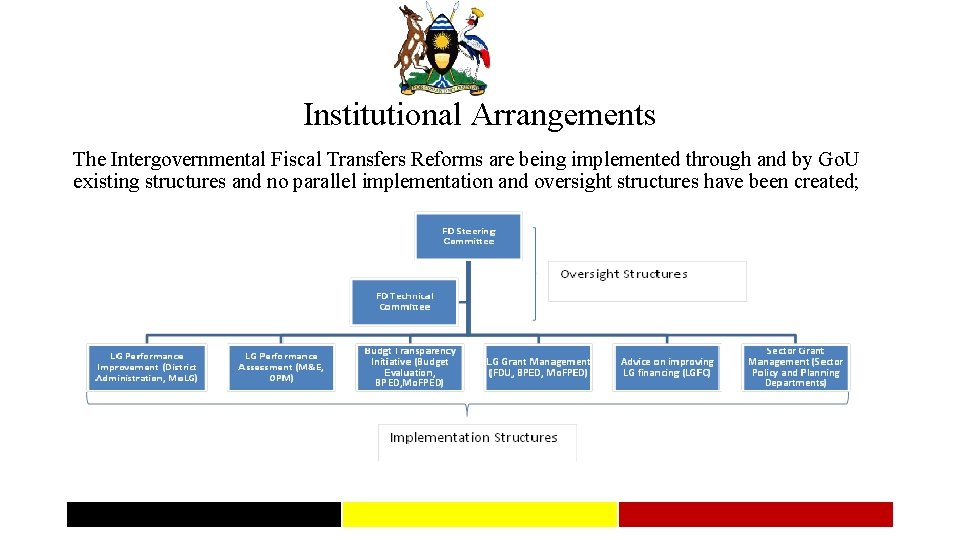
Institutional Arrangements The Intergovernmental Fiscal Transfers Reforms are being implemented through and by Go. U existing structures and no parallel implementation and oversight structures have been created;
2. Main Features of the DDEG
What is the Discretional Development Equalization Grant (DDEG) • The DDEG is a consolidation of: • Equalization grant; • Local Government Management Service Delivery Program (LGMSD); • Peace Recovery and Development Plan (PRDP); • Luwero-Rwenzori Development Program (LRDP); and • Uganda Support to Municipal Infrastructure Development (USMID). • DDEG is allocated in such a way that Local Governments lagging behind national average indicators in accordance with the Constitution Article 193 (4).
What are the objectives of the DDEG • Enhance discretion of LGs in allocation of funds to priority local development needs that are within their mandate and are consistent with the National priorities. • Provide LGs with equitable access to development financing, ensuring that more disadvantaged LGs receive additional funding to enable them catch up with the rest of the country. • Provide development financing which caters for the differing development needs of rural and urban areas. • Improve LGs capacities and systems for provision of quality services.
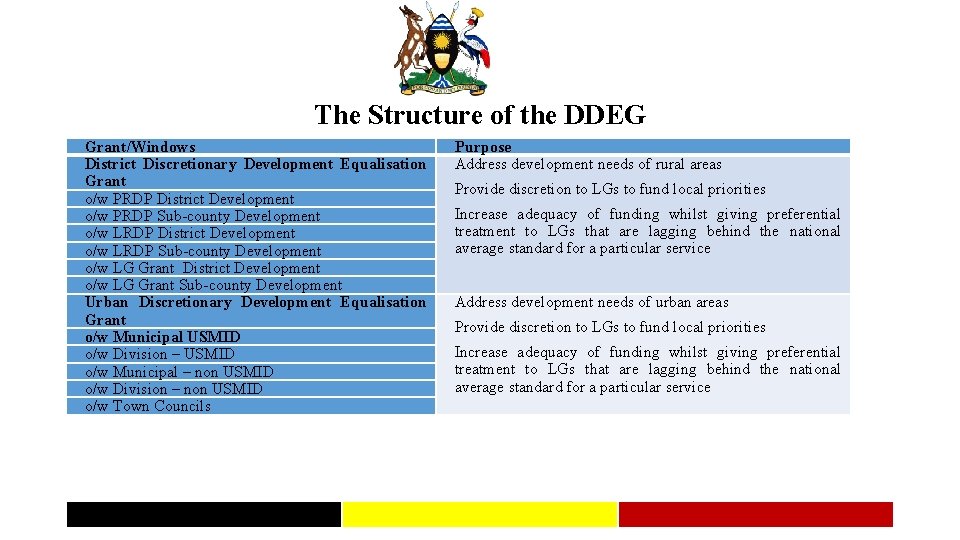
The Structure of the DDEG Grant/Windows District Discretionary Development Equalisation Grant o/w PRDP District Development o/w PRDP Sub-county Development o/w LRDP District Development o/w LRDP Sub-county Development o/w LG Grant District Development o/w LG Grant Sub-county Development Urban Discretionary Development Equalisation Grant o/w Municipal USMID o/w Division – USMID o/w Municipal – non USMID o/w Division – non USMID o/w Town Councils Purpose Address development needs of rural areas Provide discretion to LGs to fund local priorities Increase adequacy of funding whilst giving preferential treatment to LGs that are lagging behind the national average standard for a particular service Address development needs of urban areas Provide discretion to LGs to fund local priorities Increase adequacy of funding whilst giving preferential treatment to LGs that are lagging behind the national average standard for a particular service
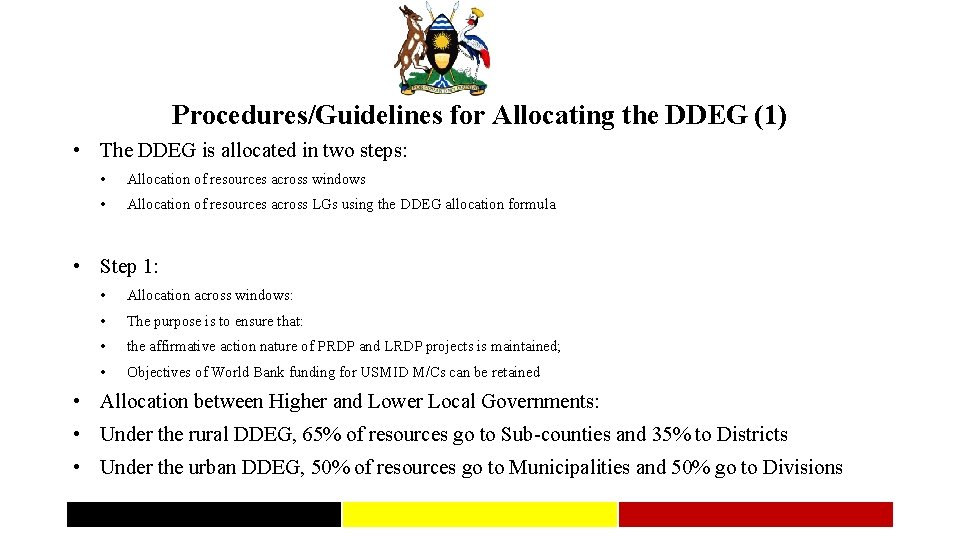
Procedures/Guidelines for Allocating the DDEG (1) • The DDEG is allocated in two steps: • Allocation of resources across windows • Allocation of resources across LGs using the DDEG allocation formula • Step 1: • Allocation across windows: • The purpose is to ensure that: • the affirmative action nature of PRDP and LRDP projects is maintained; • Objectives of World Bank funding for USMID M/Cs can be retained • Allocation between Higher and Lower Local Governments: • Under the rural DDEG, 65% of resources go to Sub-counties and 35% to Districts • Under the urban DDEG, 50% of resources go to Municipalities and 50% go to Divisions
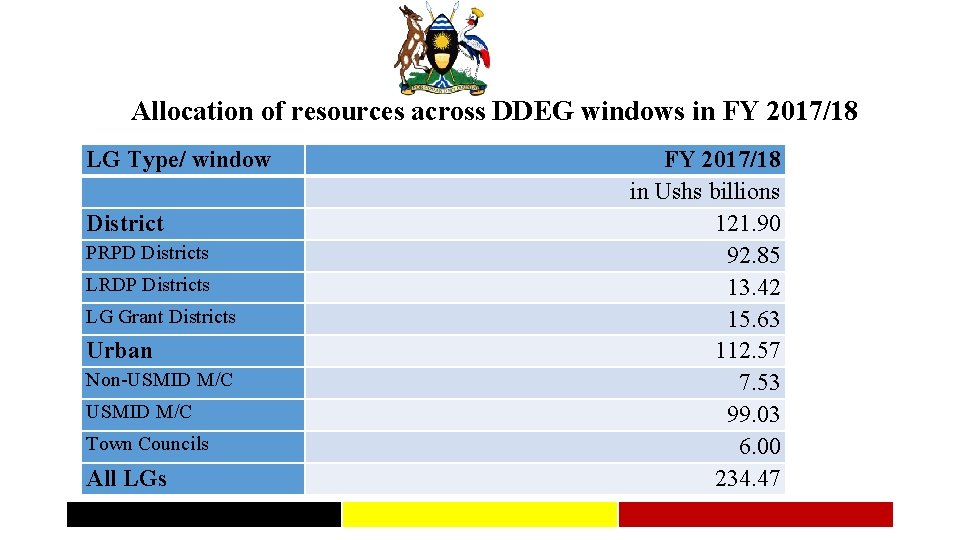
Allocation of resources across DDEG windows in FY 2017/18 LG Type/ window District PRPD Districts LRDP Districts LG Grant Districts Urban Non-USMID M/C Town Councils All LGs FY 2017/18 in Ushs billions 121. 90 92. 85 13. 42 15. 63 112. 57 7. 53 99. 03 6. 00 234. 47
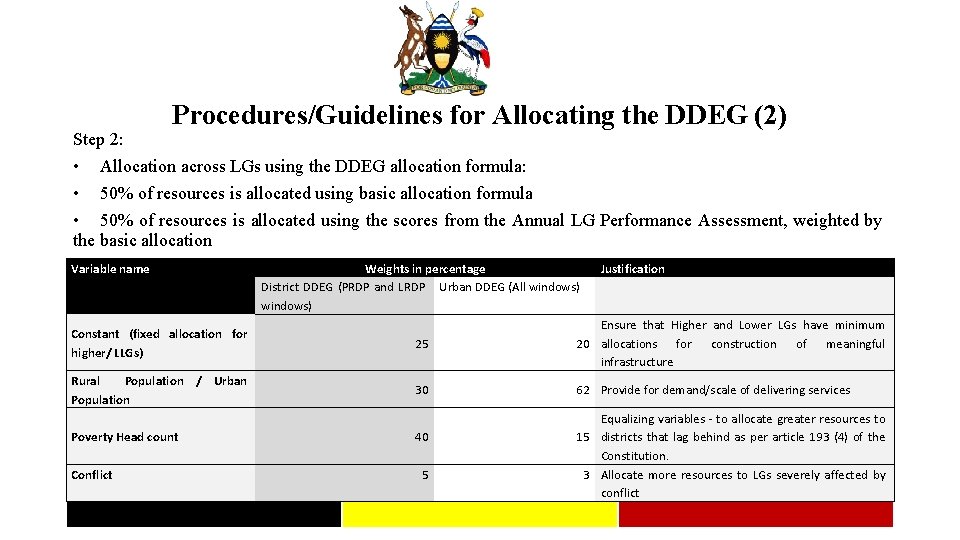
Procedures/Guidelines for Allocating the DDEG (2) Step 2: • Allocation across LGs using the DDEG allocation formula: • 50% of resources is allocated using basic allocation formula • 50% of resources is allocated using the scores from the Annual LG Performance Assessment, weighted by the basic allocation Variable name Weights in percentage District DDEG (PRDP and LRDP Urban DDEG (All windows) Justification Constant (fixed allocation for higher/ LLGs) 25 Ensure that Higher and Lower LGs have minimum 20 allocations for construction of meaningful infrastructure Rural Population / Urban Population 30 62 Provide for demand/scale of delivering services Poverty Head count Conflict 40 5 Equalizing variables - to allocate greater resources to 15 districts that lag behind as per article 193 (4) of the Constitution. 3 Allocate more resources to LGs severely affected by conflict
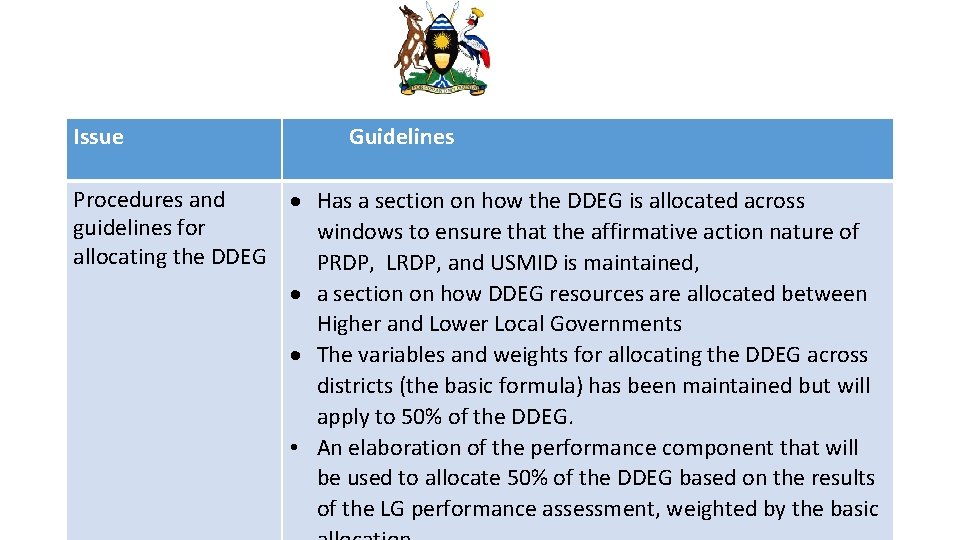
Issue Guidelines Procedures and Has a section on how the DDEG is allocated across guidelines for windows to ensure that the affirmative action nature of allocating the DDEG PRDP, LRDP, and USMID is maintained, a section on how DDEG resources are allocated between Higher and Lower Local Governments The variables and weights for allocating the DDEG across districts (the basic formula) has been maintained but will apply to 50% of the DDEG. • An elaboration of the performance component that will be used to allocate 50% of the DDEG based on the results of the LG performance assessment, weighted by the basic
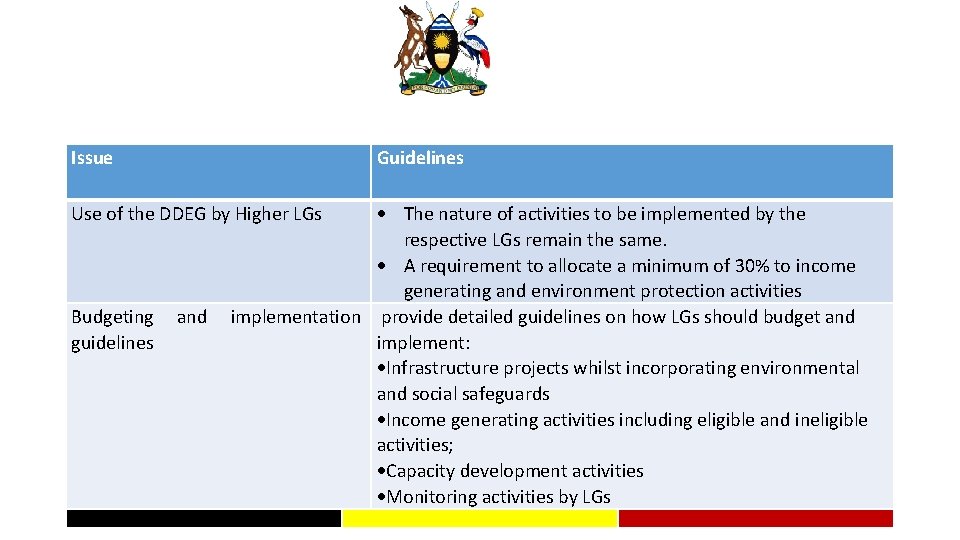
Issue Guidelines The nature of activities to be implemented by the respective LGs remain the same. A requirement to allocate a minimum of 30% to income generating and environment protection activities Budgeting and implementation provide detailed guidelines on how LGs should budget and guidelines implement: Infrastructure projects whilst incorporating environmental and social safeguards Income generating activities including eligible and ineligible activities; Capacity development activities Monitoring activities by LGs Use of the DDEG by Higher LGs
3. Frequently Asked Questions
Why was the PRDP, LGMSDP, USMID, and Equalisation Grant consolidated into the Discretional Development Equalisation Grant (DDEG)? The creation of the DDEG is in consonance with section 5. 2, page 29 of the Third Peace, Recovery and Development Plan for Northern Uganda (2015 -2020) approved by Cabinet. • • The objectives are: To distribute resources more equitably across and within LGs, so that those areas which are less welloff are able to catch up with other areas - as per the Constitution Article 193; To provide greater discretion for LGs to allocate resources to local needs that are within their mandate and that are consistent with the National priorities - as per National Development Plan. To support the implementation of the Government policy of promoting wealth creation and livelihood improvement. An Inter-ministry Design Team was constituted to discuss and refine the guidelines that were issued to LGs: Chaired by OPM – PIC Composed of OPM (P&D), Mo. LG, LGFC, Mo. LHUD and Mo. FPED
How will the DDEG promote livelihood and wealth creation as per Government Policy? • Out of the 97 billion allocated to PRDP districts, 40 billion is allocated to the districts and 57 billion is allocated to sub-counties. • The 57 billion allocated to sub-counties will be used to fund investments promoting wealth creation and livelihood improvement. • This amount is more than the minimum of 70% (equivalent to 51 billion of the 73 billions) provided for under former PRDP guidelines
Why should DDEG be allocated directly to Sub-counties yet PRDP was only allocated to District level? (For Northern and Eastern regions) • Compliance with legal provisions: • As per LG Act Cap 243, both districts and sub-counties are corporate bodies with distinct mandates that have to be financed. • Therefore the consolidated DDEG is directly allocated and transferred to districts and gazetted sub-counties • Ensuring intra district equity: • Having allocations of the DDEG to Sub-Counties clearly provided in the IPFs and budget book ensures equitable allocation of resources within the district.
How will the sub-counties with low capacities manage to use the DDEG? • Sub-counties have been managing development funds – the Local Development Fund since early 2000 s • Under the LG transfer reforms: • Sub-counties are also managing the Un-conditional Grant Non Wage Recurrent. • Transfers are also being made directly to schools and health facilities • It is the responsibility of the districts to build the capacity and support the sub-counties to properly use the funds. • For funds to flow sub-counties, Town Councils and Municipal Divisions, they have to be warranted by the respective LG Accounting Officers. • The LG Accounting Officers have to ensure that the funds are used as per guidelines and properly accounted for.
What is the role of OPM wrt DDEG? • Issuing grant information and budget requirements as Chair of the PSM SWG • Providing data formulae variables not available with UBOS (e. g. conflict impact) • Reviewing LG draft Budget Framework Papers to check LG compliance with the budgeting requirements. • Designing a system and indicators to be used in the assessment of LG performance • Conducting physical and financial monitoring of activities implemented by LGs • Compiling information about LG performance based on assessment and monitoring results • Providing targeted support and capacity building to LGs
Give suggestions on how Lower Local Governments (Sub counties, town councils and Divisions) can report. This is still a gap
Thank you