Direct Fusion Drive for Fast Mars Missions with

- Slides: 25
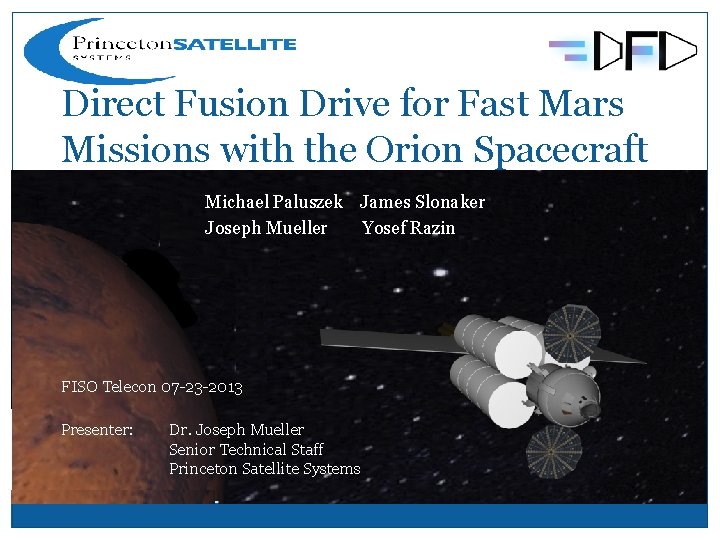
Direct Fusion Drive for Fast Mars Missions with the Orion Spacecraft Michael Paluszek James Slonaker Joseph Mueller Yosef Razin FISO Telecon 07 -23 -2013 Presenter: Dr. Joseph Mueller Senior Technical Staff Princeton Satellite Systems
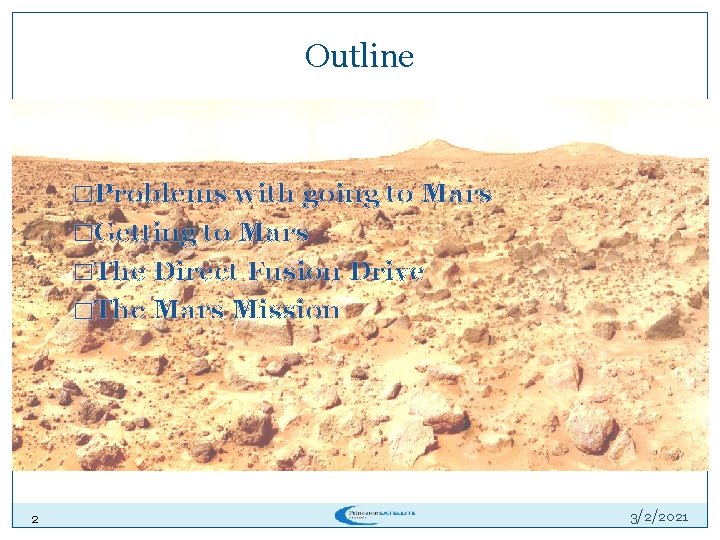
Outline �Problems with going to Mars �Getting to Mars �The Direct Fusion Drive �The Mars Mission 2 3/2/2021
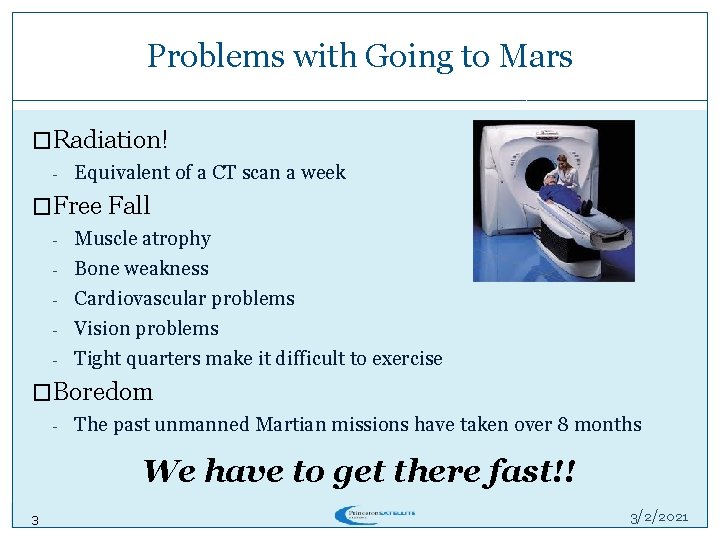
Problems with Going to Mars �Radiation! - Equivalent of a CT scan a week �Free Fall - Muscle atrophy Bone weakness Cardiovascular problems Vision problems Tight quarters make it difficult to exercise �Boredom - The past unmanned Martian missions have taken over 8 months We have to get there fast!! 3 3/2/2021
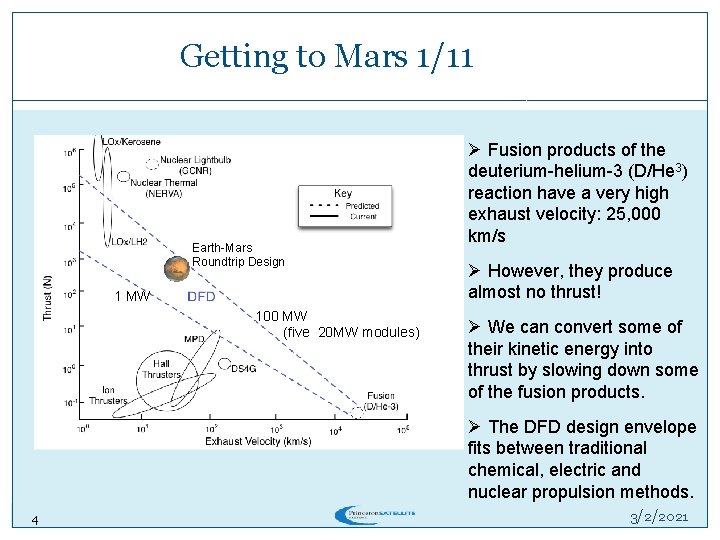
Getting to Mars 1/11 Earth-Mars Roundtrip Design 1 MW 100 MW (five 20 MW modules) Ø Fusion products of the deuterium-helium-3 (D/He 3) reaction have a very high exhaust velocity: 25, 000 km/s Ø However, they produce almost no thrust! Ø We can convert some of their kinetic energy into thrust by slowing down some of the fusion products. Ø The DFD design envelope fits between traditional chemical, electric and nuclear propulsion methods. 4 3/2/2021
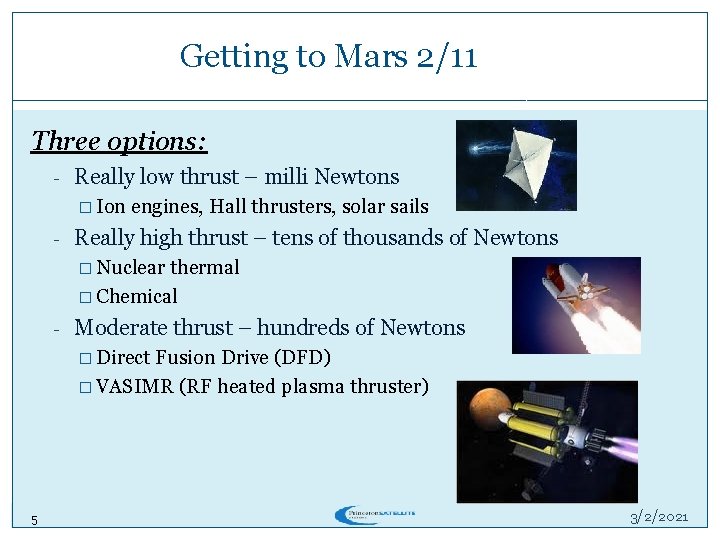
Getting to Mars 2/11 Three options: - Really low thrust – milli Newtons � Ion - engines, Hall thrusters, solar sails Really high thrust – tens of thousands of Newtons � Nuclear thermal � Chemical - Moderate thrust – hundreds of Newtons � Direct Fusion Drive (DFD) � VASIMR (RF heated plasma thruster) 5 3/2/2021
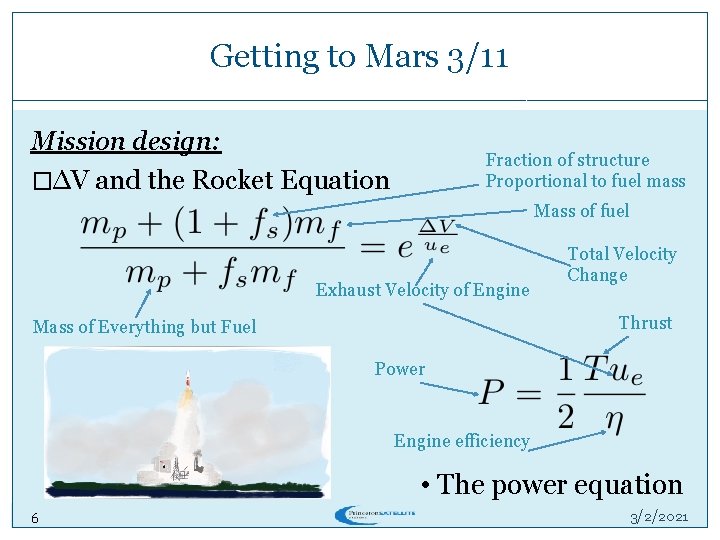
Getting to Mars 3/11 Mission design: �∆V and the Rocket Equation Fraction of structure Proportional to fuel mass Mass of fuel Exhaust Velocity of Engine Total Velocity Change Thrust Mass of Everything but Fuel Power Engine efficiency • The power equation 6 3/2/2021
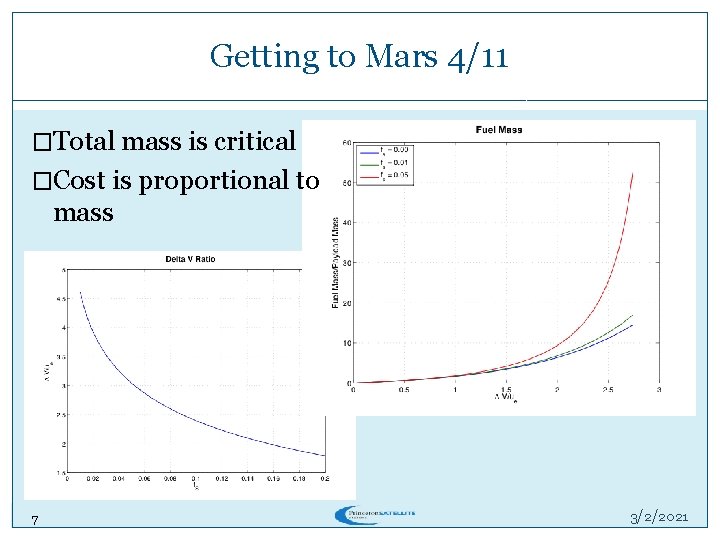
Getting to Mars 4/11 �Total mass is critical �Cost is proportional to mass 7 3/2/2021
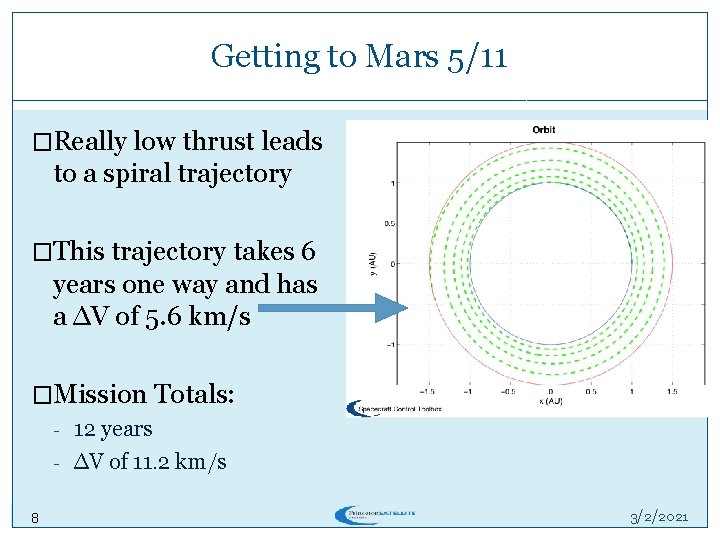
Getting to Mars 5/11 �Really low thrust leads to a spiral trajectory �This trajectory takes 6 years one way and has a ∆V of 5. 6 km/s �Mission Totals: - 8 12 years ∆V of 11. 2 km/s 3/2/2021
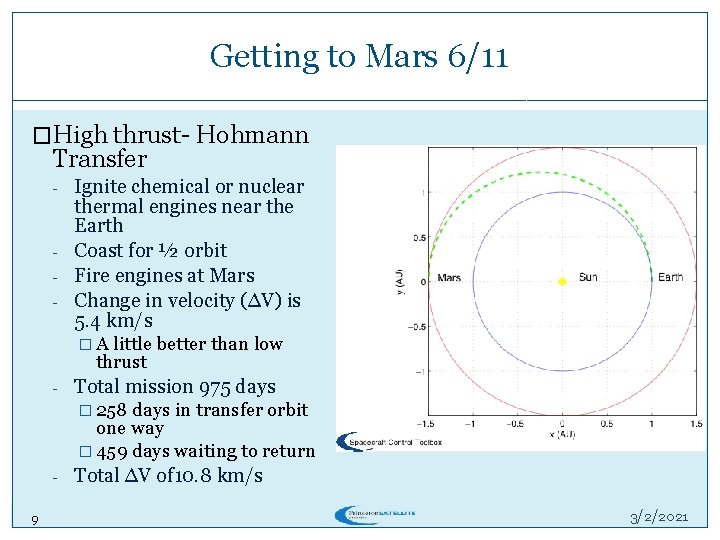
Getting to Mars 6/11 �High thrust- Hohmann Transfer - - Ignite chemical or nuclear thermal engines near the Earth Coast for ½ orbit Fire engines at Mars Change in velocity (∆V) is 5. 4 km/s �A little better than low thrust - Total mission 975 days � 258 days in transfer orbit one way � 459 days waiting to return 9 Total ∆V of 10. 8 km/s 3/2/2021
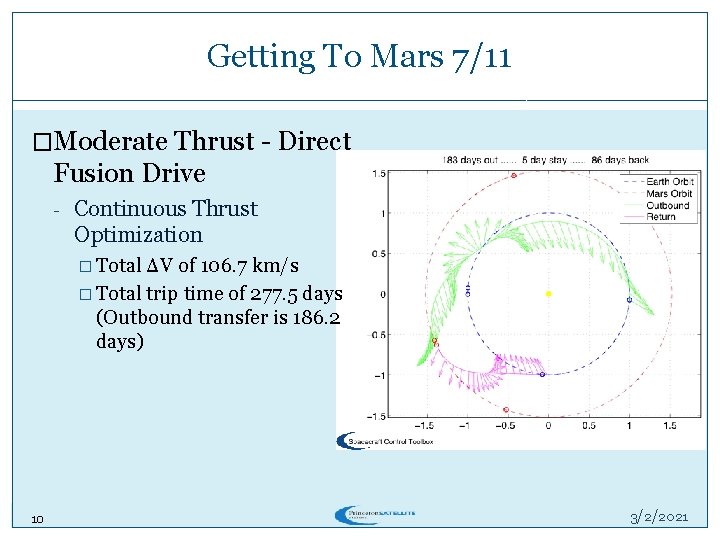
Getting To Mars 7/11 �Moderate Thrust - Direct Fusion Drive - Continuous Thrust Optimization � Total ΔV of 106. 7 km/s � Total trip time of 277. 5 days (Outbound transfer is 186. 2 days) 10 3/2/2021
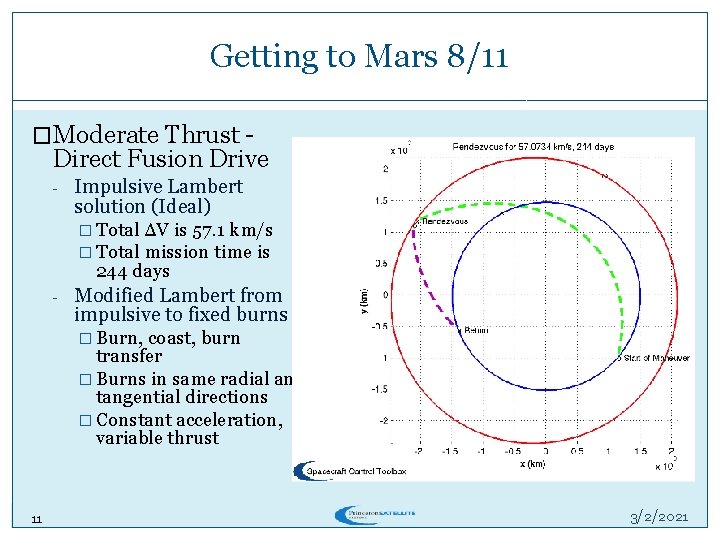
Getting to Mars 8/11 �Moderate Thrust - Direct Fusion Drive - Impulsive Lambert solution (Ideal) � Total ΔV is 57. 1 km/s � Total mission time is 244 days - Modified Lambert from impulsive to fixed burns � Burn, coast, burn transfer � Burns in same radial and tangential directions � Constant acceleration, variable thrust 11 3/2/2021
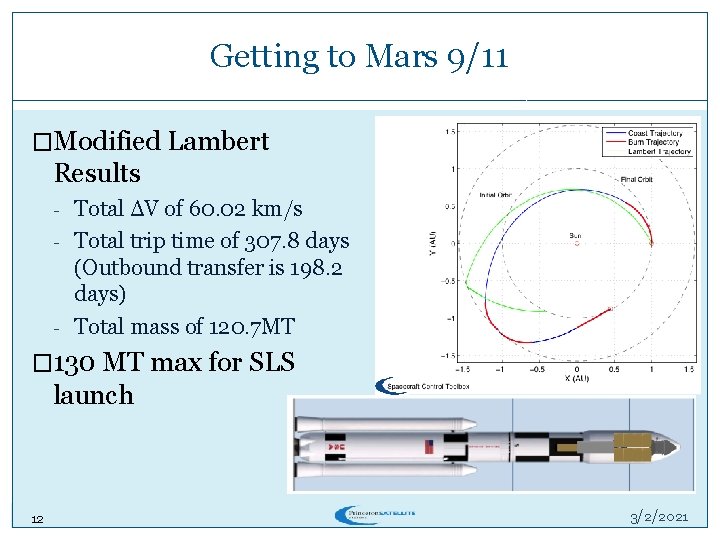
Getting to Mars 9/11 �Modified Lambert Results - - Total ΔV of 60. 02 km/s Total trip time of 307. 8 days (Outbound transfer is 198. 2 days) Total mass of 120. 7 MT � 130 MT max for SLS launch 12 3/2/2021
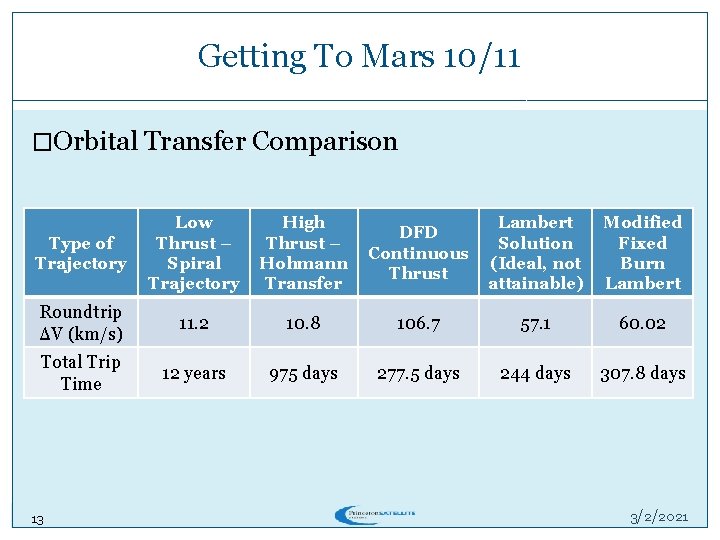
Getting To Mars 10/11 �Orbital Transfer Comparison Type of Trajectory Low Thrust – Spiral Trajectory High Thrust – Hohmann Transfer DFD Continuous Thrust Lambert Solution (Ideal, not attainable) Modified Fixed Burn Lambert Roundtrip ΔV (km/s) 11. 2 10. 8 106. 7 57. 1 60. 02 Total Trip Time 12 years 975 days 277. 5 days 244 days 307. 8 days 13 3/2/2021
Getting to Mars 11/11 �Future Work - Optimization of variable thrust � Most likely a burn, coast, burn transfer � Need thrust vector targeting during burns - 14 Keep total mass under 130 MT Decrease flight time further due to health risks 3/2/2021
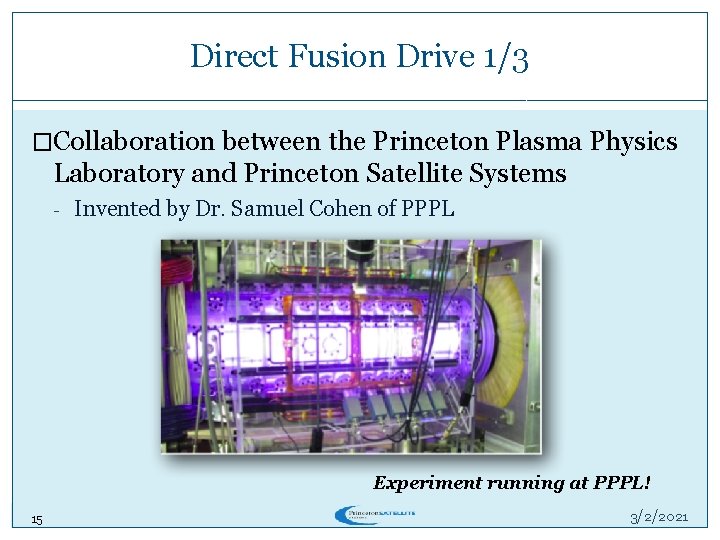
Direct Fusion Drive 1/3 �Collaboration between the Princeton Plasma Physics Laboratory and Princeton Satellite Systems - Invented by Dr. Samuel Cohen of PPPL Experiment running at PPPL! 15 3/2/2021
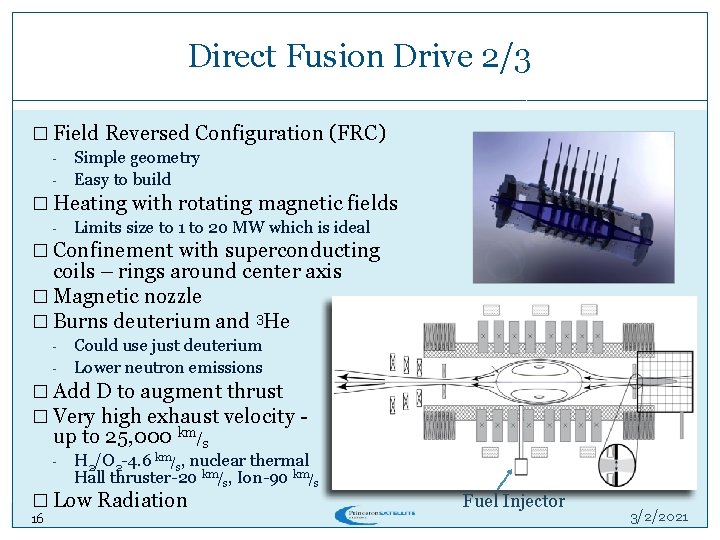
Direct Fusion Drive 2/3 � Field Reversed Configuration (FRC) - Simple geometry Easy to build � Heating with rotating magnetic fields - Limits size to 1 to 20 MW which is ideal � Confinement with superconducting coils – rings around center axis � Magnetic nozzle � Burns deuterium and 3 He - Could use just deuterium Lower neutron emissions � Add D to augment thrust � Very high exhaust velocity - up to 25, 000 km/s - H 2/O 2 -4. 6 km/s, nuclear thermal Hall thruster-20 km/s, Ion-90 km/s � Low Radiation 16 Fuel Injector 3/2/2021
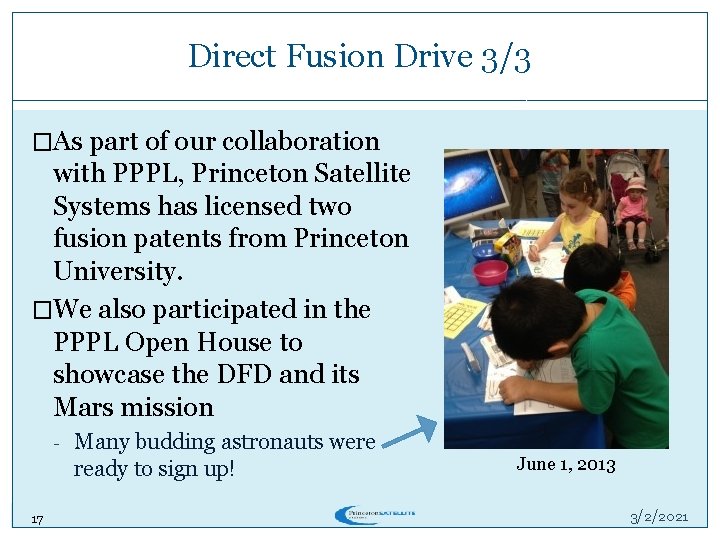
Direct Fusion Drive 3/3 �As part of our collaboration with PPPL, Princeton Satellite Systems has licensed two fusion patents from Princeton University. �We also participated in the PPPL Open House to showcase the DFD and its Mars mission - 17 Many budding astronauts were ready to sign up! June 1, 2013 3/2/2021
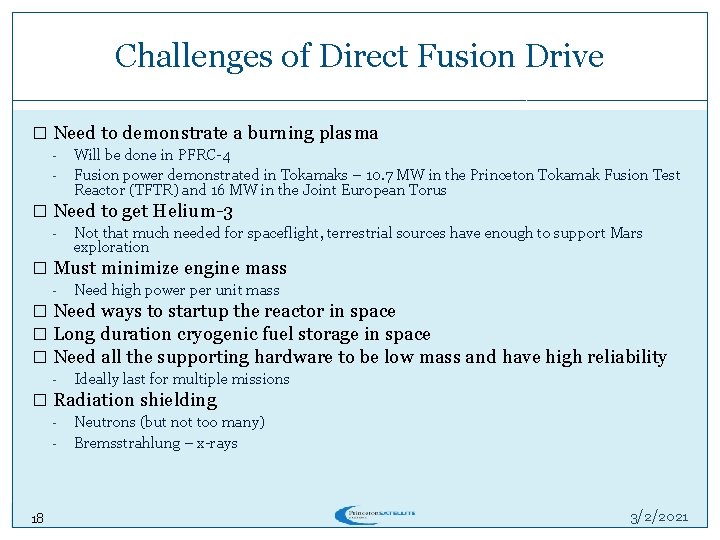
Challenges of Direct Fusion Drive � Need to demonstrate a burning plasma - Will be done in PFRC-4 Fusion power demonstrated in Tokamaks – 10. 7 MW in the Princeton Tokamak Fusion Test Reactor (TFTR) and 16 MW in the Joint European Torus � Need to get Helium-3 - Not that much needed for spaceflight, terrestrial sources have enough to support Mars exploration � Must minimize engine mass - Need high power per unit mass � Need ways to startup the reactor in space � Long duration cryogenic fuel storage in space � Need all the supporting hardware to be low mass and have high reliability - Ideally last for multiple missions � Radiation shielding - 18 Neutrons (but not too many) Bremsstrahlung – x-rays 3/2/2021
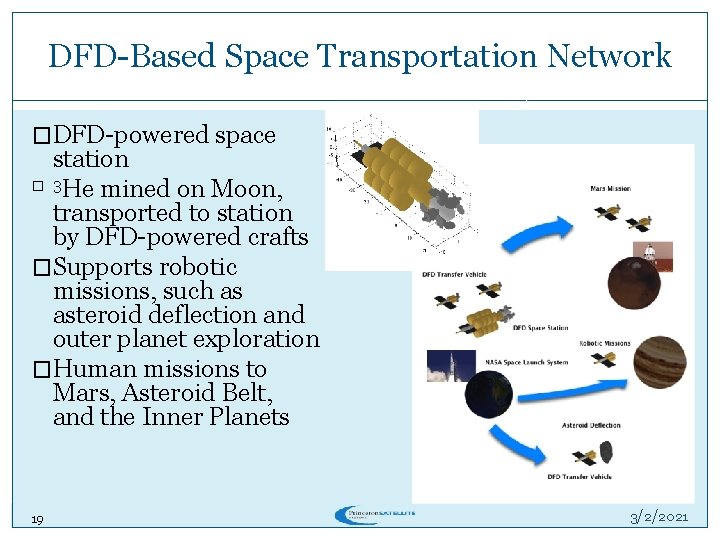
DFD-Based Space Transportation Network �DFD-powered space station � 3 He mined on Moon, transported to station by DFD-powered crafts �Supports robotic missions, such as asteroid deflection and outer planet exploration �Human missions to Mars, Asteroid Belt, and the Inner Planets 19 3/2/2021
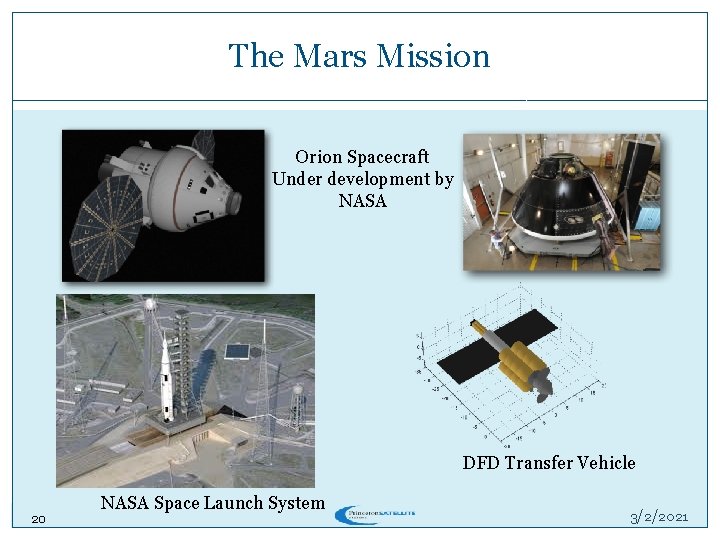
The Mars Mission Orion Spacecraft Under development by NASA DFD Transfer Vehicle 20 NASA Space Launch System 3/2/2021
Mars Spacecraft Design �Five 6 MW DFD engines on DFD Transfer Vehicle (TV) �Orion spacecraft �Dual radiator wings � 32 cryogenic tanks for deuterium �Cryogenic tank for helium-3 21 3/2/2021
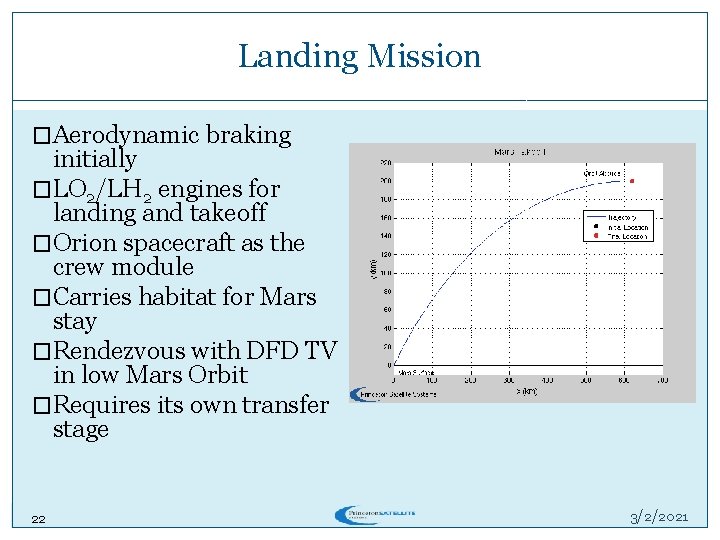
Landing Mission �Aerodynamic braking initially �LO 2/LH 2 engines for landing and takeoff �Orion spacecraft as the crew module �Carries habitat for Mars stay �Rendezvous with DFD TV in low Mars Orbit �Requires its own transfer stage 22 3/2/2021
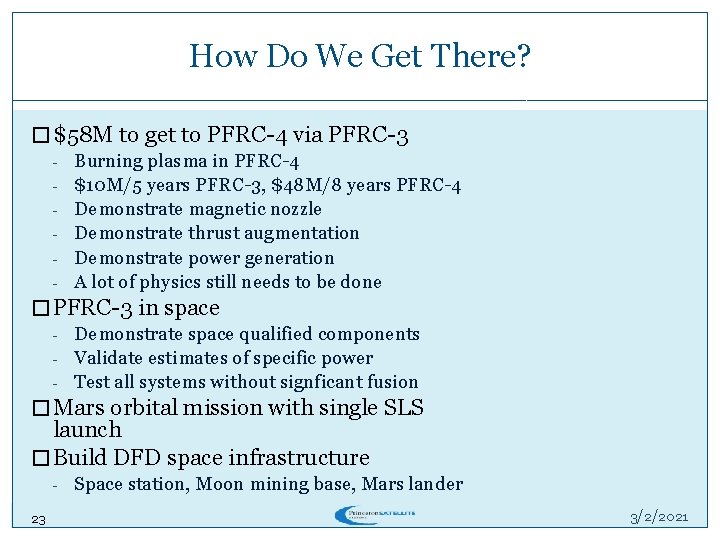
How Do We Get There? � $58 M to get to PFRC-4 via PFRC-3 - Burning plasma in PFRC-4 $10 M/5 years PFRC-3, $48 M/8 years PFRC-4 Demonstrate magnetic nozzle Demonstrate thrust augmentation Demonstrate power generation A lot of physics still needs to be done � PFRC-3 in space - Demonstrate space qualified components Validate estimates of specific power Test all systems without signficant fusion � Mars orbital mission with single SLS launch � Build DFD space infrastructure 23 Space station, Moon mining base, Mars lander 3/2/2021
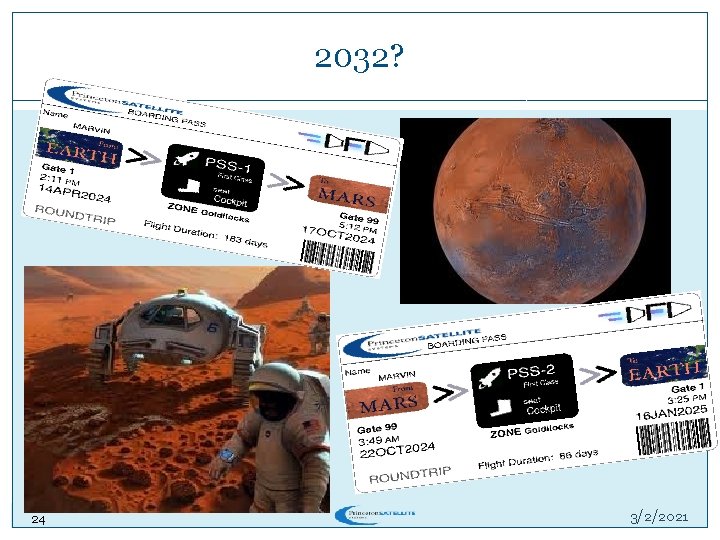
2032? 24 3/2/2021
For More Information Joseph Mueller jmueller@psatellite. com Michael Paluszek map@psatellite. com James Slonaker jslonaker@psatellite. com Dr. Gary Pajer gpajer@psatellite. com Yosef Razin yrazin@psatellite. com Dr. Samuel Cohen scohen@pppl. gov Princeton Satellite Systems 6 Market St. Suite 926 Plainsboro, NJ 08536 (609) 275 -9606 http: //www. psatellite. com/research/fusion. php 25 3/2/2021