Data Warehouse and OLAP CSE 601 Why data
- Slides: 30
Data Warehouse and OLAP · · CSE 601 Why data warehouse What’s multi-dimensional data model What’s difference between OLAP and OLTP 1
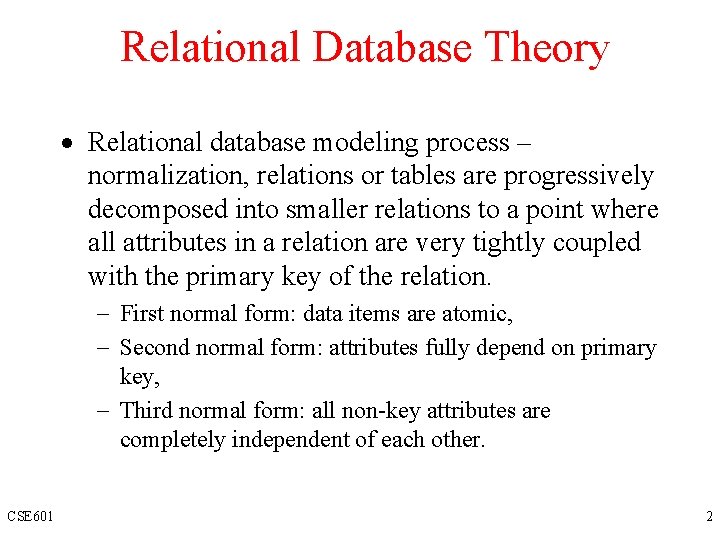
Relational Database Theory · Relational database modeling process – normalization, relations or tables are progressively decomposed into smaller relations to a point where all attributes in a relation are very tightly coupled with the primary key of the relation. - First normal form: data items are atomic, - Second normal form: attributes fully depend on primary key, - Third normal form: all non-key attributes are completely independent of each other. CSE 601 2
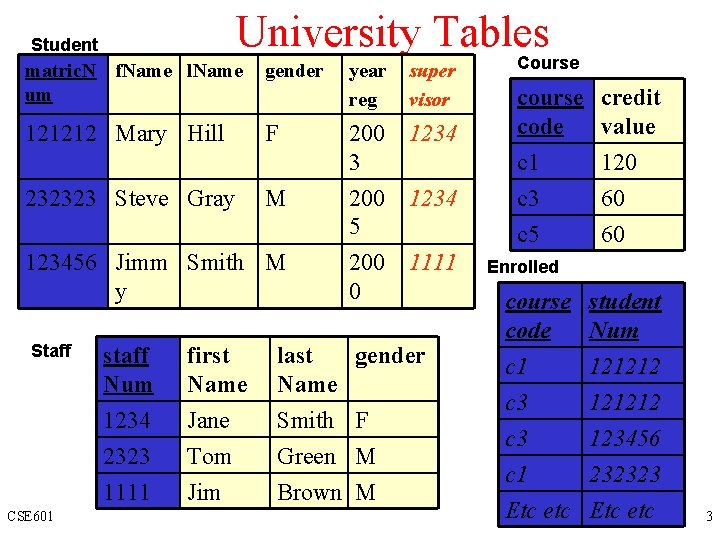
University Tables Student matric. N f. Name l. Name um gender 121212 Mary Hill F Course year reg super visor 200 3 1234 M 200 5 1234 c 1 c 3 c 5 123456 Jimm Smith M y 200 0 1111 Enrolled 232323 Steve Gray Staff CSE 601 staff Num first Name last gender Name 1234 2323 1111 Jane Tom Jim Smith F Green M Brown M course credit code value 120 60 60 course student code Num c 1 c 3 c 1 Etc etc 121212 123456 232323 Etc etc 3
Relation Database Theory, cont’d · The process of normalization generally breaks a table into many independent tables. · A normalized database yields a flexible model, making it easy to maintain dynamic relationships between business entities. · A relational database system is effective and efficient for operational databases – a lot of updates (aiming at optimizing update performance). CSE 601 4
Problems · A fully normalized data model can perform very inefficiently for queries. · Historical data are usually large with static relationships: - Unnecessary joins may take unacceptably long time · Historical data are diverse CSE 601 5
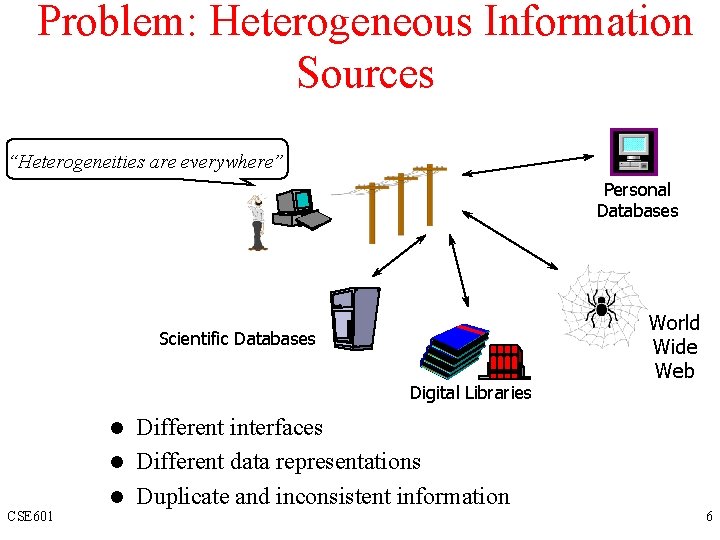
Problem: Heterogeneous Information Sources “Heterogeneities are everywhere” Personal Databases Scientific Databases Digital Libraries Different interfaces l Different data representations l Duplicate and inconsistent information World Wide Web l CSE 601 6
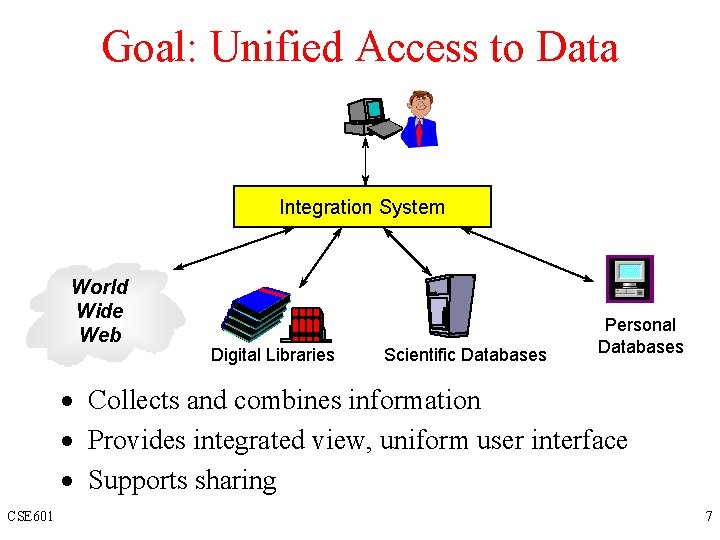
Goal: Unified Access to Data Integration System World Wide Web Digital Libraries Scientific Databases Personal Databases · Collects and combines information · Provides integrated view, uniform user interface · Supports sharing CSE 601 7
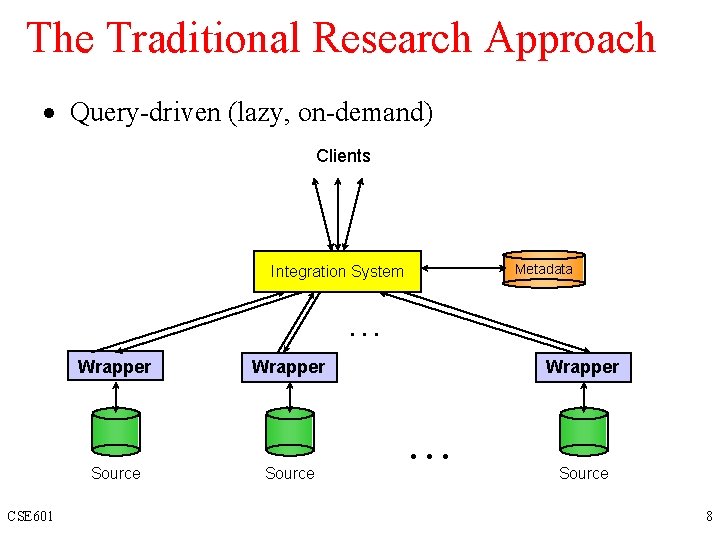
The Traditional Research Approach · Query-driven (lazy, on-demand) Clients Metadata Integration System . . . Wrapper Source CSE 601 Wrapper Source Wrapper . . . Source 8
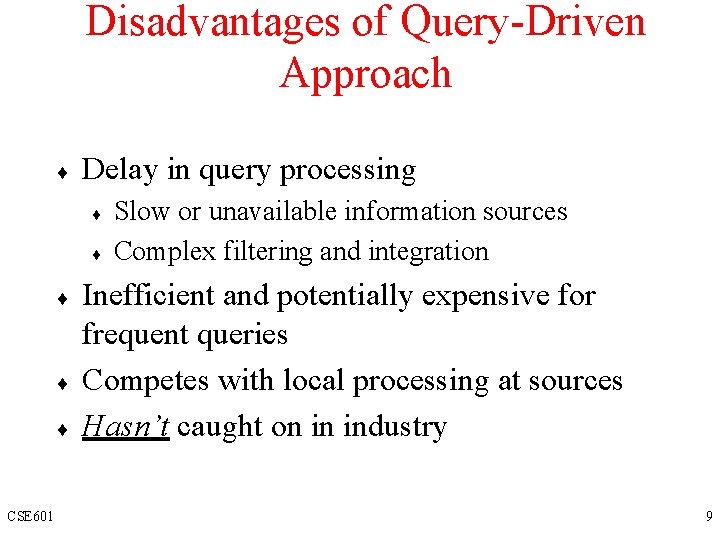
Disadvantages of Query-Driven Approach ¨ Delay in query processing ¨ ¨ ¨ CSE 601 Slow or unavailable information sources Complex filtering and integration Inefficient and potentially expensive for frequent queries Competes with local processing at sources Hasn’t caught on in industry 9
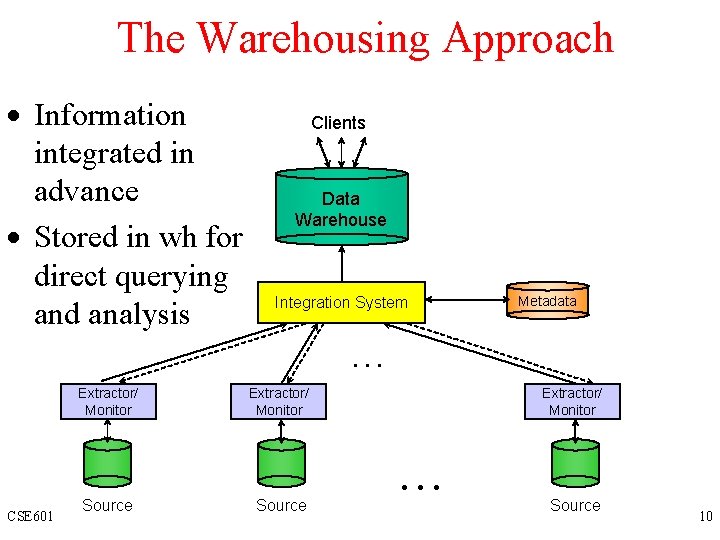
The Warehousing Approach · Information integrated in advance · Stored in wh for direct querying and analysis Clients Data Warehouse Integration System Metadata . . . Extractor/ Monitor CSE 601 Source Extractor/ Monitor . . . Source 10
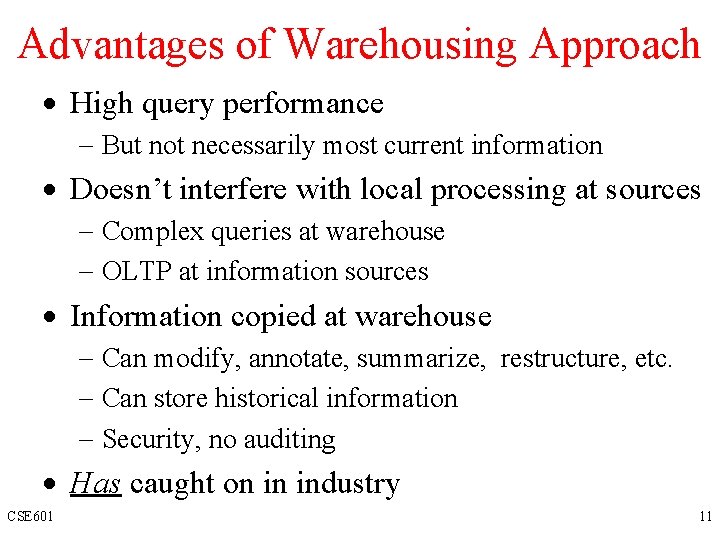
Advantages of Warehousing Approach · High query performance - But not necessarily most current information · Doesn’t interfere with local processing at sources - Complex queries at warehouse - OLTP at information sources · Information copied at warehouse - Can modify, annotate, summarize, restructure, etc. - Can store historical information - Security, no auditing · Has caught on in industry CSE 601 11
Not Either-Or Decision · Query-driven approach still better for - Rapidly changing information sources - Truly vast amounts of data from large numbers of sources - Clients with unpredictable needs CSE 601 12
What is a Data Warehouse? A Practitioners Viewpoint “A data warehouse is simply a single, complete, and consistent store of data obtained from a variety of sources and made available to end users in a way they can understand use it in a business context. ” -- Barry Devlin, IBM Consultant CSE 601 13
What is a Data Warehouse? An Alternative Viewpoint “A DW is a - subject-oriented, - integrated, - time-varying, - non-volatile collection of data that is used primarily in organizational decision making. ” -- W. H. Inmon, Building the Data Warehouse, 1992 CSE 601 14
A Data Warehouse is. . . · Stored collection of diverse data - A solution to data integration problem - Single repository of information · Subject-oriented - Organized by subject, not by application - Used for analysis, data mining, etc. · Optimized differently from transactionoriented db · User interface aimed at executive CSE 601 15
… Cont’d · Large volume of data (Gb, Tb) · Non-volatile - Historical - Time attributes are important · Updates infrequent · May be append-only · Examples - All transactions ever at Sainsbury’s - Complete client histories at insurance firm - LSE financial information and portfolios CSE 601 16
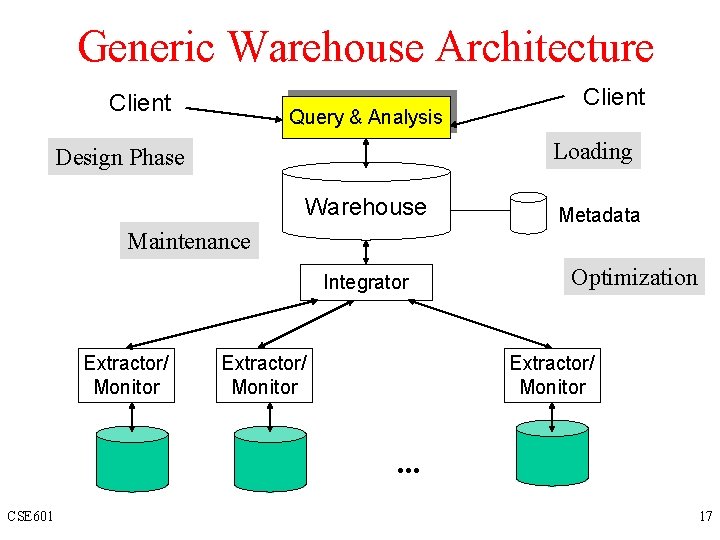
Generic Warehouse Architecture Client Query & Analysis Client Loading Design Phase Warehouse Metadata Maintenance Integrator Extractor/ Monitor Optimization Extractor/ Monitor . . . CSE 601 17
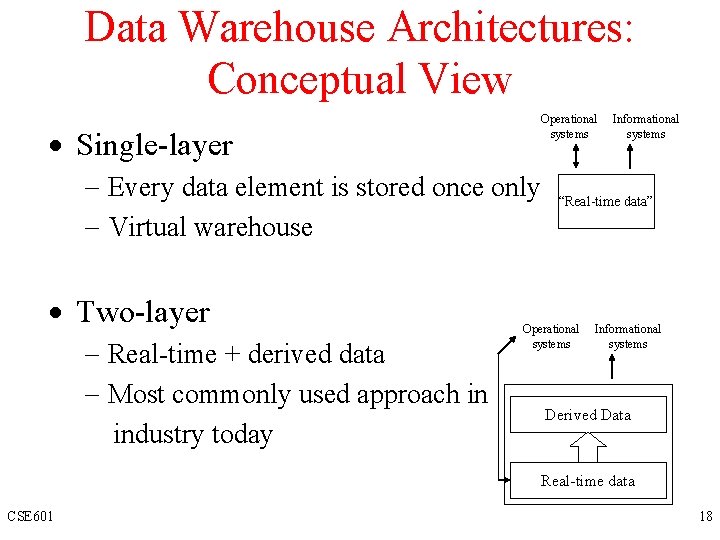
Data Warehouse Architectures: Conceptual View Operational systems · Single-layer - Every data element is stored once only - Virtual warehouse · Two-layer - Real-time + derived data - Most commonly used approach in industry today Informational systems “Real-time data” Operational systems Informational systems Derived Data Real-time data CSE 601 18
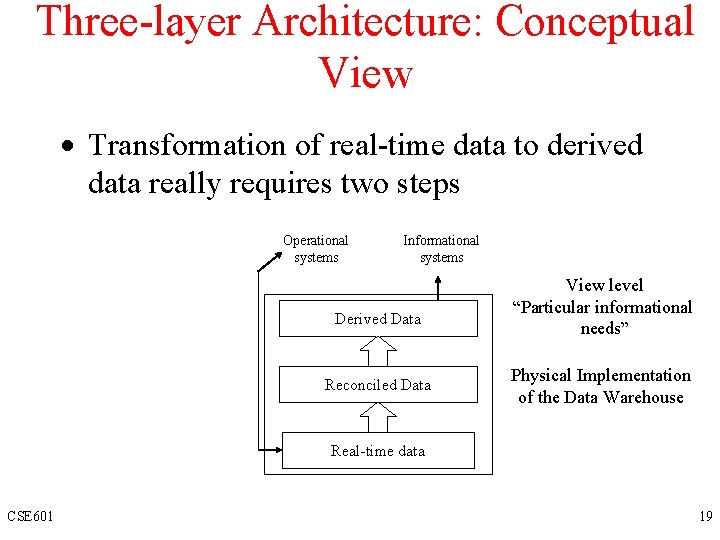
Three-layer Architecture: Conceptual View · Transformation of real-time data to derived data really requires two steps Operational systems Informational systems Derived Data Reconciled Data View level “Particular informational needs” Physical Implementation of the Data Warehouse Real-time data CSE 601 19
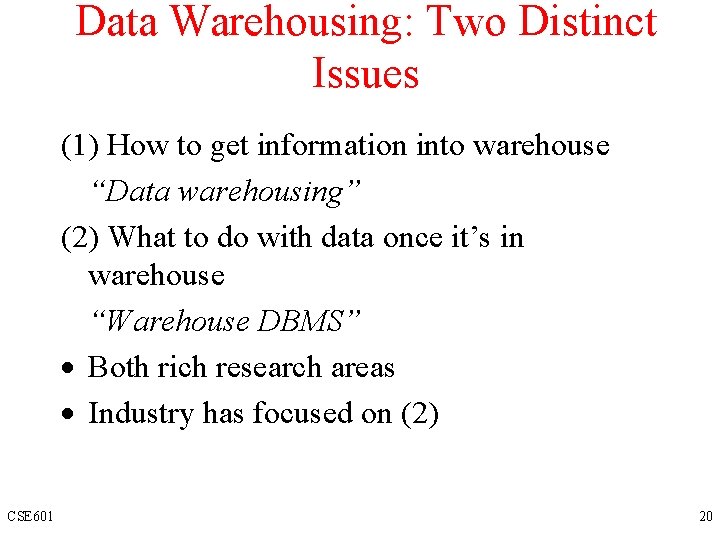
Data Warehousing: Two Distinct Issues (1) How to get information into warehouse “Data warehousing” (2) What to do with data once it’s in warehouse “Warehouse DBMS” · Both rich research areas · Industry has focused on (2) CSE 601 20
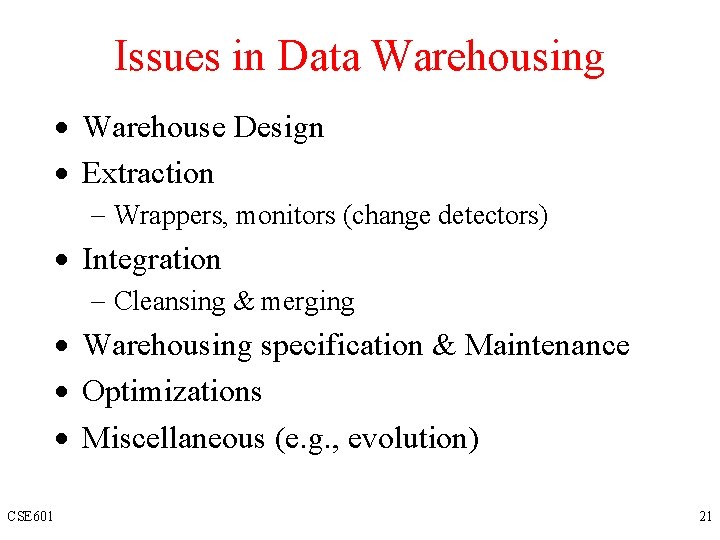
Issues in Data Warehousing · Warehouse Design · Extraction - Wrappers, monitors (change detectors) · Integration - Cleansing & merging · Warehousing specification & Maintenance · Optimizations · Miscellaneous (e. g. , evolution) CSE 601 21
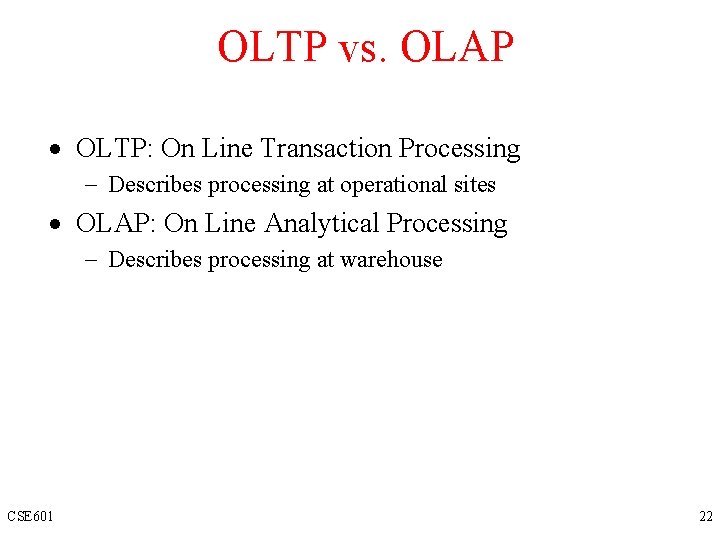
OLTP vs. OLAP · OLTP: On Line Transaction Processing - Describes processing at operational sites · OLAP: On Line Analytical Processing - Describes processing at warehouse CSE 601 22
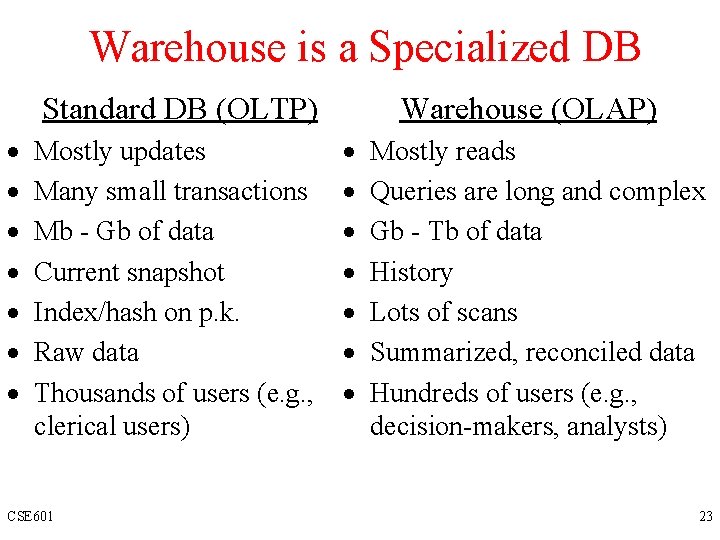
Warehouse is a Specialized DB Standard DB (OLTP) · · · · Mostly updates Many small transactions Mb - Gb of data Current snapshot Index/hash on p. k. Raw data Thousands of users (e. g. , clerical users) CSE 601 Warehouse (OLAP) · · · · Mostly reads Queries are long and complex Gb - Tb of data History Lots of scans Summarized, reconciled data Hundreds of users (e. g. , decision-makers, analysts) 23
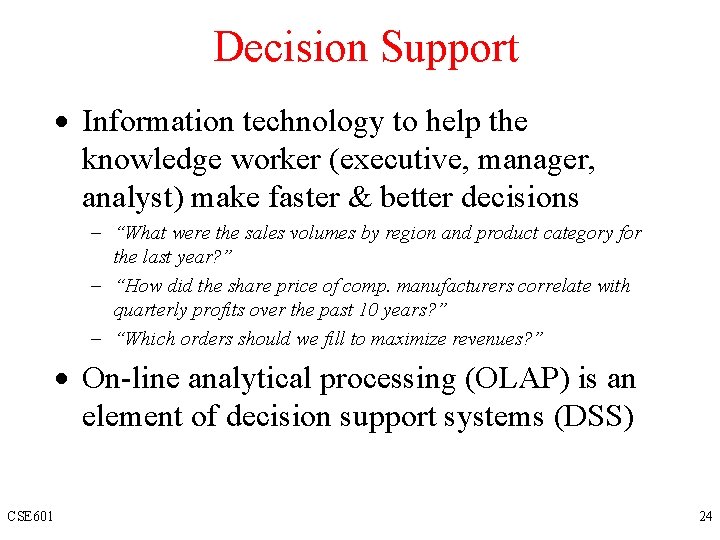
Decision Support · Information technology to help the knowledge worker (executive, manager, analyst) make faster & better decisions - “What were the sales volumes by region and product category for the last year? ” - “How did the share price of comp. manufacturers correlate with quarterly profits over the past 10 years? ” - “Which orders should we fill to maximize revenues? ” · On-line analytical processing (OLAP) is an element of decision support systems (DSS) CSE 601 24
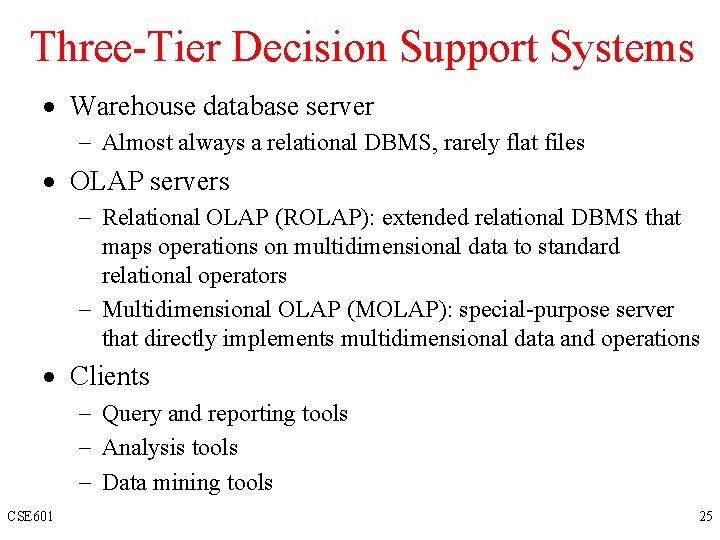
Three-Tier Decision Support Systems · Warehouse database server - Almost always a relational DBMS, rarely flat files · OLAP servers - Relational OLAP (ROLAP): extended relational DBMS that maps operations on multidimensional data to standard relational operators - Multidimensional OLAP (MOLAP): special-purpose server that directly implements multidimensional data and operations · Clients - Query and reporting tools - Analysis tools - Data mining tools CSE 601 25
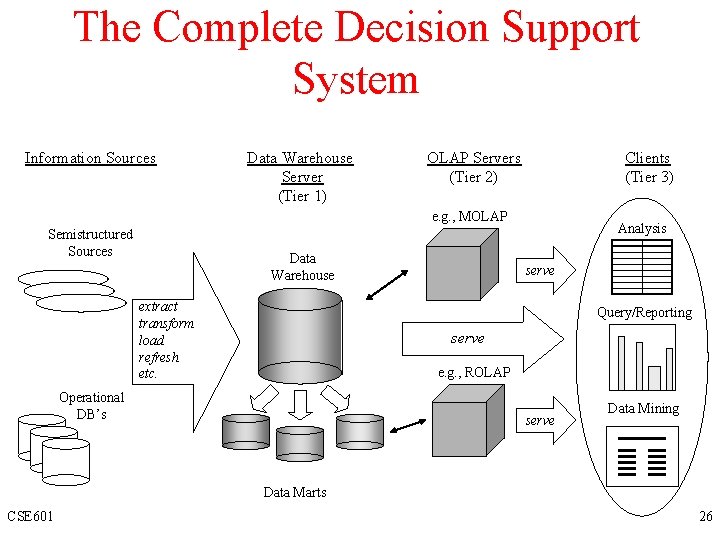
The Complete Decision Support System Information Sources Data Warehouse Server (Tier 1) OLAP Servers (Tier 2) Clients (Tier 3) e. g. , MOLAP Semistructured Sources Data Warehouse extract transform load refresh etc. Analysis serve Query/Reporting serve e. g. , ROLAP Operational DB’s serve Data Mining Data Marts CSE 601 26
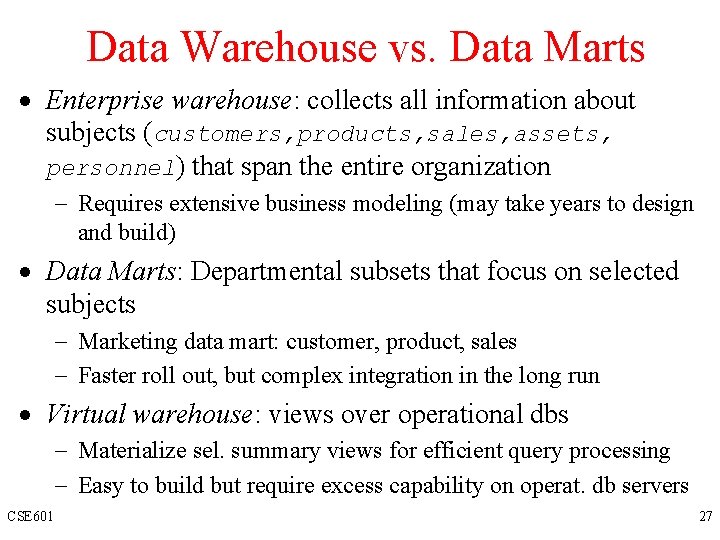
Data Warehouse vs. Data Marts · Enterprise warehouse: collects all information about subjects (customers, products, sales, assets, personnel) that span the entire organization - Requires extensive business modeling (may take years to design and build) · Data Marts: Departmental subsets that focus on selected subjects - Marketing data mart: customer, product, sales - Faster roll out, but complex integration in the long run · Virtual warehouse: views over operational dbs - Materialize sel. summary views for efficient query processing - Easy to build but require excess capability on operat. db servers CSE 601 27
OLAP for Decision Support · OLAP = Online Analytical Processing · Support (almost) ad-hoc querying for business analyst · Think in terms of spreadsheets - View sales data by geography, time, or product · Extend spreadsheet analysis model to work with warehouse data - Large data sets - Semantically enriched to understand business terms - Combine interactive queries with reporting functions · Multidimensional view of data is the foundation of OLAP CSE 601 - Data model, operations, etc. 28
Approaches to OLAP Servers · Relational DBMS as Warehouse Servers · Two possibilities for OLAP servers · (1) Relational OLAP (ROLAP) - Relational and specialized relational DBMS to store and manage warehouse data - OLAP middleware to support missing pieces · (2) Multidimensional OLAP (MOLAP) - Array-based storage structures - Direct access to array data structures CSE 601 29
OLAP Server: Query Engine Requirements · Aggregates (maintenance and querying) - Decide what to precompute and when · Query language to support multidimensional operations - Standard SQL falls short · Scalable query processing - Data intensive and data selective queries CSE 601 30