
IT 601 Mobile Computing TCP over wireless TCP
IT 601: Mobile Computing TCP over wireless TCP and mobility Slides from Prof. Sridhar Iyer’s lecture IIT Bombay Session: 15 Prof. Sridhar Iyer 1
Effect of Mobility on Protocol Stack • Application: new applications and adaptations • Transport: congestion and flow control • Network: addressing and routing • Link: media access and handoff • Physical: transmission errors and interference Session: 15 Prof. Sridhar Iyer 2
TCP basics • Reliable, ordered delivery – uses sequence numbers, acknowledgements, timeouts and retransmissions – End-to-end semantics (ACK after data recd) • Provides flow and congestion control – uses sliding window based buffers and feedback from receiver/network to adjust Session: 15 Prof. Sridhar Iyer transmission rate 3
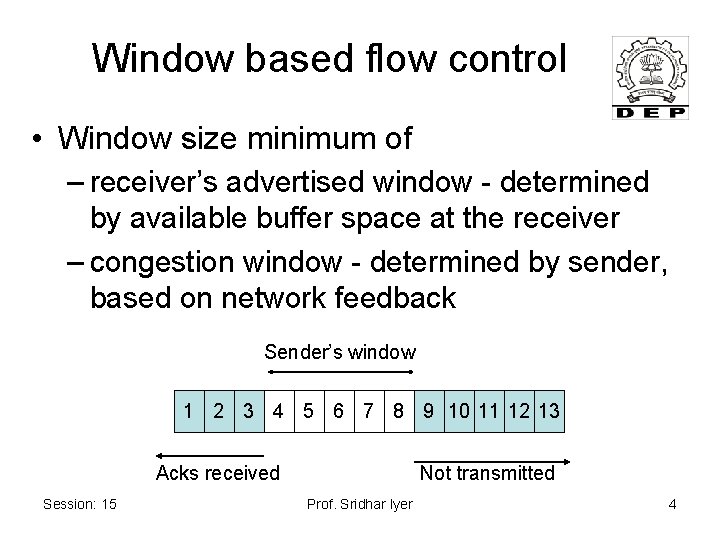
Window based flow control • Window size minimum of – receiver’s advertised window - determined by available buffer space at the receiver – congestion window - determined by sender, based on network feedback Sender’s window 1 2 3 4 5 6 7 8 9 10 11 12 13 Acks received Session: 15 Not transmitted Prof. Sridhar Iyer 4
Timeouts and retransmission • TCP manages four different timers for each connection – retransmission timer: when awaiting ACK – persist timer: keeps window size information flowing – keepalive timer: when other end crashes or reboots – 2 MSL timer: for the TIME_WAIT state Session: 15 Prof. Sridhar Iyer 5
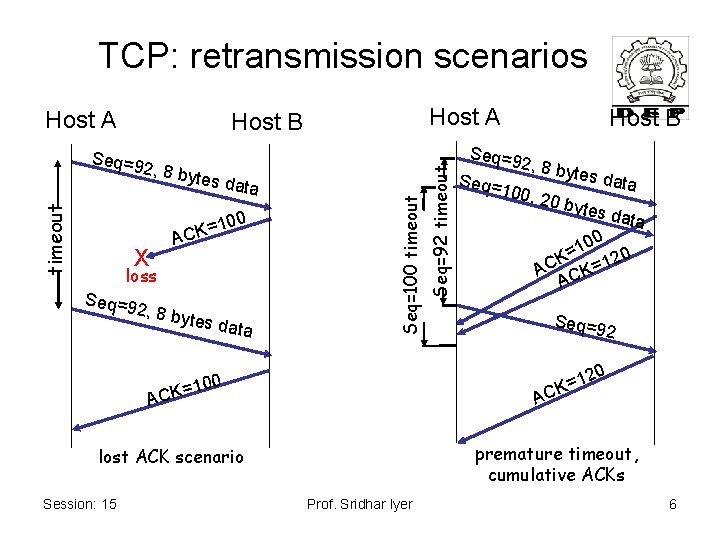
TCP: retransmission scenarios Host A Host B Seq=9 es dat a X 100 = K AC loss Seq=9 2, 8 by t es dat a Seq=100 timeout 2, 8 by t Host B Seq=9 Seq= 2, 8 by 100, 2 tes da 0 byte ta s data 00 1 K= =120 C A CK A Seq=9 2 0 =12 K AC 0 K=10 AC premature timeout, cumulative ACKs lost ACK scenario Session: 15 Seq=92 timeout Host A Prof. Sridhar Iyer 6
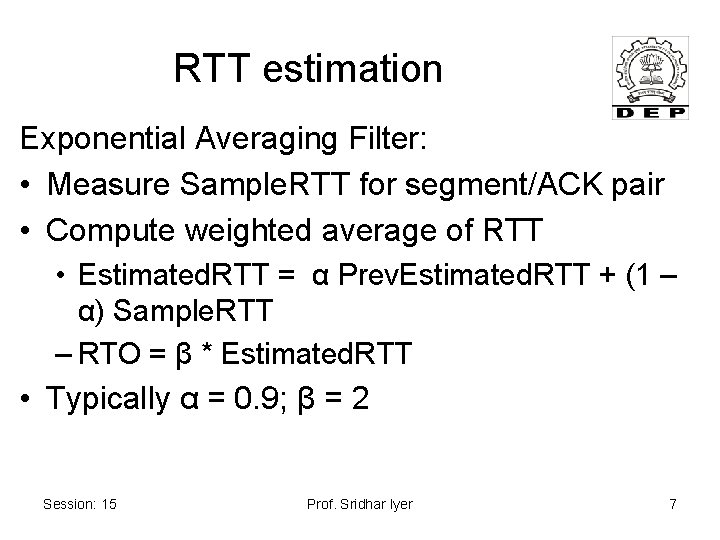
RTT estimation Exponential Averaging Filter: • Measure Sample. RTT for segment/ACK pair • Compute weighted average of RTT • Estimated. RTT = α Prev. Estimated. RTT + (1 – α) Sample. RTT – RTO = β * Estimated. RTT • Typically α = 0. 9; β = 2 Session: 15 Prof. Sridhar Iyer 7
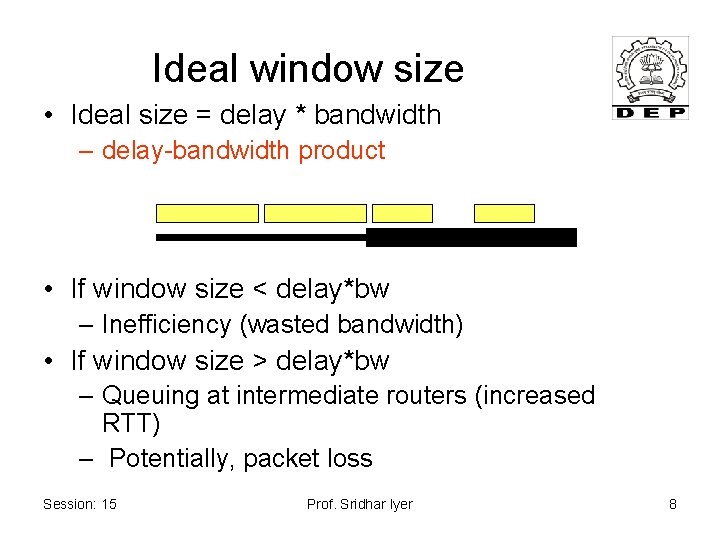
Ideal window size • Ideal size = delay * bandwidth – delay-bandwidth product • If window size < delay*bw – Inefficiency (wasted bandwidth) • If window size > delay*bw – Queuing at intermediate routers (increased RTT) – Potentially, packet loss Session: 15 Prof. Sridhar Iyer 8
Congestion control • On detecting a packet loss, TCP sender assumes that network congestion has occurred • On detecting packet loss, TCP sender drastically reduces the congestion window • Reducing congestion window reduces amount of data that can be sent per RTT Session: 15 Prof. Sridhar Iyer 9
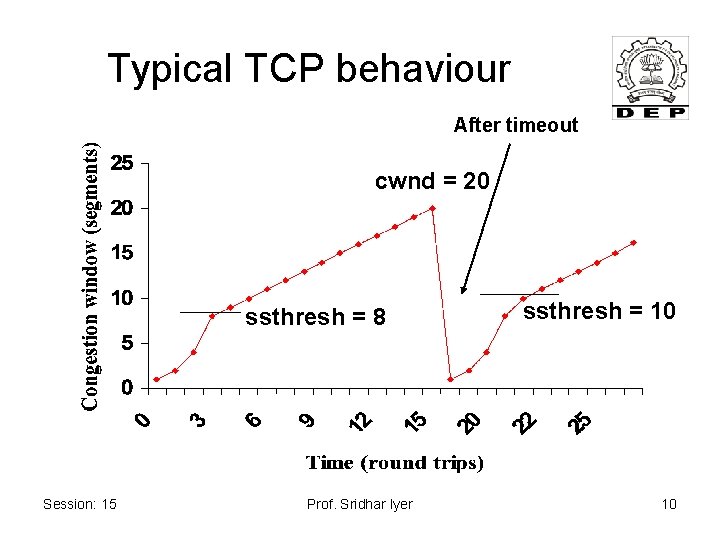
Typical TCP behaviour After timeout cwnd = 20 ssthresh = 8 Session: 15 Prof. Sridhar Iyer ssthresh = 10 10
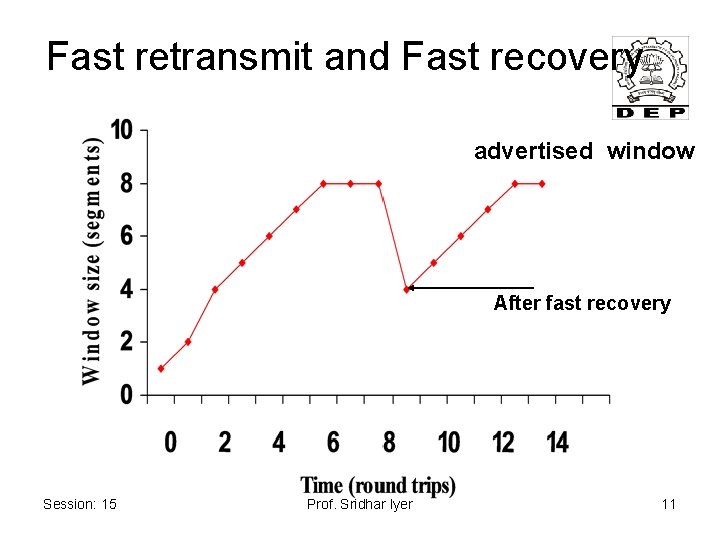
Fast retransmit and Fast recovery advertised window After fast recovery Session: 15 Prof. Sridhar Iyer 11
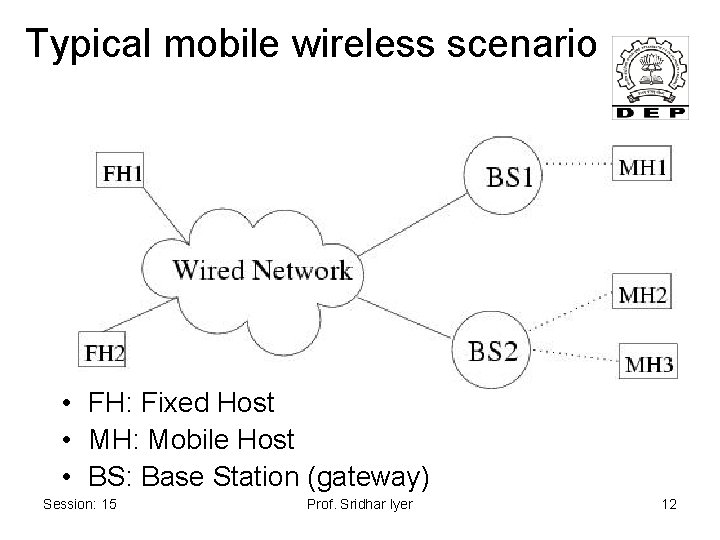
Typical mobile wireless scenario • FH: Fixed Host • MH: Mobile Host • BS: Base Station (gateway) Session: 15 Prof. Sridhar Iyer 12
Burst errors may cause Timeouts • If wireless link remains unavailable for extended duration, a window worth of data may be lost – driving through a tunnel; passing a truck • Timeout results in slow start – Slow start reduces congestion window to 1 MSS, reducing throughput • Reduction in window in response to errors unnecessary Session: 15 Prof. Sridhar Iyer 13
Random errors may cause Fast Retransmit or Timeout • If a packet is lost due to transient link conditions – Channel noise leading to CRC error • Fast retransmit results in fast recovery – Fast recovery reduces congestion window to 1/2 • If multiple packets losses happen in a window, – Results in timeout Session: 15 Prof. Sridhar Iyer 14 • Reduction in window in response to errors
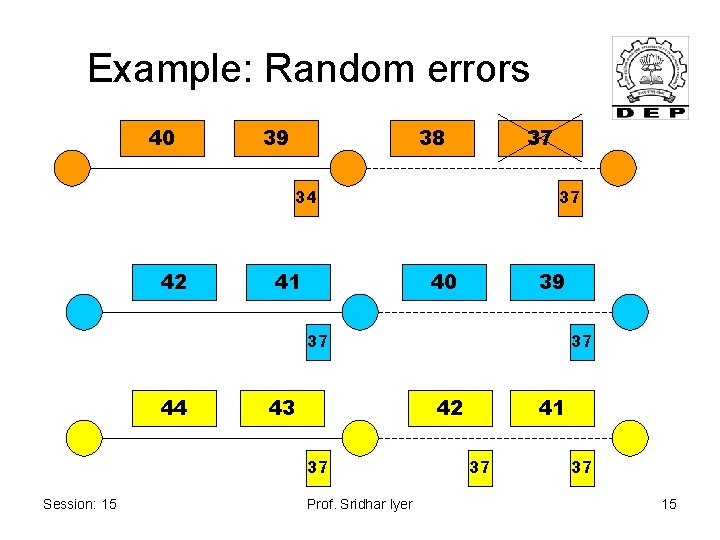
Example: Random errors 40 39 38 37 34 42 41 37 40 39 37 44 43 42 37 Session: 15 37 Prof. Sridhar Iyer 41 37 37 15
TCP and wireless/mobility TCP assumes congestion if packets dropped • typically wrong in wireless networks – often packet loss due to transmission errors • mobility itself can cause packet loss – nodes roam from one access point or foreign agent to another with packets in transit Session: 15 Prof. Sridhar Iyer 16
Motivation for TCP adaptation Performance of an unchanged TCP degrades severely for wireless/mobile environments • TCP cannot be changed fundamentally – Widely deployed in the fixed network – Internet interoperability requirement • TCP for wireless/mobility has to be compatible with “standard” TCP Session: 15 Prof. Sridhar Iyer 17
Adaptation for TCP over wireless Several proposals to adapt TCP to wireless environments • Modifications to TCP implementation at – Fixed Host – Base Station – Mobile Host • Approaches – Hide error losses from the sender – Let sender know the cause of packet loss Session: 15 Prof. Sridhar Iyer 18
Ideal behavior • Ideal TCP behavior: TCP sender should simply retransmit a packet lost due to transmission errors, without taking any congestion control actions – Ideal TCP typically not realizable • Ideal network behavior: Transmission errors should be hidden from the sender – Errors should be recovered transparently and efficiently • Proposed schemes attempt to approximate one Session: 15 Prof. Sridhar Iyer of the above two ideals 19
Link Layer mechanisms • Forward Error Correction (FEC) – Can be use to correct small number of errors – Incurs overhead even when errors do not occur • Link Level Retransmissions – Retransmit a packet at the link layer, if errors are detected – Retransmission overhead incurred only if Session: 15 Prof. Sridhar Iyer 20 errors occur
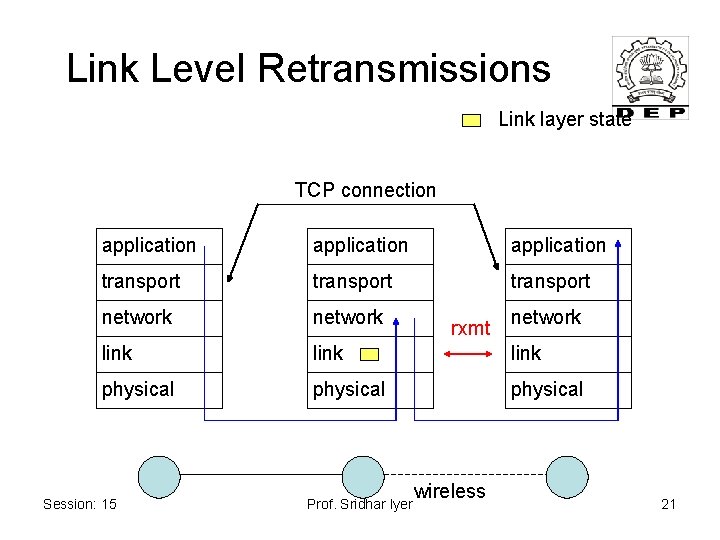
Link Level Retransmissions Link layer state TCP connection application transport network link physical Session: 15 Prof. Sridhar Iyer rxmt wireless network 21
Issues • How many times to retransmit at the link level before giving up? • What triggers link level retransmissions? • How much time is required for a link layer retransmission? • Should the link layer deliver packets as they arrive, or deliver them in-order? Session: 15 Prof. Sridhar Iyer 22
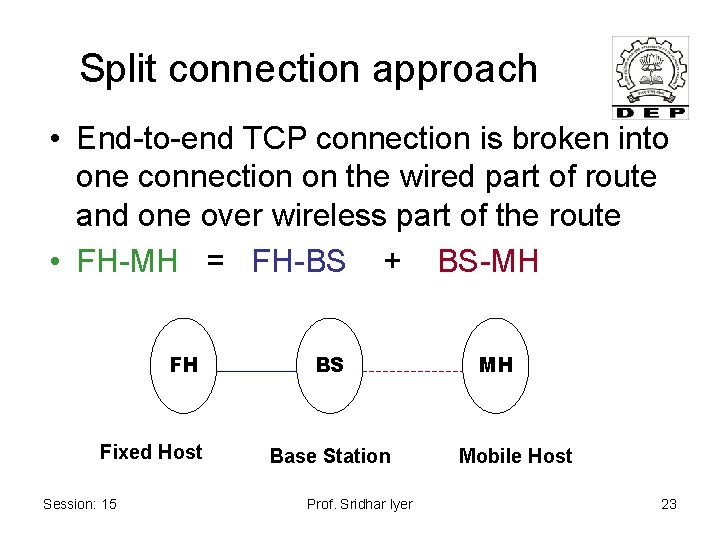
Split connection approach • End-to-end TCP connection is broken into one connection on the wired part of route and one over wireless part of the route • FH-MH = FH-BS + BS-MH FH Fixed Host Session: 15 BS Base Station Prof. Sridhar Iyer MH Mobile Host 23
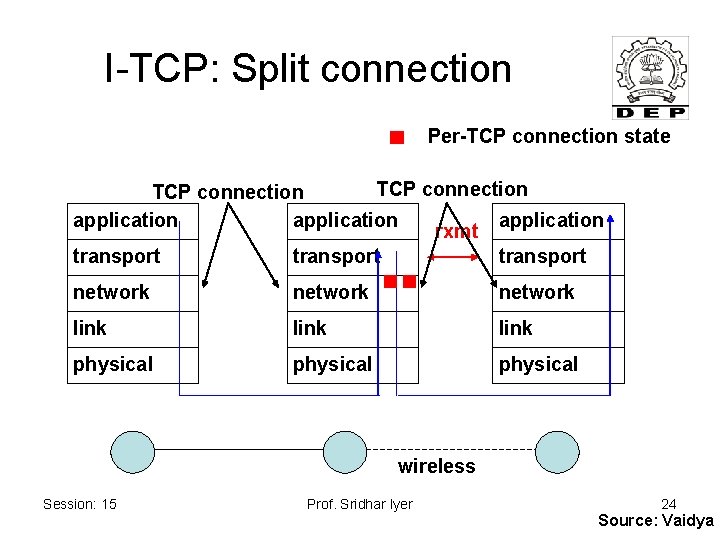
I-TCP: Split connection Per-TCP connection state TCP connection application rxmt transport network link physical wireless Session: 15 Prof. Sridhar Iyer 24 Source: Vaidya
I-TCP advantages • No changes to TCP for FH • BS-MH connection can be optimized independent of FH-BS connection – Different flow / error control on the two connections – Faster recovery due to relatively shorter RTT on wireless link Session: 15 Prof. Sridhar Iyer 25
I-TCP disadvantages • End-to-end semantics violated – ack may be delivered to sender, before data delivered to the receiver • BS retains hard state – Buffer space required at BS on a per-TCPconnection basis – BS failure can result in permanent loss of data (unreliability) – Hand-off latency increases Session: 15 Prof. Sridhar Iyer 26
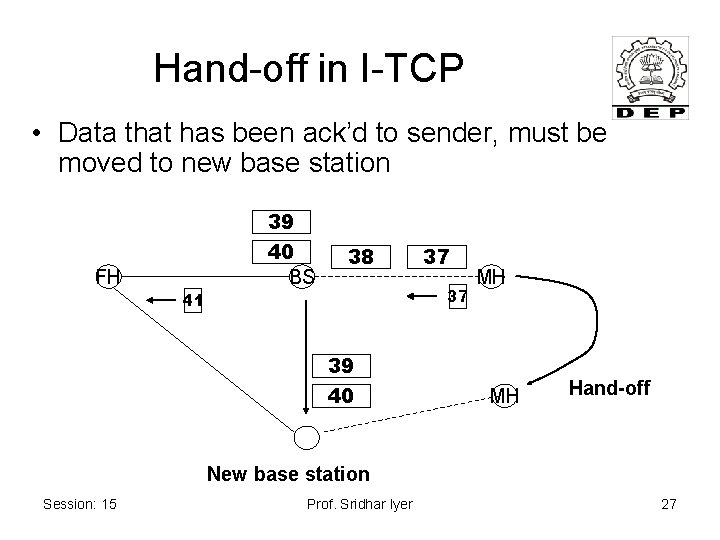
Hand-off in I-TCP • Data that has been ack’d to sender, must be moved to new base station FH 41 39 40 BS 38 37 37 MH 39 40 MH Hand-off New base station Session: 15 Prof. Sridhar Iyer 27
Snoop Protocol • Retains local recovery of Split Connection approach and uses link level retransmission • Improves on split connection – end-to-end semantics retained – soft state at base station, instead of hard state Session: 15 Prof. Sridhar Iyer 28
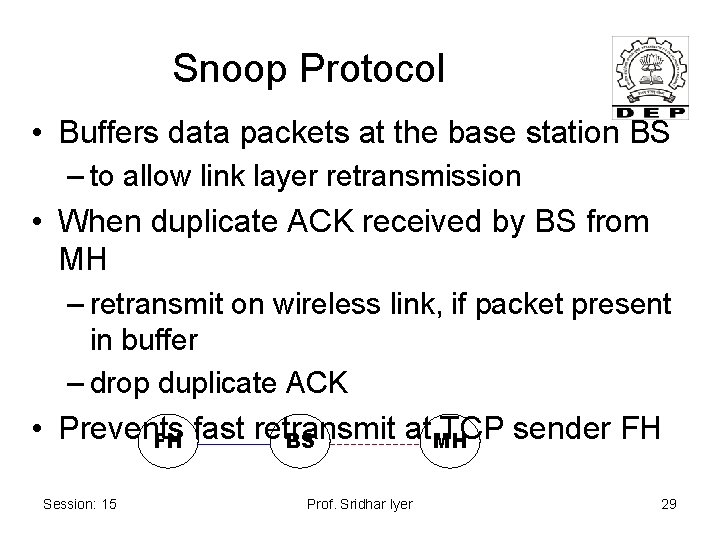
Snoop Protocol • Buffers data packets at the base station BS – to allow link layer retransmission • When duplicate ACK received by BS from MH – retransmit on wireless link, if packet present in buffer – drop duplicate ACK • Prevents at. MH TCP sender FH FH fast retransmit BS Session: 15 Prof. Sridhar Iyer 29
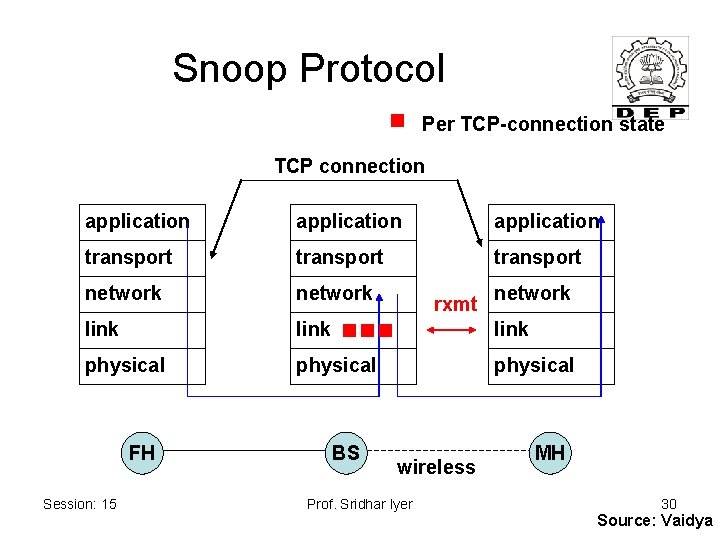
Snoop Protocol Per TCP-connection state TCP connection application transport network link physical FH Session: 15 BS rxmt wireless Prof. Sridhar Iyer network MH 30 Source: Vaidya
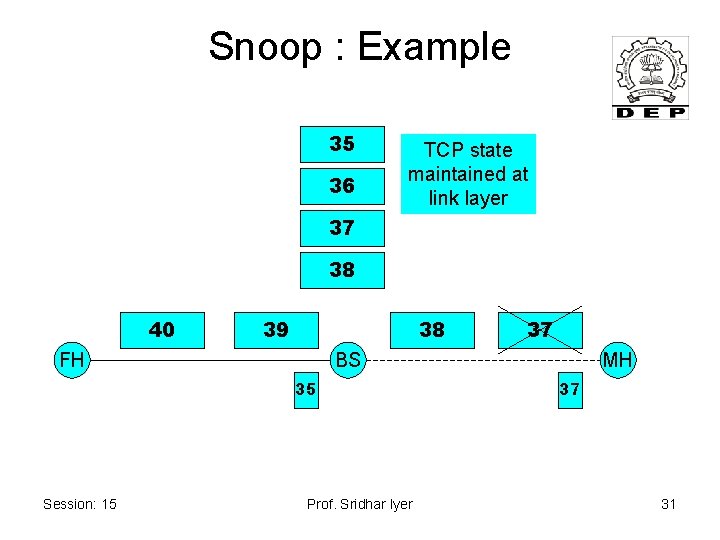
Snoop : Example 35 36 TCP state maintained at link layer 37 38 40 39 38 FH BS 35 Session: 15 37 Prof. Sridhar Iyer MH 37 31
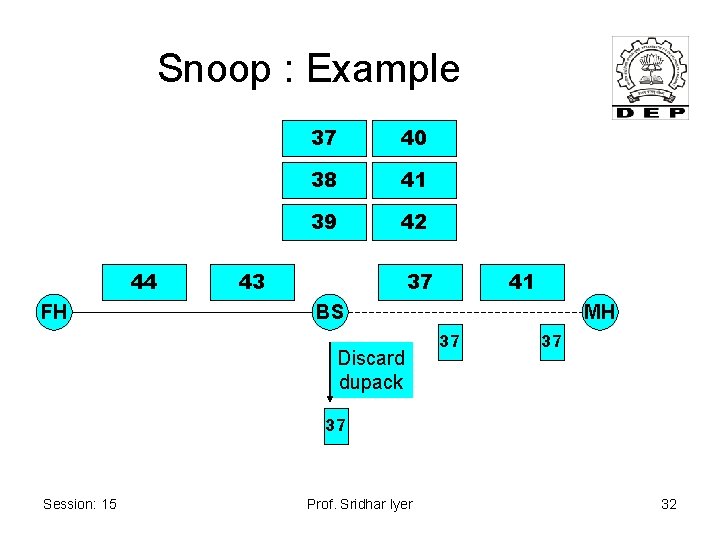
Snoop : Example 44 FH 37 40 38 41 39 42 43 37 41 BS Discard dupack MH 37 37 37 Session: 15 Prof. Sridhar Iyer 32
Snoop advantages • Local recovery from wireless losses • Fast retransmit not triggered at sender despite out-of-order link layer delivery • High throughput can be achieved • End-to-end semantics retained • Soft state at base station – loss of the soft state affects performance, but not correctness Session: 15 Prof. Sridhar Iyer 33
Snoop disadvantages • Link layer at base station needs to be TCPaware • Not useful if TCP headers are encrypted (IPsec) Session: 15 Prof. Sridhar Iyer 34
Delayed Dupacks • Attempts to imitate Snoop, without making the base station TCP-aware • Delayed Dupacks implements the same two features – at BS : link layer retransmission – at MH : reducing interference between TCP and link layer retransmissions (by delaying dupacks) Session: 15 Prof. Sridhar Iyer 35
Delayed Dupacks • TCP receiver delays dupacks for interval D, when out-of-order packets received – Dupack delay intended to give link level retransmit time to succeed • Benefit: can result in recovery from a transmission loss without triggering a response from the TCP sender Session: 15 Prof. Sridhar Iyer 36
Delayed dupacks advantages • Link layer need not be TCP-aware • Can be used even if TCP headers are encrypted • Works well for relatively small wireless RTT (compared to end-to-end RTT) – relatively small delay D sufficient in such cases Session: 15 Prof. Sridhar Iyer 37
Delayed dupacks disadvantages • Right value of dupack delay D dependent on the wireless link properties • Mechanisms to automatically choose D needed • Delays dupacks for congestion losses too, delaying congestion loss recovery Session: 15 Prof. Sridhar Iyer 38
Mobility and handoff • Hand-offs may result in temporary loss of route to MH – with non-overlapping cells, it may be a while before the mobile host receives a beacon from the new BS • While routes are being reestablished during handoff, MH and old BS may attempt to send packets to each other, resulting in loss Session: 15 Prof. Sridhar Iyer 39 of packets
Impact of handoff • Split connection approach – hard state at base station must be moved to new base station • Snoop protocol – soft state need not be moved – while the new base station builds new state, packet losses may not be recovered locally Session: 15 Prof. Sridhar Iyer 40
Handoff issues • During the long delay for a handoff to complete – a whole window worth of data may be lost • After handoff is complete – acks are not received by the TCP sender • Sender eventually times out, and retransmits – If handoff still not complete, another timeout will occur • Performance penalty – Time wasted until timeout occurs – Window shrunk after timeout Session: 15 Prof. Sridhar Iyer 41
Using Fast Retransmit • When MH is the TCP receiver: – after handoff is complete, it sends 3 dupacks to the sender – this triggers fast retransmit at the sender • When MH is the TCP sender: – invoke fast retransmit after completion of handoff Session: 15 Prof. Sridhar Iyer 42
Mobile TCP (M-TCP) • Handling of lengthy or frequent disconnections • M-TCP splits as I-TCP does – unmodified TCP for FH to BS – optimized TCP for BS to MH • BS (Foreign Agent) – monitors all packets, if disconnection detected • set advertised window size to 0 • sender automatically goes into persistent mode – no caching, no retransmission at the BS • If a packet is lost on the wireless link, it has to be retransmitted by the original sender Session: 15 Prof. Sridhar Iyer 43
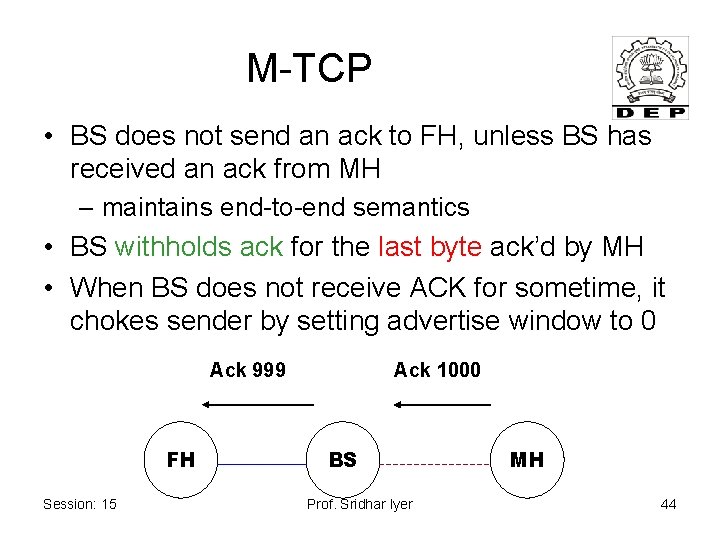
M-TCP • BS does not send an ack to FH, unless BS has received an ack from MH – maintains end-to-end semantics • BS withholds ack for the last byte ack’d by MH • When BS does not receive ACK for sometime, it chokes sender by setting advertise window to 0 Ack 999 FH Session: 15 Ack 1000 BS Prof. Sridhar Iyer MH 44
M-TCP • When a new ack is received with receiver’s advertised window = 0, the sender enters persist mode • Sender does not send any data in persist mode – except when persist timer goes off • When a positive window advertisement is received, sender exits persist mode • On exiting persist mode, RTO and cwnd are same as before the persist mode Session: 15 Prof. Sridhar Iyer 45
M-TCP • Avoids reduction of congestion window due to handoff, unlike the fast retransmit scheme • Is not reducing the window a good idea? – When host moves, route changes, and new route may be more congested – It is not obvious that starting full window after handoff is right Session: 15 Prof. Sridhar Iyer 46
Freeze. TCP • M-TCP needs help from base station (BS) – BS withholds ack for one byte – BS uses this ack to send a zero window advertisement when MH moves to another cell • Freeze. TCP – Receiver sends zero window advertisement (ZWA), upon impending disconnection – Receiver sends full window advertisement Session: (FWA), 15 Prof. Sridhar Iyer 47 upon reconnection
Freeze. TCP • TCP receiver determines if a handoff is about to happen – determination may be based on signal strength • Receiver should attempt to send ZWA 1 RTT before handoff • Receiver sends 3 dupacks when route is reestablished • No help needed from the base station Session: 15 Prof. Sridhar Iyer 48
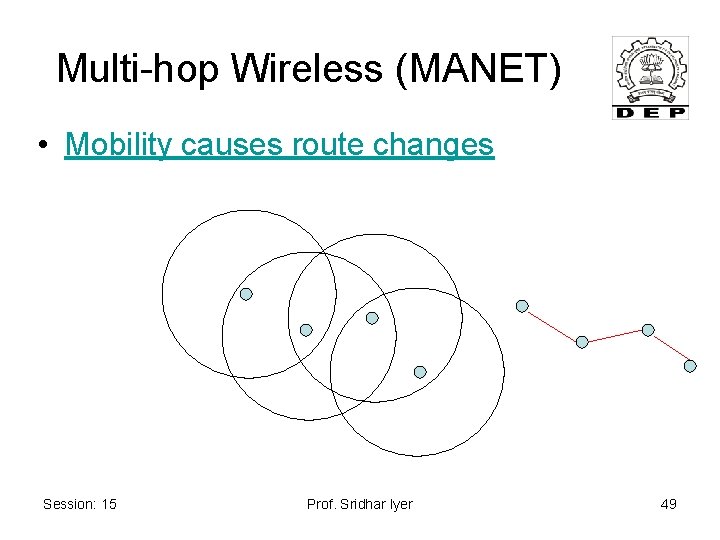
Multi-hop Wireless (MANET) • Mobility causes route changes Session: 15 Prof. Sridhar Iyer 49
TCP Issues • Route changes due to mobility • Wireless transmission errors – problem compounded with multiple hops • Out-of-order packet delivery – frequent route changes may cause outof-order delivery • Multiple access protocol – choice of MAC protocol can impact TCP performance significantly Session: 15 Prof. Sridhar Iyer 50
TCP over multi hop wireless • When contention-based MAC protocol is used, connections over multiple hops are at a disadvantage compared to shorter connections – because they have to contend for wireless access at each hop – extent of packet delay or drop increases with number of hops Session: 15 Prof. Sridhar Iyer 51
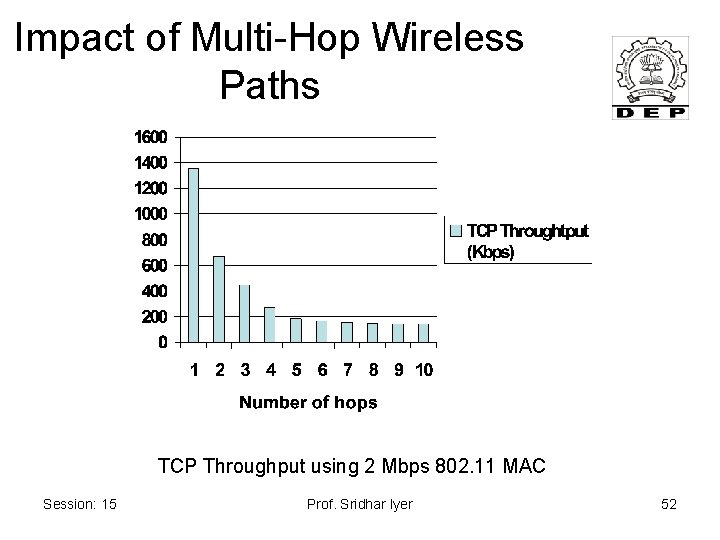
Impact of Multi-Hop Wireless Paths TCP Throughput using 2 Mbps 802. 11 MAC Session: 15 Prof. Sridhar Iyer 52
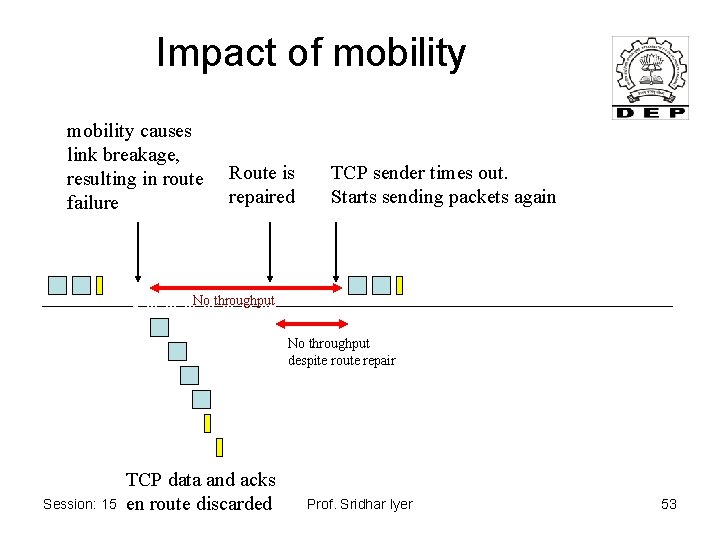
Impact of mobility causes link breakage, resulting in route failure Route is repaired TCP sender times out. Starts sending packets again No throughput despite route repair Session: 15 TCP data and acks en route discarded Prof. Sridhar Iyer 53
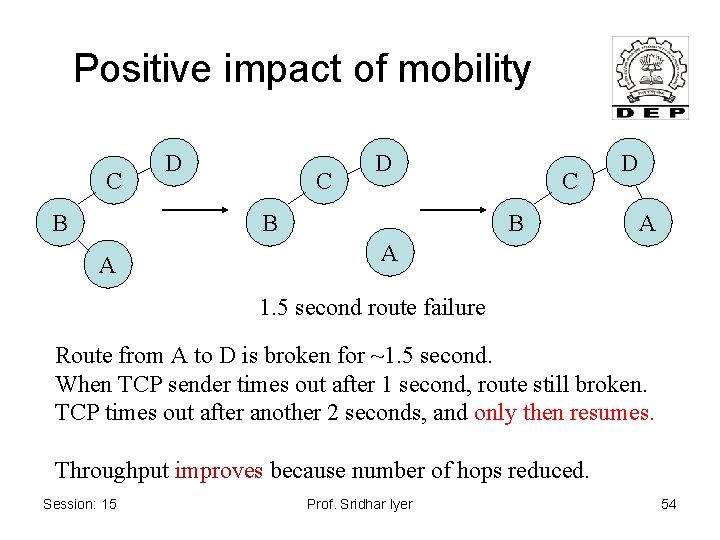
Positive impact of mobility C B D C D B A C B D A A 1. 5 second route failure Route from A to D is broken for ~1. 5 second. When TCP sender times out after 1 second, route still broken. TCP times out after another 2 seconds, and only then resumes. Throughput improves because number of hops reduced. Session: 15 Prof. Sridhar Iyer 54
Improving throughput • Network feedback • Inform TCP of route failure by explicit message • Let TCP know when route is repaired – Probing – Explicit notification • Reduces repeated TCP timeouts and backoff Session: 15 Prof. Sridhar Iyer 55
Network Feedback • Network feedback beneficial • Need to modify transport & network layer to receive/send feedback • Need mechanisms for information exchange between layers Session: 15 Prof. Sridhar Iyer 56
References • • Bakre, A. , Badrinath, B. , “I-TCP: Indirect TCP for mobile hosts”- IEEE ICDCS 1995. Balakrishnan, H. , Srinivasan, S. , Amir, E. , and Katz, R. , “Improving TCP/IP Performance over Wireless Networks” – ACM Mobicom 1995. Brown, K. , Singh, S. , “M-TCP: TCP for mobile cellular networks” – ACM Computer Communication Review, 27 (5), 1997. Goff, T. Moronski, J. Phatak, D. S. Gupta, V. “Freeze-TCP: a true end-to-end TCP enhancement mechanism for mobile environments” – IEEE Infocom 2000. Session: 15 Prof. Sridhar Iyer 57
- Slides: 57