Curs 11 Ateptri i satisfacerea lor n parsarea
- Slides: 33
Curs 11: Aşteptări şi satisfacerea lor în parsarea discursului Dan Cristea Selecţie de sliduri
Expectations and Incremental Discourse Parsing Cristea and Webber, EACL-1998 Cristea et al, Venice-2003 Cristea et al, CICLING-2005
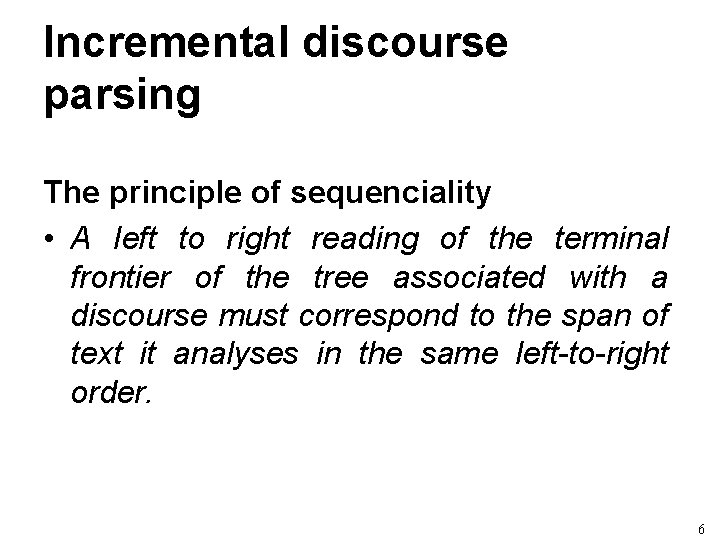
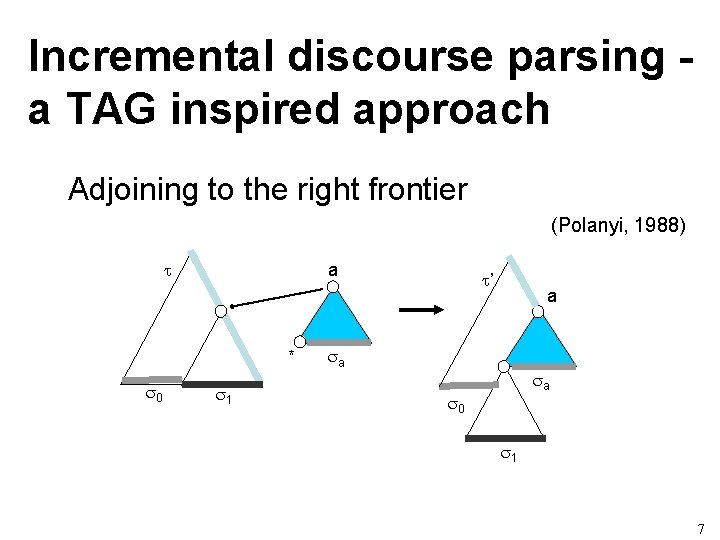
Incremental discourse parsing The principle of sequenciality • A left to right reading of the terminal frontier of the tree associated with a discourse must correspond to the span of text it analyses in the same left-to-right order. 6
Incremental discourse parsing a TAG inspired approach Adjoining to the right frontier (Polanyi, 1988) a * 0 ’ a a a a 1 1 0 1 7
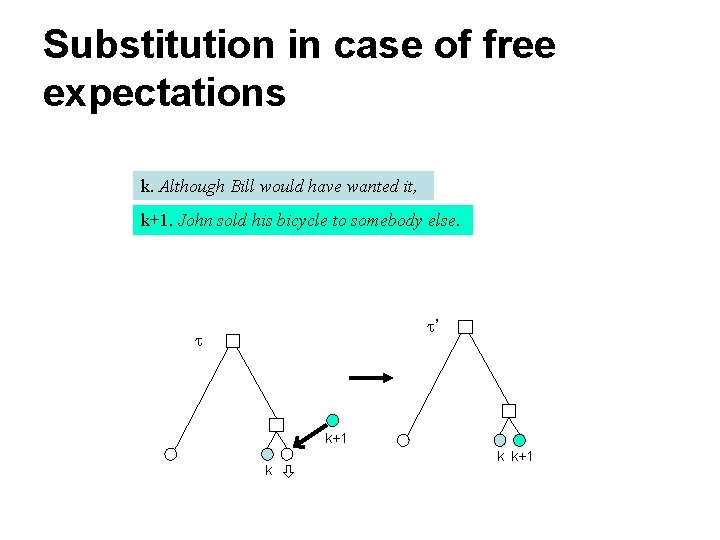
Substitution in case of free expectations k. Although Bill would have wanted it, k+1. John sold his bicycle to somebody else. ’ k+1 k k k+1
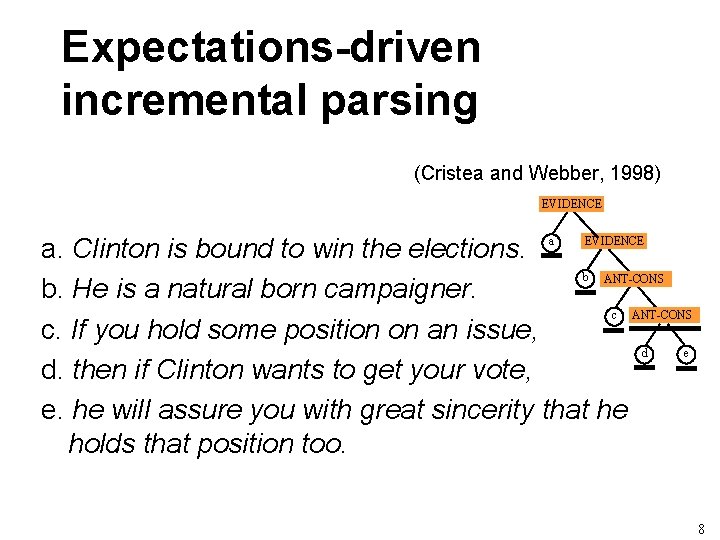
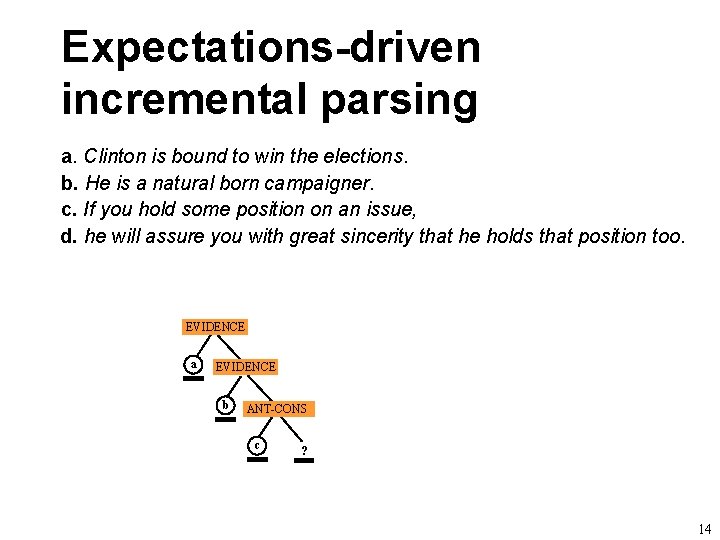
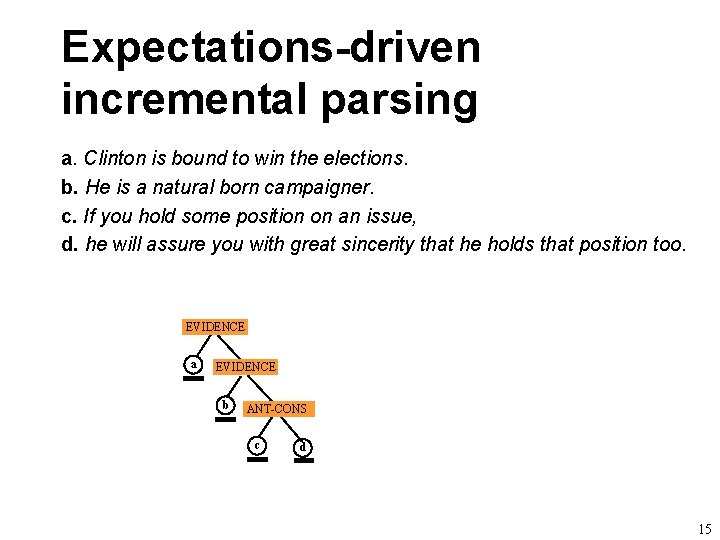
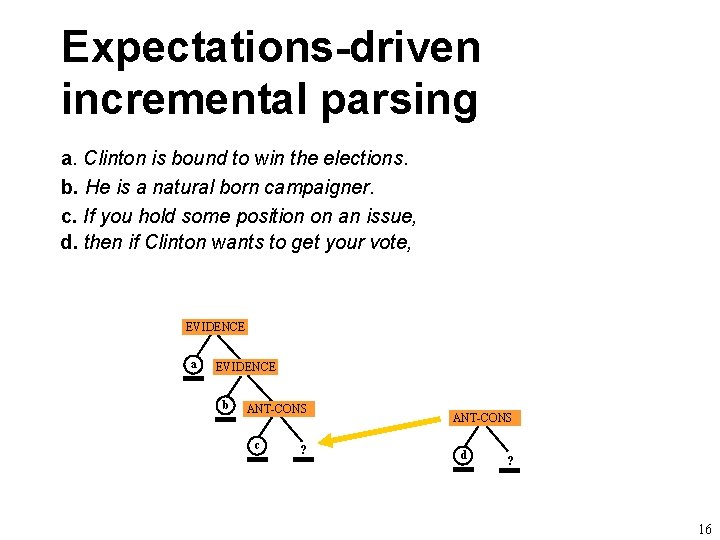
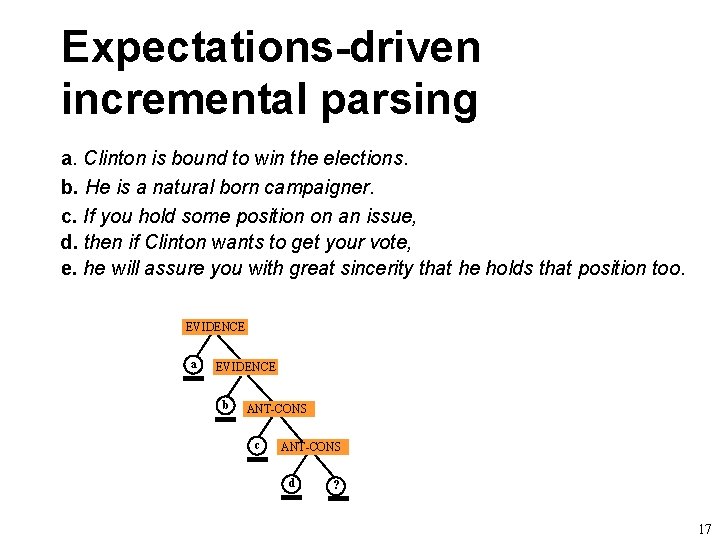
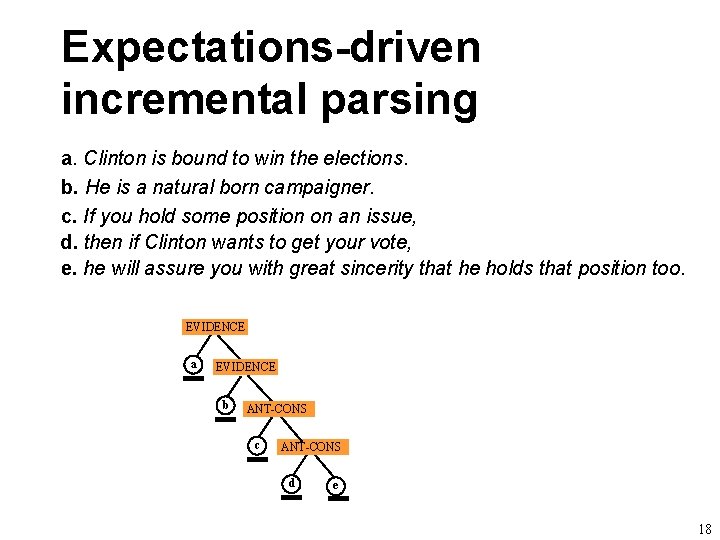
Expectations-driven incremental parsing (Cristea and Webber, 1998) EVIDENCE a. Clinton is bound to win the elections. a EVIDENCE b ANT-CONS b. He is a natural born campaigner. c ANT-CONS c. If you hold some position on an issue, d e d. then if Clinton wants to get your vote, e. he will assure you with great sincerity that he holds that position too. 8
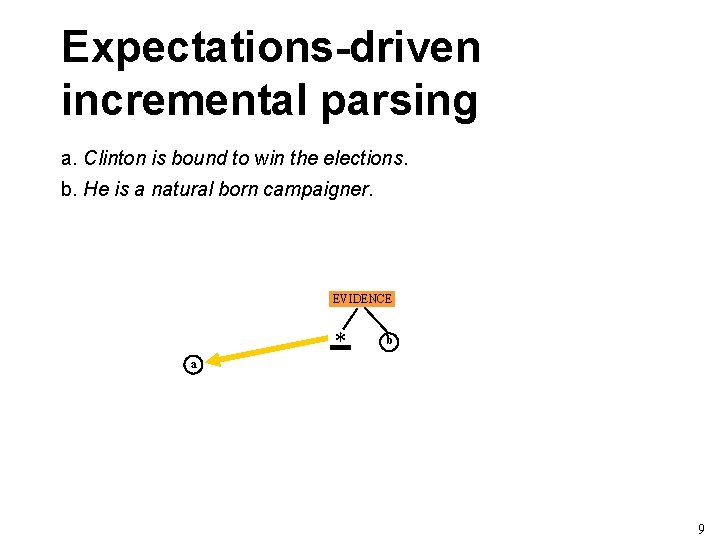
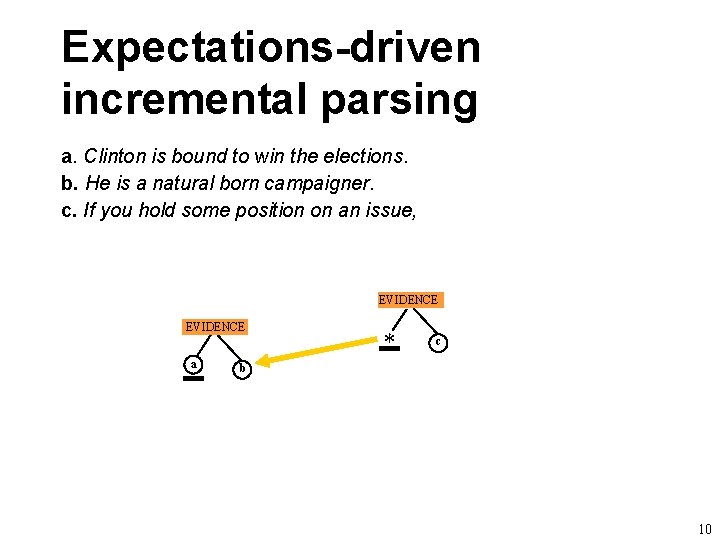
Expectations-driven incremental parsing a. Clinton is bound to win the elections. b. He is a natural born campaigner. EVIDENCE * b a 9
Expectations-driven incremental parsing a. Clinton is bound to win the elections. b. He is a natural born campaigner. c. If you hold some position on an issue, EVIDENCE a * c b 10
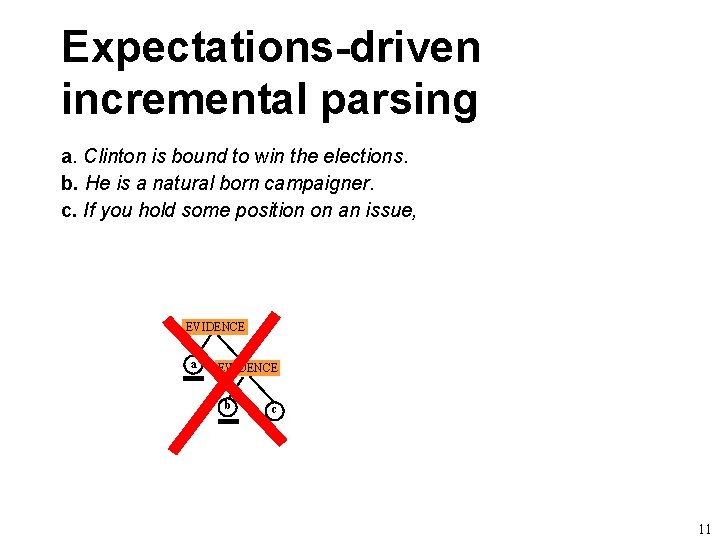
Expectations-driven incremental parsing a. Clinton is bound to win the elections. b. He is a natural born campaigner. c. If you hold some position on an issue, EVIDENCE a EVIDENCE b c 11
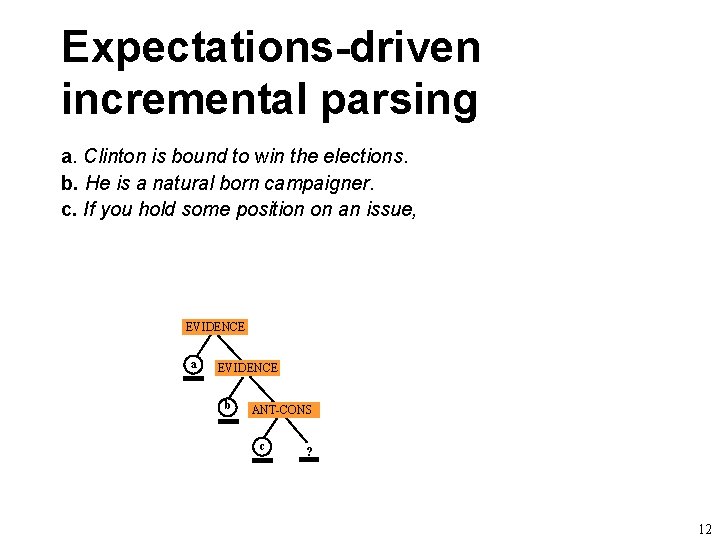
Expectations-driven incremental parsing a. Clinton is bound to win the elections. b. He is a natural born campaigner. c. If you hold some position on an issue, EVIDENCE a EVIDENCE b ANT-CONS c ? 12
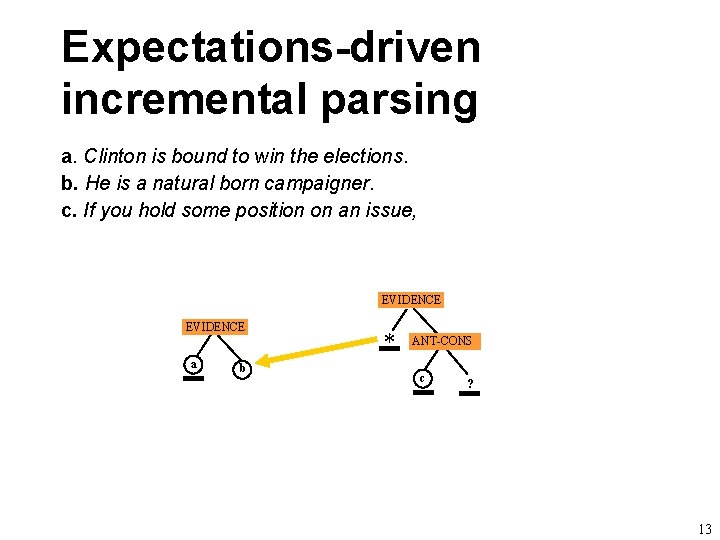
Expectations-driven incremental parsing a. Clinton is bound to win the elections. b. He is a natural born campaigner. c. If you hold some position on an issue, EVIDENCE a b * ANT-CONS c ? 13
Expectations-driven incremental parsing a. Clinton is bound to win the elections. b. He is a natural born campaigner. c. If you hold some position on an issue, d. he will assure you with great sincerity that he holds that position too. EVIDENCE a EVIDENCE b ANT-CONS c ? 14
Expectations-driven incremental parsing a. Clinton is bound to win the elections. b. He is a natural born campaigner. c. If you hold some position on an issue, d. he will assure you with great sincerity that he holds that position too. EVIDENCE a EVIDENCE b ANT-CONS c d 15
Expectations-driven incremental parsing a. Clinton is bound to win the elections. b. He is a natural born campaigner. c. If you hold some position on an issue, d. then if Clinton wants to get your vote, EVIDENCE a EVIDENCE b ANT-CONS c ? ANT-CONS d ? 16
Expectations-driven incremental parsing a. Clinton is bound to win the elections. b. He is a natural born campaigner. c. If you hold some position on an issue, d. then if Clinton wants to get your vote, e. he will assure you with great sincerity that he holds that position too. EVIDENCE a EVIDENCE b ANT-CONS c ANT-CONS d ? 17
Expectations-driven incremental parsing a. Clinton is bound to win the elections. b. He is a natural born campaigner. c. If you hold some position on an issue, d. then if Clinton wants to get your vote, e. he will assure you with great sincerity that he holds that position too. EVIDENCE a EVIDENCE b ANT-CONS c ANT-CONS d e 18
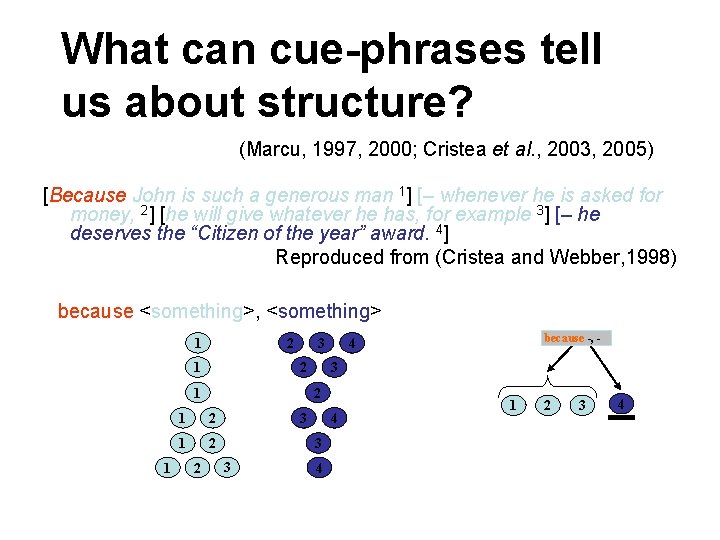
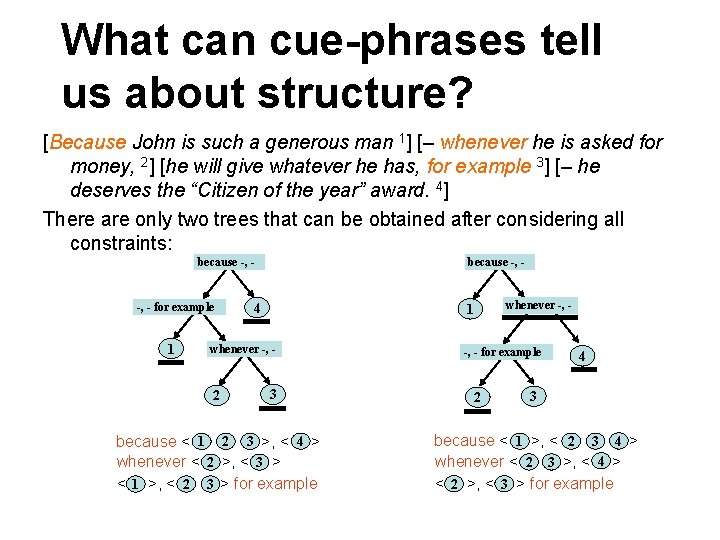
What can cue-phrases tell us about structure? (Marcu, 1997, 2000; Cristea et al. , 2003, 2005) [Because John is such a generous man 1] [– whenever he is asked for money, 2] [he will give whatever he has, for example 3] [– he deserves the “Citizen of the year” award. 4] Reproduced from (Cristea and Webber, 1998) because <something>, <something> 1 2 1 3 2 1 1 2 2 3 2 1 3 4 3 3 because -, - 4 4 1 2 3 4
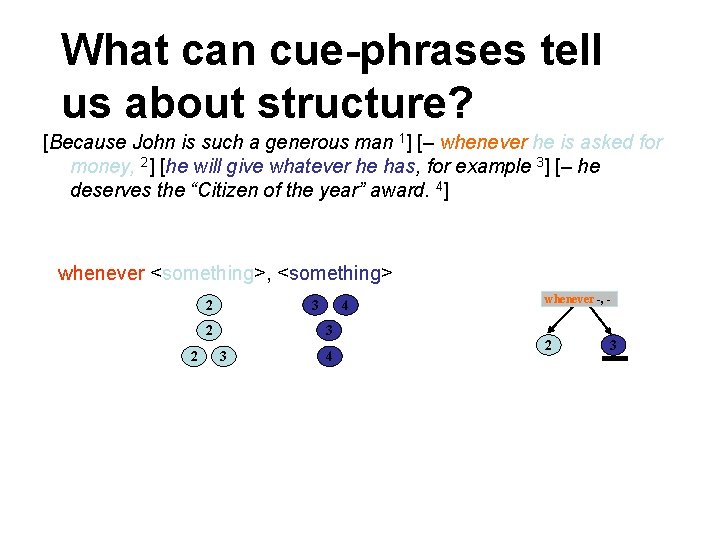
What can cue-phrases tell us about structure? [Because John is such a generous man 1] [– whenever he is asked for money, 2] [he will give whatever he has, for example 3] [– he deserves the “Citizen of the year” award. 4] whenever <something>, <something> 2 3 2 2 4 3 3 4 whenever -, - 2 3
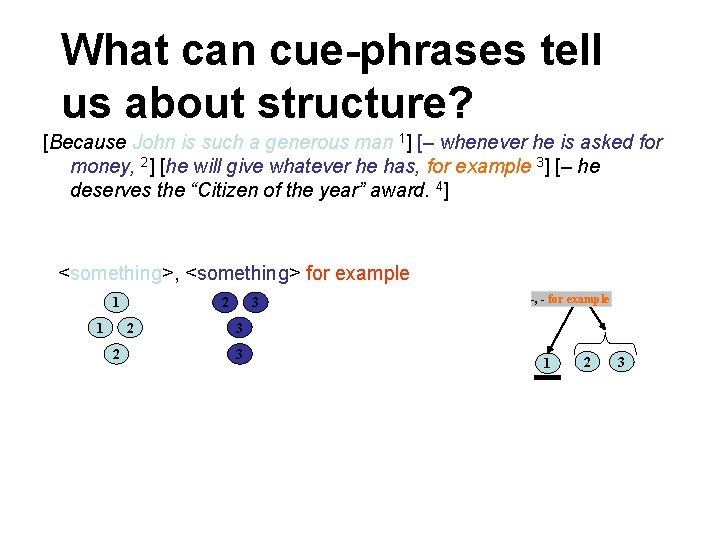
What can cue-phrases tell us about structure? [Because John is such a generous man 1] [– whenever he is asked for money, 2] [he will give whatever he has, for example 3] [– he deserves the “Citizen of the year” award. 4] <something>, <something> for example 1 1 2 2 2 3 -, - for example 3 3 1 2 3
What can cue-phrases tell us about structure? [Because John is such a generous man 1] [– whenever he is asked for money, 2] [he will give whatever he has, for example 3] [– he deserves the “Citizen of the year” award. 4] There are only two trees that can be obtained after considering all constraints: because -, - for example 1 because -, - 4 whenever -, - 2 whenever -, - 1 3 because < 1 2 3 >, < 4 > whenever < 2 >, < 3 > < 1 >, < 2 3 > for example -, - for example 2 4 3 because < 1 >, < 2 3 4 > whenever < 2 3 >, < 4 > < 2 >, < 3 > for example
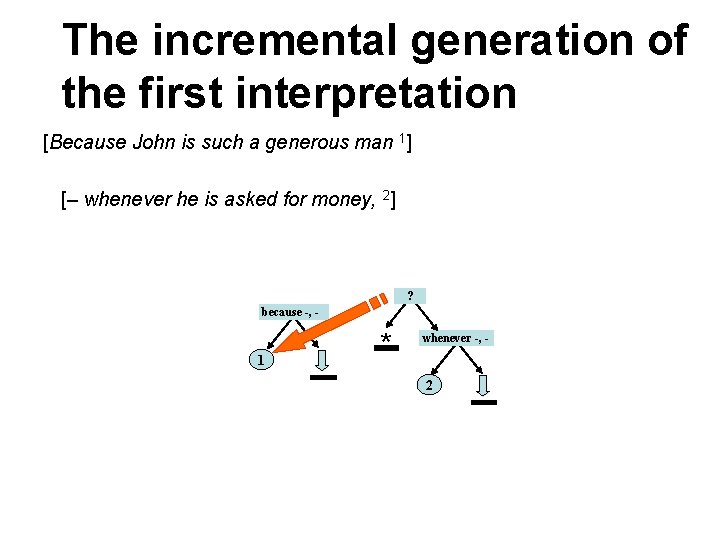
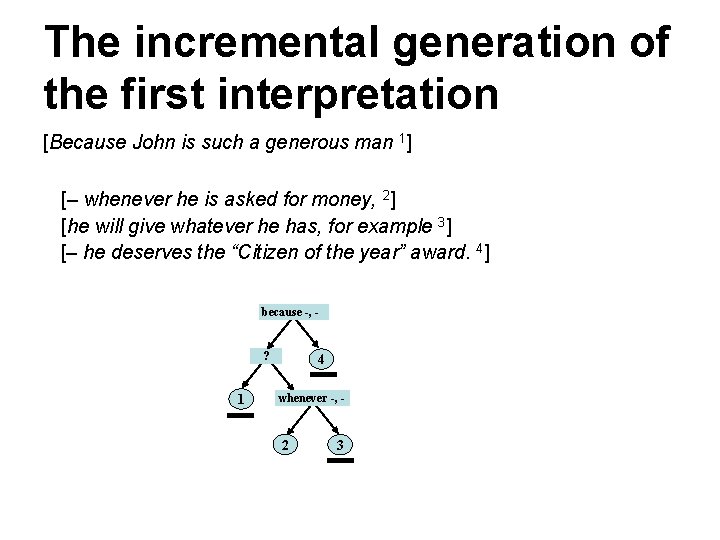
The incremental generation of the first interpretation [Because John is such a generous man 1] [– whenever he is asked for money, 2] ? because -, - 1 * whenever -, - 2
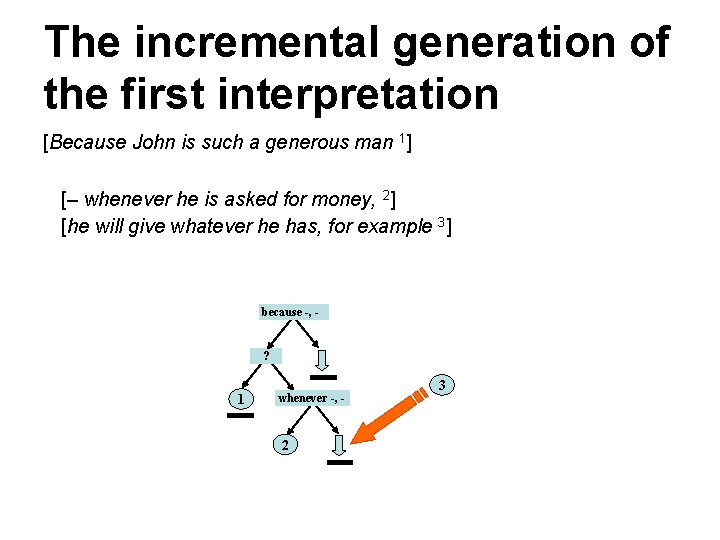
The incremental generation of the first interpretation [Because John is such a generous man 1] [– whenever he is asked for money, 2] [he will give whatever he has, for example 3] because -, - ? 1 whenever -, - 2 3
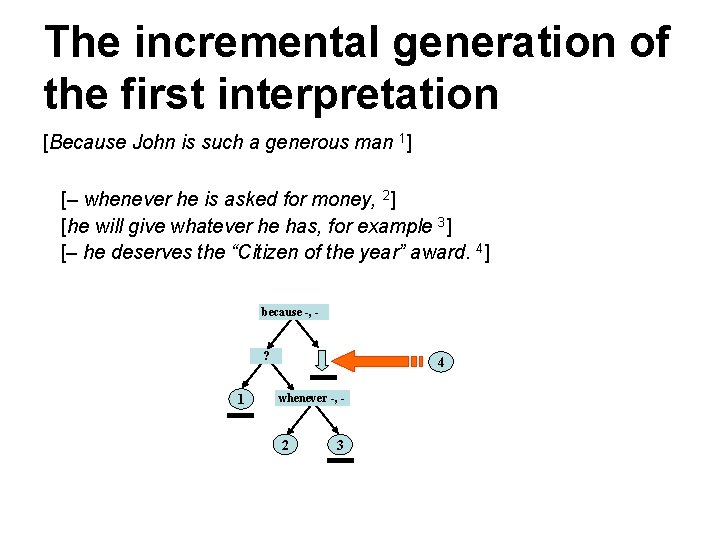
The incremental generation of the first interpretation [Because John is such a generous man 1] [– whenever he is asked for money, 2] [he will give whatever he has, for example 3] [– he deserves the “Citizen of the year” award. 4] because -, - ? 1 4 whenever -, - 2 3
The incremental generation of the first interpretation [Because John is such a generous man 1] [– whenever he is asked for money, 2] [he will give whatever he has, for example 3] [– he deserves the “Citizen of the year” award. 4] because -, - ? 1 4 whenever -, - 2 3
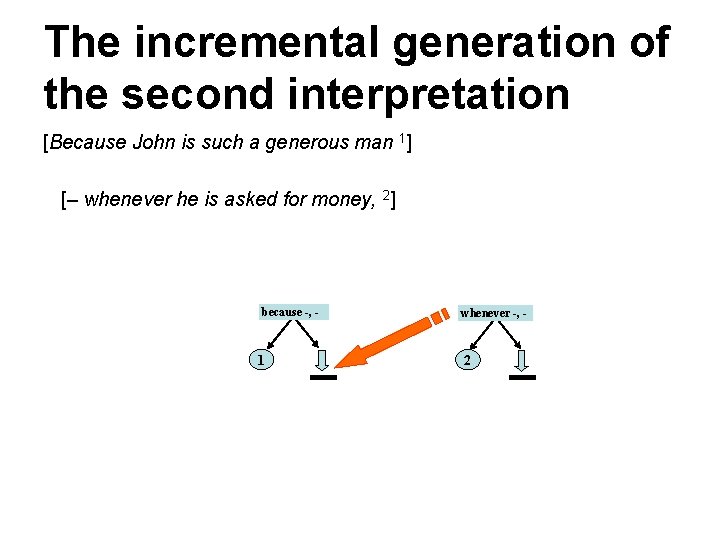
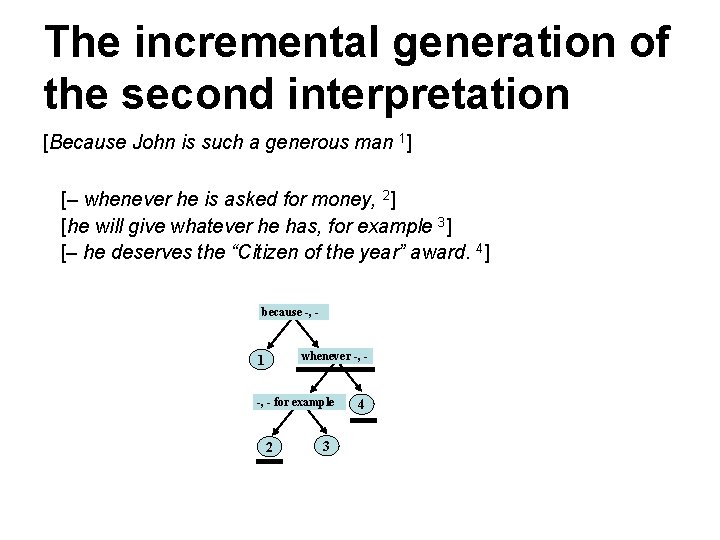
The incremental generation of the second interpretation [Because John is such a generous man 1] [– whenever he is asked for money, 2] because -, - 1 whenever -, - 2
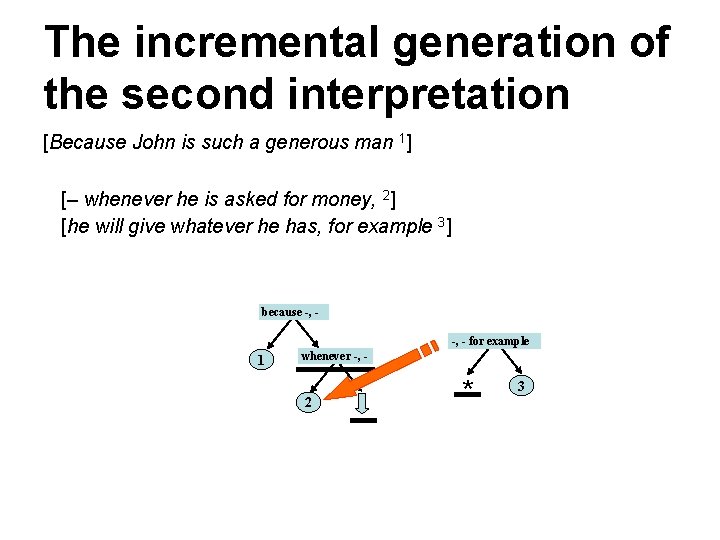
The incremental generation of the second interpretation [Because John is such a generous man 1] [– whenever he is asked for money, 2] [he will give whatever he has, for example 3] because -, -, - for example 1 whenever -, - 2 * 3
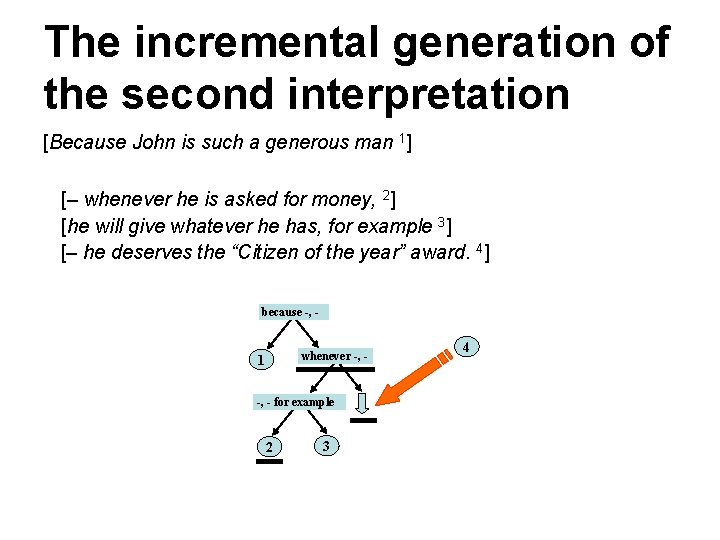
The incremental generation of the second interpretation [Because John is such a generous man 1] [– whenever he is asked for money, 2] [he will give whatever he has, for example 3] [– he deserves the “Citizen of the year” award. 4] because -, - whenever -, - 1 -, - for example 2 3 4
The incremental generation of the second interpretation [Because John is such a generous man 1] [– whenever he is asked for money, 2] [he will give whatever he has, for example 3] [– he deserves the “Citizen of the year” award. 4] because -, - whenever -, - 1 -, - for example 2 3 4
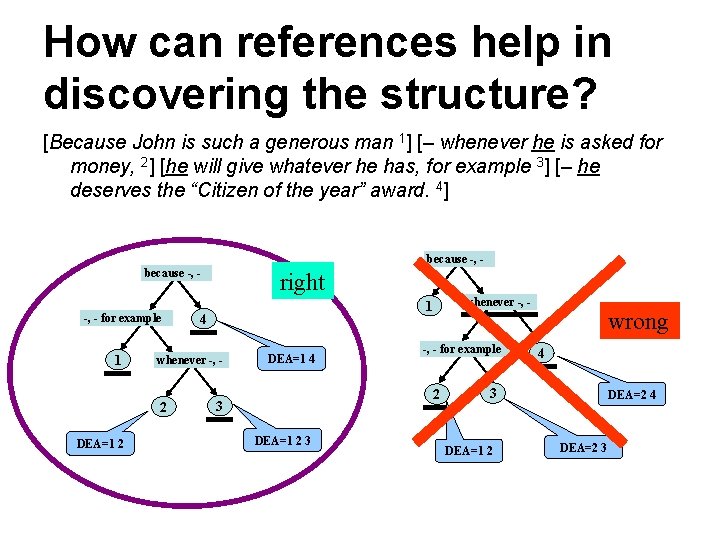
How can references help in discovering the structure? [Because John is such a generous man 1] [– whenever he is asked for money, 2] [he will give whatever he has, for example 3] [– he deserves the “Citizen of the year” award. 4] because -, - for example 1 whenever -, - 1 4 whenever -, - 2 DEA=1 2 right DEA=1 4 -, - for example 2 3 DEA=1 2 3 wrong 4 3 DEA=1 2 DEA=2 4 DEA=2 3
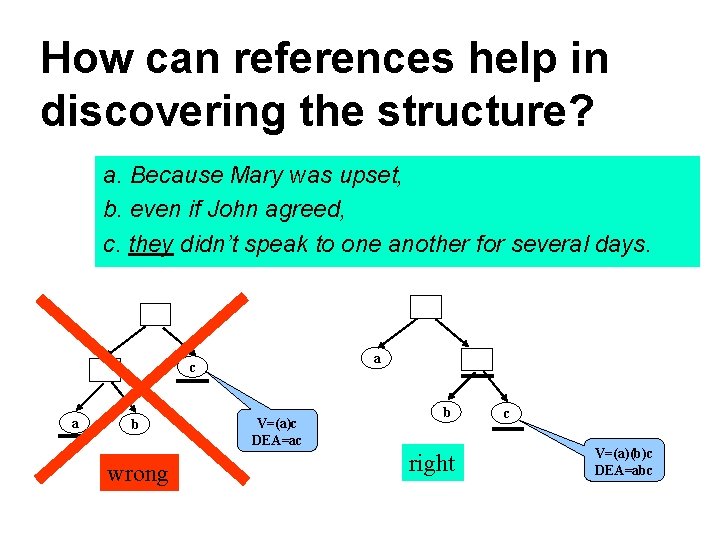
How can references help in discovering the structure? a. Because Mary was upset, b. even if John agreed, c. they didn’t speak to one another for several days. a c a b wrong V=(a)c DEA=ac b right c V=(a)(b)c DEA=abc
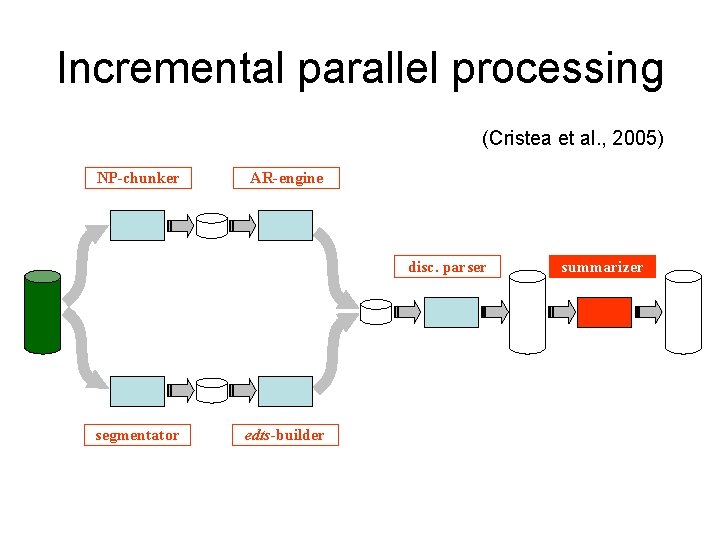
Incremental parallel processing (Cristea et al. , 2005) NP-chunker AR-engine disc. parser segmentator edts-builder summarizer
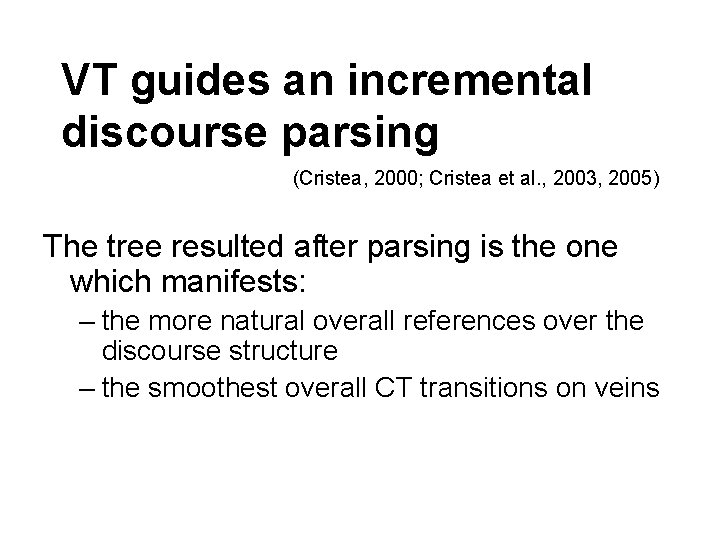
VT guides an incremental discourse parsing (Cristea, 2000; Cristea et al. , 2003, 2005) The tree resulted after parsing is the one which manifests: – the more natural overall references over the discourse structure – the smoothest overall CT transitions on veins
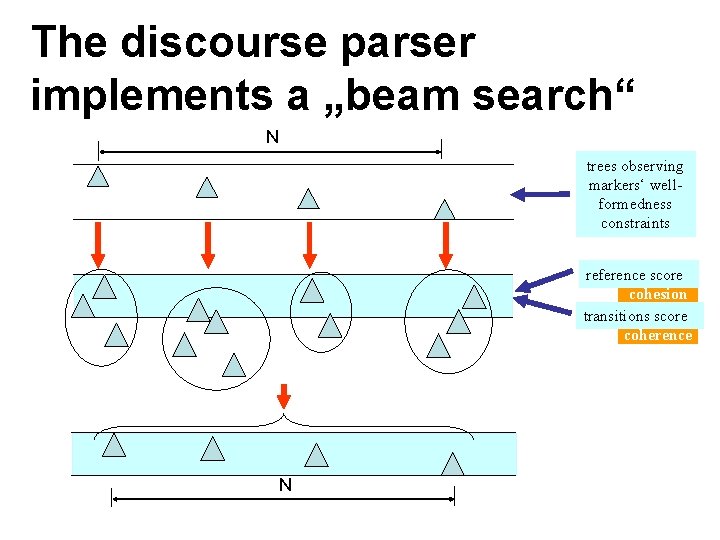
The discourse parser implements a „beam search“ N trees observing markers‘ wellformedness constraints reference score cohesion transitions score coherence N