CUPE LOCAL 882 What is CUPE Local 882


- Slides: 19
CUPE LOCAL 882
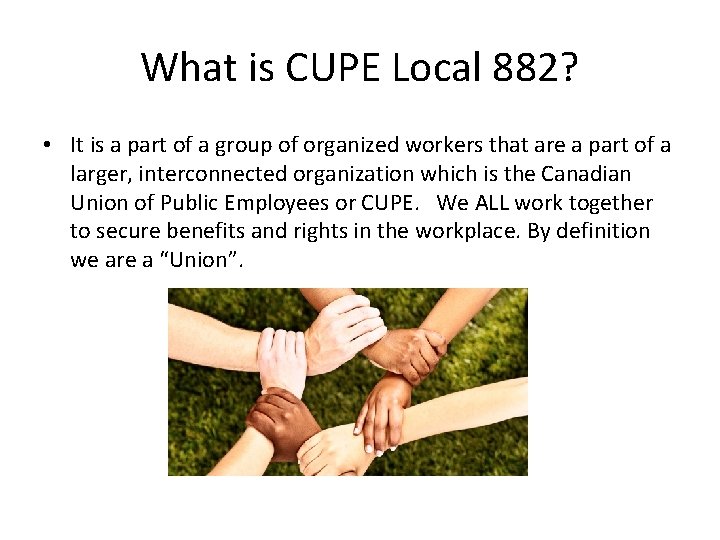
What is CUPE Local 882? • It is a part of a group of organized workers that are a part of a larger, interconnected organization which is the Canadian Union of Public Employees or CUPE. We ALL work together to secure benefits and rights in the workplace. By definition we are a “Union”.
Who is in CUPE Local 882? Our local consists of workers from different backgrounds, skill sets, education levels, race, religion, etc. Our sisters and brothers, that is what we refer ourselves as, are found through out different departments of the City. Found in: Aquatics – Frank Dunn Pool, Kinsmen Water Park Recreation- Alfred Jenkins Centre, Margo Fournier Centre, City Parks Concessions – Art Hauser, Arenas City Hall – Public Works, Community Services, Planning & Development Services, City Clerks, Information Services, Financial Services (Taxation, Water, Assessment, Cashier, Parking Tickets, Accounts Payable, Accounts Receivable, Asset Management, and Payroll) Art Centre (There approximately 90 permanent and 60 to 70 non-permanent staff) What is a Collective Bargaining Agreement (CBA)? • It is an agreement between the employer (City of Prince Albert) and the local, which are rules that all members are required to follow in an effort to maintain a harmonious workplace (Article 1 -Preamble). There also other rules and policies that the employer has in place that are outside the Collective Bargaining Agreement that all employees of the City of Prince Albert are expected to follow. What’s in this CBA? Many things are covered in the CBA such as: • Article 3. 01 Bargaining Unit Outlines those positions which are not part of the collective. Otherwise known as Out of Scope/management. • The schedules with our wages are located at the end of the CBA and the classifications IN our local. Anyone in a classification under the schedules is a Local 882 member. Both Non-Permanent and Permanent are listed. Each year has a chart to follow as rates of pay change on an anniversary date. (for example page 43) • Hours of work, EDO’s, Over Time, seniority, sick bank, illnesses in the family, bereavement, breaks, training, vacation time, grievance procedures, maternity leave, Additional Duty Pay, callback, etc. What isn’t covered in the CBA, may be in the employers policies or protocols. Union dues • Are monthly dues of 2. 0% of your pay. (Bylaws Section 9(c) ) this is voted by the membership.
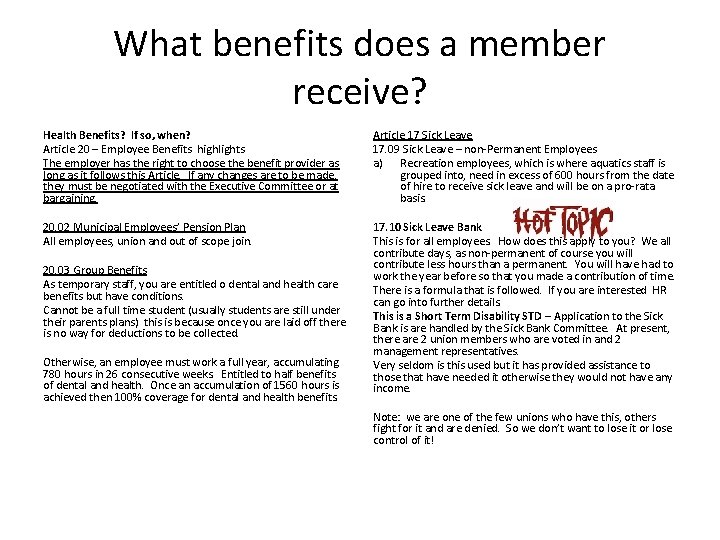
What benefits does a member receive? Health Benefits? If so, when? Article 20 – Employee Benefits highlights The employer has the right to choose the benefit provider as long as it follows this Article. If any changes are to be made, they must be negotiated with the Executive Committee or at bargaining. Article 17 Sick Leave 17. 09 Sick Leave – non-Permanent Employees a) Recreation employees, which is where aquatics staff is grouped into, need in excess of 600 hours from the date of hire to receive sick leave and will be on a pro-rata basis. 20. 02 Municipal Employees’ Pension Plan All employees, union and out of scope join. 17. 10 Sick Leave Bank This is for all employees. How does this apply to you? We all contribute days, as non-permanent of course you will contribute less hours than a permanent. You will have had to work the year before so that you made a contribution of time. There is a formula that is followed. If you are interested HR can go into further details. This is a Short Term Disability STD – Application to the Sick Bank is are handled by the Sick Bank Committee. At present, there are 2 union members who are voted in and 2 management representatives. Very seldom is this used but it has provided assistance to those that have needed it otherwise they would not have any income. 20. 03 Group Benefits As temporary staff, you are entitled o dental and health care benefits but have conditions. Cannot be a full time student (usually students are still under their parents plans) this is because once you are laid off there is no way for deductions to be collected. Otherwise, an employee must work a full year, accumulating 780 hours in 26 consecutive weeks. Entitled to half benefits of dental and health. Once an accumulation of 1560 hours is achieved then 100% coverage for dental and health benefits. Note: we are one of the few unions who have this, others fight for it and are denied. So we don’t want to lose it or lose control of it!
What is a grievance? Article 17 -Grievance Procedure 7. 01 Definition of Grievance A grievance shall be defined as any difference or dispute between the Employer and any employee(s) or the Union. We strive to settle things before going to a grievance level. Once a grievance goes to the Grievance Committee, the Union owns it. Steps are followed as outlined in the CBA. How does the union help you if you are disciplined? There is a progressive discipline policy that all City employees are to follow. If you feel that you should not have been disciplined, whether written notice, etc. , that is when you should talk to someone from the Executive – usually the Shop Steward, Vice-President or President. • You are expected to responsible to be at work for your shifts, in a timely manner and to be professional at all times. • If you are late? Why and are there extenuating circumstances. • Missing shifts? Why and are there extenuating circumstances. • Bad behaviour at work? Why If you are not meeting expectations without just reason, it makes it hard to argue a defense case. Remember the “union” is a group of workers which the Executive represents. What are my rights as a union member? • • As a member in good standing with Local 882 you have the right to work with the City of Prince Albert. You are afforded the rights as outline in the CBA and any other laws or legislations that may be applicable. How does being a part of a union when you are 16 – 20 years old help you in the future? As with any job whether it be part of a union collective or with a private business, you gain experience and training which can be beneficial for you for future employment, career, education, through out life. Can you transfer into a different Local? NO. Each union local negotiates their own contract with their employer. Example: Our employer is the City of Prince Albert, but if you are a CUPE member with the hospital then your employer is the Prince Albert Parkland Health Region, who would have different rules, regulations, policies and CBA. However, if the CUPE locals are with the same employer, such as the City, then you would be able to transfer over your years of service, benefits, vacation, but that has nothing to do with CUPE or the locals, that is due to the fact that you are with the same employer. Within the locals seniority does not transfer.
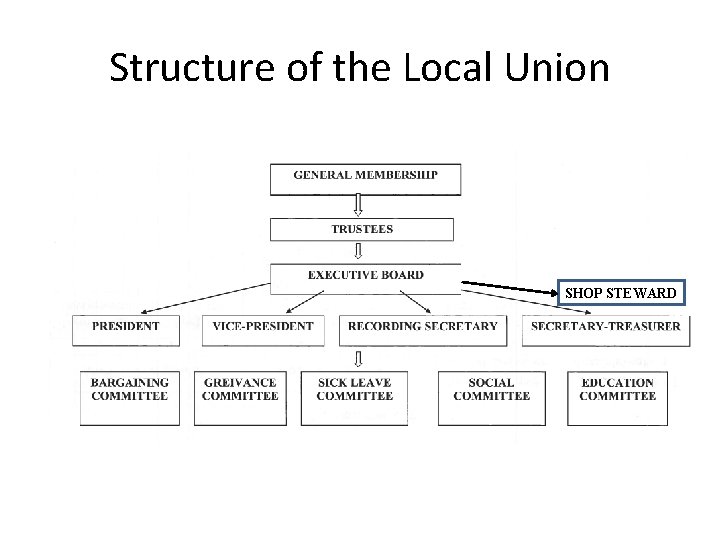
Structure of the Local Union SHOP STEWARD
Union Executive!!! • Consists of members within the local who are voted in by the membership to represent ALL Local 882 members on issues in the workplace that affect our members and to ensure that our committees functions effectively. Position descriptions are given through the BYLAWS. Who is on the Union Executive? – President: Tammy Vermette – Vice President: Michael Nelson – Treasurer-Secretary: Mariya Firman – Recording Secretary: Karen Underhill – Shop Steward: Leanne Fyrk What does “Union Executive” mean? An executive board/committee is required for all locals as per the CUPE Constitution. Our local executive consists of the above positions. What does the Executive Committee do? Hold monthly labour management meetings that are held with the President and Vice President, and the City’s HR Consultant (Kerri Kristian) to discuss job postings, members on probation, proposed changes to the workplace (such as reorganizations, job descriptions, new positions, etc. ) Any issues that come up that need to be addressed that are between a union member(s) and management. The President, Vice President and Shop Steward address any concerns from the membership and work to find a resolve, whether these are issues between the members themselves or issues with members and management. The Secretary-Treasurer ensures that all members are paying their dues, pays our bills, prepares the treasurer’s report and supplies the gift cards for our membership meetings, basically is in charge of our money. The Recording –Secretary takes minutes at our meetings, sends out notices to the membership, helps prepare information for meetings and other secretarial duties.
Committees • • • All members are welcome to nominate another member or themselves for any position on the committees when a position becomes vacant. Executive Committee (all positons) Bargaining Committee (President, Recording Secretary, Concessions, Aquatics, member at large) Sick Bank Committee (2 members) Grievance Committee (Vice-President , 2 members) Occupational Health Committee (2 members) Trustees (3 members – no executive) Website Committee is strictly volunteers (Executive member, 2 members) Social Committee is not through the union and is open to all employees of the City (union members and out of scope) Dress Down Committee is not through the union and is an “employee” committee of the City, therefore, there is 1 management representative and 1 union representative. At present our Union President and Payroll Manager oversee this. Getting Involved!! • • Getting involved is entirely up to you. What are you passionate about? What is your comfort level? Attending membership meetings. Be informed on what’s happening in labour management. Be social, get to know other members other than your immediate co-workers, what jobs do they do? Ask good quality questions. Workshops are offered through CUPE. The Union Executive strongly encourages any member to attend the Introduction to Shop Stewarding. This workshop gives you an overview of what the union is all about. Put your name forward to sit on Committees. Help keep your co-workers informed. Emails received from CUPE National, CUPE Sask, or from our CUPE Rep, are sent out to the CUPE 882 email group. However, as this is sent over the employer’s email, we cannot use an individual’s personal email address – only addresses that are City addresses. Each division has an email group for the staff that work there, so if you receive the CUPE 882 email you are more than welcome to forward to your work group. Read and get to know your CBA.
• What are Bylaws and why does a union have them? These are required under CUPE Constitution and is explained under Preamble of our bylaws. Our bylaws have been recently updated and approved by CUPE National. • Once the local has received copies of the new bylaws, it will be available on the website. • Any changes to the bylaws must be in line with the constitution, must be voted on at a membership meeting and must be approved by CUPE National. How to access it? • On the Local’s website • Executive Members.
882. cupe. ca This is our local website just most recently created and needs work, but we try! • • • News and updates Events Upcoming Meetings Rallies Social Committee Activities Committee updates such as OHC (Occupational Health and Safety) Committee members contact information CBA and what does it mean Union Bylaws If you would like to be a part of the Website Committee this is a volunteer position and work is done on your own time. • If you have new ideas, anything to add or would like to see, please contact Leanne Fyrk in Planning and Development Services at lfyrk@cityp. com or 306 -953 -4377. **Other members are Samantha Bear in Public Works and Amelia Cao in Financial Services** •
Negotiations • • • Happening now. Still in negotiations. The Bargaining Committee agreed to an information meeting on Wednesday evening, May 17, 2017, to discuss the items that were still outstanding. Next meeting TBA.
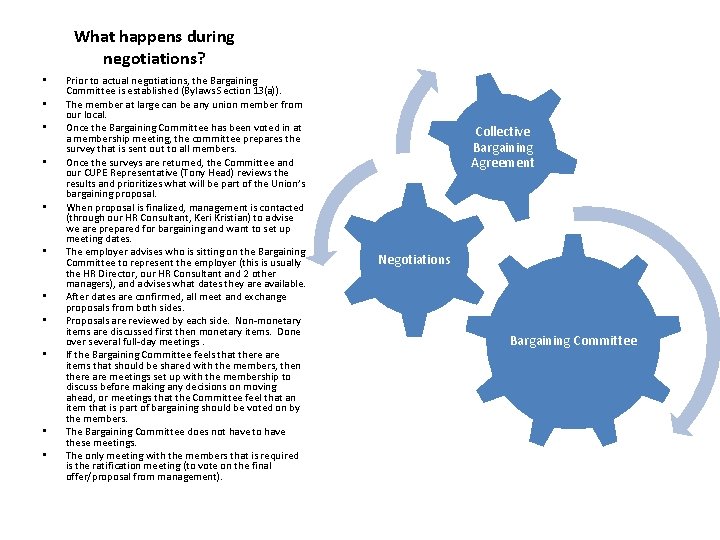
What happens during negotiations? • • • Prior to actual negotiations, the Bargaining Committee is established (Bylaws Section 13(a)). The member at large can be any union member from our local. Once the Bargaining Committee has been voted in at a membership meeting, the committee prepares the survey that is sent out to all members. Once the surveys are returned, the Committee and our CUPE Representative (Tony Head) reviews the results and prioritizes what will be part of the Union’s bargaining proposal. When proposal is finalized, management is contacted (through our HR Consultant, Keri Kristian) to advise we are prepared for bargaining and want to set up meeting dates. The employer advises who is sitting on the Bargaining Committee to represent the employer (this is usually the HR Director, our HR Consultant and 2 other managers), and advises what dates they are available. After dates are confirmed, all meet and exchange proposals from both sides. Proposals are reviewed by each side. Non-monetary items are discussed first then monetary items. Done over several full-day meetings. If the Bargaining Committee feels that there are items that should be shared with the members, then there are meetings set up with the membership to discuss before making any decisions on moving ahead, or meetings that the Committee feel that an item that is part of bargaining should be voted on by the members. The Bargaining Committee does not have to have these meetings. The only meeting with the members that is required is the ratification meeting (to vote on the final offer/proposal from management). Collective Bargaining Agreement Negotiations Bargaining Committee
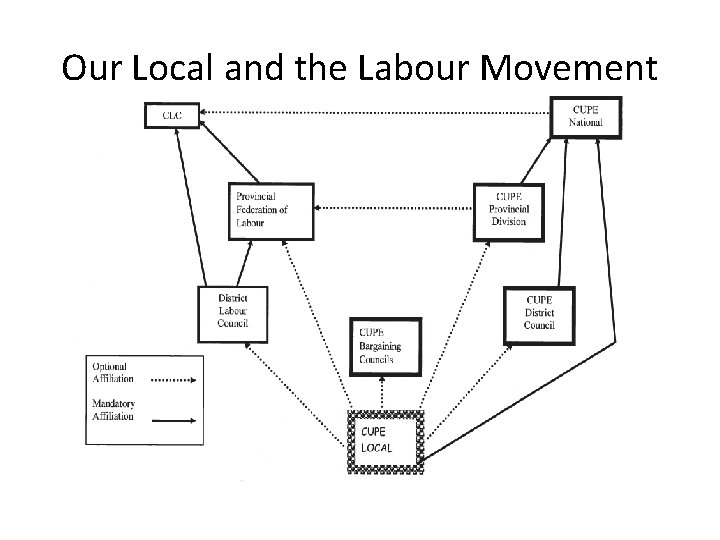
Our Local and the Labour Movement
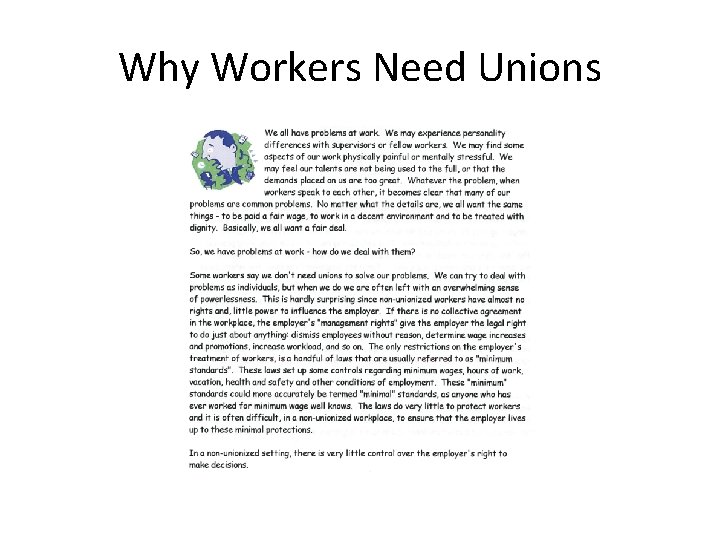
Why Workers Need Unions
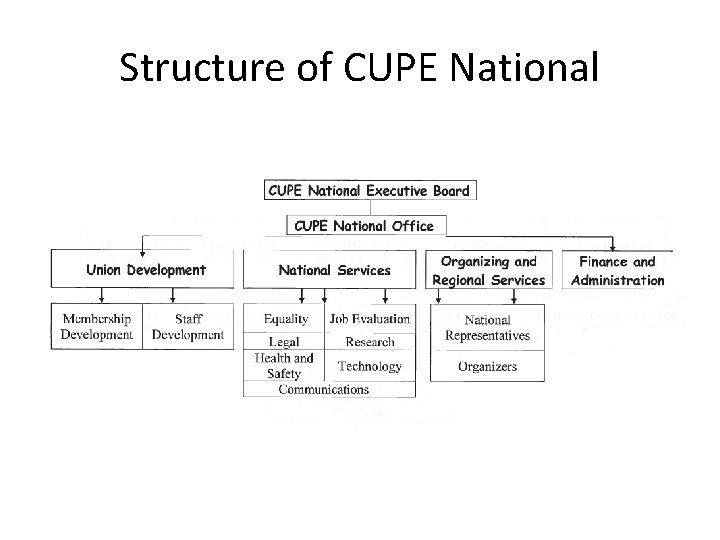
Structure of CUPE National
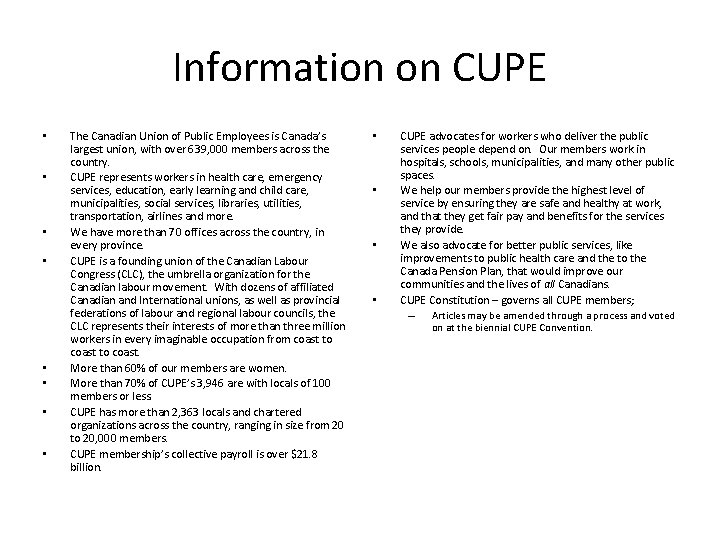
Information on CUPE • • The Canadian Union of Public Employees is Canada’s largest union, with over 639, 000 members across the country. CUPE represents workers in health care, emergency services, education, early learning and child care, municipalities, social services, libraries, utilities, transportation, airlines and more. We have more than 70 offices across the country, in every province. CUPE is a founding union of the Canadian Labour Congress (CLC), the umbrella organization for the Canadian labour movement. With dozens of affiliated Canadian and International unions, as well as provincial federations of labour and regional labour councils, the CLC represents their interests of more than three million workers in every imaginable occupation from coast to coast. More than 60% of our members are women. More than 70% of CUPE’s 3, 946 are with locals of 100 members or less. CUPE has more than 2, 363 locals and chartered organizations across the country, ranging in size from 20 to 20, 000 members. CUPE membership’s collective payroll is over $21. 8 billion. • • CUPE advocates for workers who deliver the public services people depend on. Our members work in hospitals, schools, municipalities, and many other public spaces. We help our members provide the highest level of service by ensuring they are safe and healthy at work, and that they get fair pay and benefits for the services they provide. We also advocate for better public services, like improvements to public health care and the to the Canada Pension Plan, that would improve our communities and the lives of all Canadians. CUPE Constitution – governs all CUPE members; – Articles may be amended through a process and voted on at the biennial CUPE Convention.
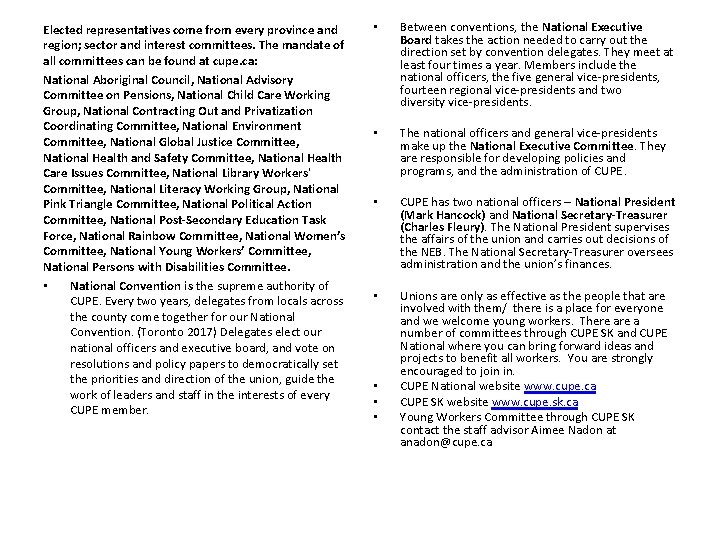
Elected representatives come from every province and region; sector and interest committees. The mandate of all committees can be found at cupe. ca: National Aboriginal Council, National Advisory Committee on Pensions, National Child Care Working Group, National Contracting Out and Privatization Coordinating Committee, National Environment Committee, National Global Justice Committee, National Health and Safety Committee, National Health Care Issues Committee, National Library Workers' Committee, National Literacy Working Group, National Pink Triangle Committee, National Political Action Committee, National Post-Secondary Education Task Force, National Rainbow Committee, National Women’s Committee, National Young Workers’ Committee, National Persons with Disabilities Committee. • National Convention is the supreme authority of CUPE. Every two years, delegates from locals across the county come together for our National Convention. (Toronto 2017) Delegates elect our national officers and executive board, and vote on resolutions and policy papers to democratically set the priorities and direction of the union, guide the work of leaders and staff in the interests of every CUPE member. • Between conventions, the National Executive Board takes the action needed to carry out the direction set by convention delegates. They meet at least four times a year. Members include the national officers, the five general vice-presidents, fourteen regional vice-presidents and two diversity vice-presidents. • The national officers and general vice-presidents make up the National Executive Committee. They are responsible for developing policies and programs, and the administration of CUPE. • CUPE has two national officers – National President (Mark Hancock) and National Secretary-Treasurer (Charles Fleury). The National President supervises the affairs of the union and carries out decisions of the NEB. The National Secretary-Treasurer oversees administration and the union’s finances. • Unions are only as effective as the people that are involved with them/ there is a place for everyone and we welcome young workers. There a number of committees through CUPE SK and CUPE National where you can bring forward ideas and projects to benefit all workers. You are strongly encouraged to join in. CUPE National website www. cupe. ca CUPE SK website www. cupe. sk. ca Young Workers Committee through CUPE SK contact the staff advisor Aimee Nadon at anadon@cupe. ca • • •