CS 626 449 Speech Natural Language Processing and
![To target N 1’ n I want [NPthis [N’big book of poems with the](https://slidetodoc.com/presentation_image_h/23e53eb286e48633ebe27e7e2e0558ff/image-7.jpg "To target N 1’ n I want [NPthis [N’big book of poems with the")
- Slides: 30
CS 626 -449: Speech, Natural Language Processing and the Web/Topics in Artificial Intelligence Pushpak Bhattacharyya CSE Dept. , IIT Bombay Lecture 12: Deeper Verb Structure; Different Parsing Algorithms
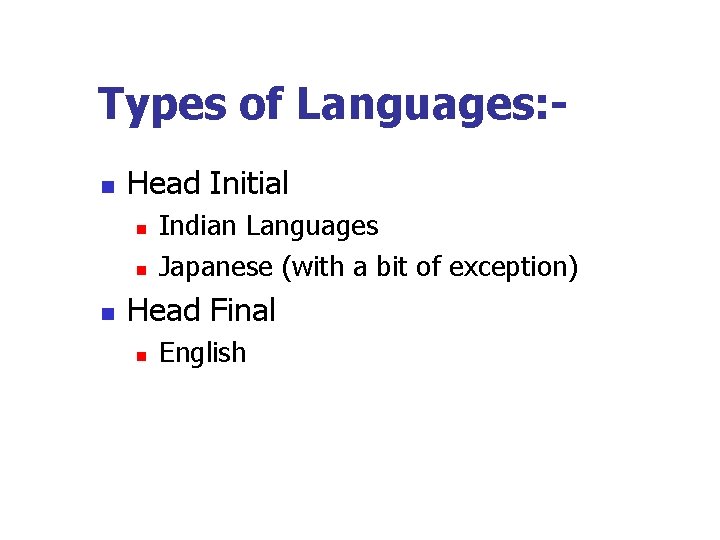
Types of Languages: n Head Initial n n n Indian Languages Japanese (with a bit of exception) Head Final n English
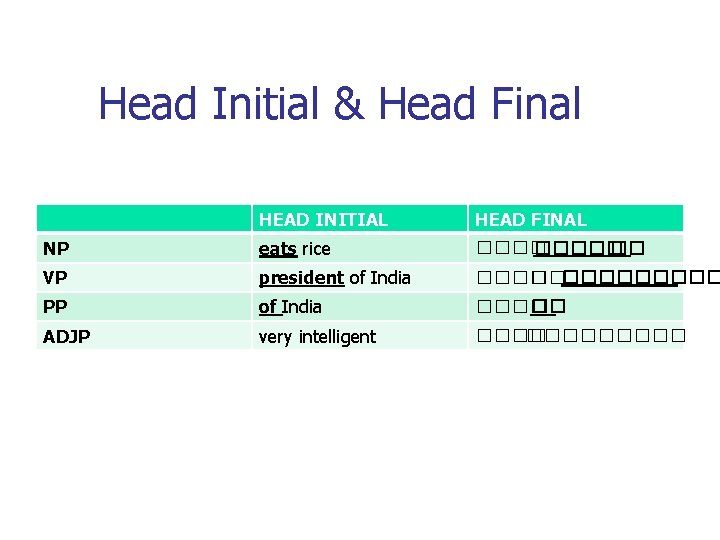
Head Initial & Head Final HEAD INITIAL HEAD FINAL NP eats rice ����� �� VP president of India ����������� PP of India ���� �� ADJP very intelligent ���������
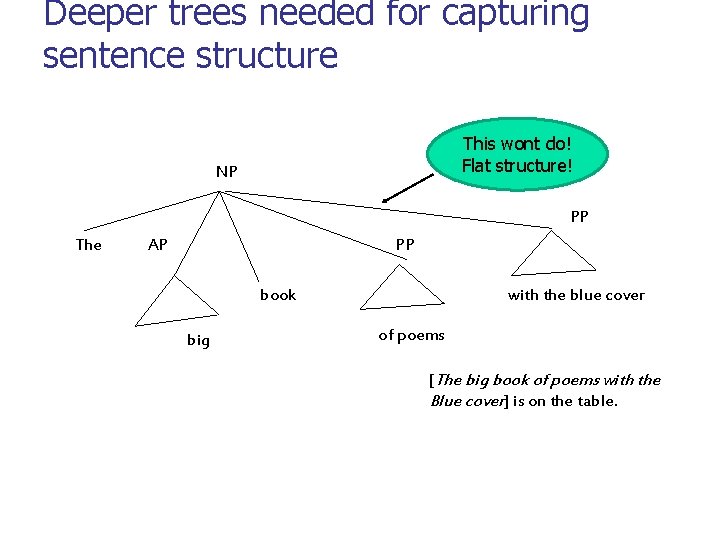
Deeper trees needed for capturing sentence structure This wont do! Flat structure! NP PP The AP PP book big with the blue cover of poems [The big book of poems with the Blue cover] is on the table.
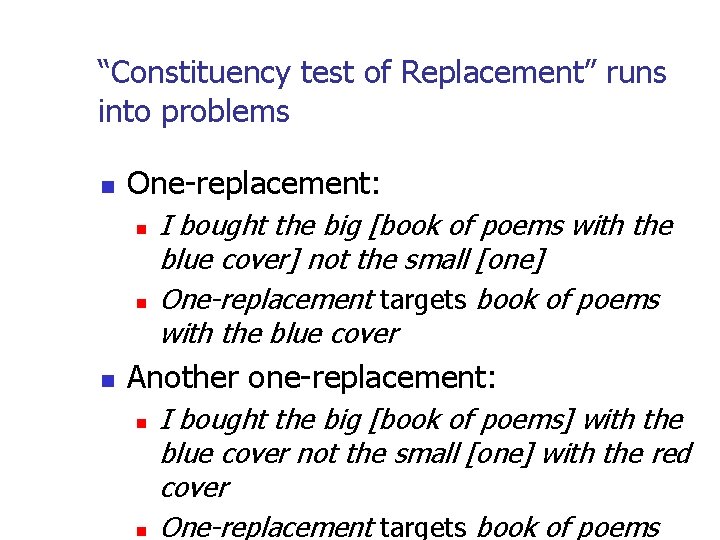
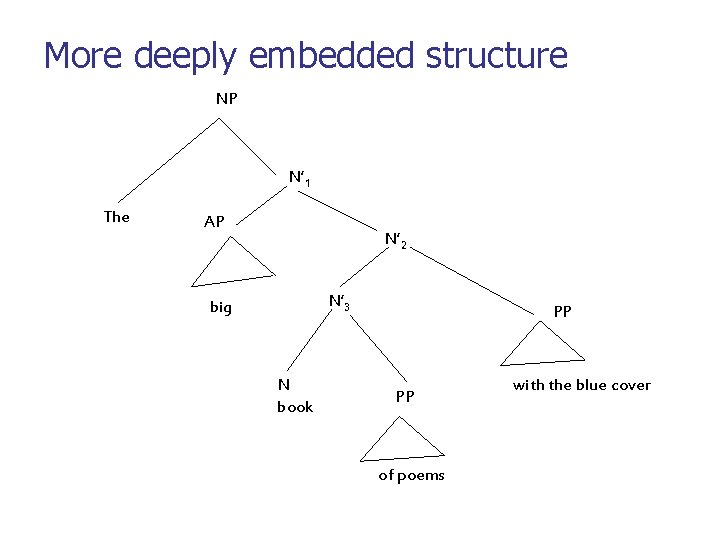
“Constituency test of Replacement” runs into problems n One-replacement: n n n I bought the big [book of poems with the blue cover] not the small [one] One-replacement targets book of poems with the blue cover Another one-replacement: n n I bought the big [book of poems] with the blue cover not the small [one] with the red cover One-replacement targets book of poems
More deeply embedded structure NP N’ 1 The AP N’ 2 N’ 3 big N book PP PP of poems with the blue cover
To target N 1’ n I want [NPthis [N’big book of poems with the red cover] and not [Nthat [None]]
V-bar n n What is the element in verbs corresponding to one-replacement for nouns do-so or did-so
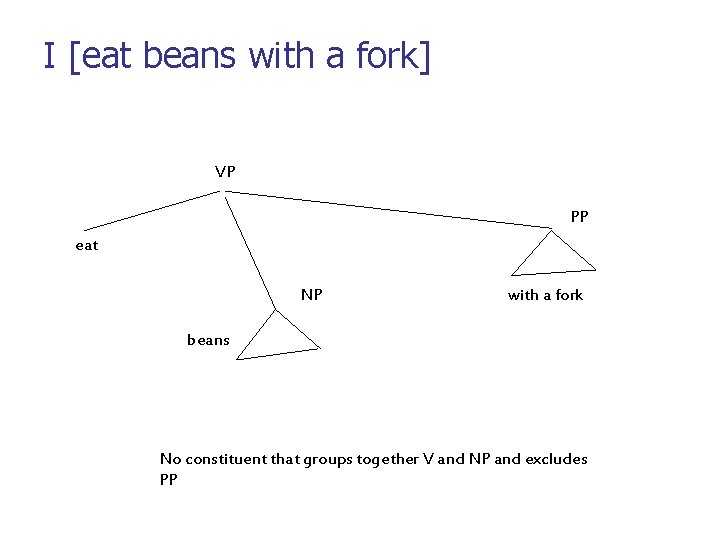
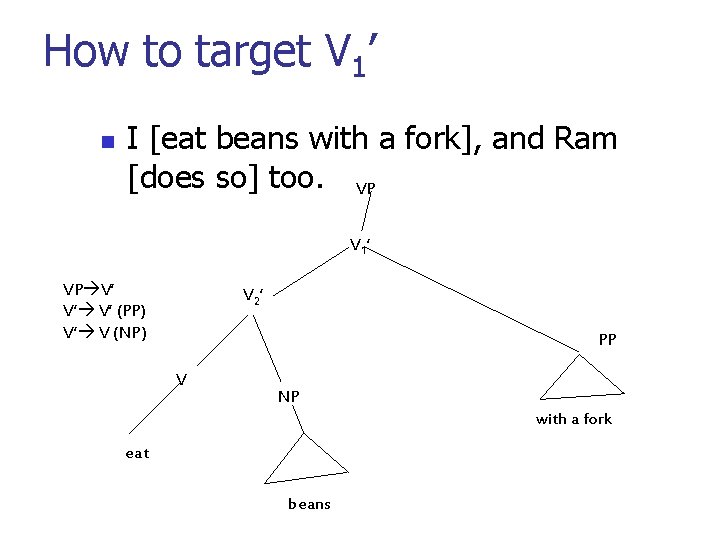
I [eat beans with a fork] VP PP eat NP with a fork beans No constituent that groups together V and NP and excludes PP
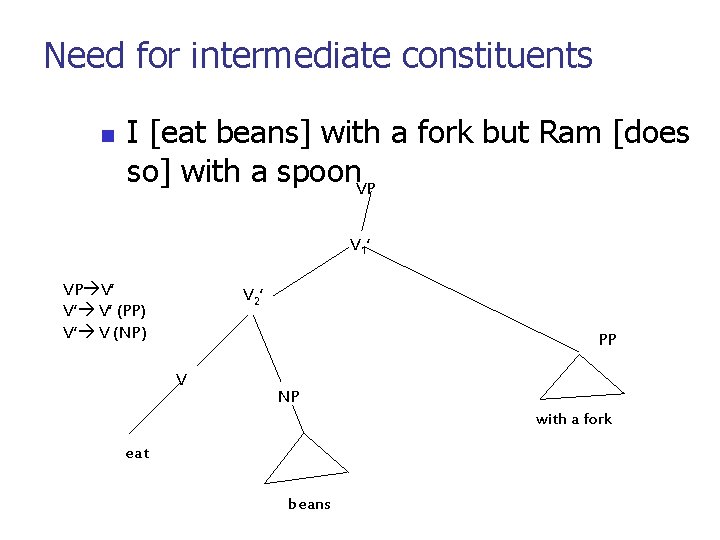
Need for intermediate constituents n I [eat beans] with a fork but Ram [does so] with a spoon. VP V 1’ VP V’ V’ V’ (PP) V’ V (NP) V 2’ PP V NP with a fork eat beans
How to target V 1’ n I [eat beans with a fork], and Ram [does so] too. VP V 1’ VP V’ V’ V’ (PP) V’ V (NP) V 2’ PP V NP with a fork eat beans
Parsing Algorithm
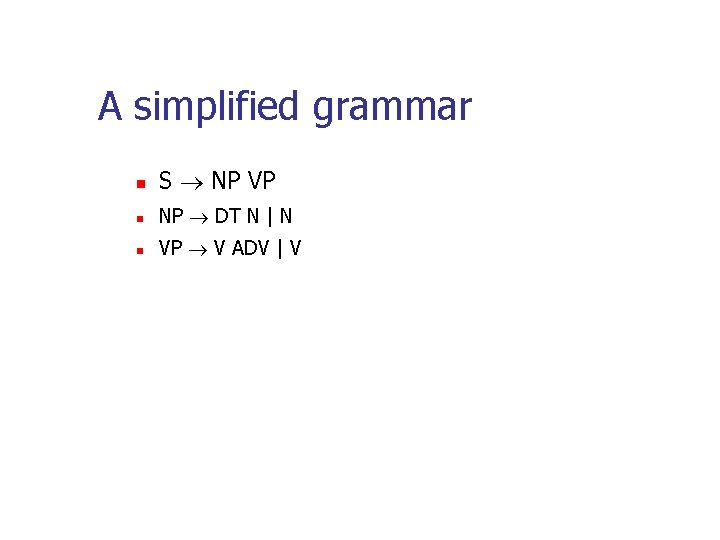
A simplified grammar n S NP VP n NP DT N | N n VP V ADV | V
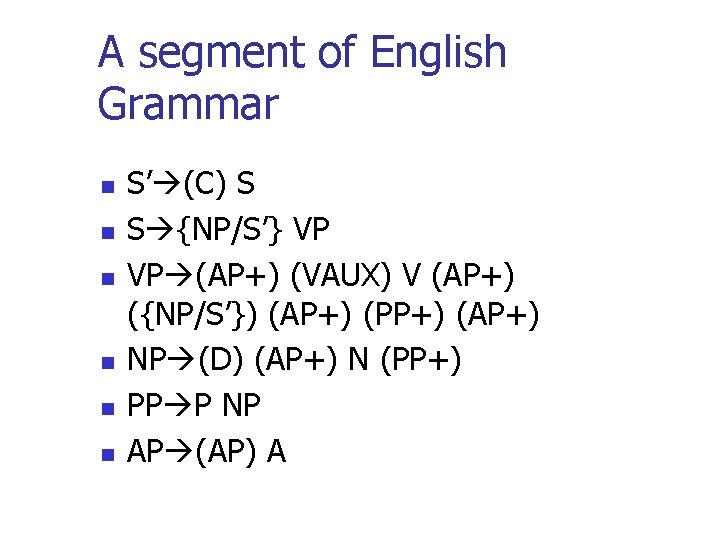
A segment of English Grammar n n n S’ (C) S S {NP/S’} VP VP (AP+) (VAUX) V (AP+) ({NP/S’}) (AP+) (PP+) (AP+) NP (D) (AP+) N (PP+) PP P NP AP (AP) A
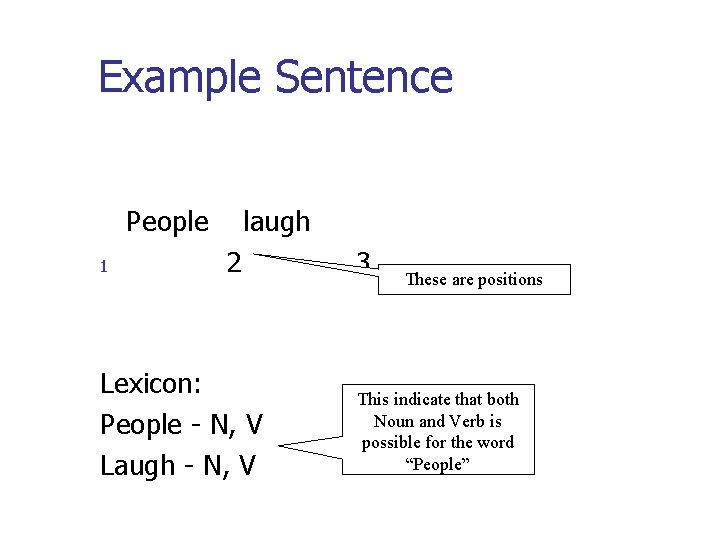
Example Sentence People 1 laugh 2 Lexicon: People - N, V Laugh - N, V 3 These are positions This indicate that both Noun and Verb is possible for the word “People”
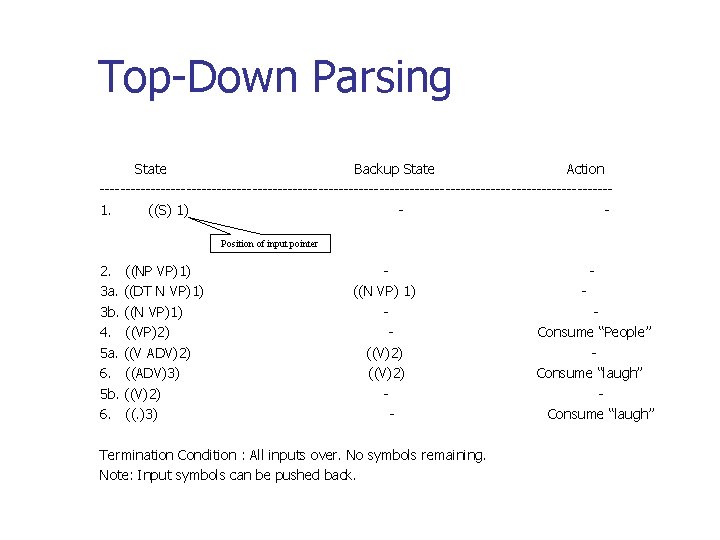
Top-Down Parsing State Backup State Action --------------------------------------------------1. ((S) 1) Position of input pointer 2. ((NP VP)1) 3 a. ((DT N VP)1) 3 b. ((N VP)1) 4. ((VP)2) 5 a. ((V ADV)2) 6. ((ADV)3) 5 b. ((V)2) 6. ((. )3) ((N VP) 1) ((V)2) - Termination Condition : All inputs over. No symbols remaining. Note: Input symbols can be pushed back. Consume “People” Consume “laugh”
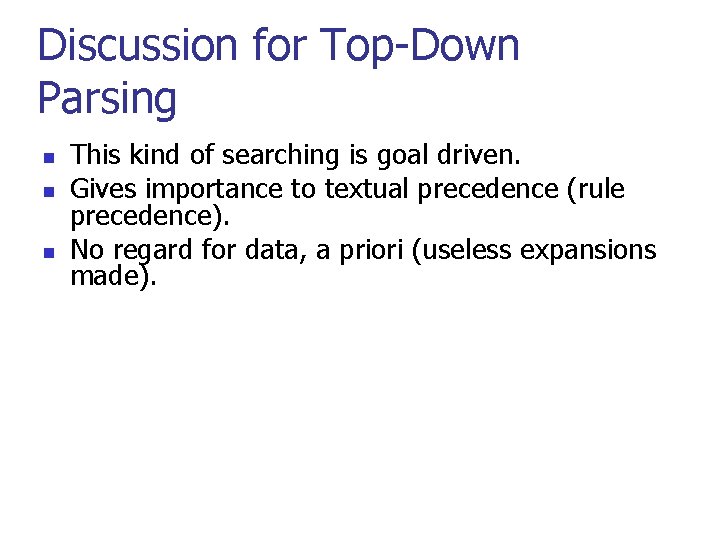
Discussion for Top-Down Parsing n n n This kind of searching is goal driven. Gives importance to textual precedence (rule precedence). No regard for data, a priori (useless expansions made).
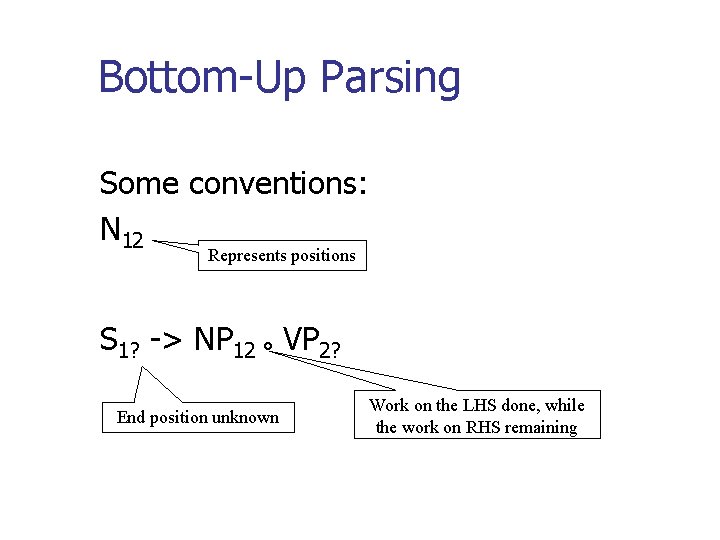
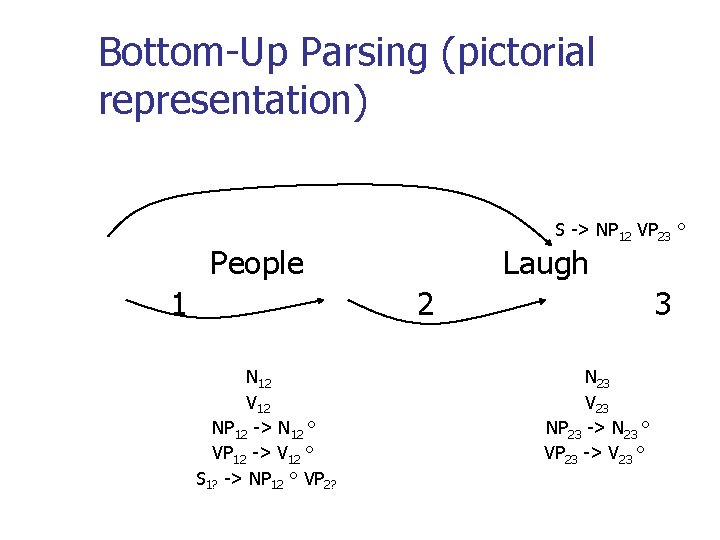
Bottom-Up Parsing Some conventions: N 12 Represents positions S 1? -> NP 12 ° VP 2? End position unknown Work on the LHS done, while the work on RHS remaining
Bottom-Up Parsing (pictorial representation) S -> NP 12 VP 23 ° People 1 Laugh 2 N 12 V 12 NP 12 -> N 12 ° VP 12 -> V 12 ° S 1? -> NP 12 ° VP 2? 3 N 23 V 23 NP 23 -> N 23 ° VP 23 -> V 23 °
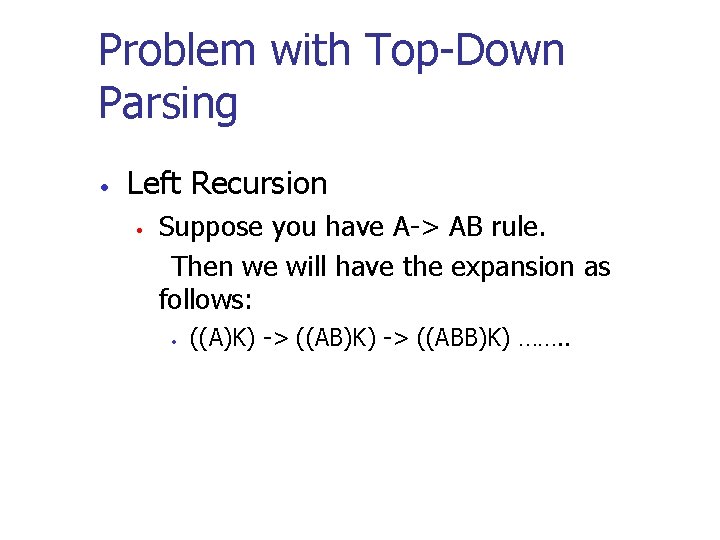
Problem with Top-Down Parsing • Left Recursion • Suppose you have A-> AB rule. Then we will have the expansion as follows: • ((A)K) -> ((ABB)K) ……. .
Combining top-down and bottom-up strategies
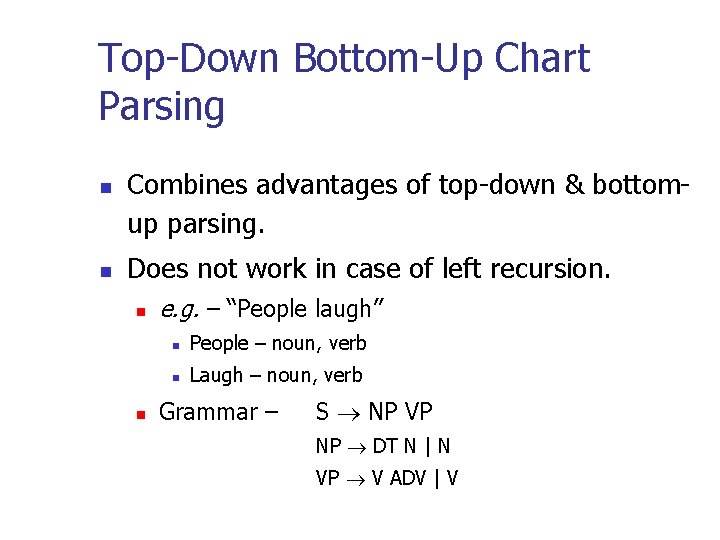
Top-Down Bottom-Up Chart Parsing n n Combines advantages of top-down & bottomup parsing. Does not work in case of left recursion. n n e. g. – “People laugh” n People – noun, verb n Laugh – noun, verb Grammar – S NP VP NP DT N | N VP V ADV | V
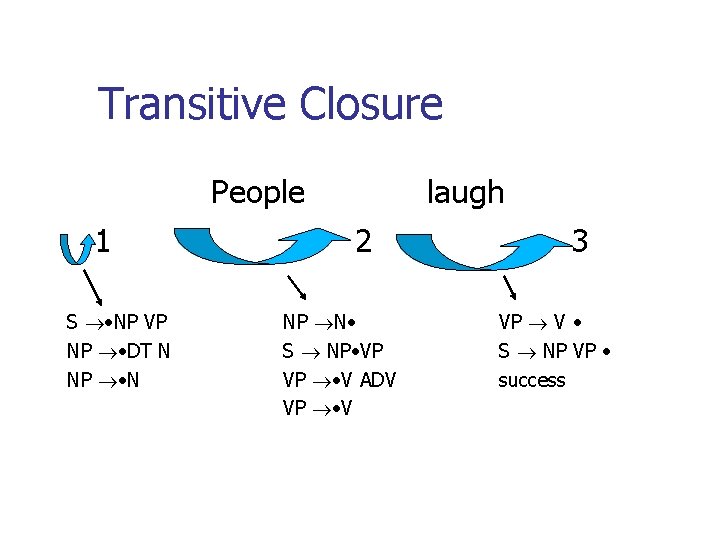
Transitive Closure People 1 S NP VP NP DT N NP N laugh 2 NP N S NP VP VP V ADV VP V 3 VP V S NP VP success
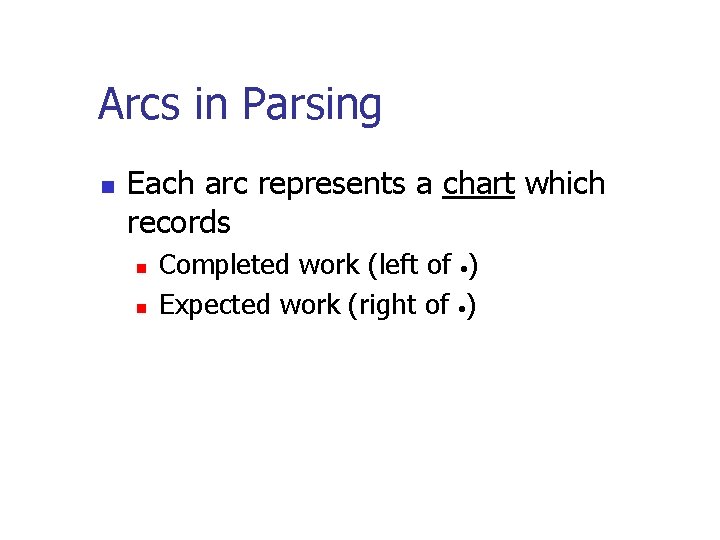
Arcs in Parsing n Each arc represents a chart which records n n Completed work (left of ) Expected work (right of )
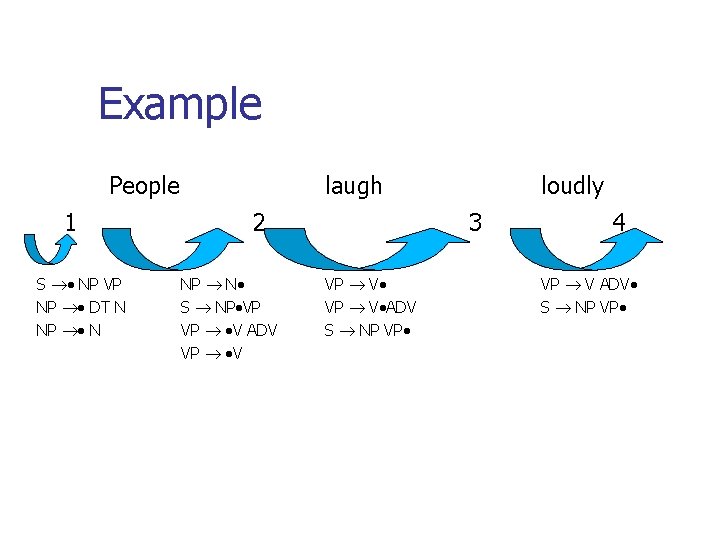
Example People 1 S NP VP NP DT N NP N laugh 2 NP N S NP VP VP V ADV VP V loudly 3 VP V ADV S NP VP 4 VP V ADV S NP VP
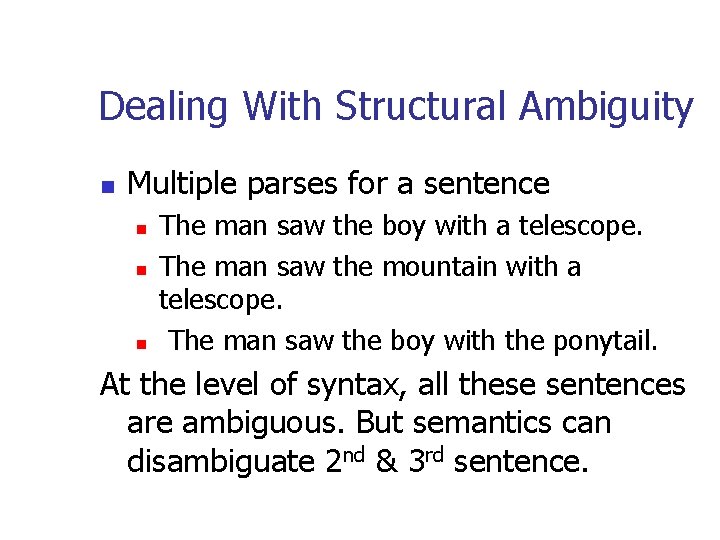
Dealing With Structural Ambiguity n Multiple parses for a sentence n n n The man saw the boy with a telescope. The man saw the mountain with a telescope. The man saw the boy with the ponytail. At the level of syntax, all these sentences are ambiguous. But semantics can disambiguate 2 nd & 3 rd sentence.
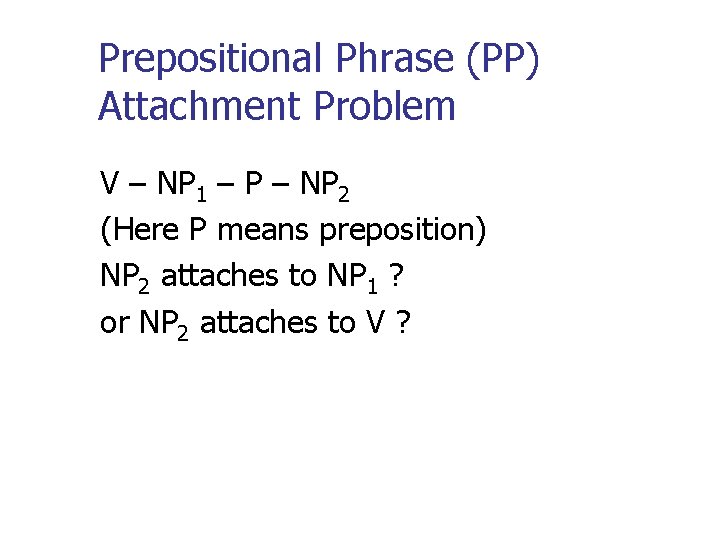
Prepositional Phrase (PP) Attachment Problem V – NP 1 – P – NP 2 (Here P means preposition) NP 2 attaches to NP 1 ? or NP 2 attaches to V ?
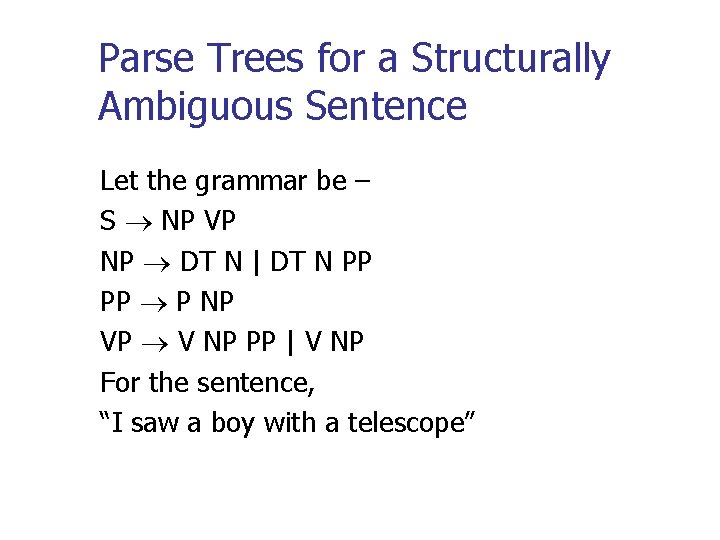
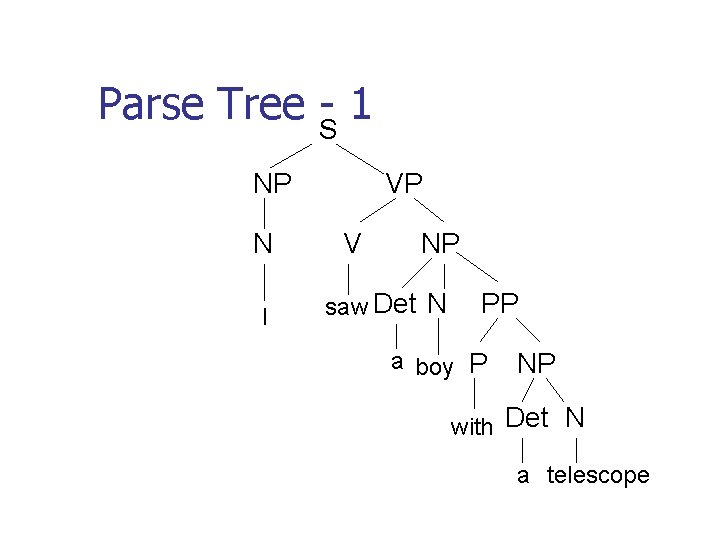
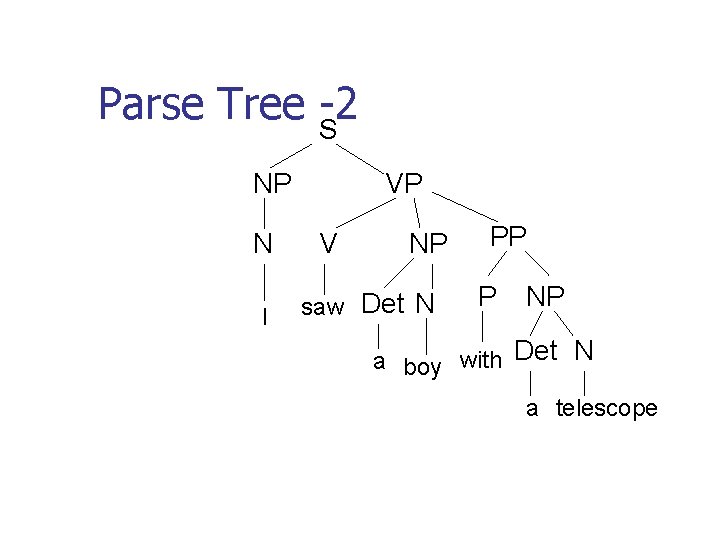
Parse Trees for a Structurally Ambiguous Sentence Let the grammar be – S NP VP NP DT N | DT N PP PP P NP VP V NP PP | V NP For the sentence, “I saw a boy with a telescope”
Parse Tree -S 1 NP N I VP V NP saw Det N PP a boy P NP with Det N a telescope
Parse Tree -2 S NP N I VP V NP saw Det N PP P NP a boy with Det N a telescope