CS 584 Lecture 8 Assignment Message Passing Very


- Slides: 25
CS 584 Lecture 8 • Assignment?
Message Passing • Very close to Task-Channel model • Based on multi-processor – Set of independent processors – Connected via some communication net • All communication between processes is done via a message sent from one to the other
MPI • Message Passing Interface • Computation is made of: – One or more processors – Communicate by calling library routines • MIMD programming model • SPMD most common.
MPI • Processes use point-to-point communication operations • Collective communication operations are also available. • Communication can be modularized by the use of communicators. – MPI_COMM_WORLD is the base. – Used to identify subsets of processors
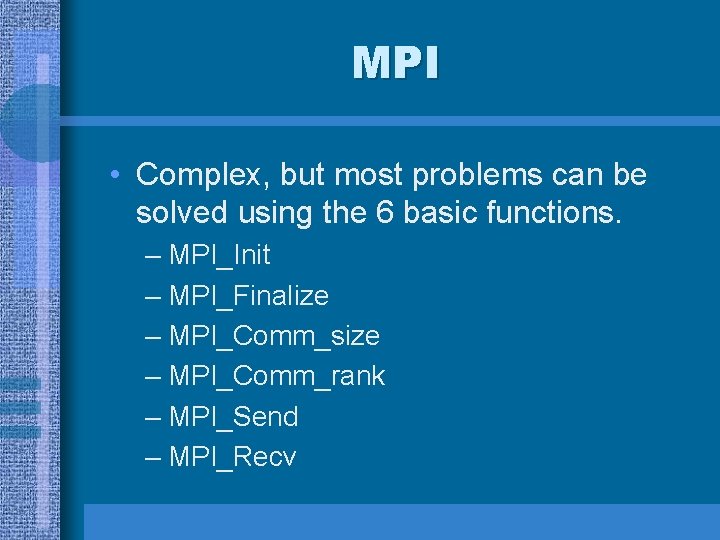
MPI • Complex, but most problems can be solved using the 6 basic functions. – MPI_Init – MPI_Finalize – MPI_Comm_size – MPI_Comm_rank – MPI_Send – MPI_Recv
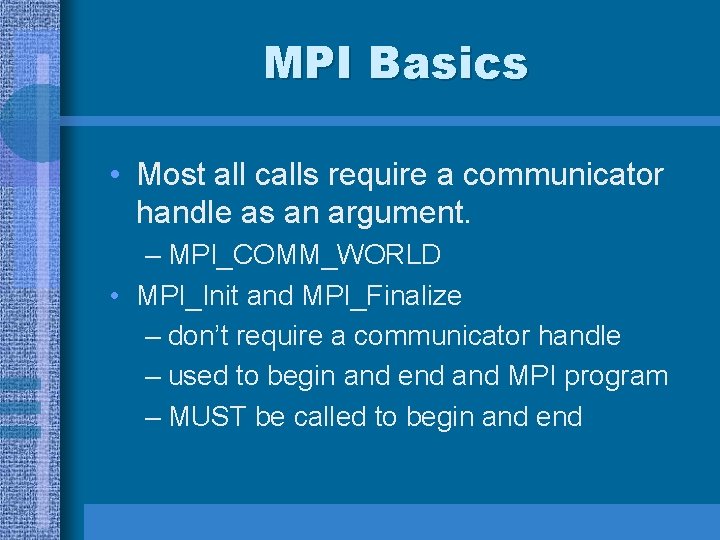
MPI Basics • Most all calls require a communicator handle as an argument. – MPI_COMM_WORLD • MPI_Init and MPI_Finalize – don’t require a communicator handle – used to begin and end and MPI program – MUST be called to begin and end
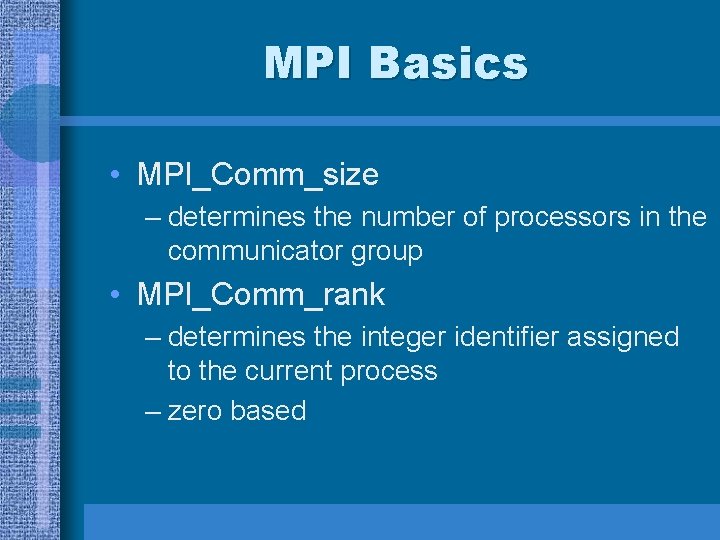
MPI Basics • MPI_Comm_size – determines the number of processors in the communicator group • MPI_Comm_rank – determines the integer identifier assigned to the current process – zero based
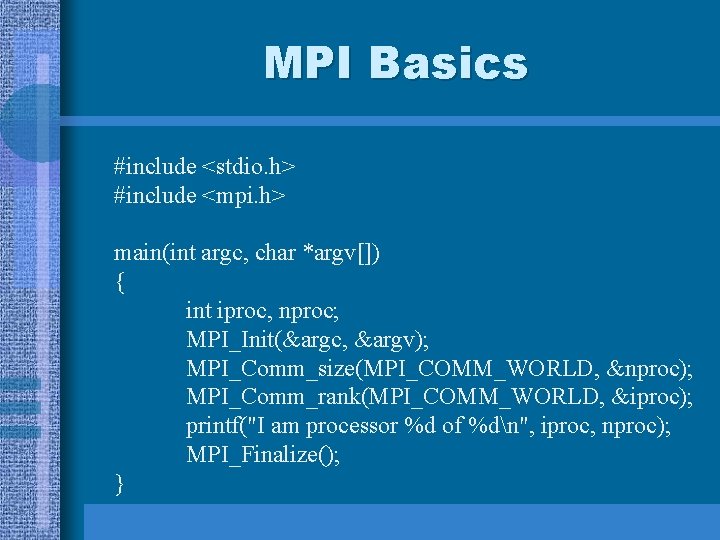
MPI Basics #include <stdio. h> #include <mpi. h> main(int argc, char *argv[]) { int iproc, nproc; MPI_Init(&argc, &argv); MPI_Comm_size(MPI_COMM_WORLD, &nproc); MPI_Comm_rank(MPI_COMM_WORLD, &iproc); printf("I am processor %d of %dn", iproc, nproc); MPI_Finalize(); }
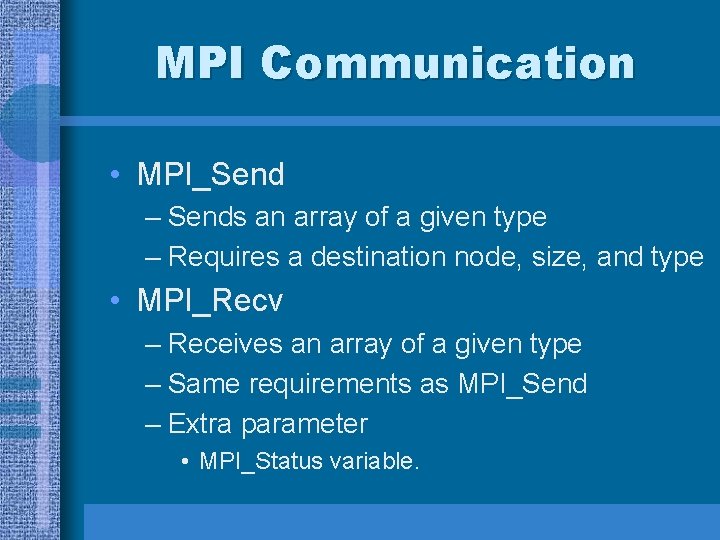
MPI Communication • MPI_Send – Sends an array of a given type – Requires a destination node, size, and type • MPI_Recv – Receives an array of a given type – Same requirements as MPI_Send – Extra parameter • MPI_Status variable.
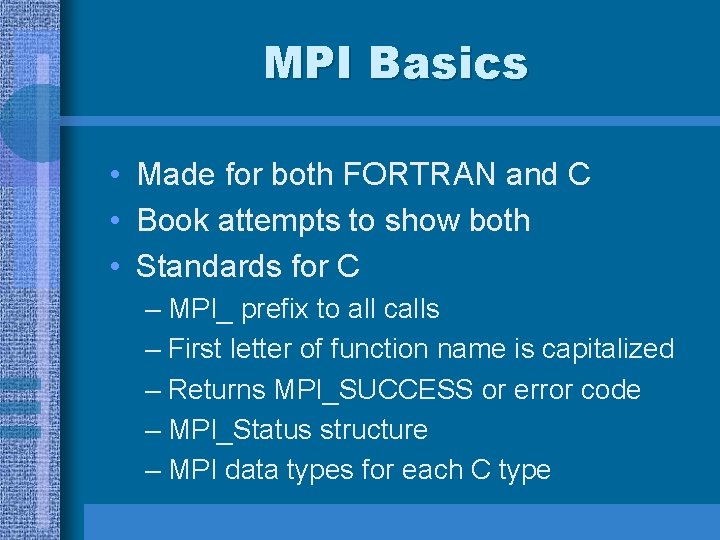
MPI Basics • Made for both FORTRAN and C • Book attempts to show both • Standards for C – MPI_ prefix to all calls – First letter of function name is capitalized – Returns MPI_SUCCESS or error code – MPI_Status structure – MPI data types for each C type
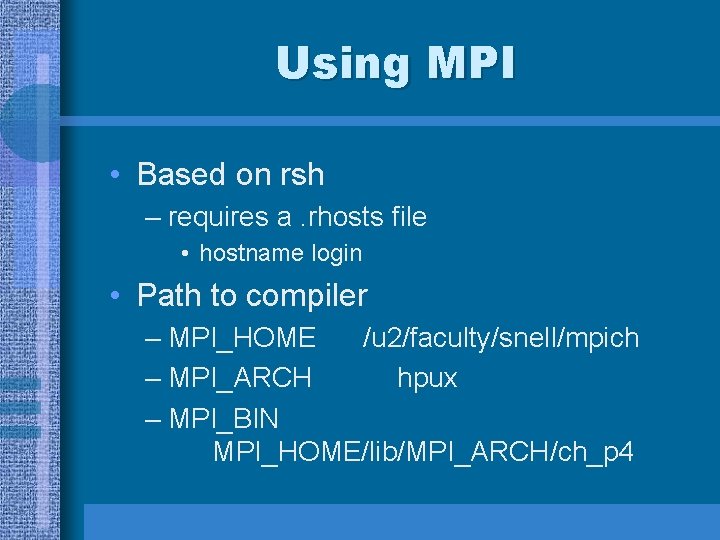
Using MPI • Based on rsh – requires a. rhosts file • hostname login • Path to compiler – MPI_HOME /u 2/faculty/snell/mpich – MPI_ARCH hpux – MPI_BIN MPI_HOME/lib/MPI_ARCH/ch_p 4
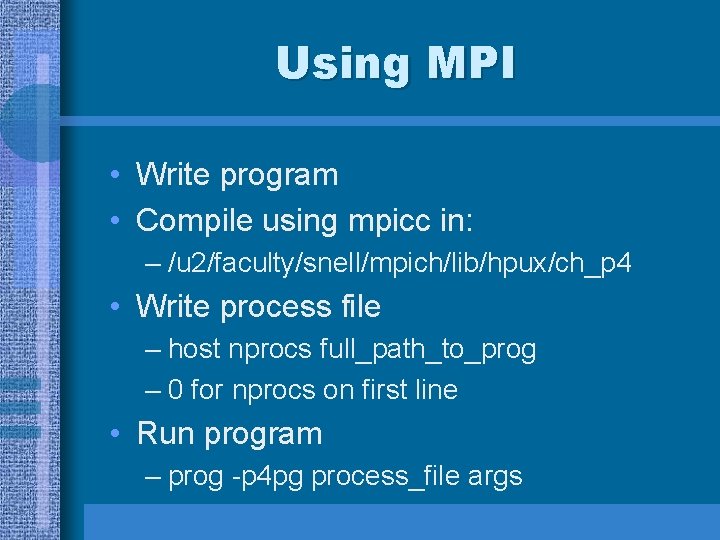
Using MPI • Write program • Compile using mpicc in: – /u 2/faculty/snell/mpich/lib/hpux/ch_p 4 • Write process file – host nprocs full_path_to_prog – 0 for nprocs on first line • Run program – prog -p 4 pg process_file args
Example • 2 D finite differences code • Incomplete • In book on page 281
MPI • Message Passing programs are nondeterministic because of concurrency – Consider 2 processes sending messages to third • MPI does guarantee that 2 messages sent from a single process to another will arrive in order. • It is the programmer's responsibility to ensure computation determinism
MPI & Determinism • Task-Channel model – One reader and one writer per channel – Separate channel for each communication • MPI – A Process may specify the source of the message – A Process may specify the type of message • Non-Determinism – MPI_ANY_SOURCE or MPI_ANY_TAG
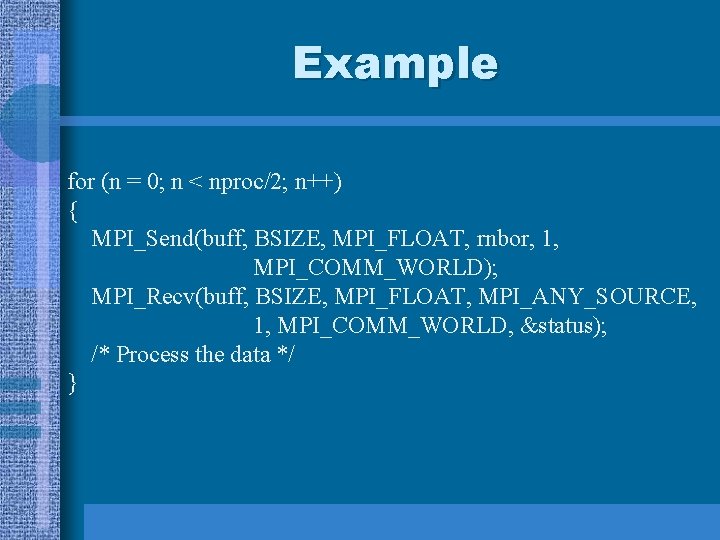
Example for (n = 0; n < nproc/2; n++) { MPI_Send(buff, BSIZE, MPI_FLOAT, rnbor, 1, MPI_COMM_WORLD); MPI_Recv(buff, BSIZE, MPI_FLOAT, MPI_ANY_SOURCE, 1, MPI_COMM_WORLD, &status); /* Process the data */ }
Global Operations • Coordinated communication involving multiple processes. • Can be implemented by the programmer using sends and receives • For convenience, MPI provides a suite of collective communication functions.
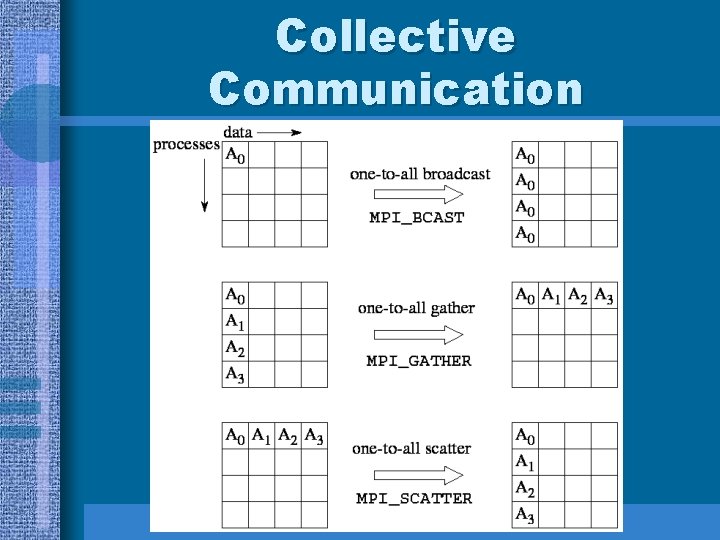
Collective Communication • Barrier – Synchronize all processes • Broadcast • Gather – Gather data from all processes to one process • Scatter • Reduction – Global sums, products, etc.
Collective Communication
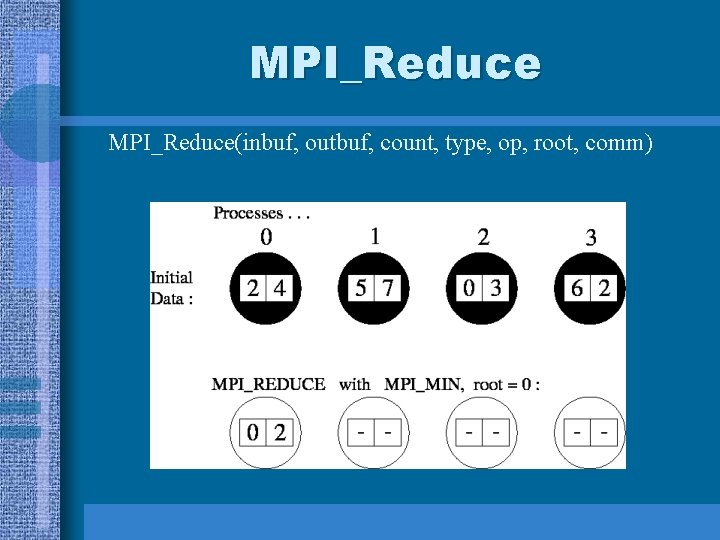
MPI_Reduce(inbuf, outbuf, count, type, op, root, comm)
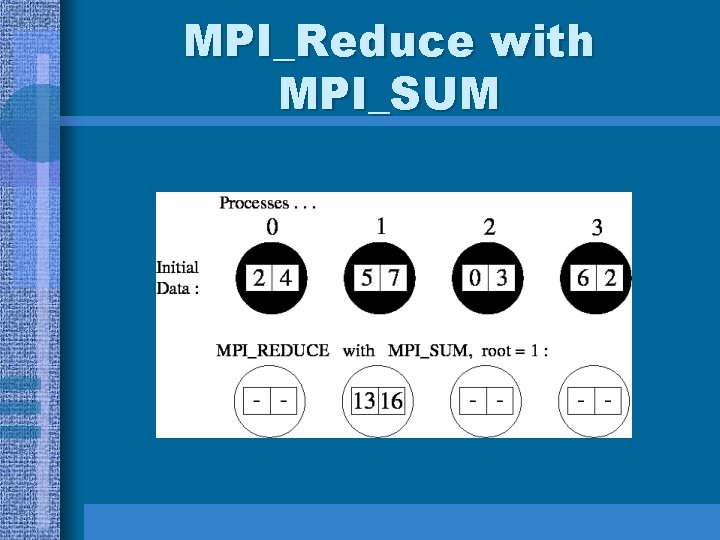
MPI_Reduce with MPI_SUM
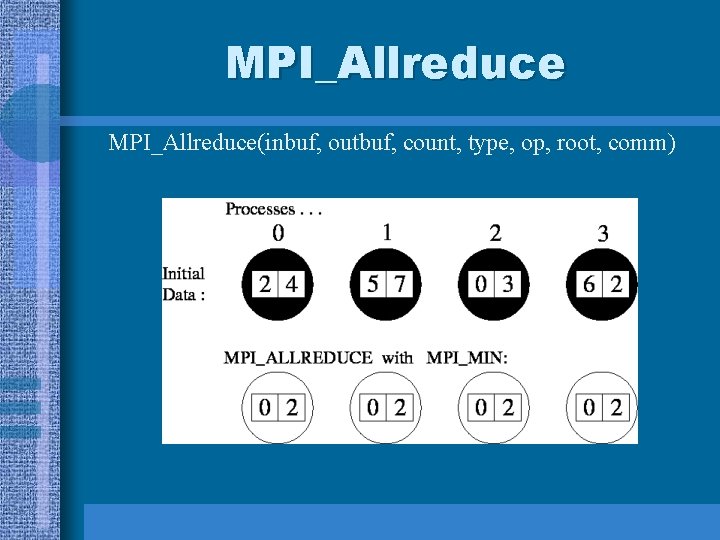
MPI_Allreduce(inbuf, outbuf, count, type, op, root, comm)
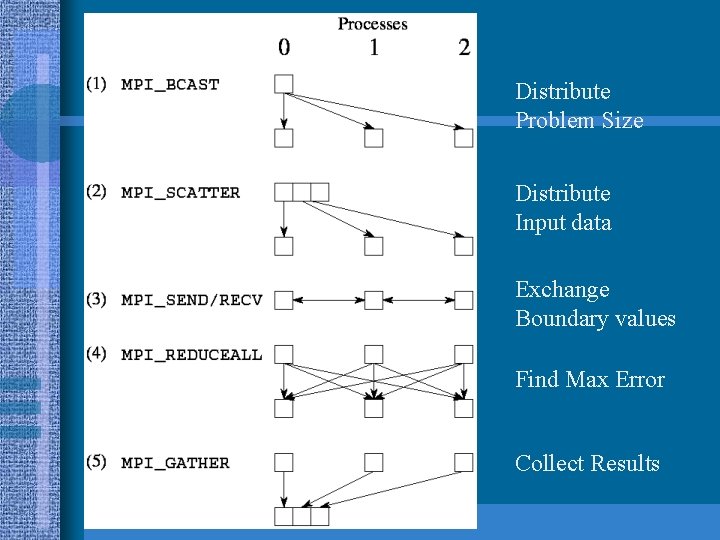
Example • Finite Differences code – program 8. 5 page 289 • Notice the stages – 5 – Signified by the global communication calls
Distribute Problem Size Distribute Input data Exchange Boundary values Find Max Error Collect Results
Other MPI Features • Asynchronous Communication – MPI_ISend – MPI_Wait and MPI_Test – MPI_Probe and MPI_Get_count • Modularity – Communicator creation routines • Derived Datatypes