CS 242 Simula and Smalltalk John Mitchell Simula
- Slides: 36
CS 242 Simula and Smalltalk John Mitchell
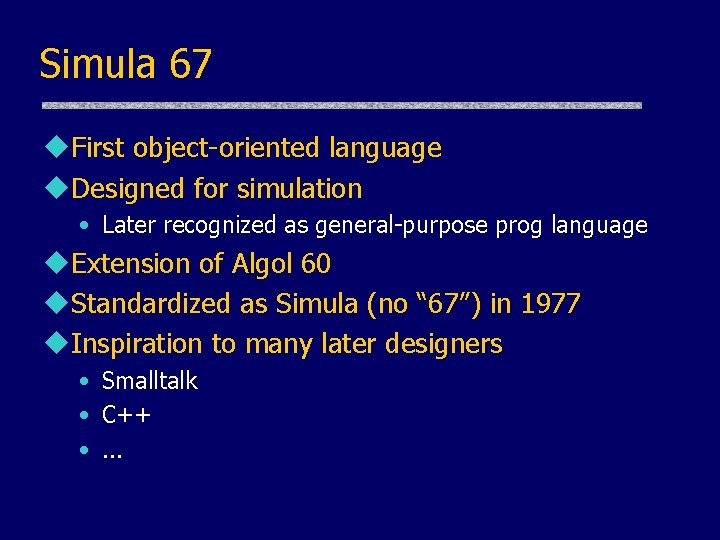
Simula 67 u. First object-oriented language u. Designed for simulation • Later recognized as general-purpose prog language u. Extension of Algol 60 u. Standardized as Simula (no “ 67”) in 1977 u. Inspiration to many later designers • Smalltalk • C++ • . . .
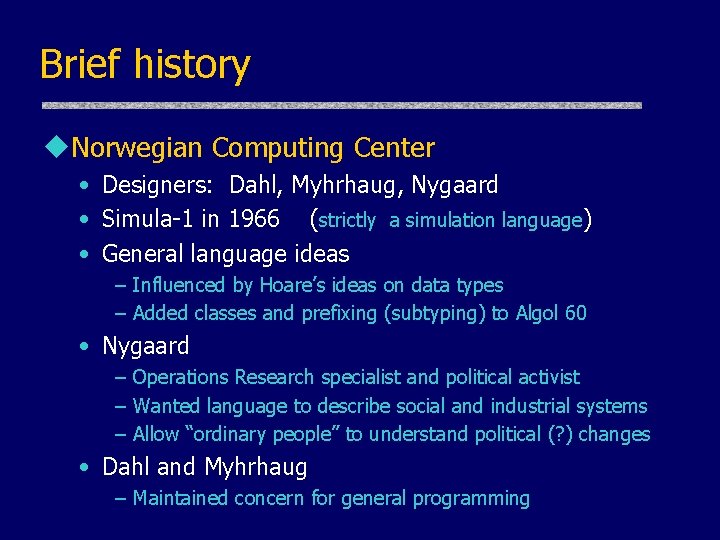
Brief history u. Norwegian Computing Center • Designers: Dahl, Myhrhaug, Nygaard • Simula-1 in 1966 (strictly a simulation language) • General language ideas – Influenced by Hoare’s ideas on data types – Added classes and prefixing (subtyping) to Algol 60 • Nygaard – Operations Research specialist and political activist – Wanted language to describe social and industrial systems – Allow “ordinary people” to understand political (? ) changes • Dahl and Myhrhaug – Maintained concern for general programming
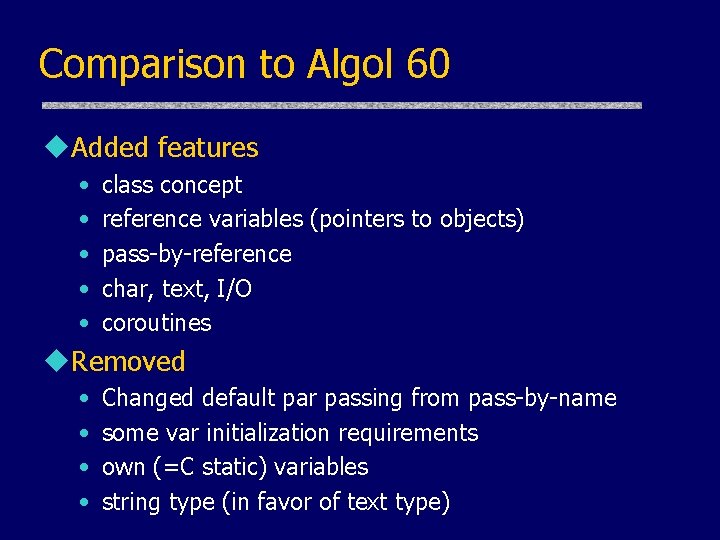
Comparison to Algol 60 u. Added features • • • class concept reference variables (pointers to objects) pass-by-reference char, text, I/O coroutines u. Removed • • Changed default par passing from pass-by-name some var initialization requirements own (=C static) variables string type (in favor of text type)
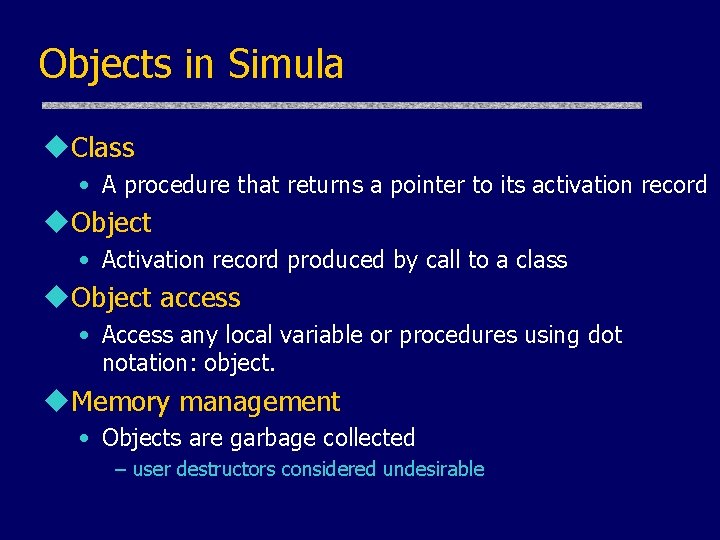
Objects in Simula u. Class • A procedure that returns a pointer to its activation record u. Object • Activation record produced by call to a class u. Object access • Access any local variable or procedures using dot notation: object. u. Memory management • Objects are garbage collected – user destructors considered undesirable
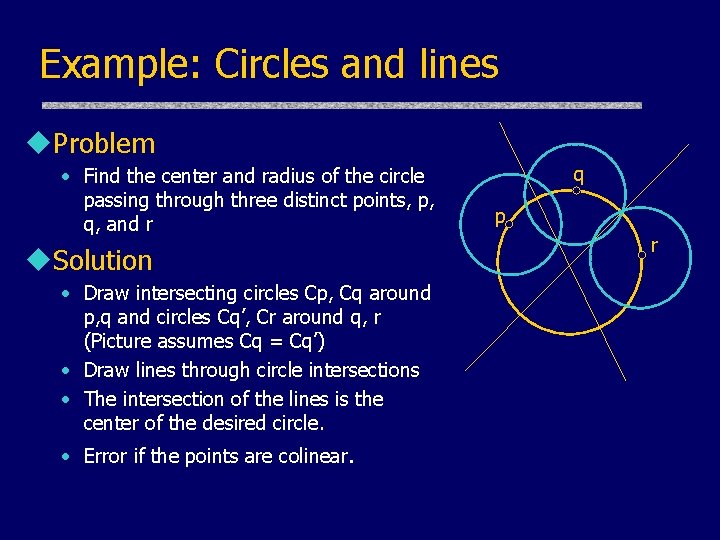
Example: Circles and lines u. Problem • Find the center and radius of the circle passing through three distinct points, p, q, and r u. Solution • Draw intersecting circles Cp, Cq around p, q and circles Cq’, Cr around q, r (Picture assumes Cq = Cq’) • Draw lines through circle intersections • The intersection of the lines is the center of the desired circle. • Error if the points are colinear. q p r
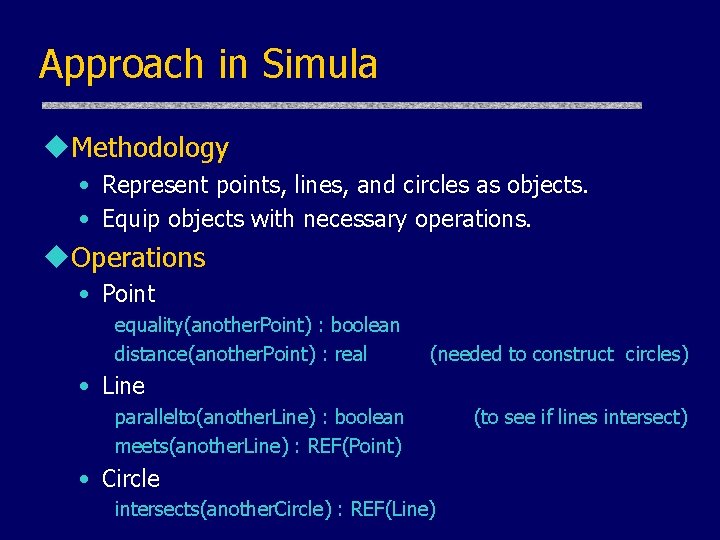
Approach in Simula u. Methodology • Represent points, lines, and circles as objects. • Equip objects with necessary operations. u. Operations • Point equality(another. Point) : boolean distance(another. Point) : real (needed to construct circles) • Line parallelto(another. Line) : boolean meets(another. Line) : REF(Point) • Circle intersects(another. Circle) : REF(Line) (to see if lines intersect)
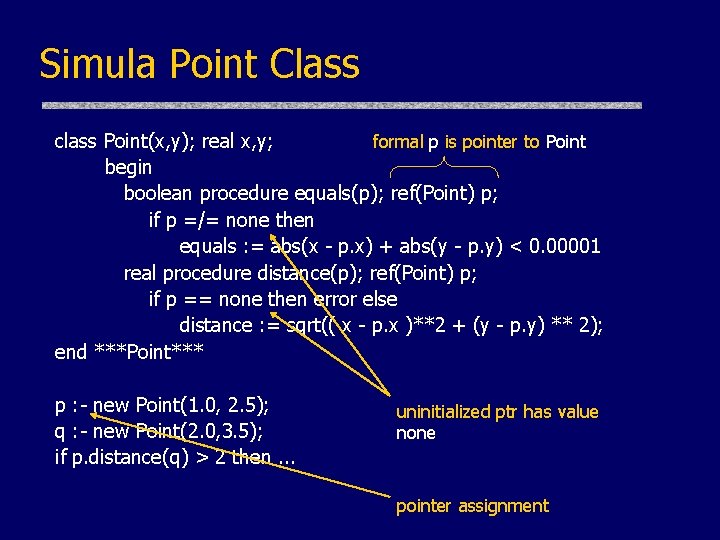
Simula Point Class class Point(x, y); real x, y; formal p is pointer to Point begin boolean procedure equals(p); ref(Point) p; if p =/= none then equals : = abs(x - p. x) + abs(y - p. y) < 0. 00001 real procedure distance(p); ref(Point) p; if p == none then error else distance : = sqrt(( x - p. x )**2 + (y - p. y) ** 2); end ***Point*** p : - new Point(1. 0, 2. 5); q : - new Point(2. 0, 3. 5); if p. distance(q) > 2 then. . . uninitialized ptr has value none pointer assignment
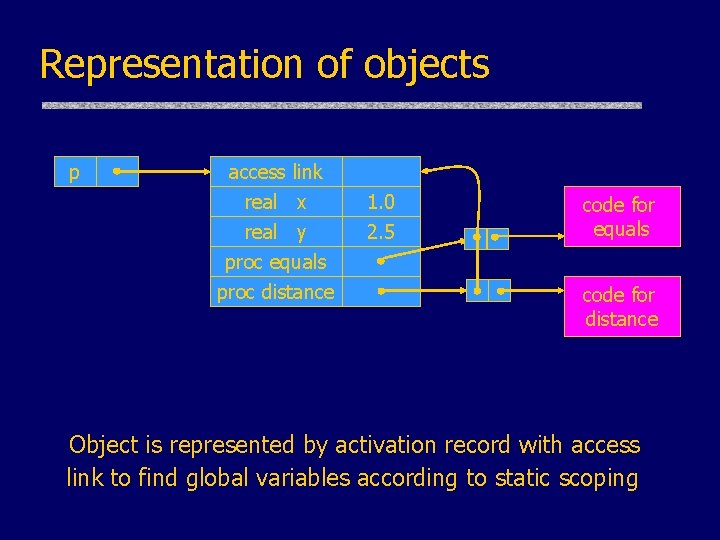
Representation of objects p access link real x real y proc equals proc distance 1. 0 2. 5 code for equals code for distance Object is represented by activation record with access link to find global variables according to static scoping
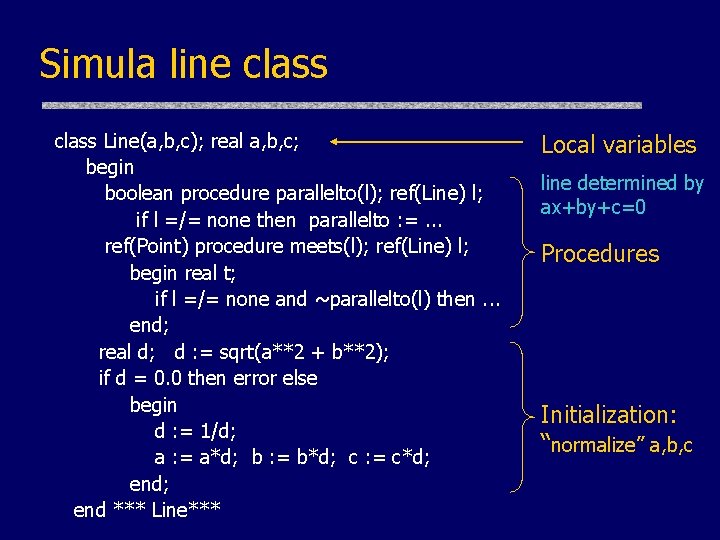
Simula line class Line(a, b, c); real a, b, c; begin boolean procedure parallelto(l); ref(Line) l; if l =/= none then parallelto : =. . . ref(Point) procedure meets(l); ref(Line) l; begin real t; if l =/= none and ~parallelto(l) then. . . end; real d; d : = sqrt(a**2 + b**2); if d = 0. 0 then error else begin d : = 1/d; a : = a*d; b : = b*d; c : = c*d; end *** Line*** Local variables line determined by ax+by+c=0 Procedures Initialization: “normalize” a, b, c
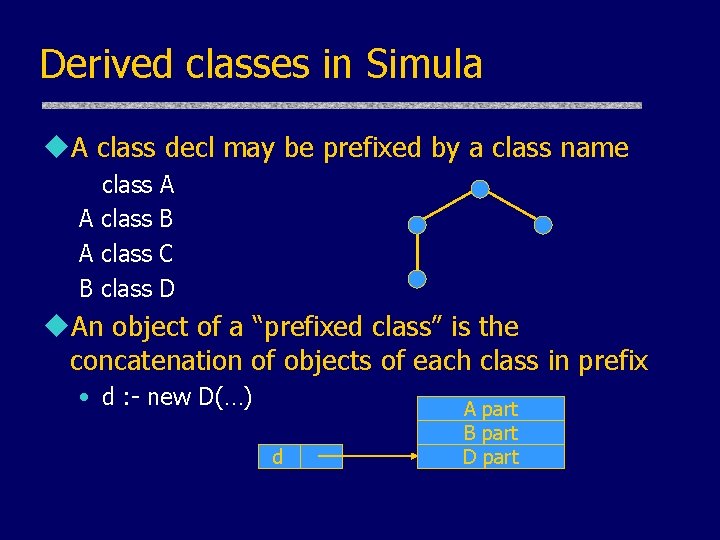
Derived classes in Simula u. A class decl may be prefixed by a class name class A A class B A class C B class D u. An object of a “prefixed class” is the concatenation of objects of each class in prefix • d : - new D(…) d A part B part D part
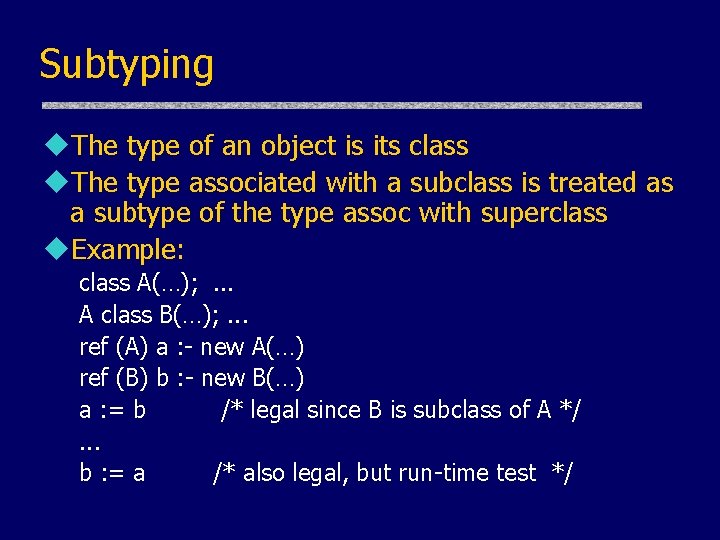
Subtyping u. The type of an object is its class u. The type associated with a subclass is treated as a subtype of the type assoc with superclass u. Example: class A(…); . . . A class B(…); . . . ref (A) a : - new A(…) ref (B) b : - new B(…) a : = b /* legal since B is subclass of A */. . . b : = a /* also legal, but run-time test */
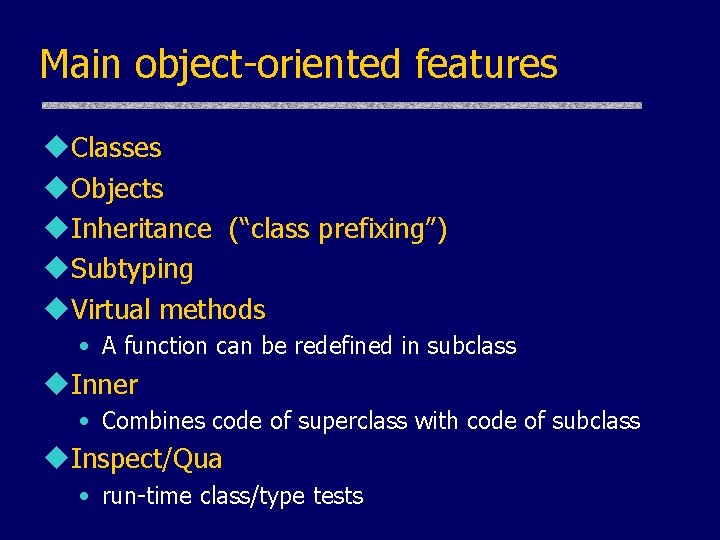
Main object-oriented features u. Classes u. Objects u. Inheritance (“class prefixing”) u. Subtyping u. Virtual methods • A function can be redefined in subclass u. Inner • Combines code of superclass with code of subclass u. Inspect/Qua • run-time class/type tests
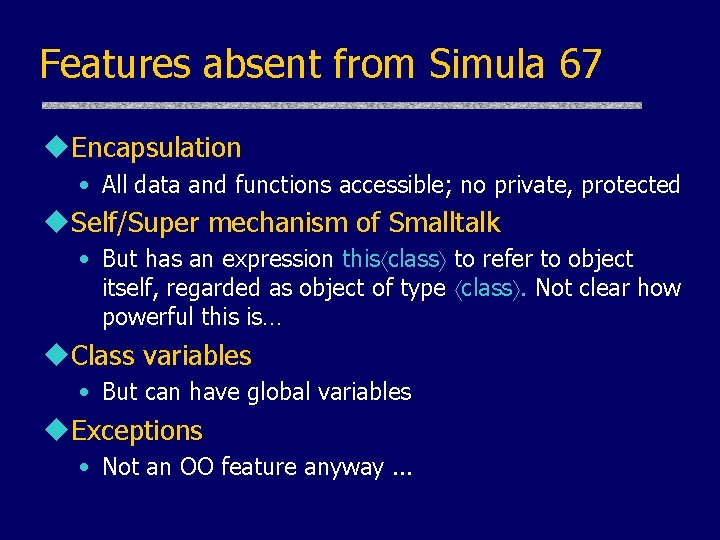
Features absent from Simula 67 u. Encapsulation • All data and functions accessible; no private, protected u. Self/Super mechanism of Smalltalk • But has an expression this class to refer to object itself, regarded as object of type class. Not clear how powerful this is… u. Class variables • But can have global variables u. Exceptions • Not an OO feature anyway. . .
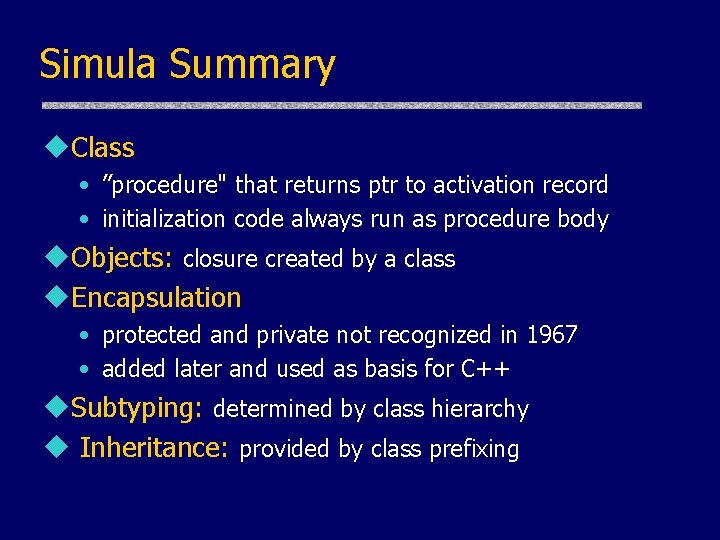
Simula Summary u. Class • ”procedure" that returns ptr to activation record • initialization code always run as procedure body u. Objects: closure created by a class u. Encapsulation • protected and private not recognized in 1967 • added later and used as basis for C++ u. Subtyping: determined by class hierarchy u Inheritance: provided by class prefixing
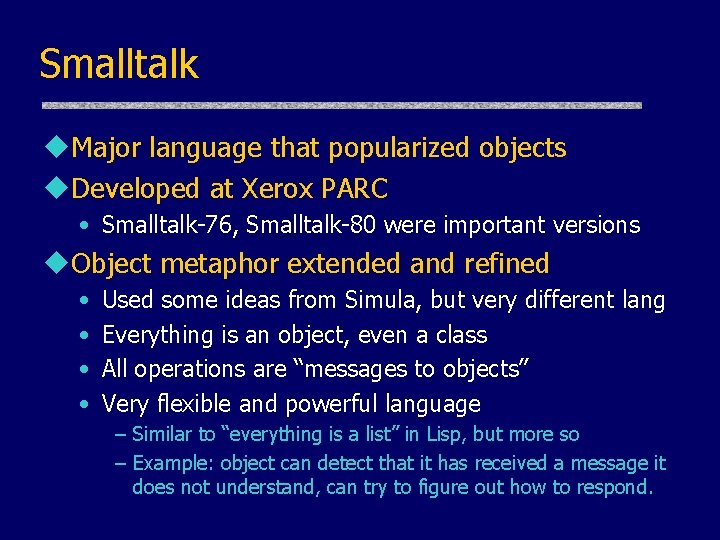
Smalltalk u. Major language that popularized objects u. Developed at Xerox PARC • Smalltalk-76, Smalltalk-80 were important versions u. Object metaphor extended and refined • • Used some ideas from Simula, but very different lang Everything is an object, even a class All operations are “messages to objects” Very flexible and powerful language – Similar to “everything is a list” in Lisp, but more so – Example: object can detect that it has received a message it does not understand, can try to figure out how to respond.
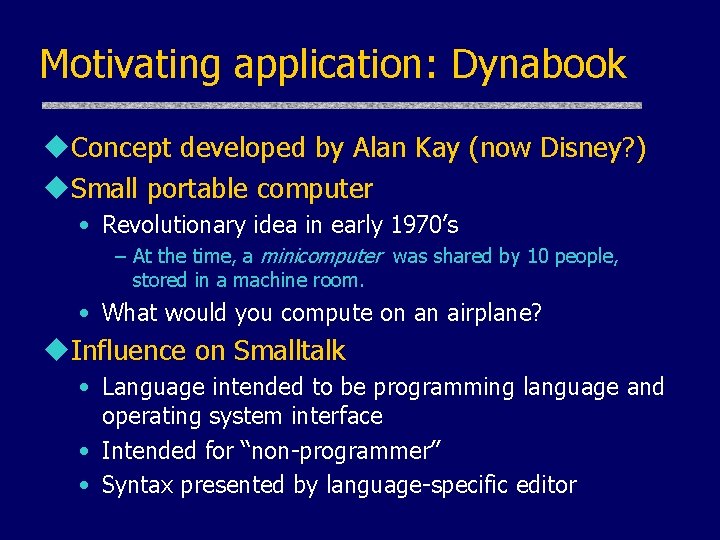
Motivating application: Dynabook u. Concept developed by Alan Kay (now Disney? ) u. Small portable computer • Revolutionary idea in early 1970’s – At the time, a minicomputer was shared by 10 people, stored in a machine room. • What would you compute on an airplane? u. Influence on Smalltalk • Language intended to be programming language and operating system interface • Intended for “non-programmer” • Syntax presented by language-specific editor
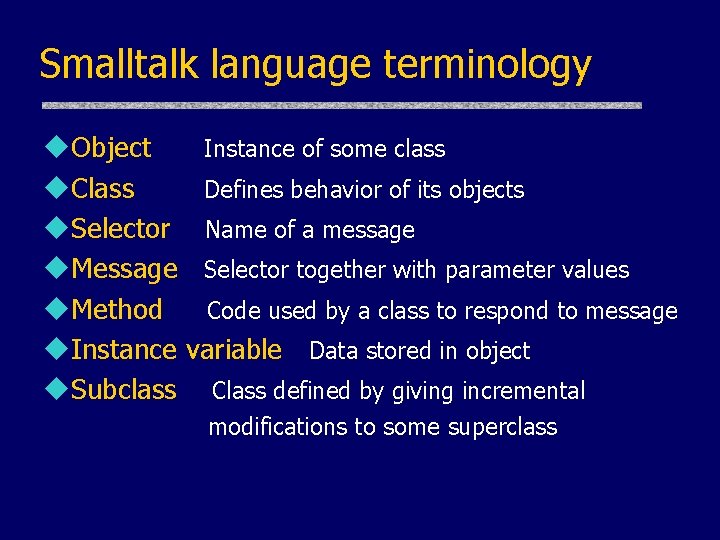
Smalltalk language terminology u. Object Instance of some class u. Class Defines behavior of its objects u. Selector Name of a message u. Message Selector together with parameter values u. Method Code used by a class to respond to message u. Instance variable Data stored in object u. Subclass Class defined by giving incremental modifications to some superclass
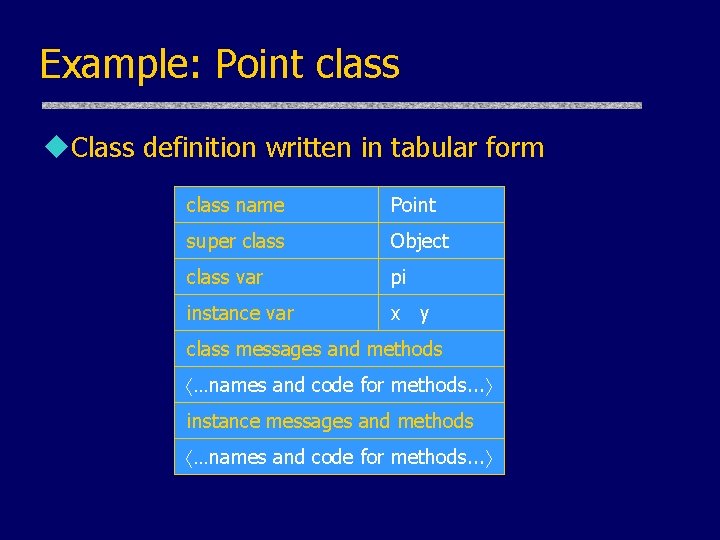
Example: Point class u. Class definition written in tabular form class name Point super class Object class var pi instance var x y class messages and methods …names and code for methods. . . instance messages and methods …names and code for methods. . .
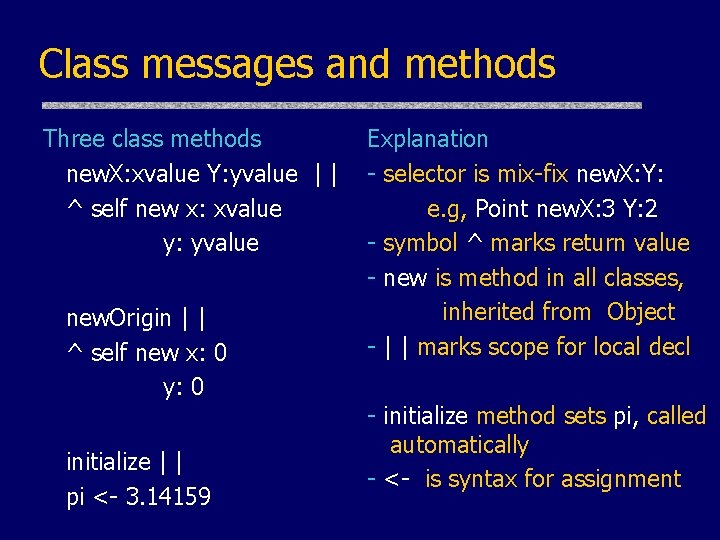
Class messages and methods Three class methods new. X: xvalue Y: yvalue | | ^ self new x: xvalue y: yvalue new. Origin | | ^ self new x: 0 y: 0 initialize | | pi <- 3. 14159 Explanation - selector is mix-fix new. X: Y: e. g, Point new. X: 3 Y: 2 - symbol ^ marks return value - new is method in all classes, inherited from Object - | | marks scope for local decl - initialize method sets pi, called automatically - <- is syntax for assignment
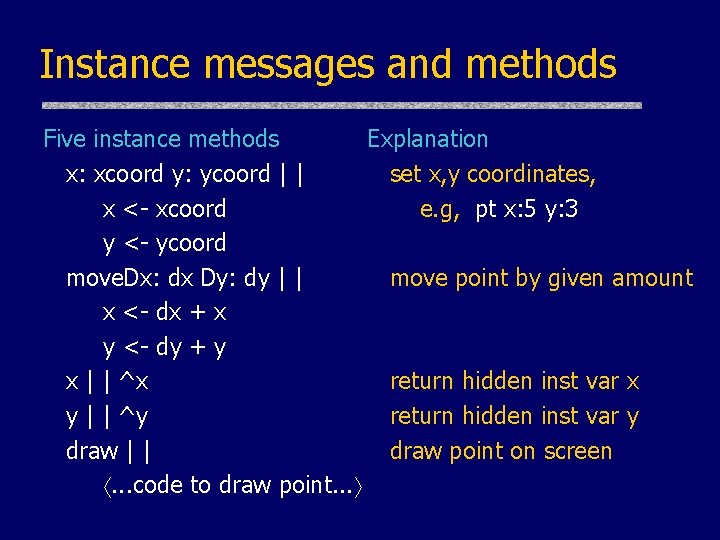
Instance messages and methods Five instance methods Explanation x: xcoord y: ycoord | | set x, y coordinates, x <- xcoord e. g, pt x: 5 y: 3 y <- ycoord move. Dx: dx Dy: dy | | move point by given amount x <- dx + x y <- dy + y x | | ^x return hidden inst var x y | | ^y return hidden inst var y draw | | draw point on screen . . . code to draw point. . .
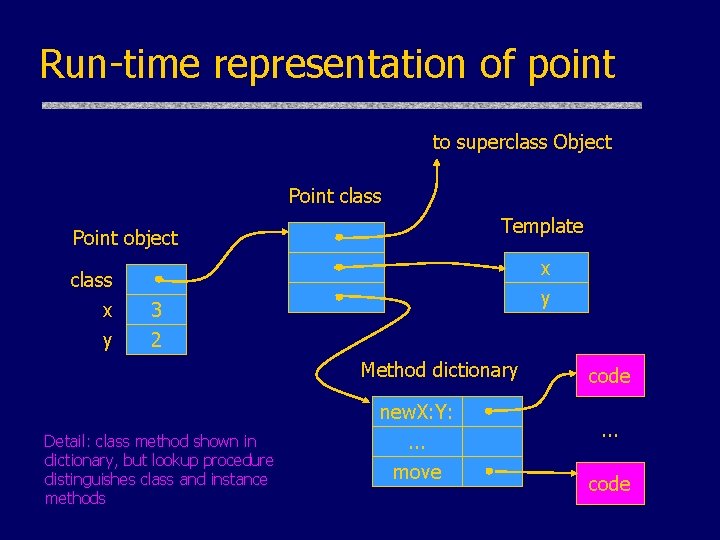
Run-time representation of point to superclass Object Point class Template Point object class x y 3 2 Method dictionary Detail: class method shown in dictionary, but lookup procedure distinguishes class and instance methods new. X: Y: . . . move code. . . code
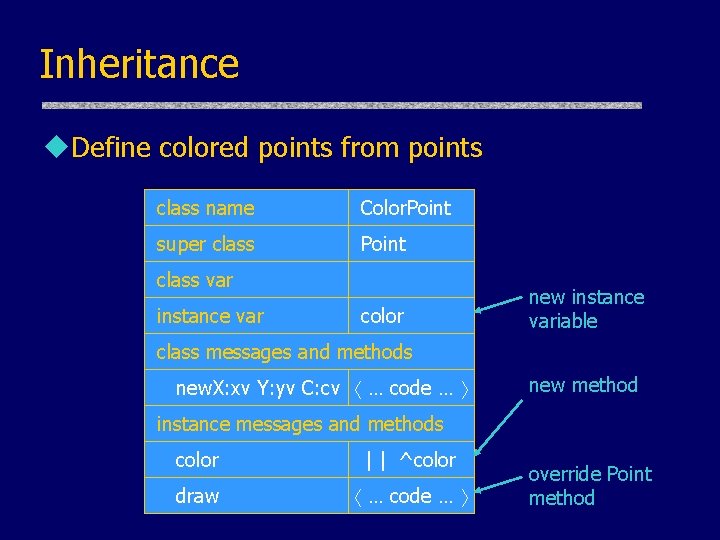
Inheritance u. Define colored points from points class name Color. Point super class Point class var instance var color new instance variable class messages and methods new. X: xv Y: yv C: cv … code … new method instance messages and methods color | | ^color draw … code … override Point method
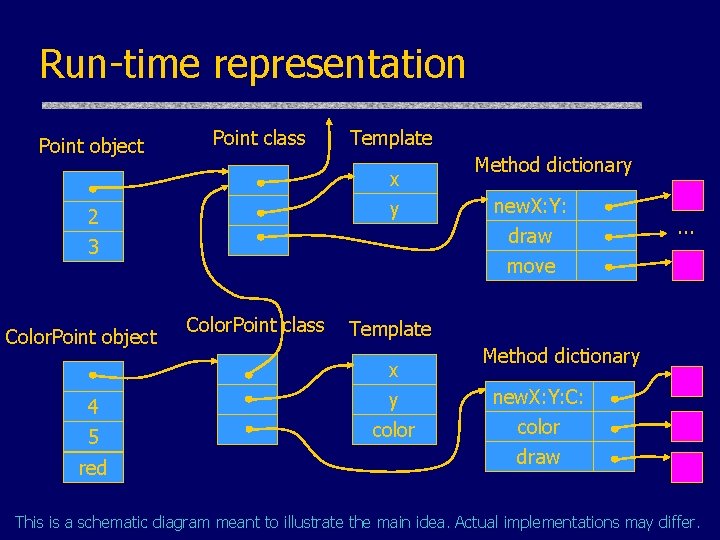
Run-time representation Point object Point class x y 2 3 Color. Point object 4 5 red Template Color. Point class Method dictionary new. X: Y: draw move . . . Template x y color Method dictionary new. X: Y: C: color draw This is a schematic diagram meant to illustrate the main idea. Actual implementations may differ.
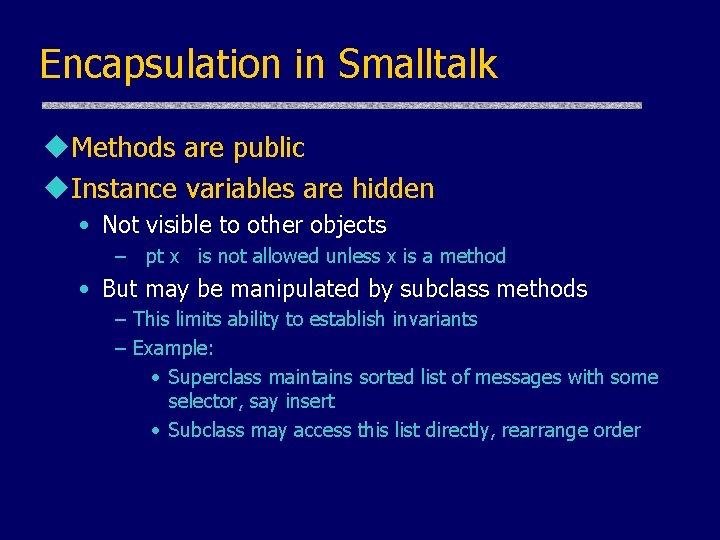
Encapsulation in Smalltalk u. Methods are public u. Instance variables are hidden • Not visible to other objects – pt x is not allowed unless x is a method • But may be manipulated by subclass methods – This limits ability to establish invariants – Example: • Superclass maintains sorted list of messages with some selector, say insert • Subclass may access this list directly, rearrange order
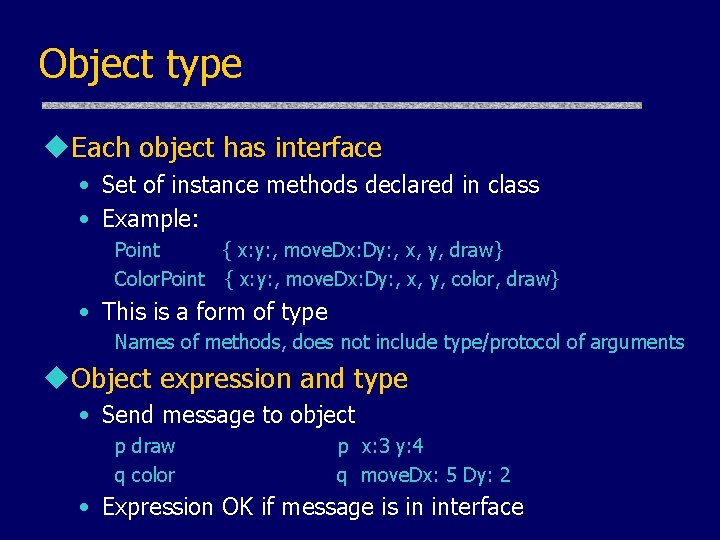
Object type u. Each object has interface • Set of instance methods declared in class • Example: Point { x: y: , move. Dx: Dy: , x, y, draw} Color. Point { x: y: , move. Dx: Dy: , x, y, color, draw} • This is a form of type Names of methods, does not include type/protocol of arguments u. Object expression and type • Send message to object p draw q color p x: 3 y: 4 q move. Dx: 5 Dy: 2 • Expression OK if message is in interface
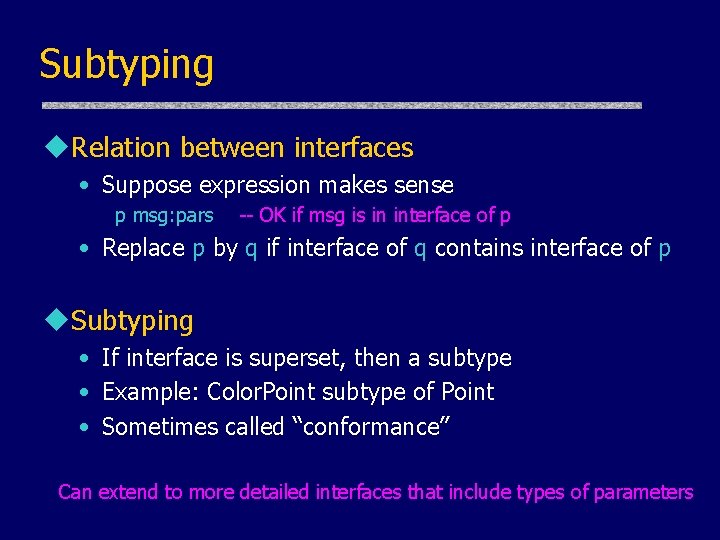
Subtyping u. Relation between interfaces • Suppose expression makes sense p msg: pars -- OK if msg is in interface of p • Replace p by q if interface of q contains interface of p u. Subtyping • If interface is superset, then a subtype • Example: Color. Point subtype of Point • Sometimes called “conformance” Can extend to more detailed interfaces that include types of parameters
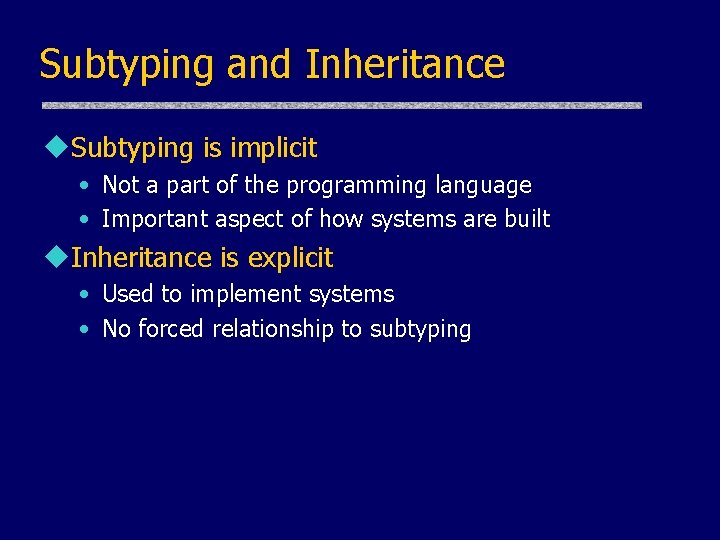
Subtyping and Inheritance u. Subtyping is implicit • Not a part of the programming language • Important aspect of how systems are built u. Inheritance is explicit • Used to implement systems • No forced relationship to subtyping
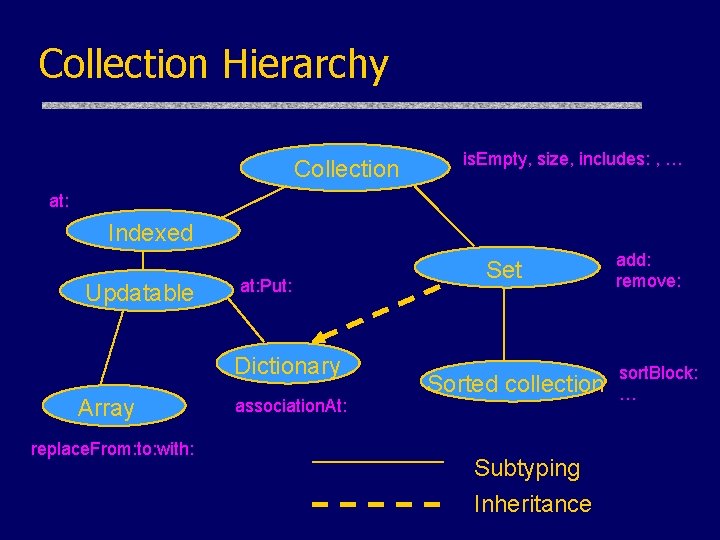
Collection Hierarchy Collection is. Empty, size, includes: , … at: Indexed Updatable at: Put: Dictionary Array replace. From: to: with: association. At: Set Sorted collection Subtyping Inheritance add: remove: sort. Block: …
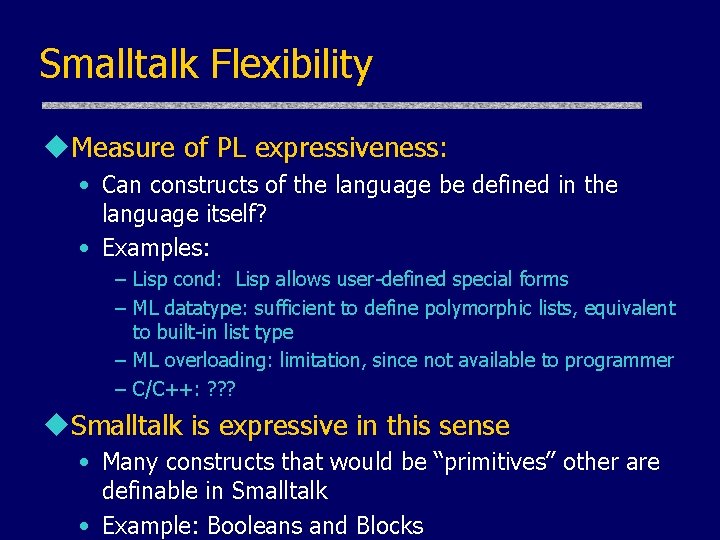
Smalltalk Flexibility u. Measure of PL expressiveness: • Can constructs of the language be defined in the language itself? • Examples: – Lisp cond: Lisp allows user-defined special forms – ML datatype: sufficient to define polymorphic lists, equivalent to built-in list type – ML overloading: limitation, since not available to programmer – C/C++: ? ? ? u. Smalltalk is expressive in this sense • Many constructs that would be “primitives” other are definable in Smalltalk • Example: Booleans and Blocks
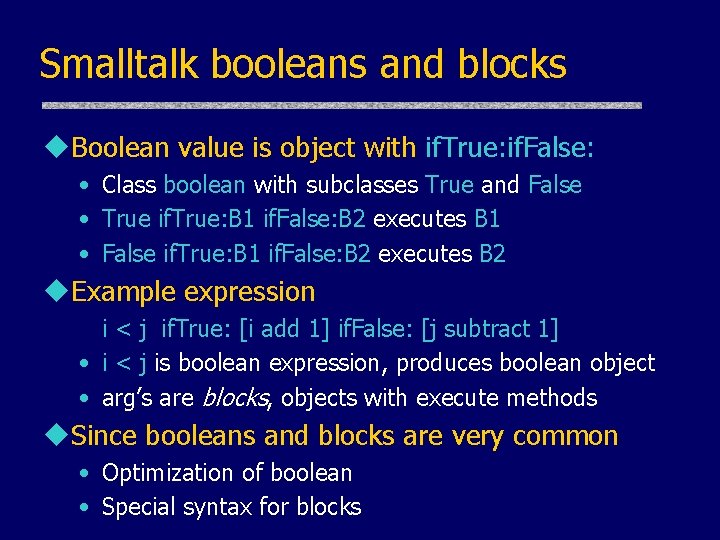
Smalltalk booleans and blocks u. Boolean value is object with if. True: if. False: • Class boolean with subclasses True and False • True if. True: B 1 if. False: B 2 executes B 1 • False if. True: B 1 if. False: B 2 executes B 2 u. Example expression i < j if. True: [i add 1] if. False: [j subtract 1] • i < j is boolean expression, produces boolean object • arg’s are blocks, objects with execute methods u. Since booleans and blocks are very common • Optimization of boolean • Special syntax for blocks
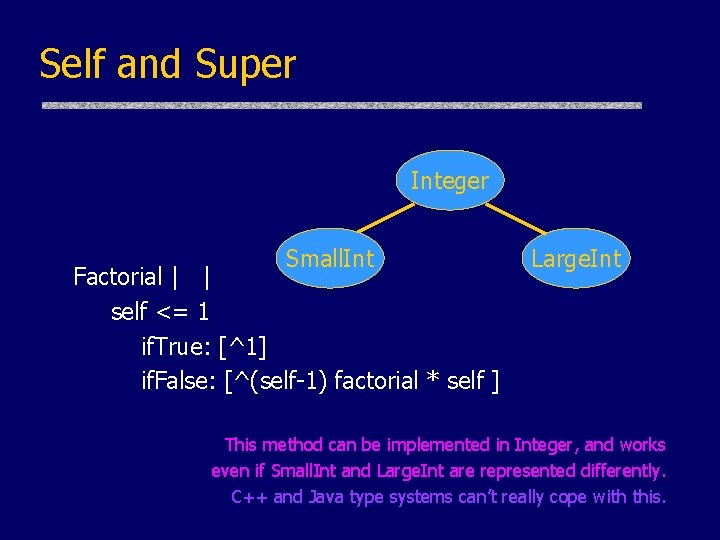
Self and Super Integer Small. Int Factorial | | self <= 1 if. True: [^1] if. False: [^(self-1) factorial * self ] Large. Int This method can be implemented in Integer, and works even if Small. Int and Large. Int are represented differently. C++ and Java type systems can’t really cope with this.
Ingalls’ test u. Dan Ingalls: principal designer Smalltalk system • Grace Murray Hopper award for Smalltalk and Bitmap graphics work at Xerox PARC • 1987 ACM Software Systems Award with Kay, Goldberg u Proposed test for “object oriented” • Can you define a new kind of integer, put your new integers into rectangles (which are already part of the window system), ask the system to blacken a rectangle, and have everything work? • Smalltalk passes, C++ fails this test
Smalltalk integer operations u. Integer expression • x plus: 1 times: 3 plus: (y plus: 1) print u. Properties • All operations are executed by sending messages • If x is from some “new” kind of integer, expression makes sense as long as x has plus, times, print methods. Actually, compiler does some optimization. But will revert to this if x is not built-in integer.
Costs and benefits of “true OO” u. Why is property of Ingalls test useful? • Everything is an object • All objects are accessed only through interface • Makes programs extensible u. What is implementation cost? • Every integer operation involves method call – Unless optimizing compiler can recognize many cases • Is this worth it? – One application where it seems useful ? – One application where it seems too costly? – Are there other issues? Security? (wait for Java final classes…)
Smalltalk Summary u. Class • creates objects that share methods • pointers to template, dictionary, parent class u. Objects: created by a class, contains instance variables u. Encapsulation • methods public, instance variables hidden u. Subtyping: implicit, no static type system u Inheritance: subclasses, self, super Single inheritance in Smalltalk-76, Smalltalk-80