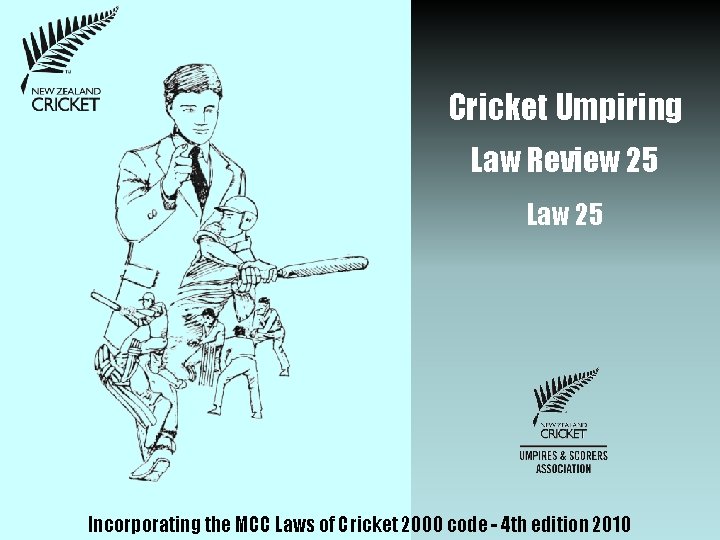
Cricket Umpiring Law Review 25 Law 25 Incorporating
- Slides: 28
Cricket Umpiring Law Review 25 Law 25 Incorporating the MCC Laws of Cricket 2000 code - 4 th edition 2010
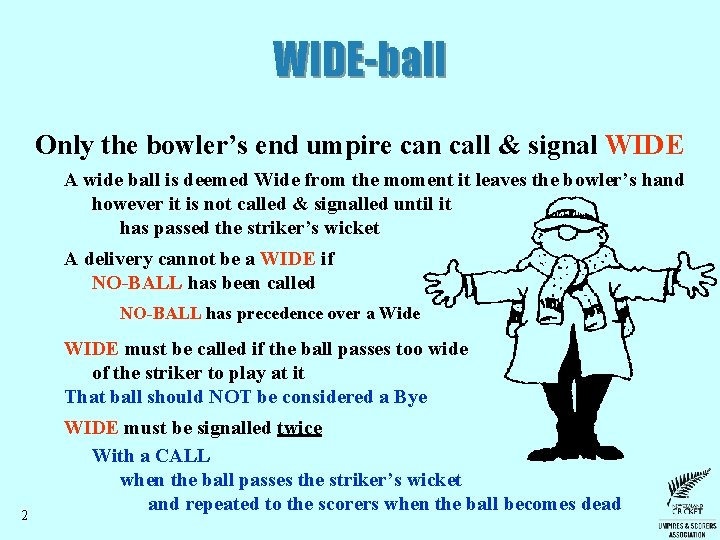
WIDE-ball Only the bowler’s end umpire can call & signal WIDE A wide ball is deemed Wide from the moment it leaves the bowler’s hand however it is not called & signalled until it has passed the striker’s wicket A delivery cannot be a WIDE if NO-BALL has been called NO-BALL has precedence over a Wide WIDE must be called if the ball passes too wide of the striker to play at it That ball should NOT be considered a Bye 2 WIDE must be signalled twice With a CALL when the ball passes the striker’s wicket and repeated to the scorers when the ball becomes dead
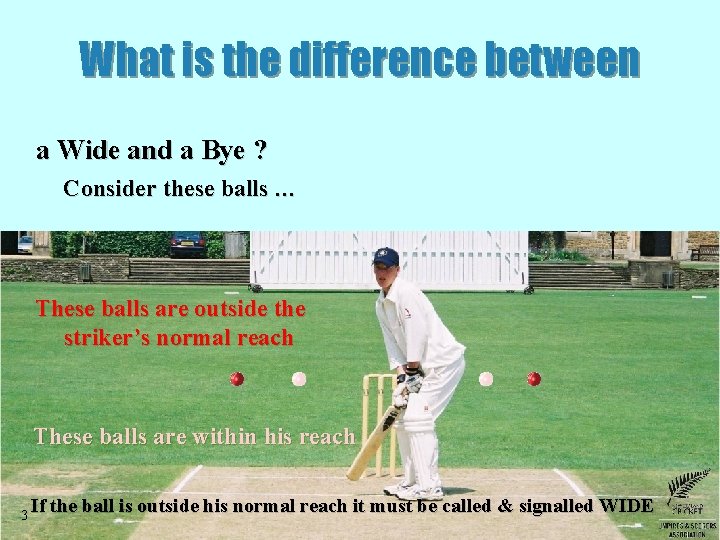
What is the difference between a Wide and a Bye ? Consider these balls … These balls are outside the striker’s normal reach These balls are within his reach 3 If the ball is outside his normal reach it must be called & signalled WIDE
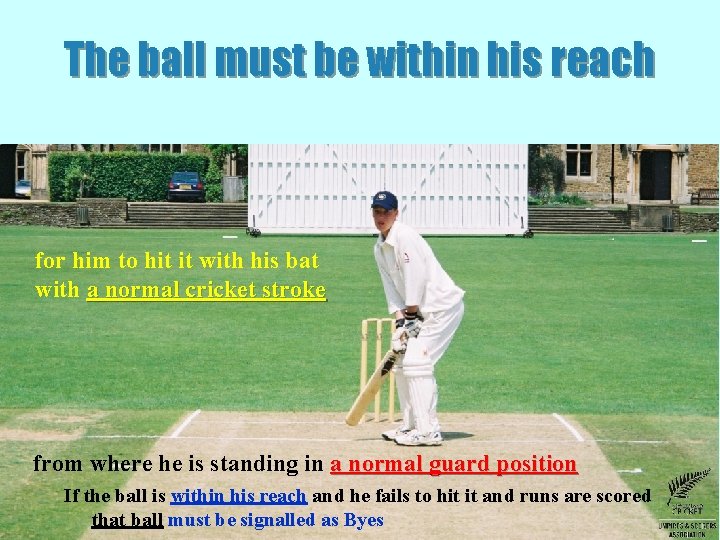
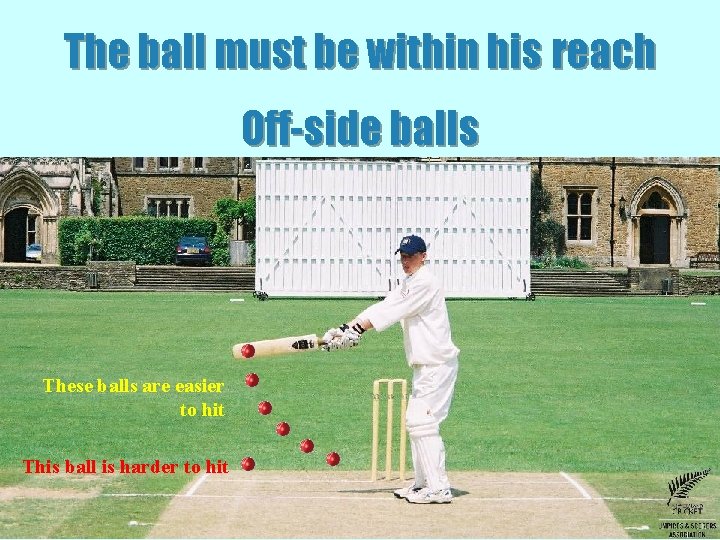
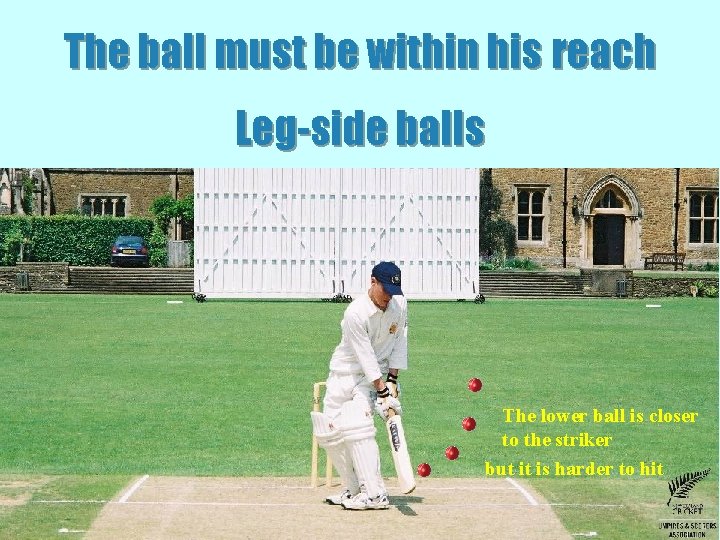
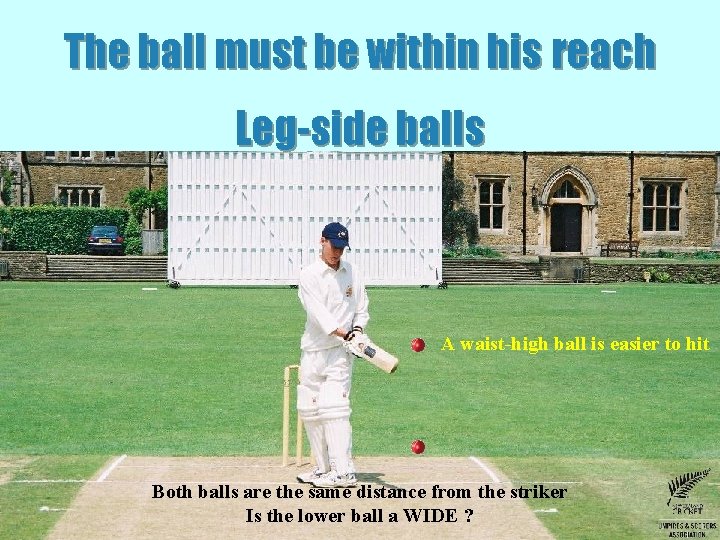
The ball must be within his reach for him to hit it with his bat with a normal cricket stroke from where he is standing in a normal guard position If the ball is within his reach and he fails to hit it and runs are scored that ball must be signalled as Byes
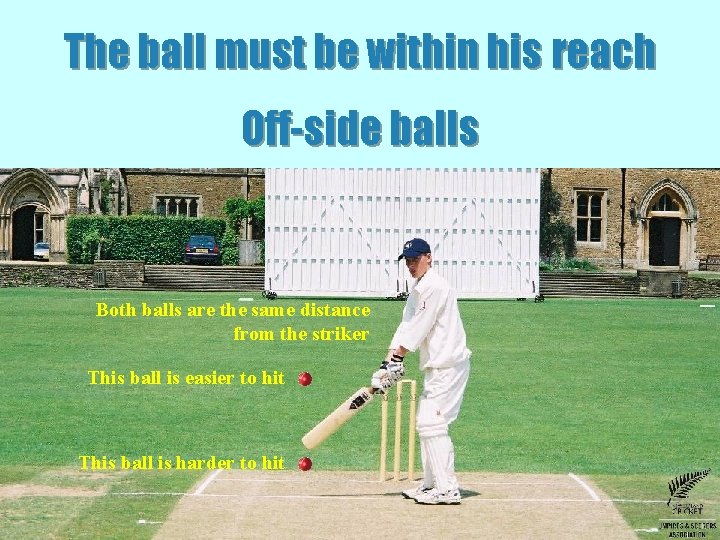
The ball must be within his reach Off-side balls Both balls are the same distance from the striker This ball is easier to hit This ball is harder to hit
The ball must be within his reach Off-side balls These balls are easier to hit This ball is harder to hit
The ball must be within his reach Leg-side balls The lower ball is closer to the striker but it is harder to hit
The ball must be within his reach Leg-side balls A waist-high ball is easier to hit Both balls are the same distance from the striker Is the lower ball a WIDE ?
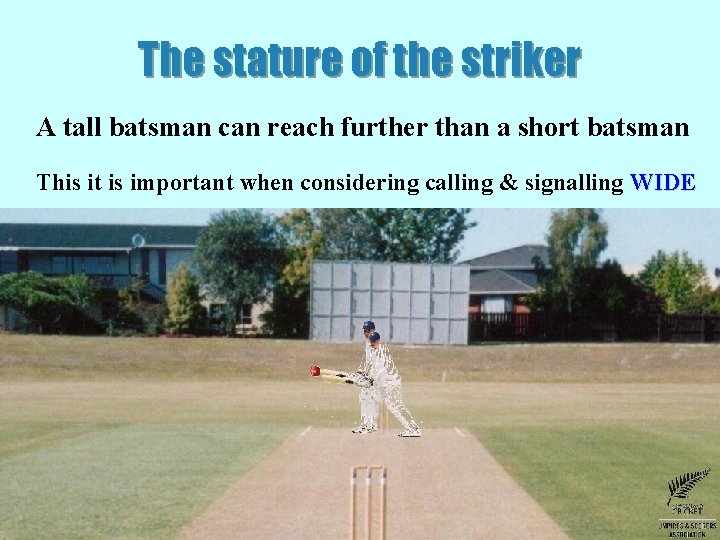
The stature of the striker A tall batsman can reach further than a short batsman This it is important when considering calling & signalling WIDE
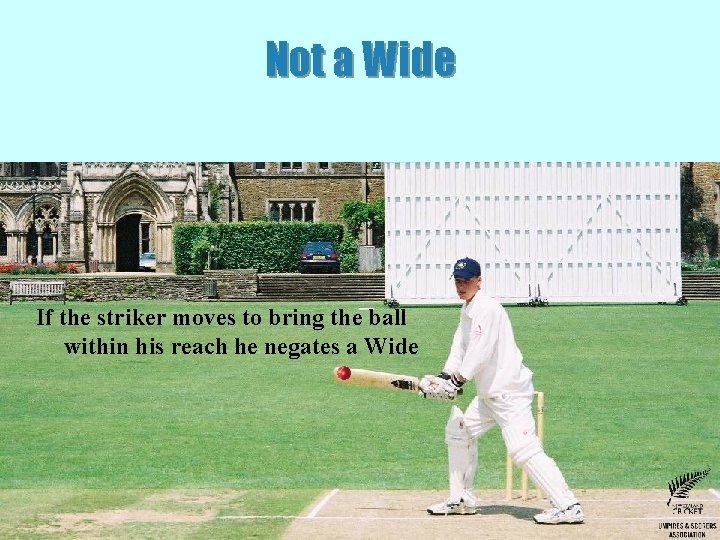
Not a Wide If the striker moves to bring the ball within his reach he negates a Wide
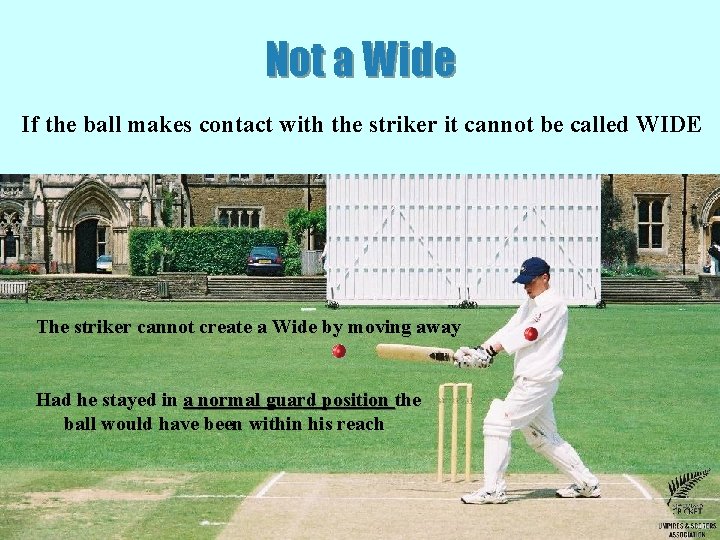
Not a Wide If the ball makes contact with the striker it cannot be called WIDE The striker cannot create a Wide by moving away Had he stayed in a normal guard position the ball would have been within his reach
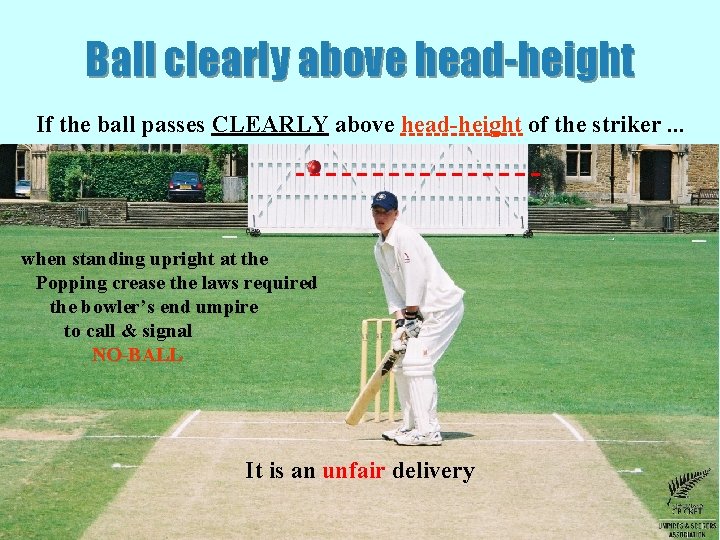
Ball clearly above head-height If the ball passes CLEARLY above head-height of the striker. . . when standing upright at the Popping crease the laws required the bowler’s end umpire to call & signal NO-BALL It is an unfair delivery
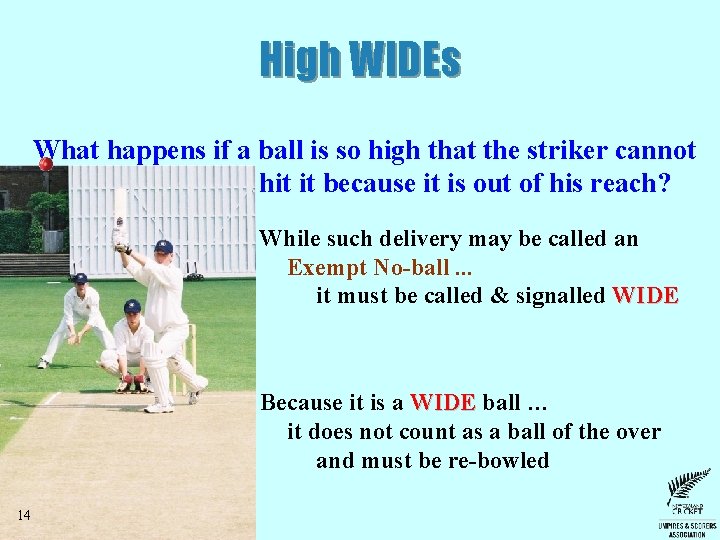
High WIDEs New Zealand Cricket permits the bowler. . . to deliver two Exempt balls in an over above shoulder-height of the striker when he is standing upright at the Popping crease without a call & signal of NO-BALL However what happens if a ball is so high that the striker cannot hit it because it is out of his reach? While such a ball may be called an Exempt No-ball. . . it must be called & signalled WIDE If it is not an Exempt ball as permitted by NZC it must be called & signalled NO-BALL 13
High WIDEs What happens if a ball is so high that the striker cannot hit it because it is out of his reach? While such delivery may be called an Exempt No-ball. . . it must be called & signalled WIDE Because it is a WIDE ball … it does not count as a ball of the over and must be re-bowled 14
Limited-over matches - Wides Many playing conditions for Limited-over matches contains these provisions … Umpires are instructed to apply a very strict and consistent interpretation in regard to this Law in order to prevent negative bowling wide of the wicket Any off-side or leg-side delivery which in the opinion of the Umpire does not give the batsman a reasonable opportunity to score shall be called & signalled WIDE As a guide on the leg side a ball landing clearly outside the leg stump going further away shall be called & signalled WIDE As a guide on the offside a ball passing outside a line drawn between the bowling and popping creases measured 43 cm (17 inches) in from the Return crease shall be called & signalled WIDE The above provisions do not apply if the striker makes contact with the ball 15 Moving on …
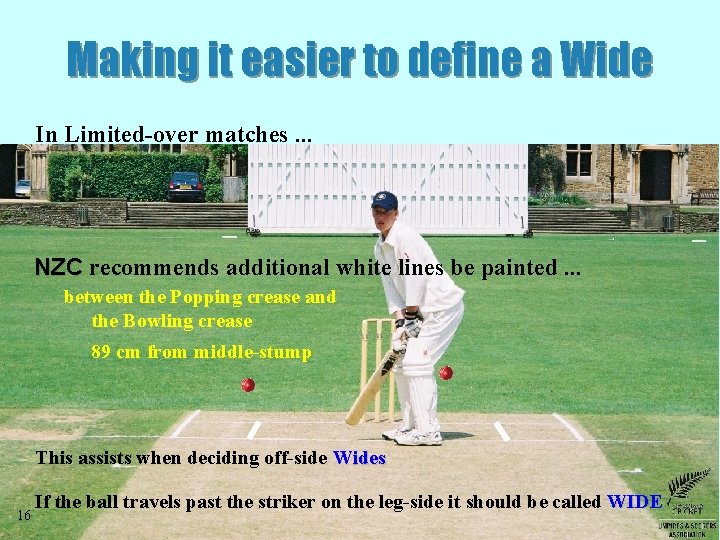
Making it easier to define a Wide In Limited-over matches. . . NZC recommends additional white lines be painted. . . between the Popping crease and the Bowling crease 89 cm from middle-stump This assists when deciding off-side Wides 16 If the ball travels past the striker on the leg-side it should be called WIDE
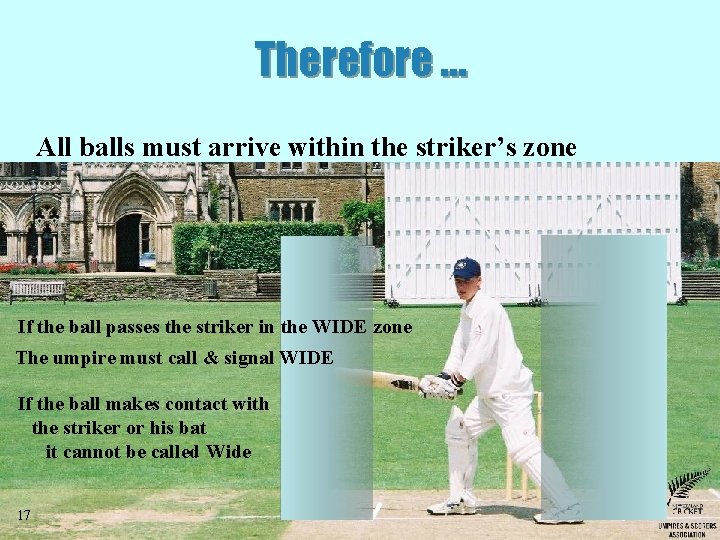
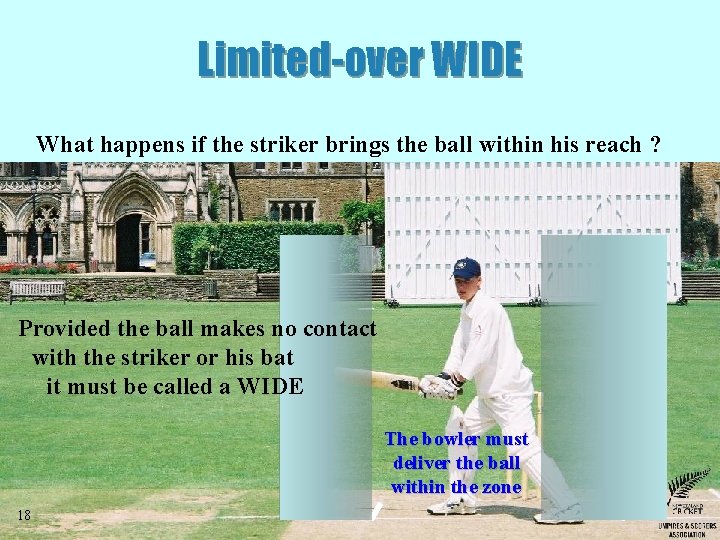
Therefore … All balls must arrive within the striker’s zone If the ball passes the striker in the WIDE zone The umpire must call & signal WIDE If the ball makes contact with the striker or his bat it cannot be called Wide 17
Limited-over WIDE What happens if the striker brings the ball within his reach ? Provided the ball makes no contact with the striker or his bat it must be called a WIDE The bowler must deliver the ball within the zone 18
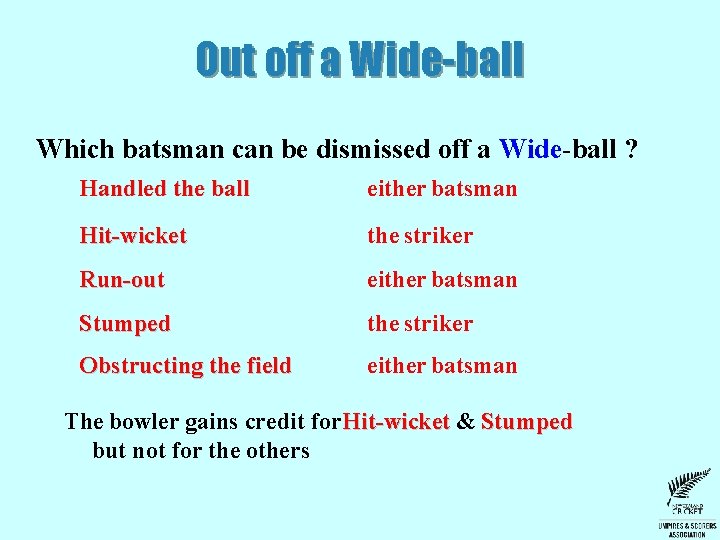
Out off a Wide-ball Which batsman can be dismissed off a Wide-ball ? Handled the ball either batsman Hit-wicket the striker Run-out either batsman Stumped the striker Obstructing the field either batsman The bowler gains credit for Hit-wicket & Stumped but not for the others
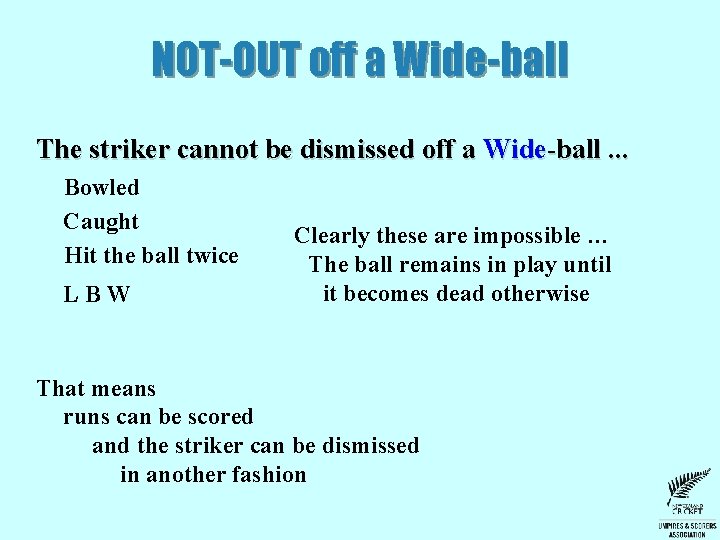
NOT-OUT off a Wide-ball The striker cannot be dismissed off a Wide-ball. . . Bowled Caught Hit the ball twice LBW Clearly these are impossible … The ball remains in play until it becomes dead otherwise That means runs can be scored and the striker can be dismissed in another fashion
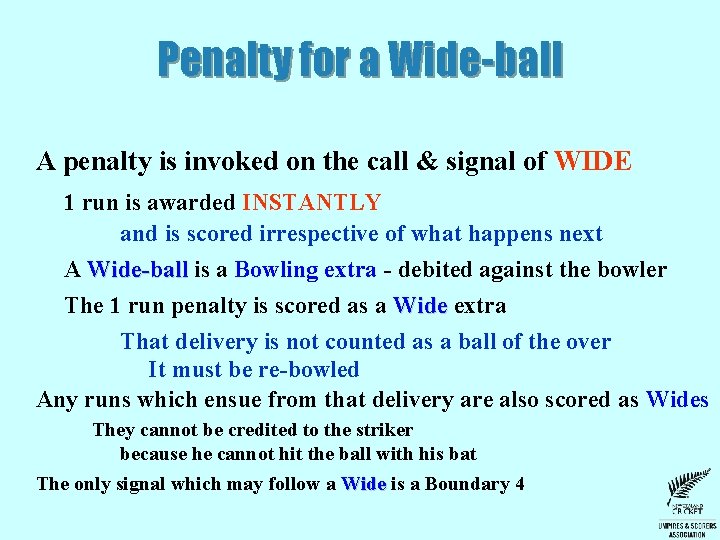
Penalty for a Wide-ball A penalty is invoked on the call & signal of WIDE 1 run is awarded INSTANTLY and is scored irrespective of what happens next A Wide-ball is a Bowling extra - debited against the bowler The 1 run penalty is scored as a Wide extra That delivery is not counted as a ball of the over It must be re-bowled Any runs which ensue from that delivery are also scored as Wides They cannot be credited to the striker because he cannot hit the ball with his bat The only signal which may follow a Wide is a Boundary 4
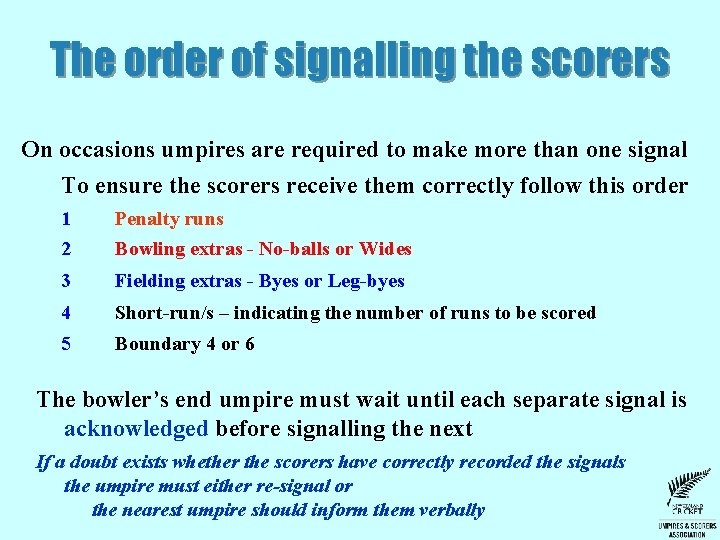
The order of signalling the scorers On occasions umpires are required to make more than one signal To ensure the scorers receive them correctly follow this order 1 2 Penalty runs Bowling extras - No-balls or Wides 3 Fielding extras - Byes or Leg-byes 4 Short-run/s – indicating the number of runs to be scored 5 Boundary 4 or 6 The bowler’s end umpire must wait until each separate signal is acknowledged before signalling the next If a doubt exists whether the scorers have correctly recorded the signals the umpire must either re-signal or the nearest umpire should inform them verbally
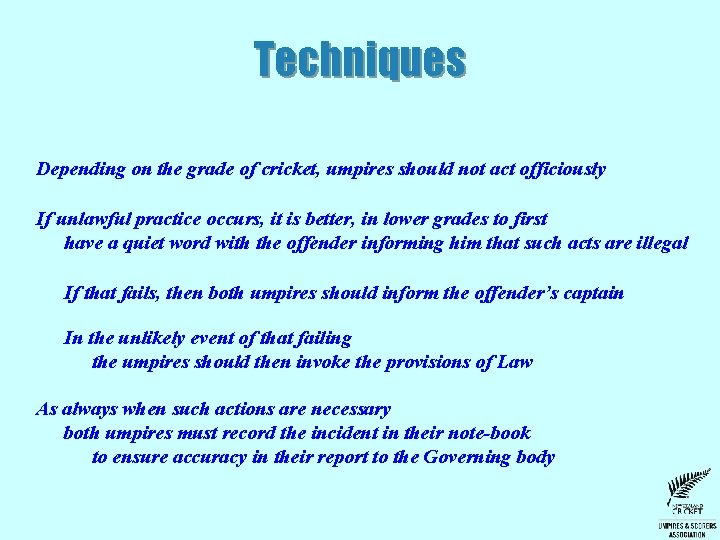
Techniques Depending on the grade of cricket, umpires should not act officiously If unlawful practice occurs, it is better, in lower grades to first have a quiet word with the offender informing him that such acts are illegal If that fails, then both umpires should inform the offender’s captain In the unlikely event of that failing the umpires should then invoke the provisions of Law As always when such actions are necessary both umpires must record the incident in their note-book to ensure accuracy in their report to the Governing body
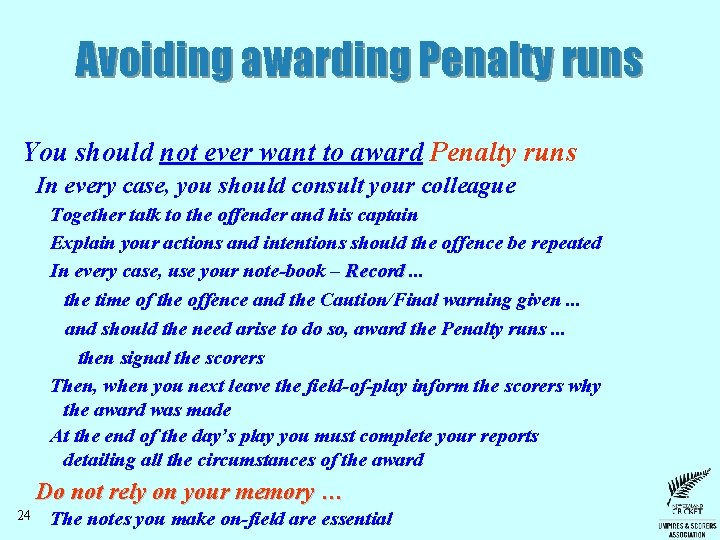
Avoiding awarding Penalty runs You should not ever want to award Penalty runs In every case, you should consult your colleague Together talk to the offender and his captain Explain your actions and intentions should the offence be repeated In every case, use your note-book – Record. . . the time of the offence and the Caution/Final warning given. . . and should the need arise to do so, award the Penalty runs. . . then signal the scorers Then, when you next leave the field-of-play inform the scorers why the award was made At the end of the day’s play you must complete your reports detailing all the circumstances of the award Do not rely on your memory … 24 The notes you make on-field are essential
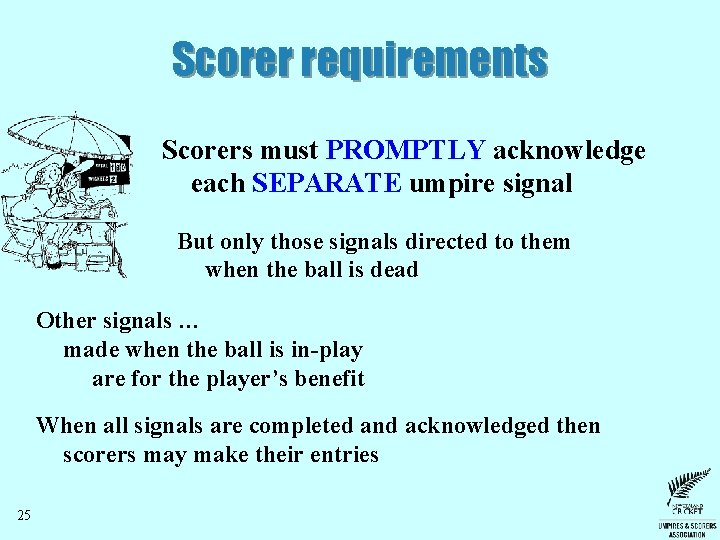
Scorer requirements Scorers must PROMPTLY acknowledge each SEPARATE umpire signal But only those signals directed to them when the ball is dead Other signals … made when the ball is in-play are for the player’s benefit When all signals are completed and acknowledged then scorers may make their entries 25
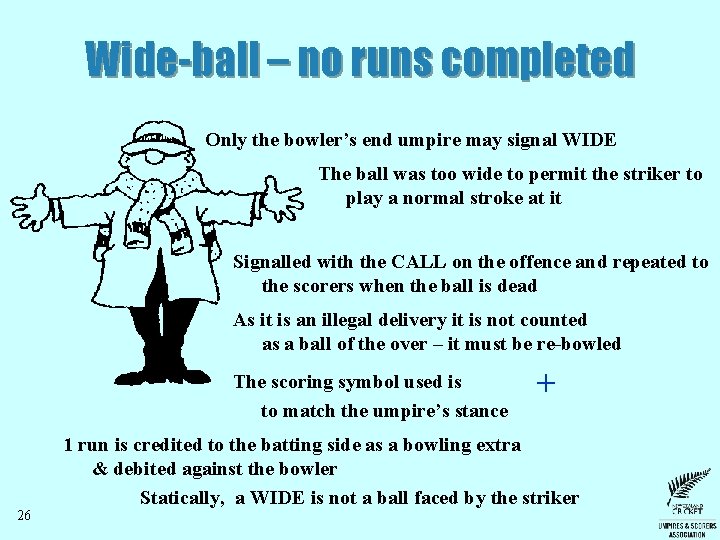
Wide-ball – no runs completed Only the bowler’s end umpire may signal WIDE The ball was too wide to permit the striker to play a normal stroke at it Signalled with the CALL on the offence and repeated to the scorers when the ball is dead As it is an illegal delivery it is not counted as a ball of the over – it must be re-bowled The scoring symbol used is to match the umpire’s stance 26 + 1 run is credited to the batting side as a bowling extra & debited against the bowler Statically, a WIDE is not a ball faced by the striker
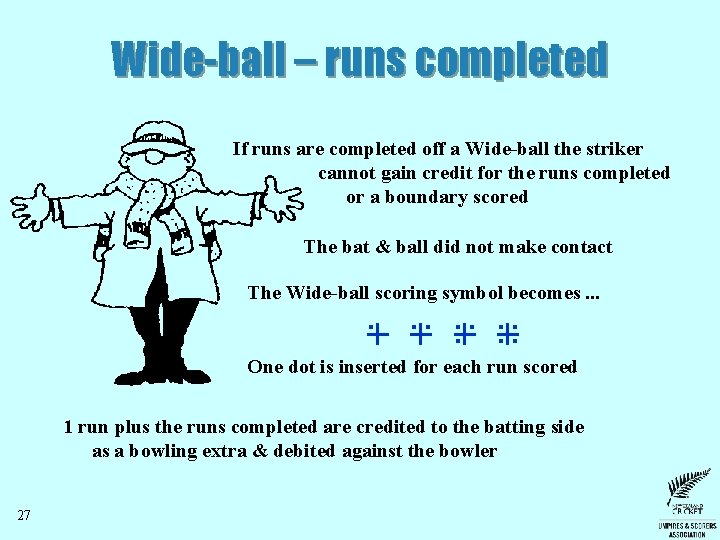
Wide-ball – runs completed If runs are completed off a Wide-ball the striker cannot gain credit for the runs completed or a boundary scored The bat & ball did not make contact The Wide-ball scoring symbol becomes. . . ; < ' ( One dot is inserted for each run scored 1 run plus the runs completed are credited to the batting side as a bowling extra & debited against the bowler 27
These modules were written & produced for New Zealand Cricket by the New Zealand Cricket Umpires & Scorers Association 28 © 2010 NZC-NZCUSA