
Cricket Umpiring Levels Module 1 1 Incorporating the

- Slides: 56
Cricket Umpiring Levels Module 1. 1 Incorporating the MCC Laws of Cricket 2000 code - 4 th edition 2010
Umpires & Player-Umpires Cricket deserves the best umpires possible But it cannot achieve this, without having people willing, and able to take the time to study and to umpire When you are playing – you are a player When you are umpiring – you cease to be a player Cricket matches require two umpires to work together you are part of a separate team – this is TEAMWORK There is no ‘I’ in ‘teamwork’ Umpires must work together and consult whenever required 2 Here we deal solely with Cricket Law Not with any local regulations that may vary the Law
The Spirit of Cricket is compulsory reading for everyone It sets the tone of a match and our role in it It confirms the captain, is responsible for the conduct of his team It confirms the umpires, are the sole judges of fair & unfair play It requires the umpires, to intervene if there any unfair acts It requires the highest standards of sportsmanship It confirms that there is no room for any form of bad behaviour It confirms that there is no place for violence in any form It confirms that captains & umpires, together set the tone of the conduct of a match and expects every player to contribute to this In short, the Spirit of Cricket sets the guidelines to ensue every participant enjoys their game 3
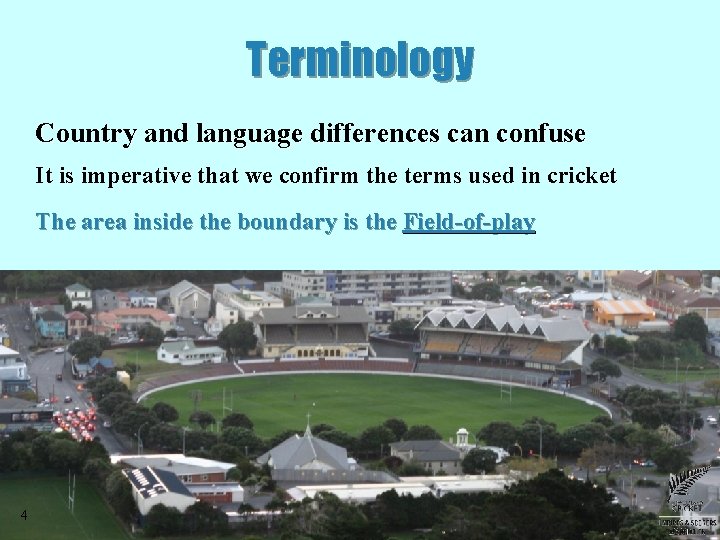
Terminology Country and language differences can confuse It is imperative that we confirm the terms used in cricket The area inside the boundary is the Field-of-play 4
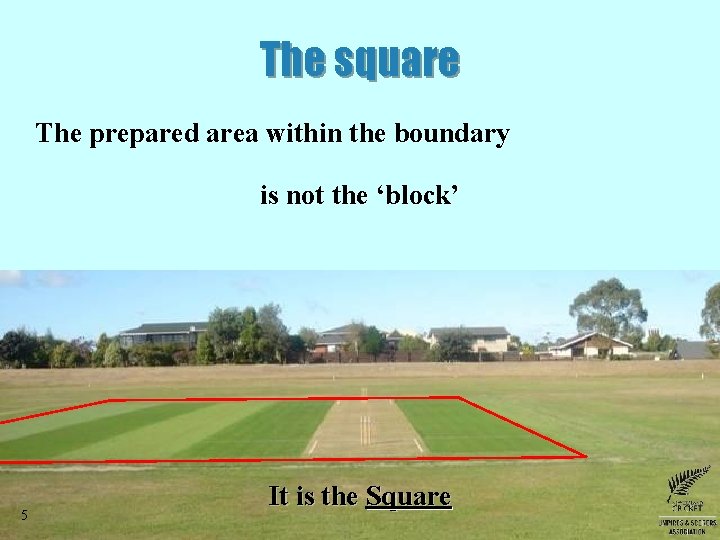
The square The prepared area within the boundary is not the ‘block’ 5 It is the Square
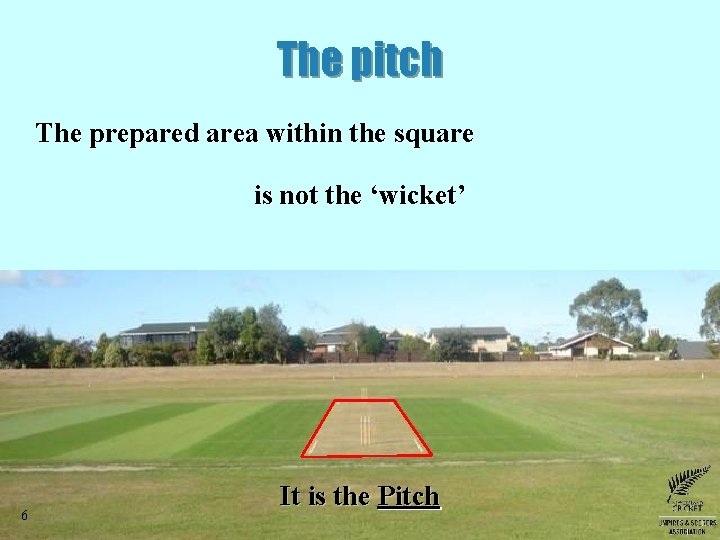
The pitch The prepared area within the square is not the ‘wicket’ 6 It is the Pitch
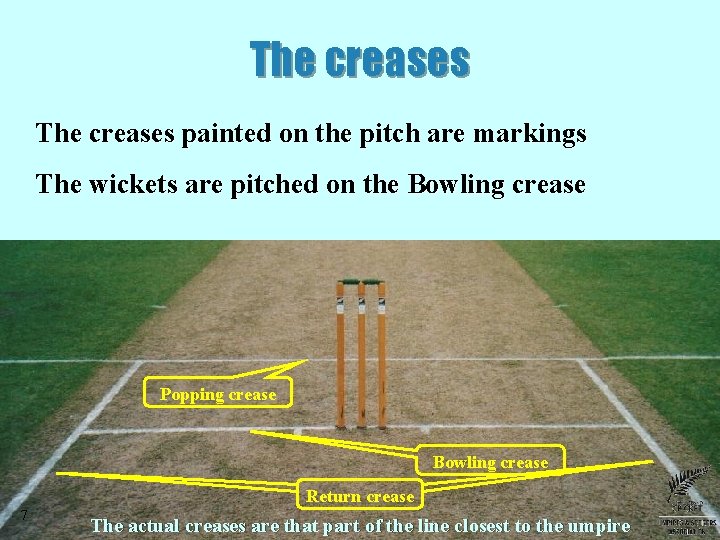
The creases painted on the pitch are markings The wickets are pitched on the Bowling crease Popping crease Bowling crease Return crease 7 The actual creases are that part of the line closest to the umpire
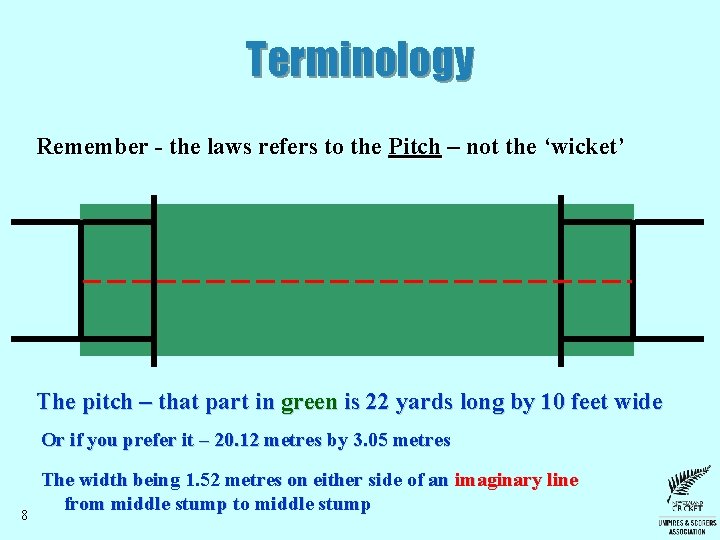
Terminology Remember - the laws refers to the Pitch – not the ‘wicket’ The pitch – that part in green is 22 yards long by 10 feet wide Or if you prefer it – 20. 12 metres by 3. 05 metres 8 The width being 1. 52 metres on either side of an imaginary line from middle stump to middle stump
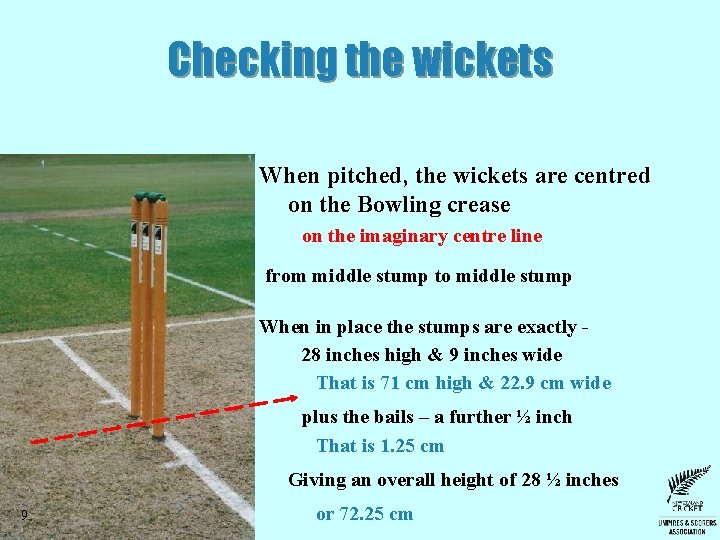
Checking the wickets When pitched, the wickets are centred on the Bowling crease on the imaginary centre line from middle stump to middle stump When in place the stumps are exactly 28 inches high & 9 inches wide That is 71 cm high & 22. 9 cm wide plus the bails – a further ½ inch That is 1. 25 cm Giving an overall height of 28 ½ inches 9 or 72. 25 cm
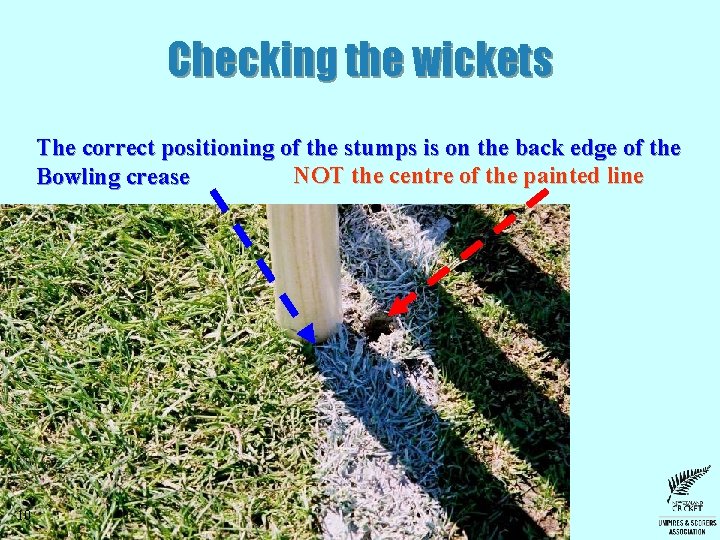
Checking the wickets The correct positioning of the stumps is on the back edge of the NOT the centre of the painted line Bowling crease 10
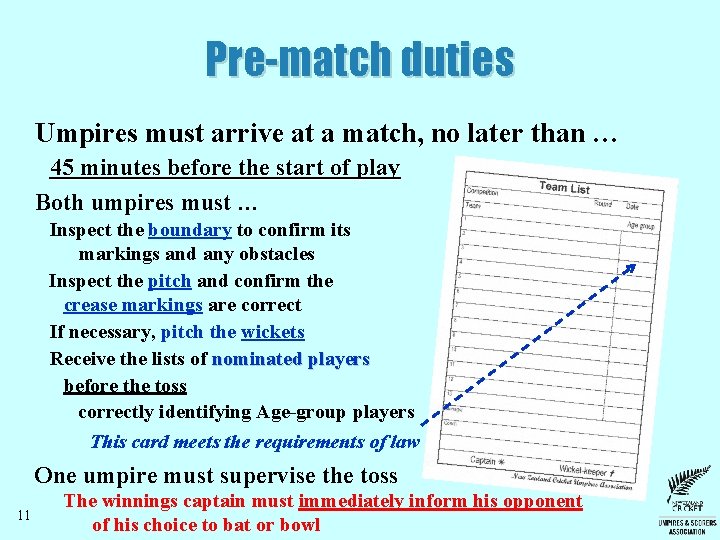
Pre-match duties Umpires must arrive at a match, no later than … 45 minutes before the start of play Both umpires must … Inspect the boundary to confirm its markings and any obstacles Inspect the pitch and confirm the crease markings are correct If necessary, pitch the wickets Receive the lists of nominated players before the toss correctly identifying Age-group players This card meets the requirements of law One umpire must supervise the toss 11 The winnings captain must immediately inform his opponent of his choice to bat or bowl
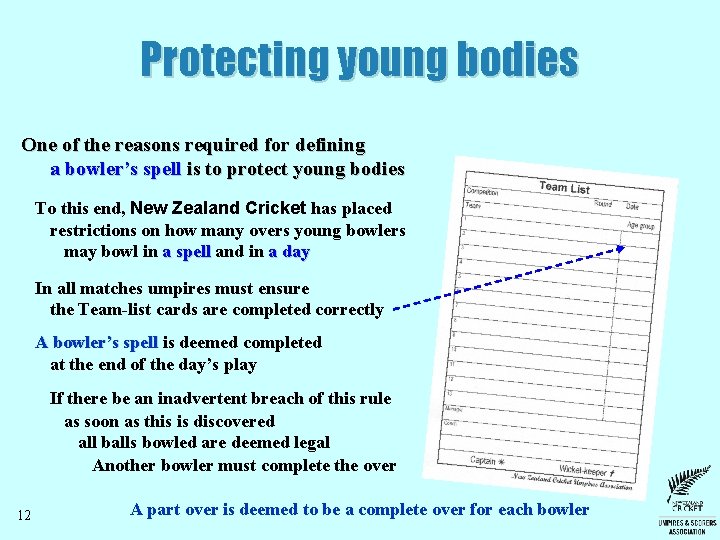
Protecting young bodies One of the reasons required for defining a bowler’s spell is to protect young bodies To this end, New Zealand Cricket has placed restrictions on how many overs young bowlers may bowl in a spell and in a day In all matches umpires must ensure the Team-list cards are completed correctly A bowler’s spell is deemed completed at the end of the day’s play If there be an inadvertent breach of this rule as soon as this is discovered all balls bowled are deemed legal Another bowler must complete the over 12 A part over is deemed to be a complete over for each bowler
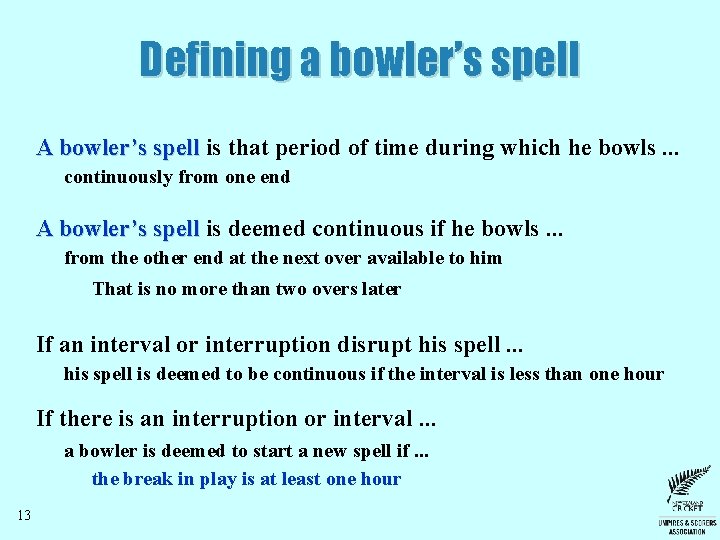
Defining a bowler’s spell A bowler’s spell is that period of time during which he bowls. . . continuously from one end A bowler’s spell is deemed continuous if he bowls. . . from the other end at the next over available to him That is no more than two overs later If an interval or interruption disrupt his spell. . . his spell is deemed to be continuous if the interval is less than one hour If there is an interruption or interval. . . a bowler is deemed to start a new spell if. . . the break in play is at least one hour 13
Pre-match duties During the pre-match conference with captains Confirm the hours of play, including all intervals Confirm the balls to be used Confirm any special provisions Then advise the scorers accordingly Confirm their scoring location Confirm their acknowledgment method Confirm the time Confirm who will update the score-board and when Updating the score-board is not the scorers’ duty This should be done by others 14
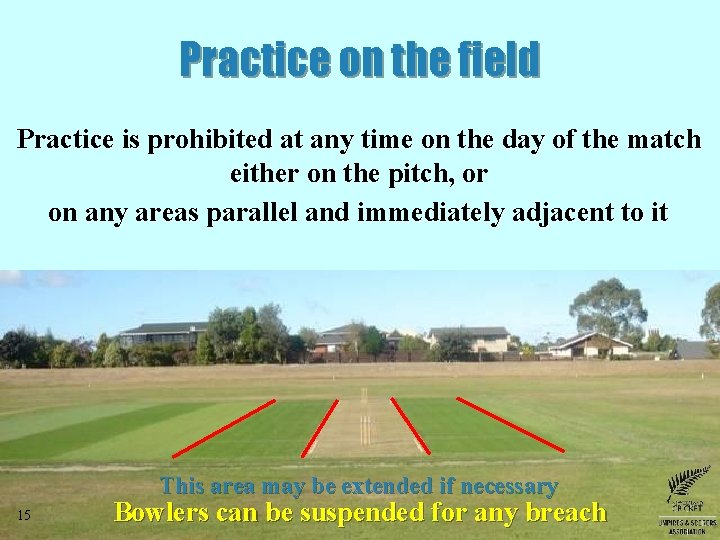
Practice on the field Practice is prohibited at any time on the day of the match either on the pitch, or on any areas parallel and immediately adjacent to it This area may be extended if necessary 15 Bowlers can be suspended for any breach
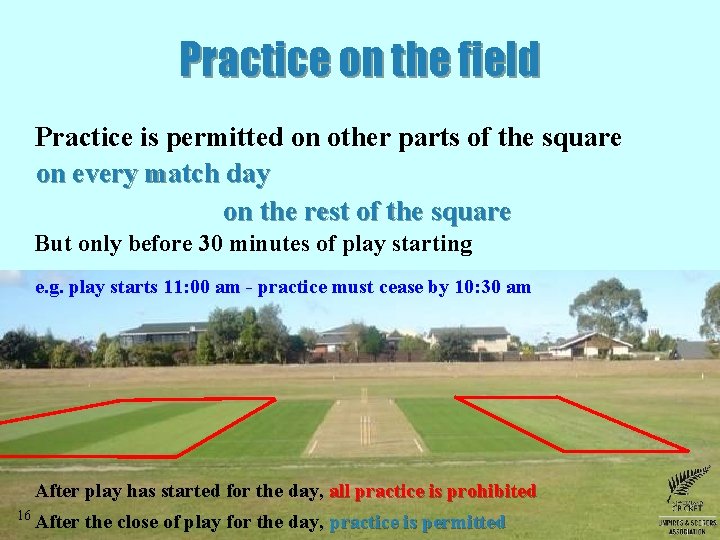
Practice on the field Practice is permitted on other parts of the square on every match day on the rest of the square But only before 30 minutes of play starting e. g. play starts 11: 00 am - practice must cease by 10: 30 am After play has started for the day, all practice is prohibited 16 After the close of play for the day, practice is permitted
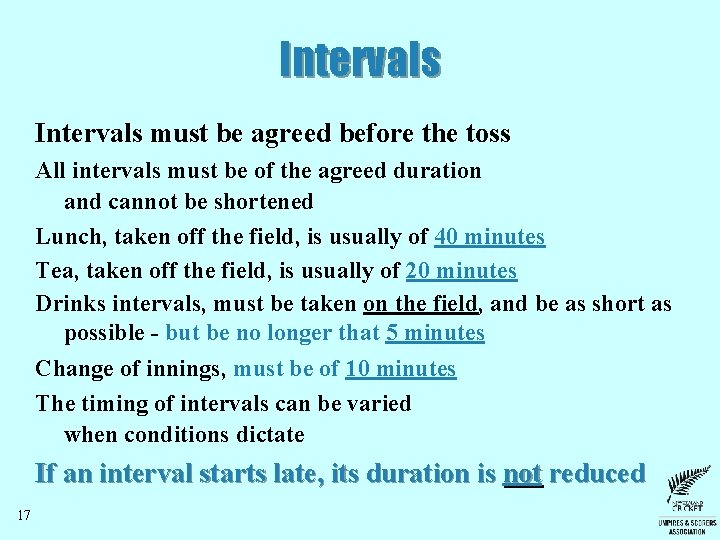
Intervals must be agreed before the toss All intervals must be of the agreed duration and cannot be shortened Lunch, taken off the field, is usually of 40 minutes Tea, taken off the field, is usually of 20 minutes Drinks intervals, must be taken on the field, and be as short as possible - but be no longer that 5 minutes Change of innings, must be of 10 minutes The timing of intervals can be varied when conditions dictate If an interval starts late, its duration is not reduced 17
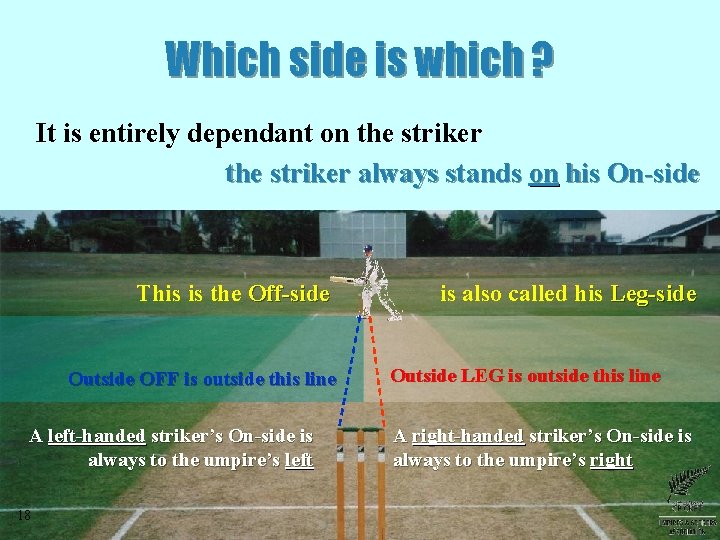
Which side is which ? It is entirely dependant on the striker always stands on his On-side This is the Off-side Outside OFF is outside this line A left-handed striker’s On-side is always to the umpire’s left 18 is also called his Leg-side Outside LEG is outside this line A right-handed striker’s On-side is always to the umpire’s right
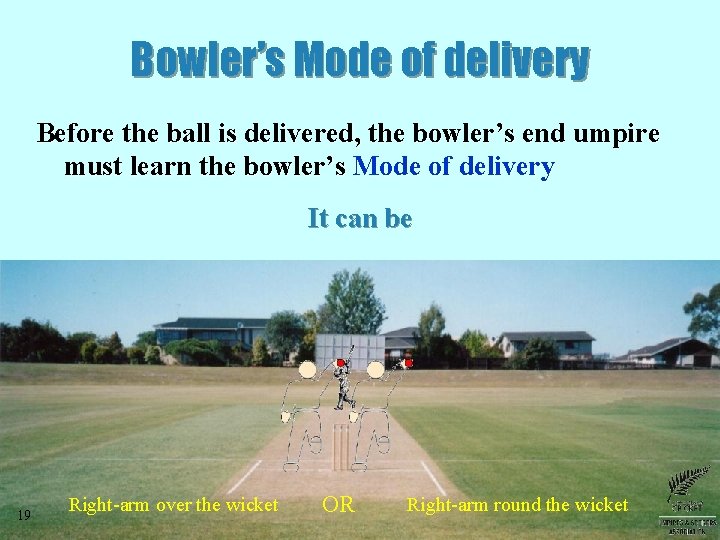
Bowler’s Mode of delivery Before the ball is delivered, the bowler’s end umpire must learn the bowler’s Mode of delivery It can be 19 Right-arm over the wicket OR Right-arm round the wicket
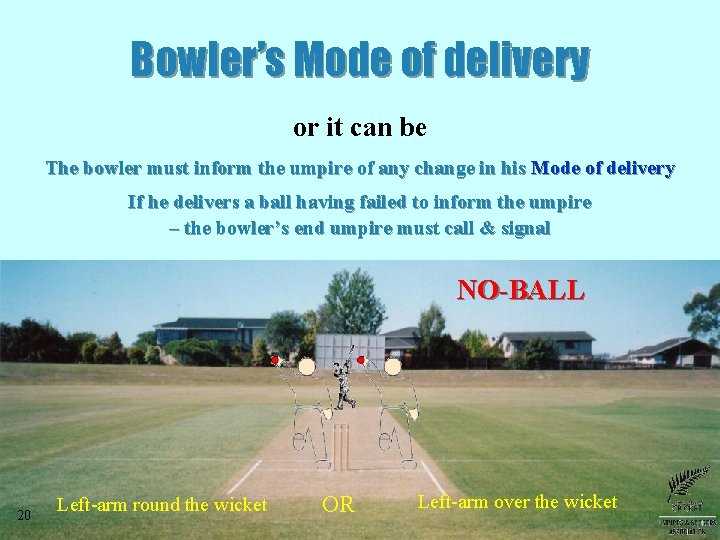
Bowler’s Mode of delivery or it can be The bowler must inform the umpire of any change in his Mode of delivery If he delivers a ball having failed to inform the umpire – the bowler’s end umpire must call & signal NO-BALL 20 Left-arm round the wicket OR Left-arm over the wicket
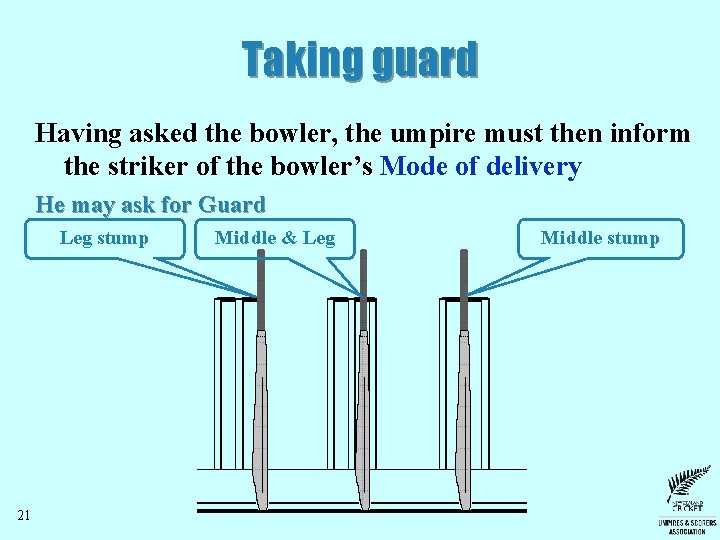
Taking guard Having asked the bowler, the umpire must then inform the striker of the bowler’s Mode of delivery He may ask for Guard Leg stump 21 Middle & Leg Middle stump
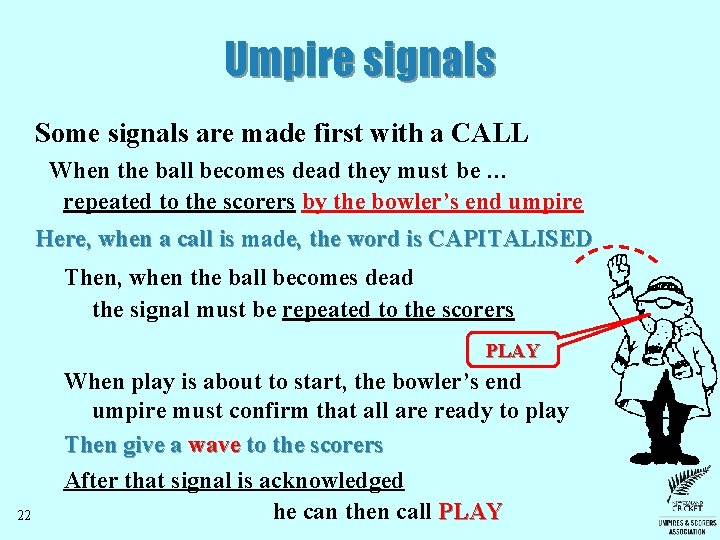
Umpire signals Some signals are made first with a CALL When the ball becomes dead they must be … repeated to the scorers by the bowler’s end umpire Here, when a call is made, the word is CAPITALISED Then, when the ball becomes dead the signal must be repeated to the scorers PLAY 22 When play is about to start, the bowler’s end umpire must confirm that all are ready to play Then give a wave to the scorers After that signal is acknowledged he can then call PLAY
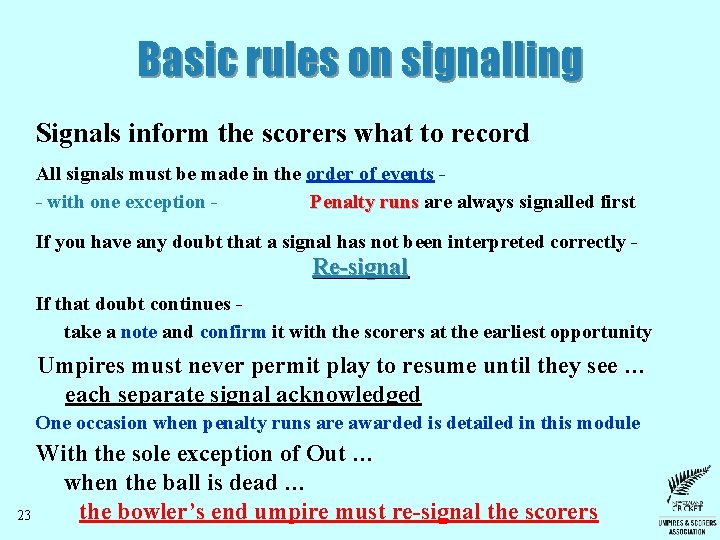
Basic rules on signalling Signals inform the scorers what to record All signals must be made in the order of events - with one exception Penalty runs are always signalled first If you have any doubt that a signal has not been interpreted correctly - Re-signal If that doubt continues take a note and confirm it with the scorers at the earliest opportunity Umpires must never permit play to resume until they see … each separate signal acknowledged One occasion when penalty runs are awarded is detailed in this module With the sole exception of Out … when the ball is dead … the bowler’s end umpire must re-signal the scorers 23
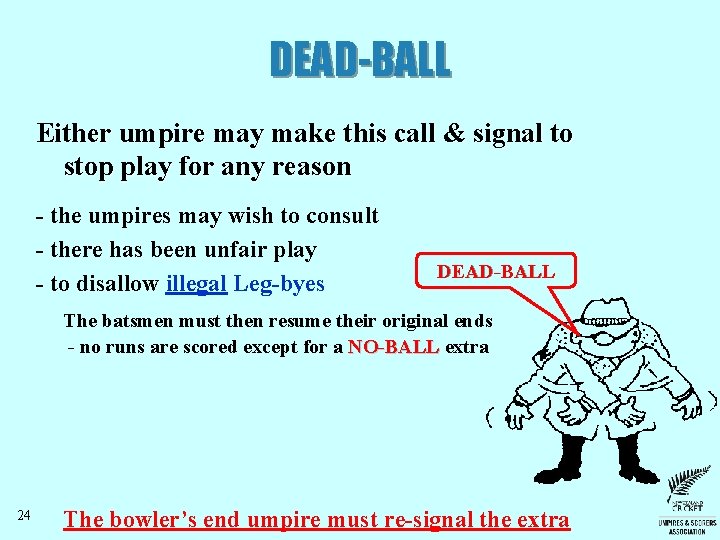
DEAD-BALL Either umpire may make this call & signal to stop play for any reason - the umpires may wish to consult - there has been unfair play - to disallow illegal Leg-byes DEAD-BALL The batsmen must then resume their original ends - no runs are scored except for a NO-BALL extra 24 The bowler’s end umpire must re-signal the extra
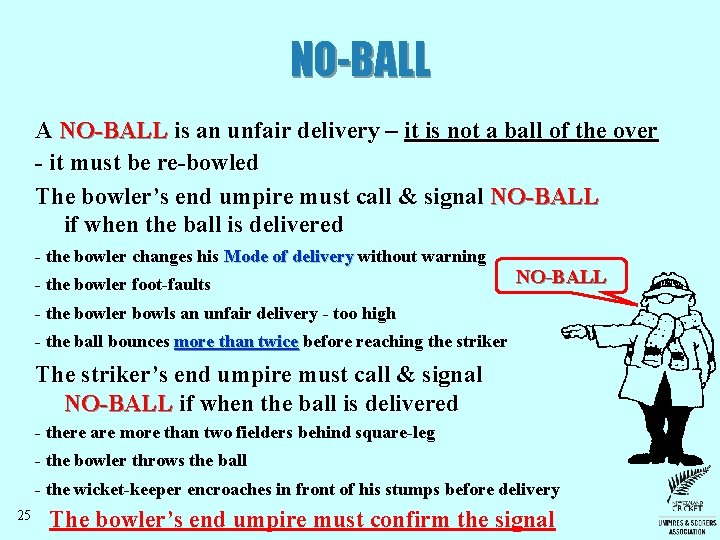
NO-BALL A NO-BALL is an unfair delivery – it is not a ball of the over - it must be re-bowled The bowler’s end umpire must call & signal NO-BALL if when the ball is delivered - the bowler changes his Mode of delivery without warning - the bowler foot-faults NO-BALL - the bowler bowls an unfair delivery - too high - the ball bounces more than twice before reaching the striker The striker’s end umpire must call & signal NO-BALL if when the ball is delivered - there are more than two fielders behind square-leg - the bowler throws the ball - the wicket-keeper encroaches in front of his stumps before delivery 25 The bowler’s end umpire must confirm the signal
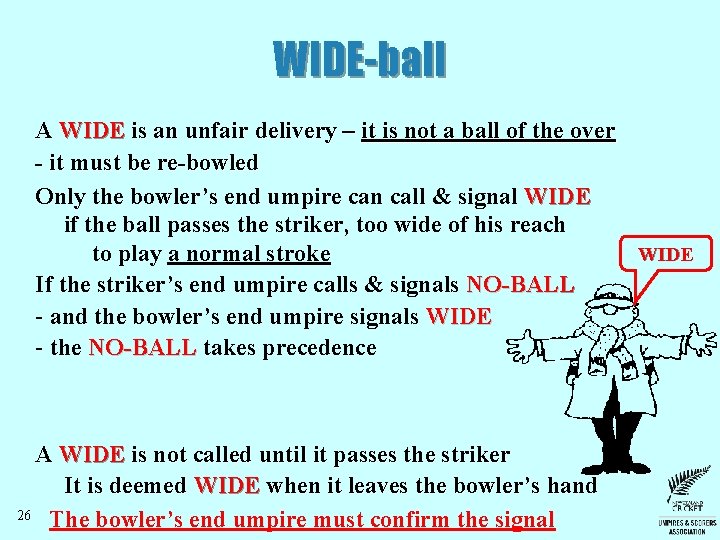
WIDE-ball A WIDE is an unfair delivery – it is not a ball of the over - it must be re-bowled Only the bowler’s end umpire can call & signal WIDE if the ball passes the striker, too wide of his reach WIDE to play a normal stroke If the striker’s end umpire calls & signals NO-BALL - and the bowler’s end umpire signals WIDE - the NO-BALL takes precedence A WIDE is not called until it passes the striker It is deemed WIDE when it leaves the bowler’s hand 26 The bowler’s end umpire must confirm the signal
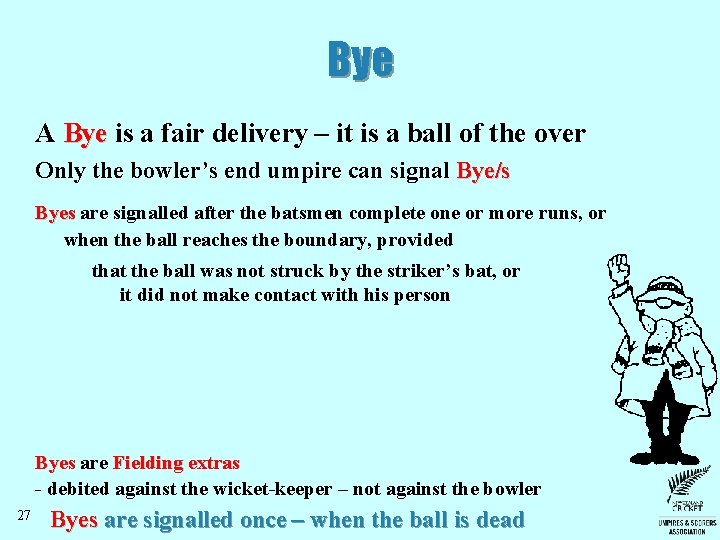
Bye A Bye is a fair delivery – it is a ball of the over Only the bowler’s end umpire can signal Bye/s Byes are signalled after the batsmen complete one or more runs, or when the ball reaches the boundary, provided that the ball was not struck by the striker’s bat, or it did not make contact with his person Byes are Fielding extras - debited against the wicket-keeper – not against the bowler 27 Byes are signalled once – when the ball is dead
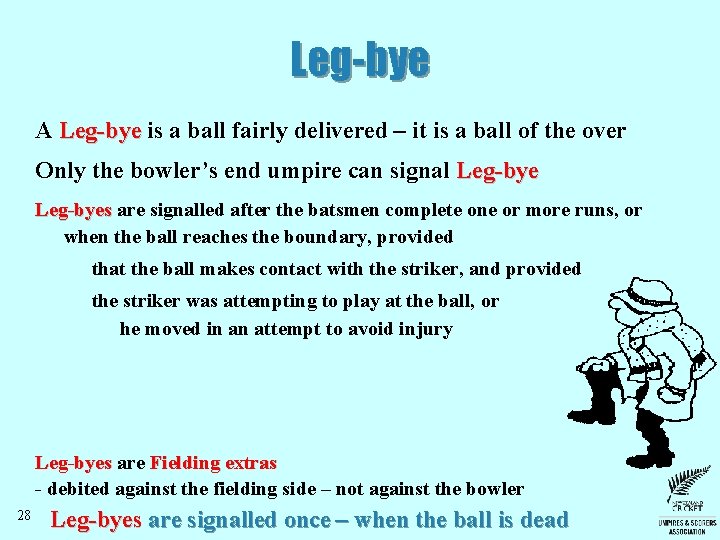
Leg-bye A Leg-bye is a ball fairly delivered – it is a ball of the over Only the bowler’s end umpire can signal Leg-byes are signalled after the batsmen complete one or more runs, or when the ball reaches the boundary, provided that the ball makes contact with the striker, and provided the striker was attempting to play at the ball, or he moved in an attempt to avoid injury Leg-byes are Fielding extras - debited against the fielding side – not against the bowler 28 Leg-byes are signalled once – when the ball is dead
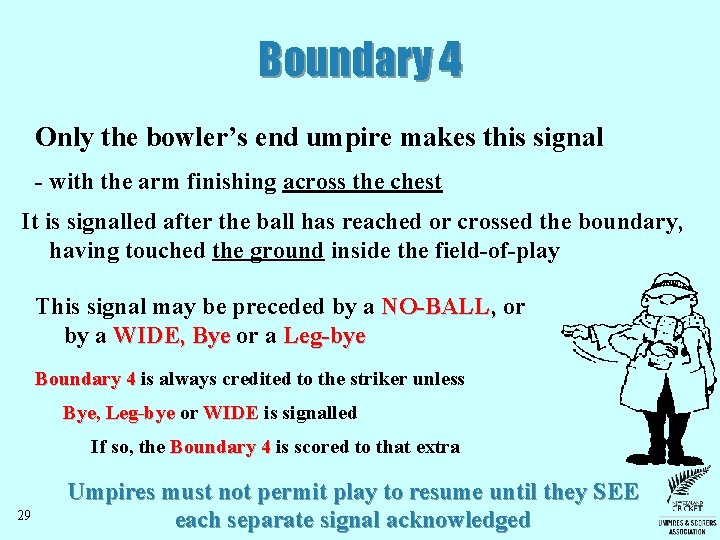
Boundary 4 Only the bowler’s end umpire makes this signal - with the arm finishing across the chest It is signalled after the ball has reached or crossed the boundary, having touched the ground inside the field-of-play This signal may be preceded by a NO-BALL, or by a WIDE, Bye or a Leg-bye Boundary 4 is always credited to the striker unless Bye, Leg-bye or WIDE is signalled If so, the Boundary 4 is scored to that extra 29 Umpires must not permit play to resume until they SEE each separate signal acknowledged
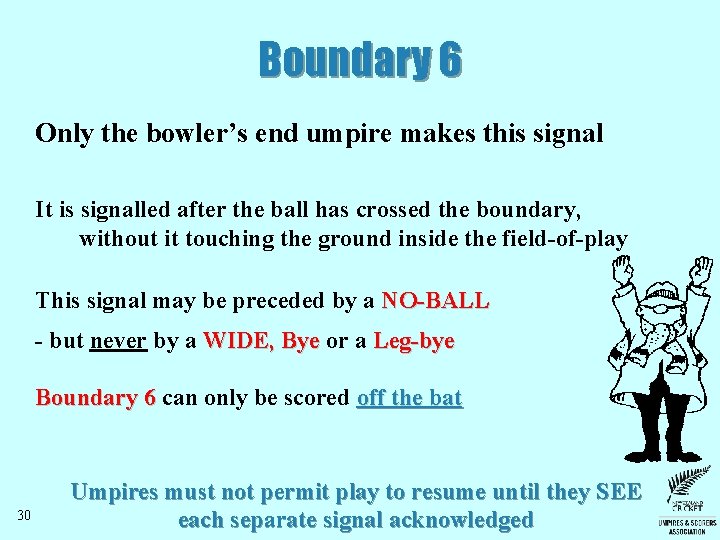
Boundary 6 Only the bowler’s end umpire makes this signal It is signalled after the ball has crossed the boundary, without it touching the ground inside the field-of-play This signal may be preceded by a NO-BALL - but never by a WIDE, Bye or a Leg-bye Boundary 6 can only be scored off the bat 30 Umpires must not permit play to resume until they SEE each separate signal acknowledged
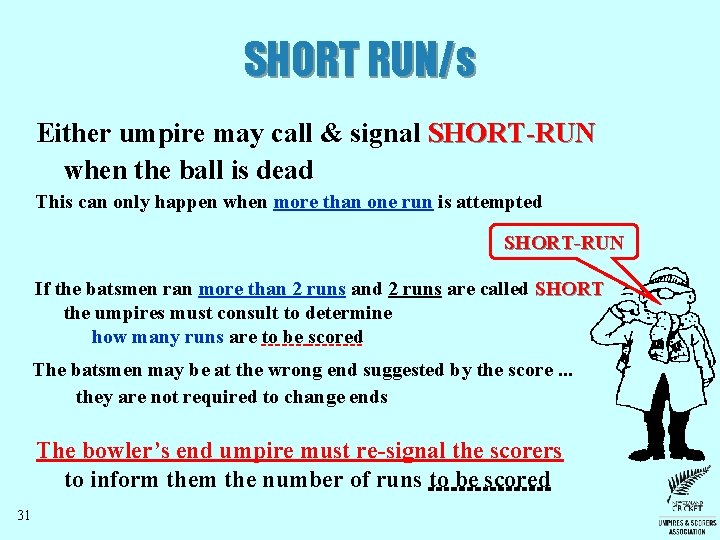
SHORT RUN/s Either umpire may call & signal SHORT-RUN when the ball is dead This can only happen when more than one run is attempted SHORT-RUN If the batsmen ran more than 2 runs and 2 runs are called SHORT the umpires must consult to determine how many runs are to be scored The batsmen may be at the wrong end suggested by the score. . . they are not required to change ends The bowler’s end umpire must re-signal the scorers to inform the number of runs to be scored 31
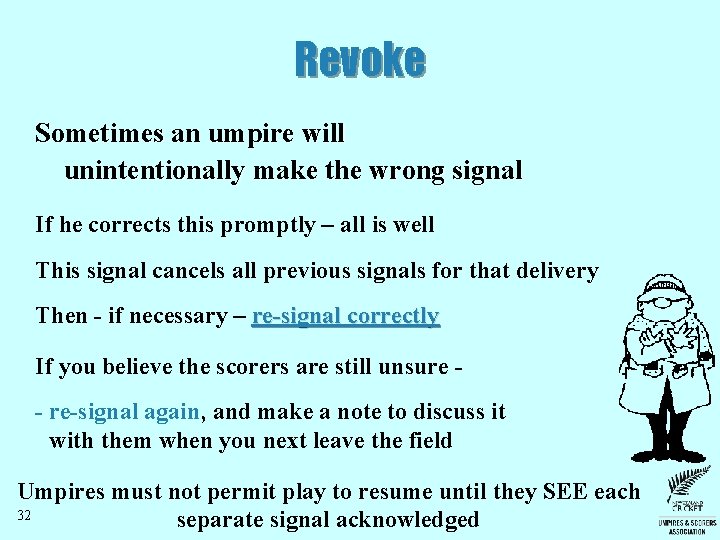
Revoke Sometimes an umpire will unintentionally make the wrong signal If he corrects this promptly – all is well This signal cancels all previous signals for that delivery Then - if necessary – re-signal correctly If you believe the scorers are still unsure - re-signal again, and make a note to discuss it with them when you next leave the field Umpires must not permit play to resume until they SEE each 32 separate signal acknowledged
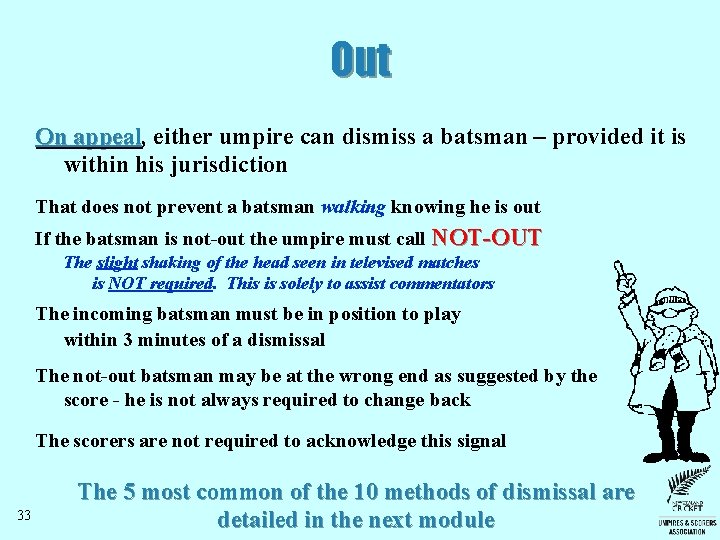
Out On appeal, either umpire can dismiss a batsman – provided it is within his jurisdiction That does not prevent a batsman walking knowing he is out If the batsman is not-out the umpire must call NOT-OUT The slight shaking of the head seen in televised matches is NOT required. This is solely to assist commentators The incoming batsman must be in position to play within 3 minutes of a dismissal The not-out batsman may be at the wrong end as suggested by the score - he is not always required to change back The scorers are not required to acknowledge this signal 33 The 5 most common of the 10 methods of dismissal are detailed in the next module
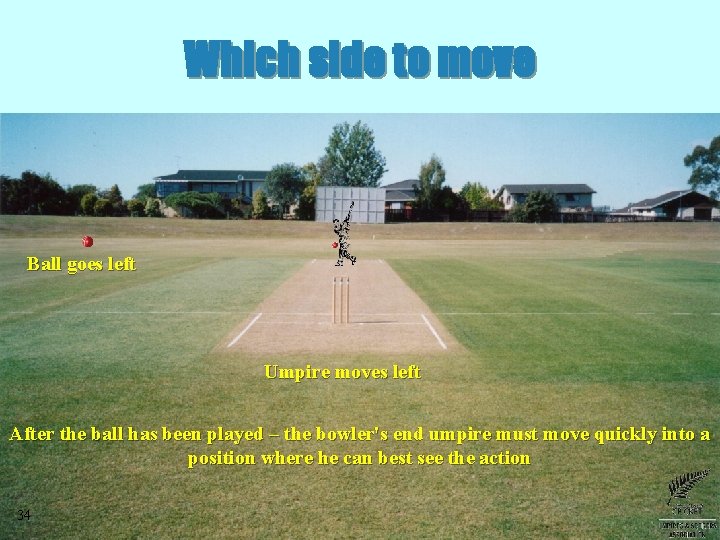
Which side to move Ball goes left Umpire moves left After the ball has been played – the bowler's end umpire must move quickly into a position where he can best see the action 34
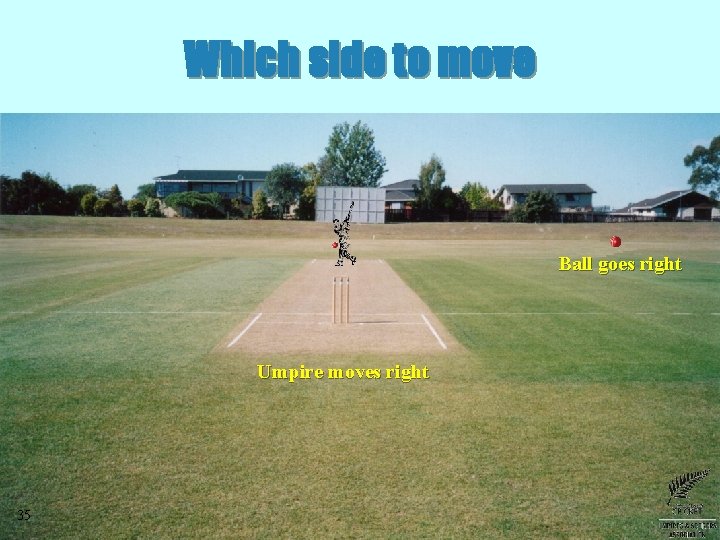
Which side to move Ball goes right Umpire moves right 35
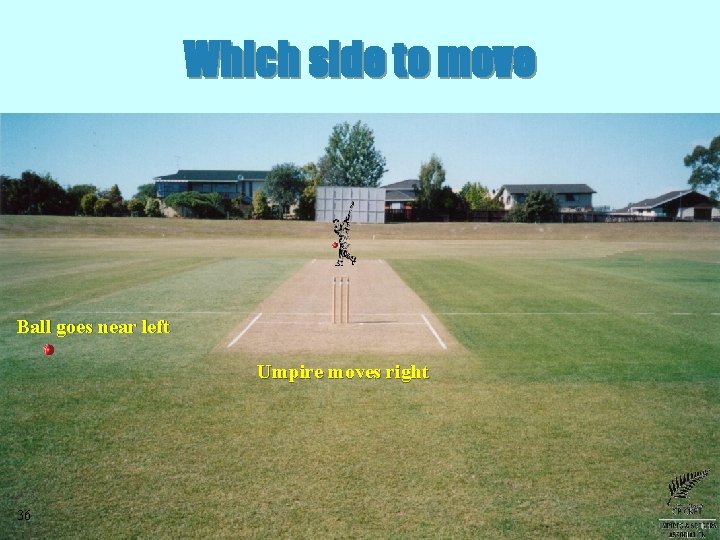
Which side to move Ball goes near left Umpire moves right 36
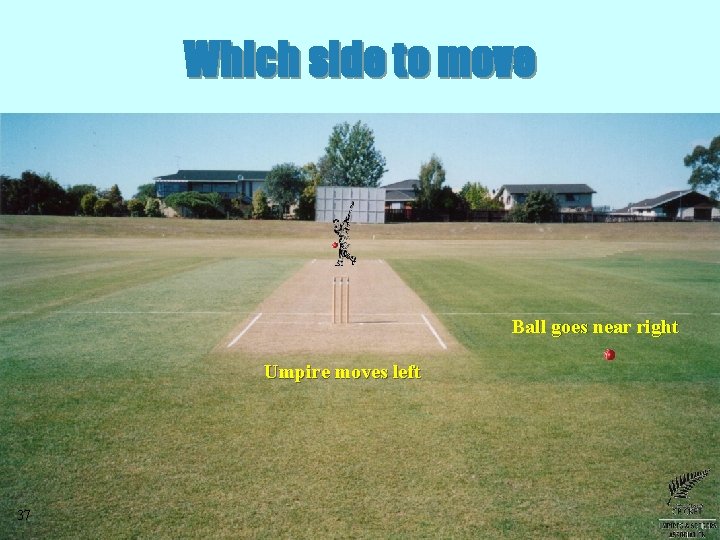
Which side to move Ball goes near right Umpire moves left 37
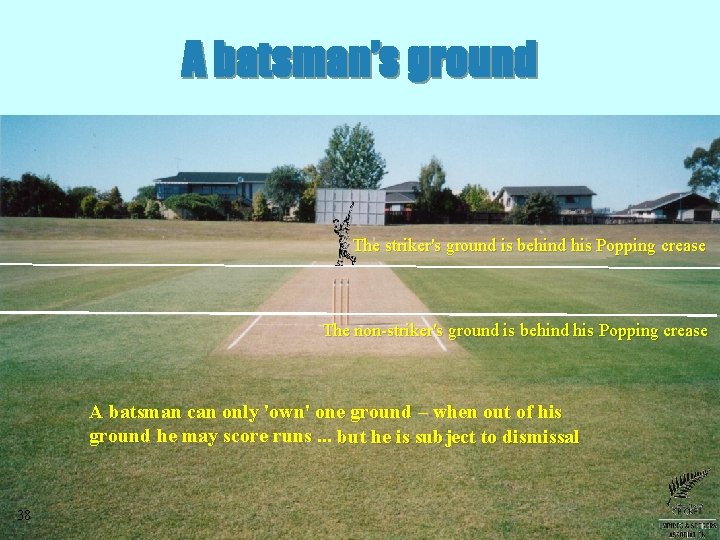
A batsman’s ground The striker's ground is behind his Popping crease The non-striker's ground is behind his Popping crease A batsman can only 'own' one ground – when out of his ground he may score runs. . . but he is subject to dismissal 38
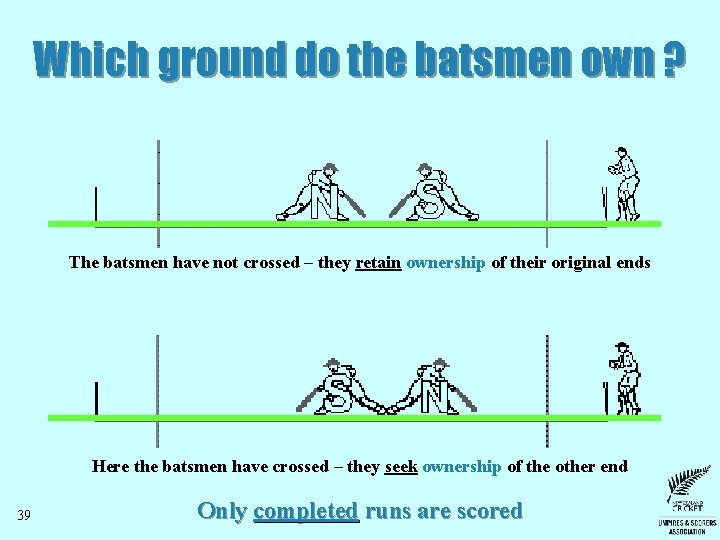
Which ground do the batsmen own ? The batsmen have not crossed – they retain ownership of their original ends Here the batsmen have crossed – they seek ownership of the other end 39 Only completed runs are scored
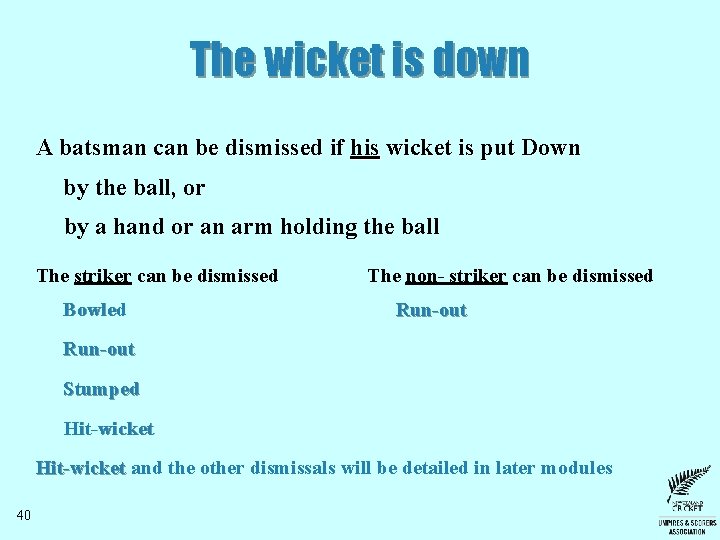
The wicket is down A batsman can be dismissed if his wicket is put Down by the ball, or by a hand or an arm holding the ball The striker can be dismissed Bowled The non- striker can be dismissed Run-out Stumped Hit-wicket and the other dismissals will be detailed in later modules 40
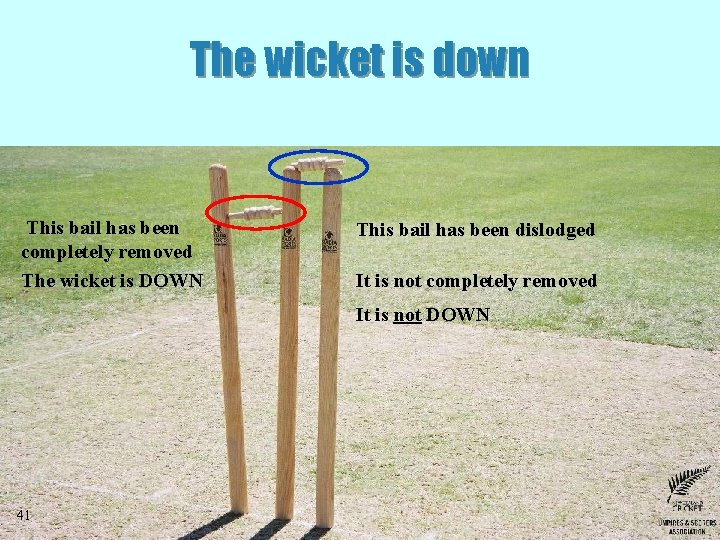
The wicket is down This bail has been completely removed The wicket is DOWN This bail has been dislodged It is not completely removed It is not DOWN 41
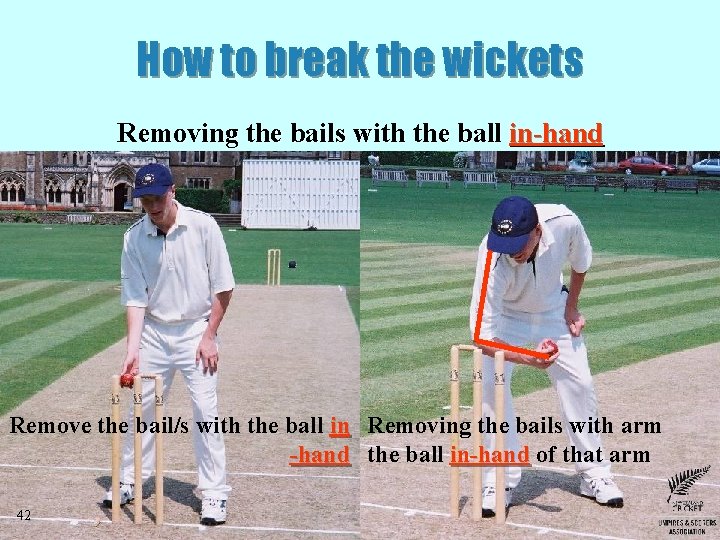
How to break the wickets Removing the bails with the ball in-hand Remove the bail/s with the ball in Removing the bails with arm -hand the ball in-hand of that arm 42
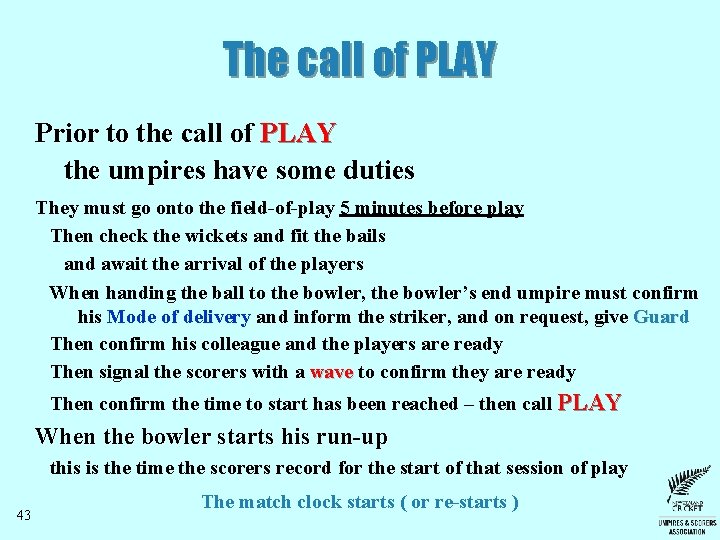
The call of PLAY Prior to the call of PLAY the umpires have some duties They must go onto the field-of-play 5 minutes before play Then check the wickets and fit the bails and await the arrival of the players When handing the ball to the bowler, the bowler’s end umpire must confirm his Mode of delivery and inform the striker, and on request, give Guard Then confirm his colleague and the players are ready Then signal the scorers with a wave to confirm they are ready Then confirm the time to start has been reached – then call PLAY When the bowler starts his run-up this is the time the scorers record for the start of that session of play 43 The match clock starts ( or re-starts )
The call of TIME The bowler’s end umpire must call TIME when there is an interval, or an interruption to play, or at the conclusion of the match TIME is not called if the umpire has reached his position at the new bowler’s end before the time for an interval has been reached If it is possible to start another over before the time for the interval, that over must start When TIME is called, the bails at both ends must be lifted 44 This is the only official visual notification the scorers have that the match clock is to stop
The ball is either in-play, or it is dead The ball comes into play when the bowler starts his run-up, or if he has none when he starts his bowling action Conversely, the ball becomes dead either automatically, or when an umpire calls & signals DEAD-BALL 45
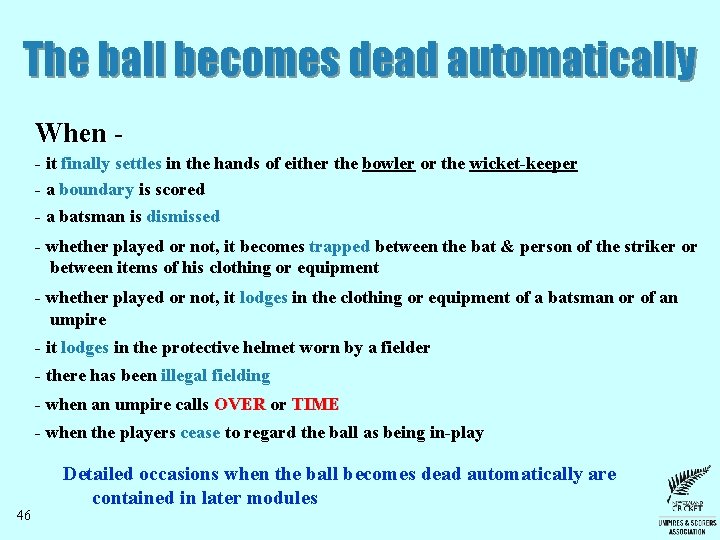
The ball becomes dead automatically When - it finally settles in the hands of either the bowler or the wicket-keeper - a boundary is scored - a batsman is dismissed - whether played or not, it becomes trapped between the bat & person of the striker or between items of his clothing or equipment - whether played or not, it lodges in the clothing or equipment of a batsman or of an umpire - it lodges in the protective helmet worn by a fielder - there has been illegal fielding - when an umpire calls OVER or TIME - when the players cease to regard the ball as being in-play 46 Detailed occasions when the ball becomes dead automatically are contained in later modules
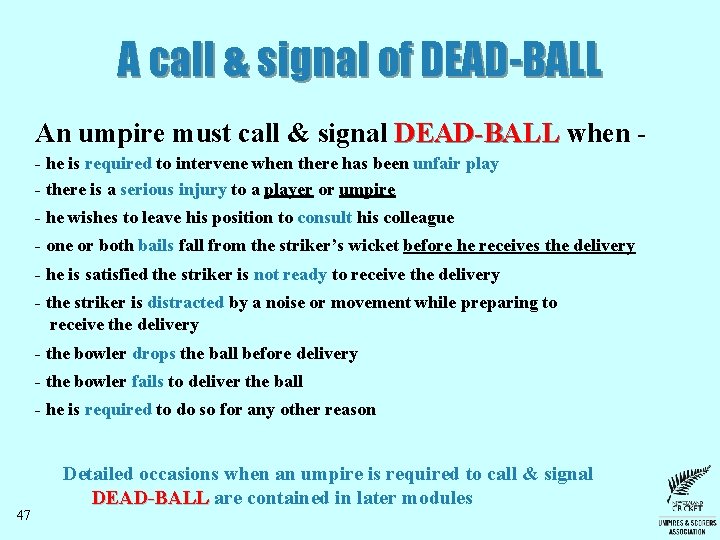
A call & signal of DEAD-BALL An umpire must call & signal DEAD-BALL when - he is required to intervene when there has been unfair play - there is a serious injury to a player or umpire - he wishes to leave his position to consult his colleague - one or both bails fall from the striker’s wicket before he receives the delivery - he is satisfied the striker is not ready to receive the delivery - the striker is distracted by a noise or movement while preparing to receive the delivery - the bowler drops the ball before delivery - the bowler fails to deliver the ball - he is required to do so for any other reason 47 Detailed occasions when an umpire is required to call & signal DEAD-BALL are contained in later modules
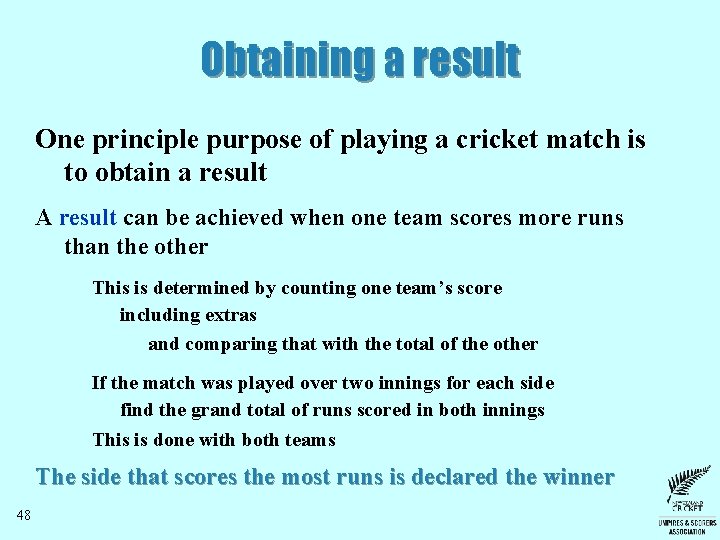
Obtaining a result One principle purpose of playing a cricket match is to obtain a result A result can be achieved when one team scores more runs than the other This is determined by counting one team’s score including extras and comparing that with the total of the other If the match was played over two innings for each side find the grand total of runs scored in both innings This is done with both teams The side that scores the most runs is declared the winner 48
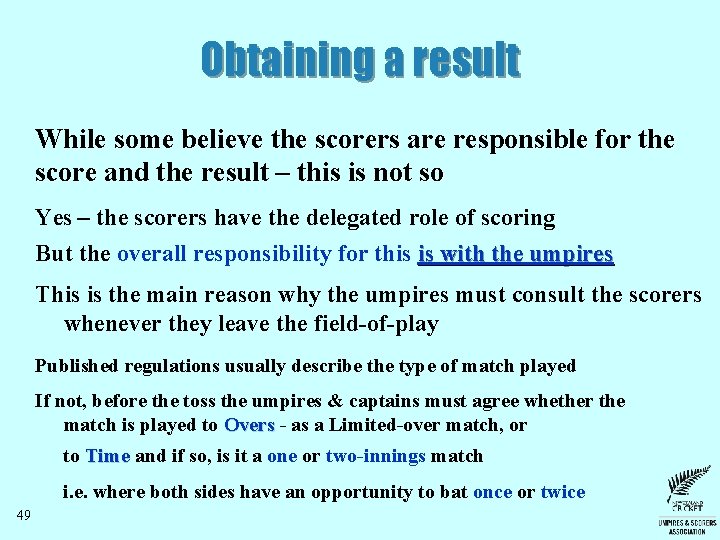
Obtaining a result While some believe the scorers are responsible for the score and the result – this is not so Yes – the scorers have the delegated role of scoring But the overall responsibility for this is with the umpires This is the main reason why the umpires must consult the scorers whenever they leave the field-of-play Published regulations usually describe the type of match played If not, before the toss the umpires & captains must agree whether the match is played to Overs - as a Limited-over match, or to Time and if so, is it a one or two-innings match i. e. where both sides have an opportunity to bat once or twice 49
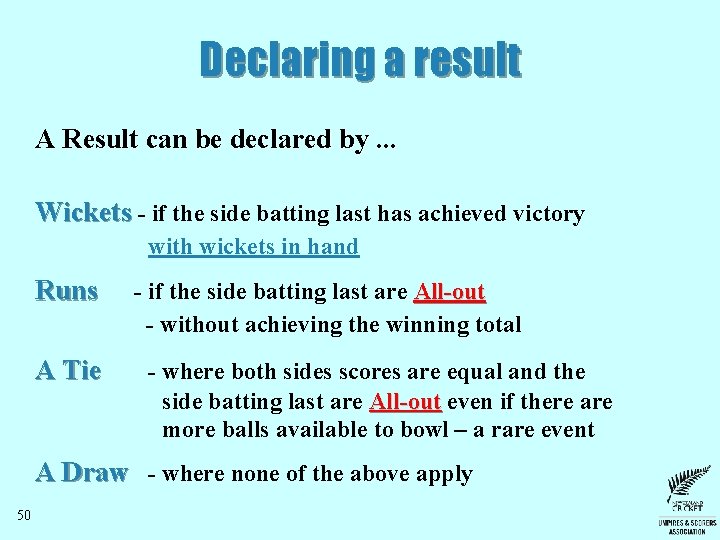
Declaring a result A Result can be declared by. . . Wickets - if the side batting last has achieved victory - with wickets in hand Runs A Tie - if the side batting last are All-out - without achieving the winning total - where both sides scores are equal and the side batting last are All-out even if there are more balls available to bowl – a rare event A Draw - where none of the above apply 50
Code of Conduct Unfortunately, cricket suffers a few players who have not bothered to read, or accept, the Spirit of Cricket Should any player fail to meet the very high standards of player conduct, the umpires must act Players must comply, with all instructions given by an umpire Players may not criticise, either by word or by action, any decision Players may not show dissent Players may not act in any way that might bring the game into disrepute Should any player breach the Spirit of Cricket in any way the umpire must call & signal DEAD-BALL and consult his colleague then together they must request the captain to take affirmative action and then decide if the matter should be reported to the Governing body 51 We all owe it to the game, to keep the Spirit of Cricket alive
Code of Conduct Every game played needs a report of some kind It may only be a signature on the score-sheet accepting the result It may be a pitch & ground report It may be a Code of Conduct report All reports must be completed as required and should bear the signatures of both umpires Just as the score-sheets record the events of the match all umpire reports must be factual and free from comment Cricket is a game first and foremost for players to enjoy However, umpires too have a right to enjoy their game 52
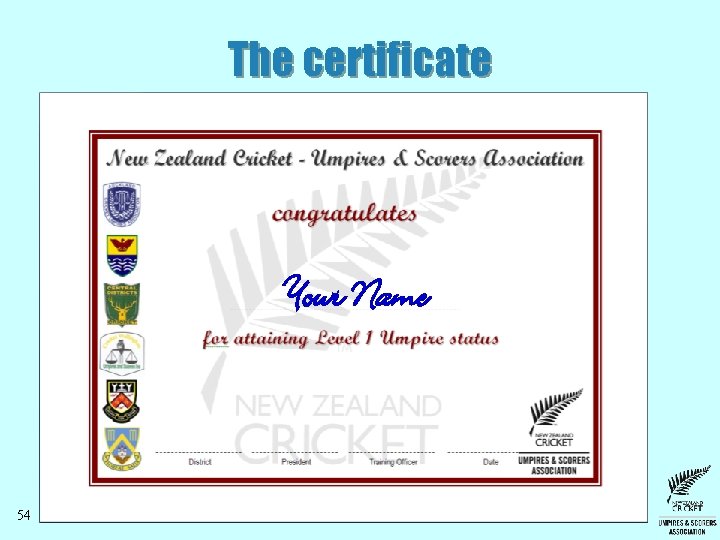
Courses & Certificates The examinations are available following courses conducted by Umpire & Scorer Training Officers Level 1 & Level 2 certificates will be issued by local associations The Secretary of the NZCUSA will issue all other certificates and record the relevant details on his database In exceptional circumstances the Secretary has authority to waive any of the qualification criteria 53 e. g. Umpires qualified in other jurisdictions who are now resident in New Zealand
The certificate Your Name 54
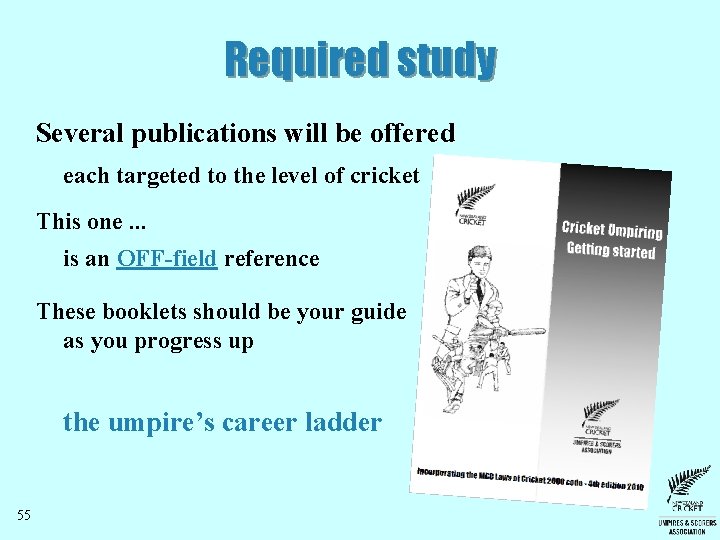
Required study Several publications will be offered each targeted to the level of cricket This one. . . is an OFF-field reference These booklets should be your guide as you progress up the umpire’s career ladder 55
These modules were written & produced for New Zealand Cricket by the New Zealand Cricket Umpires & Scorers Association 56 © 2010 NZC-NZCUSA