
MANAGEMENT BY CHANGE AND PROBLEMS INCORPORATING THE CHANGE
MANAGEMENT BY CHANGE AND PROBLEMS INCORPORATING THE CHANGE
In the context of quality management. Change is both internally generated & externally imposed. QM itself is concerned with change; With doing things better, more accurately. More consistently, more appropriately.
But it is also concerned with the introducing change as a response to the external environment. Both in response to the development of customers ‘requirements’ & in exploiting opportunities presented by the environment. For ex. To reduce the cost of inputs, change, then is at the quality management.
In recent years the management of Change received considerable attention from practitioners and researchers. A useful practical guide by Curzon (1989), designed for librarians, Suggests that a sequence of steps can be used to plan, implement & Evaluate change: 1. 2. Conceptualizing: developing awareness & envisioning the change. Preparing: Getting the organization ready for change, for ex. By listening to staff, but being committed to change.
3. Organizing the planning Group: selecting staff to participate & building them into a team. 4. Planning: examining options, deciding on goals & objectives & then developing a plan. 5. Deciding: Evaluating the options, deliberating & then making decisions.
6. Managing the individuals: Discussing the change & dealing with reactions to it, then monitoring its implementation. 7. Controlling resistance: Identifying resistance, analysing its source and counteracting it. 8. Implementing: Formal introduction of the change at the right time & then following it through.
9. Evaluating: Re-examining the goals, Identifying problems & making adjustments. Issues which need to be considered in the management of change includes. Political and Social context. Resources availability & management style.
Above all, change is dependent on people; on encouraging, persuading & enabling individuals to pursue purposeful change & improve the quality of their own outputs, whether as part of the internal quality chain or as direct products & services to end users.
Conclusion F. W. Lancaster, Introducing a collection of essays under the title, ‘Libraries and the Future; , observes that as we enter the 21 century Significant change will occur in the way in which sources of information, Inspiration & entertainment will be made available and these change will have a major impact on the library & the library profession.
But he adds, ominously, that, the most alarming that emerges from these essays is the fact that some of our most respected & Sr. Librarian seem to feel that the library profession lacks the leadership needed to turn these changes to its advantage… (Lancaster -1993)
PROBLEMS IN INCORPORATING THE CHANGE
1. Changes may be positive or negative. If they are positive employees will accept whole heartedly. If negative employees of the organisation may resist them.
2. Planned changes are difficult, expensive and painful also. Due to these changes employees may be compelled to surrender their comfortable and communicate work habits. Similarly some of the loyal employees may lose their jobs.
3. Lack of highly qualified & well trained staff. 4. Lack of managerial skills. 5. Lack of training programmes. 6. Lack of infrastructural facilities. 7. Fear in the minds of employees.
8. Lack of communicational facilities. 9. Lack of motivation. 10. Lack of exposure about the new gadgets. 11. Lack of financial resources.
FORCES OF CHANGE
Change may be of any nature or magnitude but is necessary for the managers to identify the forces of change. 1. External forces: Task environment which directly or indirectly affect the functioning of an organisation.
There are many external forces which may bring change in organisation & some of them are as under; Socio-Cultural Ex. forces; Cultural Value & norms Economic These forces; forces are very complex.
Political & legal forces; Government Technological They Work intervention. forces; bring major changes in organisation. environment forces;
Internal forces: These forces may either be derived from the change in external environment or may be because of management indeed forces. For ex. Allocation of Quarters to employees nearby library.
Ø Internal forces include the following: Top management & its philosophy & transfer of key functionaries of the organisation. Retirement, promotion, resignation & transfer of key functionaries of the organisation.
Change in the perception, attitude, feelings & expectations of the employees working in the library. Change in work schedule, allocation of duties, Job contents duty hours & composition of work group etc. Change in internal environment of the organisation.
MANAGEMENT BY OBJECTIVES (MBO)
MBO: came into limelight in the year 1954. Propounded by Peter F. Drucker. It is also called as ‘Results Management; by mission. ’ Goals
MBO : is considered a system and philosophy of management functions in a logical and effective manner for achieving goals.
According to Koontz & Weihrich define, MBO as “a comprehensive managerial system that integrates many key managerial activities in a systematic manner and that is consciously directed towards the effective and efficient achievement of organisational & individual objectives”.
According to Terry, “ It is a system in which each employee participates in determining personal objectives as well as the means by which he or she hopes to achieve these objectives”.
The concept is based on measurable and participatively set objectives. It involves joint and participative goal-setting & consultative & participative process of determining means of achieving them.
Characteristics of MBO is not a merely a tool & technique of management, it is on approach or a system & philosophy of management. Although it mainly deals with planning & control, its increasing use as a motivational technique, coordination device has been established in practice.
MBO approach is goal-oriented. It places emphasis on clearly formulated goals & fair & internally consistent hierarchy of these goals. It encourages joint participation of superiors and subordinates in the process of goal-setting for subordinates; joint goal setting is critical this approach.
MBO is continuous & systematic approach of goal setting & devising an action plan, monitoring performance of subordinate & making an appraisal, against the agreed set objectives, for initiating corrective action which completes the cycle and results in re-starts of the planning process.
Strategy Management Purpose is to establish the mission, vision, guiding principles & deployment infrastructure which encourage all employees to focus on and move in a common direction, objectives, strategies & actions are considered on a three to five year time line.
Process management – Purpose is to establish a system to effectively plan, organise, implement & control all the resource & activities needed for successful completion of the project.
Histograms are Visual representation of the Spread or distribution of data. They are also called ‘Frequency distribution’. They are used to monitor a process to see if it consistently meets customer requirement.
Measuring the process to see if it really does this usually requires the observation of several runs of the process, the recording of observations & then a comparison of these with the target, standard or specification for the process. Histograms can help those involved in preliminary data analysis find the distribution pattern of whatever variable is studies.
The information presented in Histograms is represented by a series of rectangles or bars which are proportional to groups of data.
RISK MANAGEMENT
Risk Management has been described as 'all the things you need to do to make the future sufficiently certain'. Risk Management is regarded as the rational processes that will allow risk to be managed well. It is wellestablished field of professional expertise, commonly (although still not consistently or universally) used by individuals in their daily lives but also in engineering, business, finance and government.
The prime test of good risk management is whether the measures taken will protect achievement of goals within the accepted tolerance of risk. A secondary, but still important test is whether this is achieved in the most efficient (lowest cost) way.
So the definition of risk management is - "the culture, processes and structures which are directed towards the effective management of potential opportunities and adverse effects". The risk of a proposal may included both potential benefits and potential costs. Risk Management is not designed to stifle innovation and change but to ensure that the associated risks are understood and treated in a way to make the desired outcome more likely, at the lowest net cost.
TOTAL QUALITY MANAGEMENT (TQM) IN LIBRARIES
In the 218 t Century quality has become a necessity to all aspects and areas in human life. It applies to all types of work processes, employers, institutions and all sectors including the educational sector, especially in terms of quality in educational services. Library is a part of the educational system, it is necessary to provide quality services to users of the library.
Due to information explosion, the expectations from the library are changing rapidly. In 'a rapidly changing environment, greater competition for resources, the ever increasing costs of information carriers, the rising expectation of funding agencies and clients' and the increasing complexity of information; users expect quality services, in provision of infrastructure, as well as training.
It is evident that effective management skills must match these intense demands on library and information centers. It is in this regard that application of Total Quality Management (TQM) could assist library and information managers very well.
MEANING OF TQM Both American and Japanese management experts have contributed to TQM in their own ways. Due to this TQM has many facets and became more popular in 1990 s. Now it is considered as a new managerial technique applied by many organizations to cope with the customer needs. It emphasizes on the human behaviour and active participation of all.
CHARACTERISTICS OF TQM The TQM is justified with the following three principal characteristics: The customer being the nucleus in the system, all out efforts must be enforced to satisfy the customer who is the driving force to move the wheel of the organization. Quality must be maintained subject to the change on the requirement or complaint lodged by the customer; Innovative ideas of the employees of the organization must be given due salutation along with the ideas of improvement in quality of the services.
DEFINITION Oakland defines "TQM is a comprehensive approach to improving competitiveness, effectiveness and flexibility through planning, organizing and understanding each activity and involving each individual at each level and ensures that management adopt a strategic overview of quality and focus on prevention, not detection of problems".
Quality becomes an issue when libraries try to expand the scope of, and improve their services are relating to how good a service is, and not necessarily how large or extensive. The recipients of a service therefore must experience quality, which may also be a property of the service itself and the client, and not necessarily of the provider.
In the library, quality may be recognized by the customers in terms of the prompt delivery, or timely and error freeness, of the service i. e. , Zero defects. In fact, there has to be a marked shift from a technical to a customer orientation in the delivery of service. All libraries may provide the same type of service but the delivery of that service will differ from place to place depending on its uniqueness.
Thus, Total quality Management (TQM) is both a philosophy and a set of guiding principles that represent the foundation of a continuously improving organization. TQM is a strategic, integrated management system for achieving customer satisfaction.
1. 2. 3. It involves all managers and employees and uses quantitative methods to improve continuously an organization's processes and emphasizes three principles: Focus on achieving customer satisfaction; Seek continuous improvements; and Fully involve the entire workforce.
International organization for Standardization (ISO) is an extension of Total Quality Management, that is a series of various quality standards for products and services and is very "generic", The standards desired can be applied to a broad range of businesses and companies in order to improve quality in the work process. The ISO 9000 refers to a combination of national standards from 100 countries established in 1947.
The mission of "ISO is to promote the development of standardization and related world activities in order to facilitate international exchange of goods and services and to develop co-operation in intellectual, scientific, technological and economic activities". ISO 9000 helps industries/organization to improve quality and the process cycle of their industry and a very good guide line for international quality standards representing the consumers in implementing ISO 9000 procedures not only for the benefits of the consumer, but also to the manufacturer or service provider.
ISO 9001 - Used as a model for quality assurance that is weighted toward design and development, installation, production, and service of a product or service. ISO 9002 - A model for quality assurance that is weighted more towards production and installation of a product or service. ISO 9003 - A model for quality assurance that is weighted towards final inspection and testing of a given product. ISO 9004 - A final model of ISO is a guide for the development of quality management systems.
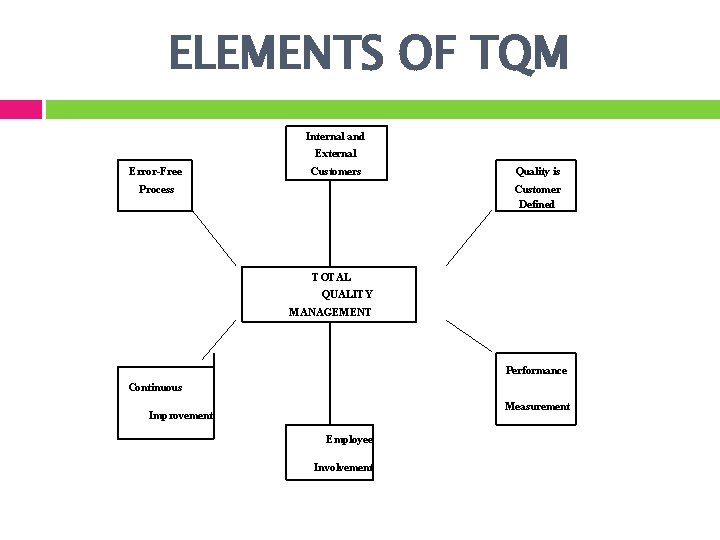
ELEMENTS OF TQM Internal and External Error-Free Customers Process Quality is Customer Defined TOTAL QUALITY MANAGEMENT Performance Continuous Measurement Improvement Employee Involvement
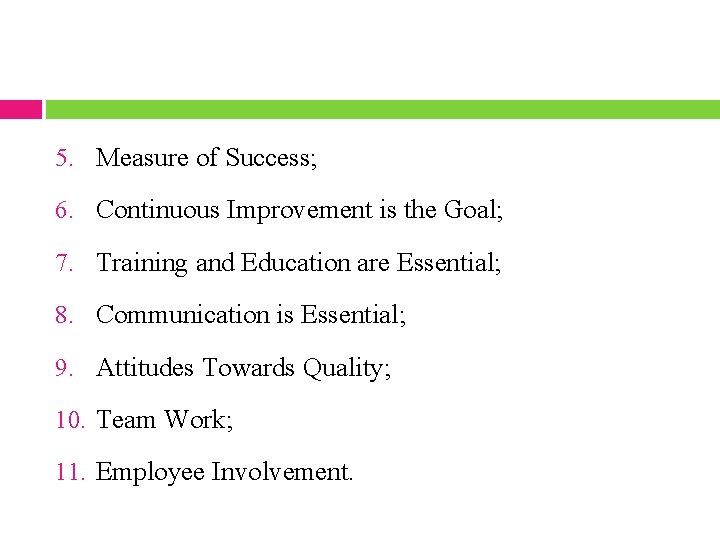
PRINCIPLES OF TQM 1. 2. 3. 4. The management scientists have also derived certain principles from the philosophy of TQM concept and they can be described as follows: Leadership; Internal and External Customers; Customer Satisfaction; Performance Measurement;
5. Measure of Success; 6. Continuous Improvement is the Goal; 7. Training and Education are Essential; 8. Communication is Essential; 9. Attitudes Towards Quality; 10. Team Work; 11. Employee Involvement.
TOOLS FOR QUALITY MANAGEMENT The powerful tools used in quality management to make the quality improvement process itself a powerful tool for improvement. These tools are commonly used in problems solving and continuous quality improvement process. Although these tools do not substitute for judgment and process knowledge but they help to deal with complexity and turn raw data into information that can be used to take necessary management decisions.
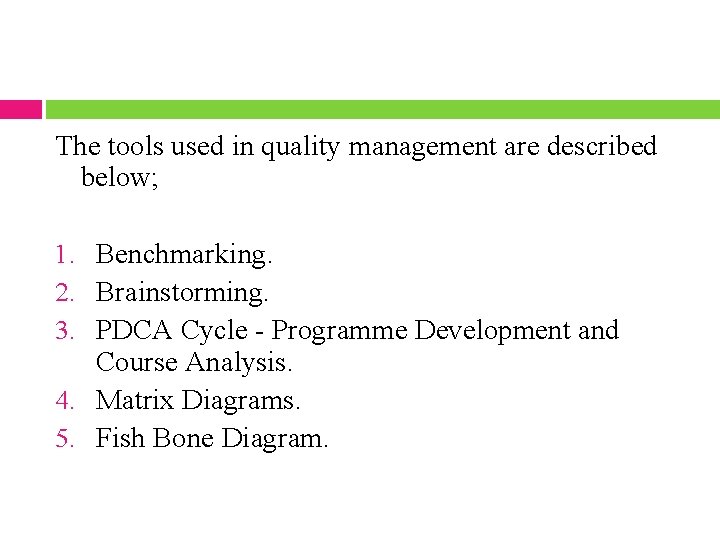
The tools used in quality management are described below; 1. Benchmarking. 2. Brainstorming. 3. PDCA Cycle - Programme Development and Course Analysis. 4. Matrix Diagrams. 5. Fish Bone Diagram.
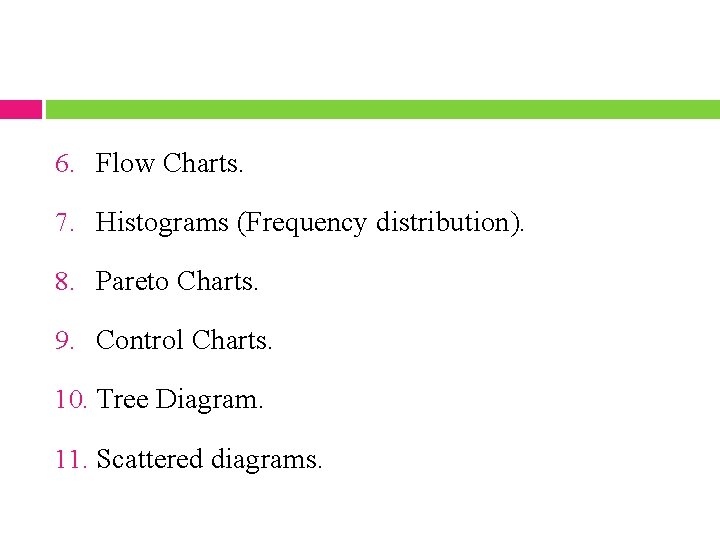
6. Flow Charts. 7. Histograms (Frequency distribution). 8. Pareto Charts. 9. Control Charts. 10. Tree Diagram. 11. Scattered diagrams.
TQM IN LIBRARY AND INFORMATION SERVICE SECTOR Quality Service in Library and Information Service Sector: A Necessary Our Society's digital revolution has transformed the traditional quit world or libraries. Open to debate is the exact form and role we can expect for academic libraries in the beginning of the new millennium. Dramatic changes are in the offing for academic libraries as the result of the digital revolution, such as: Ø Changes in the form of the library;
Changes in the relationship between an institution's library and its information technology division; Changes in the way collections are acquired, organized, stored, and delivered; and Changes in the outlook of library building and facilities.
The library of the future will be more a portal through which students and faculty will access the vast information resources of the world and less a place where information is kept. It will concentrate on access and knowledge management rather than on physical ownership of materials.
This new library needs, to bring together scholars and information resources without necessarily brining either to a physical building. The library of the future will have the daunting mission of helping scholars to discover what relevant information exists, anywhere in the world and in a variety of formats and media.
Contrary to the belief of some that, the Internet will render librarians and their services obsolete, the digital revolution has made librarians all the more essential. A deep knowledge of the scope of what is readily available online, and sound judgment on its reliability, is just one service that university librarians will be called on to provide in the future.
The move towards digital collections and services forces librarians to focus on helping users: Navigate the Internet; Understand unorganized sites; and Consider certified sources on the Internet.
Armstrong in 1991 contends that the criteria of quality, which customers ascribe to service, include: v Accessibility; v Responsiveness v Reliability v Security or timeliness; or accuracy, up-to-dateness and relevance; or non-threatening behaviour, friendliness and helpfulness;
v Communications v Assurance or easy to use; or reliability and consistence; and v Affordability, tangibility or within price range.
The application of TQM in library and information centres seems to be a very recent origin but it is not so in the Indian context wherein Dr. S. R. Ranganathan, father of library and information science stated in his fourth law 'Save the Time of the User' has direct implication to what is advocated in TQM approach.
IMPLEMENTATION OF TQM IN LIBRARY There are five major steps, that TQM is typically implemented. TQM is a process that never ends and establishing organization wide TQM generally takes three or more years. 1. First step is to gain long-term senior management commitment. This stage helps senior executives to understand the importance of long-term commitment to TQM. 2. Second, members have to be trained in quality methods. Depending on the organization's size and complexity, it varies from couple of weeks to two or more years to conduct it.
3. Third step is starting quality improvement projects. In this stage, individuals and work groups apply the quality methods to identify the few projects that hold promise for the largest improvements in organizational processes. 4. Fourth, the whole progress has to be measured. Organizational processes are measured against quality standards. 5. Fifth and the final step are rewarding accomplishment. The organization links rewards to improvements in quality.
KEY FACTORS FOR TQM SUCCESS The eight key factors for research and training program In academic and university library systems are summarized below; It is vital to gain visible commitment to the scheme from senior and middle management. A member of the senior library team should be clearly identified to ensure the quality-based service to the patrons. In itself, this may be difficult to achieve, requiring as it may do a radical realignment of the management culture of the organization.
Every member of library staff should be encouraged to participate in the scheme. All employees will be eligible and this should be made clear in recruitment materials, job descriptions and in publicity material for the scheme. Careful consideration should be given to the evaluation strategy. Those who are given responsibility for evaluating suggestions must be fully committed to the success of the scheme.
The suggestions scheme must be supported by effective administrative backup with sound procedural systems to ensure that suggestions are processed within published times scales. An adequate budget must be provided to fund awards, other forms of reorganization, the purchase of equipment and promotion and publicity of the scheme.
Every opportunity must be taken to promote the scheme throughout the organization. There is little point in launching a scheme, ifnobody knows that it exists. It must be publicized at launch and at regular intervals throughout the year, in order to ensure that everyone is aware of its existence.
The number of suggestions that are actually implemented can measures the success of a suggestion scheme. Implementation is vital because implemented ideas demonstrate the continuing success of the scheme and implemented ideas provide the suggestion(s) with personal satisfaction at seeing their idea in operation - having the knowledge that they have made a difference. It is important that everyone in the organization is aware of the benefits gained from implemented suggestions, so that they too may be encouraged to think about the ways in which they can contribute.
Continuous improvement of all operations and activities is the main thing of TQM. Once it is recognized that customer satisfaction can only be obtained by providing a high-quality product, continuous improvement of the quality of the product is seen as the only way to maintain a high level of customer satisfaction.
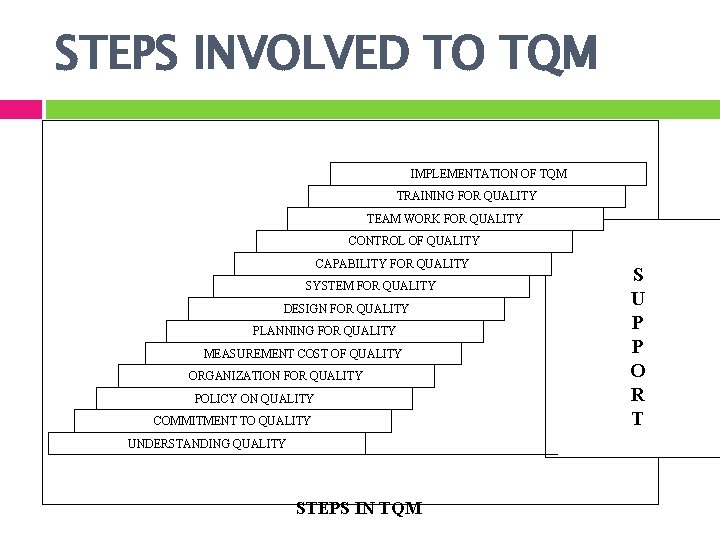
STEPS INVOLVED TO TQM IMPLEMENTATION OF TQM TRAINING FOR QUALITY TEAM WORK FOR QUALITY CONTROL OF QUALITY CAPABILITY FOR QUALITY SYSTEM FOR QUALITY DESIGN FOR QUALITY PLANNING FOR QUALITY MEASUREMENT COST OF QUALITY ORGANIZATION FOR QUALITY POLICY ON QUALITY COMMITMENT TO QUALITY UNDERSTANDING QUALITY STEPS IN TQM S U P P O R T
BARRIERS TO IMPLEMENTATION OF TQM 1. 2. The major impediments come in the way towards TQM are: Improper Data Analysis of quality environment. The major obstacles for TQM implementation in the library are due to lack of time to devote quality initiatives; poor inter-organizational communication and lack of real employee empowerment.
3. 4. 5. Lack of TQM tools and techniques and training. Lack of involvement in TQM process by all levels of management. Deficiency of Human Resource Development Management. 6. Ineffective management of process quality. 7. Lack of customer care and satisfaction.
Advantages of TQM in Libraries It ensures qualitative library and information services; It reduces bureaucracy; It helps in gauging the user expectations efficiently and effectively; It promotes co-operation and team work in library staff; It helps continuous education to library staff; It is a management of organization wide involvement.
Limitations to Induction of TQM Lack of management commitment; Improper planning; Lack of continuous education and training; Incomplete organizational structure; Inadequate empowerment and teamwork.
Summary In a nutshell, the major roadblocks in implementing TQM are summarized below; Lack of organization quality Policy; Lack of strong vision by the top management Lack of formalized strategic plan for change; Lack of customer focus;
Lack of team spirit and participation at all levels of management; Ineffective communication; Narrowly based training and development programmes to the employees; Lack of leadership ability; Insufficient TQM tools and techniques; Lack of strong motivation; and Non-implementation/delay of quality improvements teams recommendations.
- Slides: 84