Counseling Adolescent Clients to Resist Sexual Coercion Updated
- Slides: 20
Counseling Adolescent Clients to Resist Sexual Coercion Updated December 2019 1
Learning Objectives By the end of this training, participants will be able to: • Describe the Title X requirement for counseling adolescents to resist sexual coercion • Define sexual coercion for adolescent clients • Start a conversation with adolescents on how to recognize and resist sexual coercion • Explain what a healthy relationship is and is not to adolescent clients and discuss the characteristics of a healthy relationship • Show adolescent clients how to use refusal skills techniques to resist sexual coercion 2
Legislative Mandate “None of the funds appropriated in this Act may be made available to any entity under Title X of the Public Health Service Act unless the applicant for the award certifies to the Secretary of Health and Human Services that it provides counseling to minors on how to resist attempts to coerce minors into engaging in sexual activities. ” 3
Annual Training on Sexual Coercion The project’s training plan should provide for an annual training on counseling minors on how to resist being coerced into engaging in sexual activities. “Every minor who presents for treatment is provided counseling on how to resist attempts to coerce them into engaging in sexual activities. ” 4
What is Sexual Coercion? • Unwanted sexual activity that happens when someone is pressured, tricked, threatened, or forced in a nonphysical way – It can be any type of non-physical pressure used to make someone participate in sexual activity that they do not agree to – It includes a range of behaviors that a partner may use related to sexual decision making to pressure or coerce a person to have sex without using physical force 5
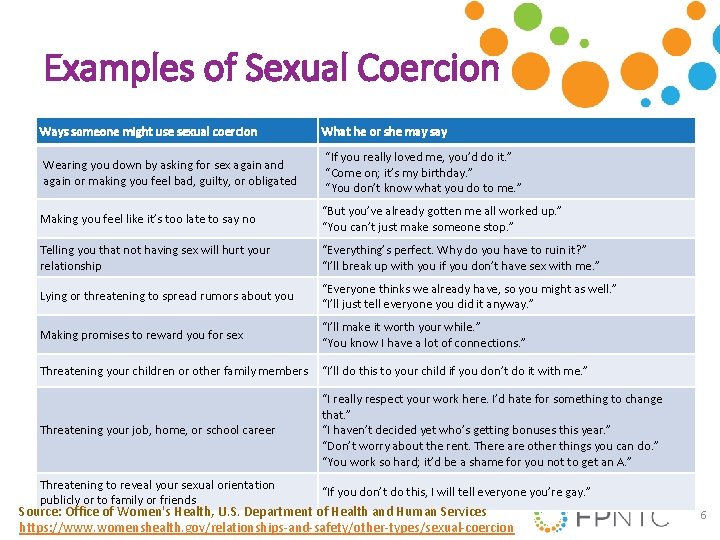
Examples of Sexual Coercion Ways someone might use sexual coercion What he or she may say Wearing you down by asking for sex again and again or making you feel bad, guilty, or obligated “If you really loved me, you’d do it. ” “Come on; it’s my birthday. ” “You don’t know what you do to me. ” Making you feel like it’s too late to say no “But you’ve already gotten me all worked up. ” “You can’t just make someone stop. ” Telling you that not having sex will hurt your relationship “Everything’s perfect. Why do you have to ruin it? ” “I’ll break up with you if you don’t have sex with me. ” Lying or threatening to spread rumors about you “Everyone thinks we already have, so you might as well. ” “I’ll just tell everyone you did it anyway. ” Making promises to reward you for sex “I’ll make it worth your while. ” “You know I have a lot of connections. ” Threatening your children or other family members “I’ll do this to your child if you don’t do it with me. ” Threatening your job, home, or school career “I really respect your work here. I’d hate for something to change that. ” “I haven’t decided yet who’s getting bonuses this year. ” “Don’t worry about the rent. There are other things you can do. ” “You work so hard; it’d be a shame for you not to get an A. ” Threatening to reveal your sexual orientation publicly or to family or friends “If you don’t do this, I will tell everyone you’re gay. ” Source: Office of Women's Health, U. S. Department of Health and Human Services https: //www. womenshealth. gov/relationships-and-safety/other-types/sexual-coercion 6
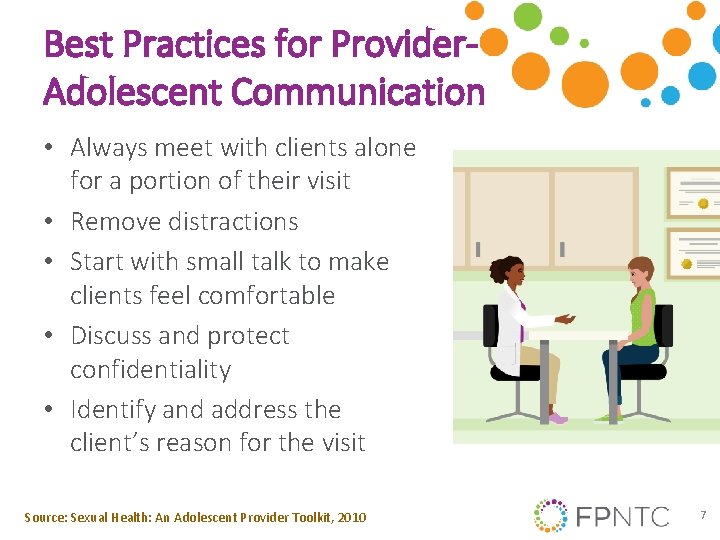
Best Practices for Provider. Adolescent Communication • Always meet with clients alone for a portion of their visit • Remove distractions • Start with small talk to make clients feel comfortable • Discuss and protect confidentiality • Identify and address the client’s reason for the visit Source: Sexual Health: An Adolescent Provider Toolkit, 2010 7
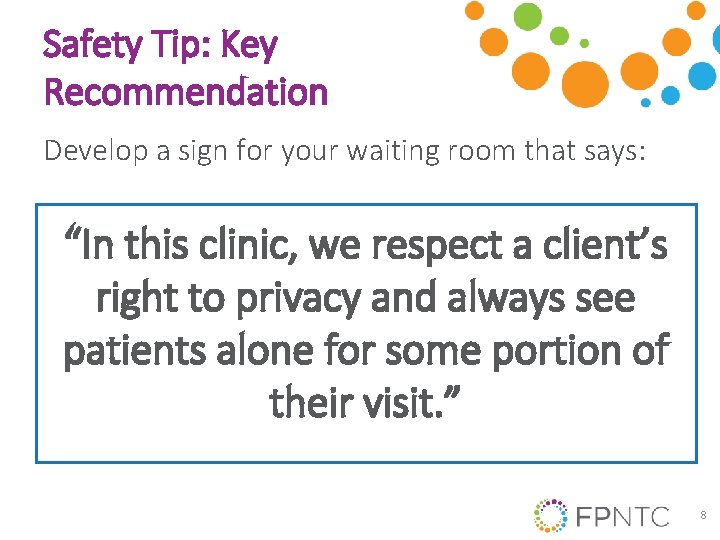
Safety Tip: Key Recommendation Develop a sign for your waiting room that says: “In this clinic, we respect a client’s right to privacy and always see patients alone for some portion of their visit. ” 8
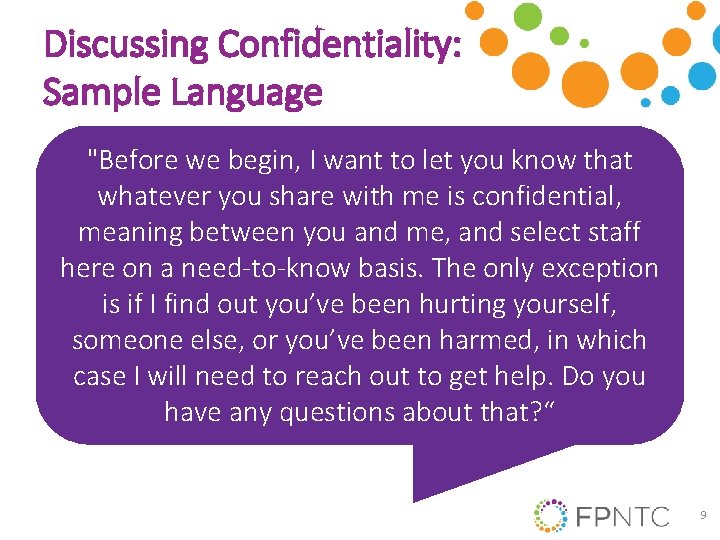
Discussing Confidentiality: Sample Language "Before we begin, I want to let you know that whatever you share with me is confidential, meaning between you and me, and select staff here on a need-to-know basis. The only exception is if I find out you’ve been hurting yourself, someone else, or you’ve been harmed, in which case I will need to reach out to get help. Do you have any questions about that? “ 9
Mandatory Reporting • You must know your state’s law and the required process for your agency and your role • Refer to Mandatory Child Abuse Reporting State Summaries here: – https: //www. fpntc. org/resources/mandatory-childabuse-reporting-state-summaries 10
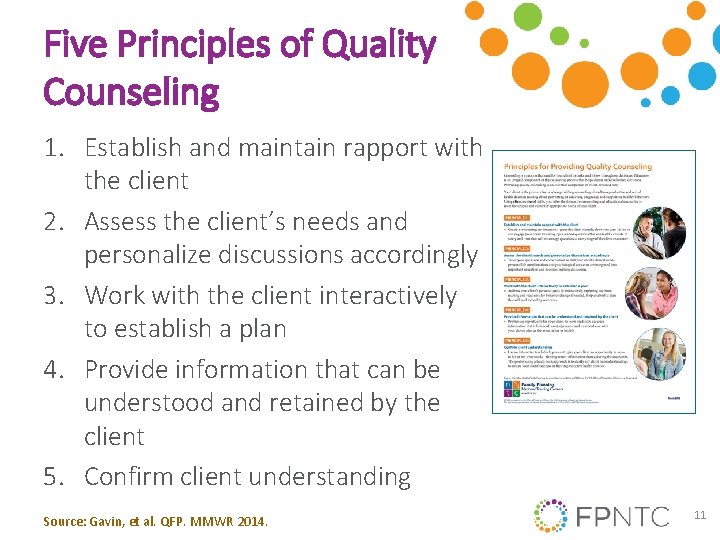
Five Principles of Quality Counseling 1. Establish and maintain rapport with the client 2. Assess the client’s needs and personalize discussions accordingly 3. Work with the client interactively to establish a plan 4. Provide information that can be understood and retained by the client 5. Confirm client understanding Source: Gavin, et al. QFP. MMWR 2014. 11
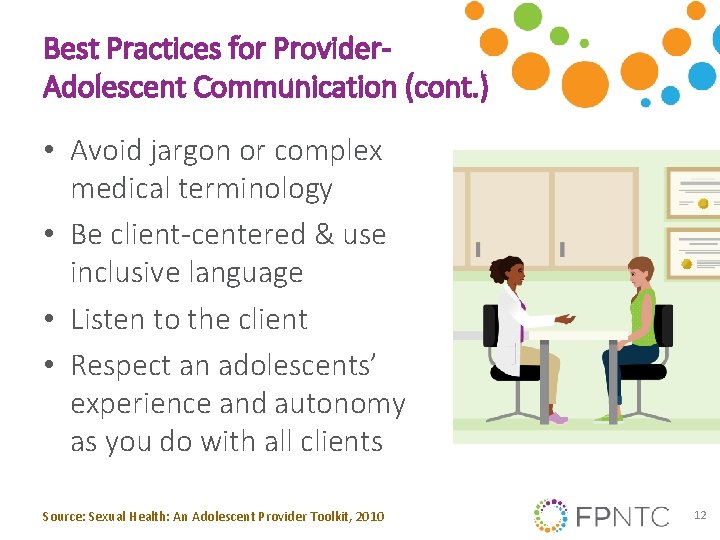
Best Practices for Provider. Adolescent Communication (cont. ) • Avoid jargon or complex medical terminology • Be client-centered & use inclusive language • Listen to the client • Respect an adolescents’ experience and autonomy as you do with all clients Source: Sexual Health: An Adolescent Provider Toolkit, 2010 12
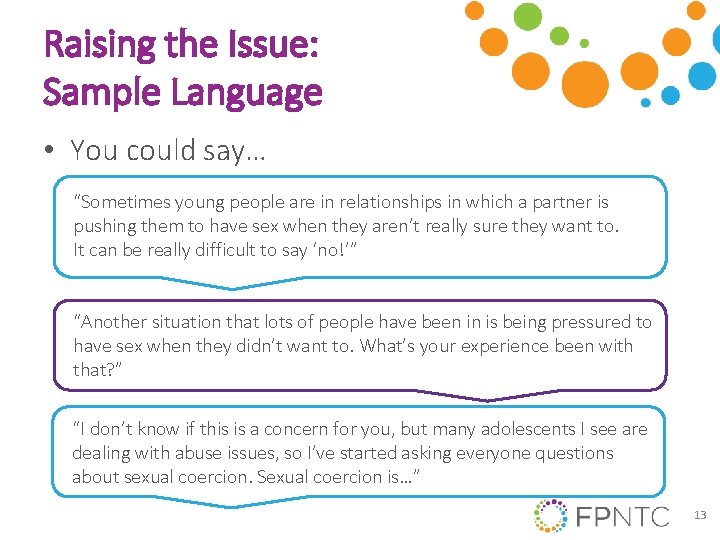
Raising the Issue: Sample Language • You could say… “Sometimes young people are in relationships in which a partner is pushing them to have sex when they aren’t really sure they want to. It can be really difficult to say ‘no!’” “Another situation that lots of people have been in is being pressured to have sex when they didn’t want to. What’s your experience been with that? ” “I don’t know if this is a concern for you, but many adolescents I see are dealing with abuse issues, so I’ve started asking everyone questions about sexual coercion. Sexual coercion is…” 13
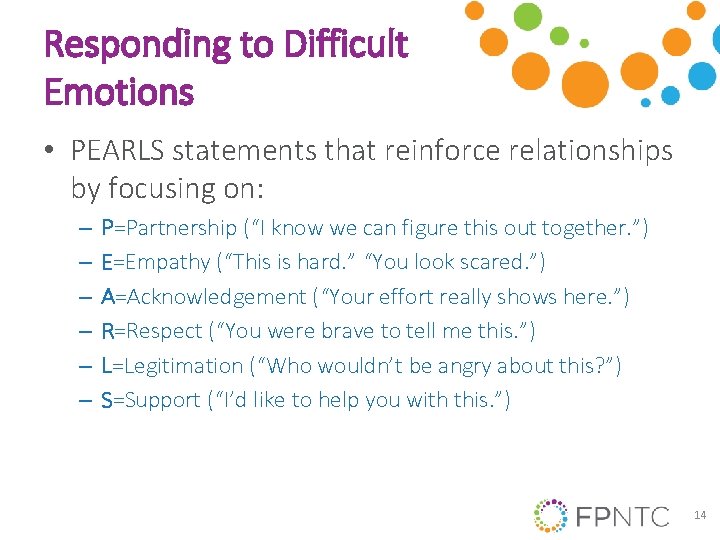
Responding to Difficult Emotions • PEARLS statements that reinforce relationships by focusing on: – – – P=Partnership (“I know we can figure this out together. ”) E=Empathy (“This is hard. ” “You look scared. ”) A=Acknowledgement (“Your effort really shows here. ”) R=Respect (“You were brave to tell me this. ”) L=Legitimation (“Who wouldn’t be angry about this? ”) S=Support (“I’d like to help you with this. ”) 14
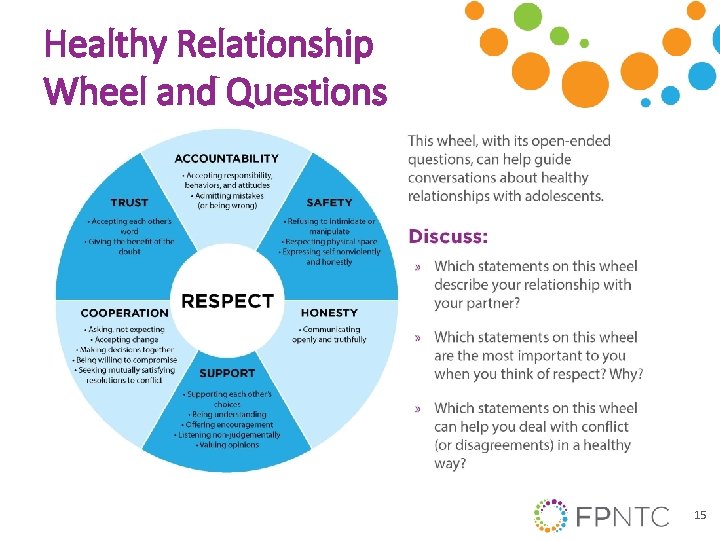
Healthy Relationship Wheel and Questions 15
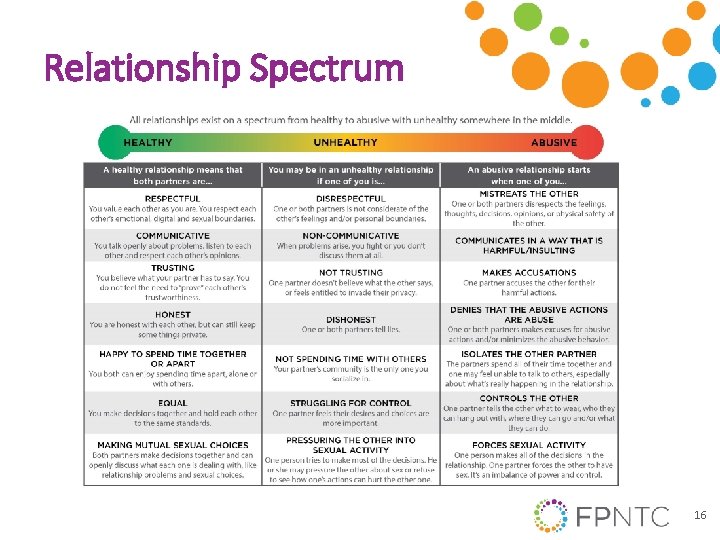
Relationship Spectrum 16
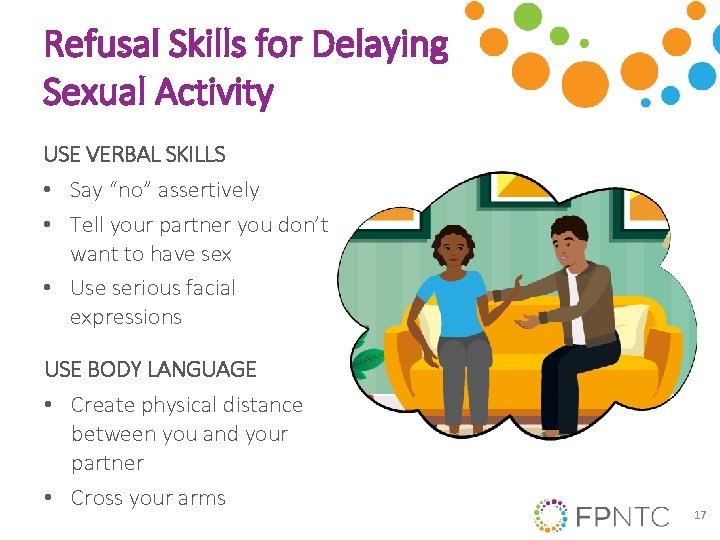
Refusal Skills for Delaying Sexual Activity USE VERBAL SKILLS • Say “no” assertively • Tell your partner you don’t want to have sex • Use serious facial expressions USE BODY LANGUAGE • Create physical distance between you and your partner • Cross your arms 17
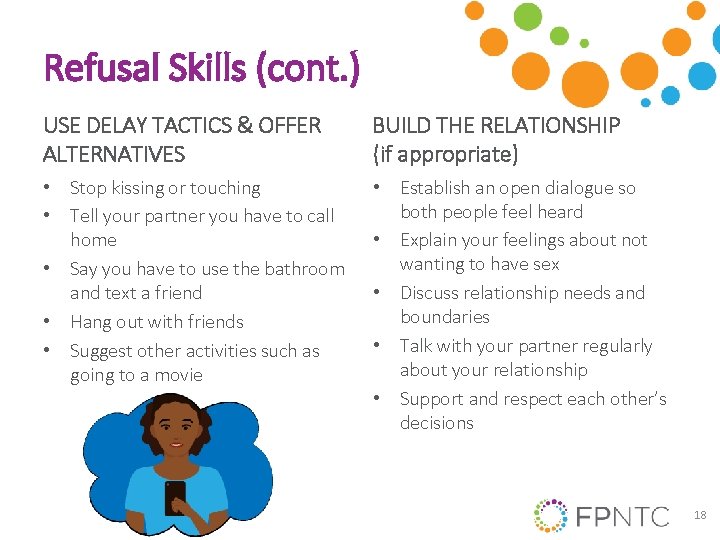
Refusal Skills (cont. ) USE DELAY TACTICS & OFFER ALTERNATIVES BUILD THE RELATIONSHIP (if appropriate) • Stop kissing or touching • Tell your partner you have to call home • Say you have to use the bathroom and text a friend • Hang out with friends • Suggest other activities such as going to a movie • Establish an open dialogue so both people feel heard • Explain your feelings about not wanting to have sex • Discuss relationship needs and boundaries • Talk with your partner regularly about your relationship • Support and respect each other’s decisions 18
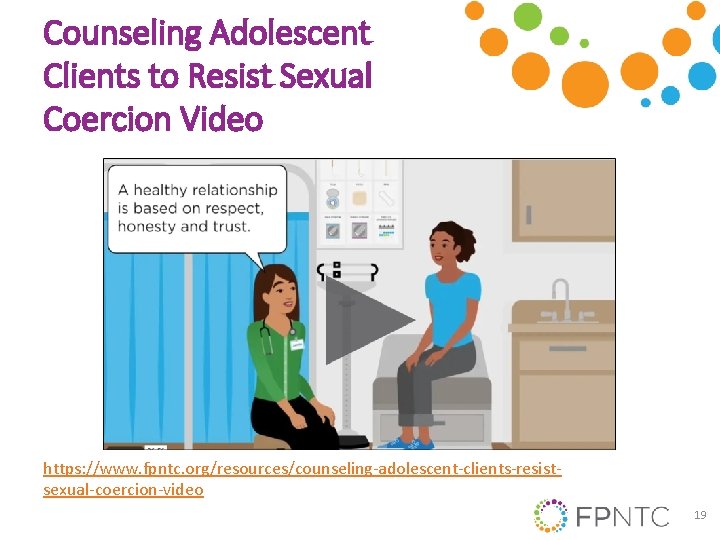
Counseling Adolescent Clients to Resist Sexual Coercion Video https: //www. fpntc. org/resources/counseling-adolescent-clients-resistsexual-coercion-video 19
Contact Us Visit www. fpntc. org Subscribe at www. fpntc. org/enewsletter This presentation was supported by Award No. FPTPA 006028 -04 -00 from the Office of Population Affairs (OPA). Its contents are solely the responsibility of the authors and do not necessarily represent the official views of OPA or HHS. 20