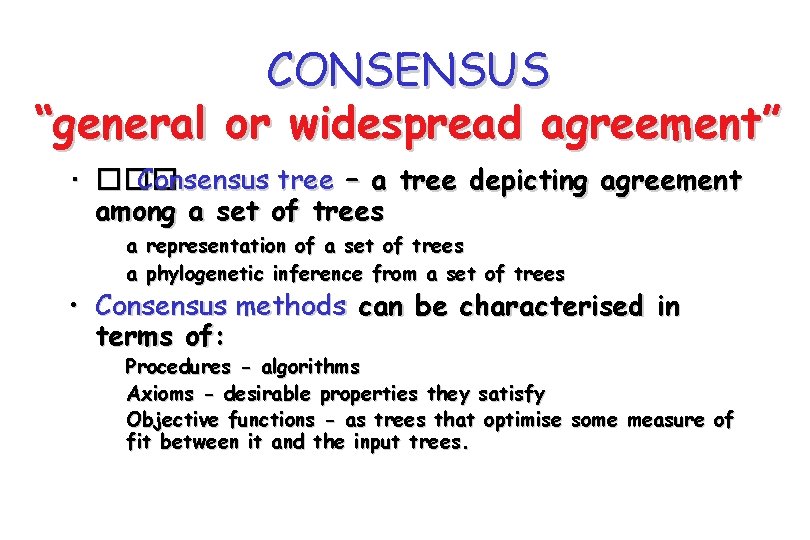
CONSENSUS general or widespread agreement Consensus tree a
- Slides: 16
CONSENSUS “general or widespread agreement” • ��� Consensus tree – a tree depicting agreement among a set of trees a representation of a set of trees a phylogenetic inference from a set of trees • Consensus methods can be characterised in terms of: Procedures - algorithms Axioms - desirable properties they satisfy Objective functions - as trees that optimise some measure of fit between it and the input trees.
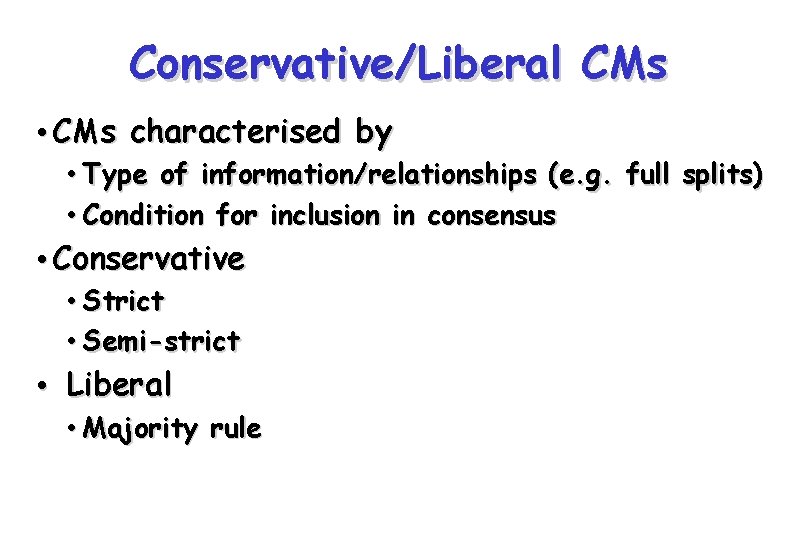
Conservative/Liberal CMs • CMs characterised by • Type of information/relationships (e. g. full splits) • Condition for inclusion in consensus • Conservative • Strict • Semi-strict • Liberal • Majority rule
Types of Relationships
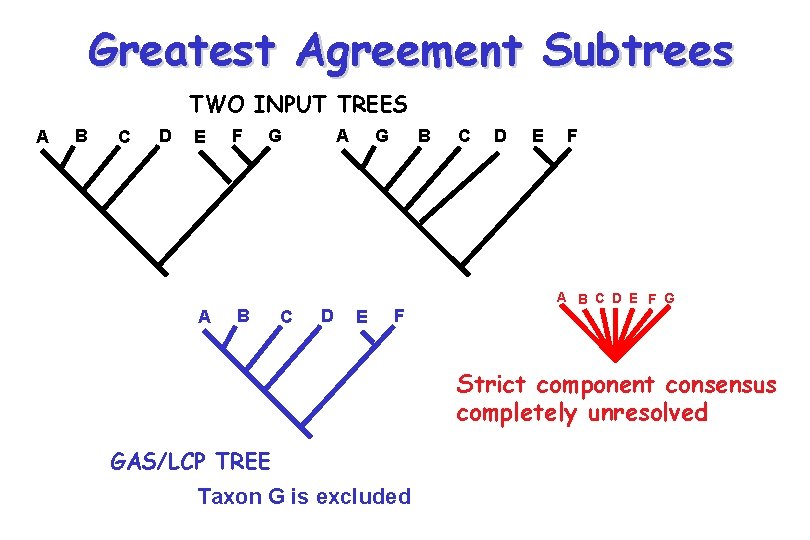
Greatest Agreement Subtrees TWO INPUT TREES A B C D E A F G B C A D G E B F C D E F A B C D E F G Strict component consensus completely unresolved GAS/LCP TREE Taxon G is excluded
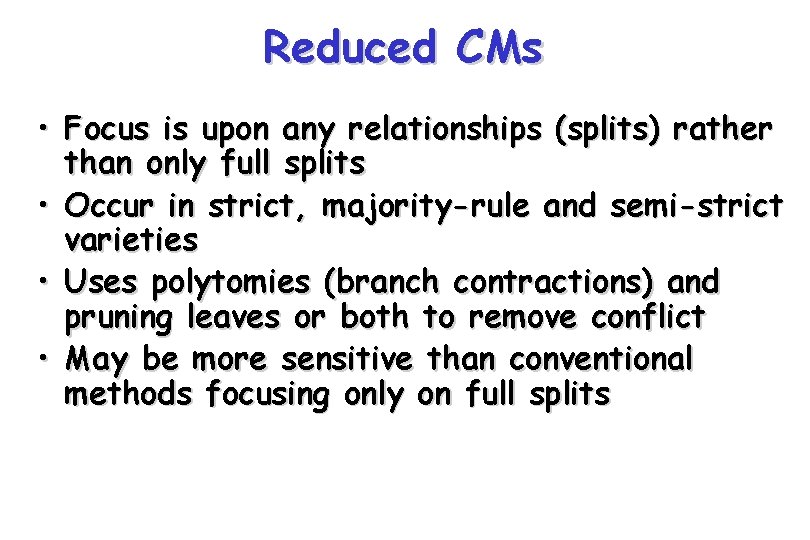
Reduced CMs • Focus is upon any relationships (splits) rather than only full splits • Occur in strict, majority-rule and semi-strict varieties • Uses polytomies (branch contractions) and pruning leaves or both to remove conflict • May be more sensitive than conventional methods focusing only on full splits
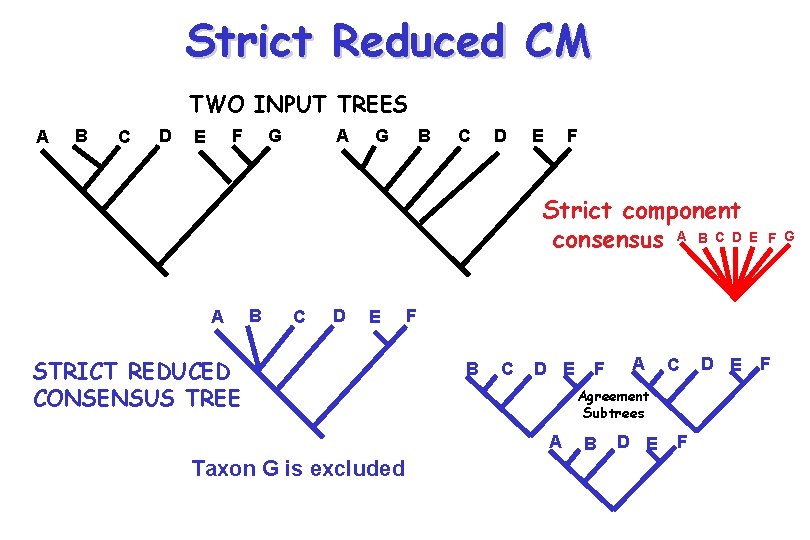
Strict Reduced CM TWO INPUT TREES A B C D F E G A G B C D E F Strict component consensus A B C D E STRICT REDUCED CONSENSUS TREE F B C D E F A C Agreement Subtrees A Taxon G is excluded F G B D E F
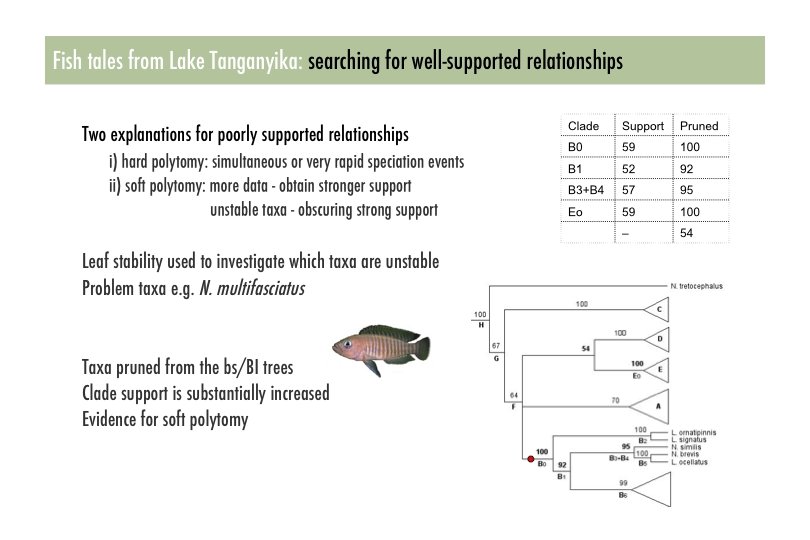
Parsimony analysis of poorly known fossils - an extreme case • Phylogenetic palaeontologists often have data sets that include very poorly known fossil taxa • Inclusion of such taxa is sometimes associated with a proliferation of most parsimonious tree and poorly resolved consensus trees • ‘Rogue’ taxa obfuscate consistent relationships among other taxa
Rhynchosaurs
Fossil & Recent Arthropods
Fossil & Recent Arthropods
Extending Support Measures • The same measures (BP, JP & DI) that are used for clades/splits can also be determined for triplets and quartets • This provides a lot more information because there are more triplets/quartets than there are clades • Furthermore. .
The Decay Theorem • The DI of an hypothesis of relationships is equal to the lowest DI of the resolved triplets that the hypothesis entails • This applies equally to BPs and JPs as well as DIs • Thus a phylogenetic chain is no stronger than its weakest link! • and, measures of clade support may give a very incomplete picture of the distribution of support
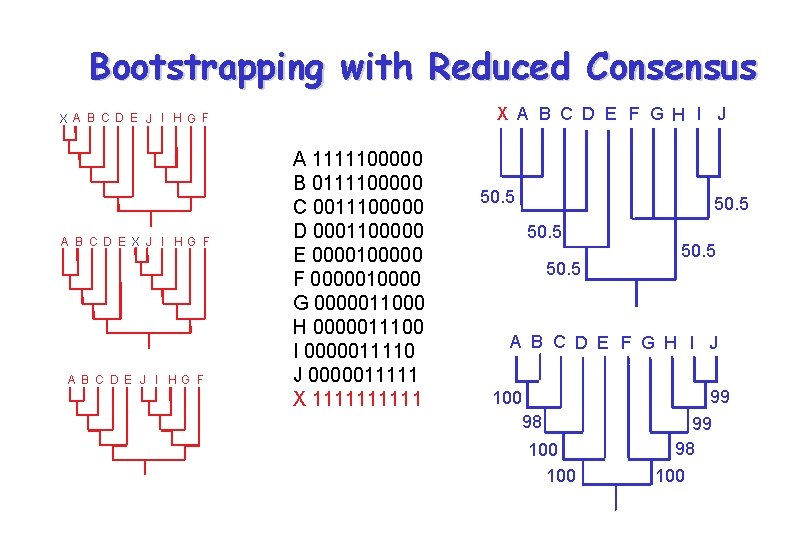
Bootstrapping with Reduced Consensus X A B C D E F G H I J X A B C D E J I HG F A B C D E X J I HG F A B C D E J I HG F A 1111100000 B 0111100000 C 0011100000 D 0001100000 E 0000100000 F 0000010000 G 0000011000 H 0000011100 I 0000011110 J 0000011111 X 11111 50. 5 A B C D E F G H I J 100 98 100 99 99 98 100
Input Trees Consensus Trees More or less Conservative More or less Liberal
Input Trees Super. Trees More or less Conservative More or less Liberal