
LATENT SEMANTIC INDEXING BY SINGULAR VALUE DECOMPOSITION PROBLEMS
LATENT SEMANTIC INDEXING BY SINGULAR VALUE DECOMPOSITION
PROBLEMS IN LEXICAL MATCHING Synonymy - widespread synonym occurances -decrease recall. Polysemy - retrieval of irrelevant documents - poor precision Noise - Boolean search on specific words - Retrieval o contently unrelated documents
MOTIVATION FOR LSI To find and fit a useful model of the relationships between terms and documents. To find out what terms "really" are implied by a query. LSI allow the user to search for concepts rather than specific words. LSI can retrieve documents related to a user's query even when the query and the documents do not share any common terms.
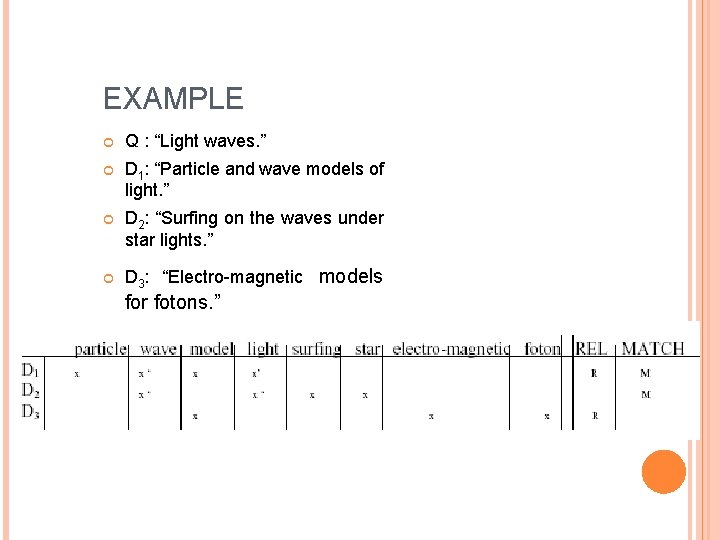
EXAMPLE Q : “Light waves. ” D 1: “Particle and wave models of light. ” D 2: “Surfing on the waves under star lights. ” D 3: “Electro-magnetic models for fotons. ”
HOW LSI WORKS? uses multidimensional vector space to place all documents and terms. Each dimension in that space corresponds to a concept existing in the collection. Thus underlying topics of the document is encoded in a vector. Common related terms in a document and query will pull document and query vector close to each other.
DRAWBACK! The complexity of the LSI model obtained from truncated SVD is costly. Its execution efficiency lag far behind the execution efficiency of the simpler, Boolean models, especially on large data sets.
SVD The key to working with SVD of any rectangular matrix A is to consider AAT and ATA. The columns of U, that is t by t, are eigenvectors of AAT, The columns of V, that is d by d, are eigenvectors of ATA. The singular values on the diagonal of S, that is t by d, are the positive square roots of the nonzero eigenvalues of both AAT and ATA.
SVD Eigenvalue-eigenvector factorization A = USVT - UUT=I -VVT=I -S singular values
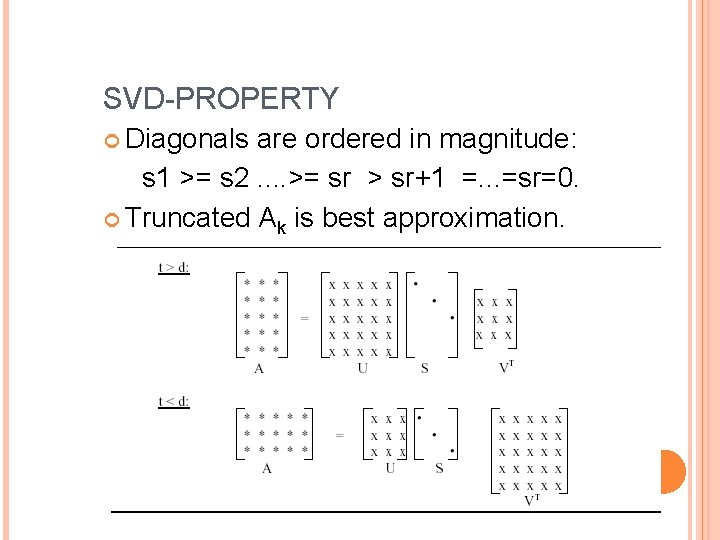
SVD-PROPERTY Diagonals are ordered in magnitude: s 1 >= s 2. . >= sr > sr+1 =. . . =sr=0. Truncated Ak is best approximation.
COMPUTING SVD T = AAT and D = ATA : Eigenvector and Eigenvalue computation for T and D
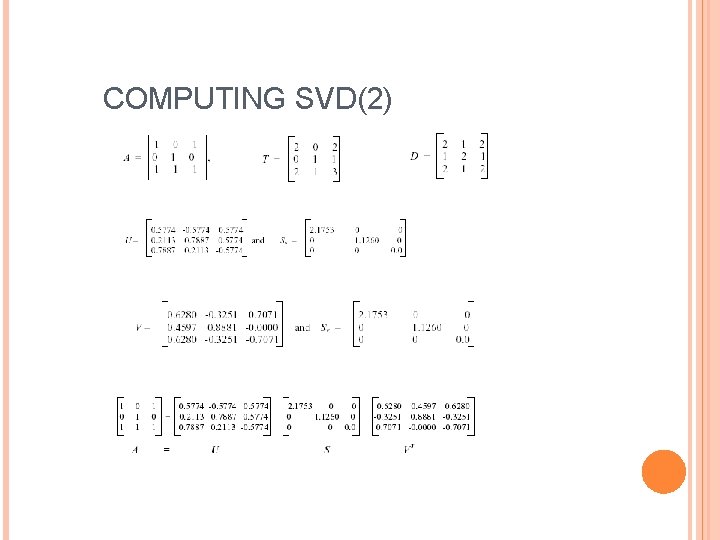
COMPUTING SVD(2)
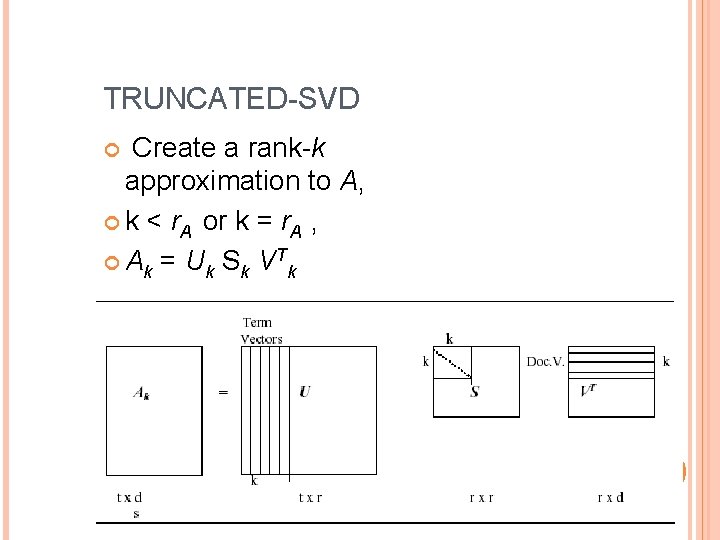
TRUNCATED-SVD Create a rank-k approximation to A, k < r. A or k = r. A , Ak = Uk Sk VTk
TRUNCATED-SVD Using truncated SVD, underlying latent structure is represented in reduced-k dimensional space. Noise in word usage is eliminated,
LSI-PROCEDURE Obtain term-document matrix. Compute the SVD. Truncate-SVD into reduced-k LSI space. -k-dimensional semantic structure -similarity on reduced-space: -term-document -document
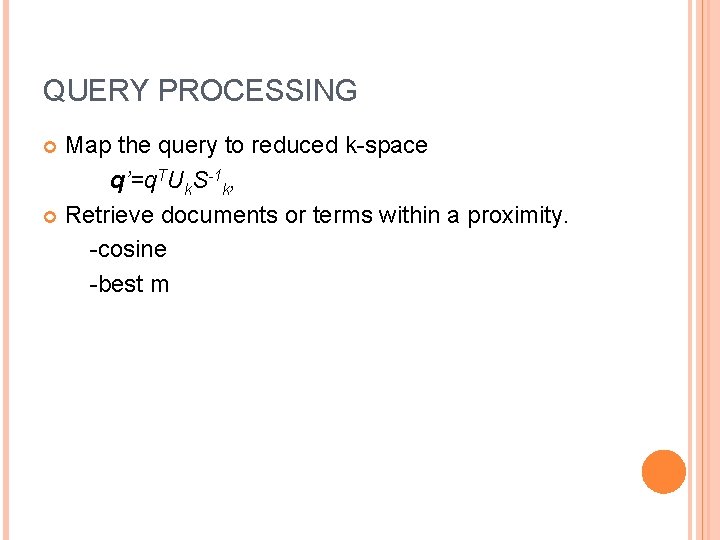
QUERY PROCESSING Map the query to reduced k-space q’=q. TUk. S-1 k, Retrieve documents or terms within a proximity. -cosine -best m
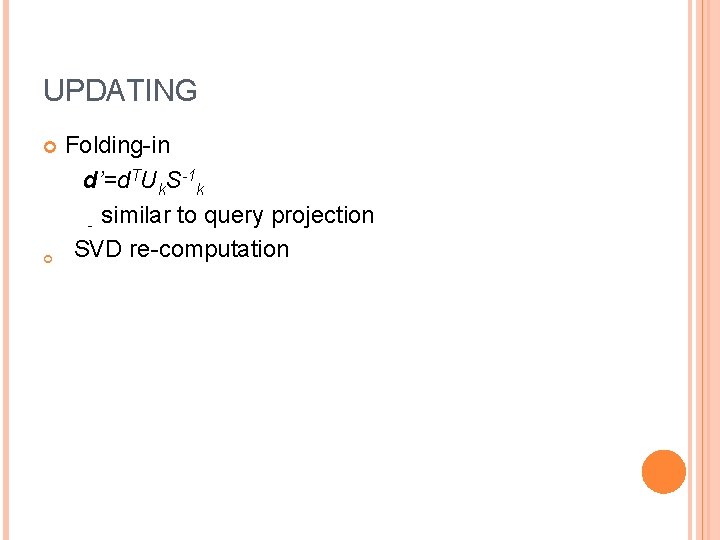
UPDATING Folding-in d’=d. TUk. S-1 k - similar to query projection SVD re-computation
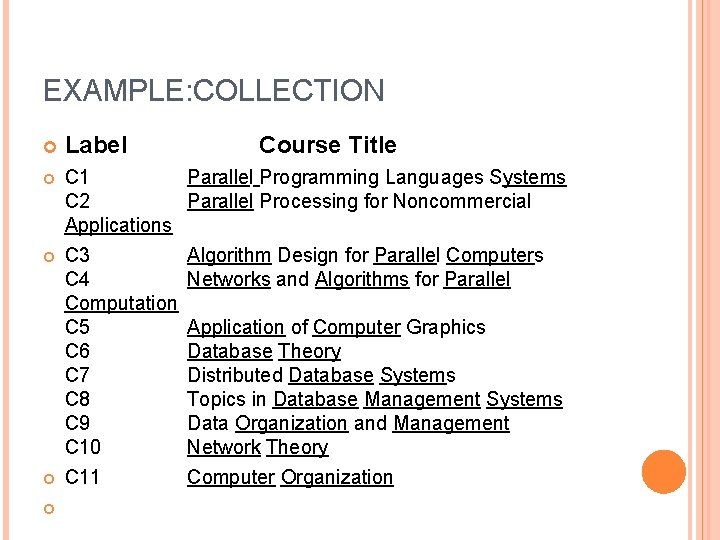
EXAMPLE: COLLECTION Label C 1 Parallel Programming Languages Systems C 2 Parallel Processing for Noncommercial Applications C 3 Algorithm Design for Parallel Computers C 4 Networks and Algorithms for Parallel Computation C 5 Application of Computer Graphics C 6 Database Theory C 7 Distributed Database Systems C 8 Topics in Database Management Systems C 9 Data Organization and Management C 10 Network Theory C 11 Computer Organization Course Title
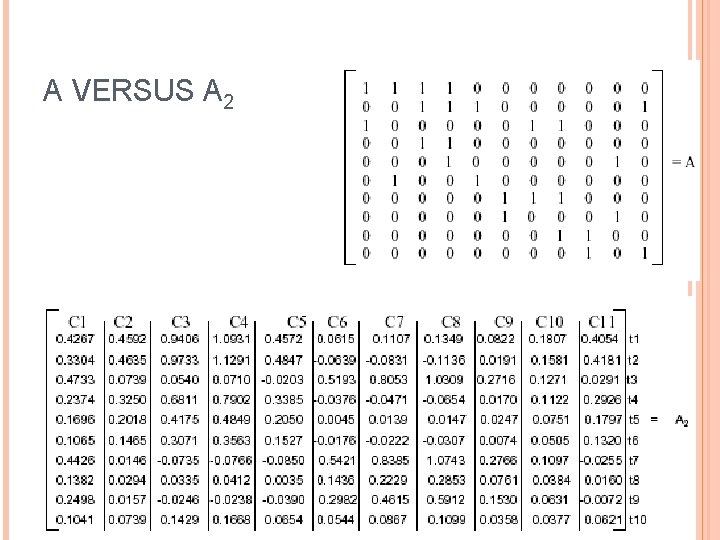
A VERSUS A 2
OBSERVATIONS Lower entry values. Higher values. Negative Entries.
MAPPING
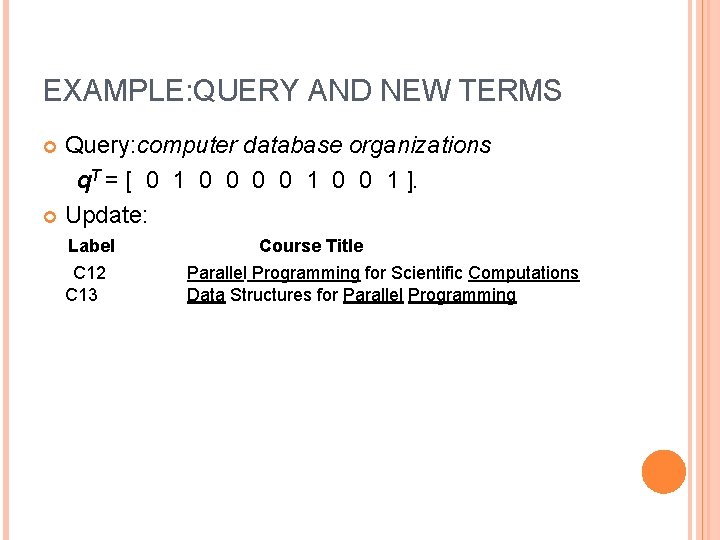
EXAMPLE: QUERY AND NEW TERMS Query: computer database organizations q. T = [ 0 1 0 0 1 ]. Update: Label C 12 C 13 Course Title Parallel Programming for Scientific Computations Data Structures for Parallel Programming

QUERY
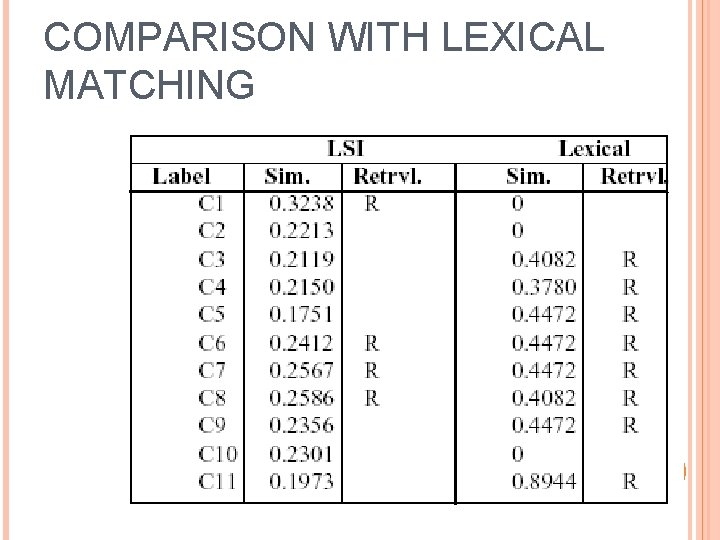
COMPARISON WITH LEXICAL MATCHING

FOLD-IN
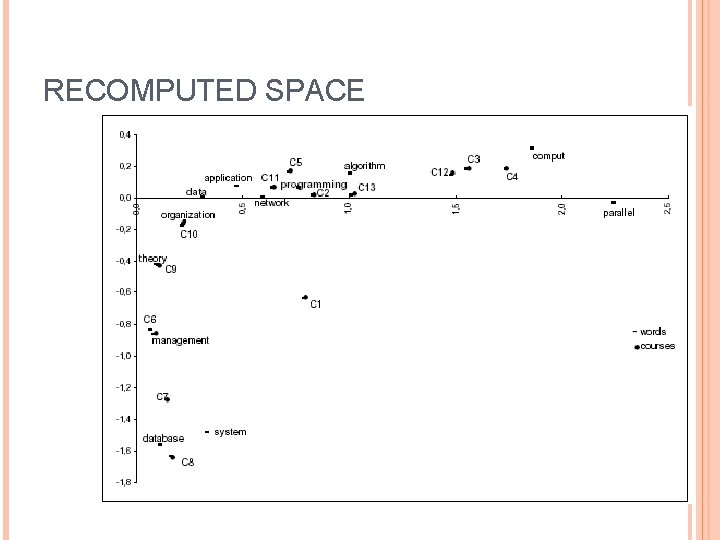
RECOMPUTED SPACE
SOME APPLICATIONS Information Retrieval Information Filtering Relevance Feedback Cross-language retrieval
- Slides: 26