Computer Networks CMSC 417 Spring 2020 Topic Intra

- Slides: 28
Computer Networks CMSC 417 : Spring 2020 Topic: Intra- and Inter-AS routing (BGP) (Textbook chapter 4) Nirupam Roy Tu-Th 2: 00 -3: 15 pm CSI 1115 1
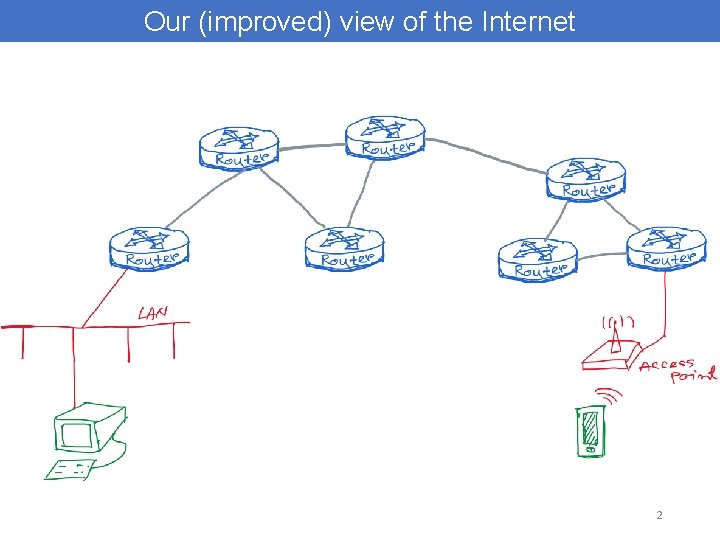
Our (improved) view of the Internet 2
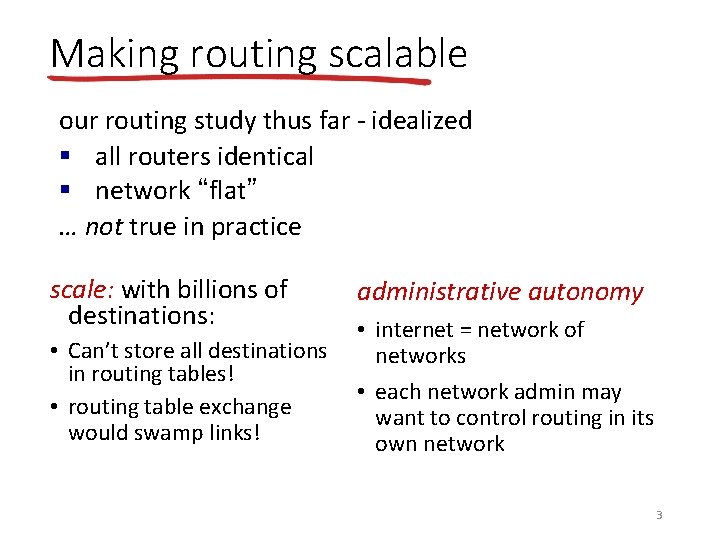
Making routing scalable our routing study thus far - idealized § all routers identical § network “flat” … not true in practice scale: with billions of destinations: • Can’t store all destinations in routing tables! • routing table exchange would swamp links! administrative autonomy • internet = network of networks • each network admin may want to control routing in its own network 3
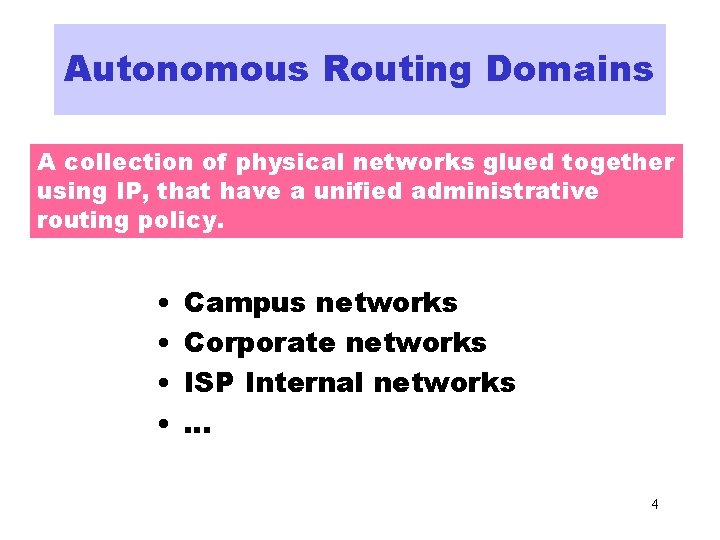
Autonomous Routing Domains A collection of physical networks glued together using IP, that have a unified administrative routing policy. • • Campus networks Corporate networks ISP Internal networks … 4
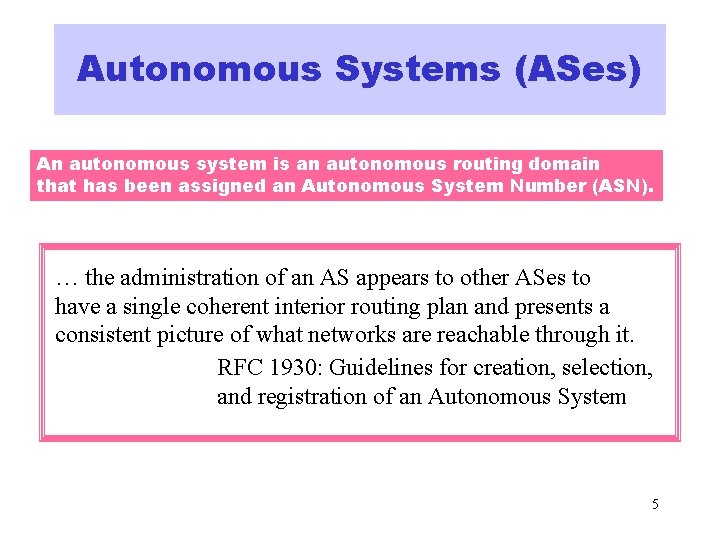
Autonomous Systems (ASes) An autonomous system is an autonomous routing domain that has been assigned an Autonomous System Number (ASN). … the administration of an AS appears to other ASes to have a single coherent interior routing plan and presents a consistent picture of what networks are reachable through it. RFC 1930: Guidelines for creation, selection, and registration of an Autonomous System 5
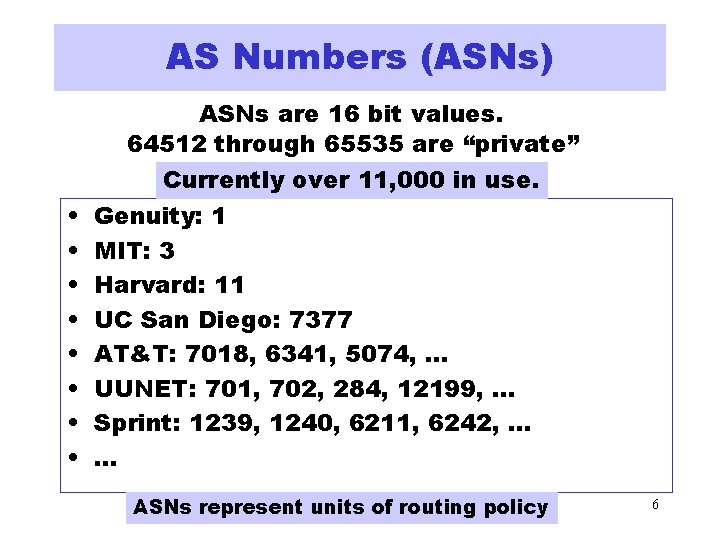
AS Numbers (ASNs) • • ASNs are 16 bit values. 64512 through 65535 are “private” Currently over 11, 000 in use. Genuity: 1 MIT: 3 Harvard: 11 UC San Diego: 7377 AT&T: 7018, 6341, 5074, … UUNET: 701, 702, 284, 12199, … Sprint: 1239, 1240, 6211, 6242, … … ASNs represent units of routing policy 6
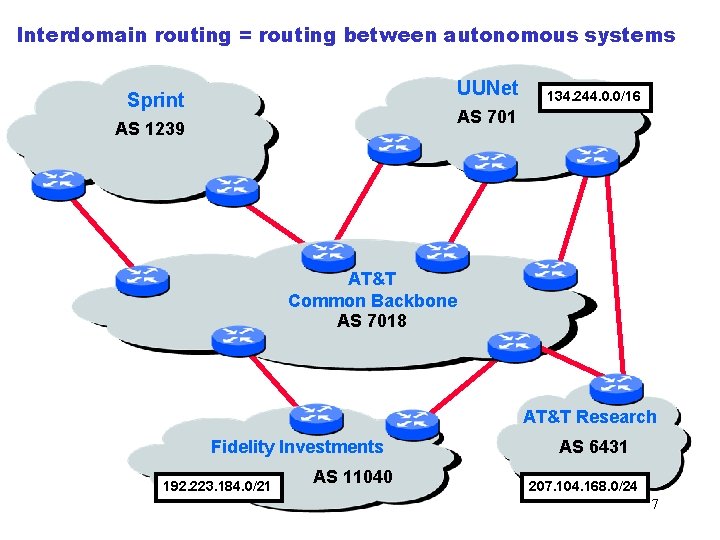
Interdomain routing = routing between autonomous systems UUNet Sprint 134. 244. 0. 0/16 AS 701 AS 1239 AT&T Common Backbone AS 7018 AT&T Research Fidelity Investments 192. 223. 184. 0/21 AS 11040 AS 6431 207. 104. 168. 0/24 7
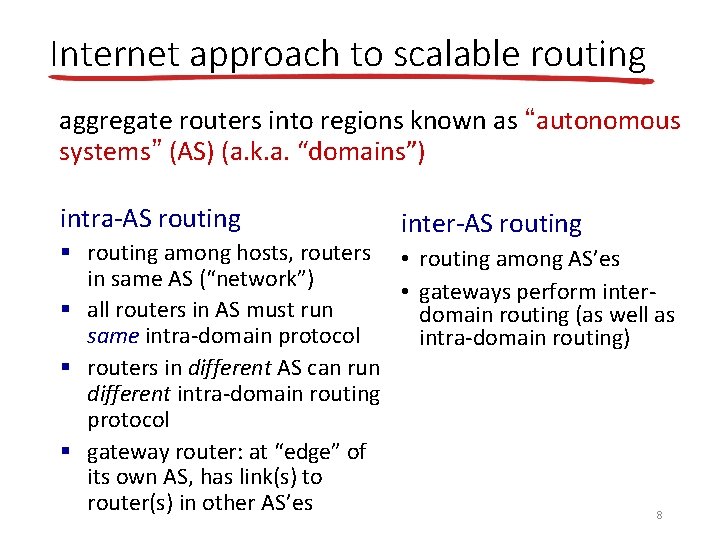
Internet approach to scalable routing aggregate routers into regions known as “autonomous systems” (AS) (a. k. a. “domains”) intra-AS routing inter-AS routing § routing among hosts, routers • routing among AS’es in same AS (“network”) • gateways perform inter§ all routers in AS must run domain routing (as well as same intra-domain protocol intra-domain routing) § routers in different AS can run different intra-domain routing protocol § gateway router: at “edge” of its own AS, has link(s) to router(s) in other AS’es 8
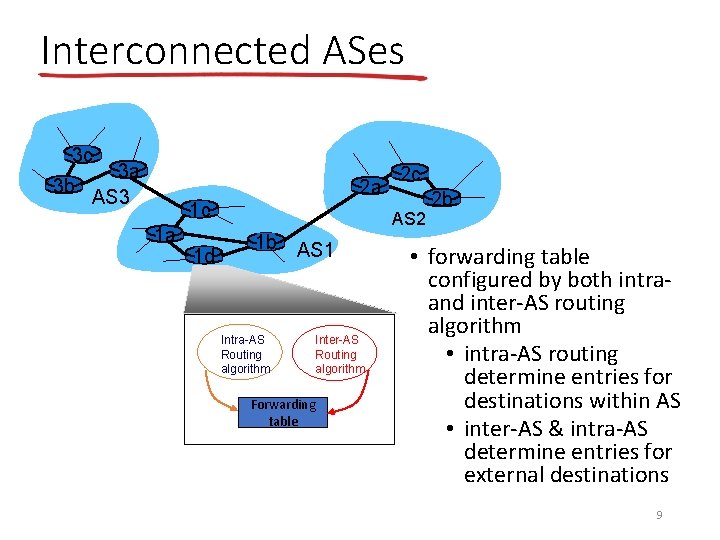
Interconnected ASes 3 c 3 a 3 b AS 3 2 a 1 c 1 a 1 d 2 c AS 2 1 b AS 1 Intra-AS Routing algorithm Inter-AS Routing algorithm Forwarding table 2 b • forwarding table configured by both intraand inter-AS routing algorithm • intra-AS routing determine entries for destinations within AS • inter-AS & intra-AS determine entries for external destinations 9
Intra-AS Routing 10
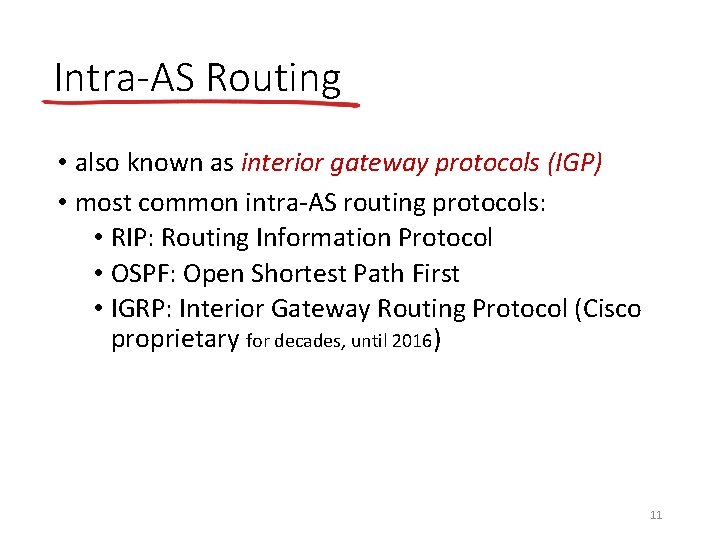
Intra-AS Routing • also known as interior gateway protocols (IGP) • most common intra-AS routing protocols: • RIP: Routing Information Protocol • OSPF: Open Shortest Path First • IGRP: Interior Gateway Routing Protocol (Cisco proprietary for decades, until 2016) 11
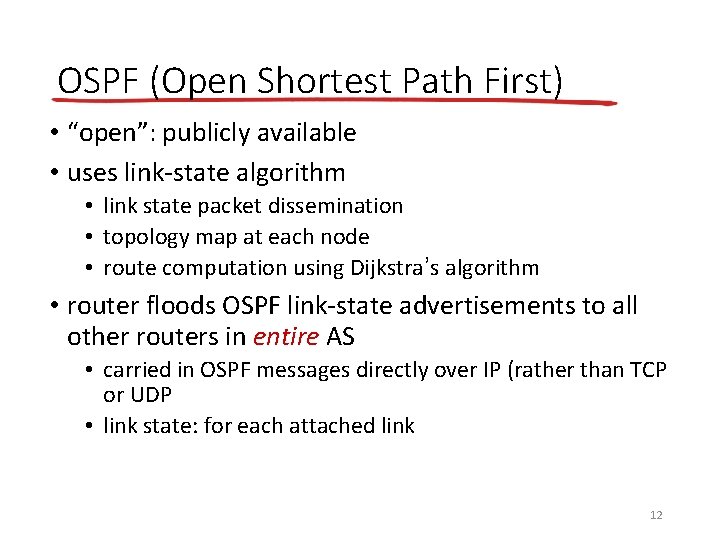
OSPF (Open Shortest Path First) • “open”: publicly available • uses link-state algorithm • link state packet dissemination • topology map at each node • route computation using Dijkstra’s algorithm • router floods OSPF link-state advertisements to all other routers in entire AS • carried in OSPF messages directly over IP (rather than TCP or UDP • link state: for each attached link 12
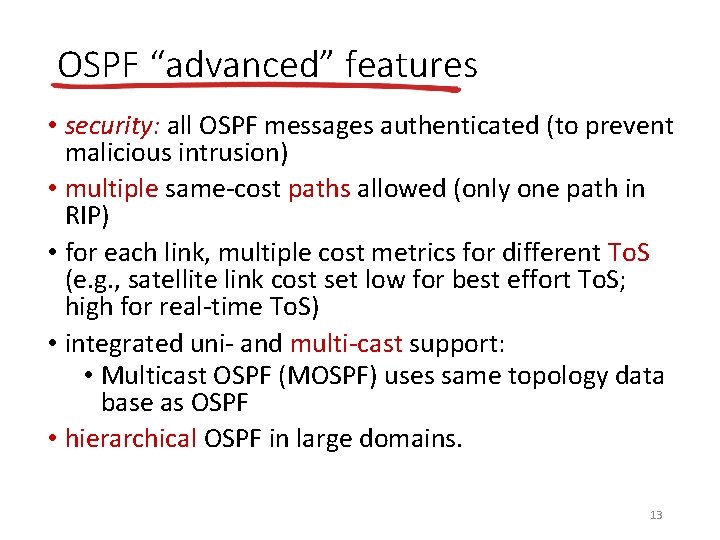
OSPF “advanced” features • security: all OSPF messages authenticated (to prevent malicious intrusion) • multiple same-cost paths allowed (only one path in RIP) • for each link, multiple cost metrics for different To. S (e. g. , satellite link cost set low for best effort To. S; high for real-time To. S) • integrated uni- and multi-cast support: • Multicast OSPF (MOSPF) uses same topology data base as OSPF • hierarchical OSPF in large domains. 13
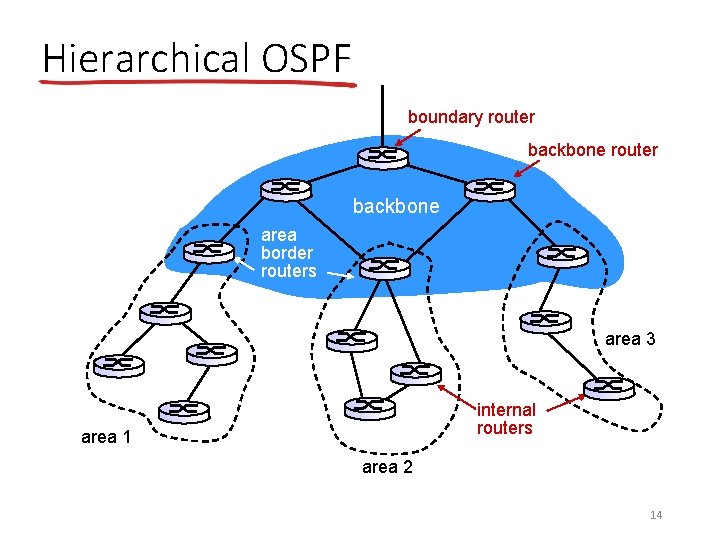
Hierarchical OSPF boundary router backbone area border routers area 3 internal routers area 1 area 2 14
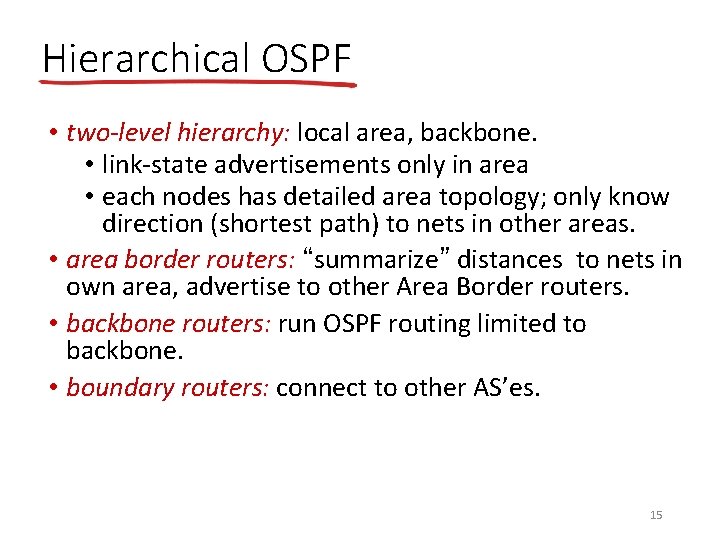
Hierarchical OSPF • two-level hierarchy: local area, backbone. • link-state advertisements only in area • each nodes has detailed area topology; only know direction (shortest path) to nets in other areas. • area border routers: “summarize” distances to nets in own area, advertise to other Area Border routers. • backbone routers: run OSPF routing limited to backbone. • boundary routers: connect to other AS’es. 15
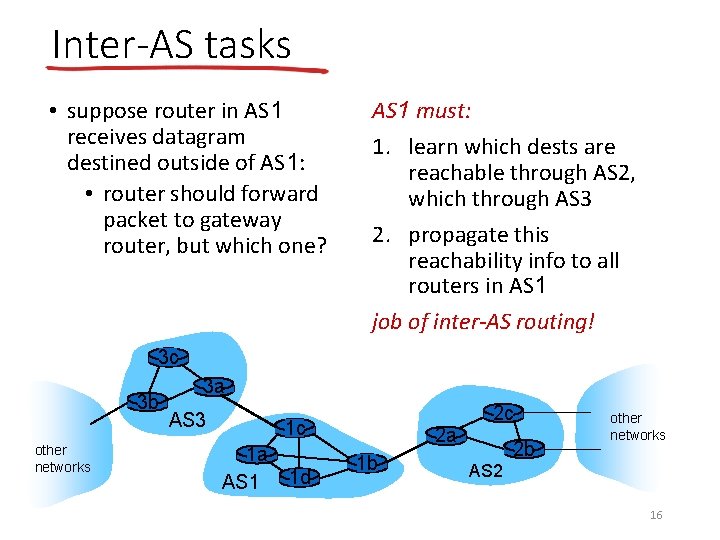
Inter-AS tasks • suppose router in AS 1 receives datagram destined outside of AS 1: • router should forward packet to gateway router, but which one? AS 1 must: 1. learn which dests are reachable through AS 2, which through AS 3 2. propagate this reachability info to all routers in AS 1 job of inter-AS routing! 3 c 3 b other networks 3 a AS 3 1 c 1 a AS 1 1 d 2 a 1 b 2 c 2 b other networks AS 2 16
Inter-AS Routing 17
Internet inter-AS routing: BGP • BGP (Border Gateway Protocol): the de facto inter -domain routing protocol • “glue that holds the Internet together” • BGP provides each AS a means to: • e. BGP: obtain subnet reachability information from neighboring ASes • i. BGP: propagate reachability information to all ASinternal routers. • determine “good” routes to other networks based on reachability information and policy • allows subnet to advertise its existence to rest of Internet: “I am here” 18
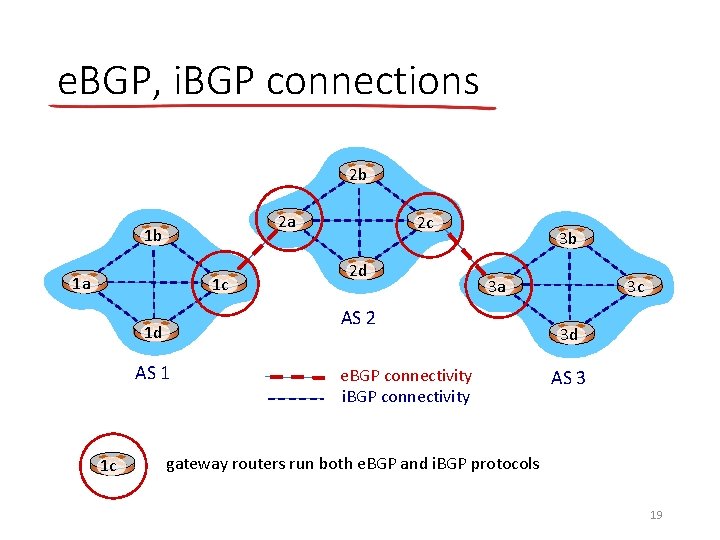
e. BGP, i. BGP connections 2 b 2 a 1 b 1 a 1 c 2 d 3 b 3 a AS 2 1 d AS 1 1 c 2 c e. BGP connectivity i. BGP connectivity 3 c 3 d AS 3 gateway routers run both e. BGP and i. BGP protocols 19
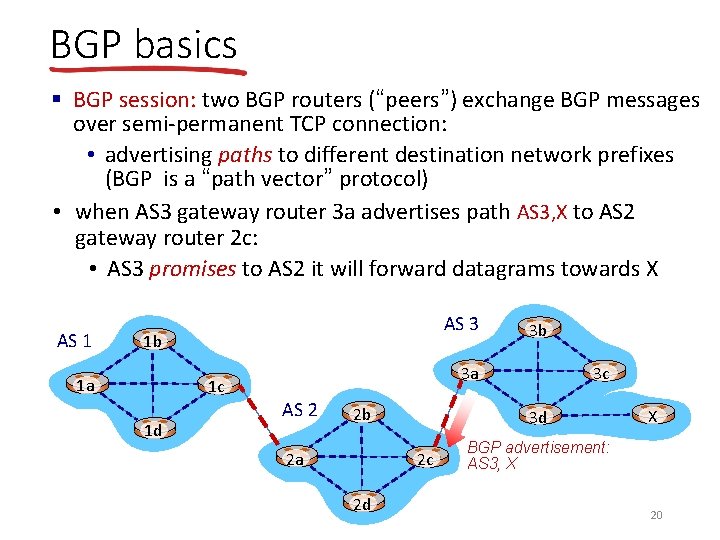
BGP basics § BGP session: two BGP routers (“peers”) exchange BGP messages over semi-permanent TCP connection: • advertising paths to different destination network prefixes (BGP is a “path vector” protocol) • when AS 3 gateway router 3 a advertises path AS 3, X to AS 2 gateway router 2 c: • AS 3 promises to AS 2 it will forward datagrams towards X AS 1 AS 3 1 b 1 a 3 a 1 c 1 d 3 b AS 2 2 b 2 a 3 d 2 c 2 d 3 c X BGP advertisement: AS 3, X 20
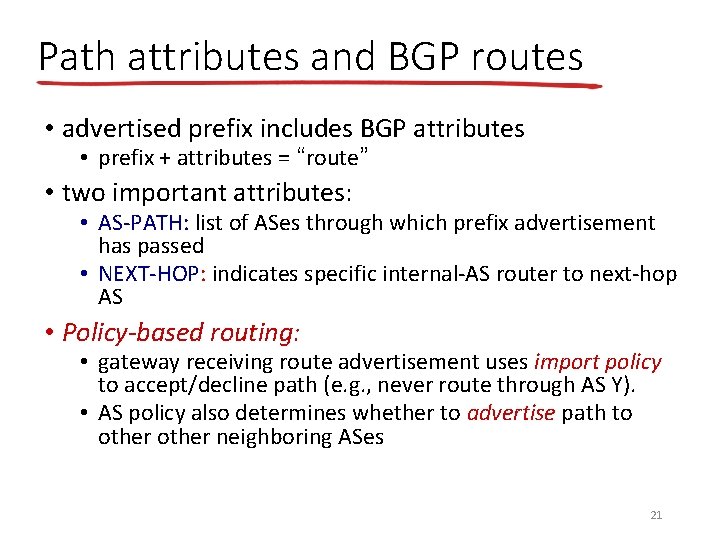
Path attributes and BGP routes • advertised prefix includes BGP attributes • prefix + attributes = “route” • two important attributes: • AS-PATH: list of ASes through which prefix advertisement has passed • NEXT-HOP: indicates specific internal-AS router to next-hop AS • Policy-based routing: • gateway receiving route advertisement uses import policy to accept/decline path (e. g. , never route through AS Y). • AS policy also determines whether to advertise path to other neighboring ASes 21
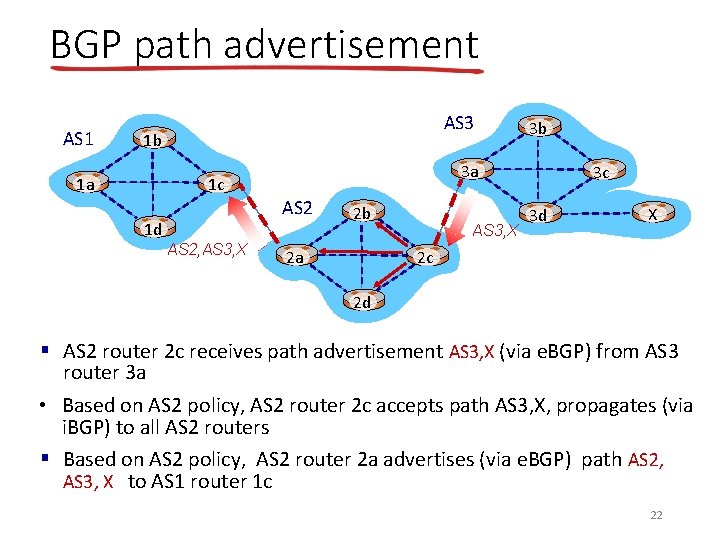
BGP path advertisement AS 1 AS 3 1 b 1 a 3 a 1 c AS 2 1 d AS 2, AS 3, X 3 b 2 b 2 a AS 3, X 3 c 3 d X 2 c 2 d § AS 2 router 2 c receives path advertisement AS 3, X (via e. BGP) from AS 3 router 3 a • Based on AS 2 policy, AS 2 router 2 c accepts path AS 3, X, propagates (via i. BGP) to all AS 2 routers § Based on AS 2 policy, AS 2 router 2 a advertises (via e. BGP) path AS 2, AS 3, X to AS 1 router 1 c 22
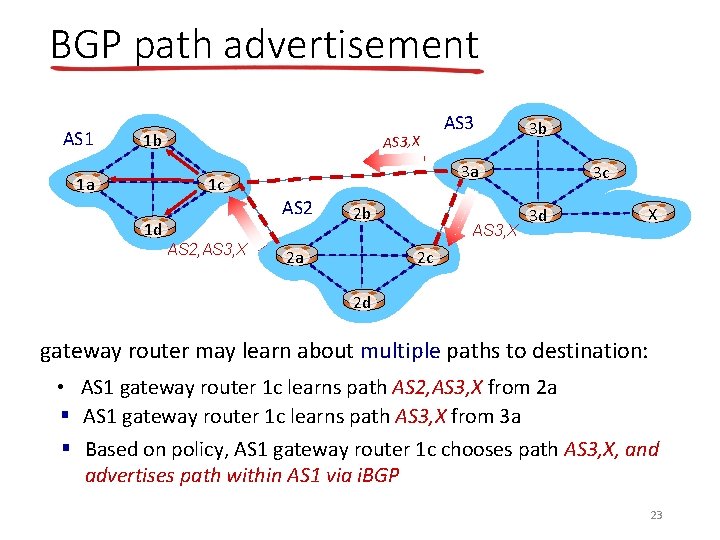
BGP path advertisement AS 1 1 b 1 a AS 3, X AS 2, AS 3, X 3 b 3 a 1 c 1 d AS 3 2 b 2 a AS 3, X 3 c 3 d X 2 c 2 d gateway router may learn about multiple paths to destination: • AS 1 gateway router 1 c learns path AS 2, AS 3, X from 2 a § AS 1 gateway router 1 c learns path AS 3, X from 3 a § Based on policy, AS 1 gateway router 1 c chooses path AS 3, X, and advertises path within AS 1 via i. BGP 23
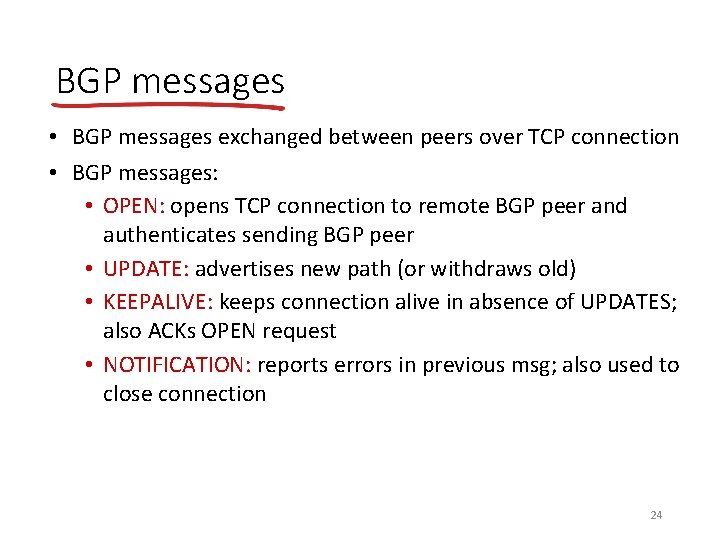
BGP messages • BGP messages exchanged between peers over TCP connection • BGP messages: • OPEN: opens TCP connection to remote BGP peer and authenticates sending BGP peer • UPDATE: advertises new path (or withdraws old) • KEEPALIVE: keeps connection alive in absence of UPDATES; also ACKs OPEN request • NOTIFICATION: reports errors in previous msg; also used to close connection 24
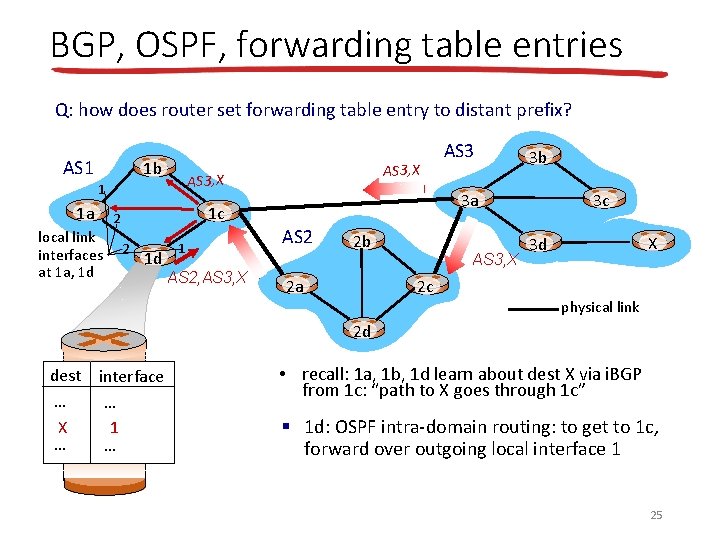
BGP, OSPF, forwarding table entries Q: how does router set forwarding table entry to distant prefix? AS 1 1 b AS 3, X 1 1 a local link interfaces at 1 a, 1 d AS 3, X 2 1 d 1 AS 2, AS 3, X 3 b 3 a 1 c 2 AS 3 AS 2 2 b 2 a AS 3, X 3 c X 3 d 2 c physical link 2 d dest interface … … X 1 … … • recall: 1 a, 1 b, 1 d learn about dest X via i. BGP from 1 c: “path to X goes through 1 c” § 1 d: OSPF intra-domain routing: to get to 1 c, forward over outgoing local interface 1 25
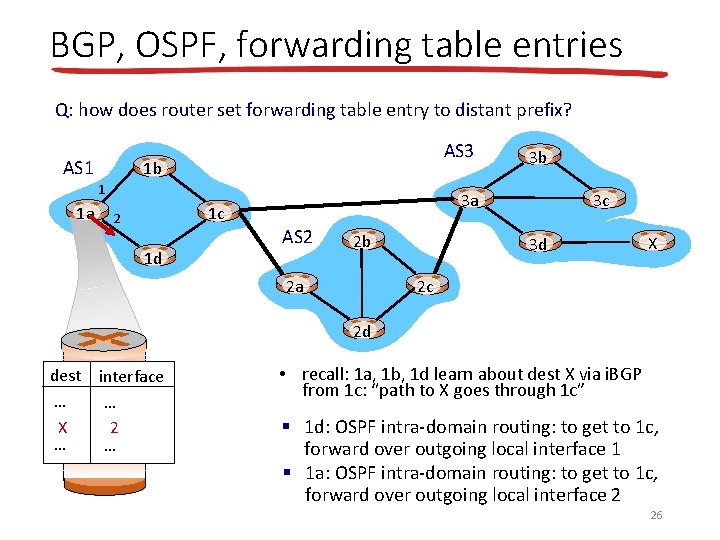
BGP, OSPF, forwarding table entries Q: how does router set forwarding table entry to distant prefix? AS 1 AS 3 1 b 1 1 a 3 a 1 c 2 1 d 3 b AS 2 2 b 2 a 3 c 3 d X 2 c 2 d dest interface … … X 2 … … • recall: 1 a, 1 b, 1 d learn about dest X via i. BGP from 1 c: “path to X goes through 1 c” § 1 d: OSPF intra-domain routing: to get to 1 c, forward over outgoing local interface 1 § 1 a: OSPF intra-domain routing: to get to 1 c, forward over outgoing local interface 2 26
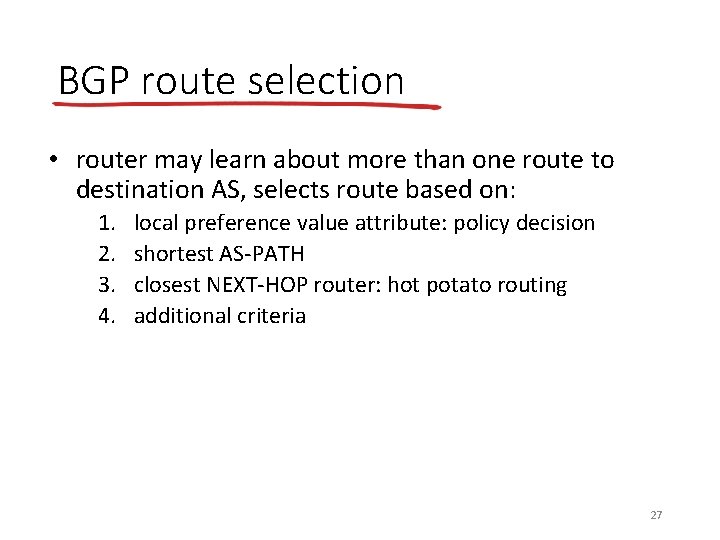
BGP route selection • router may learn about more than one route to destination AS, selects route based on: 1. 2. 3. 4. local preference value attribute: policy decision shortest AS-PATH closest NEXT-HOP router: hot potato routing additional criteria 27
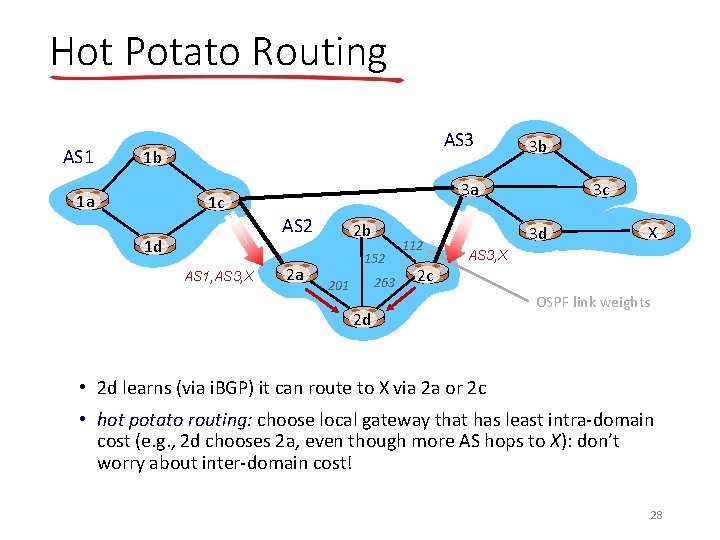
Hot Potato Routing AS 1 AS 3 1 b 1 a 3 a 1 c AS 2 1 d AS 1, AS 3, X 3 b 2 a 2 b 152 263 201 112 3 c 3 d X AS 3, X 2 c 2 d OSPF link weights • 2 d learns (via i. BGP) it can route to X via 2 a or 2 c • hot potato routing: choose local gateway that has least intra-domain cost (e. g. , 2 d chooses 2 a, even though more AS hops to X): don’t worry about inter-domain cost! 28