
CS 162 Operating Systems and Systems Programming Lecture
- Slides: 95
CS 162 Operating Systems and Systems Programming Lecture 3 Processes (con’t), Fork, System Calls January 28 th, 2020 Prof. John Kubiatowicz http: //cs 162. eecs. Berkeley. edu
Recall: Four Fundamental OS Concepts • Thread: Execution Context – Fully describes program state – Program Counter, Registers, Execution Flags, Stack • Address space (with or w/o translation) – Set of memory addresses accessible to program (for read or write) – May be distinct from memory space of the physical machine (in which case programs operate in a virtual address space) • Process: an instance of a running program – Protected Address Space + One or more Threads • Dual mode operation / Protection – Only the “system” has the ability to access certain resources – Combined with translation, isolates programs from each other and the OS from programs 1/28/20 Kubiatowicz CS 162 ©UCB Spring 2020 Lec 3. 2
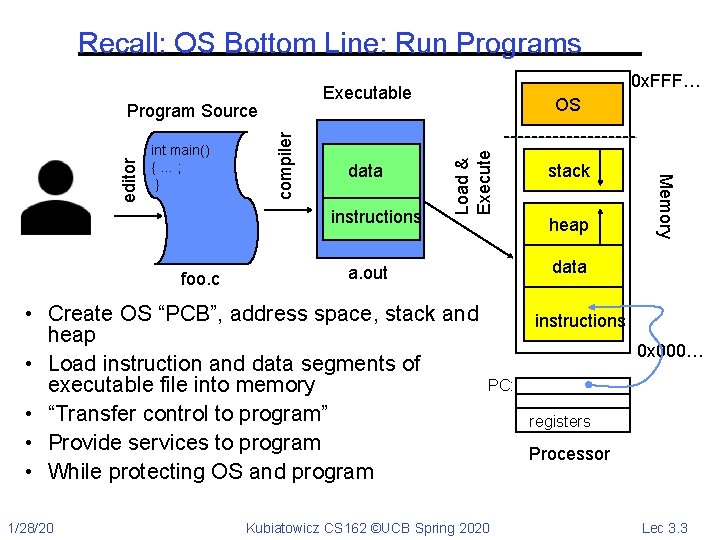
Recall: OS Bottom Line: Run Programs instructions foo. c Load & Execute compiler data OS 1/28/20 heap data a. out • Create OS “PCB”, address space, stack and heap • Load instruction and data segments of executable file into memory • “Transfer control to program” • Provide services to program • While protecting OS and program stack Memory editor Program Source int main() {…; } 0 x. FFF… Executable instructions 0 x 000… PC: Kubiatowicz CS 162 ©UCB Spring 2020 registers Processor Lec 3. 3
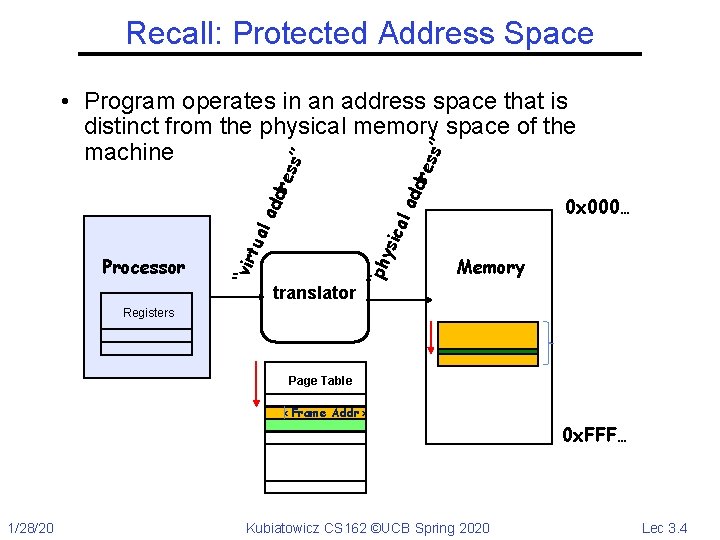
Recall: Protected Address Space translator “ph ysi al rtu “vi Processor 0 x 000… cal add r res s” ess ” • Program operates in an address space that is distinct from the physical memory space of the machine Memory Registers Page Table <Frame Addr> 0 x. FFF… 1/28/20 Kubiatowicz CS 162 ©UCB Spring 2020 Lec 3. 4
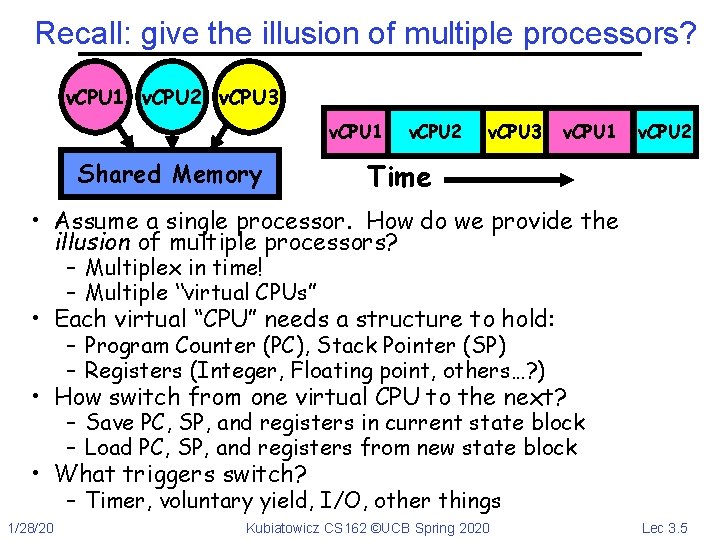
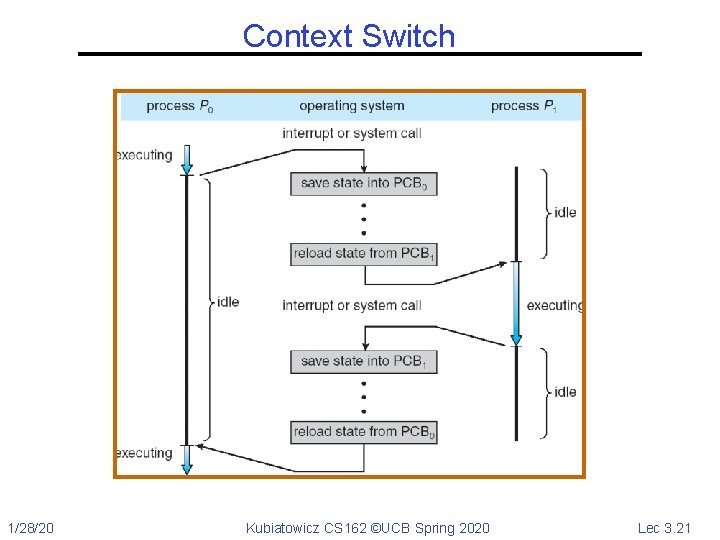
Recall: give the illusion of multiple processors? v. CPU 1 v. CPU 2 v. CPU 3 v. CPU 1 Shared Memory v. CPU 2 v. CPU 3 v. CPU 1 v. CPU 2 Time • Assume a single processor. How do we provide the illusion of multiple processors? – Multiplex in time! – Multiple “virtual CPUs” • Each virtual “CPU” needs a structure to hold: – Program Counter (PC), Stack Pointer (SP) – Registers (Integer, Floating point, others…? ) • How switch from one virtual CPU to the next? – Save PC, SP, and registers in current state block – Load PC, SP, and registers from new state block • What triggers switch? – Timer, voluntary yield, I/O, other things 1/28/20 Kubiatowicz CS 162 ©UCB Spring 2020 Lec 3. 5
Recall: The Process • Definition: execution environment with restricted rights – Address Space with One or More Threads » Page table per process! – Owns memory (mapped pages) – Owns file descriptors, file system context, … – Encapsulates one or more threads sharing process resources • Application program executes as a process – Complex applications can fork/exec child processes [later] • Why processes? – Protected from each other. OS Protected from them. – Execute concurrently [ trade-offs with threads? later ] – Basic unit OS deals with 1/28/20 Kubiatowicz CS 162 ©UCB Spring 2020 Lec 3. 6
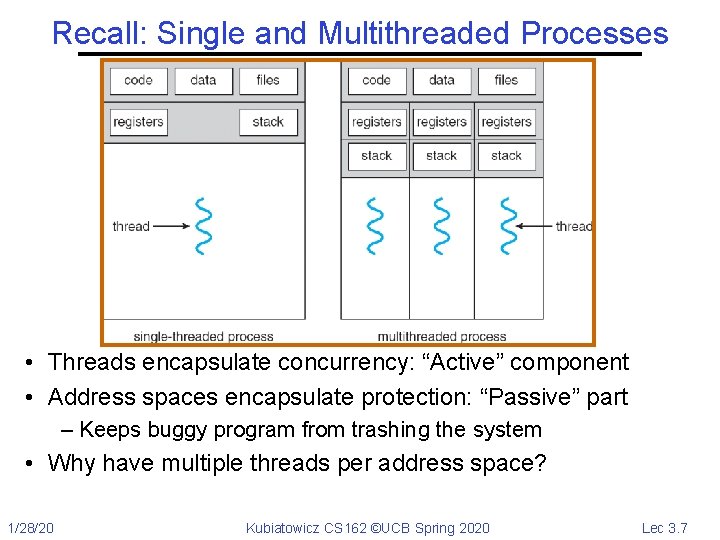
Recall: Single and Multithreaded Processes • Threads encapsulate concurrency: “Active” component • Address spaces encapsulate protection: “Passive” part – Keeps buggy program from trashing the system • Why have multiple threads per address space? 1/28/20 Kubiatowicz CS 162 ©UCB Spring 2020 Lec 3. 7
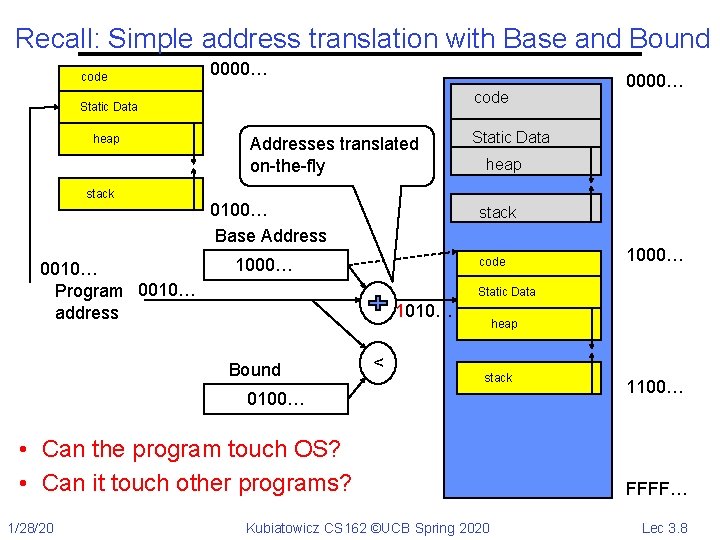
Recall: Simple address translation with Base and Bound code 0000… code Static Data heap stack 0010… Program 0010… address Addresses translated on-the-fly 0100… Base Address Static Data heap stack 1000… code 1000… Static Data 1010… Bound < heap stack 0100… • Can the program touch OS? • Can it touch other programs? 1/28/20 0000… Kubiatowicz CS 162 ©UCB Spring 2020 1100… FFFF… Lec 3. 8
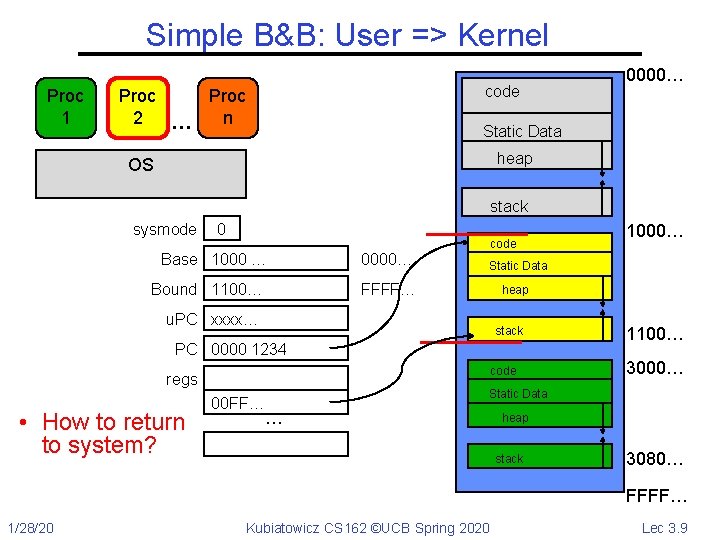
Simple B&B: User => Kernel Proc 1 Proc 2 … code Proc n 0000… Static Data heap OS stack sysmode 0 code Base 1000 … 0000… Static Data Bound 1100… FFFF… heap u. PC xxxx… stack PC 0000 1234 code regs • How to return to system? 00 FF… 1000… 1100… 3000… Static Data … heap stack 3080… FFFF… 1/28/20 Kubiatowicz CS 162 ©UCB Spring 2020 Lec 3. 9
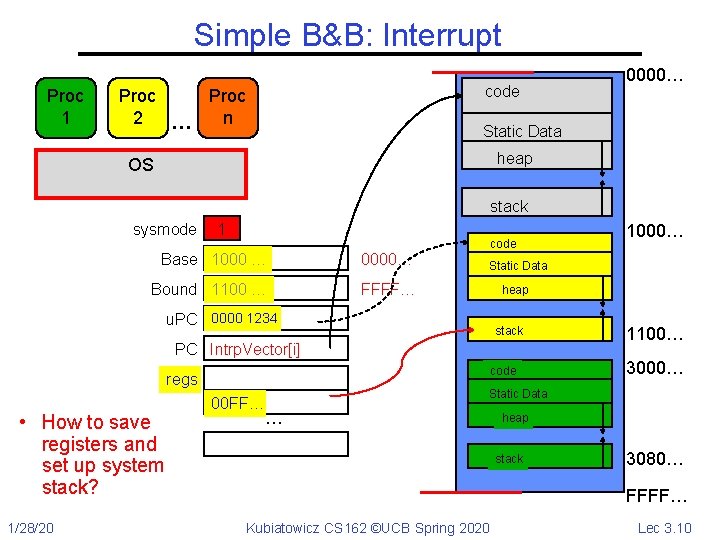
Simple B&B: Interrupt Proc 1 Proc 2 … code Proc n 0000… Static Data heap OS stack sysmode 1 code Base 1000 … 0000… Static Data Bound 1100 … FFFF… heap u. PC 0000 1234 stack PC Intrp. Vector[i] code regs • How to save registers and set up system stack? 1/28/20 00 FF… 1000… 1100… 3000… Static Data … heap stack 3080… FFFF… Kubiatowicz CS 162 ©UCB Spring 2020 Lec 3. 10
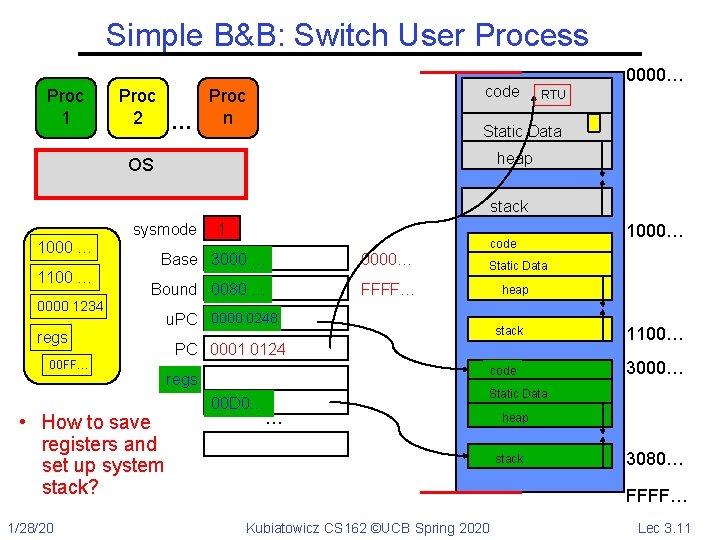
Simple B&B: Switch User Process Proc 1 Proc 2 … code Proc n 0000… RTU Static Data heap OS stack sysmode 1000 … 1100 … code Base 3000 … 0000… Static Data Bound 0080 … FFFF… heap 0000 1234 regs 00 FF… • How to save registers and set up system stack? 1/28/20 1 u. PC 0000 0248 stack PC 0001 0124 code regs 00 D 0… 1000… 1100… 3000… Static Data … heap stack 3080… FFFF… Kubiatowicz CS 162 ©UCB Spring 2020 Lec 3. 11
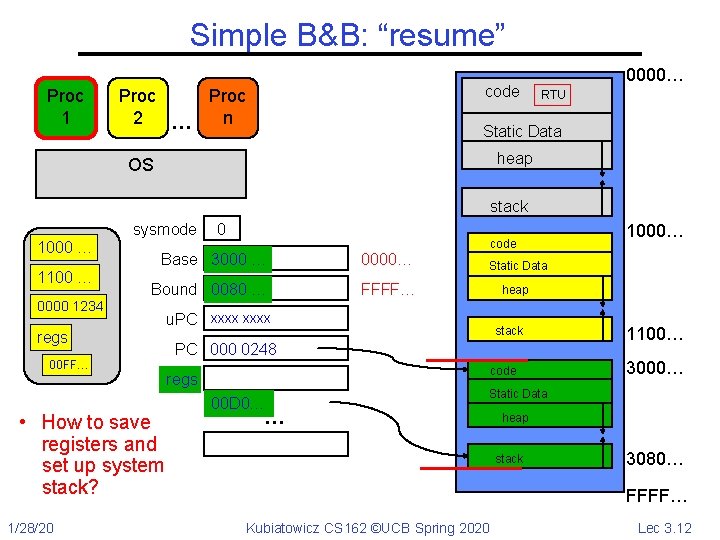
Simple B&B: “resume” Proc 1 Proc 2 … code Proc n 0000… RTU Static Data heap OS stack sysmode 1000 … 1100 … code Base 3000 … 0000… Static Data Bound 0080 … FFFF… heap 0000 1234 regs 00 FF… • How to save registers and set up system stack? 1/28/20 0 u. PC xxxx stack PC 000 0248 code regs 00 D 0… 1000… 1100… 3000… Static Data … heap stack 3080… FFFF… Kubiatowicz CS 162 ©UCB Spring 2020 Lec 3. 12
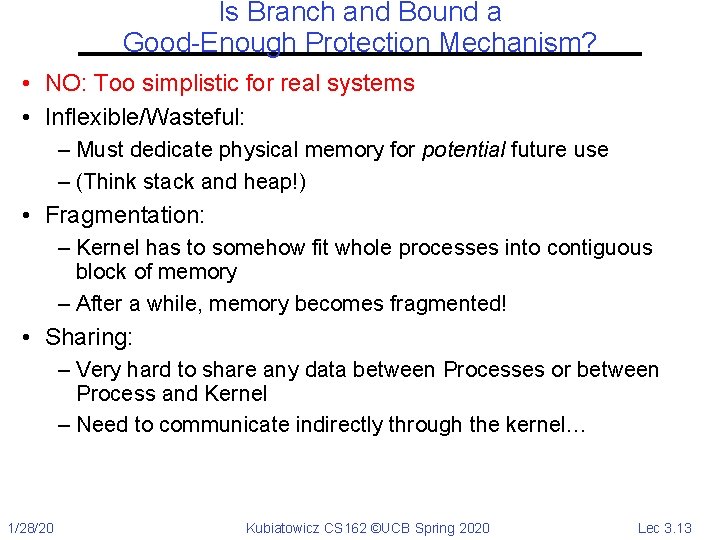
Is Branch and Bound a Good-Enough Protection Mechanism? • NO: Too simplistic for real systems • Inflexible/Wasteful: – Must dedicate physical memory for potential future use – (Think stack and heap!) • Fragmentation: – Kernel has to somehow fit whole processes into contiguous block of memory – After a while, memory becomes fragmented! • Sharing: – Very hard to share any data between Processes or between Process and Kernel – Need to communicate indirectly through the kernel… 1/28/20 Kubiatowicz CS 162 ©UCB Spring 2020 Lec 3. 13
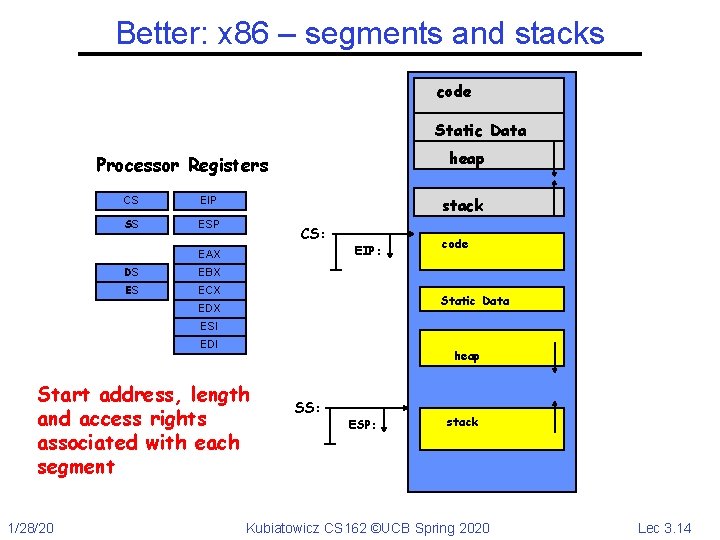
Better: x 86 – segments and stacks code Static Data heap Processor Registers CS EIP SS ESP stack CS: EAX DS EBX ES ECX EIP: code Static Data EDX ESI EDI heap Start address, length and access rights associated with each segment 1/28/20 SS: ESP: stack Kubiatowicz CS 162 ©UCB Spring 2020 Lec 3. 14
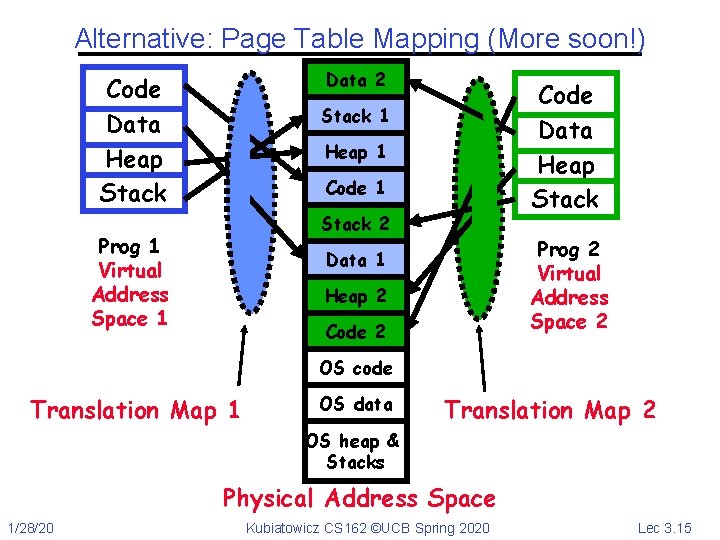
Alternative: Page Table Mapping (More soon!) Data 2 Code Data Heap Stack 1 Heap 1 Code 1 Stack 2 Prog 1 Virtual Address Space 1 Prog 2 Virtual Address Space 2 Data 1 Heap 2 Code 2 OS code Translation Map 1 OS data Translation Map 2 OS heap & Stacks Physical Address Space 1/28/20 Kubiatowicz CS 162 ©UCB Spring 2020 Lec 3. 15
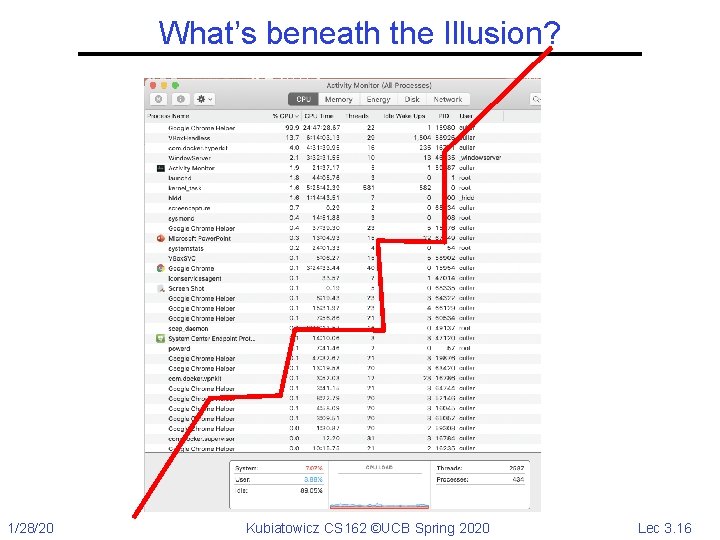
What’s beneath the Illusion? 1/28/20 Kubiatowicz CS 162 ©UCB Spring 2020 Lec 3. 16
Today: How does the Operating System create the Process Abstraction? • What data structures are used? • What machine structures are employed? – Focus on x 86, since will use in projects (and everywhere) 1/28/20 Kubiatowicz CS 162 ©UCB Spring 2020 Lec 3. 17
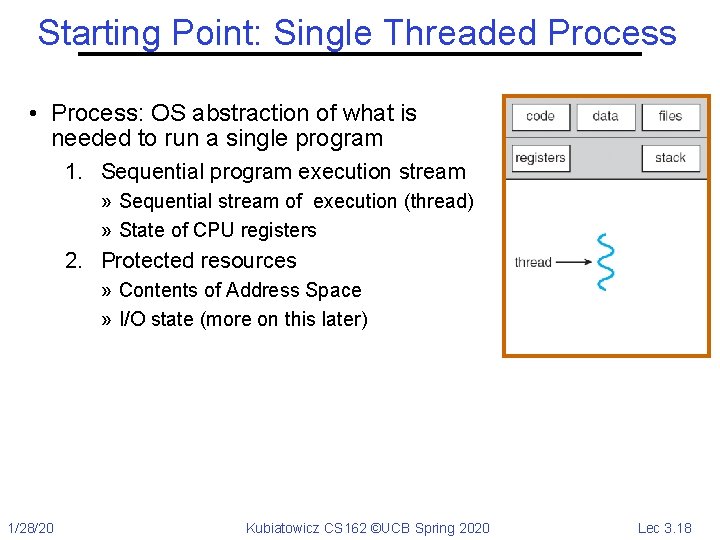
Starting Point: Single Threaded Process • Process: OS abstraction of what is needed to run a single program 1. Sequential program execution stream » Sequential stream of execution (thread) » State of CPU registers 2. Protected resources » Contents of Address Space » I/O state (more on this later) 1/28/20 Kubiatowicz CS 162 ©UCB Spring 2020 Lec 3. 18
Running Many Programs • We have the basic mechanism to – switch between user processes and the kernel, – the kernel can switch among user processes, – Protect OS from user processes and processes from each other • Questions ? ? ? – How do we represent each process in the kernel? – How do we decide which user process to run? – How do we pack up the process and set it aside? – How do we get a stack and heap for the kernel? – Aren’t we wasting are lot of memory? 1/28/20 Kubiatowicz CS 162 ©UCB Spring 2020 Lec 3. 19
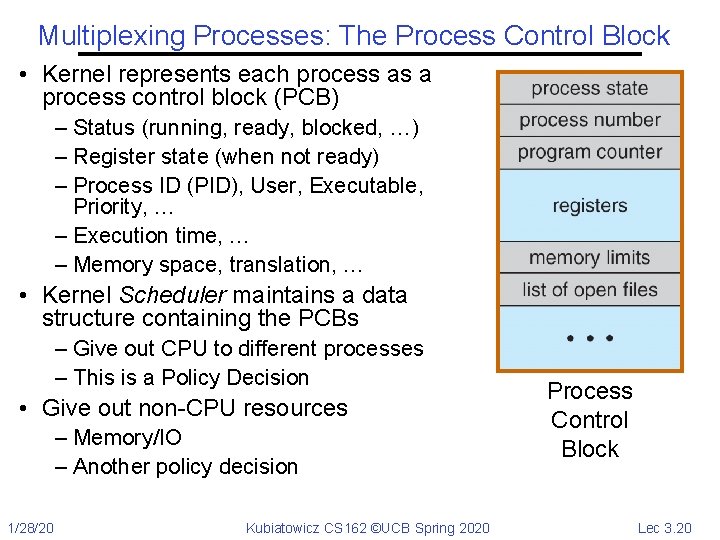
Multiplexing Processes: The Process Control Block • Kernel represents each process as a process control block (PCB) – Status (running, ready, blocked, …) – Register state (when not ready) – Process ID (PID), User, Executable, Priority, … – Execution time, … – Memory space, translation, … • Kernel Scheduler maintains a data structure containing the PCBs – Give out CPU to different processes – This is a Policy Decision • Give out non-CPU resources – Memory/IO – Another policy decision 1/28/20 Kubiatowicz CS 162 ©UCB Spring 2020 Process Control Block Lec 3. 20
Context Switch 1/28/20 Kubiatowicz CS 162 ©UCB Spring 2020 Lec 3. 21
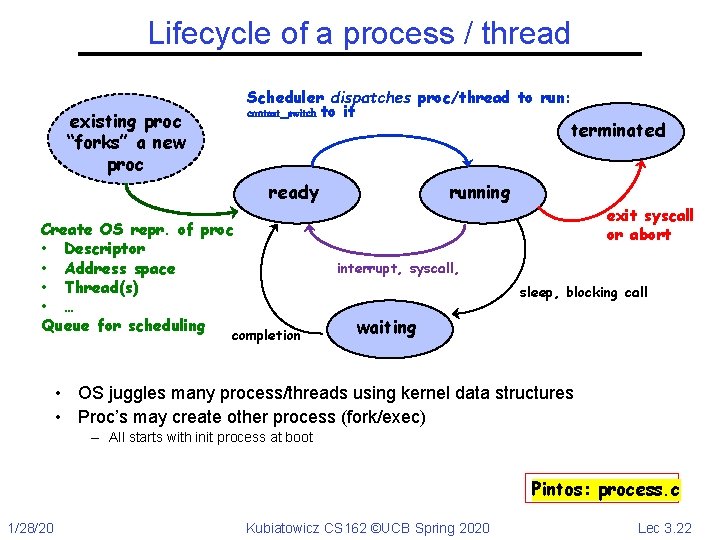
Lifecycle of a process / thread Scheduler dispatches proc/thread to run: context_switch to it existing proc “forks” a new proc terminated ready Create OS repr. of proc • Descriptor • Address space • Thread(s) • … Queue for scheduling running exit syscall or abort interrupt, syscall, sleep, blocking call completion waiting • OS juggles many process/threads using kernel data structures • Proc’s may create other process (fork/exec) – All starts with init process at boot Pintos: process. c 1/28/20 Kubiatowicz CS 162 ©UCB Spring 2020 Lec 3. 22
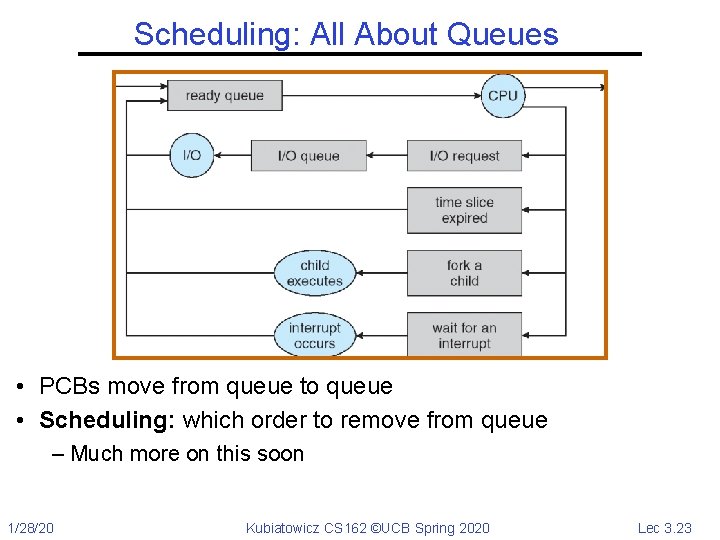
Scheduling: All About Queues • PCBs move from queue to queue • Scheduling: which order to remove from queue – Much more on this soon 1/28/20 Kubiatowicz CS 162 ©UCB Spring 2020 Lec 3. 23
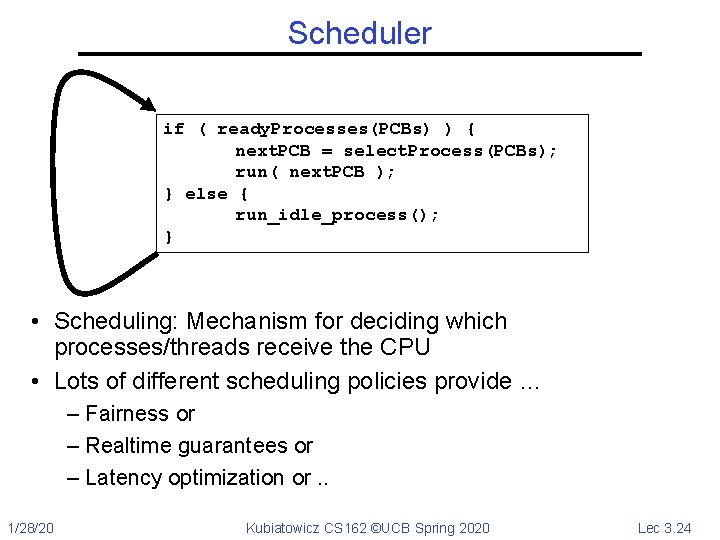
Scheduler if ( ready. Processes(PCBs) ) { next. PCB = select. Process(PCBs); run( next. PCB ); } else { run_idle_process(); } • Scheduling: Mechanism for deciding which processes/threads receive the CPU • Lots of different scheduling policies provide … – Fairness or – Realtime guarantees or – Latency optimization or. . 1/28/20 Kubiatowicz CS 162 ©UCB Spring 2020 Lec 3. 24
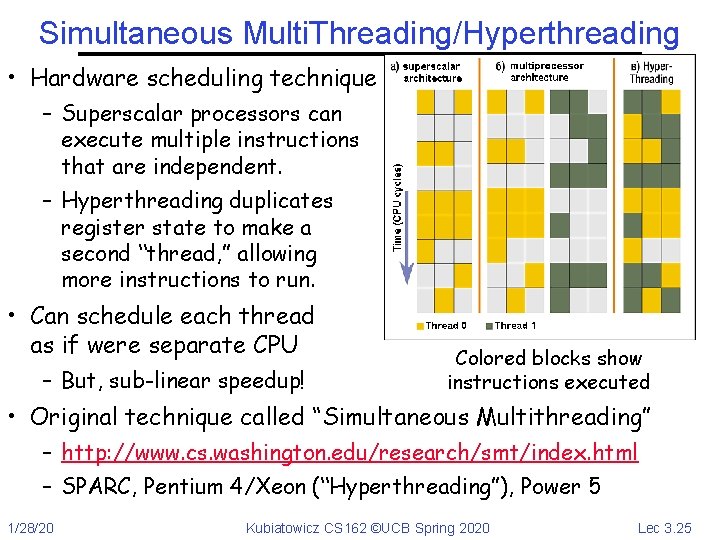
Simultaneous Multi. Threading/Hyperthreading • Hardware scheduling technique – Superscalar processors can execute multiple instructions that are independent. – Hyperthreading duplicates register state to make a second “thread, ” allowing more instructions to run. • Can schedule each thread as if were separate CPU – But, sub-linear speedup! Colored blocks show instructions executed • Original technique called “Simultaneous Multithreading” – http: //www. cs. washington. edu/research/smt/index. html – SPARC, Pentium 4/Xeon (“Hyperthreading”), Power 5 1/28/20 Kubiatowicz CS 162 ©UCB Spring 2020 Lec 3. 25
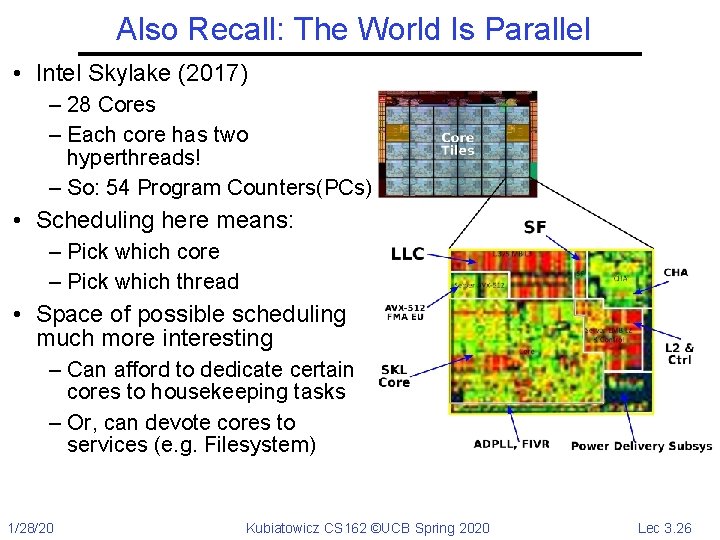
Also Recall: The World Is Parallel • Intel Skylake (2017) – 28 Cores – Each core has two hyperthreads! – So: 54 Program Counters(PCs) • Scheduling here means: – Pick which core – Pick which thread • Space of possible scheduling much more interesting – Can afford to dedicate certain cores to housekeeping tasks – Or, can devote cores to services (e. g. Filesystem) 1/28/20 Kubiatowicz CS 162 ©UCB Spring 2020 Lec 3. 26
Administrivia: Getting started • Kubiatowicz Office Hours: – 1 -2 pm, Monday & Thursday • Homework 0 Due Friday! – Get familiar with the cs 162 tools – configure your VM, submit via git – Practice finding out information: » How to use GDB? How to understand output of unix tools? » We don’t assume that you already know everything! » Learn to use “man” (command line), “help” (in gdb, etc), google • Should be going to sections now – Important information there – Any section will do until groups assigned • Class status: All regular students made it! – Concurrent enrollment will be added as possible. Over half will be admitted already. Perhaps more. • THIS Friday is Drop Deadline! HARD TO DROP LATER! – If you know you are going to drop, please do so to leave room for others! 1/28/20 Kubiatowicz CS 162 ©UCB Spring 2020 Lec 3. 27
Administrivia (Con’t) • Group sign up via autograder form next week – Get finding groups of 4 people ASAP – Priority for same section; if cannot make this work, keep same TA – Remember: Your TA needs to see you in section! • Midterm 1 conflicts – We will handle these conflicts after have final class roster – I know about one problem with Midterm 1 scheduling, and it can be dealt with. Have I missed any others? – Watch for queries by Head. TA to collect information 1/28/20 Kubiatowicz CS 162 ©UCB Spring 2020 Lec 3. 28
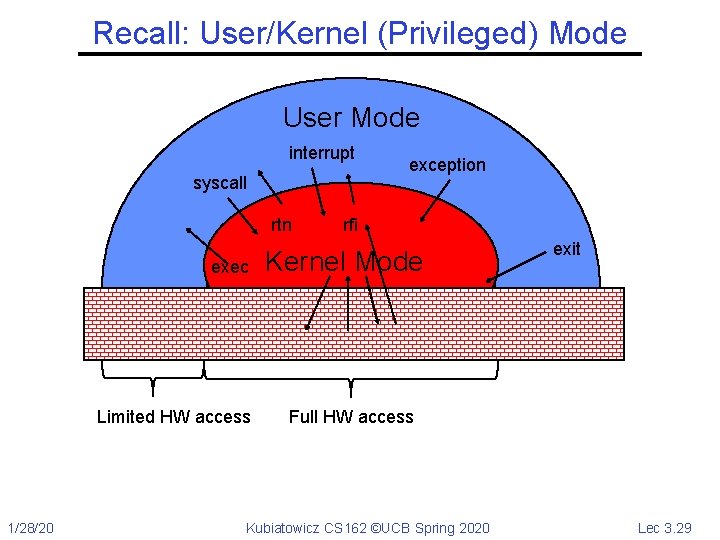
Recall: User/Kernel (Privileged) Mode User Mode interrupt syscall rtn exec Limited HW access 1/28/20 exception rfi Kernel Mode exit Full HW access Kubiatowicz CS 162 ©UCB Spring 2020 Lec 3. 29
Three types of Kernel Mode Transfer • Syscall – Process requests a system service, e. g. , exit – Like a function call, but “outside” the process – Does not have the address of the system function to call – Like a Remote Procedure Call (RPC) – for later – Marshall the syscall id and args in registers and exec syscall • Interrupt – External asynchronous event triggers context switch – eg. Timer, I/O device – Independent of user process • Trap or Exception – Internal synchronous event in process triggers context switch – e. g. , Protection violation (segmentation fault), Divide by zero, … 1/28/20 Kubiatowicz CS 162 ©UCB Spring 2020 Lec 3. 30
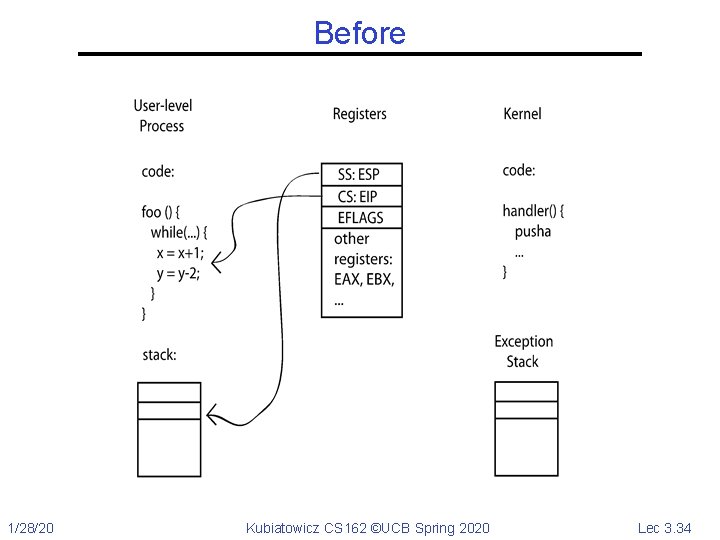
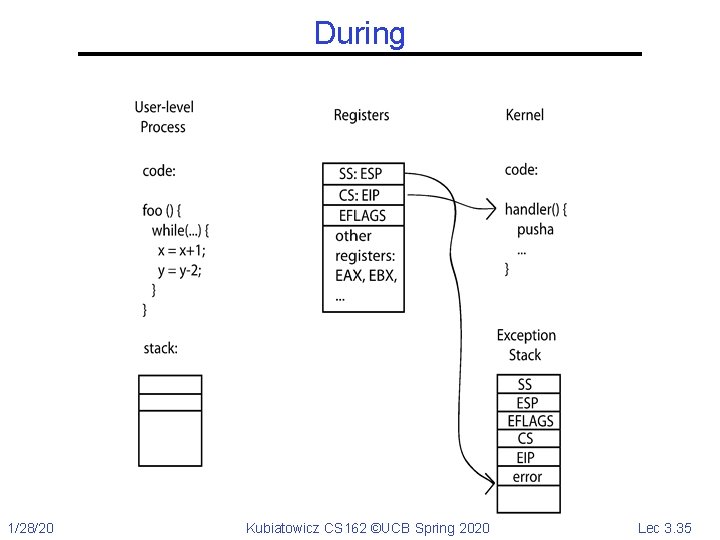
Implementing Safe Kernel Mode Transfers • Important aspects: – Controlled transfer into kernel (e. g. , syscall table) – Separate kernel stack • Carefully constructed kernel code packs up the user process state and sets it aside – Details depend on the machine architecture • Should be impossible for buggy or malicious user program to cause the kernel to corrupt itself 1/28/20 Kubiatowicz CS 162 ©UCB Spring 2020 Lec 3. 31
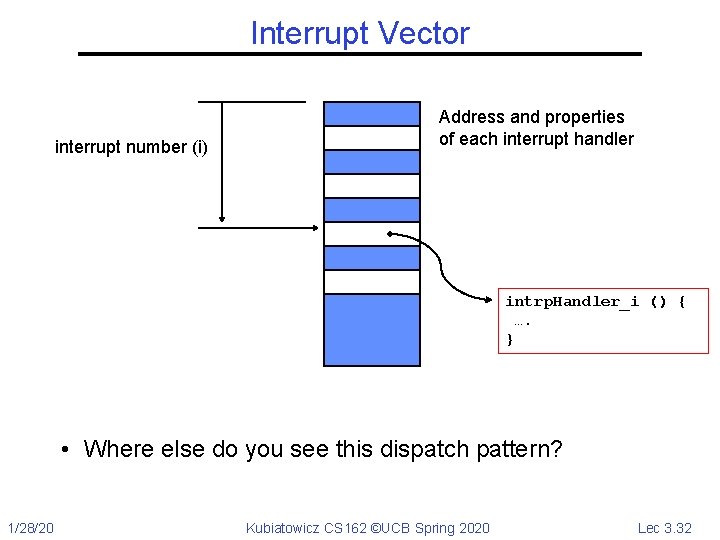
Interrupt Vector interrupt number (i) Address and properties of each interrupt handler intrp. Handler_i () { …. } • Where else do you see this dispatch pattern? 1/28/20 Kubiatowicz CS 162 ©UCB Spring 2020 Lec 3. 32
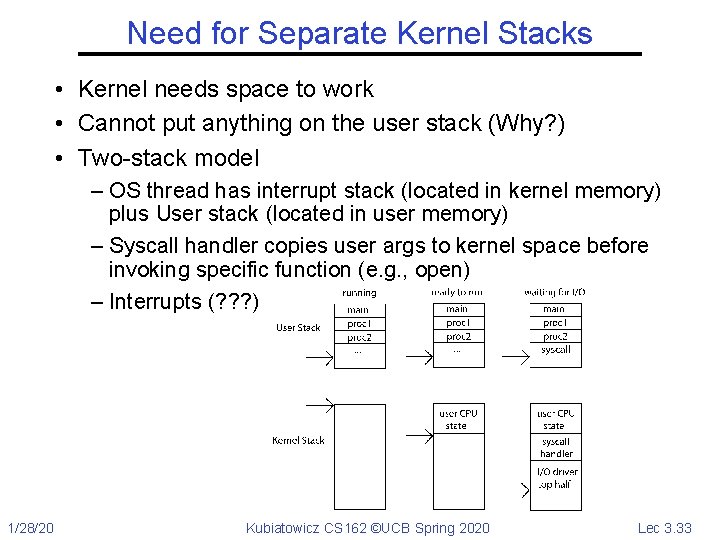
Need for Separate Kernel Stacks • Kernel needs space to work • Cannot put anything on the user stack (Why? ) • Two-stack model – OS thread has interrupt stack (located in kernel memory) plus User stack (located in user memory) – Syscall handler copies user args to kernel space before invoking specific function (e. g. , open) – Interrupts (? ? ? ) 1/28/20 Kubiatowicz CS 162 ©UCB Spring 2020 Lec 3. 33
Before 1/28/20 Kubiatowicz CS 162 ©UCB Spring 2020 Lec 3. 34
During 1/28/20 Kubiatowicz CS 162 ©UCB Spring 2020 Lec 3. 35
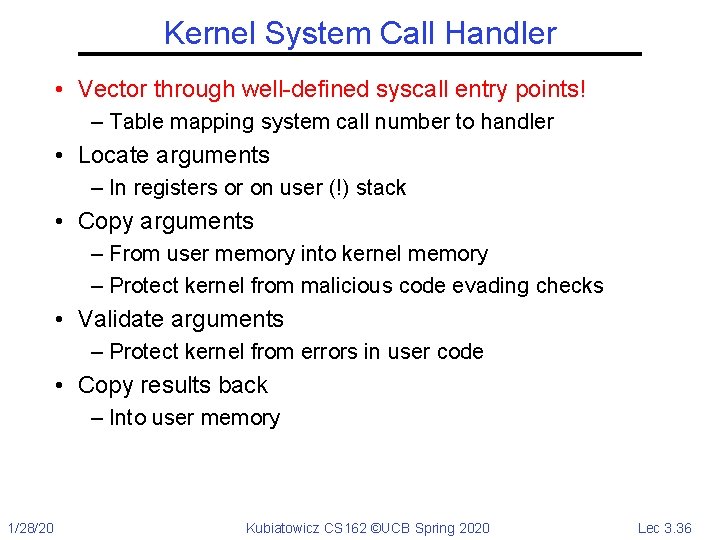
Kernel System Call Handler • Vector through well-defined syscall entry points! – Table mapping system call number to handler • Locate arguments – In registers or on user (!) stack • Copy arguments – From user memory into kernel memory – Protect kernel from malicious code evading checks • Validate arguments – Protect kernel from errors in user code • Copy results back – Into user memory 1/28/20 Kubiatowicz CS 162 ©UCB Spring 2020 Lec 3. 36
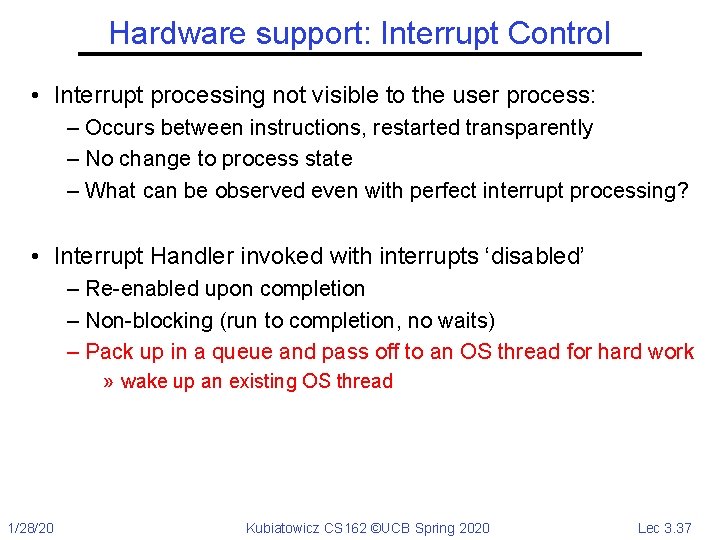
Hardware support: Interrupt Control • Interrupt processing not visible to the user process: – Occurs between instructions, restarted transparently – No change to process state – What can be observed even with perfect interrupt processing? • Interrupt Handler invoked with interrupts ‘disabled’ – Re-enabled upon completion – Non-blocking (run to completion, no waits) – Pack up in a queue and pass off to an OS thread for hard work » wake up an existing OS thread 1/28/20 Kubiatowicz CS 162 ©UCB Spring 2020 Lec 3. 37
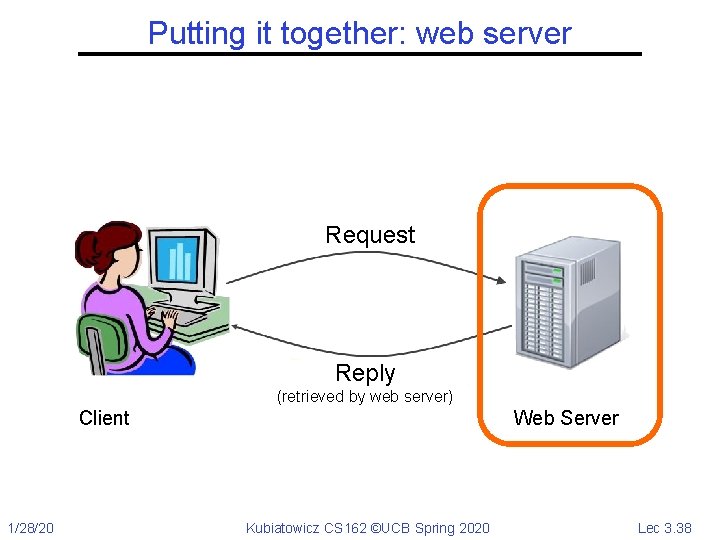
Putting it together: web server Request Reply (retrieved by web server) Client 1/28/20 Web Server Kubiatowicz CS 162 ©UCB Spring 2020 Lec 3. 38
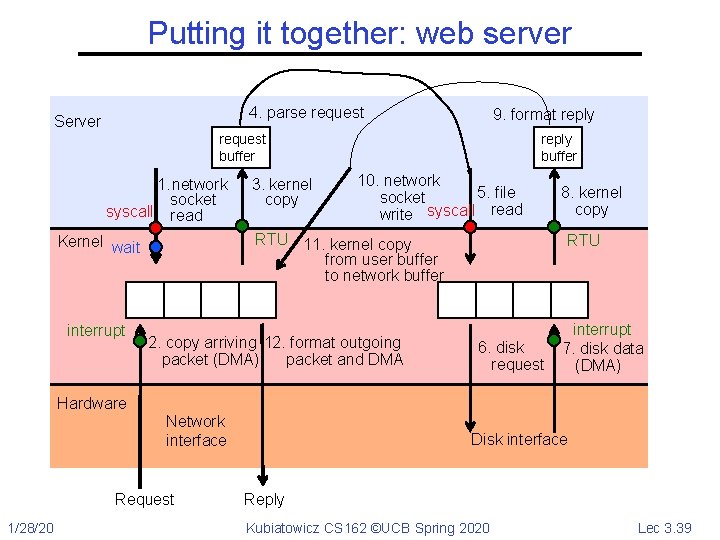
Putting it together: web server 4. parse request Server 9. format reply request buffer 1. network socket syscall read 10. network 5. file socket write syscall read RTU 11. kernel copy from user buffer to network buffer Kernel wait interrupt 3. kernel copy reply buffer 2. copy arriving 12. format outgoing packet (DMA) packet and DMA 8. kernel copy RTU 6. disk request interrupt 7. disk data (DMA) Hardware Network interface Request 1/28/20 Disk interface Reply Kubiatowicz CS 162 ©UCB Spring 2020 Lec 3. 39
A DEEP Dive into Pintos and Where we are Going! 1/28/20 Kubiatowicz CS 162 ©UCB Spring 2020 Lec 3. 40
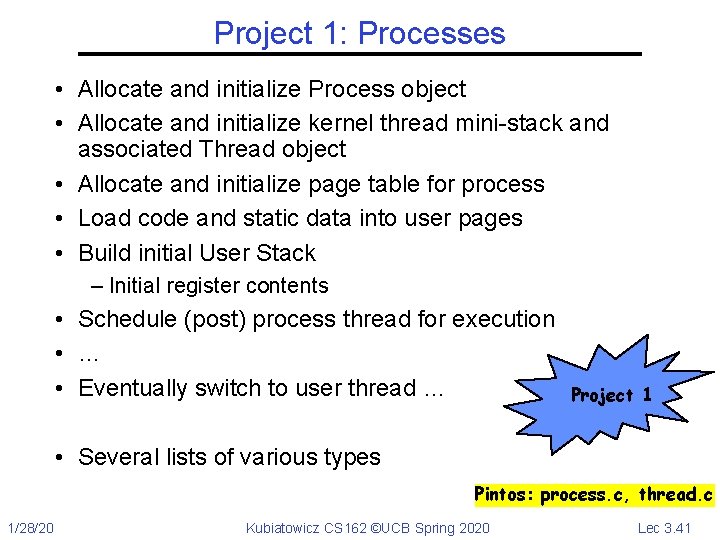
Project 1: Processes • Allocate and initialize Process object • Allocate and initialize kernel thread mini-stack and associated Thread object • Allocate and initialize page table for process • Load code and static data into user pages • Build initial User Stack – Initial register contents • Schedule (post) process thread for execution • … • Eventually switch to user thread … Project 1 • Several lists of various types Pintos: process. c, thread. c 1/28/20 Kubiatowicz CS 162 ©UCB Spring 2020 Lec 3. 41
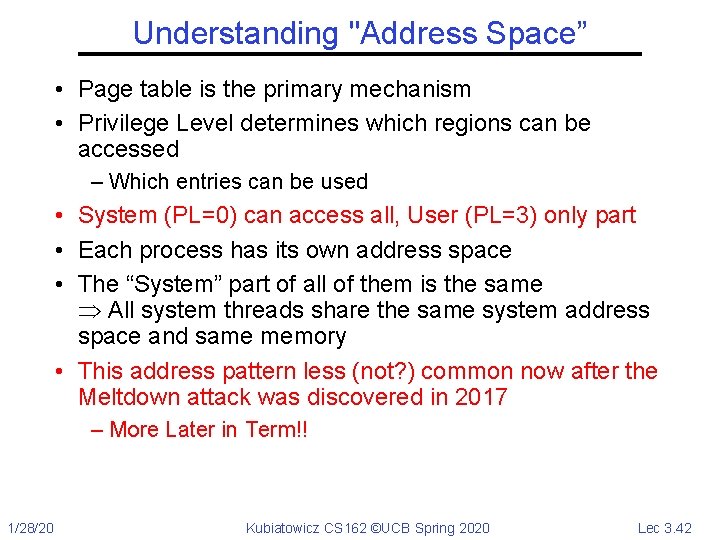
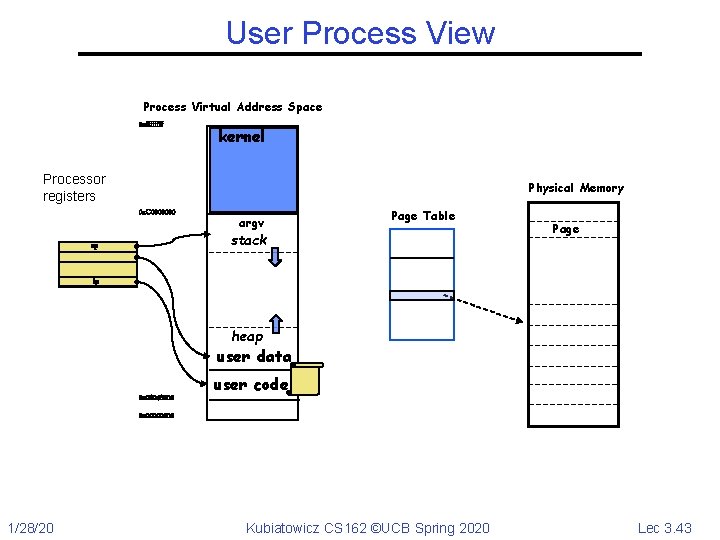
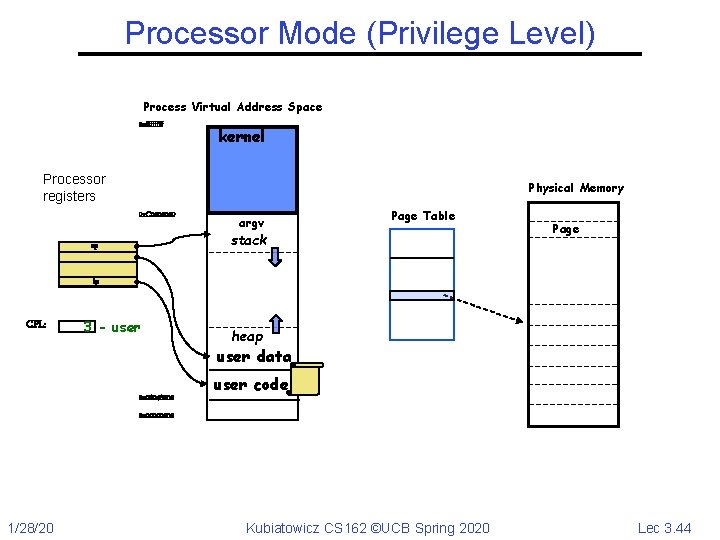
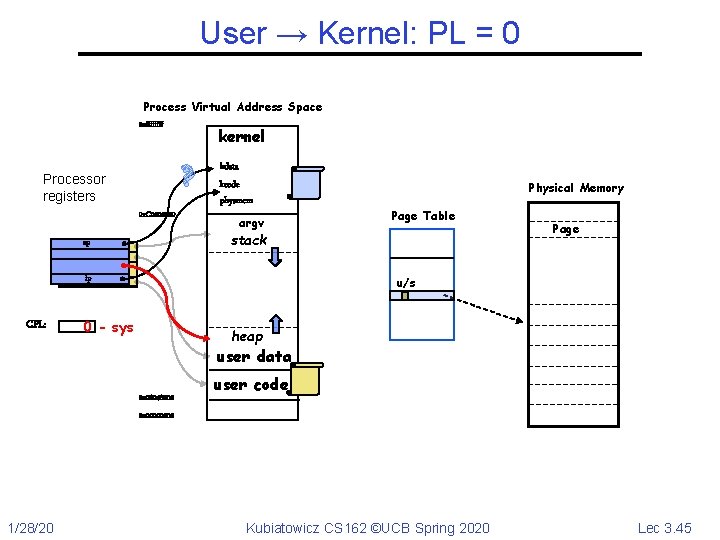
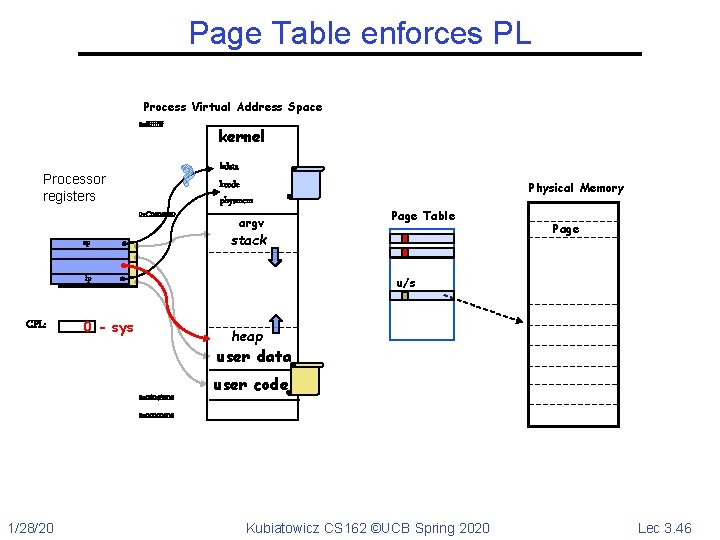
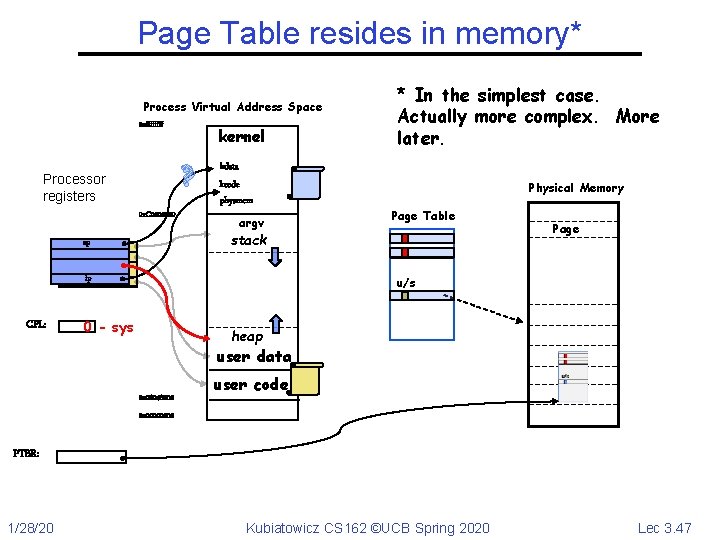
Understanding "Address Space” • Page table is the primary mechanism • Privilege Level determines which regions can be accessed – Which entries can be used • System (PL=0) can access all, User (PL=3) only part • Each process has its own address space • The “System” part of all of them is the same All system threads share the same system address space and same memory • This address pattern less (not? ) common now after the Meltdown attack was discovered in 2017 – More Later in Term!! 1/28/20 Kubiatowicz CS 162 ©UCB Spring 2020 Lec 3. 42
User Process View Process Virtual Address Space 0 xffff kernel Processor registers Physical Memory 0 x. C 0000000 argv Page Table stack sp Page ip heap user data 0 x 08048000 user code 0 x 0000 1/28/20 Kubiatowicz CS 162 ©UCB Spring 2020 Lec 3. 43
Processor Mode (Privilege Level) Process Virtual Address Space 0 xffff Processor registers 0 x. C 0000000 kernel kdata kcode physmem argv Physical Memory Page Table stack sp Page ip CPL: 3 - user heap user data 0 x 08048000 user code 0 x 0000 1/28/20 Kubiatowicz CS 162 ©UCB Spring 2020 Lec 3. 44
User → Kernel: PL = 0 Process Virtual Address Space 0 xffff kernel ? Processor registers 0 x. C 0000000 kdata kcode physmem argv Page Table stack sp sp ip ip CPL: Physical Memory Page u/s 0 - sys heap user data 0 x 08048000 user code 0 x 0000 1/28/20 Kubiatowicz CS 162 ©UCB Spring 2020 Lec 3. 45
Page Table enforces PL Process Virtual Address Space 0 xffff kernel ? Processor registers 0 x. C 0000000 kdata kcode physmem argv Page Table stack sp sp ip ip CPL: Physical Memory Page u/s 0 - sys heap user data 0 x 08048000 user code 0 x 0000 1/28/20 Kubiatowicz CS 162 ©UCB Spring 2020 Lec 3. 46
Page Table resides in memory* Process Virtual Address Space 0 xffff kernel ? Processor registers 0 x. C 0000000 kdata kcode physmem argv Physical Memory Page Table stack sp sp ip ip CPL: * In the simplest case. Actually more complex. More later. Page u/s 0 - sys heap user data 0 x 08048000 user code 0 x 0000 PTBR: 1/28/20 Kubiatowicz CS 162 ©UCB Spring 2020 Lec 3. 47
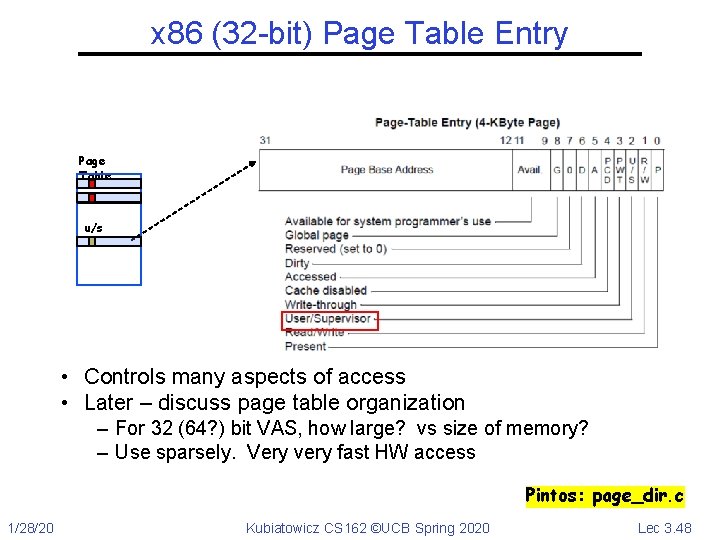
x 86 (32 -bit) Page Table Entry Page Table u/s • Controls many aspects of access • Later – discuss page table organization – For 32 (64? ) bit VAS, how large? vs size of memory? – Use sparsely. Very very fast HW access Pintos: page_dir. c 1/28/20 Kubiatowicz CS 162 ©UCB Spring 2020 Lec 3. 48
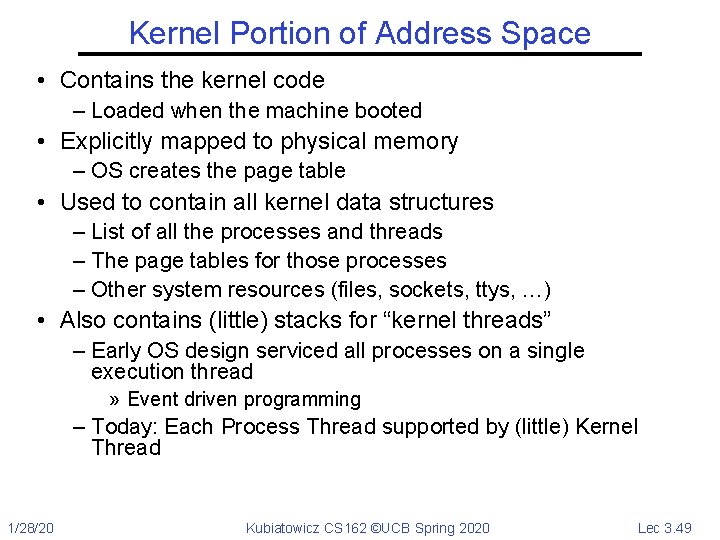
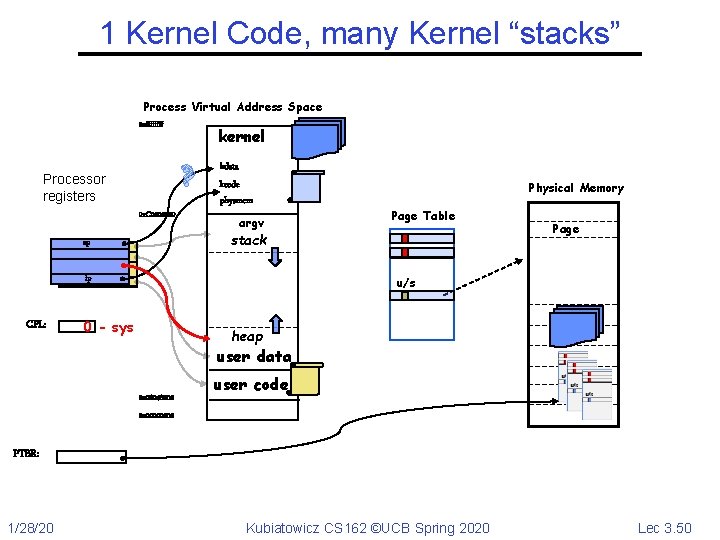
Kernel Portion of Address Space • Contains the kernel code – Loaded when the machine booted • Explicitly mapped to physical memory – OS creates the page table • Used to contain all kernel data structures – List of all the processes and threads – The page tables for those processes – Other system resources (files, sockets, ttys, …) • Also contains (little) stacks for “kernel threads” – Early OS design serviced all processes on a single execution thread » Event driven programming – Today: Each Process Thread supported by (little) Kernel Thread 1/28/20 Kubiatowicz CS 162 ©UCB Spring 2020 Lec 3. 49
1 Kernel Code, many Kernel “stacks” Process Virtual Address Space 0 xffff kernel ? Processor registers 0 x. C 0000000 kdata kcode physmem argv Page Table stack sp sp ip ip CPL: Physical Memory Page u/s 0 - sys heap user data 0 x 08048000 user code 0 x 0000 PTBR: 1/28/20 Kubiatowicz CS 162 ©UCB Spring 2020 Lec 3. 50
From Machine Structure to OS Data Structures • Traditional Unix, etc. design maintains a Process Control Block (PCB) per process • Each with a Thread Control Block (TCB) per thread of that process • Today, assume single thread per process – PINTOS model • Linux organized around threads with “groups of threads” associated with a process 1/28/20 Kubiatowicz CS 162 ©UCB Spring 2020 Lec 3. 51
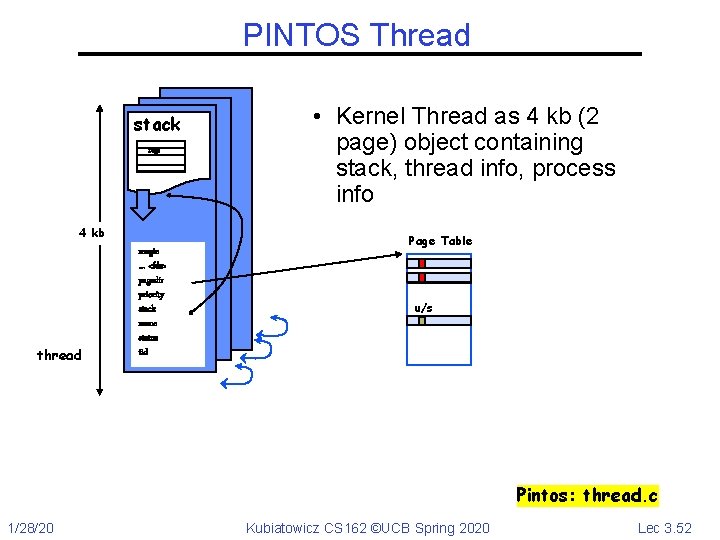
PINTOS Thread stack regs 4 kb thread magic … <fds> pagedir priority stack name status tid • Kernel Thread as 4 kb (2 page) object containing stack, thread info, process info Page Table u/s Pintos: thread. c 1/28/20 Kubiatowicz CS 162 ©UCB Spring 2020 Lec 3. 52
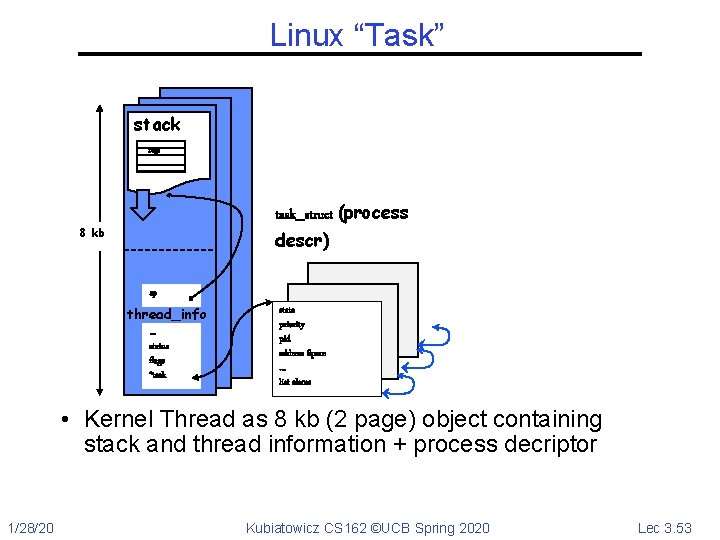
Linux “Task” stack regs task_struct (process 8 kb descr) sp thread_info … status flags *task state priority pid address Space … list elems • Kernel Thread as 8 kb (2 page) object containing stack and thread information + process decriptor 1/28/20 Kubiatowicz CS 162 ©UCB Spring 2020 Lec 3. 53
Process Creation • Allocate and initialize Process object • Allocate and initialize kernel thread mini-stack and associated Thread object • Allocate and initialize page table for process – Referenced by process object • Load code and static data into user pages • Build initial User Stack – Initial register contents, argv, … • Schedule (post) process thread for execution • … • Eventually switch to user thread … • Several lists of various types 1/28/20 Kubiatowicz CS 162 ©UCB Spring 2020 Lec 3. 54
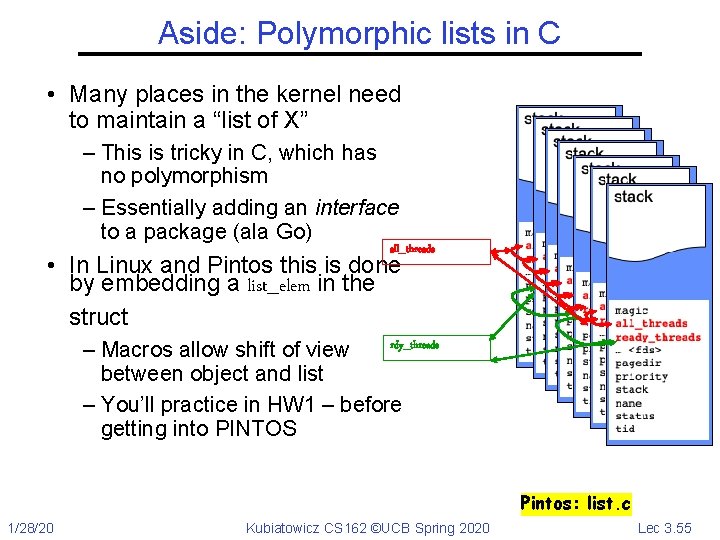
Aside: Polymorphic lists in C • Many places in the kernel need to maintain a “list of X” – This is tricky in C, which has no polymorphism – Essentially adding an interface to a package (ala Go) all_threads • In Linux and Pintos this is done by embedding a list_elem in the struct rdy_threads – Macros allow shift of view between object and list – You’ll practice in HW 1 – before getting into PINTOS Pintos: list. c 1/28/20 Kubiatowicz CS 162 ©UCB Spring 2020 Lec 3. 55
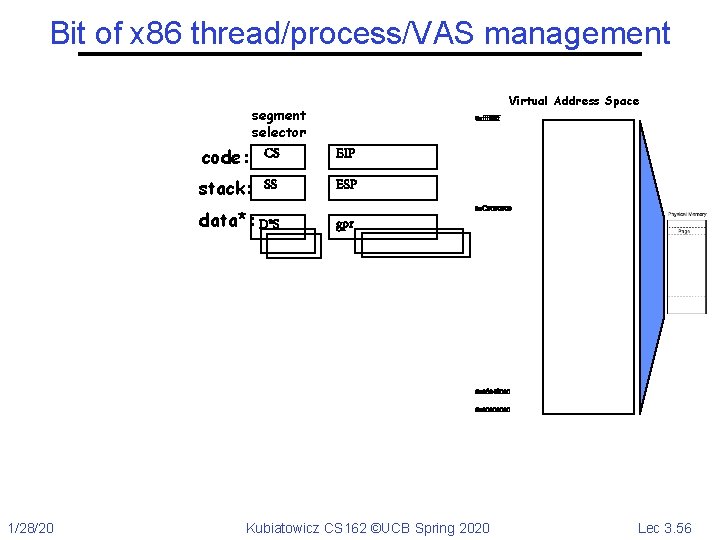
Bit of x 86 thread/process/VAS management Virtual Address Space segment selector code: CS stack: SS data*: D*S 0 xffff EIP ESP gpr 0 x. C 0000000 0 x 08048000 0 x 0000 1/28/20 Kubiatowicz CS 162 ©UCB Spring 2020 Lec 3. 56
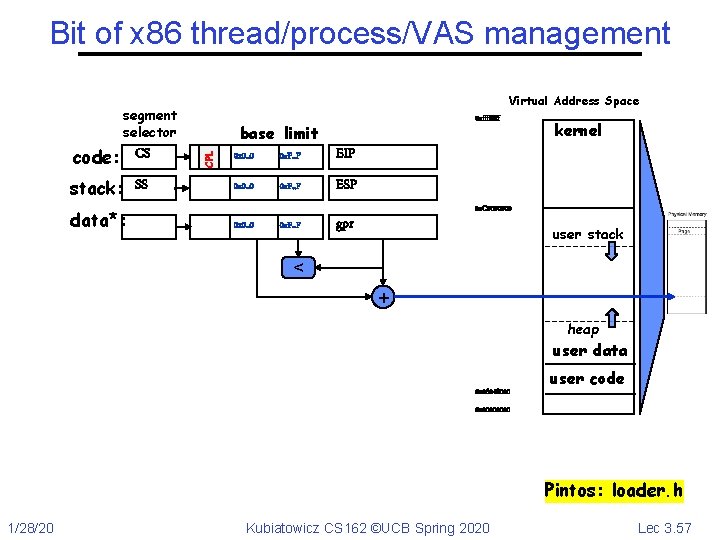
Bit of x 86 thread/process/VAS management Virtual Address Space segment selector data*: base limit CPL code: CS stack: SS 0 xffff 0 x 0. . 0 0 x. F. . F EIP 0 x 0. . 0 0 x. F. . F ESP 0 x 0. . 0 0 x. F. . F kernel 0 x. C 0000000 gpr user stack < + heap user data 0 x 08048000 user code 0 x 0000 Pintos: loader. h 1/28/20 Kubiatowicz CS 162 ©UCB Spring 2020 Lec 3. 57
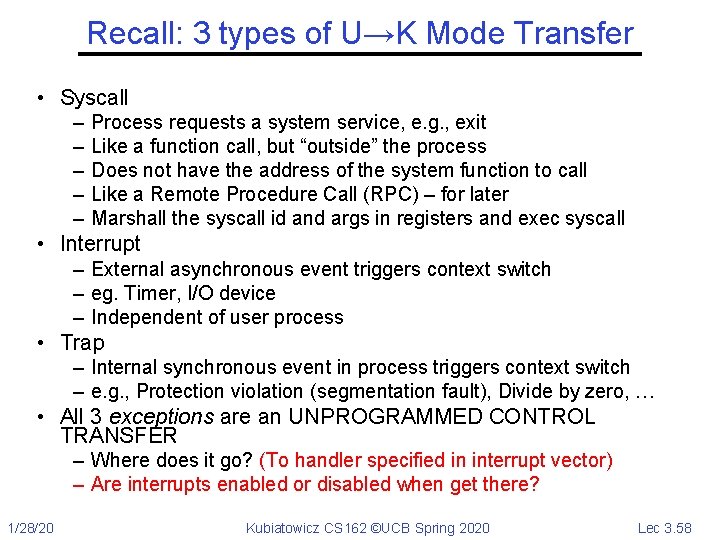
Recall: 3 types of U→K Mode Transfer • Syscall – – – Process requests a system service, e. g. , exit Like a function call, but “outside” the process Does not have the address of the system function to call Like a Remote Procedure Call (RPC) – for later Marshall the syscall id and args in registers and exec syscall • Interrupt – External asynchronous event triggers context switch – eg. Timer, I/O device – Independent of user process • Trap – Internal synchronous event in process triggers context switch – e. g. , Protection violation (segmentation fault), Divide by zero, … • All 3 exceptions are an UNPROGRAMMED CONTROL TRANSFER – Where does it go? (To handler specified in interrupt vector) – Are interrupts enabled or disabled when get there? 1/28/20 Kubiatowicz CS 162 ©UCB Spring 2020 Lec 3. 58
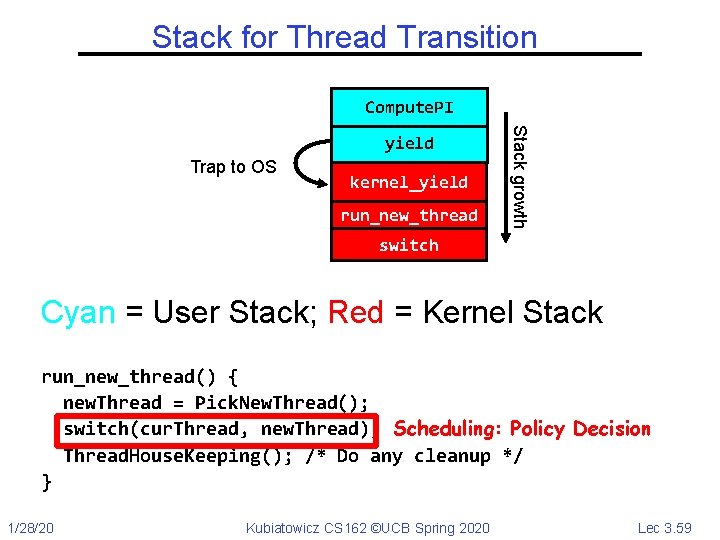
Stack for Thread Transition Compute. PI Trap to OS kernel_yield run_new_thread Stack growth yield switch Cyan = User Stack; Red = Kernel Stack run_new_thread() { new. Thread = Pick. New. Thread(); switch(cur. Thread, new. Thread); Scheduling: Policy Decision Thread. House. Keeping(); /* Do any cleanup */ } 1/28/20 Kubiatowicz CS 162 ©UCB Spring 2020 Lec 3. 59
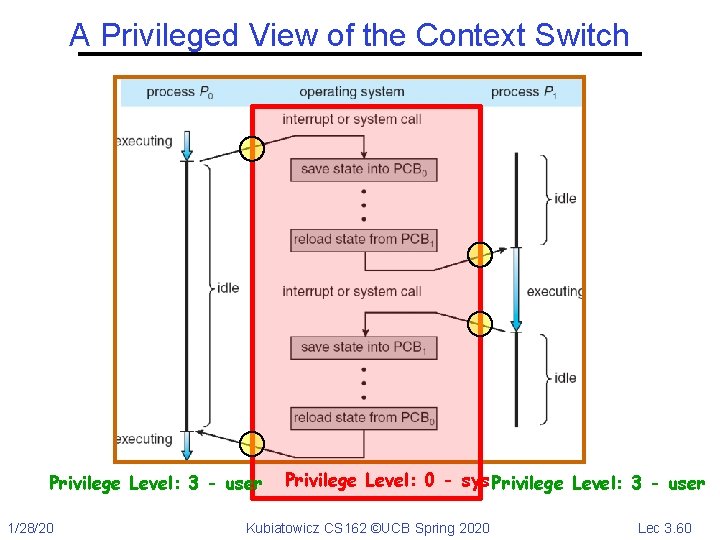
A Privileged View of the Context Switch Privilege Level: 3 - user 1/28/20 Privilege Level: 0 - sys Privilege Level: 3 - user Kubiatowicz CS 162 ©UCB Spring 2020 Lec 3. 60
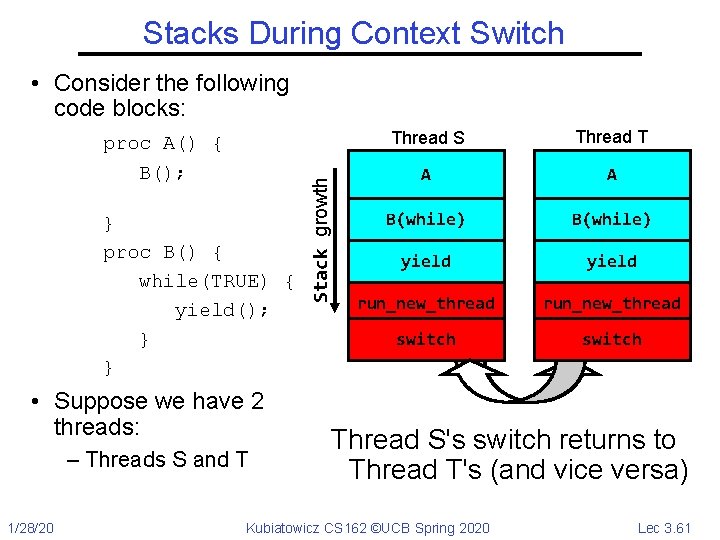
Stacks During Context Switch proc A() { B(); } proc B() { while(TRUE) { yield(); } } • Suppose we have 2 threads: – Threads S and T 1/28/20 Stack growth • Consider the following code blocks: Thread S Thread T A A B(while) yield run_new_thread switch Thread S's switch returns to Thread T's (and vice versa) Kubiatowicz CS 162 ©UCB Spring 2020 Lec 3. 61
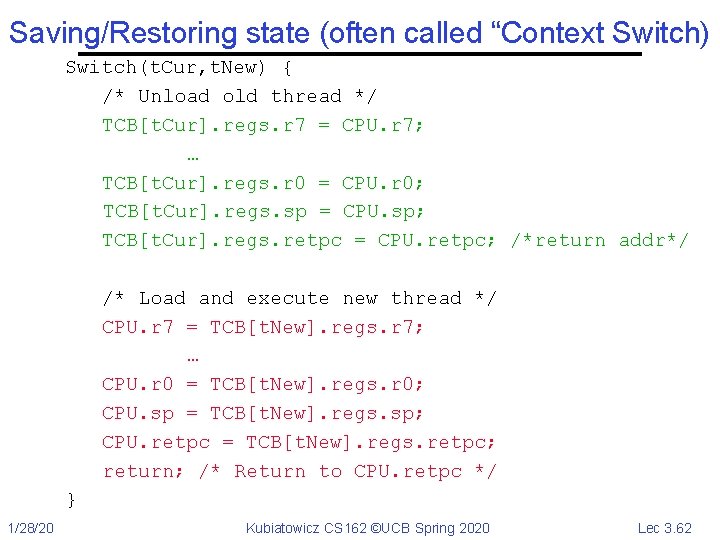
Saving/Restoring state (often called “Context Switch) Switch(t. Cur, t. New) { /* Unload old thread */ TCB[t. Cur]. regs. r 7 = CPU. r 7; … TCB[t. Cur]. regs. r 0 = CPU. r 0; TCB[t. Cur]. regs. sp = CPU. sp; TCB[t. Cur]. regs. retpc = CPU. retpc; /*return addr*/ /* Load and execute new thread */ CPU. r 7 = TCB[t. New]. regs. r 7; … CPU. r 0 = TCB[t. New]. regs. r 0; CPU. sp = TCB[t. New]. regs. sp; CPU. retpc = TCB[t. New]. regs. retpc; return; /* Return to CPU. retpc */ } 1/28/20 Kubiatowicz CS 162 ©UCB Spring 2020 Lec 3. 62
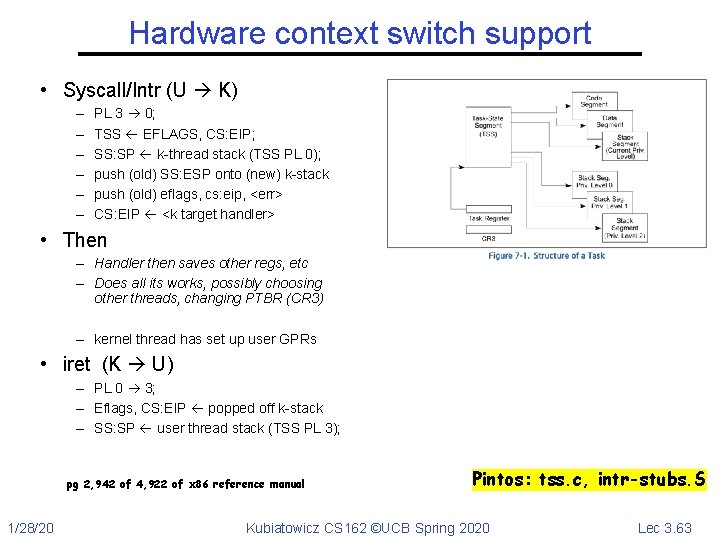
Hardware context switch support • Syscall/Intr (U K) – – – PL 3 0; TSS EFLAGS, CS: EIP; SS: SP k-thread stack (TSS PL 0); push (old) SS: ESP onto (new) k-stack push (old) eflags, cs: eip, <err> CS: EIP <k target handler> • Then – Handler then saves other regs, etc – Does all its works, possibly choosing other threads, changing PTBR (CR 3) – kernel thread has set up user GPRs • iret (K U) – PL 0 3; – Eflags, CS: EIP popped off k-stack – SS: SP user thread stack (TSS PL 3); pg 2, 942 of 4, 922 of x 86 reference manual 1/28/20 Pintos: tss. c, intr-stubs. S Kubiatowicz CS 162 ©UCB Spring 2020 Lec 3. 63
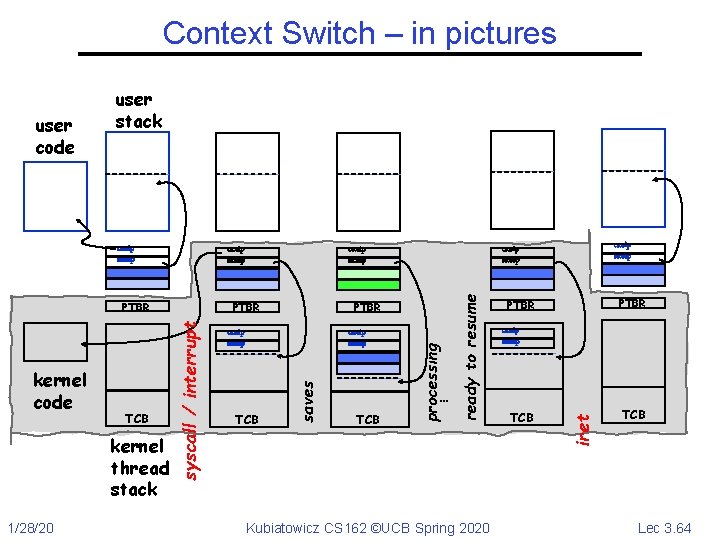
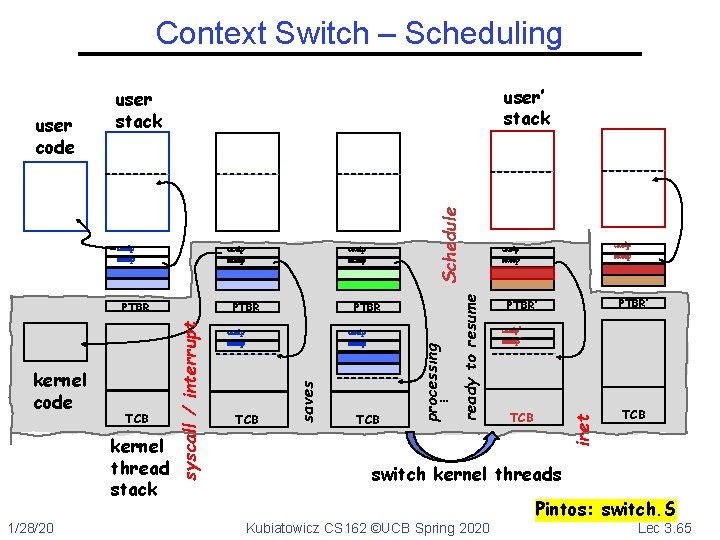
Context Switch – in pictures TCB kernel thread stack 1/28/20 syscall / interrupt kernel code PTBR cs: eip ss: esp TCB … TCB Kubiatowicz CS 162 ©UCB Spring 2020 PTBR cs: eip ss: esp TCB iret PTBR cs: eip ss: esp ready to resume cs: eip ss: esp processing cs: eip ss: esp saves user code user stack TCB Lec 3. 64
Context Switch – Scheduling kernel thread stack 1/28/20 PTBR cs: eip ss: esp TCB … TCB cs: eip ss: esp’ PTBR’ cs: eip’ ss: esp’ TCB iret TCB PTBR syscall / interrupt kernel code cs: eip ss: esp ready to resume PTBR Schedule cs: eip ss: esp processing cs: eip ss: esp saves user code user’ stack user stack TCB switch kernel threads Kubiatowicz CS 162 ©UCB Spring 2020 Pintos: switch. S Lec 3. 65
Concurrency • But, … ? ? ? • With all these threads in the kernel, won’t they step on each other? – For example, while one is loading a program, other threads should run … – Processes are isolated from each other, but all the threads in the kernel share the kernel address space, memory, data structures • We will study synchronization soon • The kernel controls whether hardware interrupts are enabled or not – Disabled on entry, selectively enable – Atomic operations, … 1/28/20 Kubiatowicz CS 162 ©UCB Spring 2020 Lec 3. 66
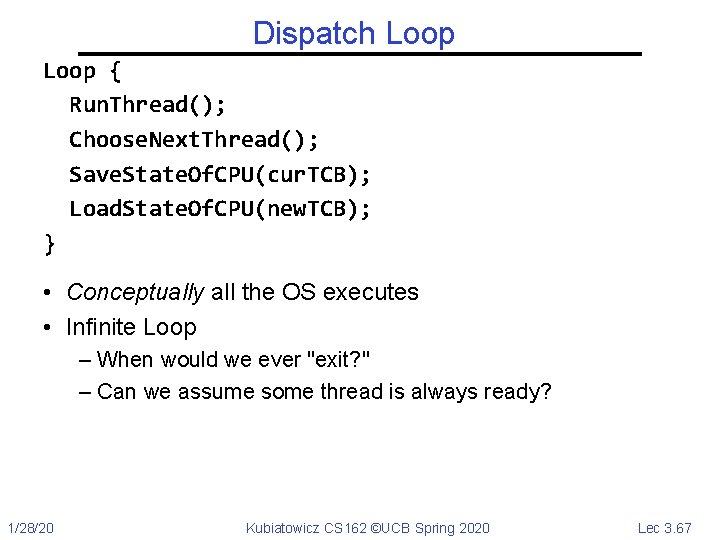
Dispatch Loop { Run. Thread(); Choose. Next. Thread(); Save. State. Of. CPU(cur. TCB); Load. State. Of. CPU(new. TCB); } • Conceptually all the OS executes • Infinite Loop – When would we ever "exit? " – Can we assume some thread is always ready? 1/28/20 Kubiatowicz CS 162 ©UCB Spring 2020 Lec 3. 67
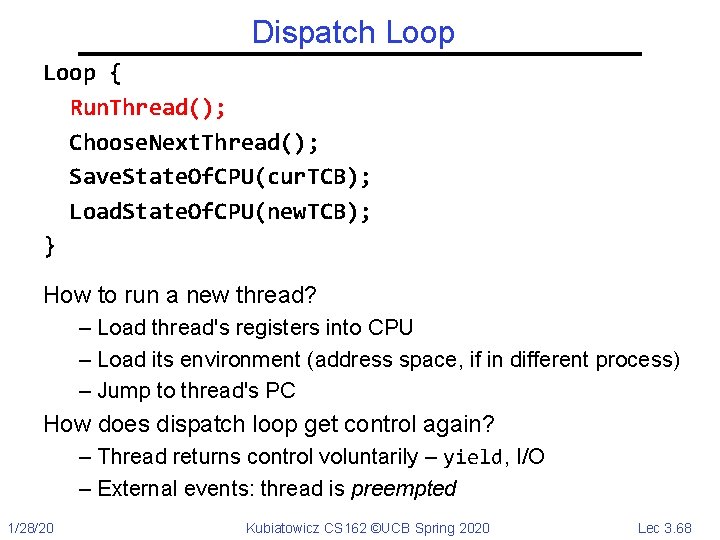
Dispatch Loop { Run. Thread(); Choose. Next. Thread(); Save. State. Of. CPU(cur. TCB); Load. State. Of. CPU(new. TCB); } How to run a new thread? – Load thread's registers into CPU – Load its environment (address space, if in different process) – Jump to thread's PC How does dispatch loop get control again? – Thread returns control voluntarily – yield, I/O – External events: thread is preempted 1/28/20 Kubiatowicz CS 162 ©UCB Spring 2020 Lec 3. 68
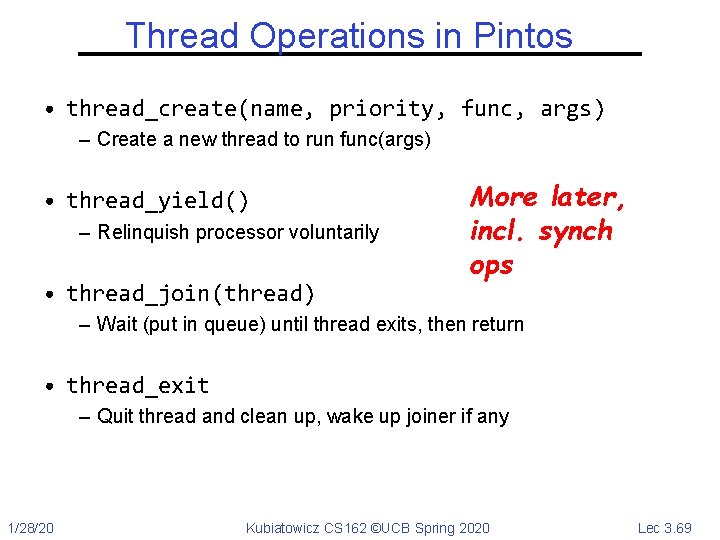
Thread Operations in Pintos • thread_create(name, priority, func, args) – Create a new thread to run func(args) • thread_yield() – Relinquish processor voluntarily • thread_join(thread) More later, incl. synch ops – Wait (put in queue) until thread exits, then return • thread_exit – Quit thread and clean up, wake up joiner if any 1/28/20 Kubiatowicz CS 162 ©UCB Spring 2020 Lec 3. 69
Meta-Question • Process is an instance of a program executing. – The fundamental OS responsibility • Processes do their work by processing and calling file system operations • Are their any operations on processes themselves? • exit ? 1/28/20 Kubiatowicz CS 162 ©UCB Spring 2020 Lec 3. 70
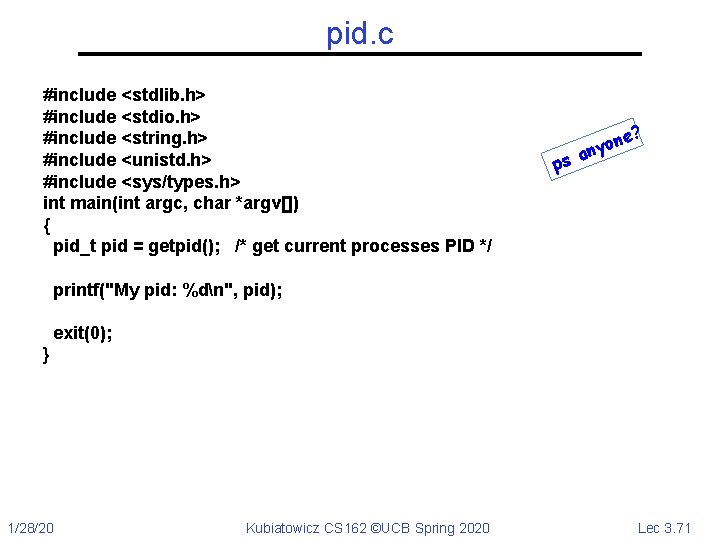
pid. c #include <stdlib. h> #include <stdio. h> #include <string. h> #include <unistd. h> #include <sys/types. h> int main(int argc, char *argv[]) { pid_t pid = getpid(); /* get current processes PID */ ps e? n o ny a printf("My pid: %dn", pid); exit(0); } 1/28/20 Kubiatowicz CS 162 ©UCB Spring 2020 Lec 3. 71
Can a process create a process ? • Yes • Fork creates a copy of process • What about the program you want to run? 1/28/20 Kubiatowicz CS 162 ©UCB Spring 2020 Lec 3. 72
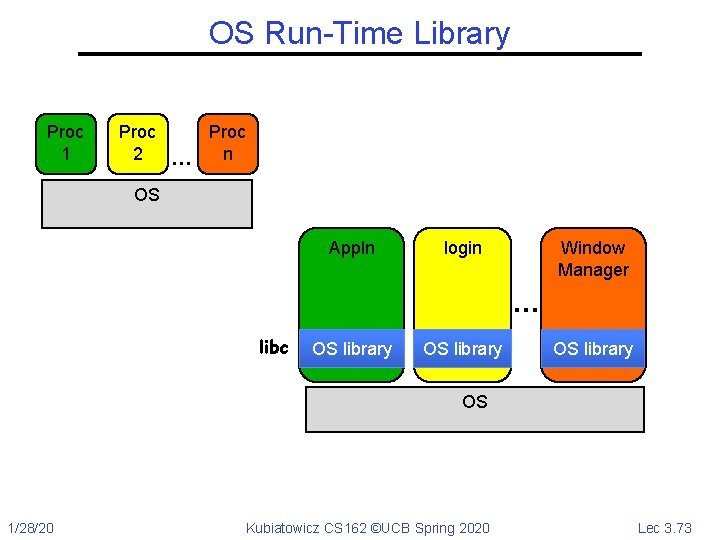
OS Run-Time Library Proc 1 Proc 2 … Proc n OS Appln login Window Manager … libc OS library OS 1/28/20 Kubiatowicz CS 162 ©UCB Spring 2020 Lec 3. 73
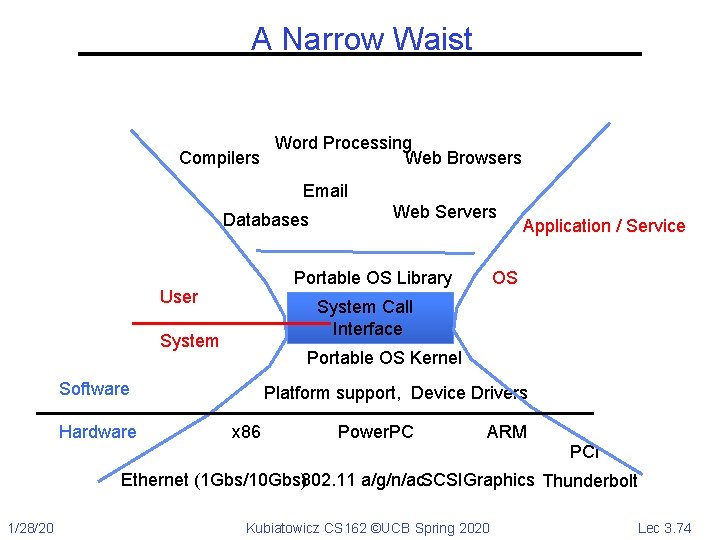
A Narrow Waist Compilers Word Processing Web Browsers Email Databases Application / Service OS Portable OS Library User System Call Interface System Portable OS Kernel Software Hardware Web Servers Platform support, Device Drivers x 86 Power. PC ARM PCI Ethernet (1 Gbs/10 Gbs)802. 11 a/g/n/ac. SCSI Graphics Thunderbolt 1/28/20 Kubiatowicz CS 162 ©UCB Spring 2020 Lec 3. 74
POSIX/Unix • Portable Operating System Interface [X? ] • Defines “Unix”, derived from AT&T Unix – Created to bring order to many Unix-derived OSs • Interface for application programmers (mostly) 1/28/20 Kubiatowicz CS 162 ©UCB Spring 2020 Lec 3. 75
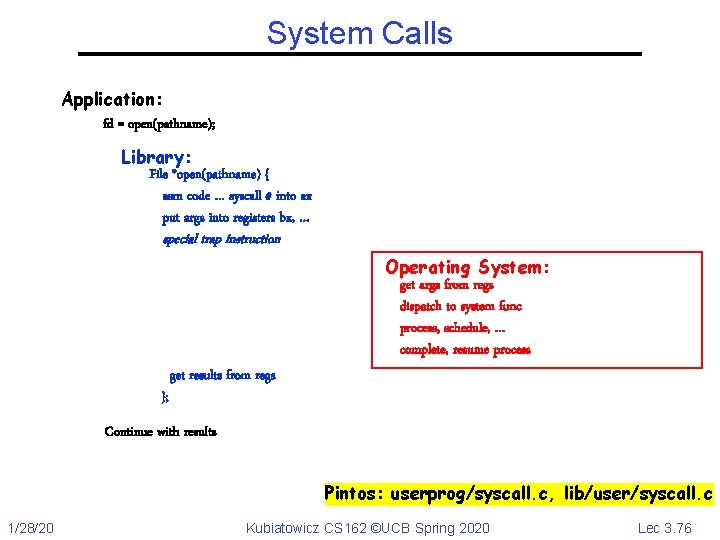
System Calls Application: fd = open(pathname); Library: File *open(pathname) { asm code … syscall # into ax put args into registers bx, … special trap instruction }; Operating System: get args from regs dispatch to system func process, schedule, … complete, resume process get results from regs Continue with results Pintos: userprog/syscall. c, lib/user/syscall. c 1/28/20 Kubiatowicz CS 162 ©UCB Spring 2020 Lec 3. 76
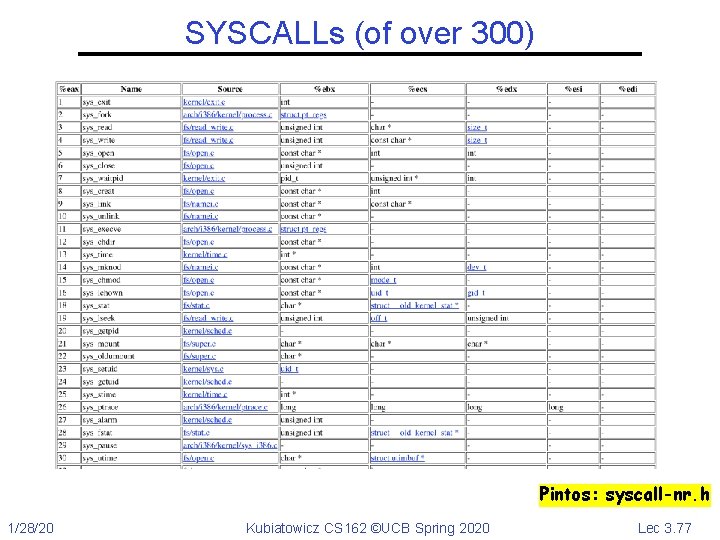
SYSCALLs (of over 300) Pintos: syscall-nr. h 1/28/20 Kubiatowicz CS 162 ©UCB Spring 2020 Lec 3. 77
Recall: Kernel System Call Handler • Locate arguments – In registers or on user(!) stack • Copy arguments – From user memory into kernel memory – Protect kernel from malicious code evading checks • Validate arguments – Protect kernel from errors in user code • Copy results back – into user memory 1/28/20 Kubiatowicz CS 162 ©UCB Spring 2020 Lec 3. 78
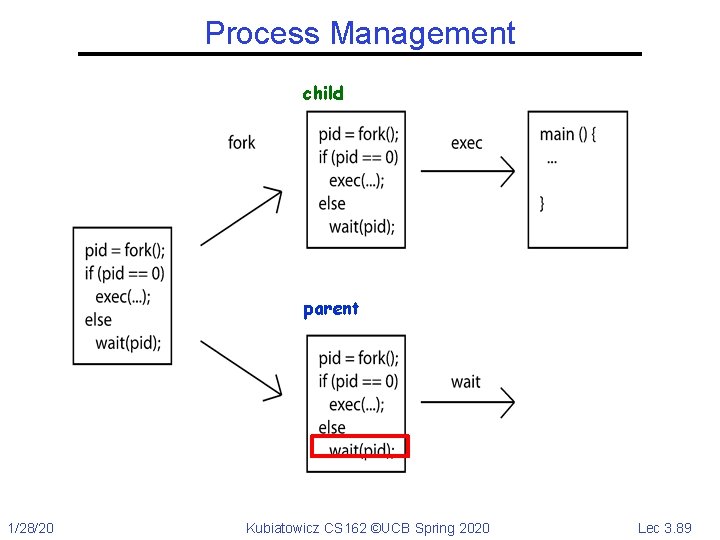
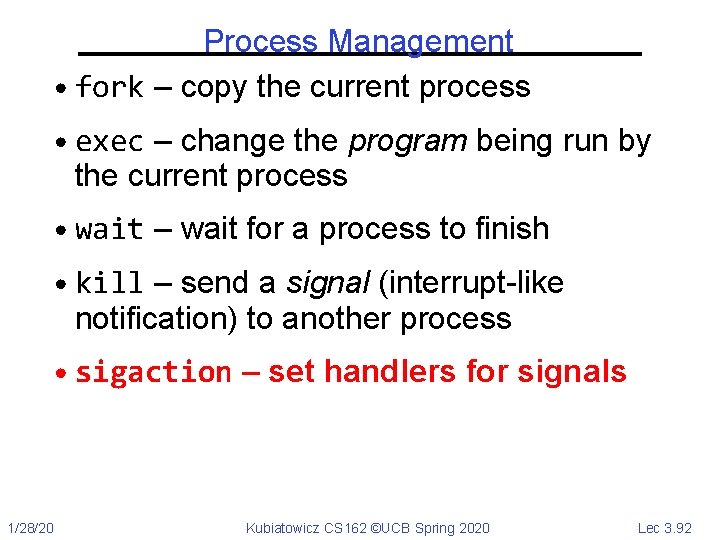
Process Management • exit – terminate a process • fork – copy the current process • exec – change the program being run by the current process • wait – wait for a process to finish • kill – send a signal (interrupt-like notification) to another process • sigaction – set handlers for signals 1/28/20 Kubiatowicz CS 162 ©UCB Spring 2020 Lec 3. 79
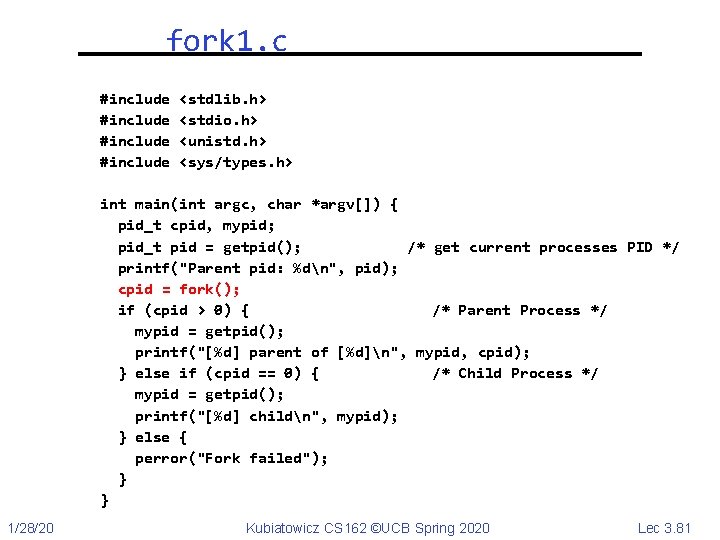
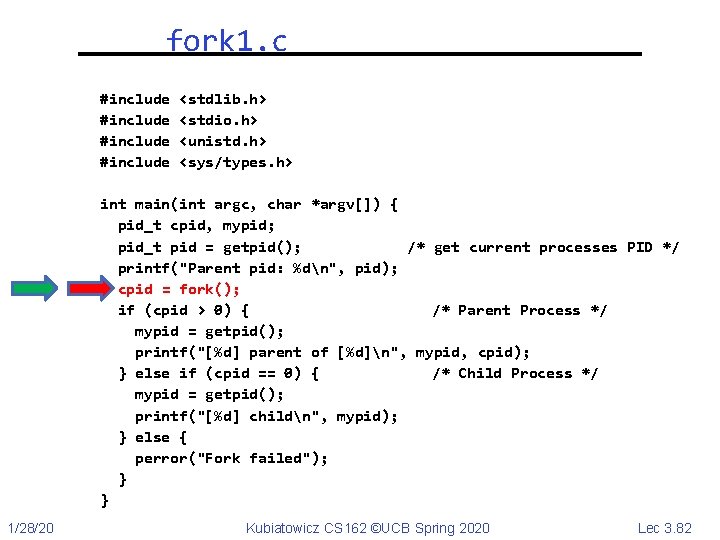
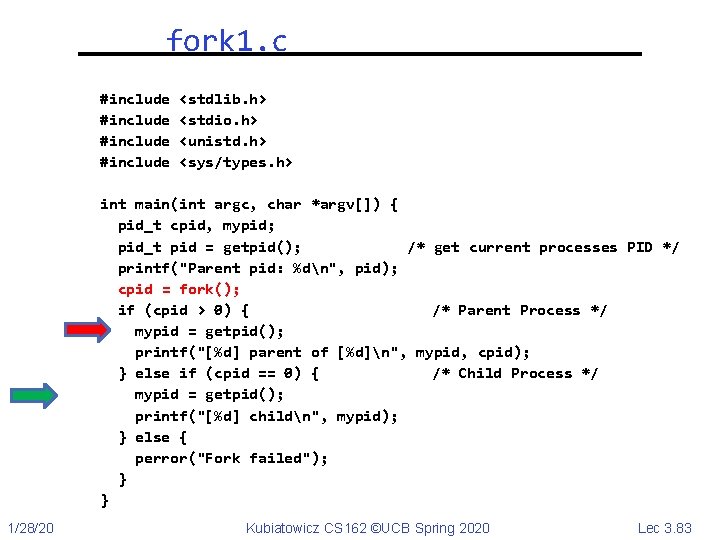
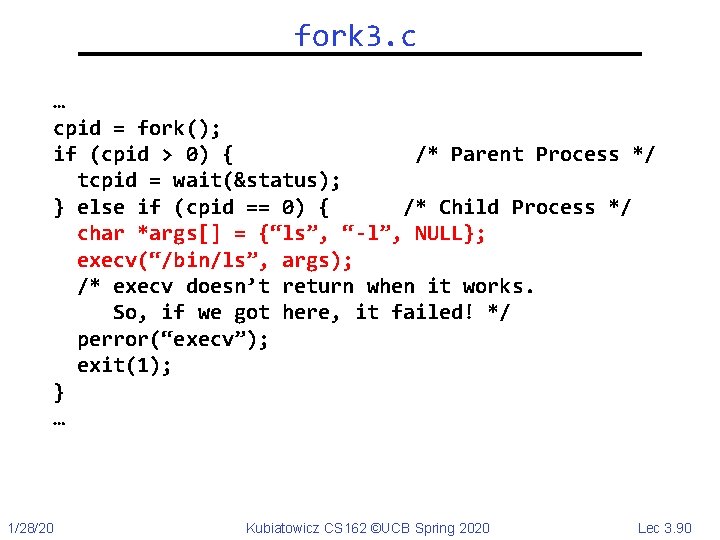
Creating Processes • pid_t fork(); -- copy the current process – New process has different pid • Return value from fork(): pid (like an integer) – When > 0: » Running in (original) Parent process » return value is pid of new child – When = 0: » Running in new Child process – When < 0: » Error! Must handle somehow » Running in original process • State of original process duplicated in both Parent and Child! – Address Space (Memory), File Descriptors (covered later), etc… 1/28/20 Kubiatowicz CS 162 ©UCB Spring 2020 Lec 3. 80
fork 1. c #include <stdlib. h> <stdio. h> <unistd. h> <sys/types. h> int main(int argc, char *argv[]) { pid_t cpid, mypid; pid_t pid = getpid(); /* get current processes PID */ printf("Parent pid: %dn", pid); cpid = fork(); if (cpid > 0) { /* Parent Process */ mypid = getpid(); printf("[%d] parent of [%d]n", mypid, cpid); } else if (cpid == 0) { /* Child Process */ mypid = getpid(); printf("[%d] childn", mypid); } else { perror("Fork failed"); } } 1/28/20 Kubiatowicz CS 162 ©UCB Spring 2020 Lec 3. 81
fork 1. c #include <stdlib. h> <stdio. h> <unistd. h> <sys/types. h> int main(int argc, char *argv[]) { pid_t cpid, mypid; pid_t pid = getpid(); /* get current processes PID */ printf("Parent pid: %dn", pid); cpid = fork(); if (cpid > 0) { /* Parent Process */ mypid = getpid(); printf("[%d] parent of [%d]n", mypid, cpid); } else if (cpid == 0) { /* Child Process */ mypid = getpid(); printf("[%d] childn", mypid); } else { perror("Fork failed"); } } 1/28/20 Kubiatowicz CS 162 ©UCB Spring 2020 Lec 3. 82
fork 1. c #include <stdlib. h> <stdio. h> <unistd. h> <sys/types. h> int main(int argc, char *argv[]) { pid_t cpid, mypid; pid_t pid = getpid(); /* get current processes PID */ printf("Parent pid: %dn", pid); cpid = fork(); if (cpid > 0) { /* Parent Process */ mypid = getpid(); printf("[%d] parent of [%d]n", mypid, cpid); } else if (cpid == 0) { /* Child Process */ mypid = getpid(); printf("[%d] childn", mypid); } else { perror("Fork failed"); } } 1/28/20 Kubiatowicz CS 162 ©UCB Spring 2020 Lec 3. 83
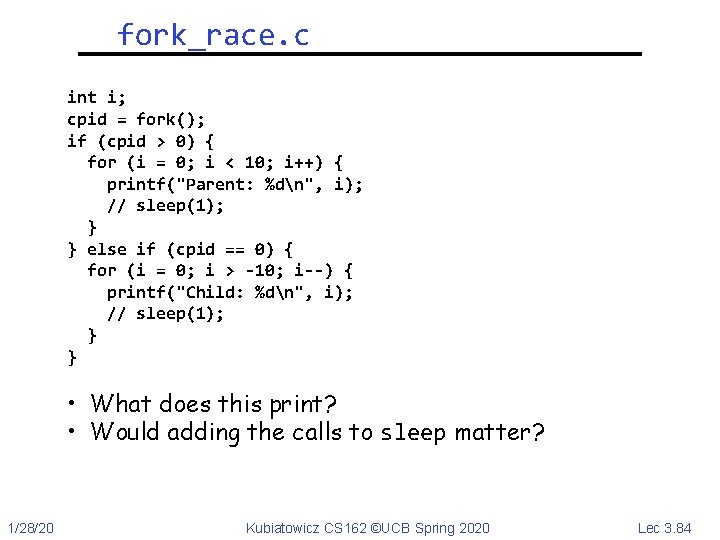
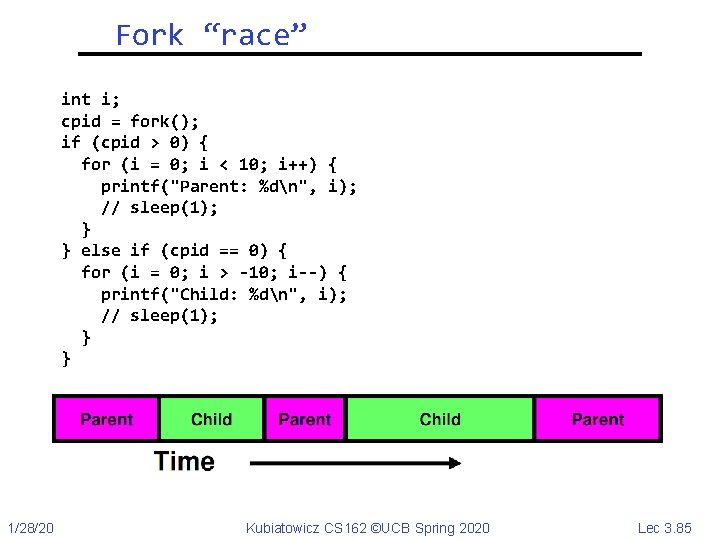
fork_race. c int i; cpid = fork(); if (cpid > 0) { for (i = 0; i < 10; i++) { printf("Parent: %dn", i); // sleep(1); } } else if (cpid == 0) { for (i = 0; i > -10; i--) { printf("Child: %dn", i); // sleep(1); } } • What does this print? • Would adding the calls to sleep matter? 1/28/20 Kubiatowicz CS 162 ©UCB Spring 2020 Lec 3. 84
Fork “race” int i; cpid = fork(); if (cpid > 0) { for (i = 0; i < 10; i++) { printf("Parent: %dn", i); // sleep(1); } } else if (cpid == 0) { for (i = 0; i > -10; i--) { printf("Child: %dn", i); // sleep(1); } } 1/28/20 Kubiatowicz CS 162 ©UCB Spring 2020 Lec 3. 85
Process Management • fork – copy the current process • exec – change the program being run by the current process • wait – wait for a process to finish • kill – send a signal (interrupt-like notification) to another process • sigaction – set handlers for signals 1/28/20 Kubiatowicz CS 162 ©UCB Spring 2020 Lec 3. 86
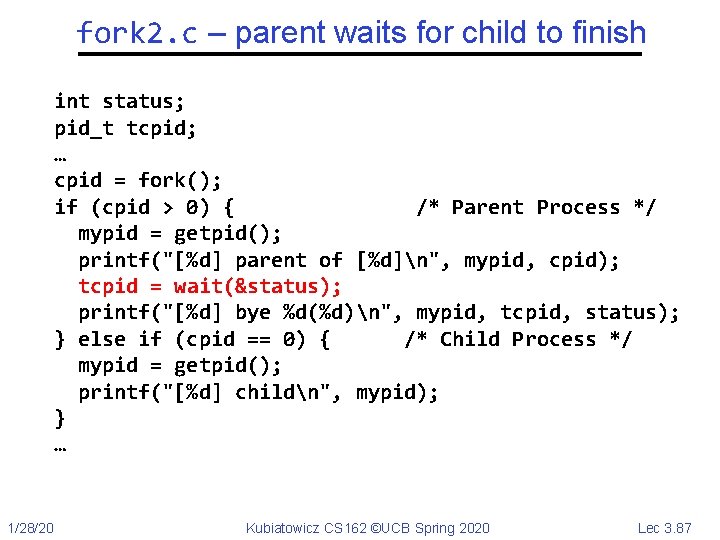
fork 2. c – parent waits for child to finish int status; pid_t tcpid; … cpid = fork(); if (cpid > 0) { /* Parent Process */ mypid = getpid(); printf("[%d] parent of [%d]n", mypid, cpid); tcpid = wait(&status); printf("[%d] bye %d(%d)n", mypid, tcpid, status); } else if (cpid == 0) { /* Child Process */ mypid = getpid(); printf("[%d] childn", mypid); } … 1/28/20 Kubiatowicz CS 162 ©UCB Spring 2020 Lec 3. 87
Process Management • fork – copy the current process • exec – change the program being run by the current process • wait – wait for a process to finish • kill – send a signal (interrupt-like notification) to another process • sigaction – set handlers for signals 1/28/20 Kubiatowicz CS 162 ©UCB Spring 2020 Lec 3. 88
Process Management child parent 1/28/20 Kubiatowicz CS 162 ©UCB Spring 2020 Lec 3. 89
fork 3. c … cpid = fork(); if (cpid > 0) { /* Parent Process */ tcpid = wait(&status); } else if (cpid == 0) { /* Child Process */ char *args[] = {“ls”, “-l”, NULL}; execv(“/bin/ls”, args); /* execv doesn’t return when it works. So, if we got here, it failed! */ perror(“execv”); exit(1); } … 1/28/20 Kubiatowicz CS 162 ©UCB Spring 2020 Lec 3. 90
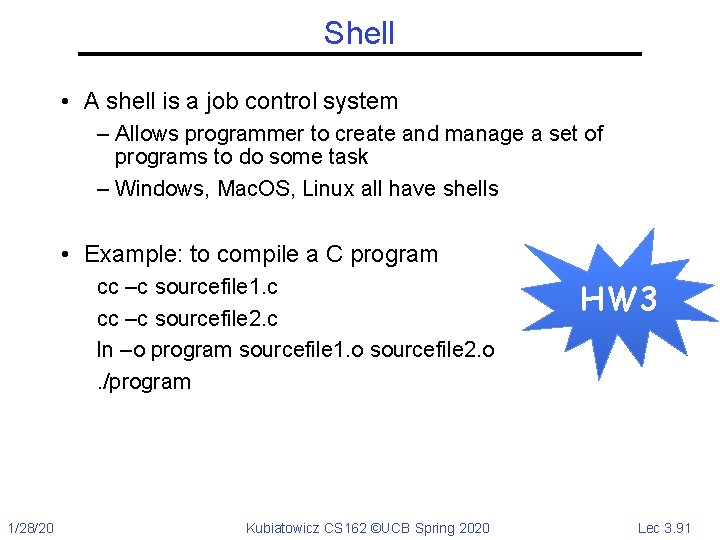
Shell • A shell is a job control system – Allows programmer to create and manage a set of programs to do some task – Windows, Mac. OS, Linux all have shells • Example: to compile a C program cc –c sourcefile 1. c cc –c sourcefile 2. c ln –o program sourcefile 1. o sourcefile 2. o. /program 1/28/20 Kubiatowicz CS 162 ©UCB Spring 2020 HW 3 Lec 3. 91
Process Management • fork – copy the current process • exec – change the program being run by the current process • wait – wait for a process to finish • kill – send a signal (interrupt-like notification) to another process • sigaction – set handlers for signals 1/28/20 Kubiatowicz CS 162 ©UCB Spring 2020 Lec 3. 92
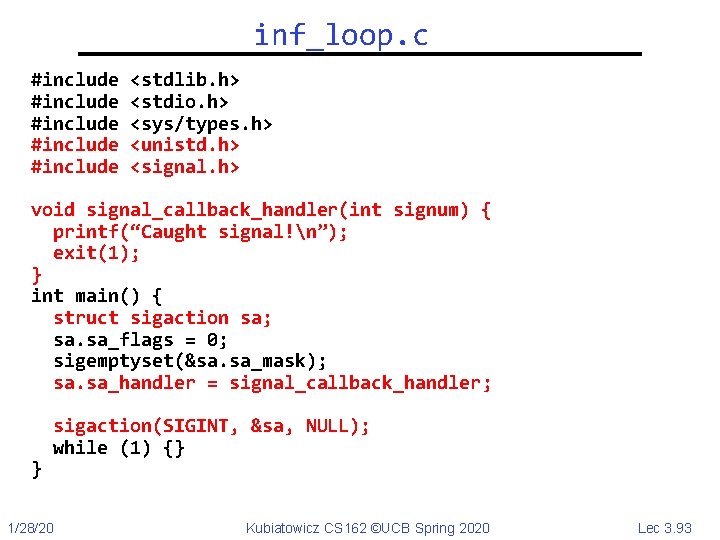
inf_loop. c #include #include <stdlib. h> <stdio. h> <sys/types. h> <unistd. h> <signal. h> void signal_callback_handler(int signum) { printf(“Caught signal!n”); exit(1); } int main() { struct sigaction sa; sa. sa_flags = 0; sigemptyset(&sa. sa_mask); sa. sa_handler = signal_callback_handler; } sigaction(SIGINT, &sa, NULL); while (1) {} 1/28/20 Kubiatowicz CS 162 ©UCB Spring 2020 Lec 3. 93
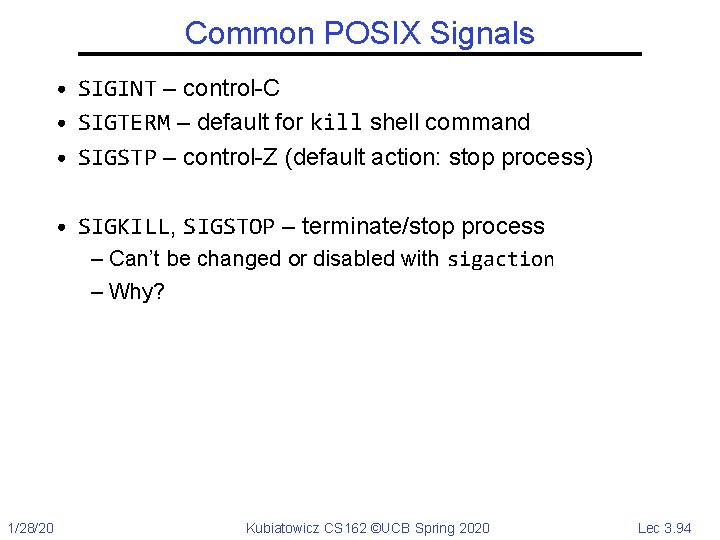
Common POSIX Signals • SIGINT – control-C • SIGTERM – default for kill shell command • SIGSTP – control-Z (default action: stop process) • SIGKILL, SIGSTOP – terminate/stop process – Can’t be changed or disabled with sigaction – Why? 1/28/20 Kubiatowicz CS 162 ©UCB Spring 2020 Lec 3. 94
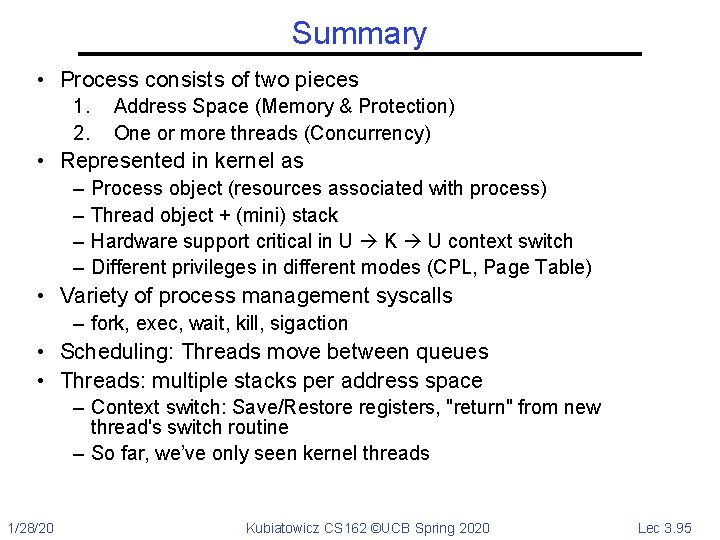
Summary • Process consists of two pieces 1. 2. Address Space (Memory & Protection) One or more threads (Concurrency) • Represented in kernel as – – Process object (resources associated with process) Thread object + (mini) stack Hardware support critical in U K U context switch Different privileges in different modes (CPL, Page Table) • Variety of process management syscalls – fork, exec, wait, kill, sigaction • Scheduling: Threads move between queues • Threads: multiple stacks per address space – Context switch: Save/Restore registers, "return" from new thread's switch routine – So far, we’ve only seen kernel threads 1/28/20 Kubiatowicz CS 162 ©UCB Spring 2020 Lec 3. 95