Community Acceptance Strategies for MHSA Housing MHSA Promising

- Slides: 23
Community Acceptance Strategies for MHSA Housing MHSA Promising Practices TA Call October 13, 2010 www. csh. org
Six Steps to Building Community Support
The Six Steps Ø Ø 3 Intended to be a proactive, comprehensive, collaborative, and flexible approach A framework, not a formula
The Six Steps Ø Ø Ø 4 Step I: Assessment and Planning Step II: Political Strategy Step III: Building Active Community Support Step IV: Dealing with Community Concerns Step V: Legal Strategy Step VI: Public Relations/Media Strategy
Benefits Ø Ø 5 Fewer costs and delays. Fewer fire drills and surprises. More sense of your own power. Increase likelihood of tenant acceptance in community.
Step I – Assessment and Planning Ø Ø 6 Done early in the pre-development process. Development team should meet with loyal supporters (seek to identify allies those who will speak in support of the proposed project) and stakeholders (those with family members, clients, community members the project will benefit) before the project goes public, to assess and plan for their participation and assistance.
Step I – continued Ø Ø 7 Assess what local government approvals are needed, when, by whom. Assess process. , criteria and timeline
Purpose Ø Separate the Unique from the Generic ü What is our organization’s reputation in its county/jurisdiction? ü Who are the leaders in the community and what is their knowledge of supportive housing; experience with our organization; knowledge and experience with the population we are serving? 8
What and Where Ø Ø 9 What is “around” the site; history of the neighborhood; who are the local organizations? What are the neighbors’ issues going to be? What are the potential legal issues? Where are we going to find sympathetic supporters?
Developing Your Strategy Ø Ø Ø 10 Strategy may affect staffing needs, timeline and budget. Step I must be done first Implementation of the remaining steps occurs simultaneously The process is not linear. Expect your plans to change, but being prepared, you will still have an advantage.
Step II – Political Strategy Ø Ø Ø 11 Assess the local government Elected officials, appointed officials, area commissions, architectural review boards, city/county/village administrators and staff. Timing is critical---harder to sway votes when proposal is already surrounded by controversy. Ask the question: “If the vote were held tonight, do I know what the outcome would be? ” Identify solid supporters, uncertain votes and opponents.
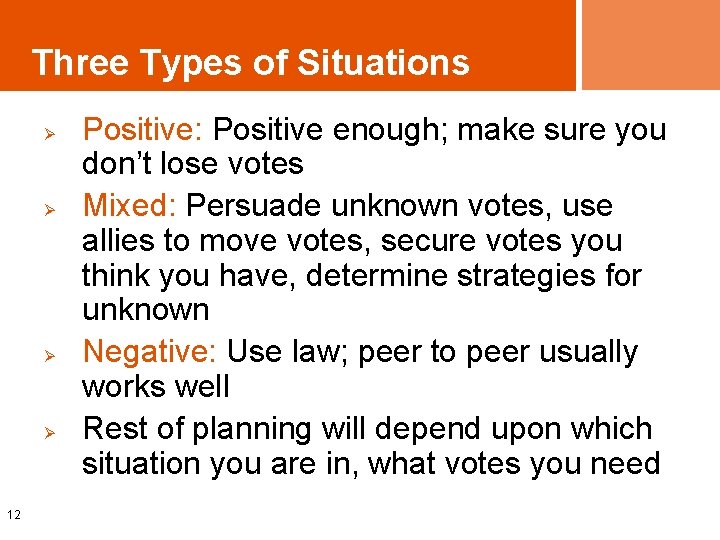
Three Types of Situations Ø Ø 12 Positive: Positive enough; make sure you don’t lose votes Mixed: Persuade unknown votes, use allies to move votes, secure votes you think you have, determine strategies for unknown Negative: Use law; peer to peer usually works well Rest of planning will depend upon which situation you are in, what votes you need
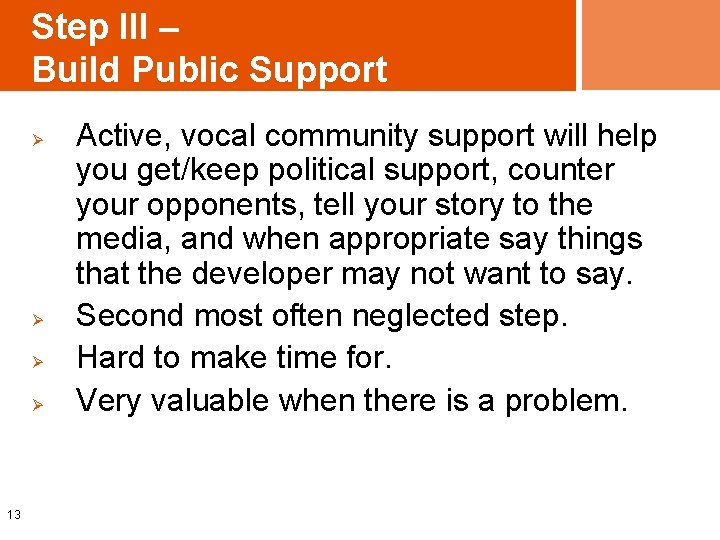
Step III – Build Public Support Ø Ø 13 Active, vocal community support will help you get/keep political support, counter your opponents, tell your story to the media, and when appropriate say things that the developer may not want to say. Second most often neglected step. Hard to make time for. Very valuable when there is a problem.
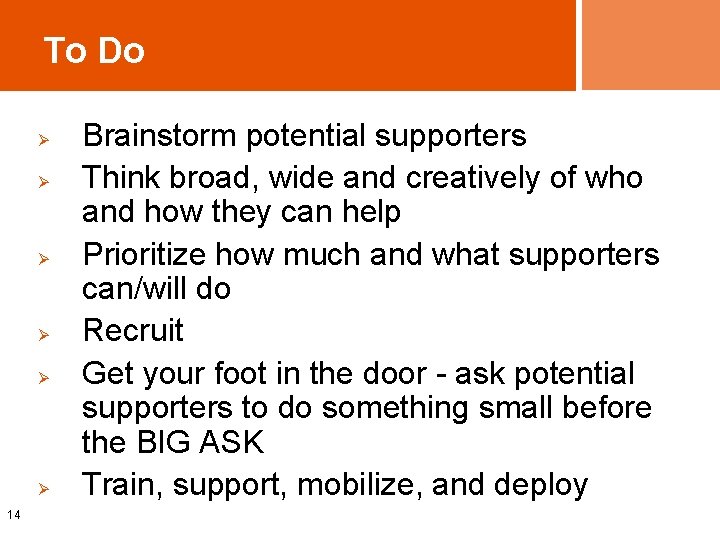
To Do Ø Ø Ø 14 Brainstorm potential supporters Think broad, wide and creatively of who and how they can help Prioritize how much and what supporters can/will do Recruit Get your foot in the door - ask potential supporters to do something small before the BIG ASK Train, support, mobilize, and deploy
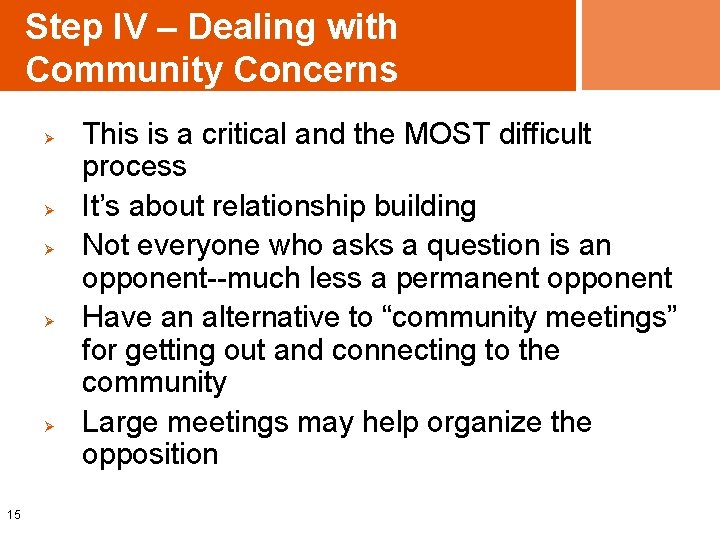
Step IV – Dealing with Community Concerns Ø Ø Ø 15 This is a critical and the MOST difficult process It’s about relationship building Not everyone who asks a question is an opponent--much less a permanent opponent Have an alternative to “community meetings” for getting out and connecting to the community Large meetings may help organize the opposition
General Strategy Ø Ø 16 Peel away the number of issues and opponents so that you can tell opponents compelling and true stories of your efforts In dealing with community concerns there always three things going on: ü Mutual education process ü Problem identification and solving ü Building relationships
To Do Ø Ø Ø 17 Canvassing Open House One-on-one meetings, small home meetings Tours Thank you letters and reminders Make no promises you’re not sure you can fulfill
Step V – Legal Strategy Ø 18 Can cover several topics: ü Any land use issues/zonings you’ll need for the siting of the project ü Responses to opponents who base opposition on discriminatory statements or actions ü Fair housing and rights of tenants
Step VI – Media Strategy Ø Ø Ø 19 Most reporters write the story that is easiest to write Learn how to make the reporter’s job easier to tell our story--do some of the reporter’s work for him/her Use a prepared response strategy rather than trying to go out and get stories
To Do Ø Ø Ø 20 Designate and prepare a spokesperson-include supporters and successful clients/residents Develop a few clear and simple messages and alternative stories for interested reporters Prepare fact sheets
To Do Ø Ø Ø 21 Offer to give tours of existing developments Give lists of references Follow-up on any coverage you get with a thank you, a factual correction If coverage biased, supporters can write letters to editor or op-ed pieces Develop ongoing friendly relationship with media
Resources n n The Supportive Housing Network of New York’s “Good Housing Good Neighbors” Video: http: //www. shnny. org/ Homebase Publications http: //www. homebaseccc. org/pages/main/publications. html – “Siting of Homeless Housing and Services: Best Practices for Community Acceptance” – “Building Inclusive Community: Tools to Create Support for Affordable Housing” n Furman Center Report on The Impact of Supportive Housing on Surrounding Neighborhoods: Evidence from New York City http: //furmancenter. org/files/Furman. Center. Policy. Briefon. Supportive. Housing _Low. Res. pdf n CSH: Thinking Beyond NIMBY: Building Community Support for Supportive Housing: http: //documents. csh. org/documents/Resource. Center/Dev. Ops. Toolkit/Beyond. NI MBYpdf. pdf n 22 CSH: Six Steps to Building Community Support http: //documents. csh. org/documents/Resource. Center/Dev. Ops. T oolkit/Six. Stepspdf. pdf
For more information: CSH: www. csh. org Abode Services: www. tricityhomeless. org Resources for Community Development: http: //rcdev. org/