Colour Mixing Dr Huw Owens Huw Owens University
- Slides: 19
Colour Mixing Dr Huw Owens © Huw Owens - University of Manchester : 12/2/2020
Introduction • • • Additive mixing Subtractive mixing Partitive mixing Choice of primaries Examples © Huw Owens - University of Manchester : 12/2/2020
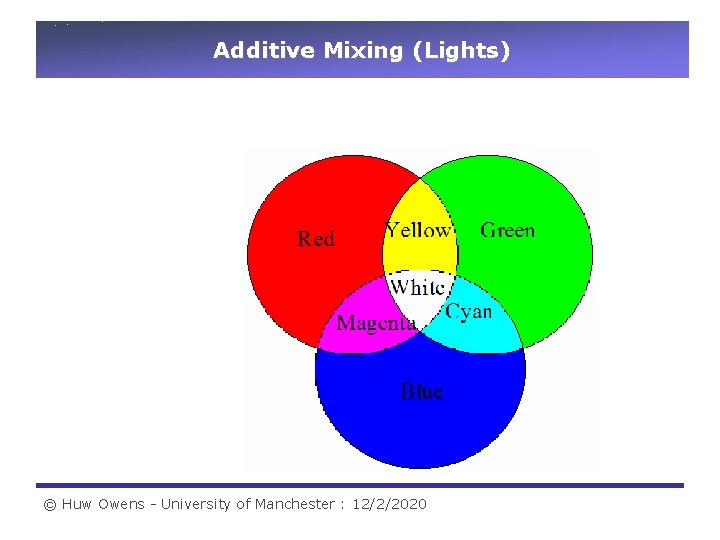
Additive Mixing • Provides the extreme limit of all colour stimuli. • The coloured lights selected for colour mixing are usually called PRIMARIES • When mixing two or more lights the result is: • Brighter • Less saturated (less vivid) © Huw Owens - University of Manchester : 12/2/2020
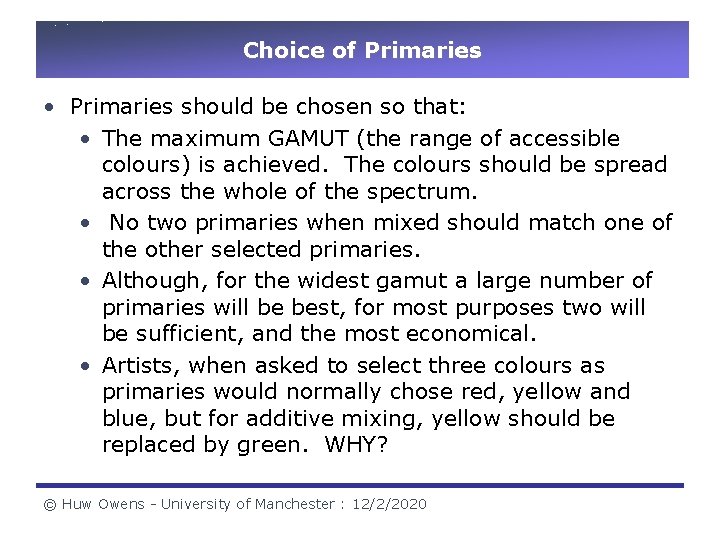
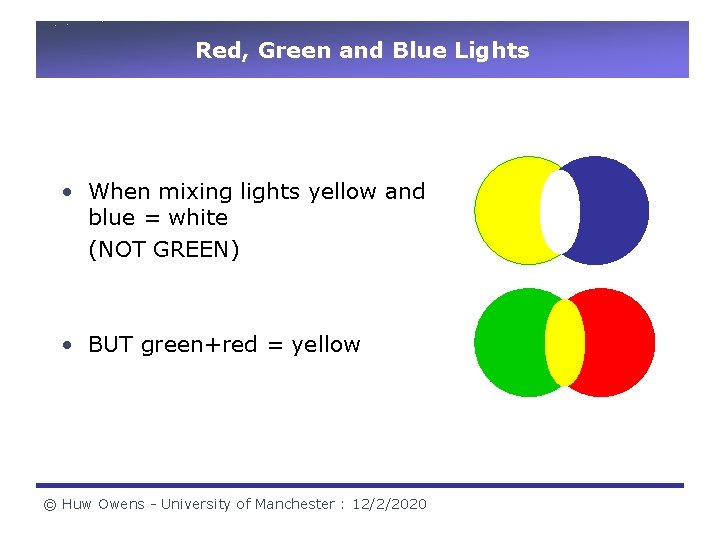
Choice of Primaries • Primaries should be chosen so that: • The maximum GAMUT (the range of accessible colours) is achieved. The colours should be spread across the whole of the spectrum. • No two primaries when mixed should match one of the other selected primaries. • Although, for the widest gamut a large number of primaries will be best, for most purposes two will be sufficient, and the most economical. • Artists, when asked to select three colours as primaries would normally chose red, yellow and blue, but for additive mixing, yellow should be replaced by green. WHY? © Huw Owens - University of Manchester : 12/2/2020
Red, Green and Blue Lights • When mixing lights yellow and blue = white (NOT GREEN) • BUT green+red = yellow © Huw Owens - University of Manchester : 12/2/2020
Additive Mixing (Lights) © Huw Owens - University of Manchester : 12/2/2020
Examples of Additive Mixing • Theatre lighting • Triple projection • As demonstrated by Maxwell (1858 - 1862) • Colour Television • Colour monitors • The eye © Huw Owens - University of Manchester : 12/2/2020
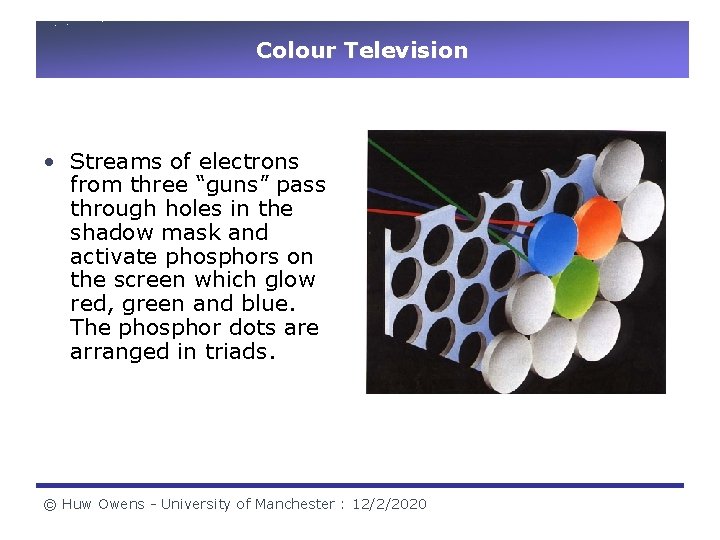
Colour Television • Streams of electrons from three “guns” pass through holes in the shadow mask and activate phosphors on the screen which glow red, green and blue. The phosphor dots are arranged in triads. © Huw Owens - University of Manchester : 12/2/2020
Partitive Mixing • When coloured lights are mixed the luminance (brightness) of the mixture is the sum of the combined luminances of the primaries. • It is often easier to simulate additive mixing using : • The persistence of vision (Temporal Integration) • When red, green and blue images are rapidly projected onto a screen successively the colours merge due to the persistence of vision. The same applies to Maxwell’s spinning disc during rapid spinning of the coloured disc. © Huw Owens - University of Manchester : 12/2/2020
Partitive Mixing (continued) • The mosaic effect (Spatial averaging) • When small patches of colour in a pattern, as a mosaic, are viewed from a distance, the colours merge. The eye cannot resolve the colours separately. • In partitive mixing the overall luminance is the average of the individual colours taking their area into account, not the sum. © Huw Owens - University of Manchester : 12/2/2020
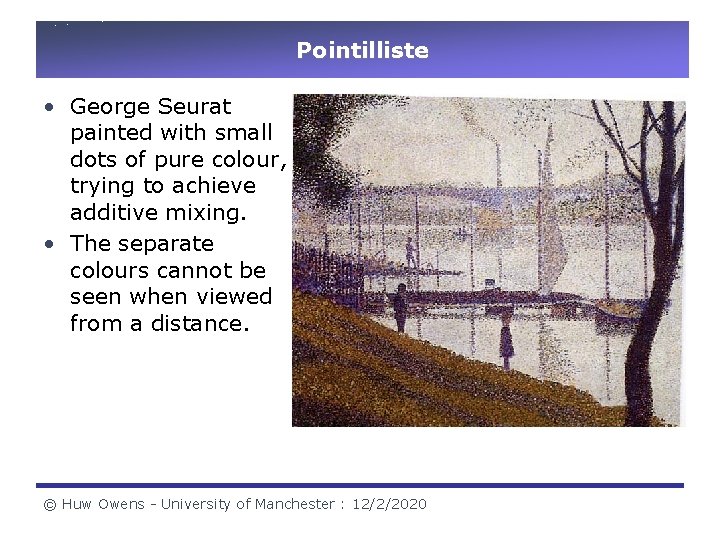
Pointilliste • George Seurat painted with small dots of pure colour, trying to achieve additive mixing. • The separate colours cannot be seen when viewed from a distance. © Huw Owens - University of Manchester : 12/2/2020
Subtractive Mixing • Dyes and pigments (colorants) act by absorbing certain parts of the spectrum of white light more than others (except for Black which absorbs evenly). • For example (Yellow dyes absorb blue light) • Subtractive mixing is the mixing of colorants. The results of mixing vivid primaries are always duller and darker. © Huw Owens - University of Manchester : 12/2/2020
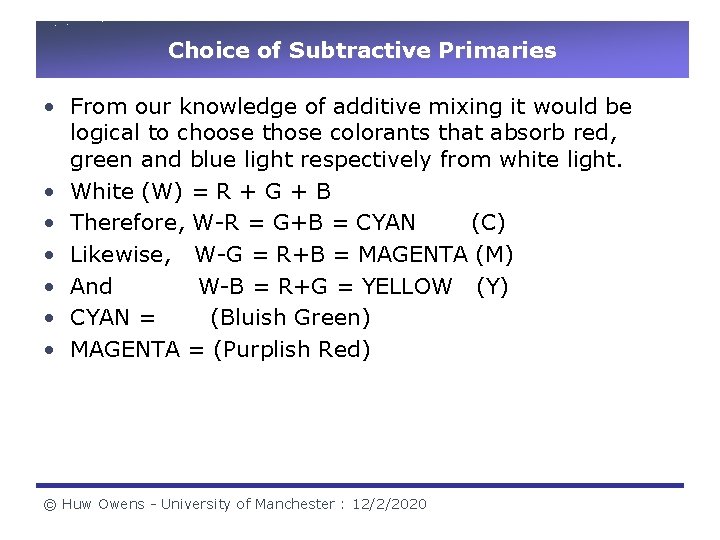
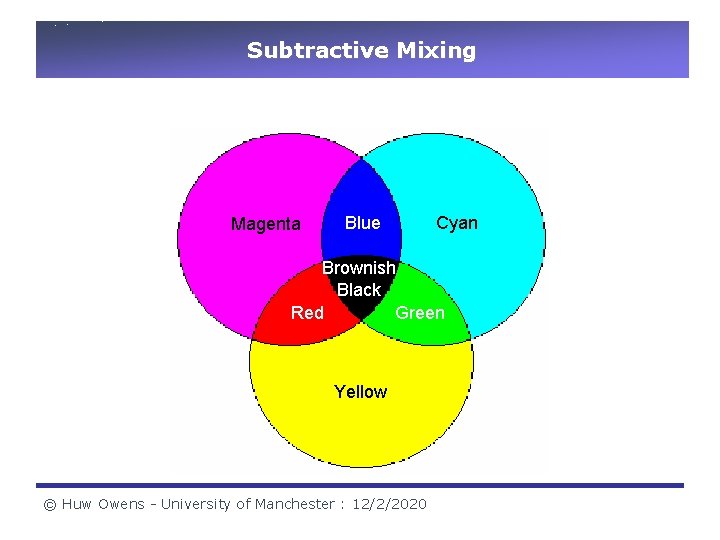
Choice of Subtractive Primaries • From our knowledge of additive mixing it would be logical to choose those colorants that absorb red, green and blue light respectively from white light. • White (W) = R + G + B • Therefore, W-R = G+B = CYAN (C) • Likewise, W-G = R+B = MAGENTA (M) • And W-B = R+G = YELLOW (Y) • CYAN = (Bluish Green) • MAGENTA = (Purplish Red) © Huw Owens - University of Manchester : 12/2/2020
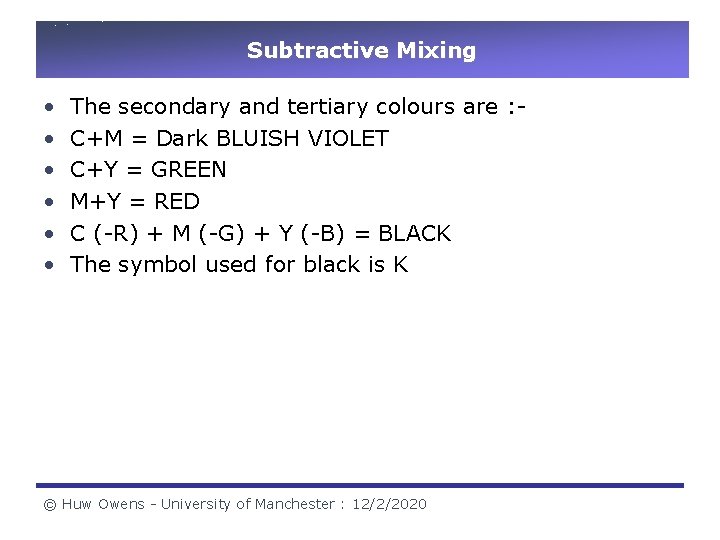
Subtractive Mixing • • • The secondary and tertiary colours are : C+M = Dark BLUISH VIOLET C+Y = GREEN M+Y = RED C (-R) + M (-G) + Y (-B) = BLACK The symbol used for black is K © Huw Owens - University of Manchester : 12/2/2020
Subtractive Mixing Magenta Blue Cyan Brownish Black Red Green Yellow © Huw Owens - University of Manchester : 12/2/2020
Subtractive Mixing • Examples include : • Painting • Dyeing • Printing • Colour Photography © Huw Owens - University of Manchester : 12/2/2020
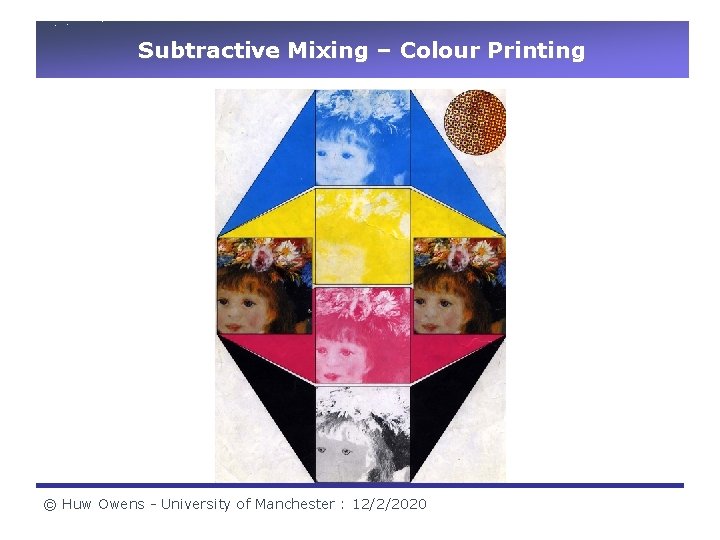
Subtractive Mixing - Printing • Halftone printing uses CMY colour separations composed of varying dot sizes are produced. As the primary inks do not absorb all of the red and green light, the black appears brownish. To produce a better quality black a separate black separation is added (CMYK). © Huw Owens - University of Manchester : 12/2/2020
Subtractive Mixing – Colour Printing © Huw Owens - University of Manchester : 12/2/2020
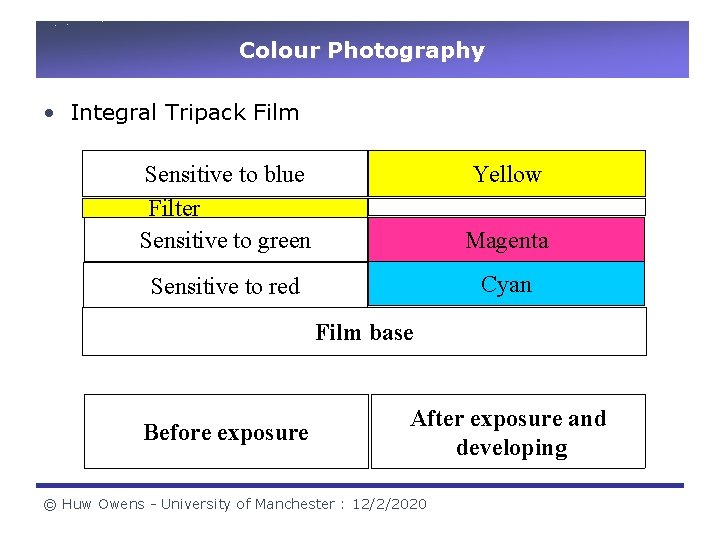
Colour Photography • Integral Tripack Film Sensitive to blue Filter Sensitive to green Yellow Magenta Sensitive to red Cyan Film base Before exposure After exposure and developing © Huw Owens - University of Manchester : 12/2/2020