Color Invariance Shadow Removal Seminar What we passed





- Slides: 39
Color Invariance Shadow Removal Seminar
What we passed till now • Cause to shadows, and what shadows means for us (the interpretation of shadows in human brain). • How to create shadows graphically. • Some shadow detection techniques
This lecture Overview • Intro – Shadows – Invariance and color invariance • Shadow classification • Shadow segmentation
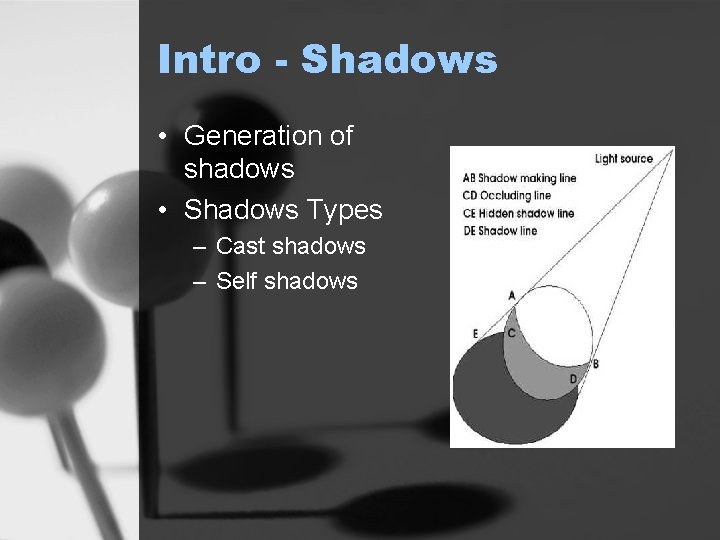
Intro - Shadows • Generation of shadows • Shadows Types – Cast shadows – Self shadows
Intro - Invariance • Invariant – A feature (quantity or property or function) that remains unchanged when a particular transformation is applied to it. – What it used for • Invariance in images – Matlab demo
Intro – Shadow detection techniques • Shadow detection techniques classification: – Model based – Property based
Shadow identification and classification using invariant color models Elena Salvador, Andrea Cavallaro, Touradj Eebrahimi 2001
Overview • • • Goal Constraints Color Invariants Algorithm steps Results Conclusions
Goal • Extraction and classification of shadows in color images.
Constraints • A simple environment assumed where shadows are cast on flat or nearly flat non textured surface. • Objects are uniformly colored. • Only one light source illuminates the scene. • Shadows and objects are within the image. • The light source must be strong.
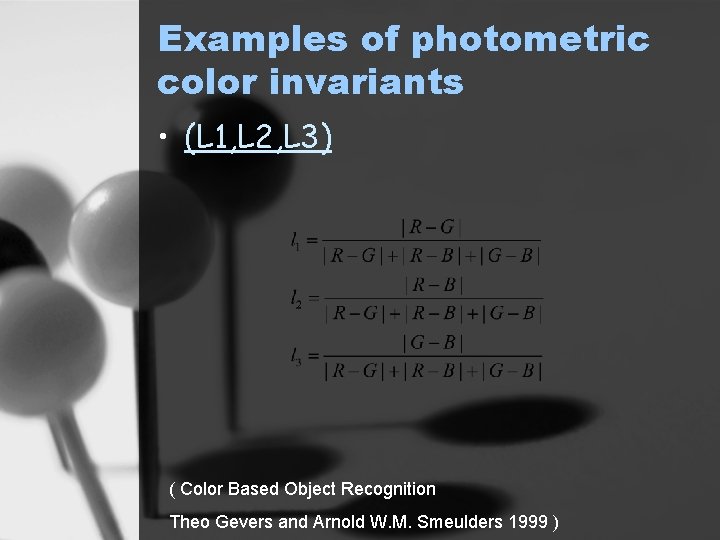
Color Invariants • Photometric color invariants – Definition – Models of photometric color invariants • Normalized rgb • Hue (H) and saturation (S) • (C 1, C 2, C 3) and (L 1, L 2, L 3)
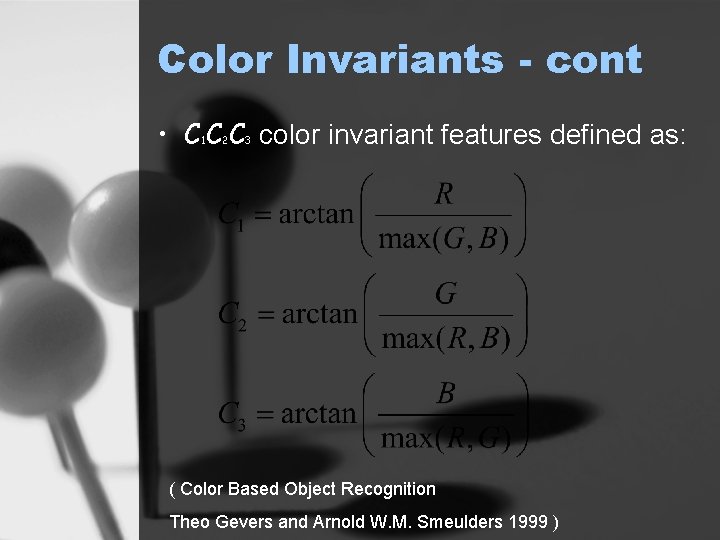
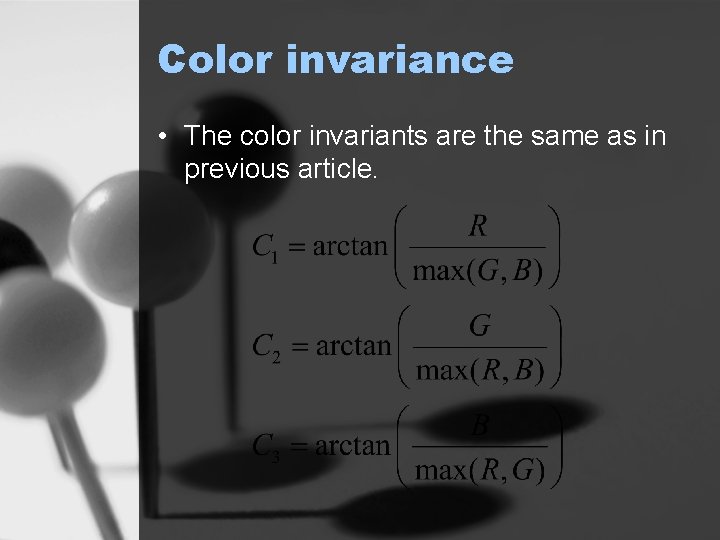
Color Invariants - cont • C C C color invariant features defined as: 1 2 3 ( Color Based Object Recognition Theo Gevers and Arnold W. M. Smeulders 1999 )
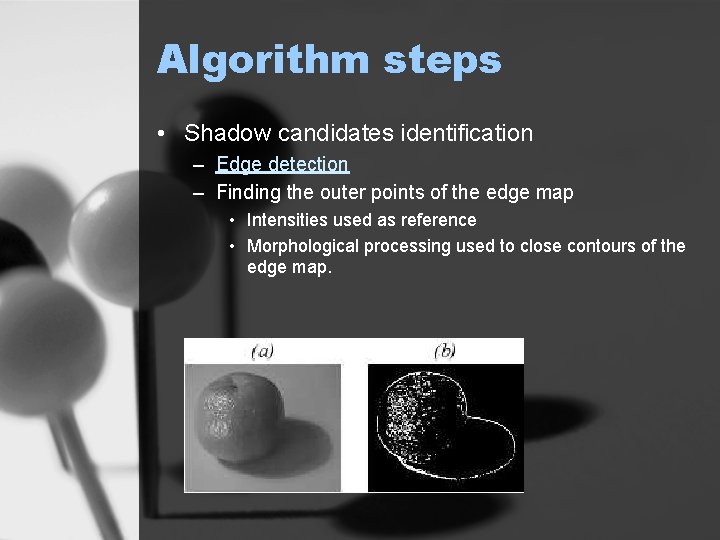
Algorithm steps • Shadow candidates identification – Edge detection – Finding the outer points of the edge map • Intensities used as reference • Morphological processing used to close contours of the edge map.
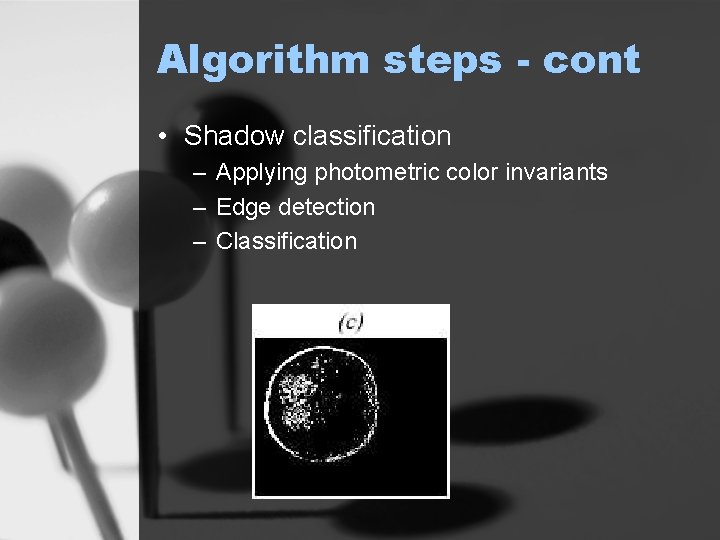
Algorithm steps - cont • Shadow classification – Applying photometric color invariants – Edge detection – Classification
Algorithm steps summary
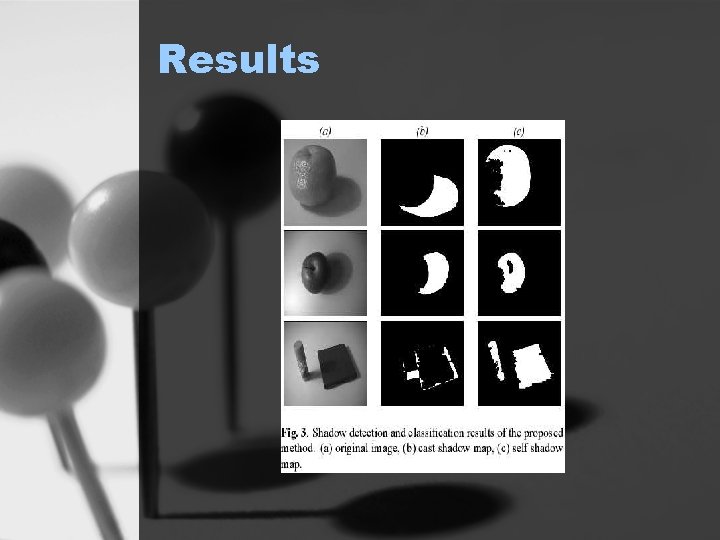
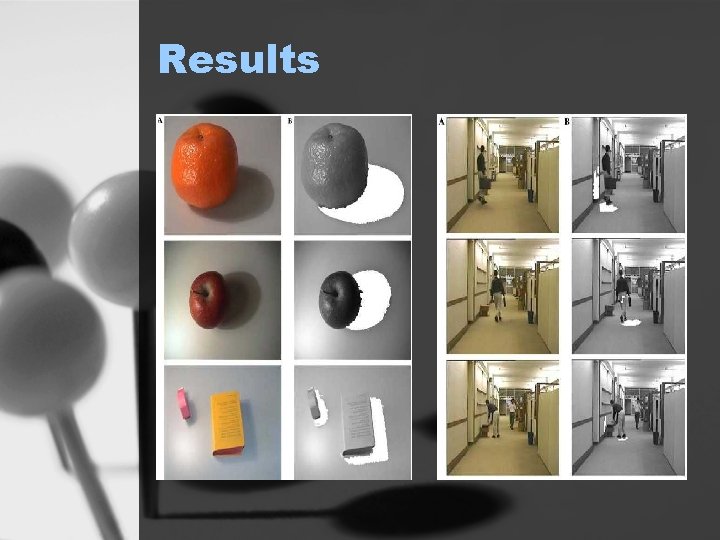
Results
Conclusions • This method succeeds in detecting and classifying shadows within environmental constraints that are less restrictive then other methods. • Need to define strategy to describe the object color discounting the effect of self shadow.
Cast shadow segmentation using invariant color features Elena Salvador, Andrea Cavallaro and Touradj Ebrahimi 2004
Overview • Goal • Constraints • Spectral properties of shadows – Dichromatic reflection model – Photometric color invariants • Algorithm steps • Results
Goal • Detection of cast shadows on video and on still images.
Constraints • The ambient light assumed to be a proportional to direct occluded light. • Inter-object reflection among different surfaces not taken in account. • Video – The camera is not moving.
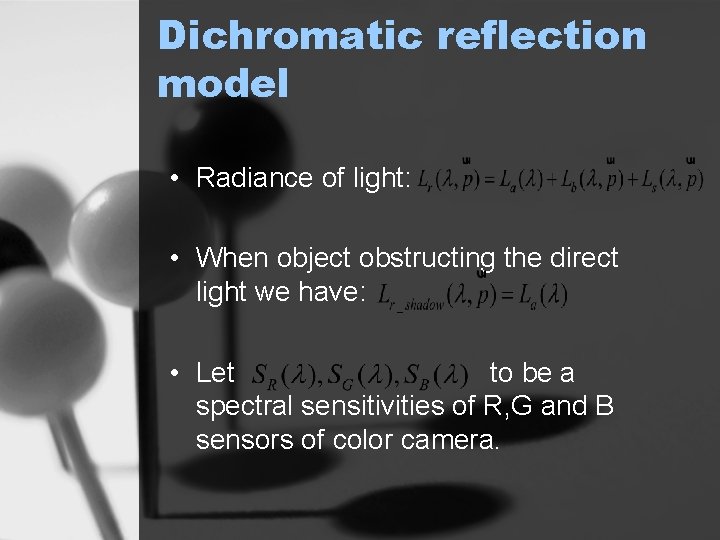
Dichromatic reflection model • Radiance of light: • When object obstructing the direct light we have: • Let to be a spectral sensitivities of R, G and B sensors of color camera.
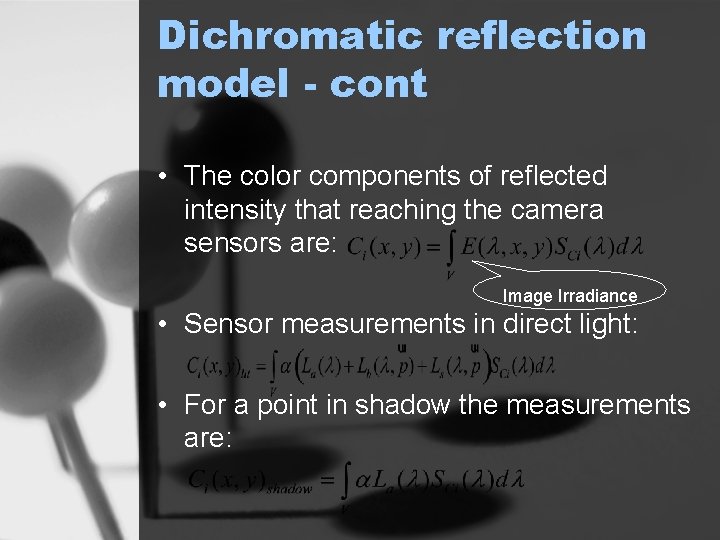
Dichromatic reflection model - cont • The color components of reflected intensity that reaching the camera sensors are: Image Irradiance • Sensor measurements in direct light: • For a point in shadow the measurements are:
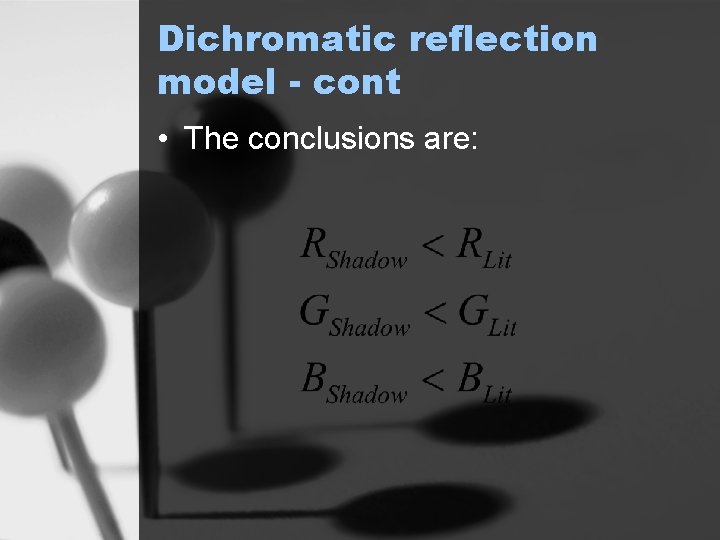
Dichromatic reflection model - cont • The conclusions are:
Color invariance • The color invariants are the same as in previous article.
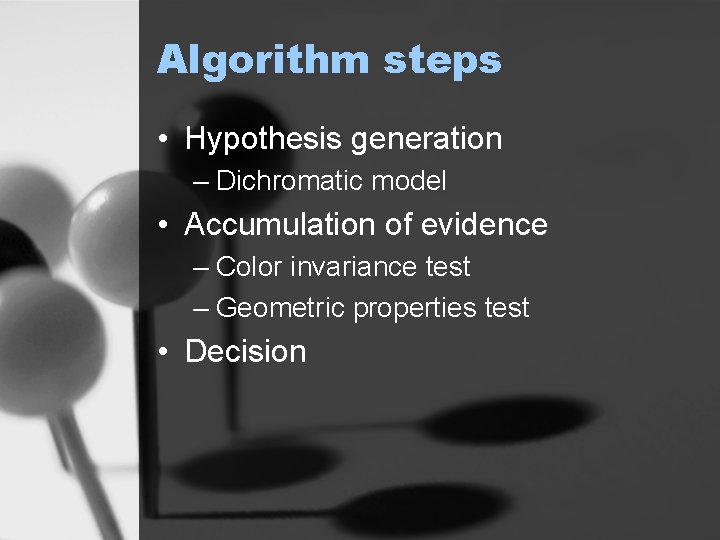
Algorithm steps • Hypothesis generation – Dichromatic model • Accumulation of evidence – Color invariance test – Geometric properties test • Decision
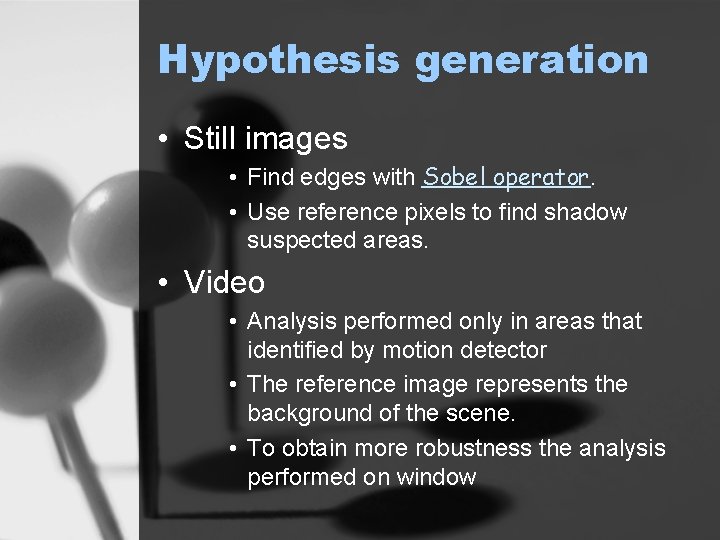
Hypothesis generation • Still images • Find edges with Sobel operator. • Use reference pixels to find shadow suspected areas. • Video • Analysis performed only in areas that identified by motion detector • The reference image represents the background of the scene. • To obtain more robustness the analysis performed on window
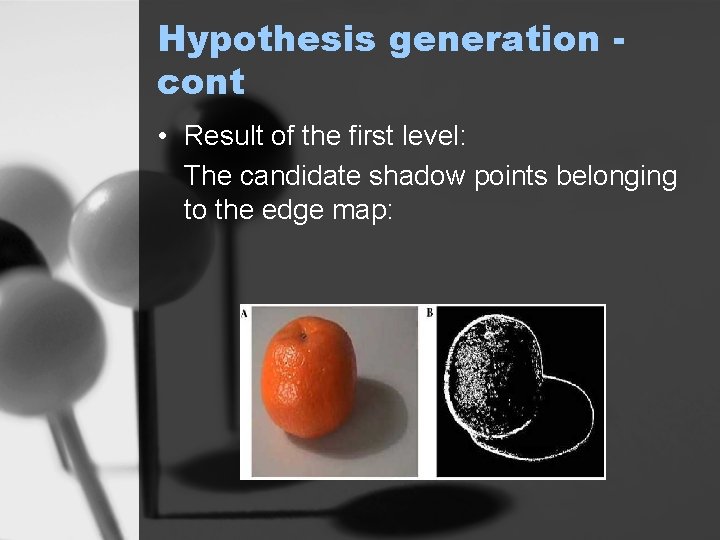
Hypothesis generation cont • Result of the first level: The candidate shadow points belonging to the edge map:
Accumulation of evidence – overview • Color invariance property used to strength or cancel the hypothesized shadow areas. • Checking the existence of shadow line and hidden line.
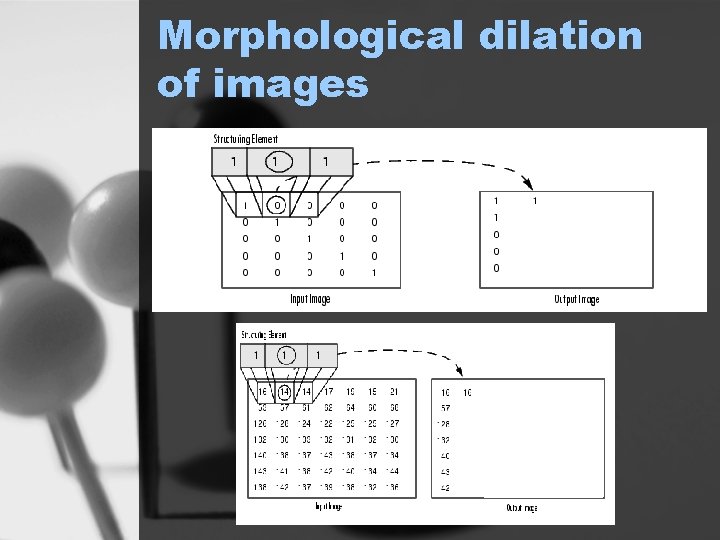
Accumulation of evidence – Still Images • Color edge detection performed in the invariant space. • Morphological dilation applied on the edge map. • Isolated pixels removed.
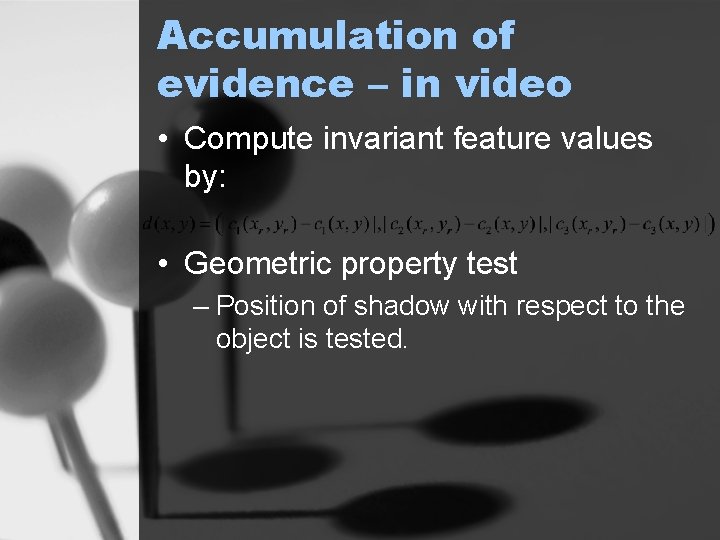
Accumulation of evidence – in video • Compute invariant feature values by: • Geometric property test – Position of shadow with respect to the object is tested.
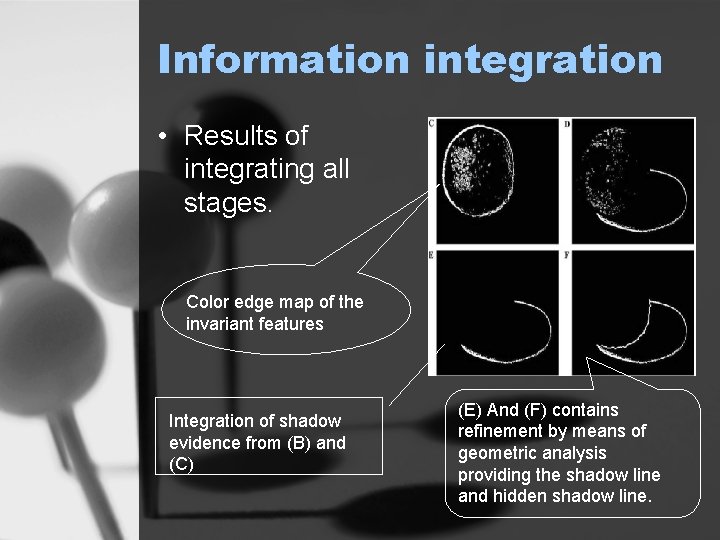
Information integration • Results of integrating all stages. Color edge map of the invariant features Integration of shadow evidence from (B) and (C) (E) And (F) contains refinement by means of geometric analysis providing the shadow line and hidden shadow line.
Results
References • Shadow identification and classification using invariant color models. Elena Salvador, Andrea Cavallaro, Touradj Eebrahimi 2001 • Cast shadow segmentation using invariant color features. Elena Salvador, Andrea Cavallaro and, Touradj Ebrahimi 2004 • http: //www. mathworks. com/access/help desk/help/toolbox/images/morph 3. html
The End…
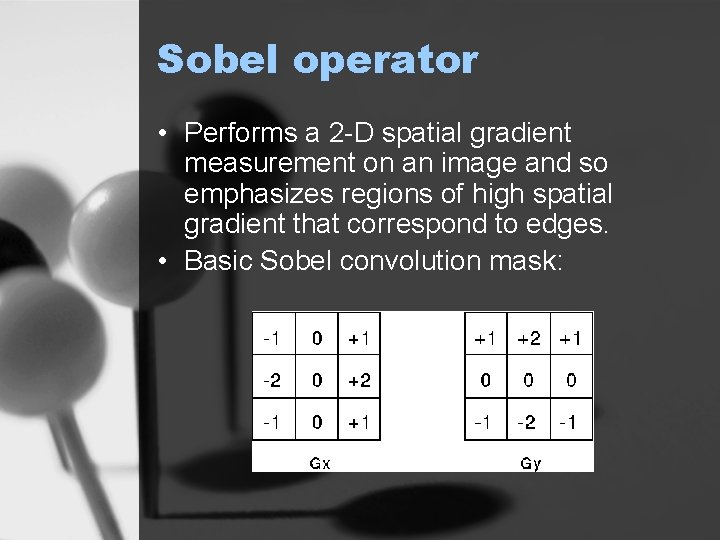
Sobel operator • Performs a 2 -D spatial gradient measurement on an image and so emphasizes regions of high spatial gradient that correspond to edges. • Basic Sobel convolution mask:
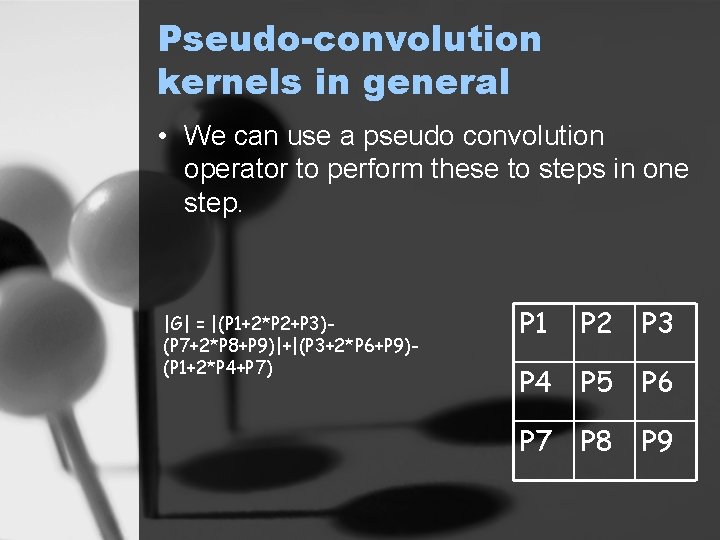
Pseudo-convolution kernels in general • We can use a pseudo convolution operator to perform these to steps in one step. |G| = |(P 1+2*P 2+P 3)(P 7+2*P 8+P 9)|+|(P 3+2*P 6+P 9)(P 1+2*P 4+P 7) P 1 P 2 P 3 P 4 P 5 P 6 P 7 P 8 P 9
Morphological dilation of images
Examples of photometric color invariants • (L 1, L 2, L 3) ( Color Based Object Recognition Theo Gevers and Arnold W. M. Smeulders 1999 )