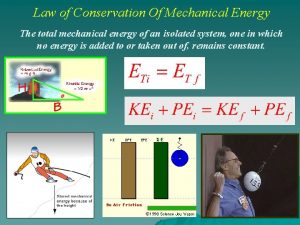
Collisions and explosions The conservation of energy is
- Slides: 42
Collisions (and explosions) The conservation of energy is a very powerful law. It is easy to use, mainly because it eliminates time and directions. But because it eliminates time and directions, it does have its limitations. In collisions, the directions of the pieces (both before and after) are important. To attack this problem, we will go back to Newton’s Second Law.
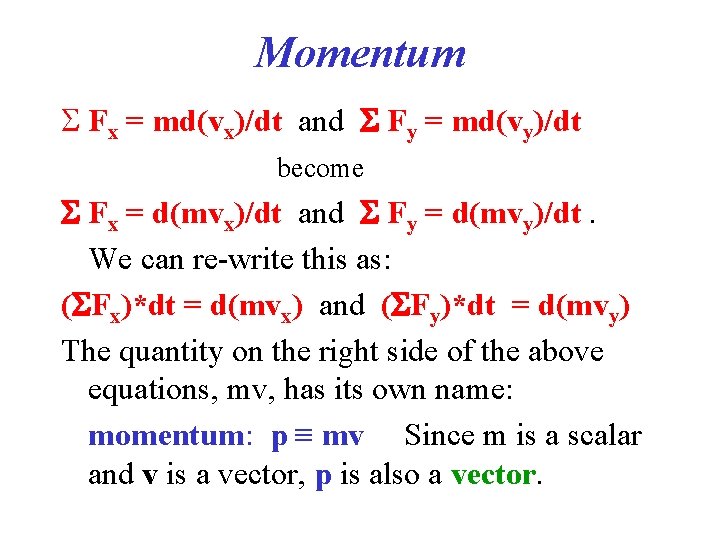
Newton’s Second Law We have worked with Newton’s Second Law in the following form: SFx = max and SFy = may , where acceleration is defined as: ax = dvx/dt and ay = dvy /dt. If mass doesn’t change with motion, which seems to be true, at least at everyday speeds, then we can put the m inside the d (or D):
Momentum S Fx = md(vx)/dt and S Fy = md(vy)/dt become S Fx = d(mvx)/dt and S Fy = d(mvy)/dt. We can re-write this as: (SFx)*dt = d(mvx) and (SFy)*dt = d(mvy) The quantity on the right side of the above equations, mv, has its own name: momentum: p ≡ mv Since m is a scalar and v is a vector, p is also a vector.
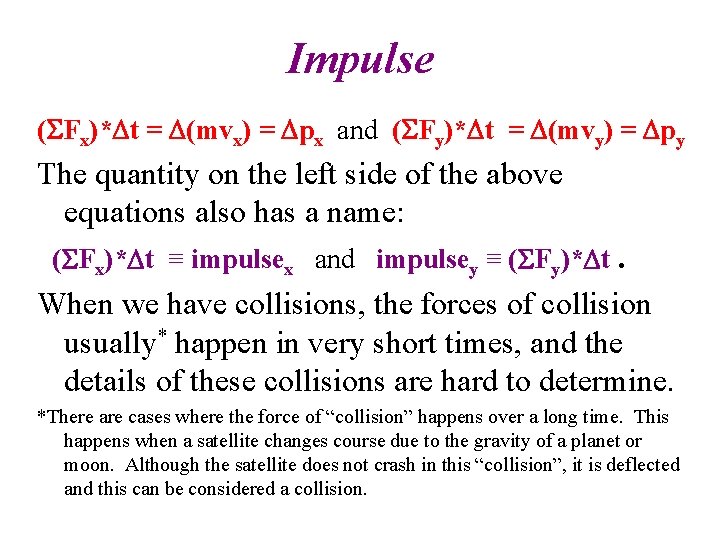
Impulse (SFx)*Dt = D(mvx) = Dpx and (SFy)*Dt = D(mvy) = Dpy The quantity on the left side of the above equations also has a name: (SFx)*Dt ≡ impulsex and impulsey ≡ (SFy)*Dt. When we have collisions, the forces of collision usually* happen in very short times, and the details of these collisions are hard to determine. *There are cases where the force of “collision” happens over a long time. This happens when a satellite changes course due to the gravity of a planet or moon. Although the satellite does not crash in this “collision”, it is deflected and this can be considered a collision.
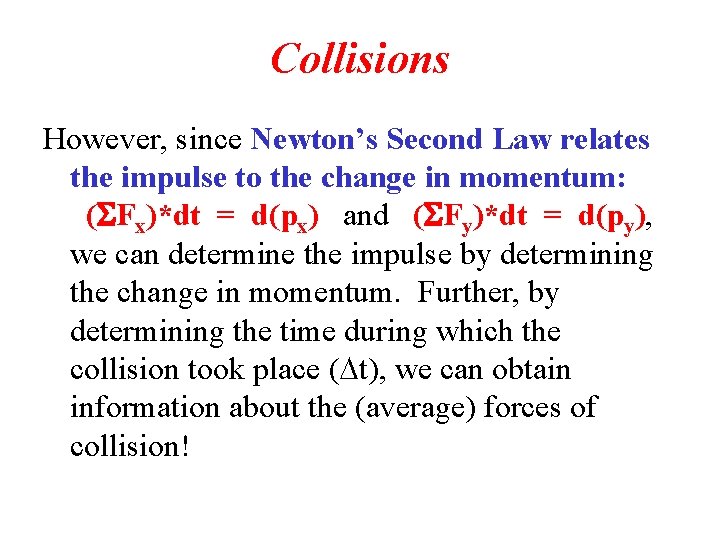
Collisions However, since Newton’s Second Law relates the impulse to the change in momentum: (SFx)*dt = d(px) and (SFy)*dt = d(py), we can determine the impulse by determining the change in momentum. Further, by determining the time during which the collision took place (Dt), we can obtain information about the (average) forces of collision!
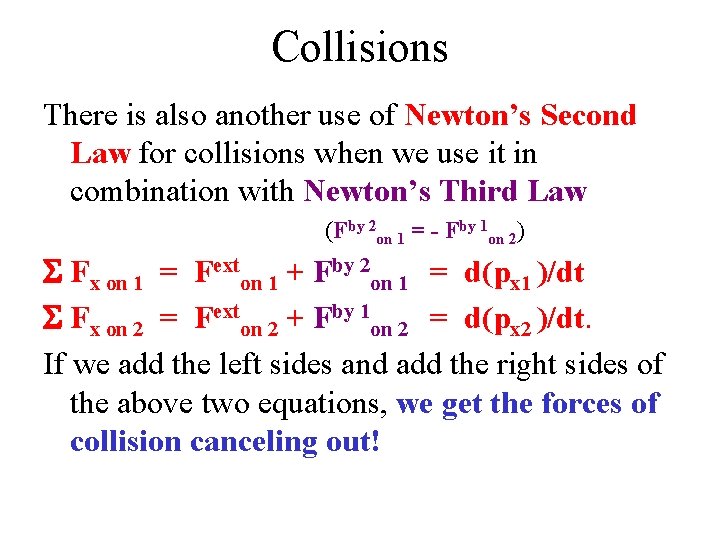
Collisions There is also another use of Newton’s Second Law for collisions when we use it in combination with Newton’s Third Law (Fby 2 on 1 = - Fby 1 on 2) S Fx on 1 = Fexton 1 + Fby 2 on 1 = d(px 1 )/dt S Fx on 2 = Fexton 2 + Fby 1 on 2 = d(px 2 )/dt. If we add the left sides and add the right sides of the above two equations, we get the forces of collision canceling out!
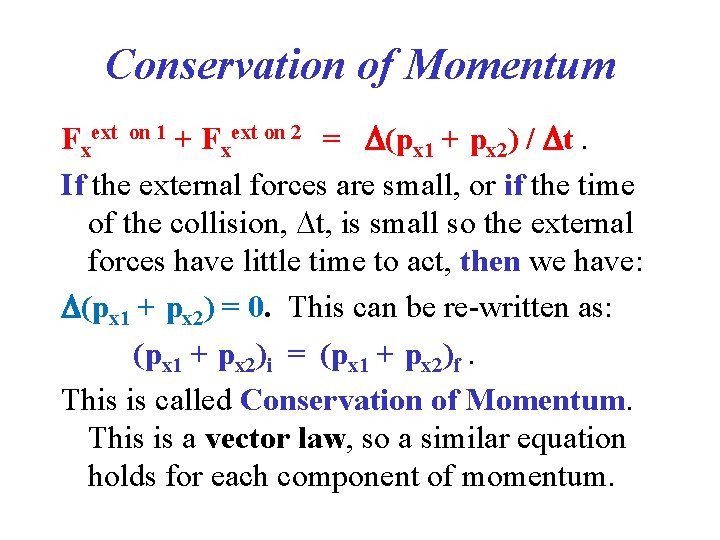
Conservation of Momentum Fxext on 1 + Fxext on 2 = D(px 1 + px 2) / Dt. If the external forces are small, or if the time of the collision, Dt, is small so the external forces have little time to act, then we have: D(px 1 + px 2) = 0. This can be re-written as: (px 1 + px 2)i = (px 1 + px 2)f. This is called Conservation of Momentum. This is a vector law, so a similar equation holds for each component of momentum.
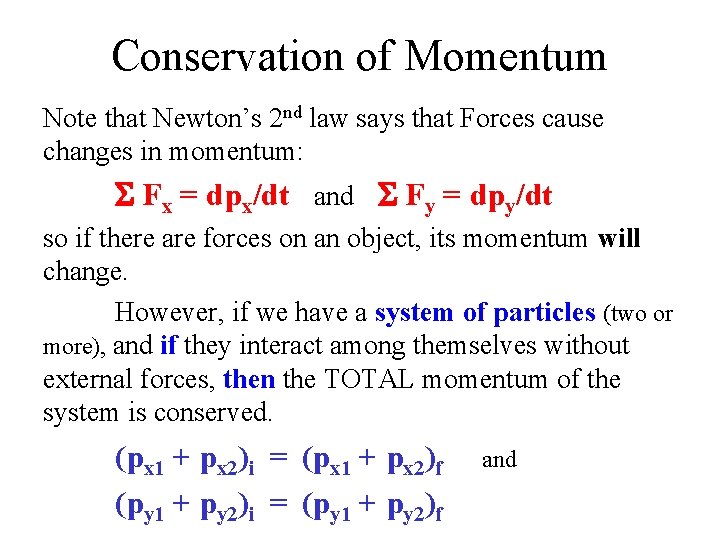
Conservation of Momentum Note that Newton’s 2 nd law says that Forces cause changes in momentum: S Fx = dpx/dt and S Fy = dpy/dt so if there are forces on an object, its momentum will change. However, if we have a system of particles (two or more), and if they interact among themselves without external forces, then the TOTAL momentum of the system is conserved. (px 1 + px 2)i = (px 1 + px 2)f (py 1 + py 2)i = (py 1 + py 2)f and
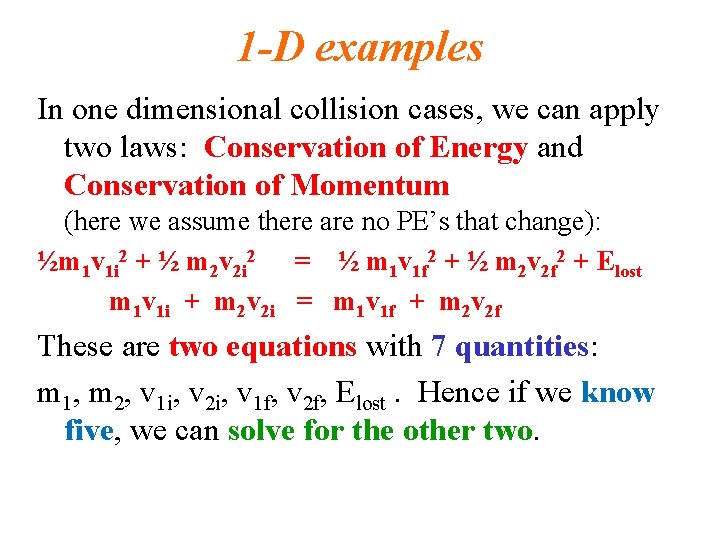
1 -D examples In one dimensional collision cases, we can apply two laws: Conservation of Energy and Conservation of Momentum (here we assume there are no PE’s that change): ½m 1 v 1 i 2 + ½ m 2 v 2 i 2 = ½ m 1 v 1 f 2 + ½ m 2 v 2 f 2 + Elost m 1 v 1 i + m 2 v 2 i = m 1 v 1 f + m 2 v 2 f These are two equations with 7 quantities: m 1, m 2, v 1 i, v 2 i, v 1 f, v 2 f, Elost. Hence if we know five, we can solve for the other two.
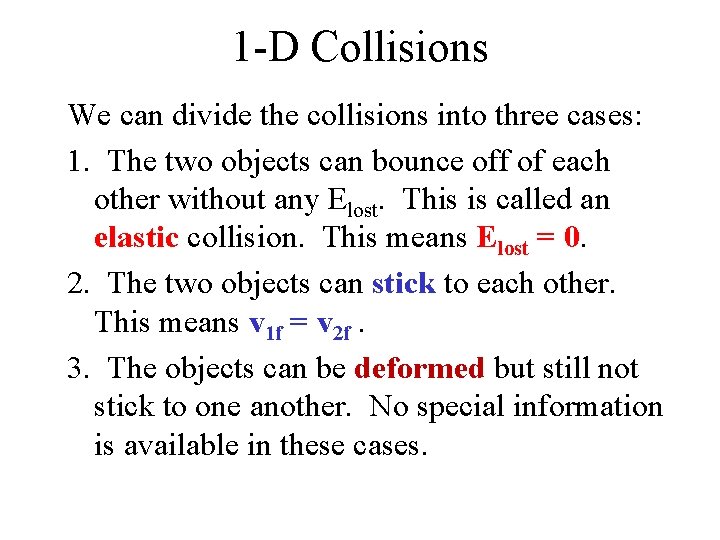
1 -D Collisions We can divide the collisions into three cases: 1. The two objects can bounce off of each other without any Elost. This is called an elastic collision. This means Elost = 0. 2. The two objects can stick to each other. This means v 1 f = v 2 f. 3. The objects can be deformed but still not stick to one another. No special information is available in these cases.
1 -D Collisions In the first two cases, we can predict the final motion (solve for v 1 f , v 2 f and Elost) if we know the initial motion (m 1, m 2, v 1 i, v 2 i). In the third case, we would have to know something besides the initial motion to solve for the final. When you think about it, this does make sense, since in the third case the results of the collision should depend on the material of the colliding objects!
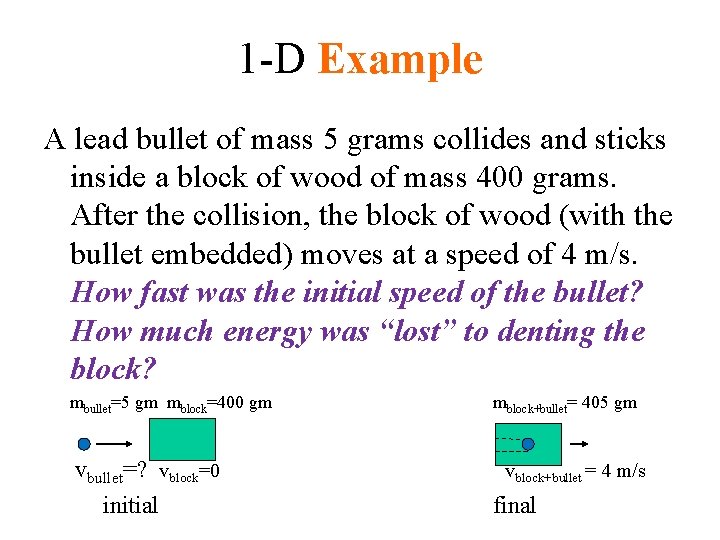
1 -D Example A lead bullet of mass 5 grams collides and sticks inside a block of wood of mass 400 grams. After the collision, the block of wood (with the bullet embedded) moves at a speed of 4 m/s. How fast was the initial speed of the bullet? How much energy was “lost” to denting the block? mbullet=5 gm mblock=400 gm vbullet=? vblock=0 initial mblock+bullet= 405 gm vblock+bullet = 4 m/s final
1 -D example, cont. This is a collision problem, so we have ½ m 1 v 1 i 2 + ½ m 2 v 2 i 2 = ½ m 1 v 1 f 2 + ½ m 2 v 2 f 2 + Elost m 1 v 1 i + m 2 v 2 i = m 1 v 1 f + m 2 v 2 f We know: m 1 = 5 grams, m 2 = 400 grams, v 2 i = 0 m/s (wood block is at rest initially), v 1 f = v 2 f = 4 m/s (since bullet becomes embedded in block). We are looking for v 1 i and Elost.
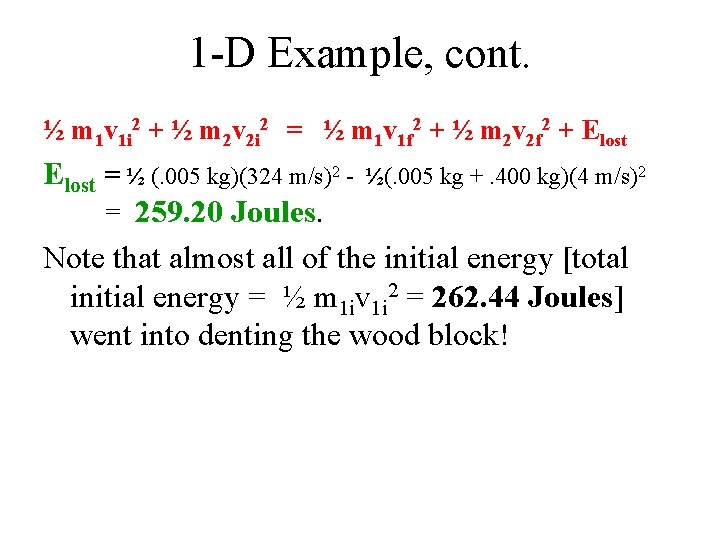
1 -D Example, cont. Using the second equation, we can solve for v 1 i: m 1 v 1 i + m 2 v 2 i = m 1 v 1 f + m 2 v 2 f Since v 2 i = 0, and v 1 f = v 2 f = 4 m/s, we have v 1 i = (5 grams + 400 grams)*(4 m/s) / 5 grams = 324 m/s Now we can use the first equation to solve for Elost :
1 -D Example, cont. ½ m 1 v 1 i 2 + ½ m 2 v 2 i 2 = ½ m 1 v 1 f 2 + ½ m 2 v 2 f 2 + Elost = ½ (. 005 kg)(324 m/s)2 - ½(. 005 kg +. 400 kg)(4 m/s)2 = 259. 20 Joules. Note that almost all of the initial energy [total initial energy = ½ m 1 iv 1 i 2 = 262. 44 Joules] went into denting the wood block!
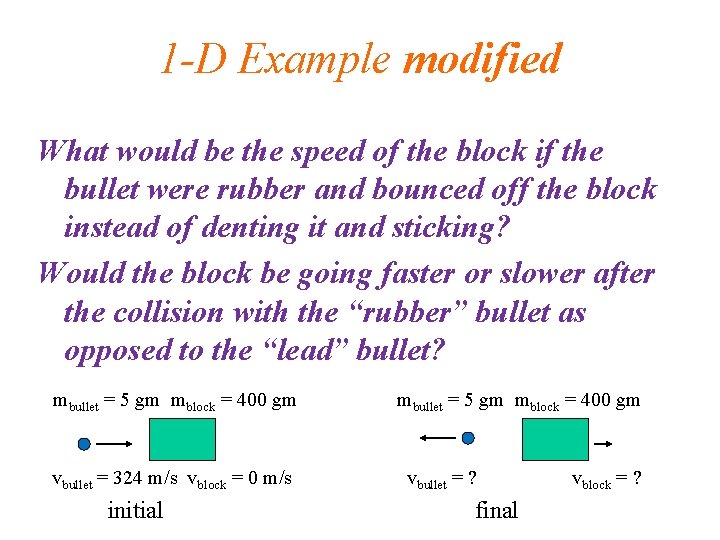
1 -D Example modified What would be the speed of the block if the bullet were rubber and bounced off the block instead of denting it and sticking? Would the block be going faster or slower after the collision with the “rubber” bullet as opposed to the “lead” bullet? mbullet = 5 gm mblock = 400 gm vbullet = 324 m/s vblock = 0 m/s initial mbullet = 5 gm mblock = 400 gm vbullet = ? final vblock = ?
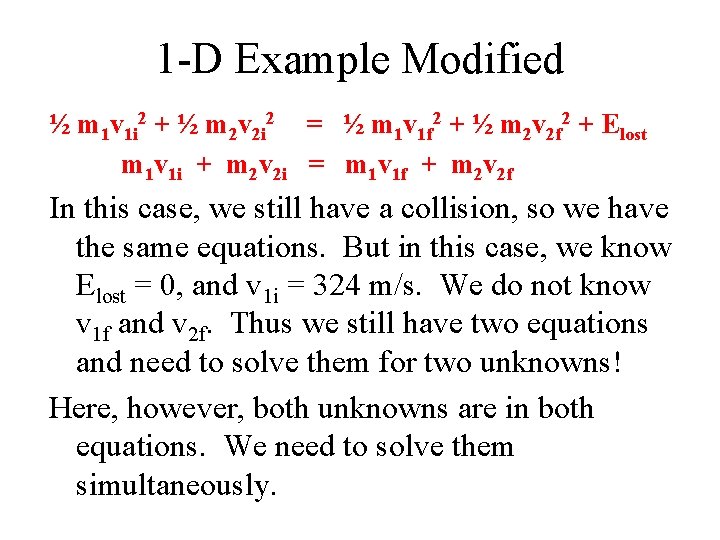
1 -D Example Modified ½ m 1 v 1 i 2 + ½ m 2 v 2 i 2 = ½ m 1 v 1 f 2 + ½ m 2 v 2 f 2 + Elost m 1 v 1 i + m 2 v 2 i = m 1 v 1 f + m 2 v 2 f In this case, we still have a collision, so we have the same equations. But in this case, we know Elost = 0, and v 1 i = 324 m/s. We do not know v 1 f and v 2 f. Thus we still have two equations and need to solve them for two unknowns! Here, however, both unknowns are in both equations. We need to solve them simultaneously.
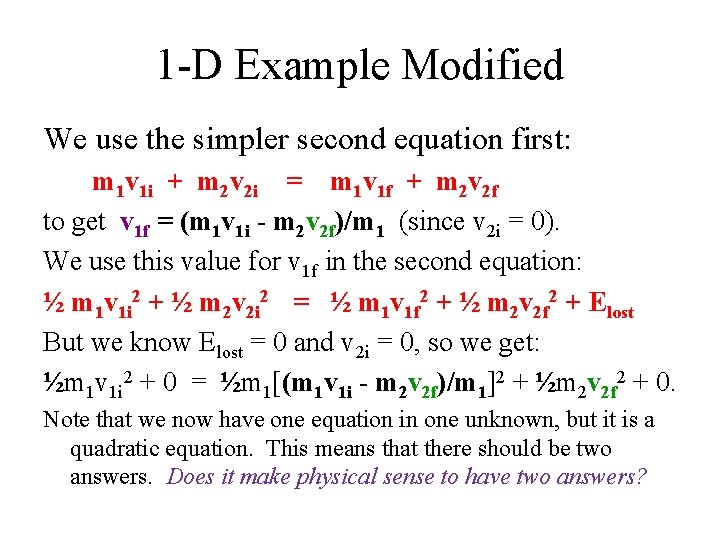
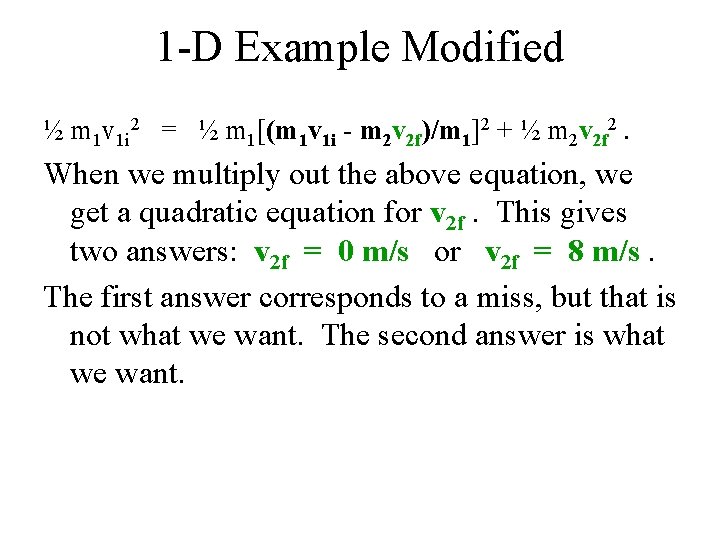
1 -D Example Modified We use the simpler second equation first: m 1 v 1 i + m 2 v 2 i = m 1 v 1 f + m 2 v 2 f to get v 1 f = (m 1 v 1 i - m 2 v 2 f)/m 1 (since v 2 i = 0). We use this value for v 1 f in the second equation: ½ m 1 v 1 i 2 + ½ m 2 v 2 i 2 = ½ m 1 v 1 f 2 + ½ m 2 v 2 f 2 + Elost But we know Elost = 0 and v 2 i = 0, so we get: ½m 1 v 1 i 2 + 0 = ½m 1[(m 1 v 1 i - m 2 v 2 f)/m 1]2 + ½m 2 v 2 f 2 + 0. Note that we now have one equation in one unknown, but it is a quadratic equation. This means that there should be two answers. Does it make physical sense to have two answers?
1 -D Example Modified ½ m 1 v 1 i 2 = ½ m 1[(m 1 v 1 i - m 2 v 2 f)/m 1]2 + ½ m 2 v 2 f 2. When we multiply out the above equation, we get a quadratic equation for v 2 f. This gives two answers: v 2 f = 0 m/s or v 2 f = 8 m/s. The first answer corresponds to a miss, but that is not what we want. The second answer is what we want.
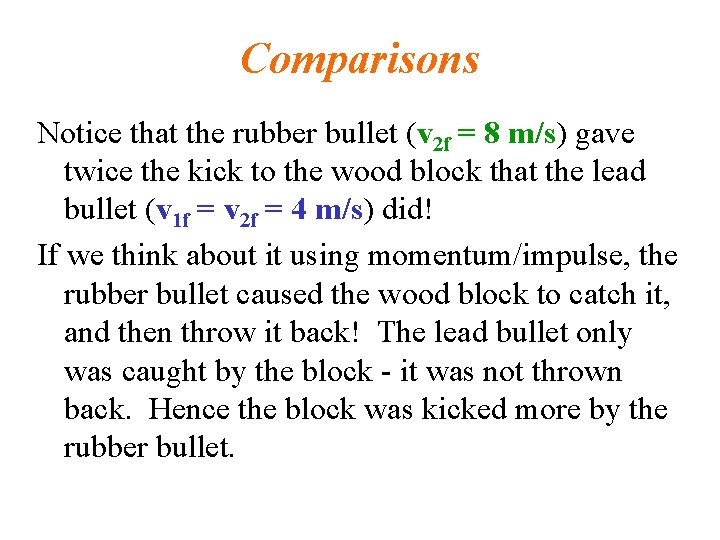
Comparisons Notice that the rubber bullet (v 2 f = 8 m/s) gave twice the kick to the wood block that the lead bullet (v 1 f = v 2 f = 4 m/s) did! If we think about it using momentum/impulse, the rubber bullet caused the wood block to catch it, and then throw it back! The lead bullet only was caught by the block - it was not thrown back. Hence the block was kicked more by the rubber bullet.
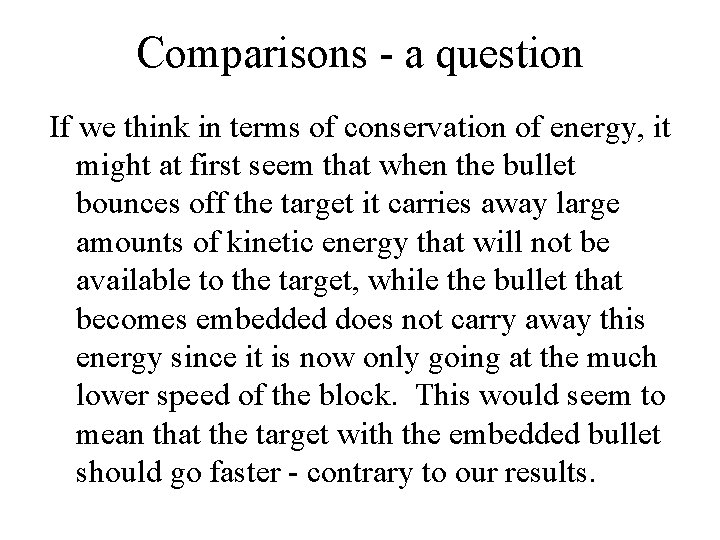
Comparisons - a question If we think in terms of conservation of energy, it might at first seem that when the bullet bounces off the target it carries away large amounts of kinetic energy that will not be available to the target, while the bullet that becomes embedded does not carry away this energy since it is now only going at the much lower speed of the block. This would seem to mean that the target with the embedded bullet should go faster - contrary to our results.
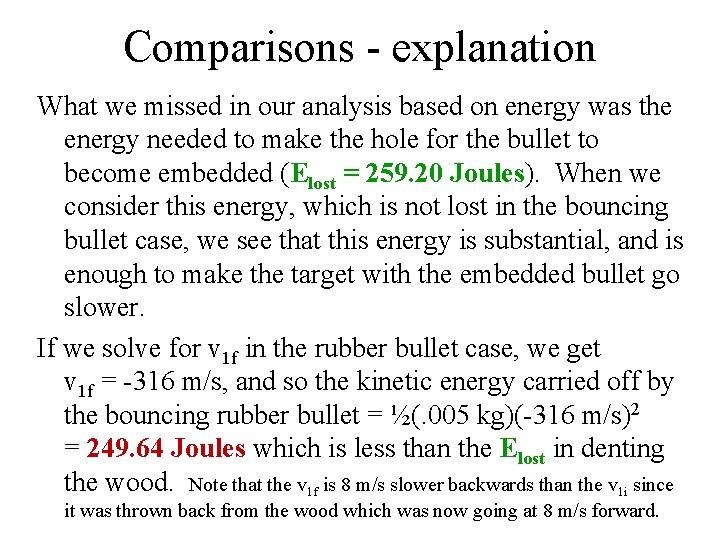
Comparisons - explanation What we missed in our analysis based on energy was the energy needed to make the hole for the bullet to become embedded (Elost = 259. 20 Joules). When we consider this energy, which is not lost in the bouncing bullet case, we see that this energy is substantial, and is enough to make the target with the embedded bullet go slower. If we solve for v 1 f in the rubber bullet case, we get v 1 f = -316 m/s, and so the kinetic energy carried off by the bouncing rubber bullet = ½(. 005 kg)(-316 m/s)2 = 249. 64 Joules which is less than the Elost in denting the wood. Note that the v 1 f is 8 m/s slower backwards than the v 1 i since it was thrown back from the wood which was now going at 8 m/s forward.
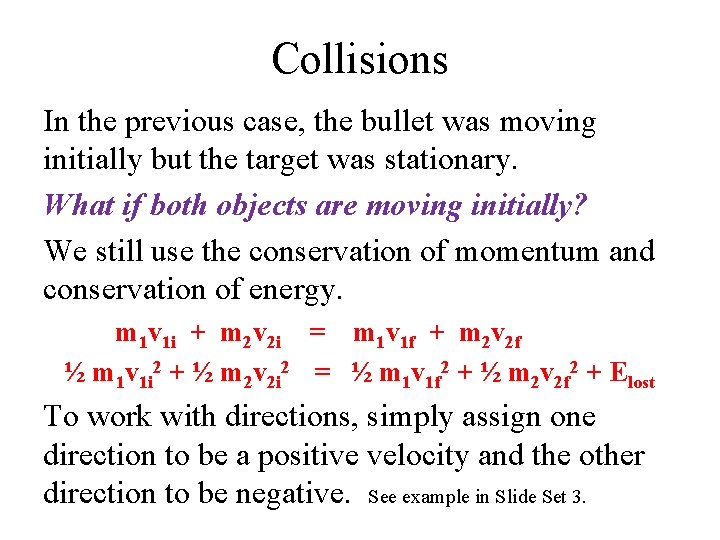
Collisions In the previous case, the bullet was moving initially but the target was stationary. What if both objects are moving initially? We still use the conservation of momentum and conservation of energy. m 1 v 1 i + m 2 v 2 i = m 1 v 1 f + m 2 v 2 f ½ m 1 v 1 i 2 + ½ m 2 v 2 i 2 = ½ m 1 v 1 f 2 + ½ m 2 v 2 f 2 + Elost To work with directions, simply assign one direction to be a positive velocity and the other direction to be negative. See example in Slide Set 3.
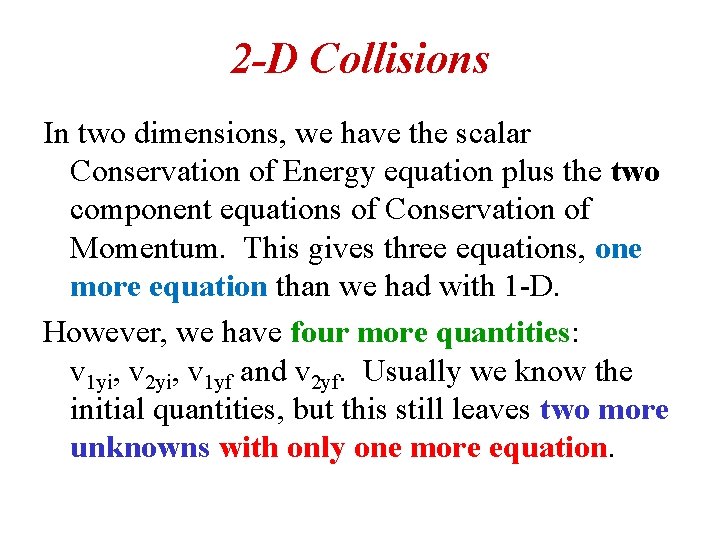
2 -D Collisions In two dimensions, we have the scalar Conservation of Energy equation plus the two component equations of Conservation of Momentum. This gives three equations, one more equation than we had with 1 -D. However, we have four more quantities: v 1 yi, v 2 yi, v 1 yf and v 2 yf. Usually we know the initial quantities, but this still leaves two more unknowns with only one more equation.
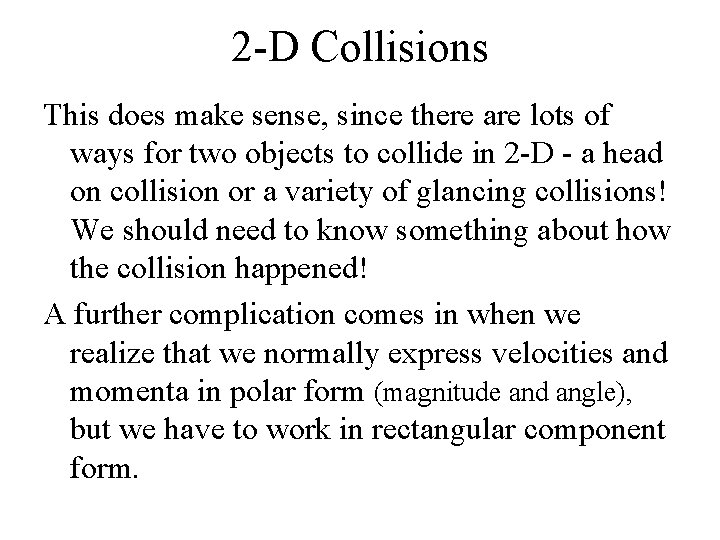
2 -D Collisions This does make sense, since there are lots of ways for two objects to collide in 2 -D - a head on collision or a variety of glancing collisions! We should need to know something about how the collision happened! A further complication comes in when we realize that we normally express velocities and momenta in polar form (magnitude and angle), but we have to work in rectangular component form.
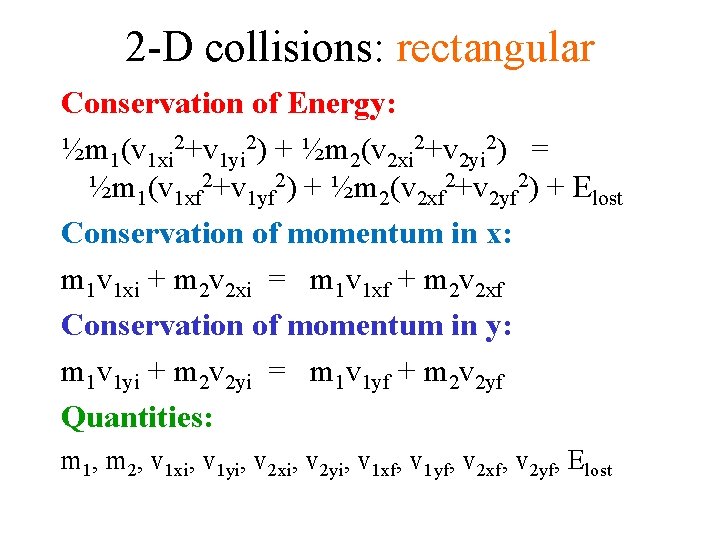
2 -D collisions: rectangular Conservation of Energy: ½m 1(v 1 xi 2+v 1 yi 2) + ½m 2(v 2 xi 2+v 2 yi 2) = ½m 1(v 1 xf 2+v 1 yf 2) + ½m 2(v 2 xf 2+v 2 yf 2) + Elost Conservation of momentum in x: m 1 v 1 xi + m 2 v 2 xi = m 1 v 1 xf + m 2 v 2 xf Conservation of momentum in y: m 1 v 1 yi + m 2 v 2 yi = m 1 v 1 yf + m 2 v 2 yf Quantities: m 1, m 2, v 1 xi, v 1 yi, v 2 xi, v 2 yi, v 1 xf, v 1 yf, v 2 xf, v 2 yf, Elost
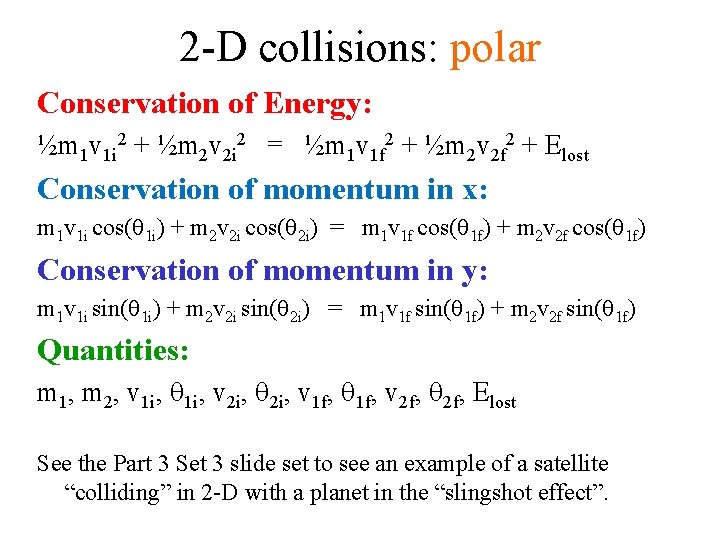
2 -D collisions: polar Conservation of Energy: ½m 1 v 1 i 2 + ½m 2 v 2 i 2 = ½m 1 v 1 f 2 + ½m 2 v 2 f 2 + Elost Conservation of momentum in x: m 1 v 1 i cos(q 1 i) + m 2 v 2 i cos(q 2 i) = m 1 v 1 f cos(q 1 f) + m 2 v 2 f cos(q 1 f) Conservation of momentum in y: m 1 v 1 i sin(q 1 i) + m 2 v 2 i sin(q 2 i) = m 1 v 1 f sin(q 1 f) + m 2 v 2 f sin(q 1 f) Quantities: m 1, m 2, v 1 i, q 1 i, v 2 i, q 2 i, v 1 f, q 1 f, v 2 f, q 2 f, Elost See the Part 3 Set 3 slide set to see an example of a satellite “colliding” in 2 -D with a planet in the “slingshot effect”.
Explosions can be viewed as collisions run backwards! Instead of Elost , we will need Esupplied by the explosion. If you shoot a gun, there is a kick. If you hit a ball, there is a “kick” - if you swing and miss, you are out of balance since you expected a “kick” that didn’t come! From Conservation of Momentum, we can see the reason for the “kick”. See the next slide.
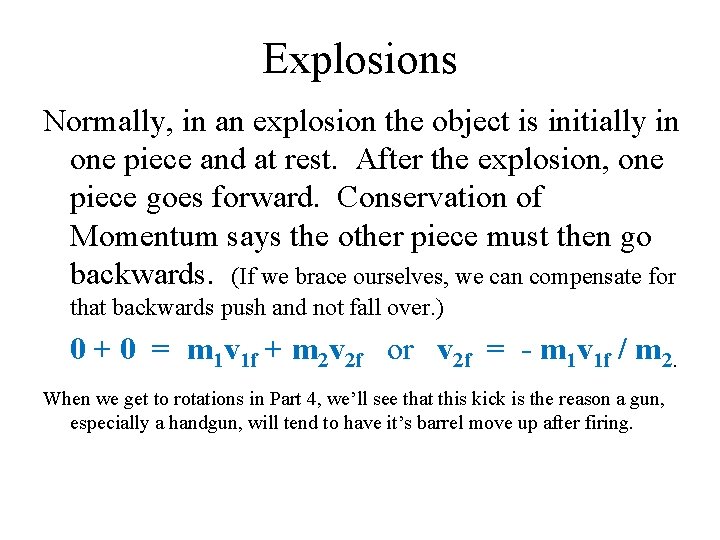
Explosions Normally, in an explosion the object is initially in one piece and at rest. After the explosion, one piece goes forward. Conservation of Momentum says the other piece must then go backwards. (If we brace ourselves, we can compensate for that backwards push and not fall over. ) 0 + 0 = m 1 v 1 f + m 2 v 2 f or v 2 f = - m 1 v 1 f / m 2. When we get to rotations in Part 4, we’ll see that this kick is the reason a gun, especially a handgun, will tend to have it’s barrel move up after firing.
Swimming in Space? If you are an astronaut on a space walk and your safety line is cut, can you swim back to your base?
Swimming in Space? If you are an astronaut and your safety line is cut, can you swim back to your base? No, since by Newton’s 3 rd law you can’t push yourself, and there is nothing in space to push off of! What can you do? Throw something (like a wrench)? Which way would you throw it? Would it be better to throw a heavier object slower or a lighter object faster? [See the Part 3 Set 3 slide set to see an example. ]
Explosions If you lose your paddle while hunting in a boat, could you use the kick from firing a shotgun to propel you back to shore? If you had a machine gun, would that work? If you had a water pump, could you pump a continuous stream of water out the back to propel you forward?
Rockets A special case of explosions is when the explosions are controlled and continuous: a rocket and a jet are examples. By throwing the exhaust gases out the back, the engine pushes the body of the plane or rocket forward - by conservation of momentum. But since this is a continuous process (rather than a series of discrete shots), we need the calculus to derive a nice formula.
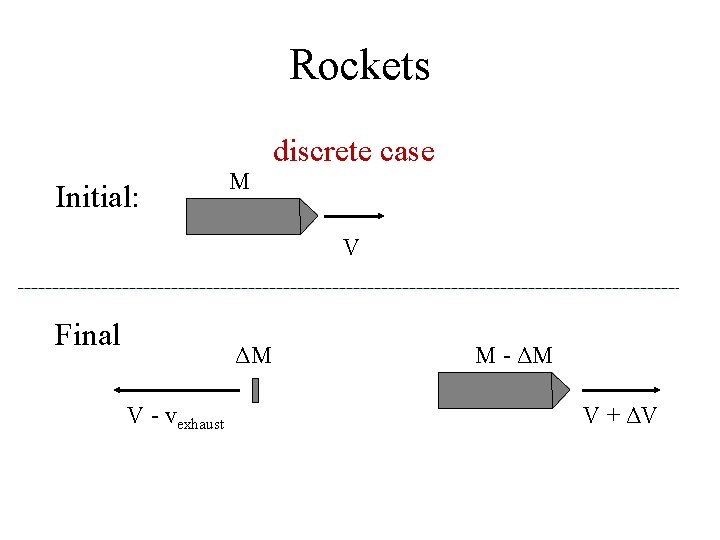
Rockets - setup of problem Let’s start with a discrete explosion, and then proceed to the limiting case to get the continuous case. Let: M = mass of rocket before the explosion; V = velocity of rocket before; DM = mass of fuel used in the explosion; vexh = velocity of fuel relative to the rocket; DV = increase in speed of rocket after explosion.
Rockets Initial: M discrete case V Final ΔM V - vexhaust M - ΔM V + ΔV
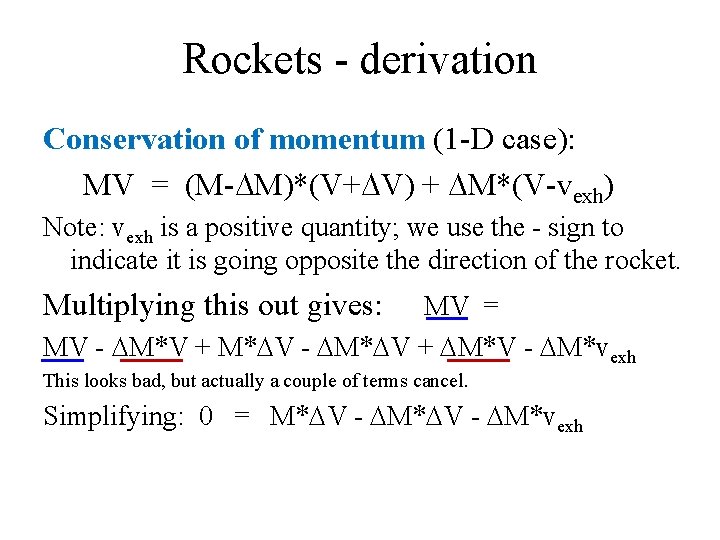
Rockets - derivation Conservation of momentum (1 -D case): MV = (M-DM)*(V+DV) + DM*(V-vexh) Note: vexh is a positive quantity; we use the - sign to indicate it is going opposite the direction of the rocket. Multiplying this out gives: MV = MV - DM*V + M*DV - DM*DV + DM*V - DM*vexh This looks bad, but actually a couple of terms cancel. Simplifying: 0 = M*DV - DM*vexh
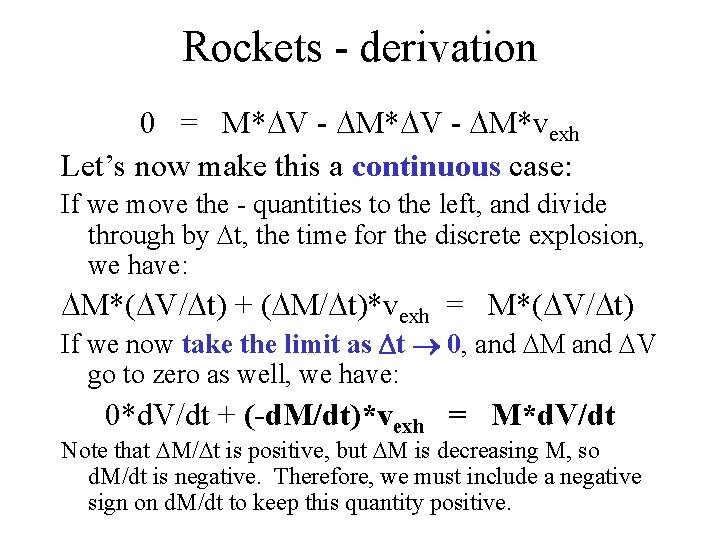
Rockets - derivation 0 = M*DV - DM*vexh Let’s now make this a continuous case: If we move the - quantities to the left, and divide through by Dt, the time for the discrete explosion, we have: DM*(DV/Dt) + (DM/Dt)*vexh = M*(DV/Dt) If we now take the limit as Dt 0, and DM and DV go to zero as well, we have: 0*d. V/dt + (-d. M/dt)*vexh = M*d. V/dt Note that DM/Dt is positive, but DM is decreasing M, so d. M/dt is negative. Therefore, we must include a negative sign on d. M/dt to keep this quantity positive.
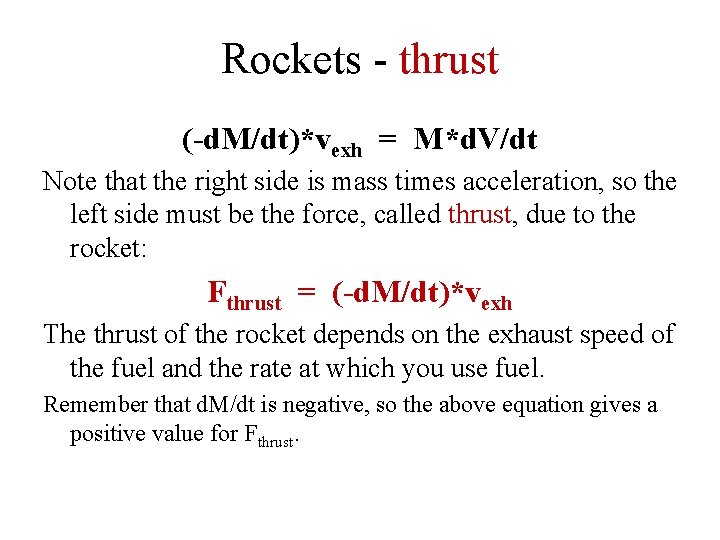
Rockets - thrust (-d. M/dt)*vexh = M*d. V/dt Note that the right side is mass times acceleration, so the left side must be the force, called thrust, due to the rocket: Fthrust = (-d. M/dt)*vexh The thrust of the rocket depends on the exhaust speed of the fuel and the rate at which you use fuel. Remember that d. M/dt is negative, so the above equation gives a positive value for Fthrust.
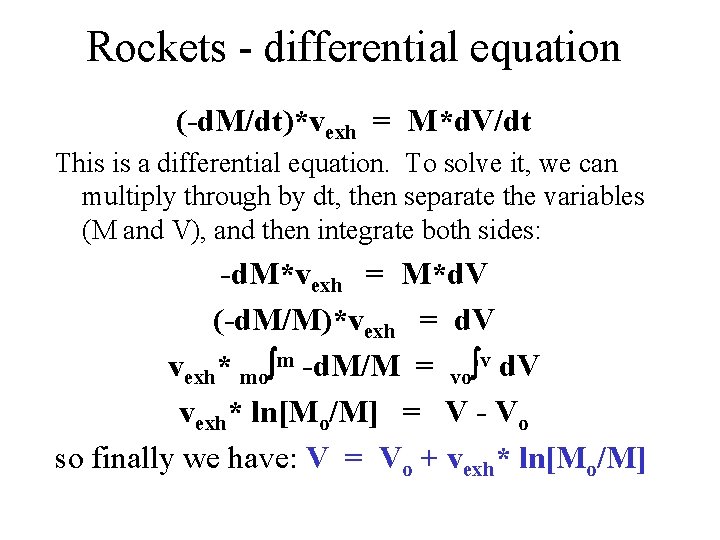
Rockets - differential equation (-d. M/dt)*vexh = M*d. V/dt This is a differential equation. To solve it, we can multiply through by dt, then separate the variables (M and V), and then integrate both sides: -d. M*vexh = M*d. V (-d. M/M)*vexh = d. V vexh* mo m -d. M/M = vo v d. V vexh* ln[Mo/M] = V - Vo so finally we have: V = Vo + vexh* ln[Mo/M]
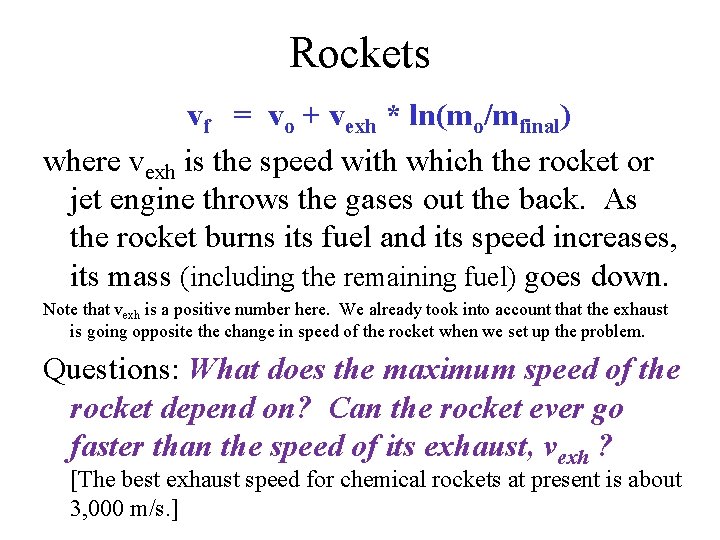
Rockets vf = vo + vexh * ln(mo/mfinal) where vexh is the speed with which the rocket or jet engine throws the gases out the back. As the rocket burns its fuel and its speed increases, its mass (including the remaining fuel) goes down. Note that vexh is a positive number here. We already took into account that the exhaust is going opposite the change in speed of the rocket when we set up the problem. Questions: What does the maximum speed of the rocket depend on? Can the rocket ever go faster than the speed of its exhaust, vexh ? [The best exhaust speed for chemical rockets at present is about 3, 000 m/s. ]
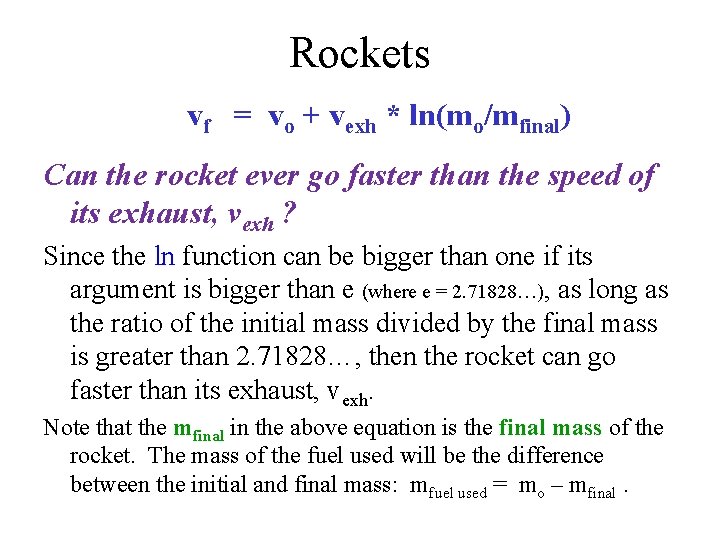
Rockets vf = vo + vexh * ln(mo/mfinal) Can the rocket ever go faster than the speed of its exhaust, vexh ? Since the ln function can be bigger than one if its argument is bigger than e (where e = 2. 71828…), as long as the ratio of the initial mass divided by the final mass is greater than 2. 71828…, then the rocket can go faster than its exhaust, vexh. Note that the mfinal in the above equation is the final mass of the rocket. The mass of the fuel used will be the difference between the initial and final mass: mfuel used = mo – mfinal.
Rockets The Trolley-Sled computer homework program and the Moonlanding computer homework program are examples that show the result of using rockets to cause changes in motion.