
Linear momentum and Collisions Chapter 9 I Linear

- Slides: 100
Linear momentum and Collisions Chapter 9
I. Linear Momentum and its Conservation II. Impulse and Momentum III. Collisions in One Dimension IV. Collisions in Two Dimensions V. The Center of Mass VI. Motion of a System of Particles VII. Deformable Systems VIII. Rocket Propulsion
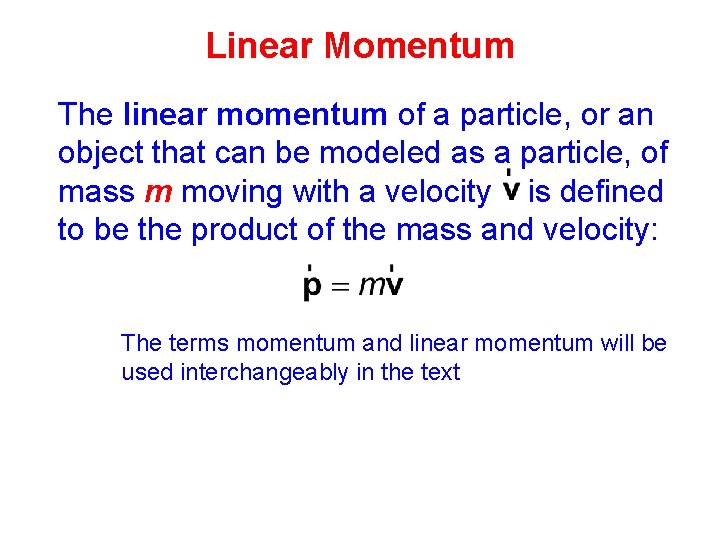
Linear Momentum The linear momentum of a particle, or an object that can be modeled as a particle, of mass m moving with a velocity is defined to be the product of the mass and velocity: The terms momentum and linear momentum will be used interchangeably in the text
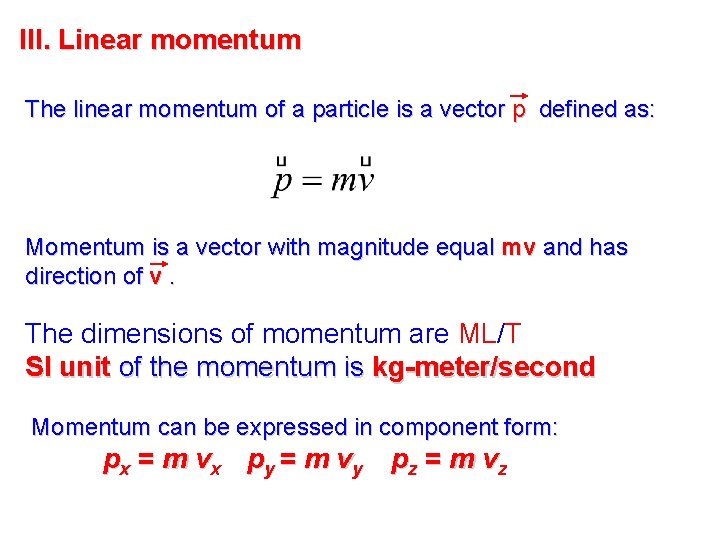
III. Linear momentum The linear momentum of a particle is a vector p defined as: Momentum is a vector with magnitude equal mv and has direction of v. The dimensions of momentum are ML/T SI unit of the momentum is kg-meter/second Momentum can be expressed in component form: px = m vx py = m vy pz = m vz
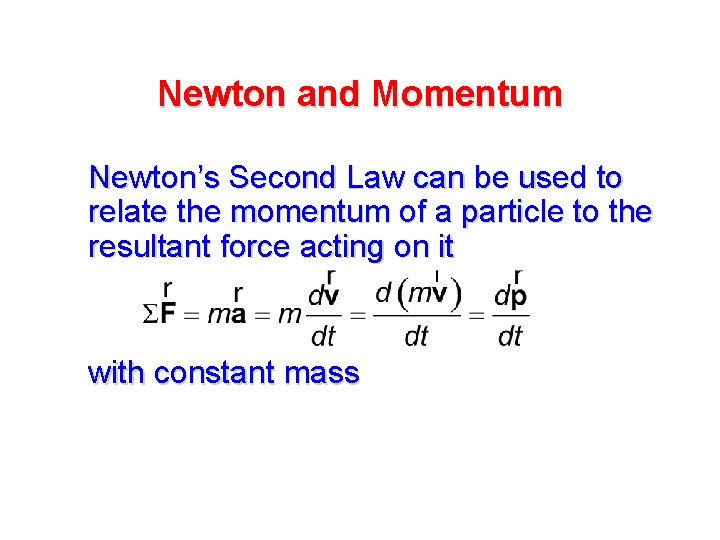
Newton and Momentum Newton’s Second Law can be used to relate the momentum of a particle to the resultant force acting on it with constant mass
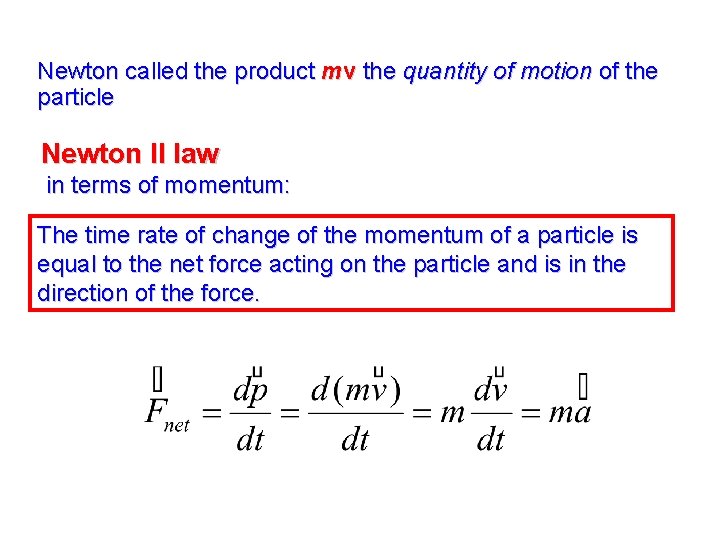
Newton called the product mv the quantity of motion of the particle Newton II law in terms of momentum: The time rate of change of the momentum of a particle is equal to the net force acting on the particle and is in the direction of the force.
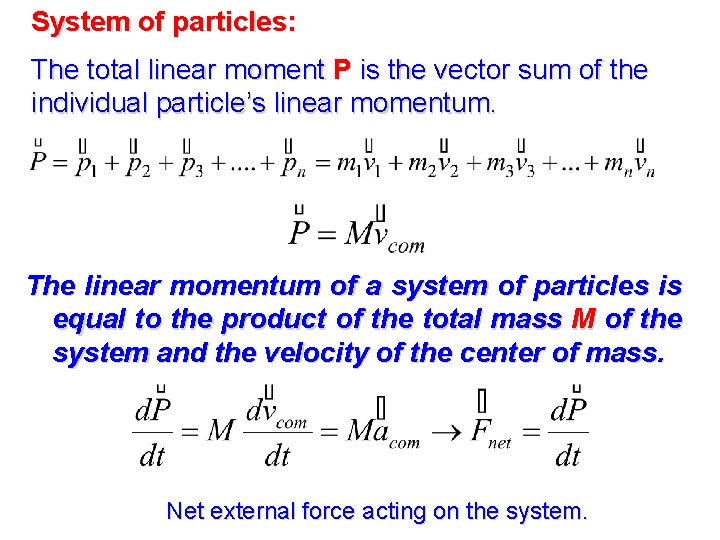
System of particles: The total linear moment P is the vector sum of the individual particle’s linear momentum. The linear momentum of a system of particles is equal to the product of the total mass M of the system and the velocity of the center of mass. Net external force acting on the system.
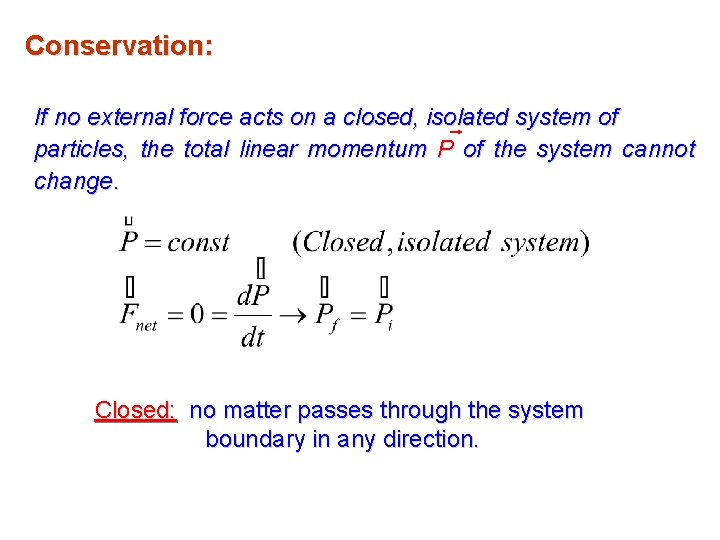
Conservation: If no external force acts on a closed, isolated system of particles, the total linear momentum P of the system cannot change. Closed: no matter passes through the system boundary in any direction.
Conservation of Linear Momentum If no net external force acts on the system of particles the total linear momentum P of the system cannot change. Each component of the linear momentum is conserved separately if the corresponding component of the net external force is zero. If the component of the net external force on a closed system is zero along an axis component of the linear momentum along that axis cannot change. The momentum is constant if no external forces act on a closed particle system. Internal forces can change the linear momentum of portions of the system, but they cannot change the total linear momentum of the entire system.
Conservation of Linear Momentum • Whenever two or more particles in an isolated system interact, the total momentum of the system remains constant – The momentum of the system is conserved, not necessarily the momentum of an individual particle – This also tells us that the total momentum of an isolated system equals its initial momentum
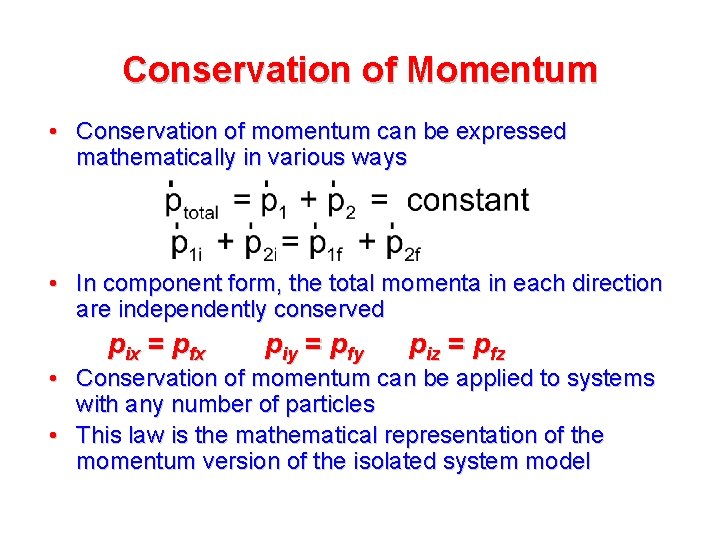
Conservation of Momentum • Conservation of momentum can be expressed mathematically in various ways • In component form, the total momenta in each direction are independently conserved pix = pfx piy = pfy piz = pfz • Conservation of momentum can be applied to systems with any number of particles • This law is the mathematical representation of the momentum version of the isolated system model
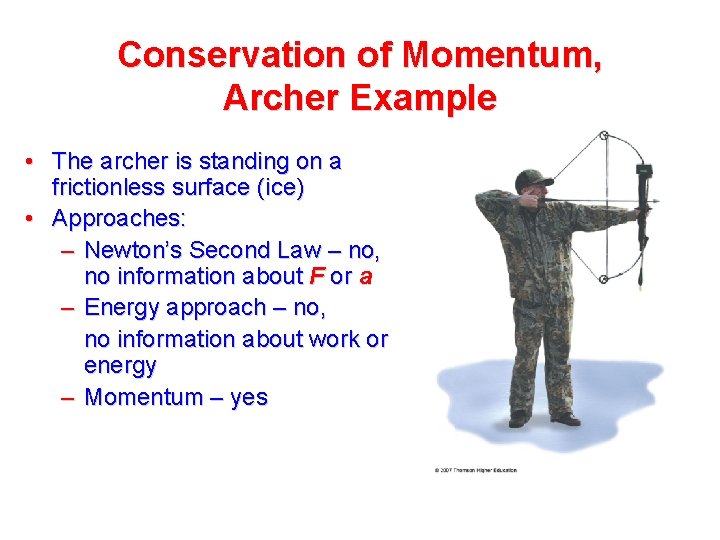
Conservation of Momentum, Archer Example • The archer is standing on a frictionless surface (ice) • Approaches: – Newton’s Second Law – no, no information about F or a – Energy approach – no, no information about work or energy – Momentum – yes
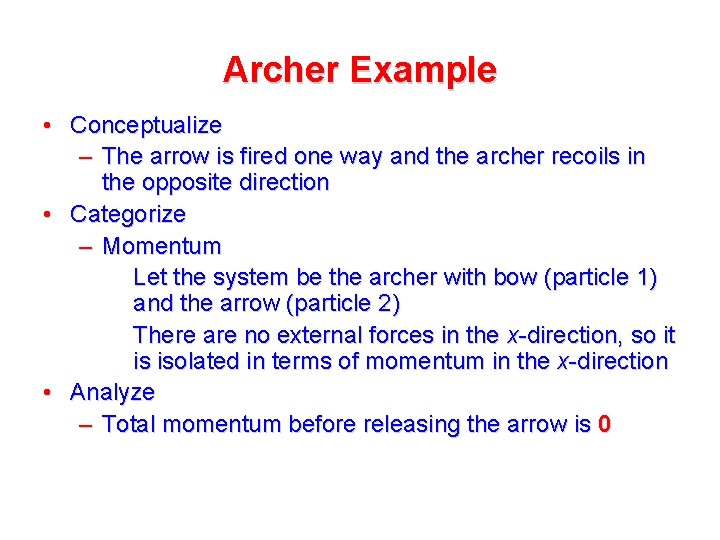
Archer Example • Conceptualize – The arrow is fired one way and the archer recoils in the opposite direction • Categorize – Momentum Let the system be the archer with bow (particle 1) and the arrow (particle 2) There are no external forces in the x-direction, so it is isolated in terms of momentum in the x-direction • Analyze – Total momentum before releasing the arrow is 0
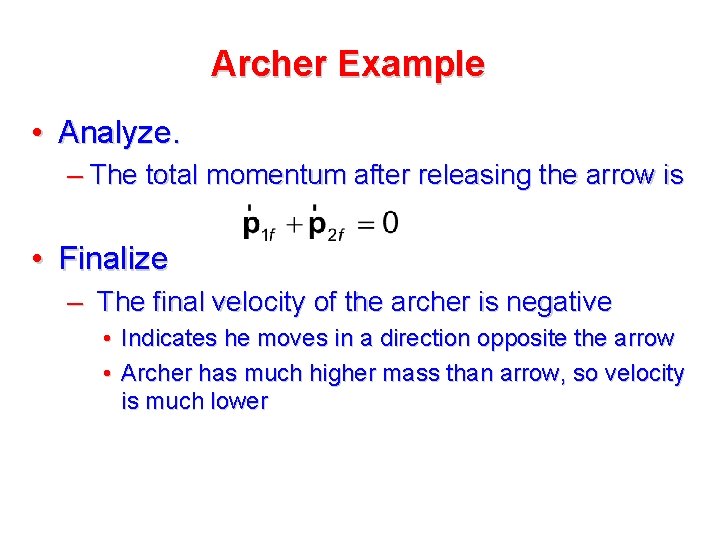
Archer Example • Analyze. – The total momentum after releasing the arrow is • Finalize – The final velocity of the archer is negative • Indicates he moves in a direction opposite the arrow • Archer has much higher mass than arrow, so velocity is much lower
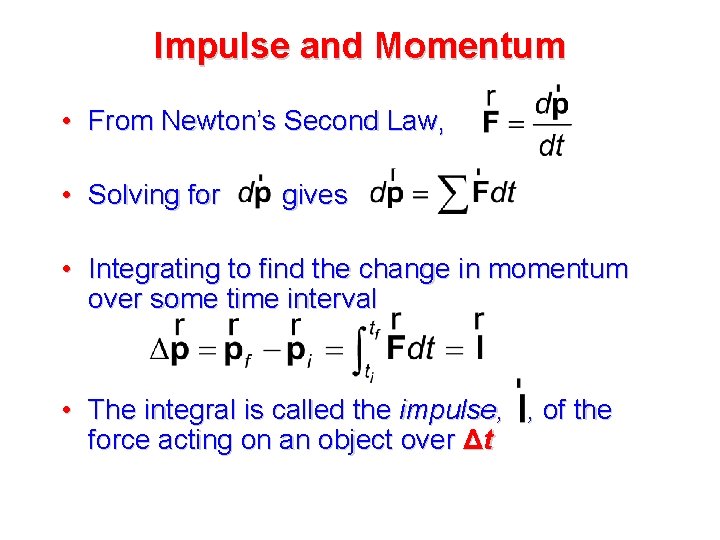
Impulse and Momentum • From Newton’s Second Law, • Solving for gives • Integrating to find the change in momentum over some time interval • The integral is called the impulse, , of the force acting on an object over Δt
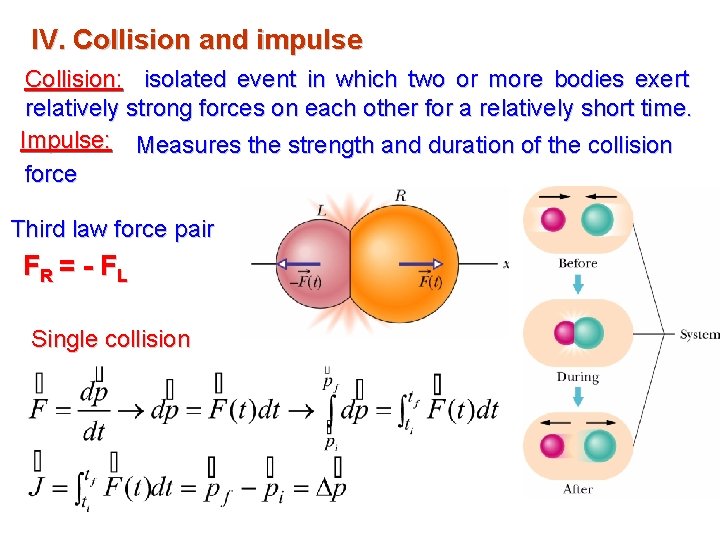
IV. Collision and impulse Collision: isolated event in which two or more bodies exert relatively strong forces on each other for a relatively short time. Impulse: Measures the strength and duration of the collision force Third law force pair FR = - FL Single collision
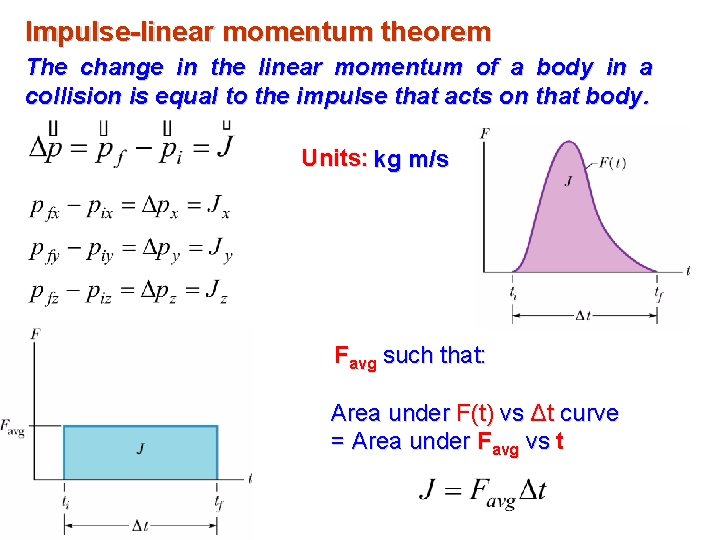
Impulse-linear momentum theorem The change in the linear momentum of a body in a collision is equal to the impulse that acts on that body. Units: kg m/s Favg such that: Area under F(t) vs Δt curve = Area under Favg vs t
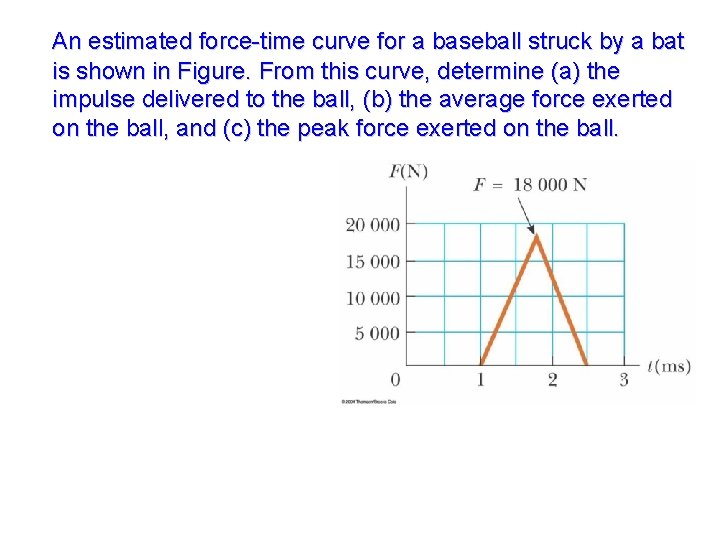
An estimated force-time curve for a baseball struck by a bat is shown in Figure. From this curve, determine (a) the impulse delivered to the ball, (b) the average force exerted on the ball, and (c) the peak force exerted on the ball.
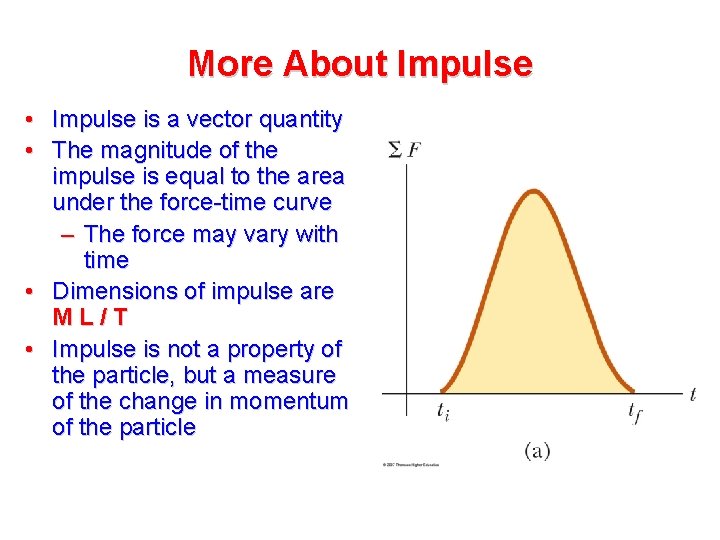
More About Impulse • Impulse is a vector quantity • The magnitude of the impulse is equal to the area under the force-time curve – The force may vary with time • Dimensions of impulse are M L / T • Impulse is not a property of the particle, but a measure of the change in momentum of the particle
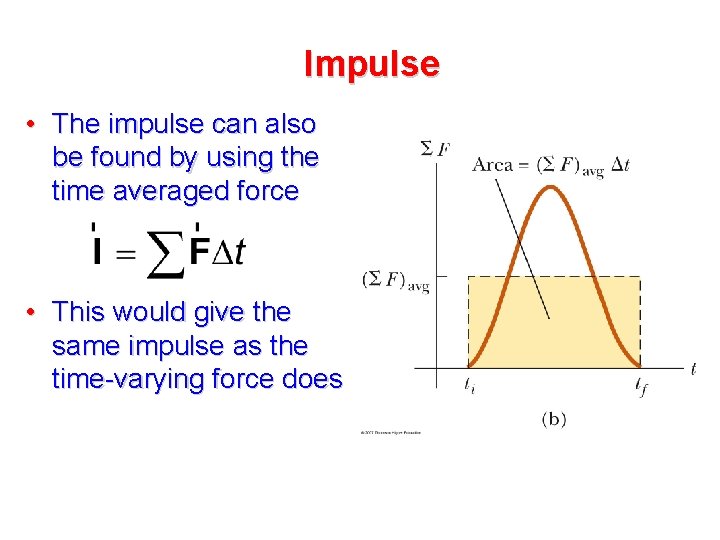
Impulse • The impulse can also be found by using the time averaged force • This would give the same impulse as the time-varying force does
Impulse Approximation • In many cases, one force acting on a particle acts for a short time, but is much greater than any other force present • When using the Impulse Approximation, we will assume this is true – Especially useful in analyzing collisions • The force will be called the impulsive force • The particle is assumed to move very little during the collision • represent the momenta immediately before and after the collision
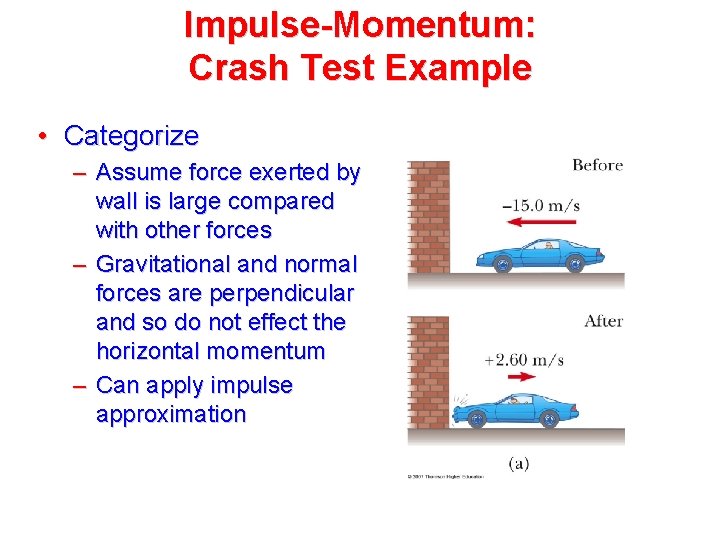
Impulse-Momentum: Crash Test Example • Categorize – Assume force exerted by wall is large compared with other forces – Gravitational and normal forces are perpendicular and so do not effect the horizontal momentum – Can apply impulse approximation
Crash Test Example • Analyze – The momenta before and after the collision between the car and the wall can be determined – Find • Initial momentum • Final momentum • Impulse • Average force • Finalize – Check signs on velocities to be sure they are reasonable
Collisions – Characteristics • We use the term collision to represent an event during which two particles come close to each other and interact by means of forces – May involve physical contact, but must be generalized to include cases with interaction without physical contact • The time interval during which the velocity changes from its initial to final values is assumed to be short • The interaction forces are assumed to be much greater than any external forces present – This means the impulse approximation can be used
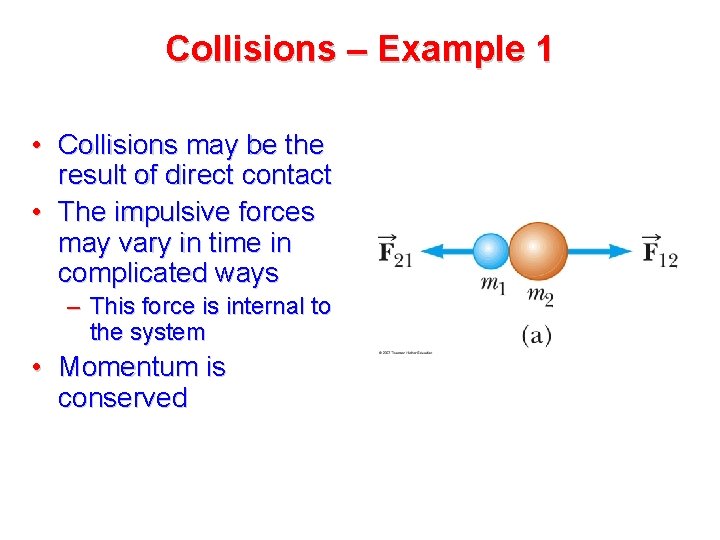
Collisions – Example 1 • Collisions may be the result of direct contact • The impulsive forces may vary in time in complicated ways – This force is internal to the system • Momentum is conserved
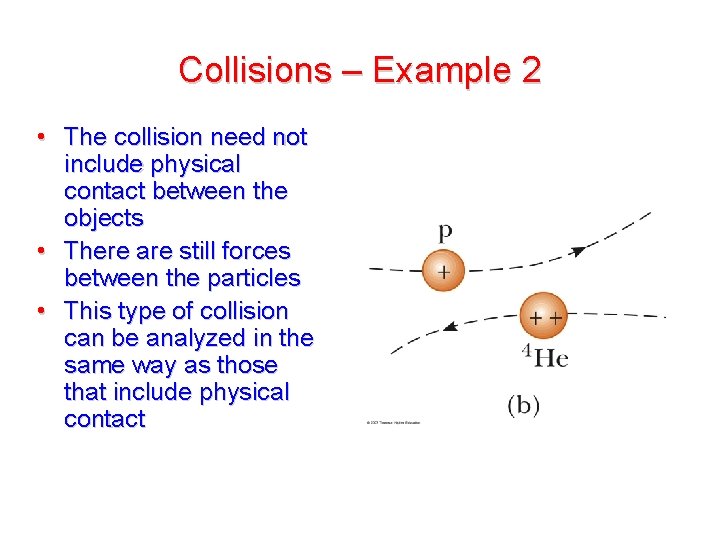
Collisions – Example 2 • The collision need not include physical contact between the objects • There are still forces between the particles • This type of collision can be analyzed in the same way as those that include physical contact
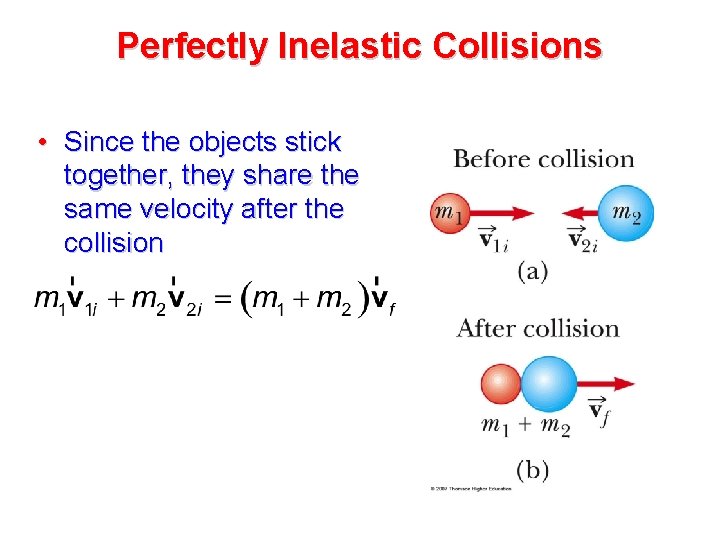
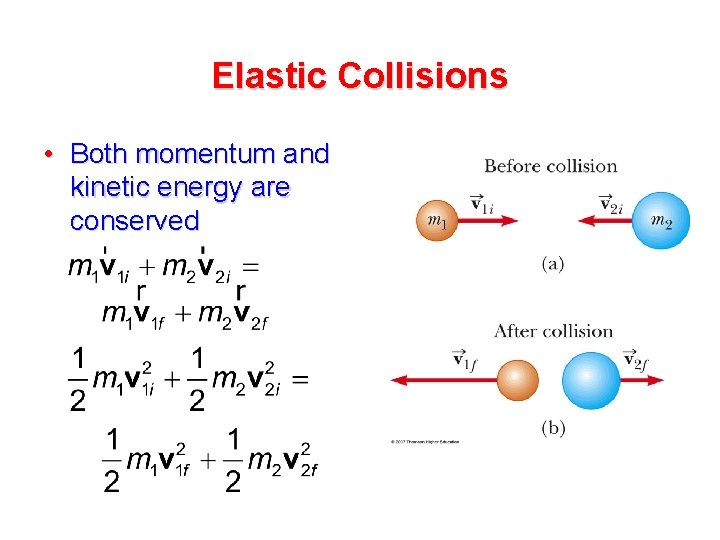
Types of Collisions • In an elastic collision, momentum and kinetic energy are conserved – Perfectly elastic collisions occur on a microscopic level – In macroscopic collisions, only approximately elastic collisions actually occur • Generally some energy is lost to deformation, sound, etc. • In an inelastic collision, kinetic energy is not conserved, although momentum is still conserved – If the objects stick together after the collision, it is a perfectly inelastic collision
Collisions • In an inelastic collision, some kinetic energy is lost, but the objects do not stick together • Elastic and perfectly inelastic collisions are limiting cases, most actual collisions fall in between these two types • Momentum is conserved in all collisions
Perfectly Inelastic Collisions • Since the objects stick together, they share the same velocity after the collision
Elastic Collisions • Both momentum and kinetic energy are conserved
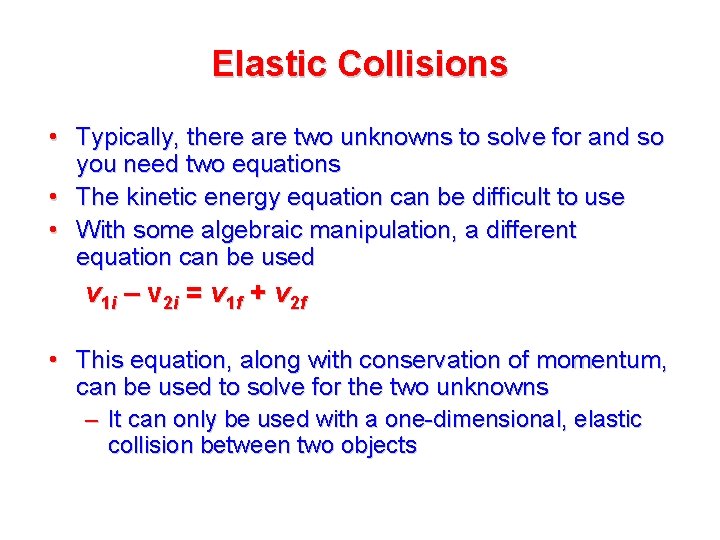
Elastic Collisions • Typically, there are two unknowns to solve for and so you need two equations • The kinetic energy equation can be difficult to use • With some algebraic manipulation, a different equation can be used v 1 i – v 2 i = v 1 f + v 2 f • This equation, along with conservation of momentum, can be used to solve for the two unknowns – It can only be used with a one-dimensional, elastic collision between two objects
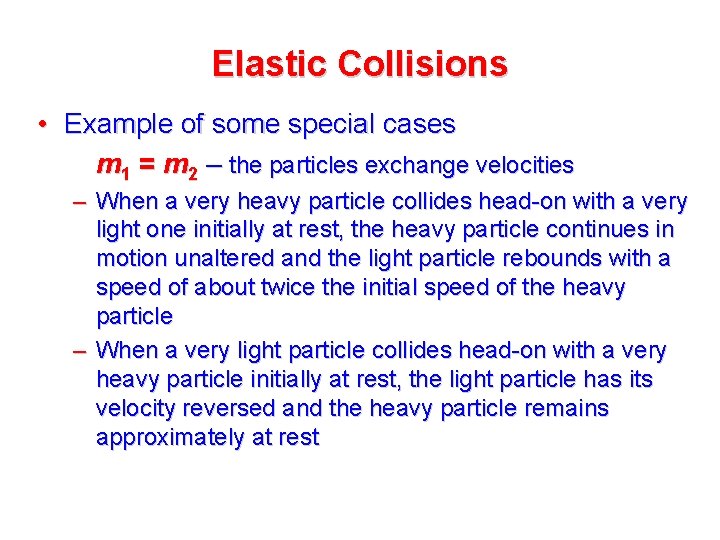
Elastic Collisions • Example of some special cases m 1 = m 2 – the particles exchange velocities – When a very heavy particle collides head-on with a very light one initially at rest, the heavy particle continues in motion unaltered and the light particle rebounds with a speed of about twice the initial speed of the heavy particle – When a very light particle collides head-on with a very heavy particle initially at rest, the light particle has its velocity reversed and the heavy particle remains approximately at rest
Problem-Solving Strategy: One-Dimensional Collisions • Conceptualize – Image the collision occurring in your mind – Draw simple diagrams of the particles before and after the collision – Include appropriate velocity vectors • Categorize – Is the system of particles isolated? – Is the collision elastic, inelastic or perfectly inelastic?
Problem-Solving Strategy: One. Dimensional Collisions • Analyze – Set up the mathematical representation of the problem – Solve for the unknown(s) • Finalize – Check to see if the answers are consistent with the mental and pictorial representations – Check to be sure your results are realistic
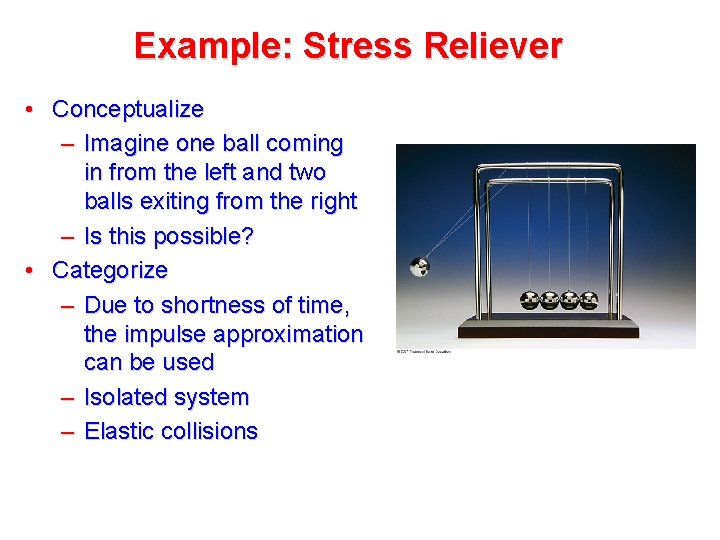
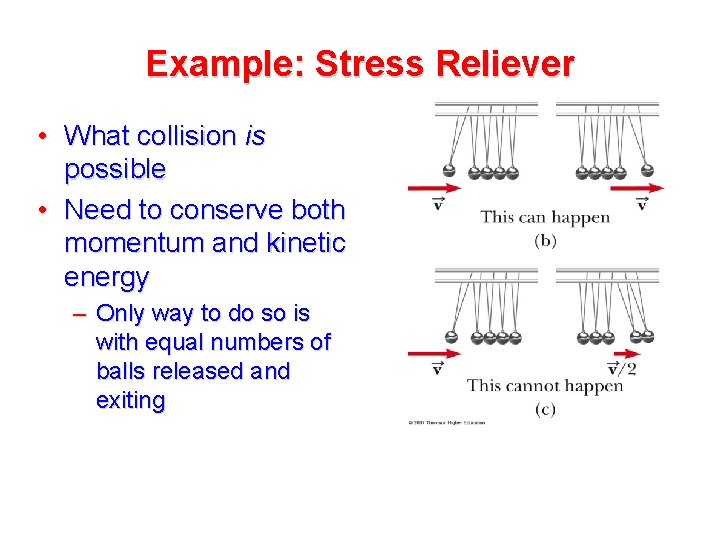
Example: Stress Reliever • Conceptualize – Imagine one ball coming in from the left and two balls exiting from the right – Is this possible? • Categorize – Due to shortness of time, the impulse approximation can be used – Isolated system – Elastic collisions
Example: Stress Reliever • Analyze – Check to see if momentum is conserved • It is – Check to see if kinetic energy is conserved • It is not • Therefore, the collision couldn’t be elastic • Finalize – Having two balls exit was not possible if only one ball is released
Example: Stress Reliever • What collision is possible • Need to conserve both momentum and kinetic energy – Only way to do so is with equal numbers of balls released and exiting
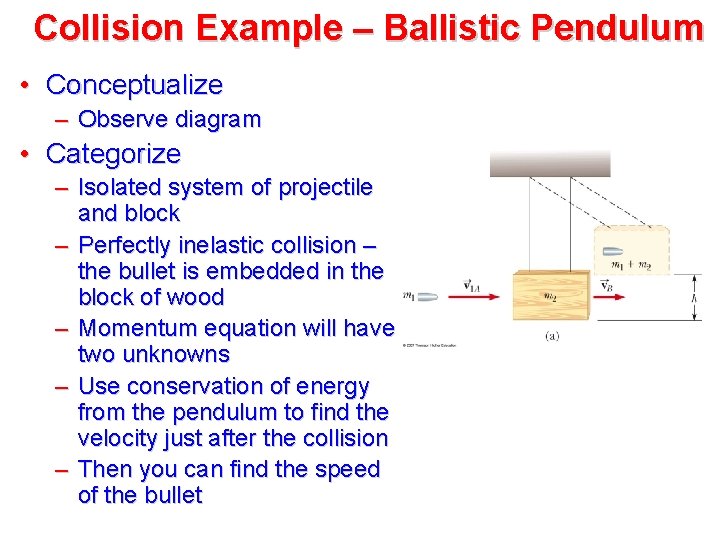
Collision Example – Ballistic Pendulum • Conceptualize – Observe diagram • Categorize – Isolated system of projectile and block – Perfectly inelastic collision – the bullet is embedded in the block of wood – Momentum equation will have two unknowns – Use conservation of energy from the pendulum to find the velocity just after the collision – Then you can find the speed of the bullet
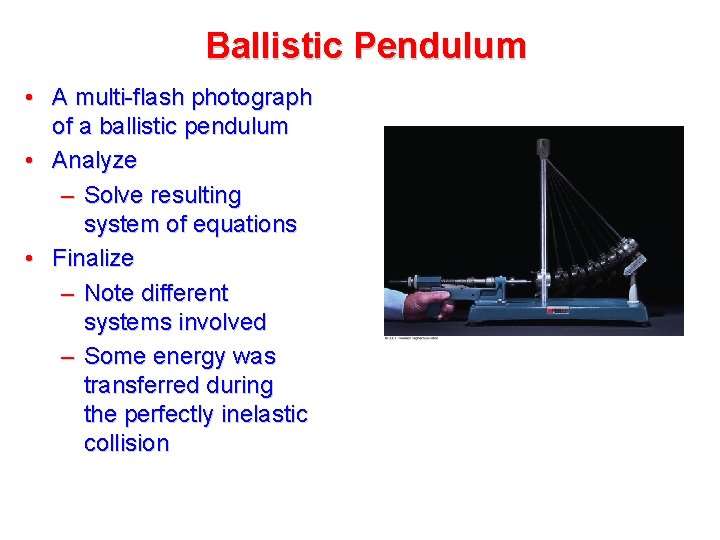
Ballistic Pendulum • A multi-flash photograph of a ballistic pendulum • Analyze – Solve resulting system of equations • Finalize – Note different systems involved – Some energy was transferred during the perfectly inelastic collision
V. Momentum and kinetic energy in collisions Assumptions: Closed systems (no mass enters or leaves them) Isolated systems (no external forces act on the bodies within the system) Elastic collision: If the total kinetic energy of the system of two colliding bodies is unchanged (conserved) by the collision. Example: Ball into hard floor. Inelastic collision: The kinetic energy of the system is not conserved some goes into thermal energy, sound, etc. Completely inelastic collision: After the collision the bodies lose energy and stick together. Example: Ball of wet putty into floor
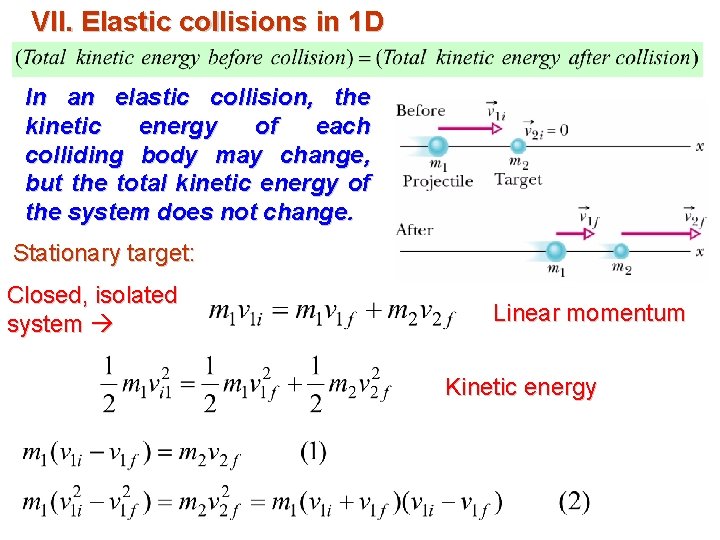
VII. Elastic collisions in 1 D In an elastic collision, the kinetic energy of each colliding body may change, but the total kinetic energy of the system does not change. Stationary target: Closed, isolated system Linear momentum Kinetic energy
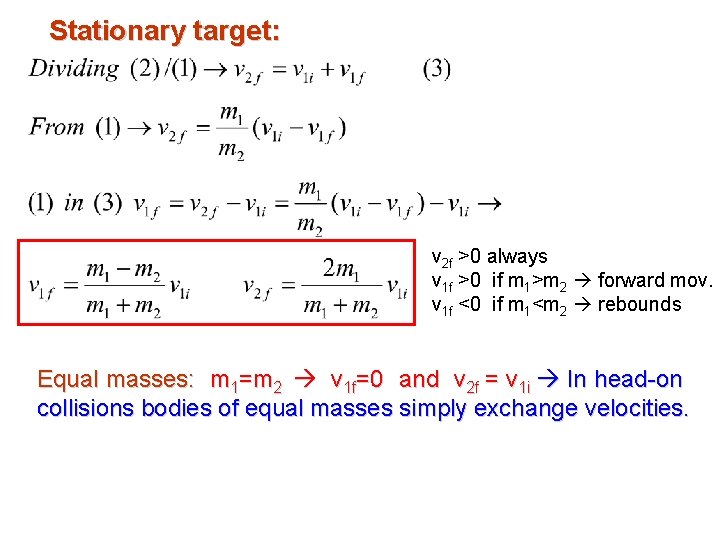
Stationary target: v 2 f >0 always v 1 f >0 if m 1>m 2 forward mov. v 1 f <0 if m 1<m 2 rebounds Equal masses: m 1=m 2 v 1 f=0 and v 2 f = v 1 i In head-on collisions bodies of equal masses simply exchange velocities.
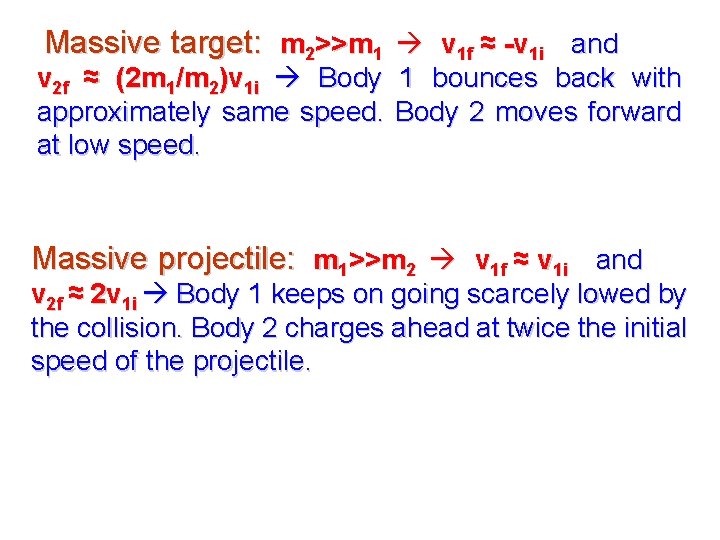
Massive target: m 2>>m 1 v 1 f ≈ -v 1 i and v 2 f ≈ (2 m 1/m 2)v 1 i Body 1 bounces back with approximately same speed. Body 2 moves forward at low speed. Massive projectile: m 1>>m 2 v 1 f ≈ v 1 i and v 2 f ≈ 2 v 1 i Body 1 keeps on going scarcely lowed by the collision. Body 2 charges ahead at twice the initial speed of the projectile.
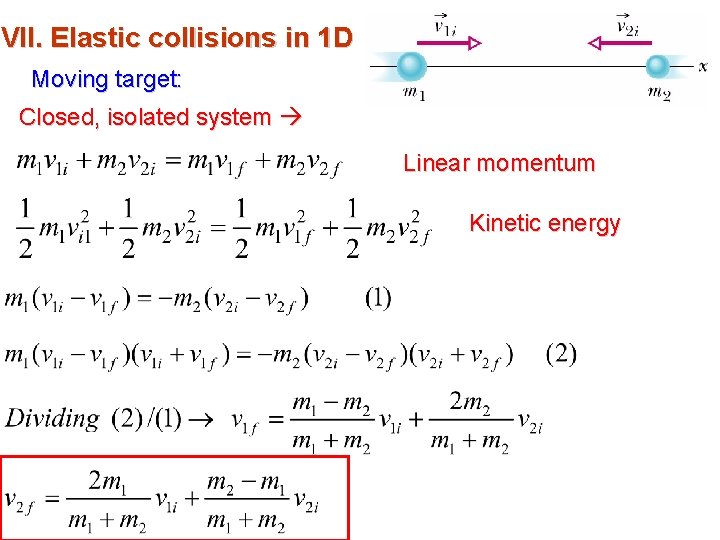
VII. Elastic collisions in 1 D Moving target: Closed, isolated system Linear momentum Kinetic energy
VIII. Collisions in 2 D Closed, isolated system Linear momentum conserved Elastic collision Kinetic energy conserved Example: If the collision is elastic
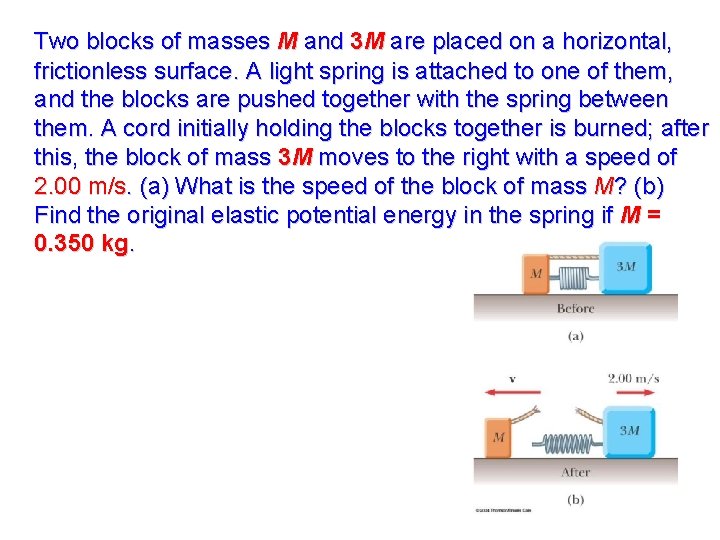
Two blocks of masses M and 3 M are placed on a horizontal, frictionless surface. A light spring is attached to one of them, and the blocks are pushed together with the spring between them. A cord initially holding the blocks together is burned; after this, the block of mass 3 M moves to the right with a speed of 2. 00 m/s. (a) What is the speed of the block of mass M? (b) Find the original elastic potential energy in the spring if M = 0. 350 kg.
A tennis player receives a shot with the ball (0. 0600 kg) traveling horizontally at 50. 0 m/s and returns the shot with the ball traveling horizontally at 40. 0 m/s in the opposite direction. (a) What is the impulse delivered to the ball by the racquet? (b) What work does the racquet do on the ball?
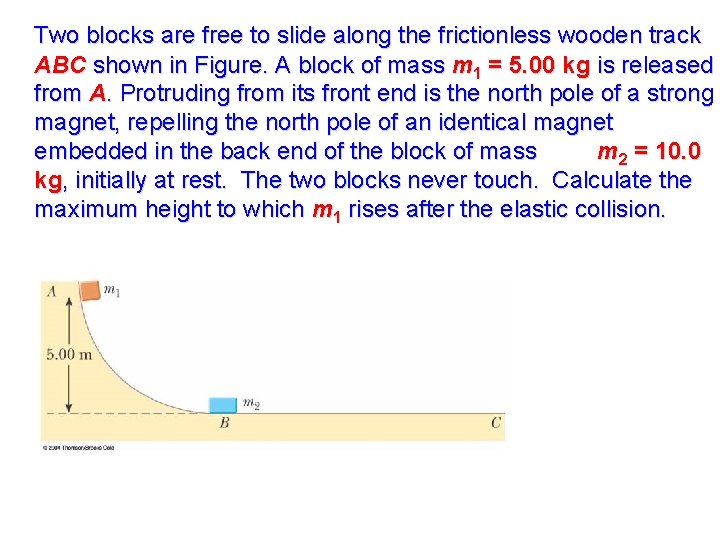
Two blocks are free to slide along the frictionless wooden track ABC shown in Figure. A block of mass m 1 = 5. 00 kg is released from A. Protruding from its front end is the north pole of a strong magnet, repelling the north pole of an identical magnet embedded in the back end of the block of mass m 2 = 10. 0 kg, initially at rest. The two blocks never touch. Calculate the maximum height to which m 1 rises after the elastic collision.
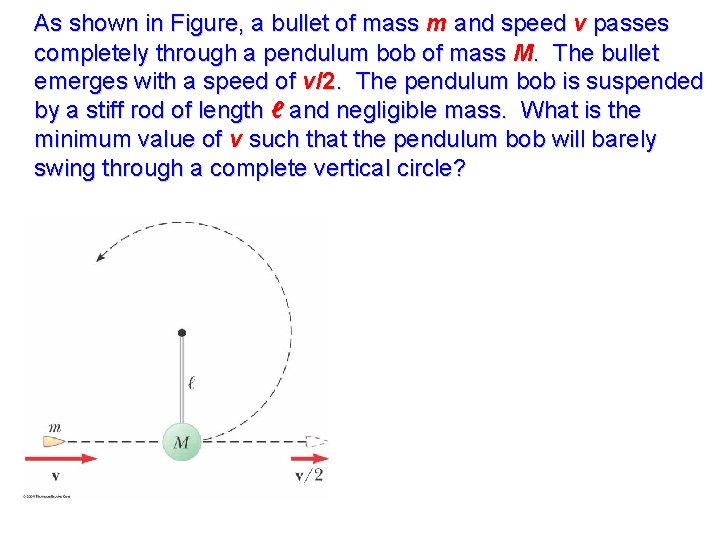
As shown in Figure, a bullet of mass m and speed v passes completely through a pendulum bob of mass M. The bullet emerges with a speed of v/2. The pendulum bob is suspended by a stiff rod of length ℓ and negligible mass. What is the minimum value of v such that the pendulum bob will barely swing through a complete vertical circle?
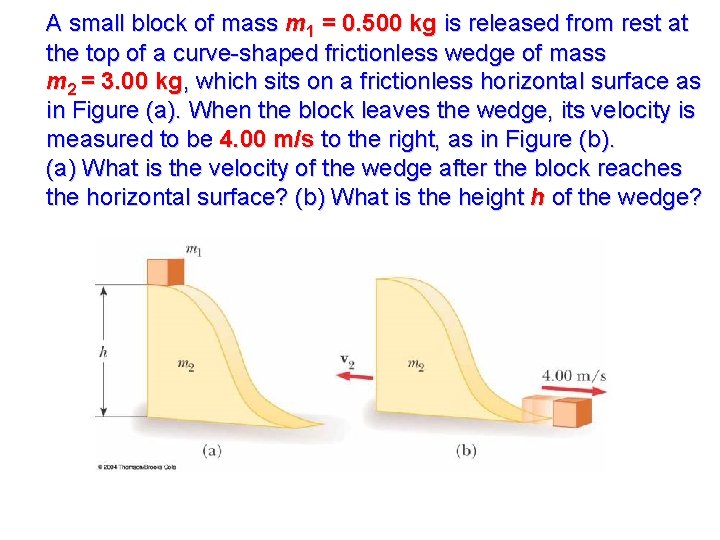
A small block of mass m 1 = 0. 500 kg is released from rest at the top of a curve-shaped frictionless wedge of mass m 2 = 3. 00 kg, which sits on a frictionless horizontal surface as in Figure (a). When the block leaves the wedge, its velocity is measured to be 4. 00 m/s to the right, as in Figure (b). (a) What is the velocity of the wedge after the block reaches the horizontal surface? (b) What is the height h of the wedge?
Two-Dimensional Collisions • The momentum is conserved in all directions • Use subscripts for – – – Identifying the object Indicating initial or final values The velocity components • If the collision is elastic, use conservation of kinetic energy as a second equation – Remember, the simpler equation can only be used for one-dimensional situations
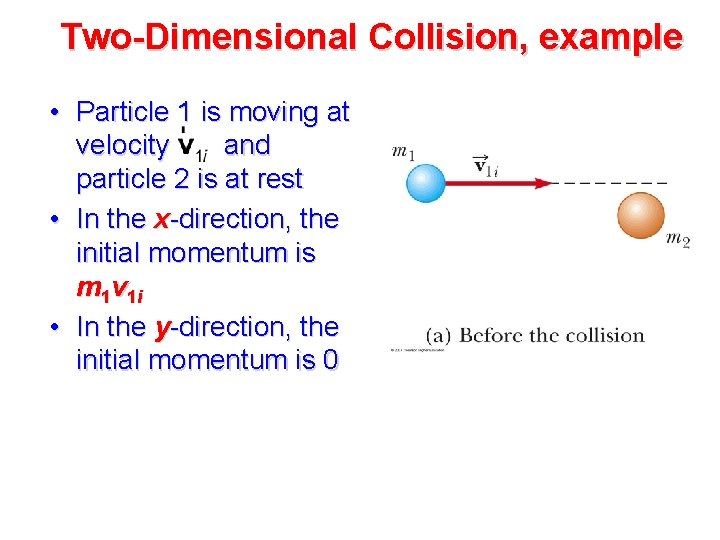
Two-Dimensional Collision, example • Particle 1 is moving at velocity and particle 2 is at rest • In the x-direction, the initial momentum is m 1 v 1 i • In the y-direction, the initial momentum is 0
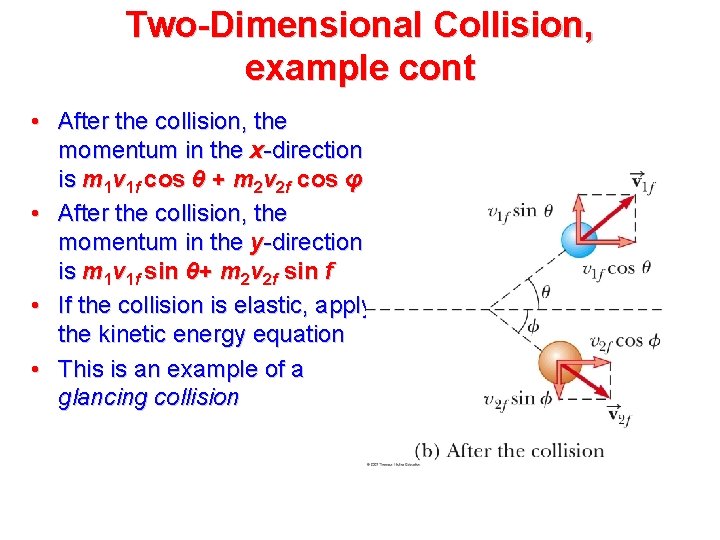
Two-Dimensional Collision, example cont • After the collision, the momentum in the x-direction is m 1 v 1 f cos θ + m 2 v 2 f cos φ • After the collision, the momentum in the y-direction is m 1 v 1 f sin θ+ m 2 v 2 f sin f • If the collision is elastic, apply the kinetic energy equation • This is an example of a glancing collision
Problem-Solving Strategies – Two. Dimensional Collisions • Conceptualize – Imagine the collision – Predict approximate directions the particles will move after the collision – Set up a coordinate system and define your velocities with respect to that system • It is usually convenient to have the x-axis coincide with one of the initial velocities – In your sketch of the coordinate system, draw and label all velocity vectors and include all the given information
Problem-Solving Strategies – Two. Dimensional Collisions • Categorize – Is the system isolated? – If so, categorize the collision as elastic, inelastic or perfectly inelastic • Analyze – Write expressions for the x- and y-components of the momentum of each object before and after the collision • Remember to include the appropriate signs for the components of the velocity vectors – Write expressions for the total momentum of the system in the x-direction before and after the collision and equate the two. Repeat for the total momentum in the y -direction.
Problem-Solving Strategies – Two. Dimensional Collisions – If the collision is inelastic, kinetic energy of the system is not conserved, and additional information is probably needed – If the collision is perfectly inelastic, the final velocities of the two objects are equal. Solve the momentum equations for the unknowns. – If the collision is elastic, the kinetic energy of the system is conserved • Equate the total kinetic energy before the collision to the total kinetic energy after the collision to obtain more information on the relationship between the velocities
Problem-Solving Strategies – Two. Dimensional Collisions • Finalize – Check to see if your answers are consistent with the mental and pictorial representations – Check to be sure your results are realistic
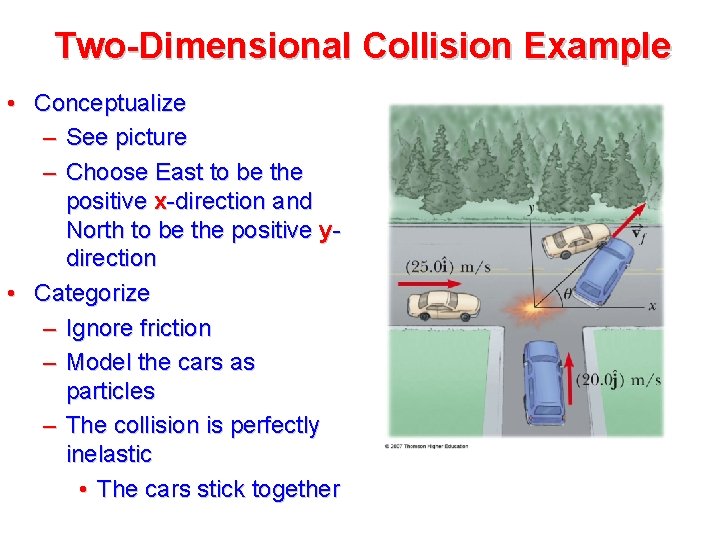
Two-Dimensional Collision Example • Conceptualize – See picture – Choose East to be the positive x-direction and North to be the positive ydirection • Categorize – Ignore friction – Model the cars as particles – The collision is perfectly inelastic • The cars stick together
Two-Dimensional Collision Example • Analyze – Before the collision, the car has the total momentum in the x-direction and the van has the total momentum in the y-direction – After the collision, both have x- and y-components – Write expressions for initial and final momenta in both directions – Solve for unknowns • Finalize – Check to be sure the results are reasonable
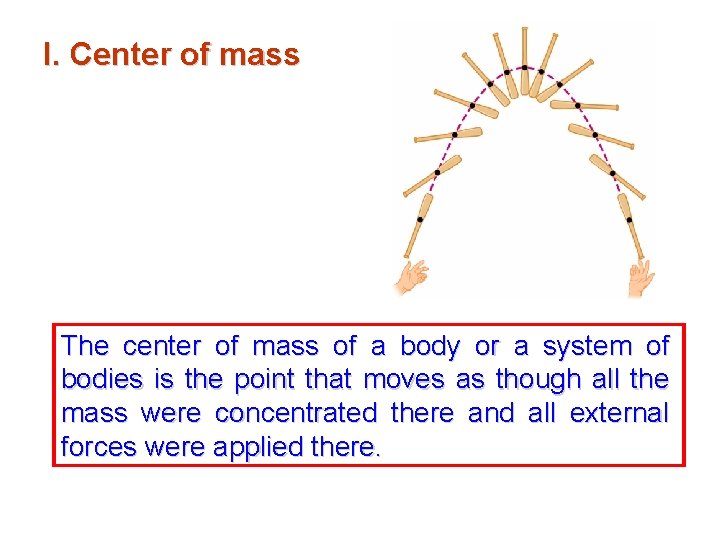
The Center of Mass • There is a special point in a system or object, called the center of mass, that moves as if all of the mass of the system is concentrated at that point • The system will move as if an external force were applied to a single particle of mass M located at the center of mass M is the total mass of the system
II. Newton’s second law for a system of particles Motion of the center of mass: Center of the mass of the system moves as a particle whose mass is equal to the total mass of the system. Fnet is the net of all external forces that act on the system. Internal forces (from one part of the system to another are not included). The system is closed: no mass enters or leaves the system during the movement. (M=total system mass). acom is the acceleration of the system’s center of mass.
I. Center of mass The center of mass of a body or a system of bodies is the point that moves as though all the mass were concentrated there and all external forces were applied there.
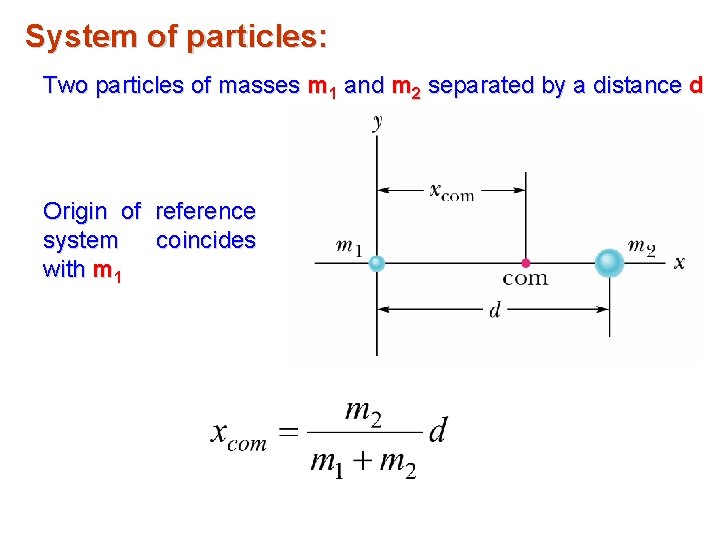
System of particles: Two particles of masses m 1 and m 2 separated by a distance d Origin of reference system coincides with m 1
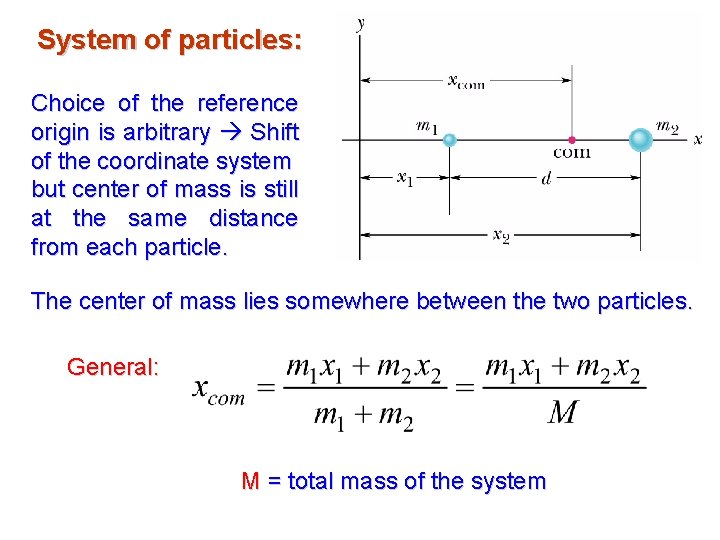
System of particles: Choice of the reference origin is arbitrary Shift of the coordinate system but center of mass is still at the same distance from each particle. The center of mass lies somewhere between the two particles. General: M = total mass of the system
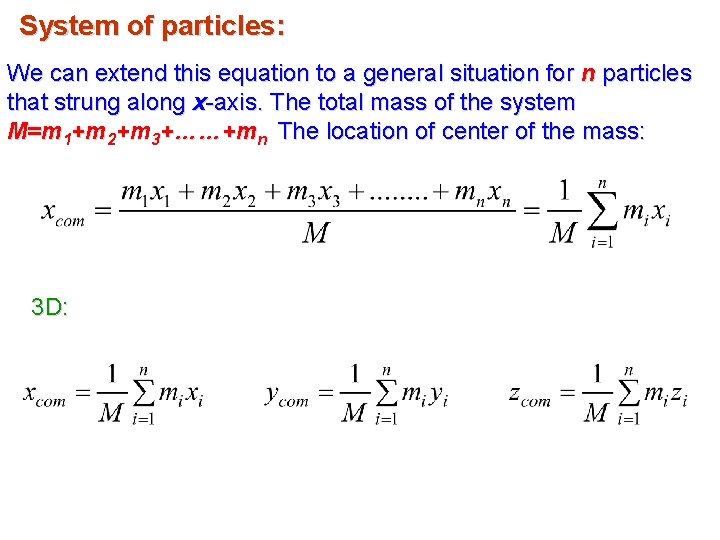
System of particles: We can extend this equation to a general situation for n particles that strung along x-axis. The total mass of the system M=m 1+m 2+m 3+……+mn The location of center of the mass: 3 D:
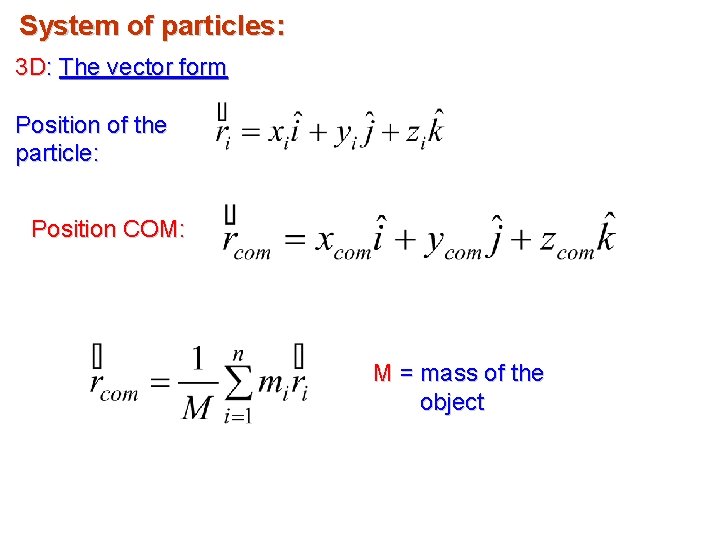
System of particles: 3 D: The vector form Position of the particle: Position COM: M = mass of the object
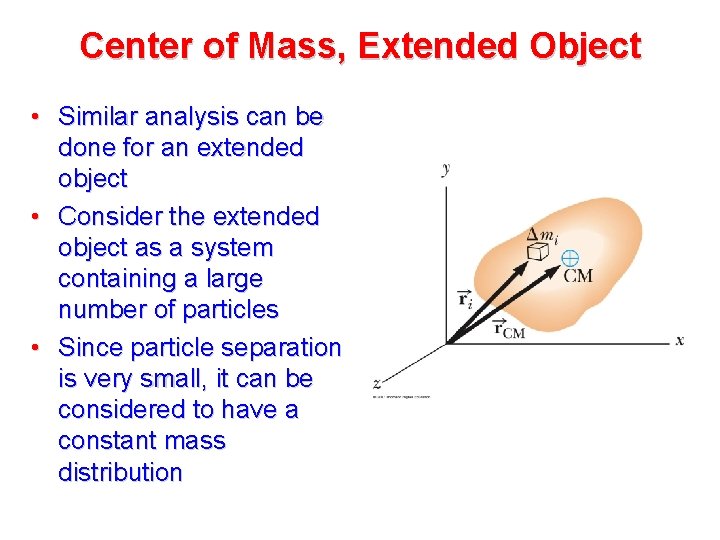
Center of Mass, Extended Object • Similar analysis can be done for an extended object • Consider the extended object as a system containing a large number of particles • Since particle separation is very small, it can be considered to have a constant mass distribution
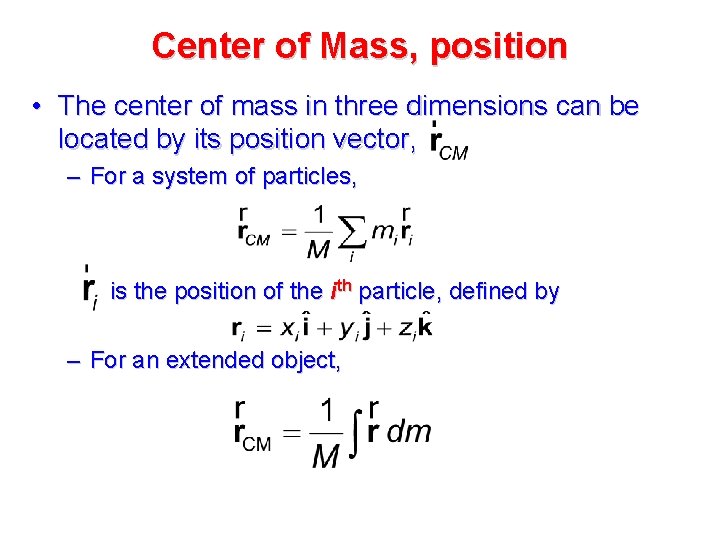
Center of Mass, position • The center of mass in three dimensions can be located by its position vector, – For a system of particles, is the position of the ith particle, defined by – For an extended object,
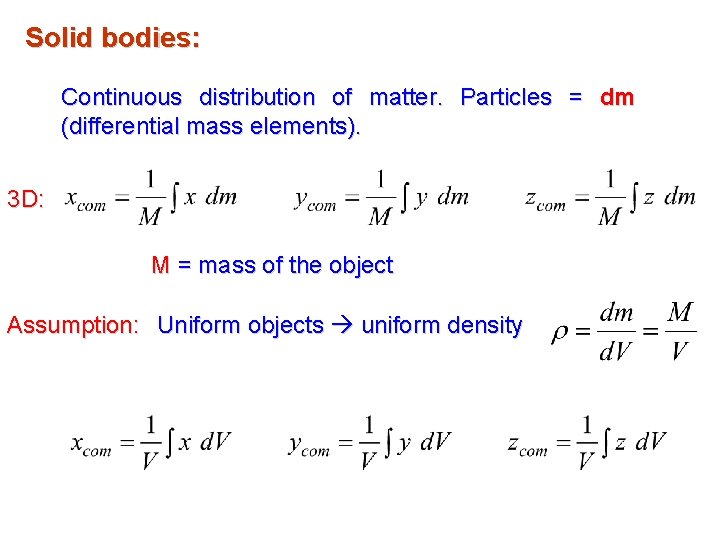
Solid bodies: Continuous distribution of matter. Particles = dm (differential mass elements). 3 D: M = mass of the object Assumption: Uniform objects uniform density
Motion of a System of Particles • Assume the total mass, M, of the system remains constant • We can describe the motion of the system in terms of the velocity and acceleration of the center of mass of the system • We can also describe the momentum of the system and Newton’s Second Law for the system
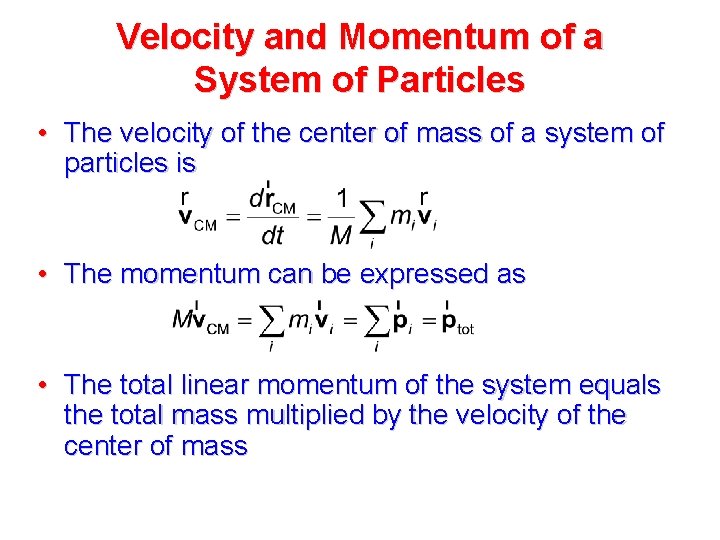
Velocity and Momentum of a System of Particles • The velocity of the center of mass of a system of particles is • The momentum can be expressed as • The total linear momentum of the system equals the total mass multiplied by the velocity of the center of mass
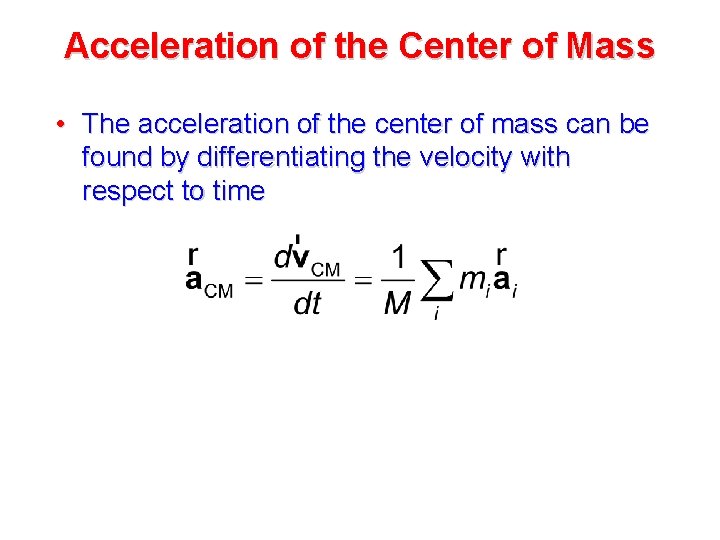
Acceleration of the Center of Mass • The acceleration of the center of mass can be found by differentiating the velocity with respect to time
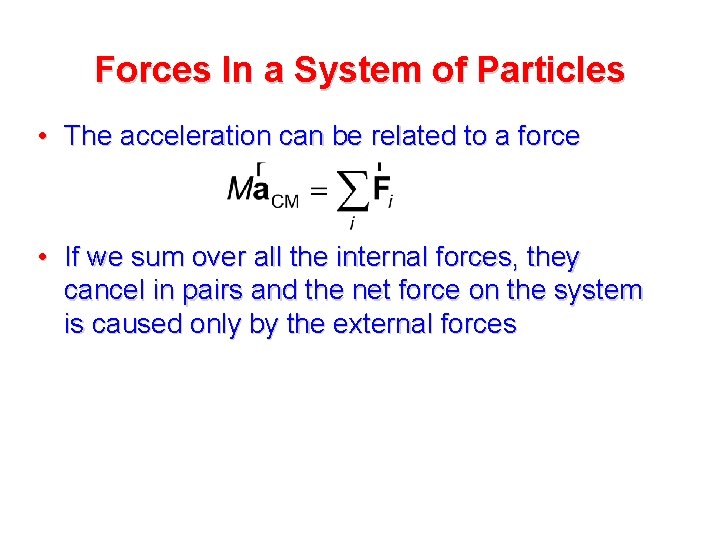
Forces In a System of Particles • The acceleration can be related to a force • If we sum over all the internal forces, they cancel in pairs and the net force on the system is caused only by the external forces
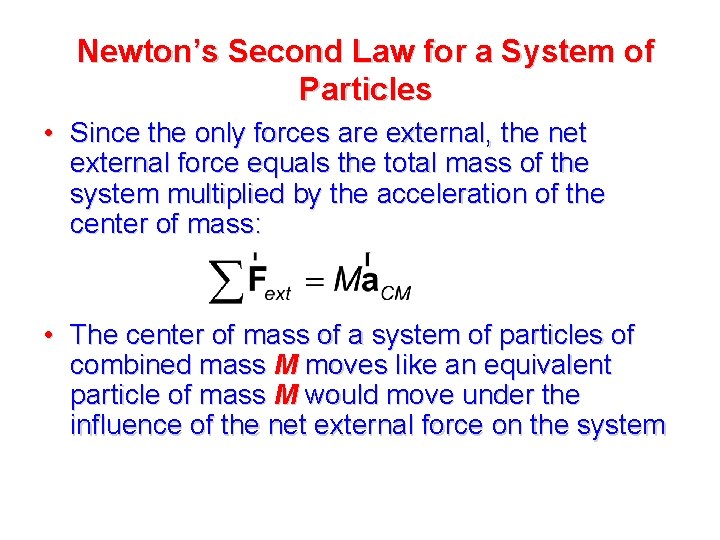
Newton’s Second Law for a System of Particles • Since the only forces are external, the net external force equals the total mass of the system multiplied by the acceleration of the center of mass: • The center of mass of a system of particles of combined mass M moves like an equivalent particle of mass M would move under the influence of the net external force on the system
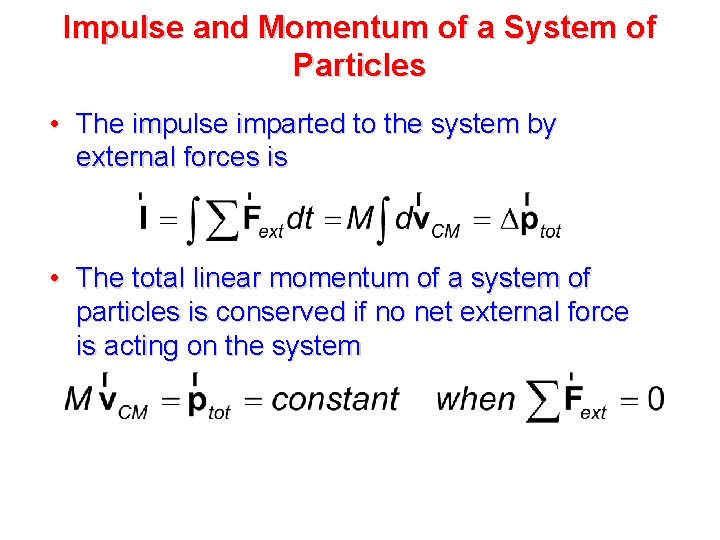
Impulse and Momentum of a System of Particles • The impulse imparted to the system by external forces is • The total linear momentum of a system of particles is conserved if no net external force is acting on the system
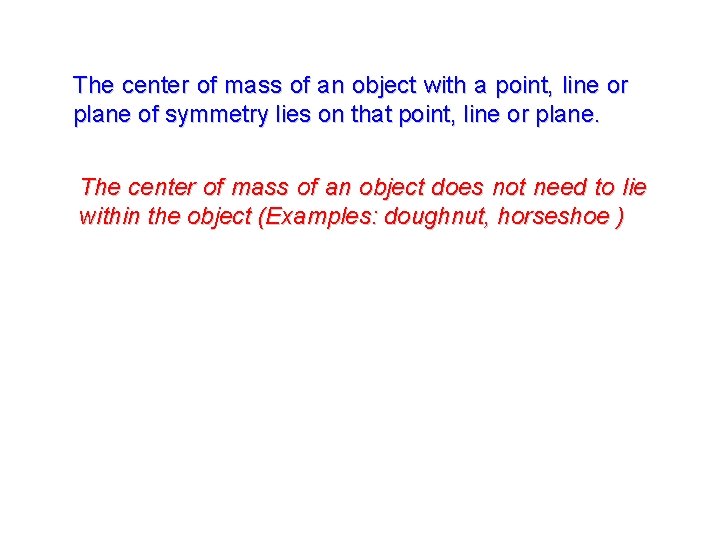
The center of mass of an object with a point, line or plane of symmetry lies on that point, line or plane. The center of mass of an object does not need to lie within the object (Examples: doughnut, horseshoe )
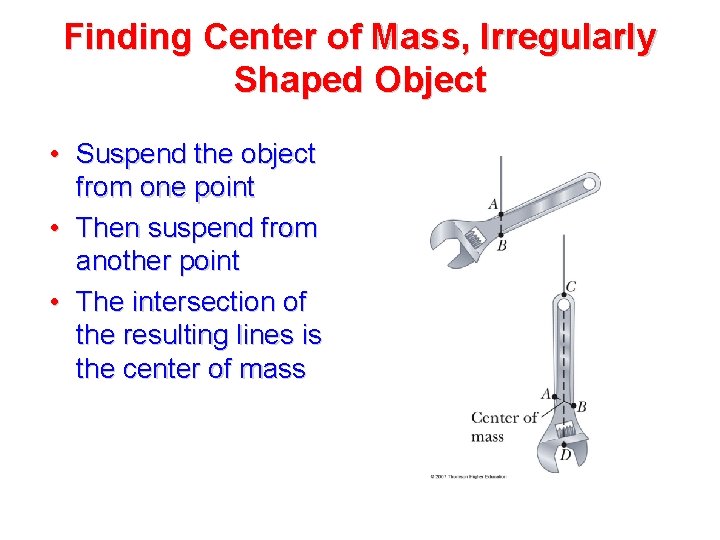
Finding Center of Mass, Irregularly Shaped Object • Suspend the object from one point • Then suspend from another point • The intersection of the resulting lines is the center of mass
Center of Gravity • Each small mass element of an extended object is acted upon by the gravitational force • The net effect of all these forces is equivalent to the effect of a single force acting through a point called the center of gravity – If is constant over the mass distribution, the center of gravity coincides with the center of mass
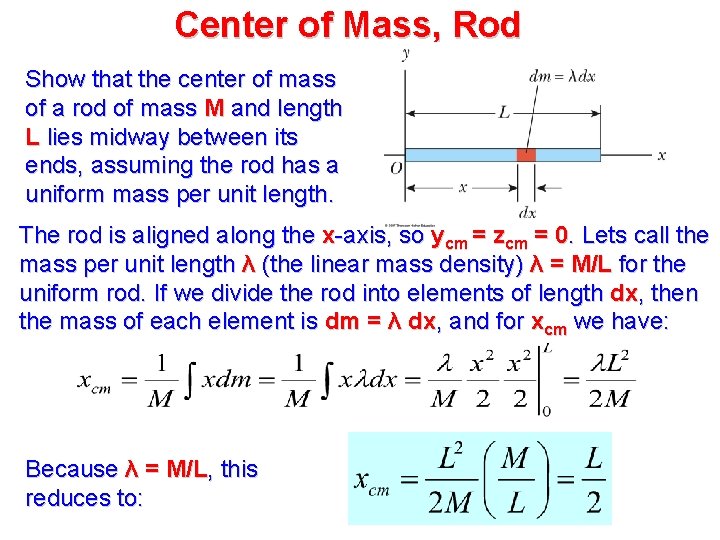
Center of Mass, Rod Show that the center of mass of a rod of mass M and length L lies midway between its ends, assuming the rod has a uniform mass per unit length. The rod is aligned along the x-axis, so ycm = zcm = 0. Lets call the mass per unit length λ (the linear mass density) λ = M/L for the uniform rod. If we divide the rod into elements of length dx, then the mass of each element is dm = λ dx, and for xcm we have: Because λ = M/L, this reduces to:
Problem solving tactics: (1) Use object’s symmetry. (2) If possible, divide object in several parts. Treat each of these parts as a particle located at its own center of mass. (3) Chose your axes wisely. Use one particle of the system as origin of your reference system or let the symmetry lines be your axis.
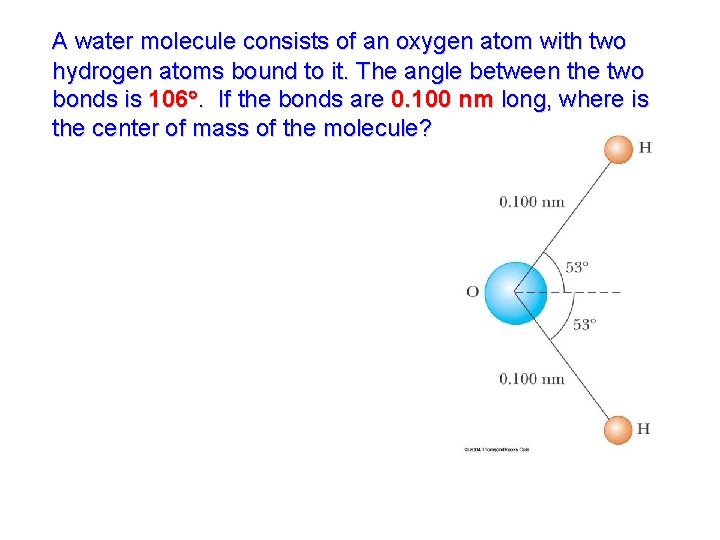
A water molecule consists of an oxygen atom with two hydrogen atoms bound to it. The angle between the two bonds is 106. If the bonds are 0. 100 nm long, where is the center of mass of the molecule?
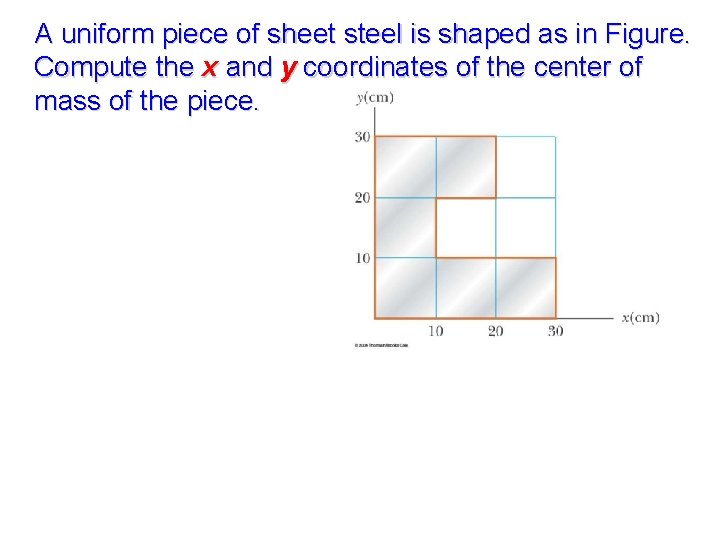
A uniform piece of sheet steel is shaped as in Figure. Compute the x and y coordinates of the center of mass of the piece.
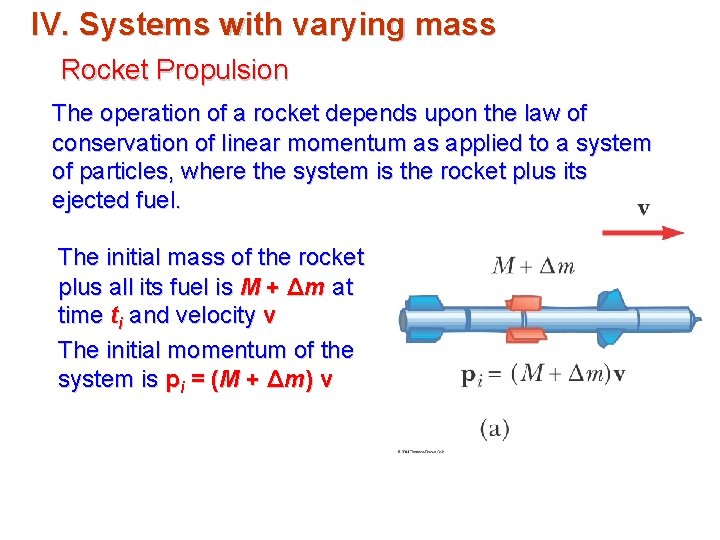
IV. Systems with varying mass Rocket Propulsion The operation of a rocket depends upon the law of conservation of linear momentum as applied to a system of particles, where the system is the rocket plus its ejected fuel. The initial mass of the rocket plus all its fuel is M + Δm at time ti and velocity v The initial momentum of the system is pi = (M + Δm) v
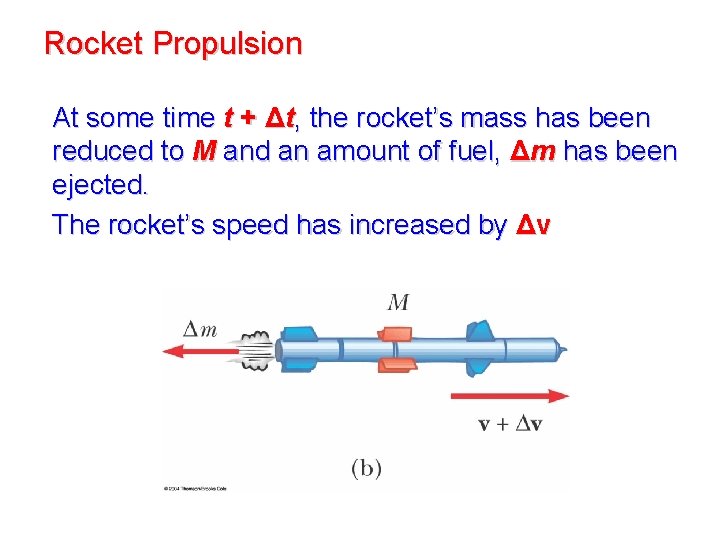
Rocket Propulsion At some time t + Δt, the rocket’s mass has been reduced to M and an amount of fuel, Δm has been ejected. The rocket’s speed has increased by Δv
Rocket Propulsion Because the gases are given some momentum when they are ejected out of the engine, the rocket receives a compensating momentum in the opposite direction Therefore, the rocket is accelerated as a result of the “push” from the exhaust gases In free space, the center of mass of the system (rocket plus expelled gases) moves uniformly, independent of the propulsion process
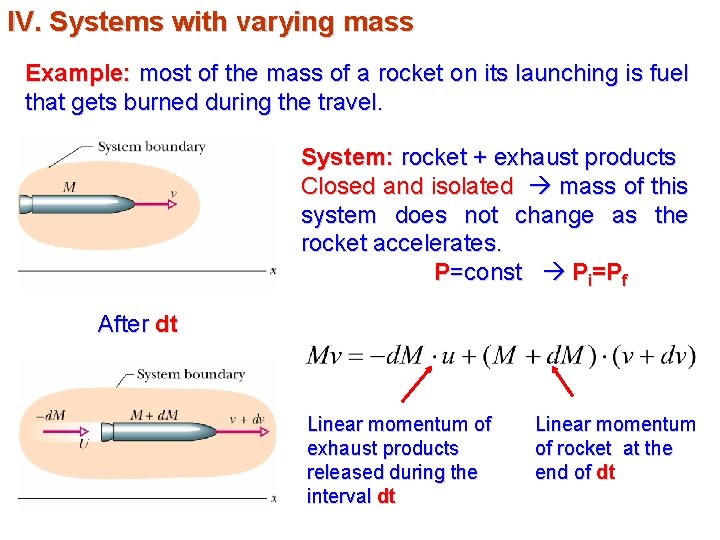
IV. Systems with varying mass Example: most of the mass of a rocket on its launching is fuel that gets burned during the travel. System: rocket + exhaust products Closed and isolated mass of this system does not change as the rocket accelerates. P=const Pi=Pf After dt Linear momentum of exhaust products released during the interval dt Linear momentum of rocket at the end of dt
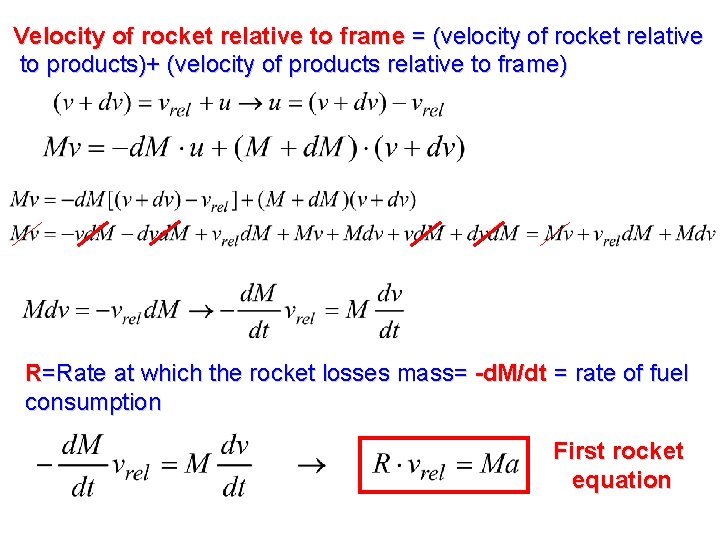
Velocity of rocket relative to frame = (velocity of rocket relative to products)+ (velocity of products relative to frame) R=Rate at which the rocket losses mass= -d. M/dt = rate of fuel consumption First rocket equation
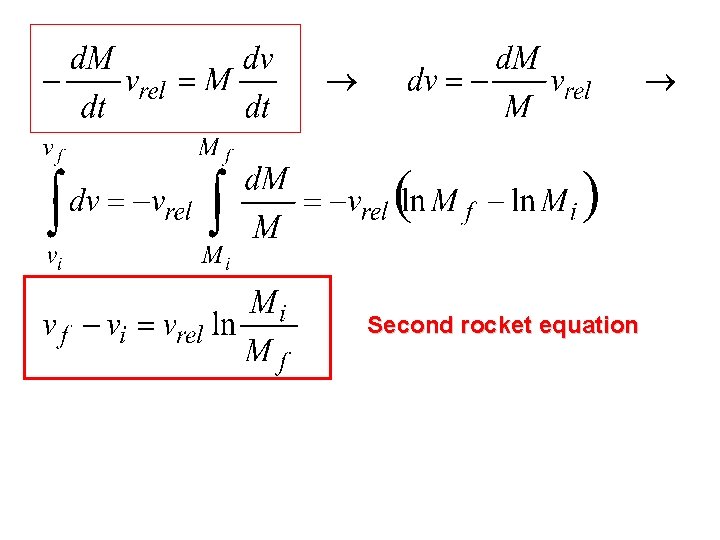
Second rocket equation
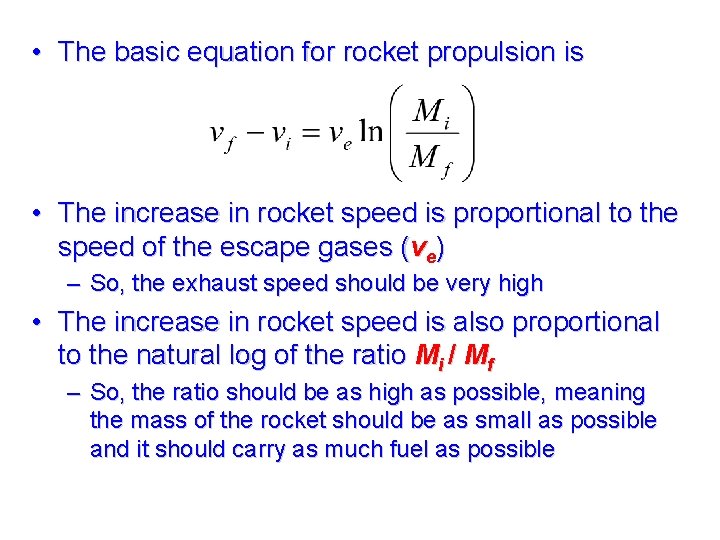
• The basic equation for rocket propulsion is • The increase in rocket speed is proportional to the speed of the escape gases (ve) – So, the exhaust speed should be very high • The increase in rocket speed is also proportional to the natural log of the ratio Mi / Mf – So, the ratio should be as high as possible, meaning the mass of the rocket should be as small as possible and it should carry as much fuel as possible
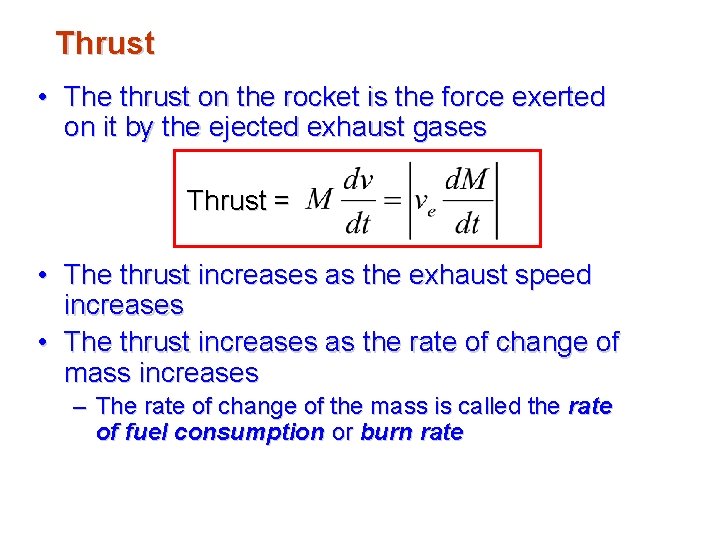
Thrust • The thrust on the rocket is the force exerted on it by the ejected exhaust gases Thrust = • The thrust increases as the exhaust speed increases • The thrust increases as the rate of change of mass increases – The rate of change of the mass is called the rate of fuel consumption or burn rate
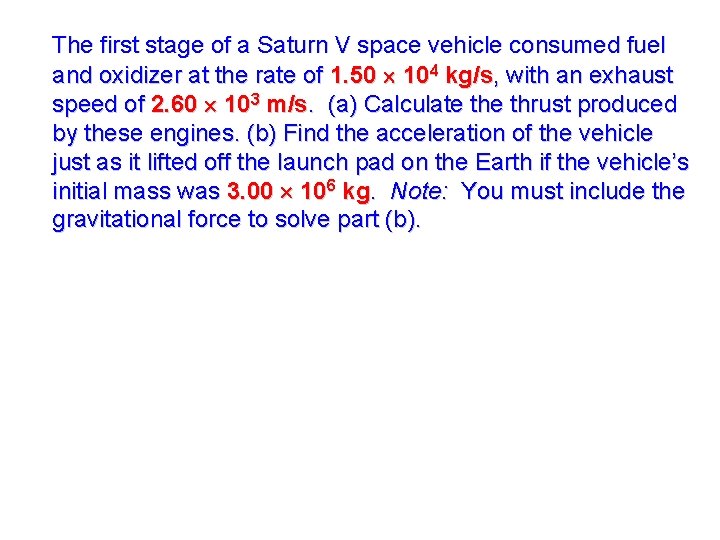
The first stage of a Saturn V space vehicle consumed fuel and oxidizer at the rate of 1. 50 104 kg/s, with an exhaust speed of 2. 60 103 m/s. (a) Calculate thrust produced by these engines. (b) Find the acceleration of the vehicle just as it lifted off the launch pad on the Earth if the vehicle’s initial mass was 3. 00 106 kg. Note: You must include the gravitational force to solve part (b).
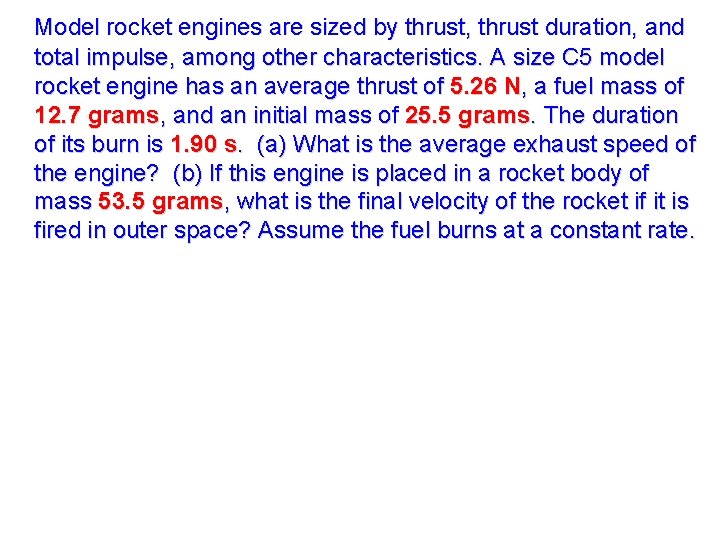
Model rocket engines are sized by thrust, thrust duration, and total impulse, among other characteristics. A size C 5 model rocket engine has an average thrust of 5. 26 N, a fuel mass of 12. 7 grams, and an initial mass of 25. 5 grams. The duration of its burn is 1. 90 s. (a) What is the average exhaust speed of the engine? (b) If this engine is placed in a rocket body of mass 53. 5 grams, what is the final velocity of the rocket if it is fired in outer space? Assume the fuel burns at a constant rate.
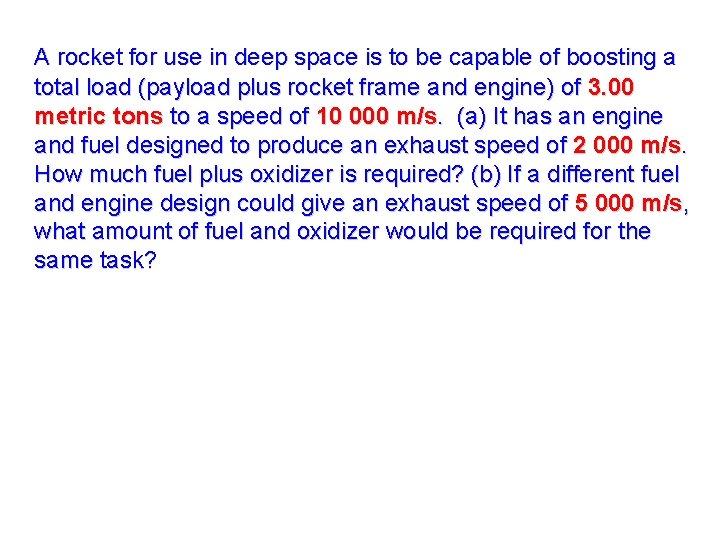
A rocket for use in deep space is to be capable of boosting a total load (payload plus rocket frame and engine) of 3. 00 metric tons to a speed of 10 000 m/s. (a) It has an engine and fuel designed to produce an exhaust speed of 2 000 m/s. How much fuel plus oxidizer is required? (b) If a different fuel and engine design could give an exhaust speed of 5 000 m/s, what amount of fuel and oxidizer would be required for the same task?
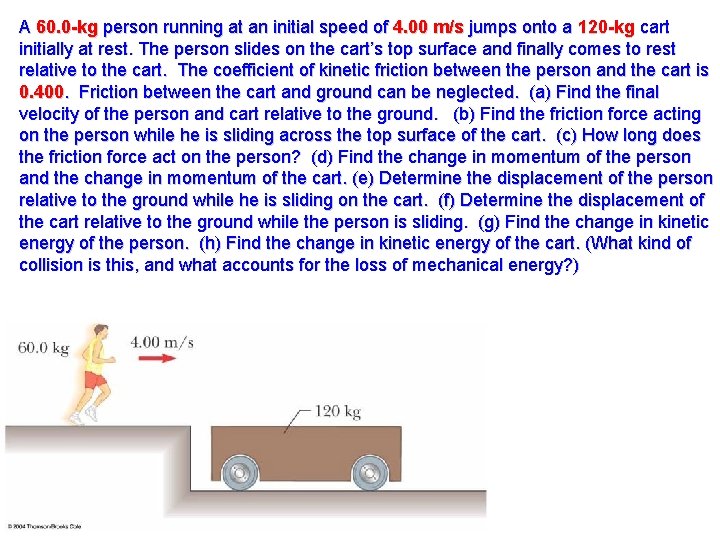
A 60. 0 -kg person running at an initial speed of 4. 00 m/s jumps onto a 120 -kg cart initially at rest. The person slides on the cart’s top surface and finally comes to rest relative to the cart. The coefficient of kinetic friction between the person and the cart is 0. 400. Friction between the cart and ground can be neglected. (a) Find the final velocity of the person and cart relative to the ground. (b) Find the friction force acting on the person while he is sliding across the top surface of the cart. (c) How long does the friction force act on the person? (d) Find the change in momentum of the person and the change in momentum of the cart. (e) Determine the displacement of the person relative to the ground while he is sliding on the cart. (f) Determine the displacement of the cart relative to the ground while the person is sliding. (g) Find the change in kinetic energy of the person. (h) Find the change in kinetic energy of the cart. (What kind of collision is this, and what accounts for the loss of mechanical energy? )
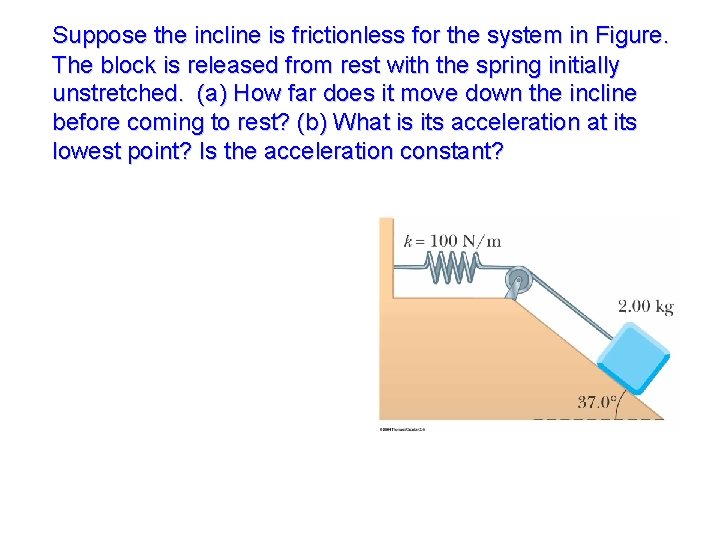
Suppose the incline is frictionless for the system in Figure. The block is released from rest with the spring initially unstretched. (a) How far does it move down the incline before coming to rest? (b) What is its acceleration at its lowest point? Is the acceleration constant?
Example: Tennis Racket A 50 g ball is struck by a racket. If the ball is initially travelling at 5 m/s up and ends up travelling at 5 m/s down after 0. 1 s of contact what is the (average) force exerted by the racket on the ball? What is the impulse?
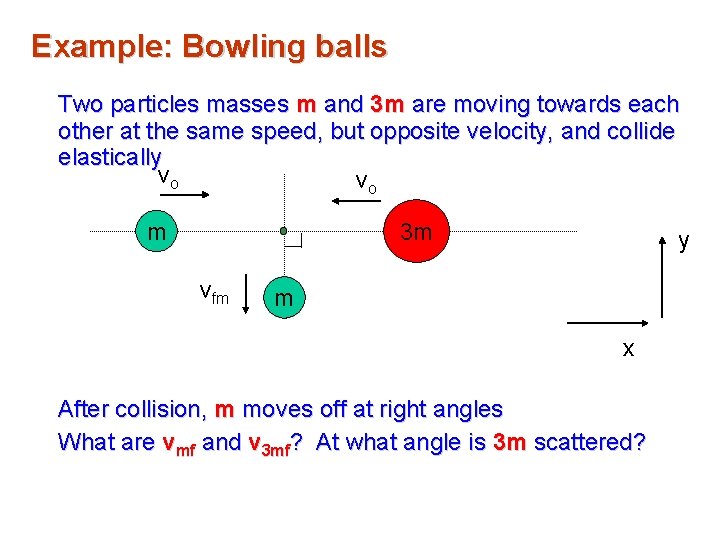
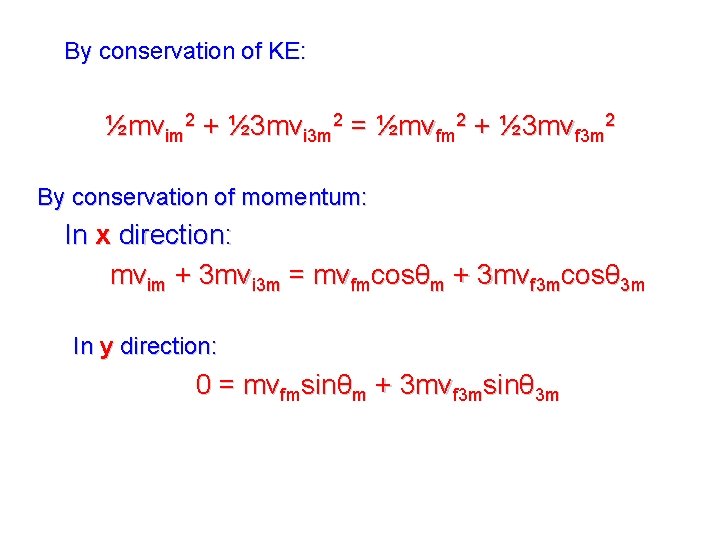
Example: Bowling balls Two particles masses m and 3 m are moving towards each other at the same speed, but opposite velocity, and collide elastically vo vo m 3 m vfm y m x After collision, m moves off at right angles What are vmf and v 3 mf? At what angle is 3 m scattered?
By conservation of KE: ½mvim 2 + ½ 3 mvi 3 m 2 = ½mvfm 2 + ½ 3 mvf 3 m 2 By conservation of momentum: In x direction: mvim + 3 mvi 3 m = mvfmcosθm + 3 mvf 3 mcosθ 3 m In y direction: 0 = mvfmsinθm + 3 mvf 3 msinθ 3 m
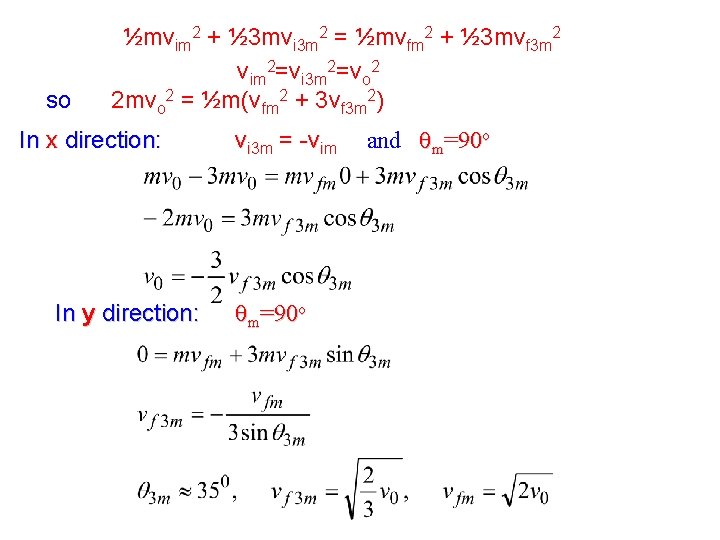
so ½mvim 2 + ½ 3 mvi 3 m 2 = ½mvfm 2 + ½ 3 mvf 3 m 2 vim 2=vi 3 m 2=vo 2 2 mvo 2 = ½m(vfm 2 + 3 vf 3 m 2) In x direction: In y direction: vi 3 m = -vim qm=90 o and qm=90 o
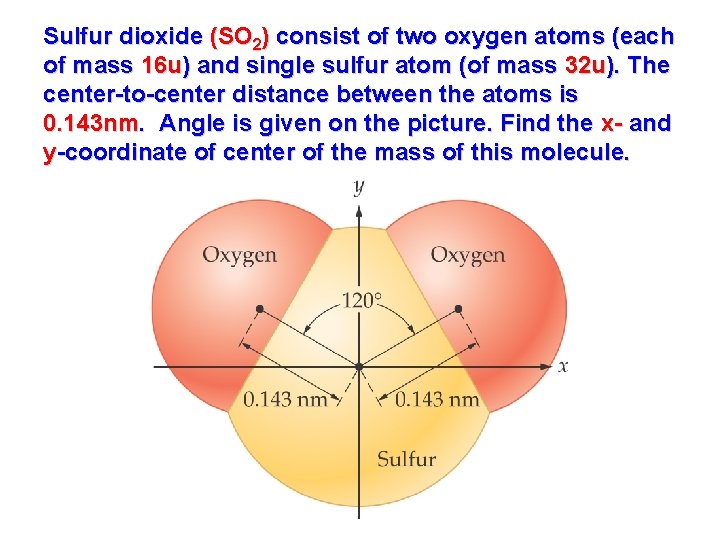
Sulfur dioxide (SO 2) consist of two oxygen atoms (each of mass 16 u) and single sulfur atom (of mass 32 u). The center-to-center distance between the atoms is 0. 143 nm. Angle is given on the picture. Find the x- and y-coordinate of center of the mass of this molecule.