Collection of Paradata in a CAPI System with
- Slides: 15
Collection of Paradata in a CAPI System with Wireless Telecommunications Vesa Kuusela and Kai Vikki Social Survey Unit Statistics Finland
Background Paradata did not exist in paper-and-pencil era n Computer Assisted Interviewing (CAI) systems brought along many possibilities to collect data about the process l CATI call schedule systems collect (automatically) data that can be used for quality control or for process development l In CAPI system paradata collection has to be arranged separately l Problem has been the limited telecommunications facilities n At Statistics Finland, newly redesigned CAPI information system is based on 3 G telecommunications l Fast data transmission has opened new perspective for paradata collection n Q 2010, Helsinki 2010 6. 5. 2010 2
Wireless Wide Area Network (WWAN) WWAN uses mobile telecommunications network for transfering data l Nearly the same as mobile phone network (GSM) n Based on third generation (3 G) of telecommunication hardware standards l Universal Mobile Telecommunications System (UMTS) is most common of the 3 G technologies (in Europe) l In theory, UMTS supports up to 21 Mbit/s data transfer rates - in practice much less. l General packet radio service (GPRS) is a mobile data service for the 2 G mobile communication systems (GSM). l GPRS provides data transfer rates up to 114 kbit/s n Pricing is based either on amount of transferred data or on fixed monthly fee n Q 2010, Helsinki 2010 6. 5. 2010 3
Current status of 3 G WWAN is originally designed for the new mobile telephones but its use for wireless connection to the Internet increases rapidly n In Finland, 3 G/UMTS networks cover nearly all parts of country and GPRS covers the whole country l Currently fastest available transfer rates are 5 Mbit/s downstream and 2 Mbit/s upstream n For computer use, a slot for a SIM card is needed either on mother board, on PCMCI card, or in a connector to UBS port. n Q 2010, Helsinki 2010 6. 5. 2010 4
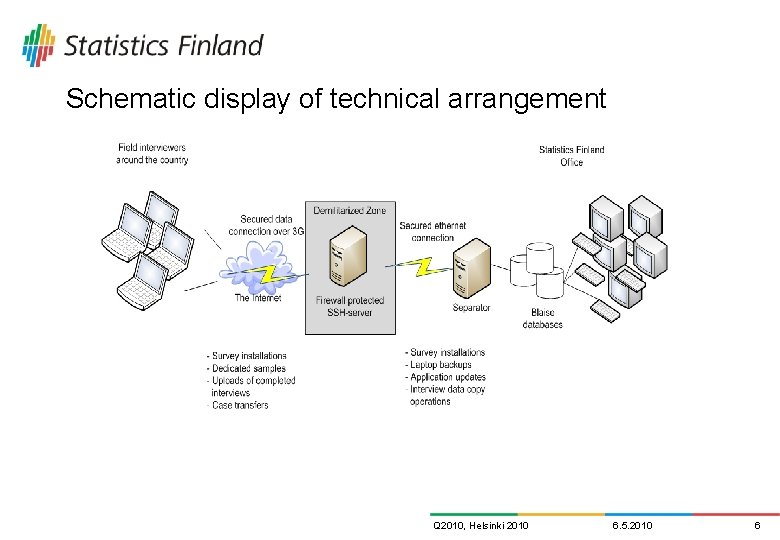
Building blocks of new CAPI System Interviewers connect using 3 G over the Internet l Fixed monthly fee, independent of amount of transmitted data n Data transmission with Secure FTP (SFTP) n Firewall protected SSH-Server on Demilitarized Zone n SSH-server has Inbox and Outbox for each interviewer n At the main office, a network computer called ”Separator” polls SSH-server once in 10 minutes and delivers objects to appropriate places n Q 2010, Helsinki 2010 6. 5. 2010 5
Schematic display of technical arrangement Q 2010, Helsinki 2010 6. 5. 2010 6
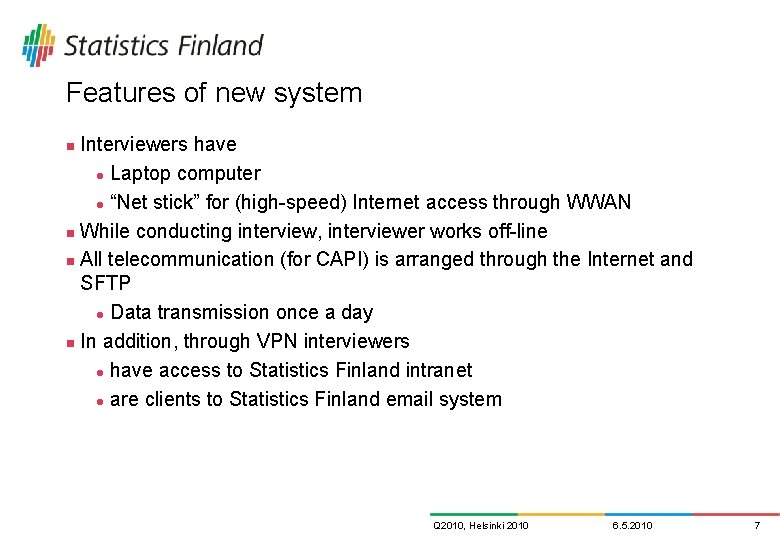
Features of new system Interviewers have l Laptop computer l “Net stick” for (high-speed) Internet access through WWAN n While conducting interview, interviewer works off-line n All telecommunication (for CAPI) is arranged through the Internet and SFTP l Data transmission once a day n In addition, through VPN interviewers l have access to Statistics Finland intranet l are clients to Statistics Finland email system n Q 2010, Helsinki 2010 6. 5. 2010 7
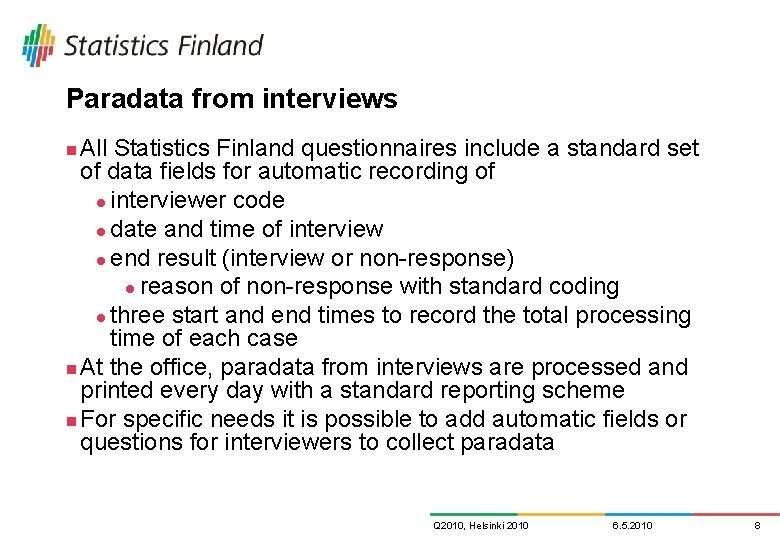
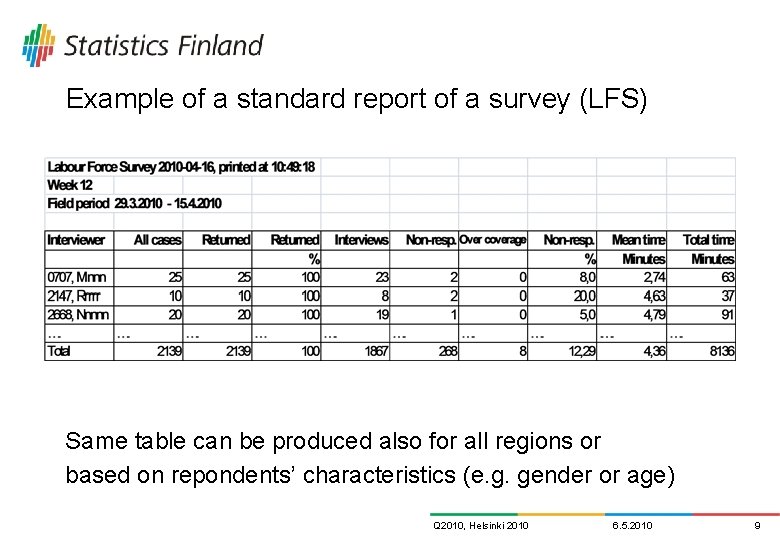
Paradata from interviews All Statistics Finland questionnaires include a standard set of data fields for automatic recording of l interviewer code l date and time of interview l end result (interview or non-response) l reason of non-response with standard coding l three start and end times to record the total processing time of each case n At the office, paradata from interviews are processed and printed every day with a standard reporting scheme n For specific needs it is possible to add automatic fields or questions for interviewers to collect paradata n Q 2010, Helsinki 2010 6. 5. 2010 8
Example of a standard report of a survey (LFS) Same table can be produced also for all regions or based on repondents’ characteristics (e. g. gender or age) Q 2010, Helsinki 2010 6. 5. 2010 9
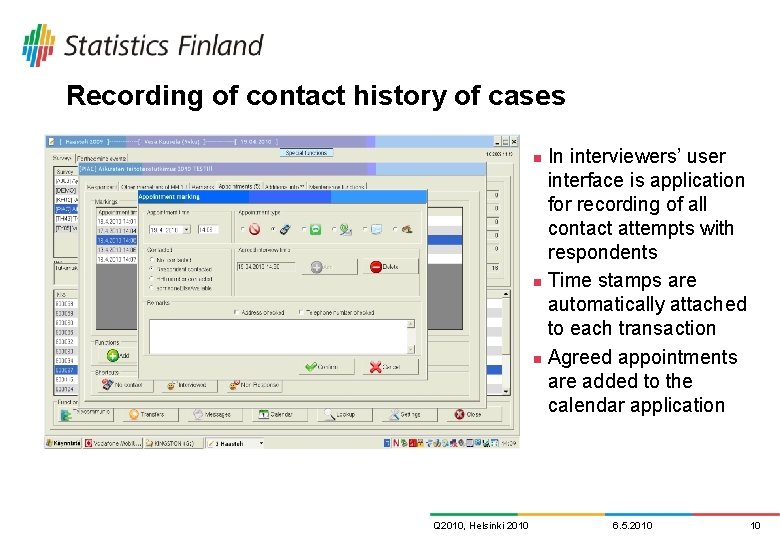
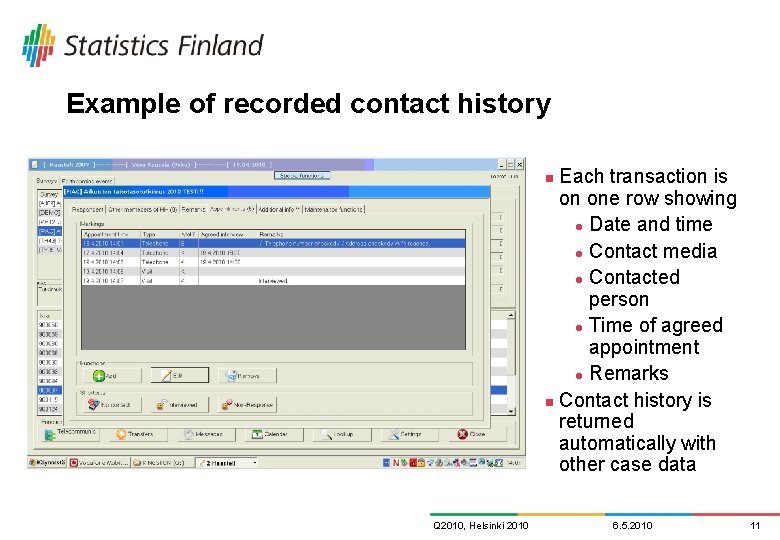
Recording of contact history of cases In interviewers’ user interface is application for recording of all contact attempts with respondents n Time stamps are automatically attached to each transaction n Agreed appointments are added to the calendar application n Q 2010, Helsinki 2010 6. 5. 2010 10
Example of recorded contact history Each transaction is on one row showing l Date and time l Contact media l Contacted person l Time of agreed appointment l Remarks n Contact history is returned automatically with other case data n Q 2010, Helsinki 2010 6. 5. 2010 11
Possibilities provided by new technology Technically, the amount of collected paradata is no problem anymore l Very large paradata files can be sent, e. g. audit trail files, audio files and video files n Many features of CATI case management can be installed in the new CAPI system l Some new possibilities for CAPI system design also emerge l New approach to paradata collection n The difficult question is what to do with the paradata n Q 2010, Helsinki 2010 6. 5. 2010 12
Questions in paradata collection For what purpose is paradata collected? l Quality control and quality assurance? l To increase cost-efficiency of data collection? n How is paradata collection arranged? l Automatically l Requires some standardisation in data collection l Interviewers enter appropriate data l Causes extra cost if interviewers are paid by hour l By supervisors from other process or administrative information n How is the reporting arranged? l Automatic reporting l Ad hoc –type reporting n What about feedback for process control? n Q 2010, Helsinki 2010 6. 5. 2010 13
Future scenarios Technically, CAPI case management with WWAN could be designed similarly as in a CATI system l Storing data real-time in a central data base is possible already (on-line interviewing) l Case assignment to interviewers is more problematic l Connection between interviewer and office can be arranged using e. g. VPN or Citrix n For example, it is possible to build a system where supervisors see in real time when an interviewer is conducting an interview and for what survey n Q 2010, Helsinki 2010 6. 5. 2010 14
The end Thank you for your attention Q 2010, Helsinki 2010 6. 5. 2010 15