Cncer de pulmn no microctico EGFR mutado Optimizacin


- Slides: 50
Cáncer de pulmón no microcítico EGFR mutado: Optimización del manejo del paciente Manuel Cobo Dols Oncologia Médica H Regional Universitario Málaga. IBIMA 12 -4 -2018
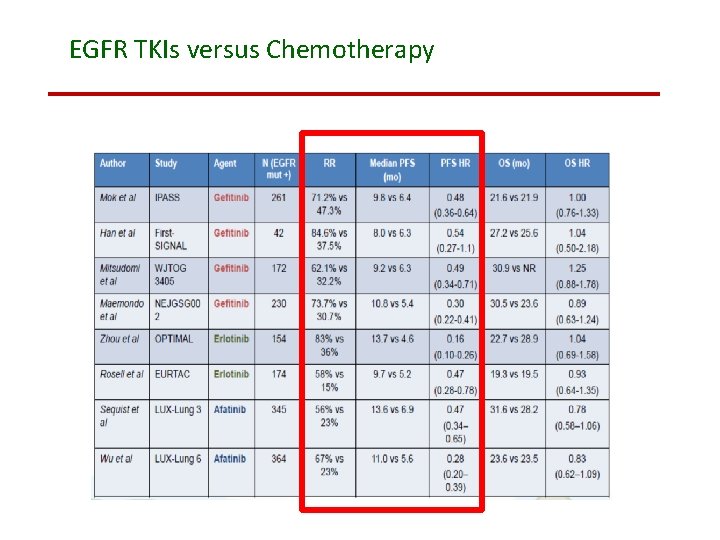
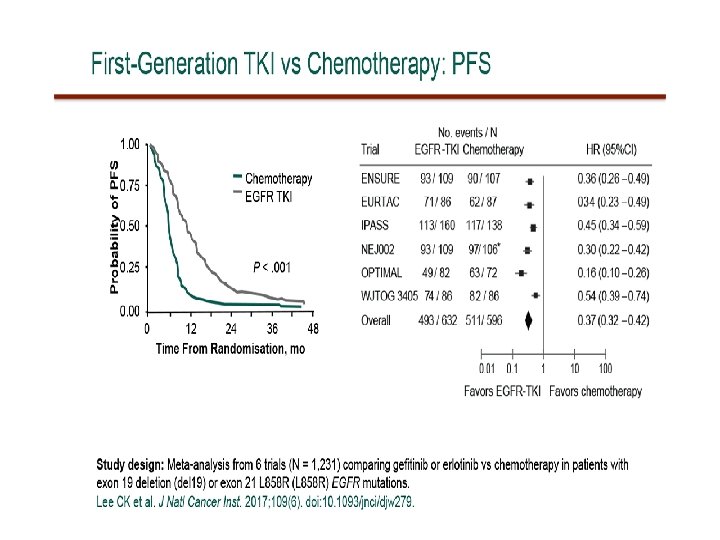
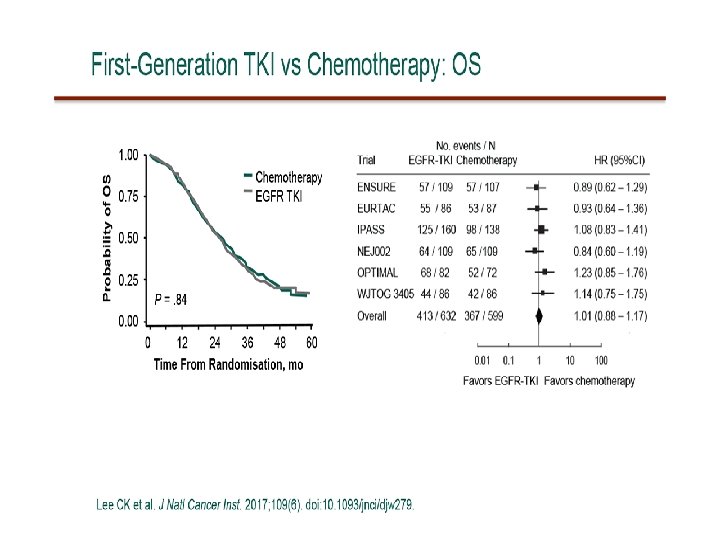
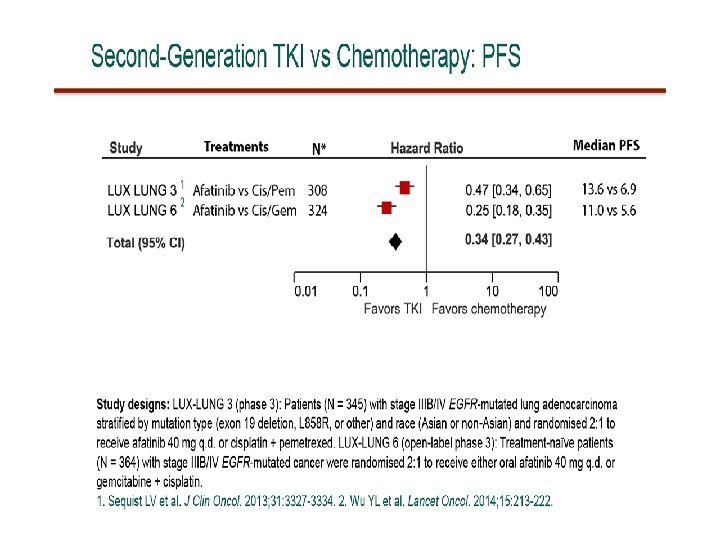
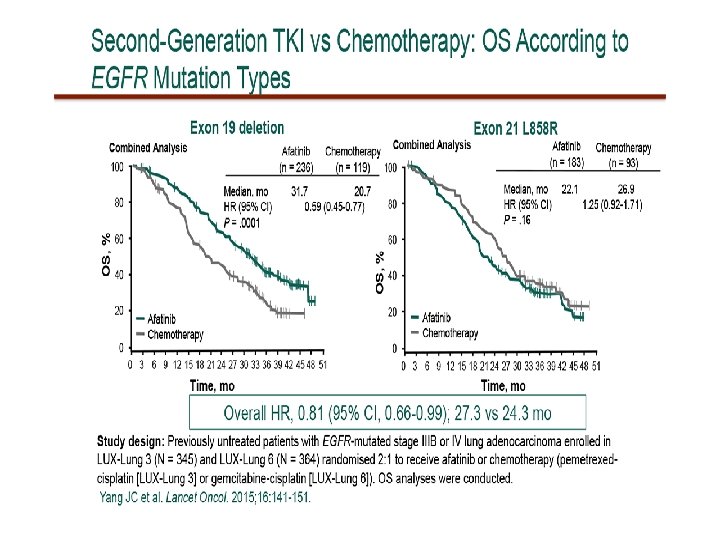
EGFR TKIs versus Chemotherapy
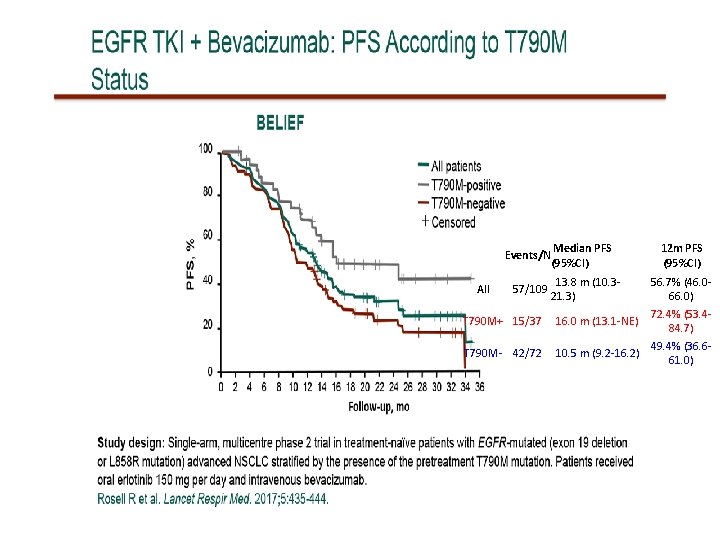
Events/N All 57/109 T 790 M+ 15/37 T 790 M- 42/72 Median PFS (95%CI) 13. 8 m (10. 321. 3) 12 m PFS (95%CI) 56. 7% (46. 066. 0) 72. 4% (53. 416. 0 m (13. 1 -NE) 84. 7) 49. 4% (36. 610. 5 m (9. 2 -16. 2) 61. 0)
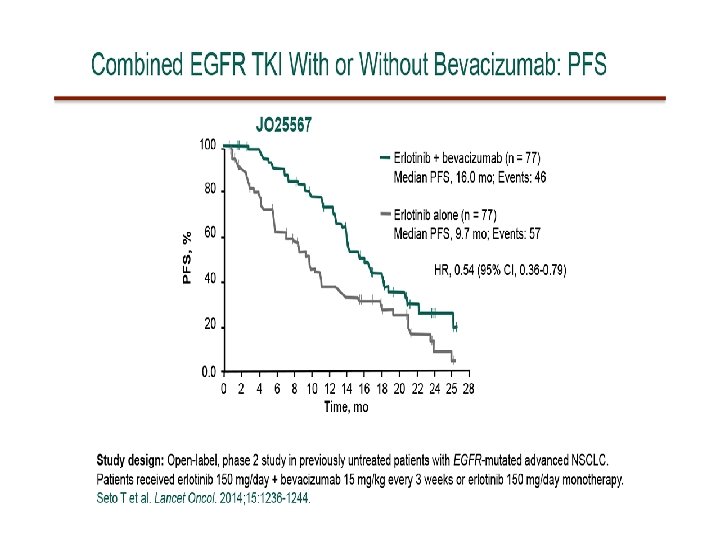
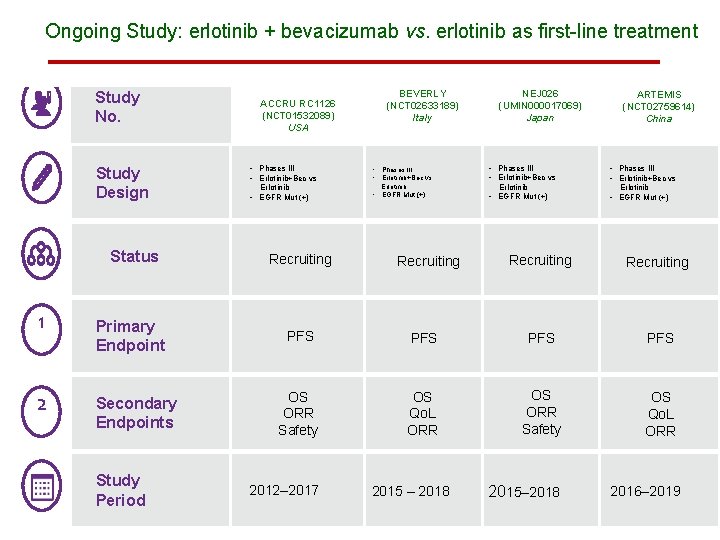
Ongoing Study: erlotinib + bevacizumab vs. erlotinib as first-line treatment Study No. Study Design Status 1 2 Primary Endpoint Secondary Endpoints Study Period BEVERLY (NCT 02633189) Italy ACCRU RC 1126 (NCT 01532089) USA • Phases III • Erlotinib+Bec vs Erlotinib • EGFR Mut (+) Recruiting • • • Phases III Erlotinib+Bec vs Erlotinib EGFR Mut (+) Recruiting NEJ 026 (UMIN 000017069) Japan • Phases III • Erlotinib+Bec vs Erlotinib • EGFR Mut (+) ARTEMIS (NCT 02759614) China • Phases III • Erlotinib+Bec vs Erlotinib • EGFR Mut (+) Recruiting PFS PFS OS ORR Safety OS Qo. L ORR 2015– 2018 2016– 2019 2012– 2017 2015 – 2018
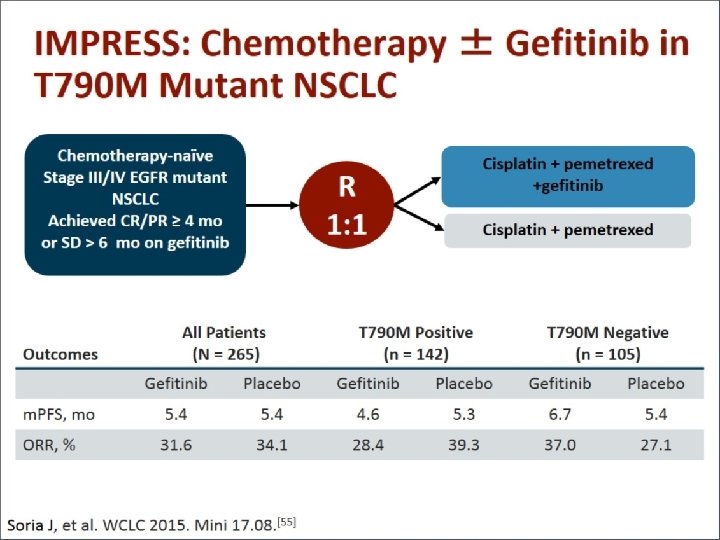
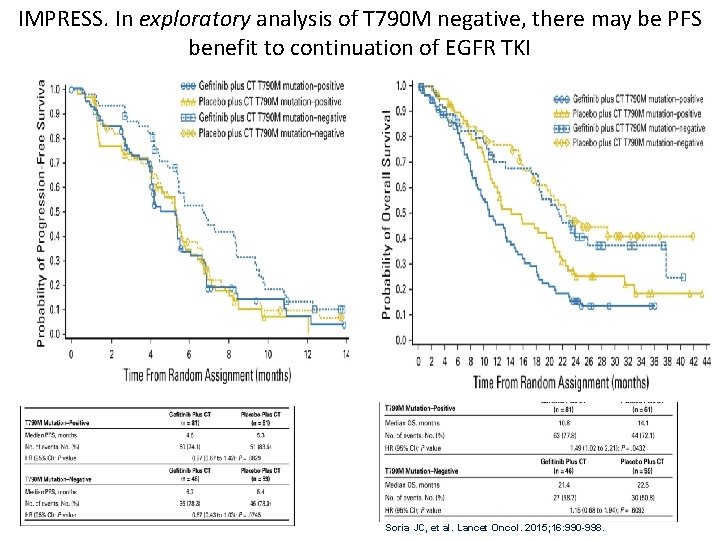
IMPRESS. In exploratory analysis of T 790 M negative, there may be PFS benefit to continuation of EGFR TKI Soria JC, et al. Lancet Oncol. 2015; 16: 990 -998.
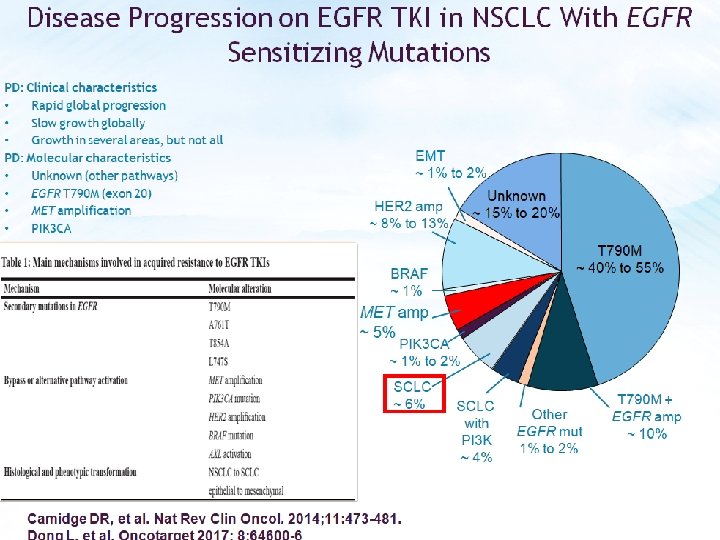
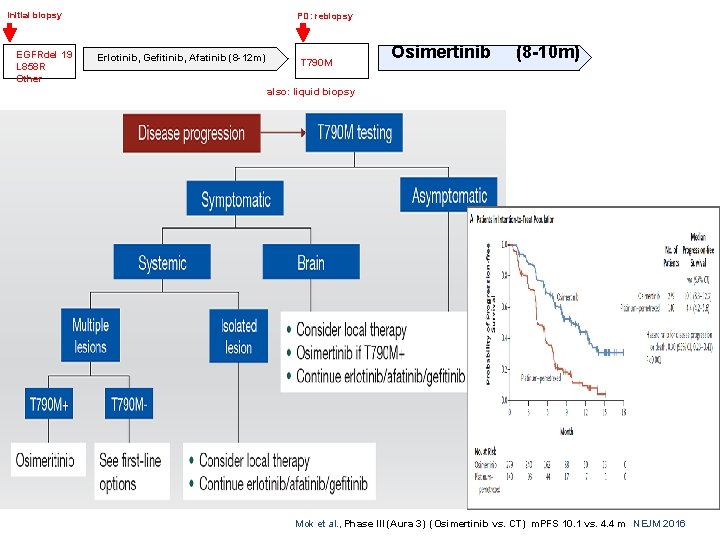
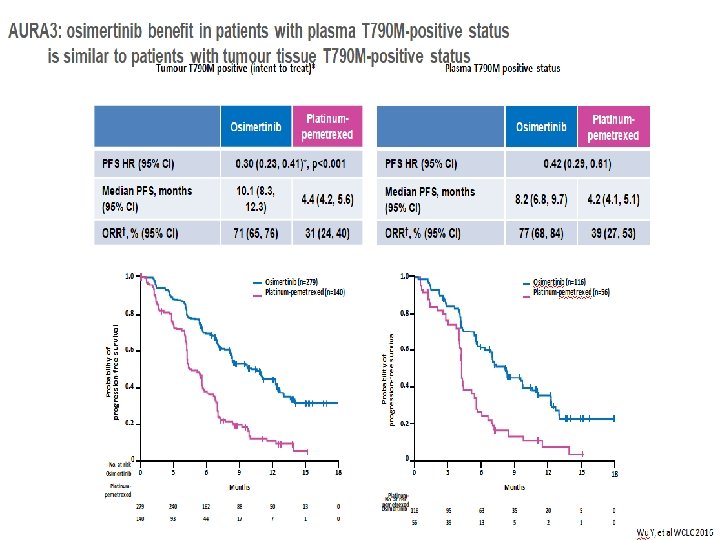
Initial biopsy EGFRdel 19 L 858 R Other PD: rebiopsy Erlotinib, Gefitinib, Afatinib (8 -12 m) T 790 M Osimertinib (8 -10 m) also: liquid biopsy Mok et al. , Phase III (Aura 3) (Osimertinib vs. CT) m. PFS 10. 1 vs. 4. 4 m NEJM 2016
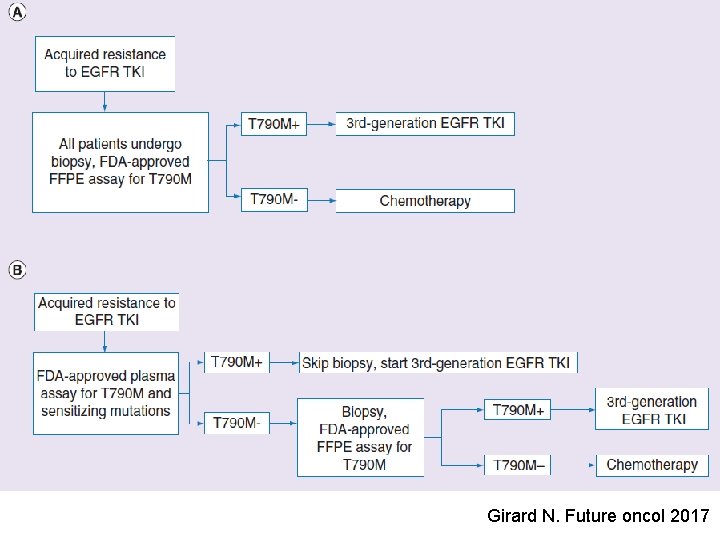
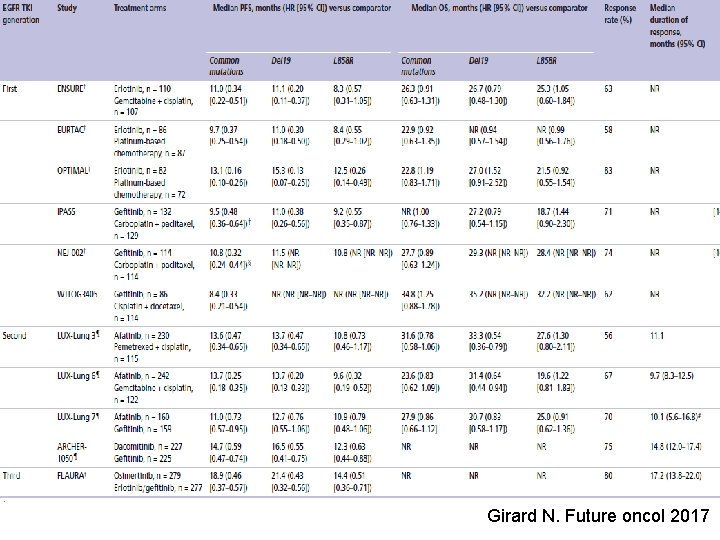
Girard N. Future oncol 2017
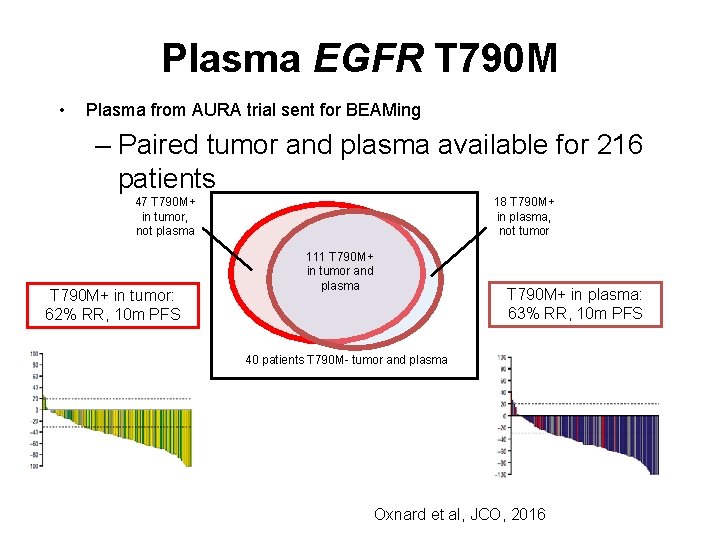
Plasma EGFR T 790 M • Plasma from AURA trial sent for BEAMing – Paired tumor and plasma available for 216 patients 47 T 790 M+ in tumor, not plasma T 790 M+ in tumor: 62% RR, 10 m PFS 18 T 790 M+ in plasma, not tumor 111 T 790 M+ in tumor and plasma T 790 M+ in plasma: 63% RR, 10 m PFS 40 patients T 790 M- tumor and plasma Oxnard et al, JCO, 2016
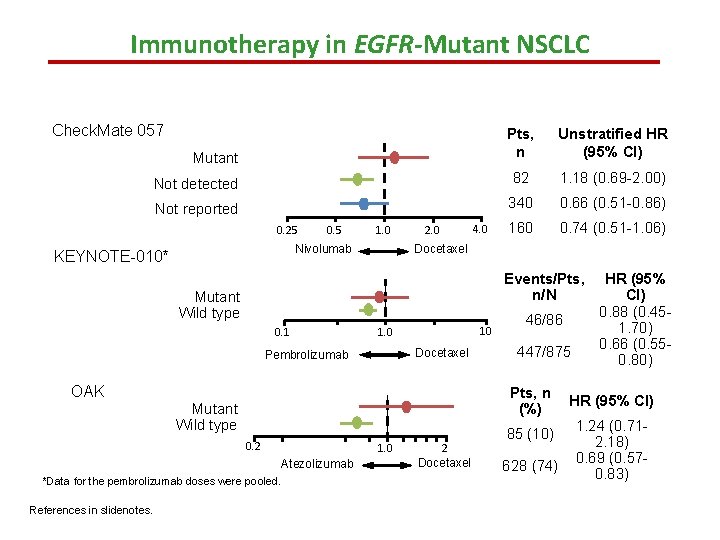
Immunotherapy in EGFR-Mutant NSCLC Check. Mate 057 Pts, n Unstratified HR (95% CI) Not detected 82 1. 18 (0. 69 -2. 00) Not reported 340 0. 66 (0. 51 -0. 86) 160 0. 74 (0. 51 -1. 06) Mutant 0. 25 0. 5 1. 0 Nivolumab KEYNOTE-010* 2. 0 4. 0 Docetaxel Events/Pts, n/N Mutant Wild type 0. 1 10 1. 0 Docetaxel Pembrolizumab OAK 447/875 Pts, n (%) Mutant Wild type 0. 2 1. 0 Atezolizumab *Data for the pembrolizumab doses were pooled. References in slidenotes. 46/86 2 Docetaxel 85 (10) 628 (74) HR (95% CI) 0. 88 (0. 451. 70) 0. 66 (0. 550. 80) HR (95% CI) 1. 24 (0. 712. 18) 0. 69 (0. 570. 83)
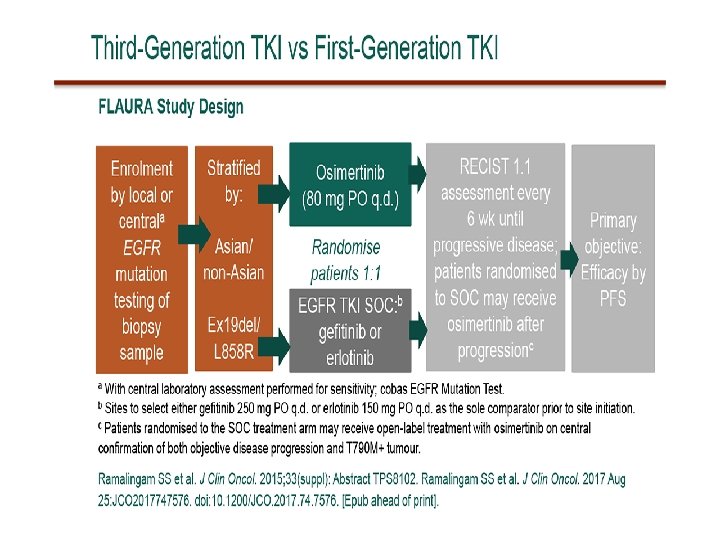
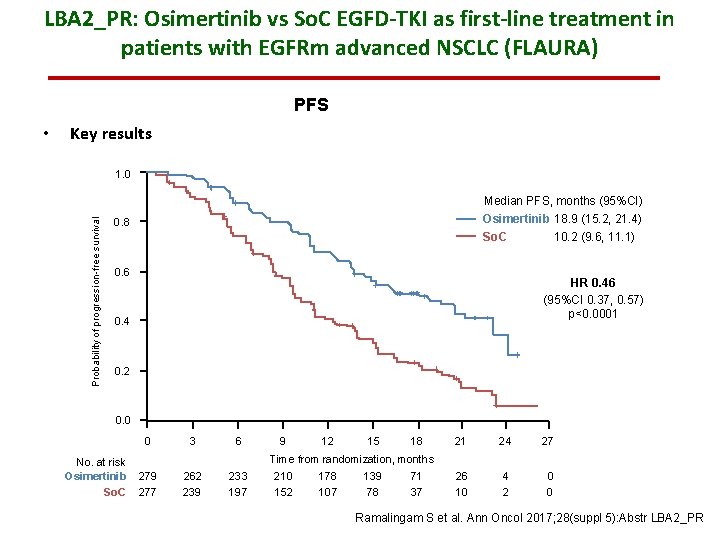
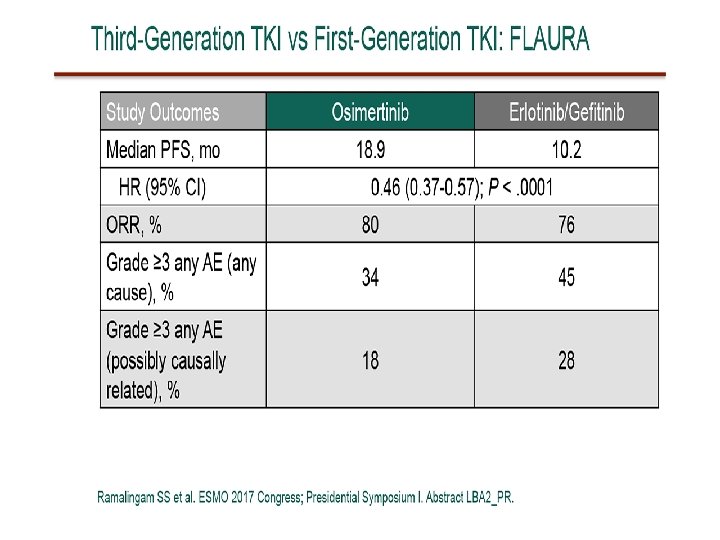
LBA 2_PR: Osimertinib vs So. C EGFD-TKI as first-line treatment in patients with EGFRm advanced NSCLC (FLAURA) PFS Key results 1. 0 Probability of progression-free survival • Median PFS, months (95%CI) Osimertinib 18. 9 (15. 2, 21. 4) So. C 10. 2 (9. 6, 11. 1) 0. 8 0. 6 HR 0. 46 (95%CI 0. 37, 0. 57) p<0. 0001 0. 4 0. 2 0. 0 0 No. at risk Osimertinib So. C 3 6 9 12 15 18 21 24 27 26 10 4 2 0 0 Time from randomization, months 279 277 262 239 233 197 210 152 178 107 139 78 71 37 Ramalingam S et al. Ann Oncol 2017; 28(suppl 5): Abstr LBA 2_PR
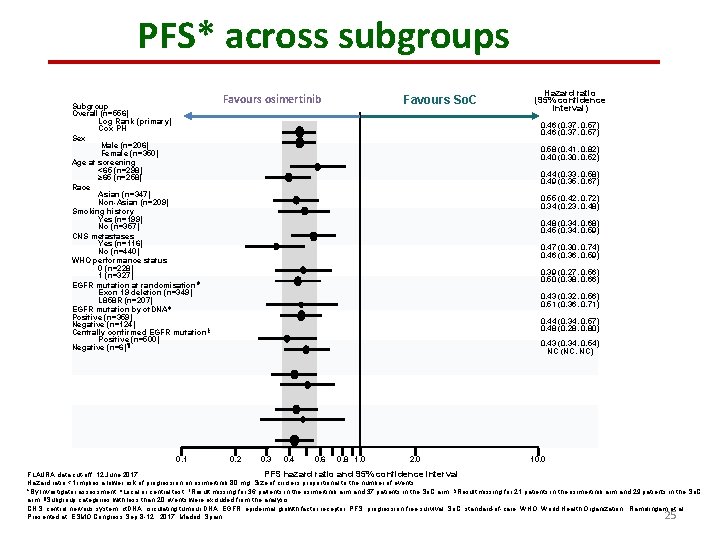
PFS* across subgroups Subgroup Overall (n=556) Log Rank (primary) Cox PH Sex Male (n=206) Female (n=350) Age at screening <65 (n=298) ≥ 65 (n=258) Race Asian (n=347) Non-Asian (n=209) Smoking history Yes (n=199) No (n=357) CNS metastases Yes (n=116) No (n=440) WHO performance status 0 (n=228) 1 (n=327) EGFR mutation at randomisation # Exon 19 deletion (n=349) L 858 R (n=207) EGFR mutation by ct. DNAǂ Positive (n=359) Negative (n=124) Centrally confirmed EGFR mutation § Positive (n=500) Negative (n=6)¶ 0. 1 Favours osimertinib Favours So. C Hazard ratio (95% confidence interval) 0. 46 (0. 37, 0. 57) 0. 58 (0. 41, 0. 82) 0. 40 (0. 30, 0. 52) 0. 44 (0. 33, 0. 58) 0. 49 (0. 35, 0. 67) 0. 55 (0. 42, 0. 72) 0. 34 (0. 23, 0. 48) 0. 48 (0. 34, 0. 68) 0. 45 (0. 34, 0. 59) 0. 47 (0. 30, 0. 74) 0. 46 (0. 36, 0. 59) 0. 39 (0. 27, 0. 56) 0. 50 (0. 38, 0. 66) 0. 43 (0. 32, 0. 56) 0. 51 (0. 36, 0. 71) 0. 44 (0. 34, 0. 57) 0. 48 (0. 28, 0. 80) 0. 43 (0. 34, 0. 54) NC (NC, NC) 0. 2 0. 3 0. 4 0. 6 0. 8 1. 0 2. 0 10. 0 FLAURA data cut-off: 12 June 2017 PFS hazard ratio and 95% confidence interval Hazard ratio <1 implies a lower risk of progression on osimertinib 80 mg. Size of circle is proportional to the number of events # ǂ *By Investigator assessment; Local or central test; Result missing for 36 patients in the osimertinib arm and 37 patients in the So. C arm; §Result missing for 21 patients in the osimertinib arm and 29 patients in the So. C arm; ¶Subgroup categories with less than 20 events were excluded from the analysis CNS, central nervous system; ct. DNA, circulating tumour DNA; EGFR, epidermal growth factor receptor; PFS, progression-free survival; So. C, standard-of-care; WHO, World Health Organization. Ramalingam et al. Presented at : ESMO Congress Sep 8 -12, , 2017; Madrid, Spain. 25
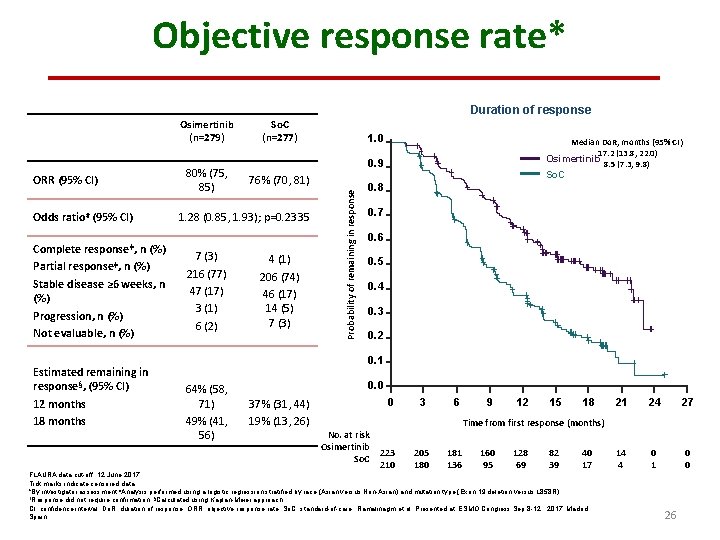
Objective response rate* Duration of response ORR (95% CI) Odds ratio# (95% CI) Complete responseǂ, n (%) Partial responseǂ, n (%) Stable disease ≥ 6 weeks, n (%) Progression, n (%) Not evaluable, n (%) Estimated remaining in response§, (95% CI) 12 months 18 months 80% (75, 85) So. C (n=277) Median Do. R, months (95% CI) 17. 2 (13. 8, 22. 0) Osimertinib 8. 5 (7. 3, 9. 8) 0. 9 76% (70, 81) 1. 28 (0. 85, 1. 93); p=0. 2335 7 (3) 216 (77) 47 (17) 3 (1) 6 (2) 1. 0 4 (1) 206 (74) 46 (17) 14 (5) 7 (3) Probability of remaining in response Osimertinib (n=279) So. C 0. 8 0. 7 0. 6 0. 5 0. 4 0. 3 0. 2 0. 1 64% (58, 71) 49% (41, 56) 0. 0 0 37% (31, 44) 19% (13, 26) No. at risk Osimertinib So. C 3 6 9 12 15 18 21 24 27 14 4 0 1 0 0 Time from first response (months) 223 210 205 180 181 136 160 95 128 69 82 39 40 17 FLAURA data cut-off: 12 June 2017 Tick marks indicate censored data *By investigator assessment #Analysis performed using a logistic regression stratified by race (Asian versus Non-Asian) and mutation type (Exon 19 deletion versus L 858 R); ǂResponse did not require confirmation; §Calculated using Kaplan-Meier approach CI, confidence interval; Do. R, duration of response; ORR, objective response rate; So. C, standard-of-care. Ramalinagm et al. Presented at : ESMO Congress Sep 8 -12, , 2017; Madrid, Spain. 26
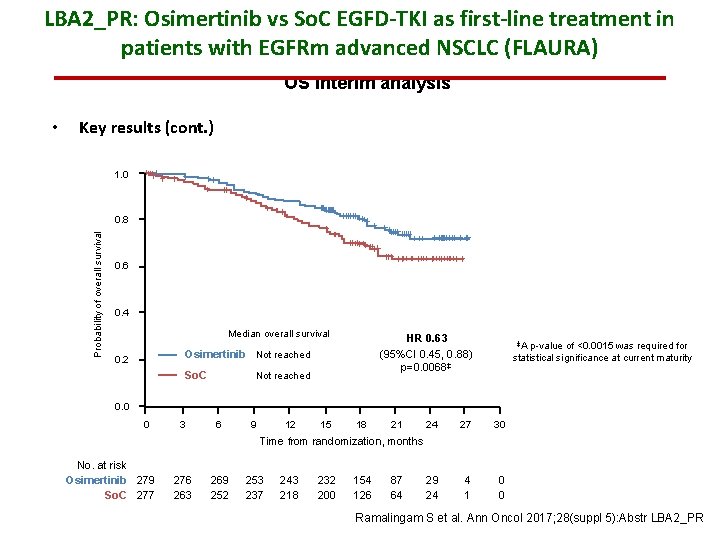
LBA 2_PR: Osimertinib vs So. C EGFD-TKI as first-line treatment in patients with EGFRm advanced NSCLC (FLAURA) OS interim analysis Key results (cont. ) 1. 0 0. 8 Probability of overall survival • 0. 6 0. 4 Median overall survival HR 0. 63 (95%CI 0. 45, 0. 88) p=0. 0068‡ Osimertinib Not reached 0. 2 So. C Not reached ‡A p-value of <0. 0015 was required for statistical significance at current maturity 0. 0 0 3 6 9 12 15 18 21 24 27 30 29 24 4 1 0 0 Time from randomization, months No. at risk Osimertinib 279 So. C 277 276 263 269 252 253 237 243 218 232 200 154 126 87 64 Ramalingam S et al. Ann Oncol 2017; 28(suppl 5): Abstr LBA 2_PR
Girard N. Future oncol 2017
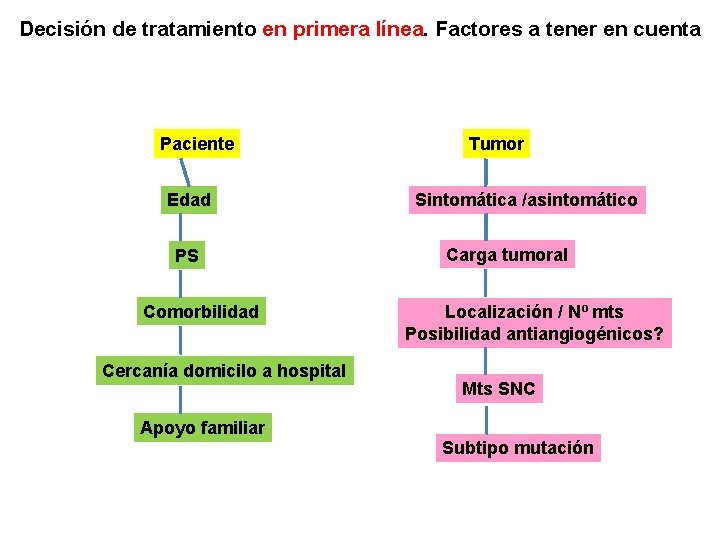
Decisión de tratamiento en primera línea. Factores a tener en cuenta Paciente Edad PS Comorbilidad Cercanía domicilo a hospital Tumor Sintomática /asintomático Carga tumoral Localización / Nº mts Posibilidad antiangiogénicos? Mts SNC Apoyo familiar Subtipo mutación
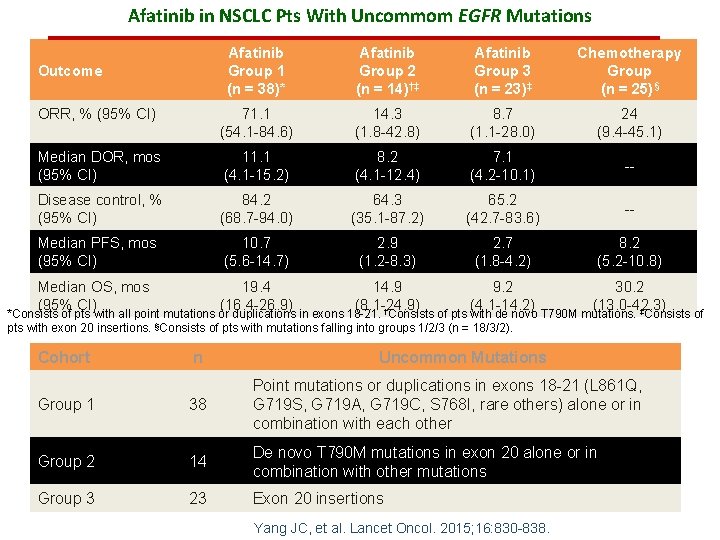
Afatinib in NSCLC Pts With Uncommom EGFR Mutations Afatinib Group 1 (n = 38)* Afatinib Group 2 (n = 14)†‡ Afatinib Group 3 (n = 23)‡ Chemotherapy Group (n = 25)§ ORR, % (95% CI) 71. 1 (54. 1 -84. 6) 14. 3 (1. 8 -42. 8) 8. 7 (1. 1 -28. 0) 24 (9. 4 -45. 1) Median DOR, mos (95% CI) 11. 1 (4. 1 -15. 2) 8. 2 (4. 1 -12. 4) 7. 1 (4. 2 -10. 1) -- Disease control, % (95% CI) 84. 2 (68. 7 -94. 0) 64. 3 (35. 1 -87. 2) 65. 2 (42. 7 -83. 6) -- Median PFS, mos (95% CI) 10. 7 (5. 6 -14. 7) 2. 9 (1. 2 -8. 3) 2. 7 (1. 8 -4. 2) 8. 2 (5. 2 -10. 8) Median OS, mos (95% CI) 19. 4 (16. 4 -26. 9) 14. 9 (8. 1 -24. 9) † 9. 2 (4. 1 -14. 2) 30. 2 (13. 0 -42. 3) ‡ Outcome *Consists of pts with all point mutations or duplications in exons 18 -21. Consists of pts with de novo T 790 M mutations. Consists of pts with exon 20 insertions. §Consists of pts with mutations falling into groups 1/2/3 (n = 18/3/2). Cohort n Uncommon Mutations Group 1 38 Point mutations or duplications in exons 18 -21 (L 861 Q, G 719 S, G 719 A, G 719 C, S 768 I, rare others) alone or in combination with each other Group 2 14 De novo T 790 M mutations in exon 20 alone or in combination with other mutations Group 3 23 Exon 20 insertions Yang JC, et al. Lancet Oncol. 2015; 16: 830 -838.
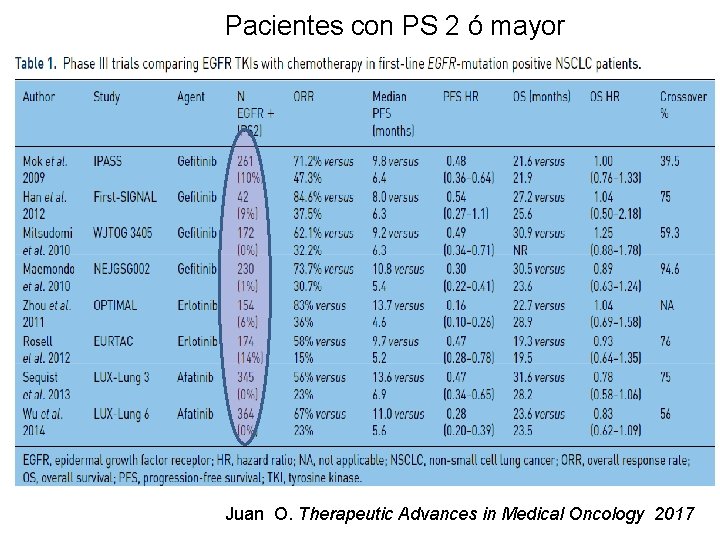
Pacientes con PS 2 ó mayor Juan O. Therapeutic Advances in Medical Oncology 2017
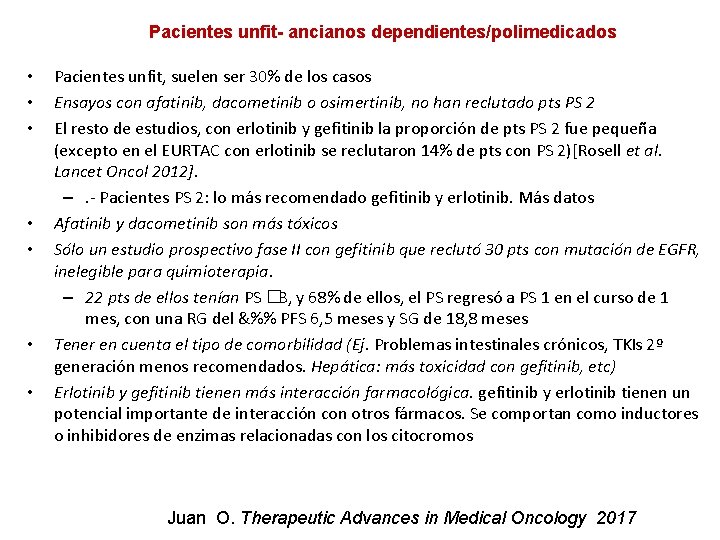
Pacientes unfit- ancianos dependientes/polimedicados • • Pacientes unfit, suelen ser 30% de los casos Ensayos con afatinib, dacometinib o osimertinib, no han reclutado pts PS 2 El resto de estudios, con erlotinib y gefitinib la proporción de pts PS 2 fue pequeña (excepto en el EURTAC con erlotinib se reclutaron 14% de pts con PS 2)[Rosell et al. Lancet Oncol 2012]. –. - Pacientes PS 2: lo más recomendado gefitinib y erlotinib. Más datos Afatinib y dacometinib son más tóxicos Sólo un estudio prospectivo fase II con gefitinib que reclutó 30 pts con mutación de EGFR, inelegible para quimioterapia. – 22 pts de ellos tenían PS � 3, y 68% de ellos, el PS regresó a PS 1 en el curso de 1 mes, con una RG del &%% PFS 6, 5 meses y SG de 18, 8 meses Tener en cuenta el tipo de comorbilidad (Ej. Problemas intestinales crónicos, TKIs 2º generación menos recomendados. Hepática: más toxicidad con gefitinib, etc) Erlotinib y gefitinib tienen más interacción farmacológica. gefitinib y erlotinib tienen un potencial importante de interacción con otros fármacos. Se comportan como inductores o inhibidores de enzimas relacionadas con los citocromos Juan O. Therapeutic Advances in Medical Oncology 2017
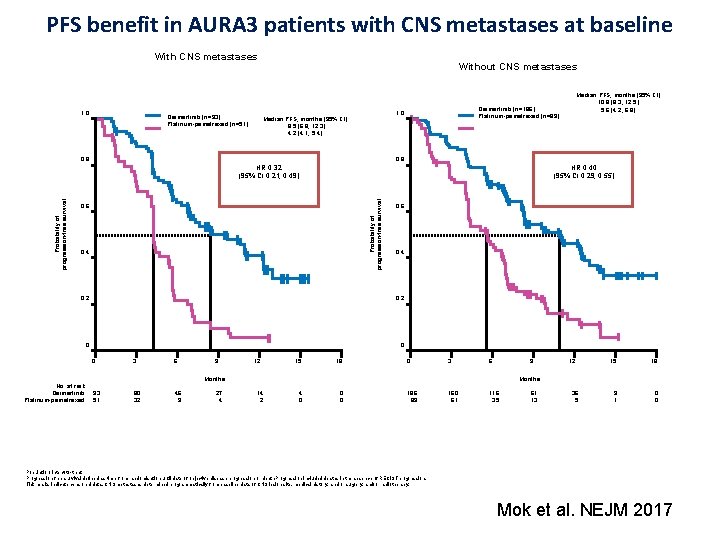
PFS benefit in AURA 3 patients with CNS metastases at baseline With CNS metastases 1. 0 Osimertinib (n=93) Platinum-pemetrexed (n=51) Without CNS metastases 1. 0 Median PFS, months (95% CI) 8. 5 (6. 8, 12. 3) 4. 2 (4. 1, 5. 4) 0. 8 HR 0. 40 (95% CI 0. 29, 0. 55) Probability of progression-free survival HR 0. 32 (95% CI 0. 21, 0. 49) 0. 6 0. 4 0. 2 0 0 0 3 6 93 51 80 32 46 9 9 12 15 18 4 0 0 3 6 9 186 89 160 61 116 35 Months No. at risk Osimertinib Platinum-pemetrexed Median PFS, months (95% CI) 10. 8 (8. 3, 12. 5) 5. 6 (4. 2, 6. 8) Osimertinib (n=186) Platinum-pemetrexed (n=89) 27 4 12 15 18 9 1 0 0 Months 14 2 61 13 36 5 Population: intent-to-treat Progression-free survival defined as time from randomisation until date of objective disease progression or death. Progression included deaths in the absence of RECIST progression. Tick marks indicate censored data. CNS metastases determined programmatically from baseline data of CNS lesion site, medical history, and/or surgery, and/or radiotherapy. Mok et al. NEJM 2017
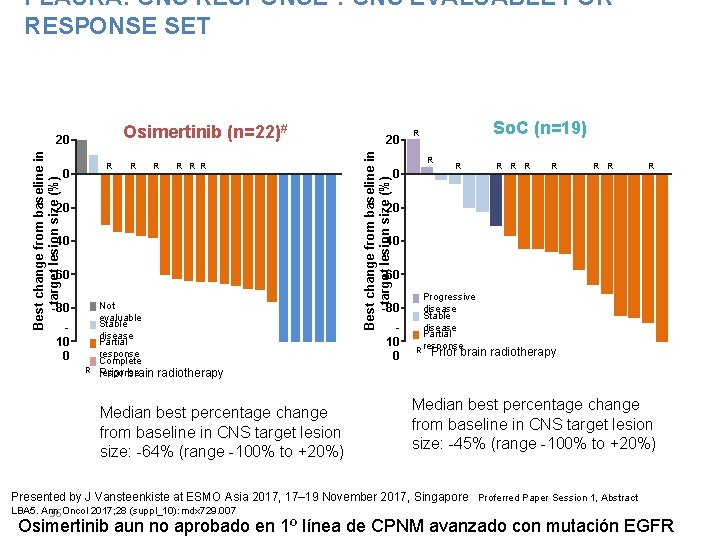
FLAURA: CNS RESPONSE*: CNS EVALUABLE FOR RESPONSE SET Best change from baseline in target lesion size (%) R 0 R R R -20 20 Best change from baseline in target lesion size (%) Osimertinib (n=22)# 20 So. C (n=19) R R 0 R R R R -20 -40 -60 -80 10 0 R Not evaluable Stable disease Partial response Complete response Prior brain -80 10 0 Progressive disease Stable disease Partial R response Prior brain radiotherapy Median best percentage change from baseline in CNS target lesion size: -64% (range -100% to +20%) Median best percentage change from baseline in CNS target lesion size: -45% (range -100% to +20%) Presented by J Vansteenkiste at ESMO Asia 2017, 17– 19 November 2017, Singapore Proferred Paper Session 1, Abstract LBA 5. Ann 36 Oncol 2017; 28 (suppl_10): mdx 729. 007 Osimertinib aun no aprobado en 1º línea de CPNM avanzado con mutación EGFR
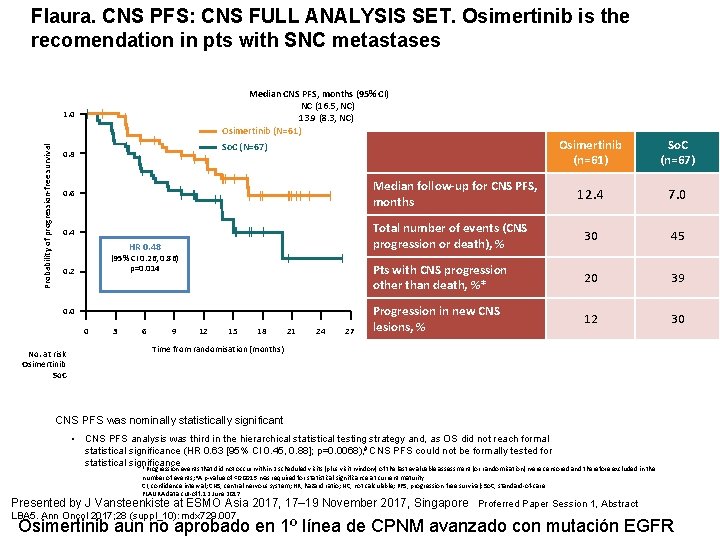
Flaura. CNS PFS: CNS FULL ANALYSIS SET. Osimertinib is the recomendation in pts with SNC metastases Median CNS PFS, months (95% CI) NC (16. 5, NC) 13. 9 (8. 3, NC) Osimertinib (N=61) Probability of progression-free survival 1. 0 So. C (N=67) 0. 8 Osimertinib (n=61) So. C (n=67) 12. 4 7. 0 0. 6 Median follow-up for CNS PFS, months 0. 4 Total number of events (CNS progression or death), % 30 45 Pts with CNS progression other than death, %* 20 39 Progression in new CNS lesions, % 12 30 HR 0. 48 (95% CI 0. 26, 0. 86) p=0. 014 0. 2 0. 0 0 No. at risk Osimertinib So. C 3 6 9 12 15 18 21 24 27 Time from randomisation (months) CNS PFS was nominally statistically significant • CNS PFS analysis was third in the hierarchical statistical testing strategy and, as OS did not reach formal statistical significance (HR 0. 63 [95% CI 0. 45, 0. 88]; p=0. 0068), # CNS PFS could not be formally tested for statistical significance *Progression events that did not occur within 2 scheduled visits (plus visit window) of the last evaluable assessment (or randomisation) were censored and therefore excluded in the number of events; #A p-value of <0. 0015 was required for statistical significance at current maturity CI, confidence interval; CNS, central nervous system; HR, hazard ratio; NC, not calculable; PFS, progression-free survival; So. C, standard-of-care FLAURA data cut-off: 12 June 2017 Presented by J Vansteenkiste at ESMO Asia 2017, 17– 19 November 2017, Singapore Proferred Paper Session 1, Abstract LBA 5. Ann Oncol 2017; 28 (suppl_10): mdx 729. 007 Osimertinib aun no aprobado en 1º línea de CPNM avanzado con mutación EGFR
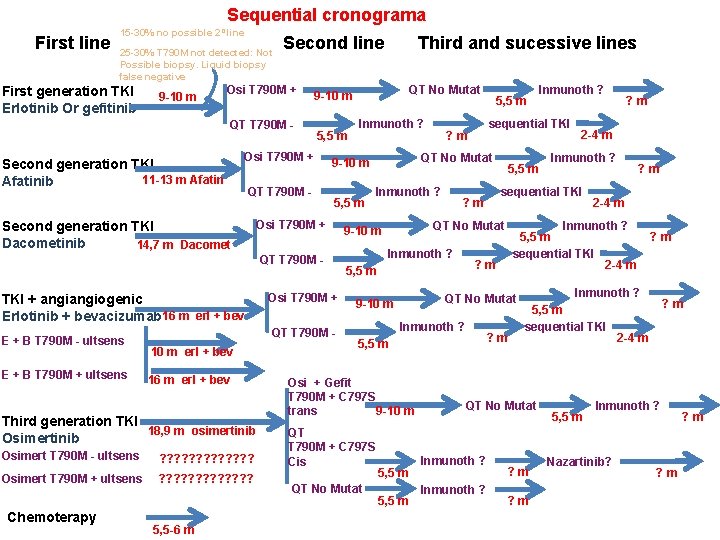
Sequential cronograma First line 15 -30% no possible 2º line 25 -30% T 790 M not detected: Not Possible biopsy. Liquid biopsy false negative First generation TKI Erlotinib Or gefitinib 9 -10 m Second line Osi T 790 M + 5, 5 m Osi T 790 M + QT T 790 M - Second generation TKI Dacometinib 14, 7 m Dacomet 5, 5 m QT T 790 M - E + B T 790 M - ultsens E + B T 790 M + ultsens 16 m erl + bev Third generation TKI 18, 9 m osimertinib Osimert T 790 M - ultsens Osimert T 790 M + ultsens Chemoterapy Osi T 790 M + QT T 790 M - 10 m erl + bev ? ? ? ? ? ? ? 5, 5 -6 m Inmunoth ? QT No Mutat 5, 5 m ? m Inmunoth ? ? m 5, 5 m Osi + Gefit T 790 M + C 797 S 9 -10 m trans 5, 5 m Inmunoth ? ? m 2 -4 m ? m Inmunoth ? 5, 5 m sequential TKI QT No Mutat Inmunoth ? 5, 5 m sequential TKI 2 -4 m QT No Mutat 9 -10 m QT No Mutat 5, 5 m ? m 2 -4 m sequential TKI ? m Inmunoth ? 9 -10 m QT T 790 M + C 797 S Cis 5, 5 m QT No Mutat 9 -10 m Osi T 790 M + TKI + angiogenic Erlotinib + bevacizumab 16 m erl + bev QT No Mutat 9 -10 m QT T 790 M - Second generation TKI 11 -13 m Afatinib Third and sucessive lines ? m 5, 5 m ? m 2 -4 m Inmunoth ? Nazartinib? ? m
CRITICAL QUESTION. When appoved, Osimertinib for all patients in first line EGFR mut, OR sequence has sense in a subgroup of patients?
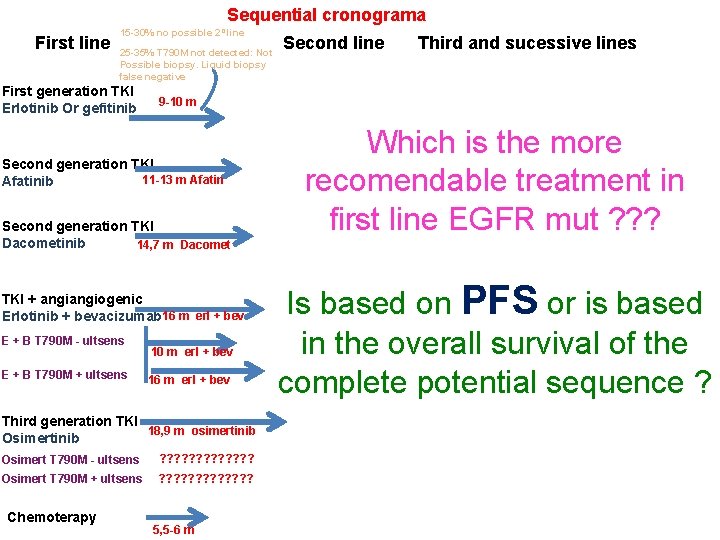
Sequential cronograma First line 15 -30% no possible 2º line 25 -35% T 790 M not detected: Not Possible biopsy. Liquid biopsy false negative First generation TKI Erlotinib Or gefitinib Second generation TKI Dacometinib 14, 7 m Dacomet TKI + angiogenic Erlotinib + bevacizumab 16 m erl + bev E + B T 790 M + ultsens 10 m erl + bev 16 m erl + bev Third generation TKI 18, 9 m osimertinib Osimert T 790 M - ultsens ? ? ? ? Osimert T 790 M + ultsens ? ? ? ? Chemoterapy Third and sucessive lines 9 -10 m Second generation TKI 11 -13 m Afatinib E + B T 790 M - ultsens Second line 5, 5 -6 m Which is the more recomendable treatment in first line EGFR mut ? ? ? Is based on PFS or is based in the overall survival of the complete potential sequence ?
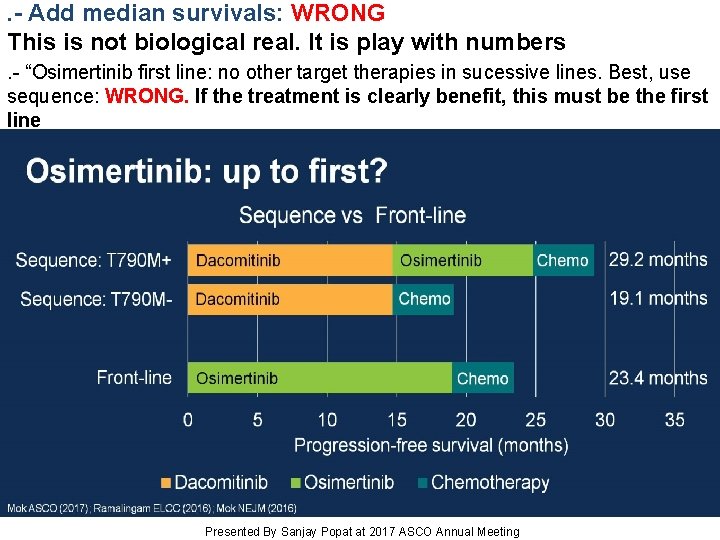
. - Add median survivals: WRONG This is not biological real. It is play with numbers. - “Osimertinib first line: no other target therapies in sucessive lines. Best, use sequence: WRONG. If the treatment is clearly benefit, this must be the first line Osimertinib: up to first? Presented By Sanjay Popat at 2017 ASCO Annual Meeting
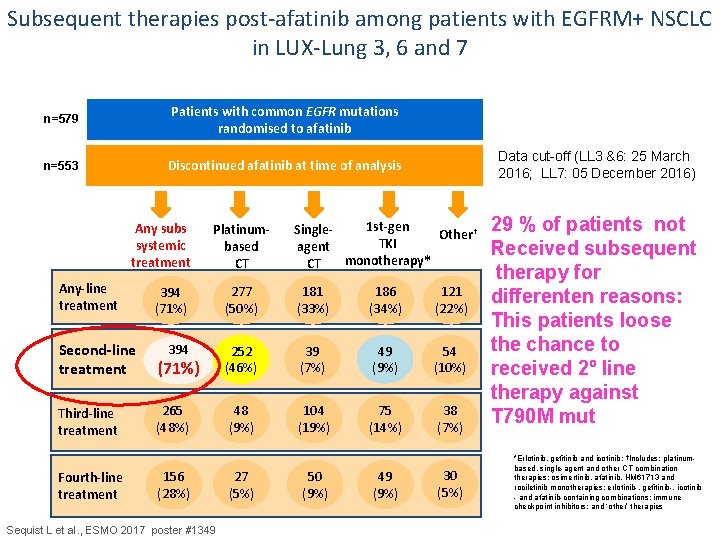
Subsequent therapies post-afatinib among patients with EGFRM+ NSCLC in LUX-Lung 3, 6 and 7 n=579 Patients with common EGFR mutations randomised to afatinib n=553 Discontinued afatinib at time of analysis Any subs systemic treatment Any-line treatment Platinumbased CT Data cut-off (LL 3 &6: 25 March 2016; LL 7: 05 December 2016) 1 st-gen Single. Other† TKI agent monotherapy* CT 394 (71%) 277 (50%) 181 (33%) 186 (34%) 121 (22%) Second-line treatment 394 (71%) 252 (46%) 39 (7%) 49 (9%) 54 (10%) Third-line treatment 265 (48%) 48 (9%) 104 (19%) 75 (14%) 38 (7%) Fourth-line treatment 156 (28%) Sequist L et al. , ESMO 2017 poster #1349 27 (5%) 50 (9%) 49 (9%) 30 (5%) 29 % of patients not Received subsequent therapy for differenten reasons: This patients loose the chance to received 2º line therapy against T 790 M mut *Erlotinib, gefitinib and icotinib; †Includes: platinumbased, single-agent and other CT combination therapies; osimertinib, afatinib, HM 61713 and rociletinib monotherapies; erlotinib-, gefitinib-, icotinib - and afatinib-containing combinations; immune checkpoint inhibitors; and ‘other’ therapies
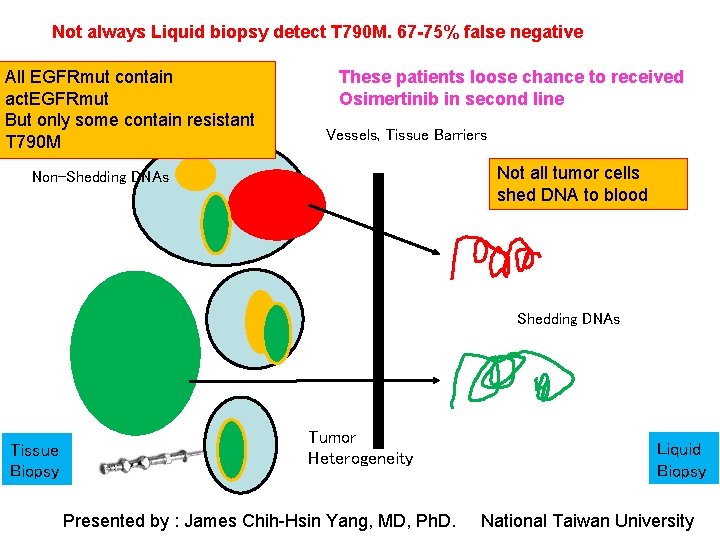
Not always Liquid biopsy detect T 790 M. 67 -75% false negative All EGFRmut contain act. EGFRmut But only some contain resistant T 790 M These patients loose chance to received Osimertinib in second line Vessels, Tissue Barriers Not all tumor cells shed DNA to blood Non-Shedding DNAs Tissue Biopsy Tumor Heterogeneity Presented by : James Chih-Hsin Yang, MD, Ph. D. Liquid Biopsy National Taiwan University
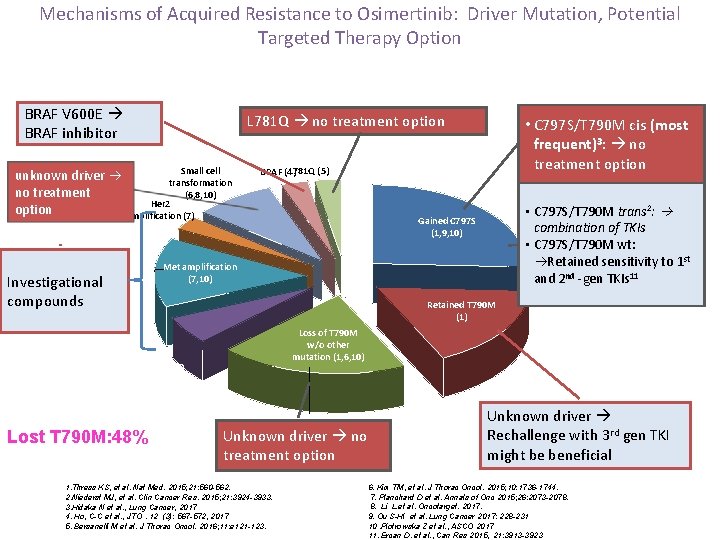
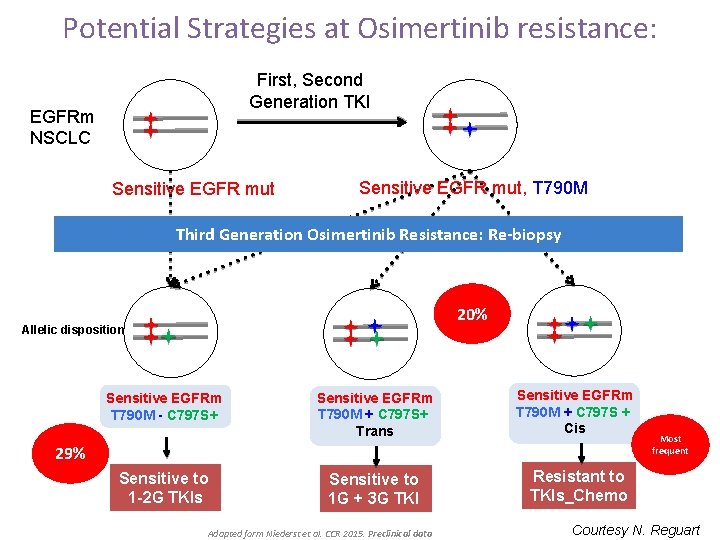
Mechanisms of Acquired Resistance to Osimertinib: Driver Mutation, Potential Targeted Therapy Option BRAF V 600 E BRAF inhibitor unknown driver no treatment option L 781 Q no treatment option Small cell transformation (6, 8, 10) Her 2 amplification (7) • C 797 S/T 790 M cis (most frequent)3: no treatment option L 781 Q (5) BRAF (4) • C 797 S/T 790 M trans 2: combination of TKIs • C 797 S/T 790 M wt: Retained sensitivity to 1 st and 2 nd -gen TKIs 11 Gained C 797 S (1, 9, 10) Met amplification (7, 10) Investigational compounds Retained T 790 M (1) Loss of T 790 M w/o other mutation (1, 6, 10) FGFR amplification (6, 10) Lost T 790 M: 48% Unknown driver no treatment option 1. Thress KS, et al. Nat Med. 2015; 21: 560 -562. 2. Niederst MJ, et al. Clin Cancer Res. 2015; 21: 3924 -3933. 3. Hidaka N et al. , Lung Cancer, 2017 4. Ho, C-C et al. , JTO. 12 (3): 567 -572, 2017 5. Bersanelli M et al. J Thorac Oncol. 2016; 11: e 121 -123. Unknown driver Rechallenge with 3 rd gen TKI might be beneficial 6. Kim TM, et al. J Thorac Oncol. 2015; 10: 1736 -1744. 7. Planchard D et al. Annals of Onc 2015; 26: 2073 -2078. Li L et al. Oncotarget. 2017. 9. Ou S-HI et al. Lung Cancer 2017: 228 -231 10. Piotrowska Z et al. , ASCO 2017 11. Ercan D. et al. , Can Res 2015, 21: 3913 -3923
Potential Strategies at Osimertinib resistance: First, Second Generation TKI EGFRm NSCLC Sensitive EGFR mut, T 790 M Third Generation Osimertinib Resistance: Re-biopsy 20% Allelic disposition Sensitive EGFRm T 790 M - C 797 S+ Sensitive EGFRm T 790 M + C 797 S+ Trans Sensitive EGFRm T 790 M + C 797 S + Cis Sensitive to 1 G + 3 G TKI Resistant to TKIs_Chemo 29% Sensitive to 1 -2 G TKIs Adapted form Niederst et al. CCR 2015. Preclinical data Most frequent Courtesy N. Reguart
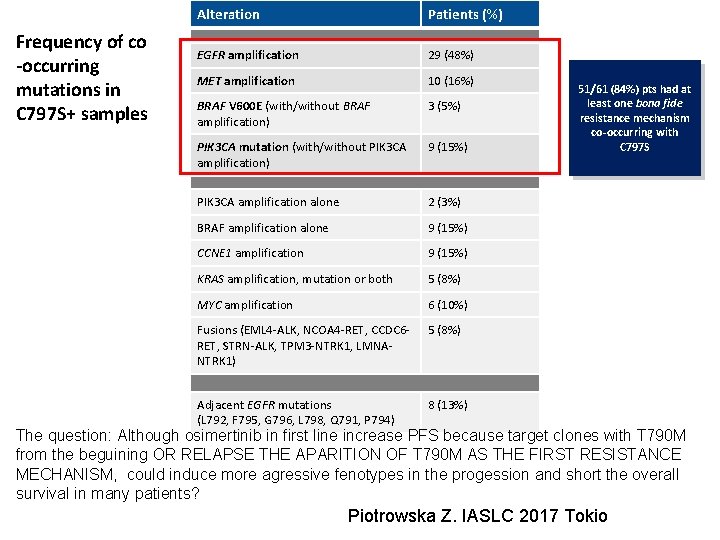
Frequency of co -occurring mutations in C 797 S+ samples Alteration Patients (%) EGFR amplification 29 (48%) MET amplification 10 (16%) BRAF V 600 E (with/without BRAF amplification) 3 (5%) PIK 3 CA mutation (with/without PIK 3 CA amplification) 9 (15%) PIK 3 CA amplification alone 2 (3%) BRAF amplification alone 9 (15%) CCNE 1 amplification 9 (15%) KRAS amplification, mutation or both 5 (8%) MYC amplification 6 (10%) Fusions (EML 4 -ALK, NCOA 4 -RET, CCDC 6 RET, STRN-ALK, TPM 3 -NTRK 1, LMNANTRK 1) 5 (8%) Adjacent EGFR mutations (L 792, F 795, G 796, L 798, Q 791, P 794) 8 (13%) 51/61 (84%) pts had at least one bona fide resistance mechanism co-occurring with C 797 S Genomic landscape of. Although EGFR C 797 S inosimertinib lung cancer ct. DNA, Presented Zofia Piotrowska The question: in first line by increase PFS 9/12 because target clones with T 790 M from the beguining OR RELAPSE THE APARITION OF T 790 M AS THE FIRST RESISTANCE MECHANISM, could induce more agressive fenotypes in the progession and short the overall survival in many patients? Piotrowska Z. IASLC 2017 Tokio
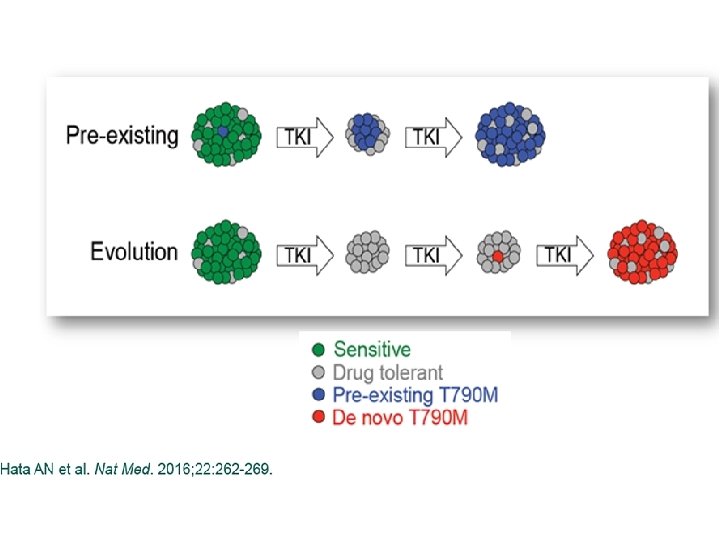
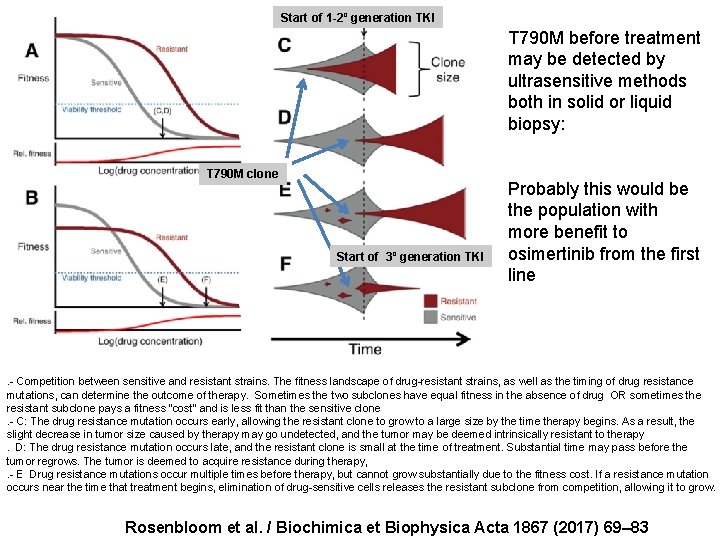
Start of 1 -2º generation TKI T 790 M before treatment may be detected by ultrasensitive methods both in solid or liquid biopsy: T 790 M clone Start of 3º generation TKI Probably this would be the population with more benefit to osimertinib from the first line . - Competition between sensitive and resistant strains. The fitness landscape of drug-resistant strains, as well as the timing of drug resistance mutations, can determine the outcome of therapy. Sometimes the two subclones have equal fitness in the absence of drug OR sometimes the resistant subclone pays a fitness “cost” and is less fit than the sensitive clone. - C: The drug resistance mutation occurs early, allowing the resistant clone to grow to a large size by the time therapy begins. As a result, the slight decrease in tumor size caused by therapy may go undetected, and the tumor may be deemed intrinsically resistant to therapy. D: The drug resistance mutation occurs late, and the resistant clone is small at the time of treatment. Substantial time may pass before the tumor regrows. The tumor is deemed to acquire resistance during therapy, . - E Drug resistance mutations occur multiple times before therapy, but cannot grow substantially due to the fitness cost. If a resistance mutation occurs near the time that treatment begins, elimination of drug-sensitive cells releases the resistant subclone from competition, allowing it to grow. Rosenbloom et al. / Biochimica et Biophysica Acta 1867 (2017) 69– 83
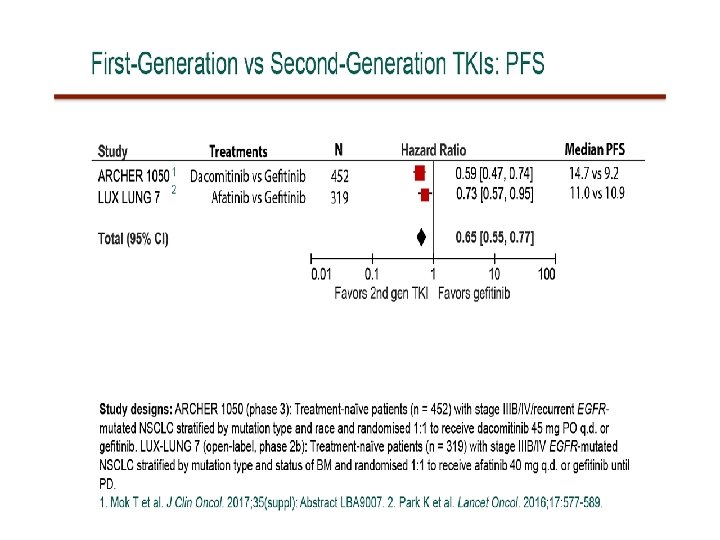
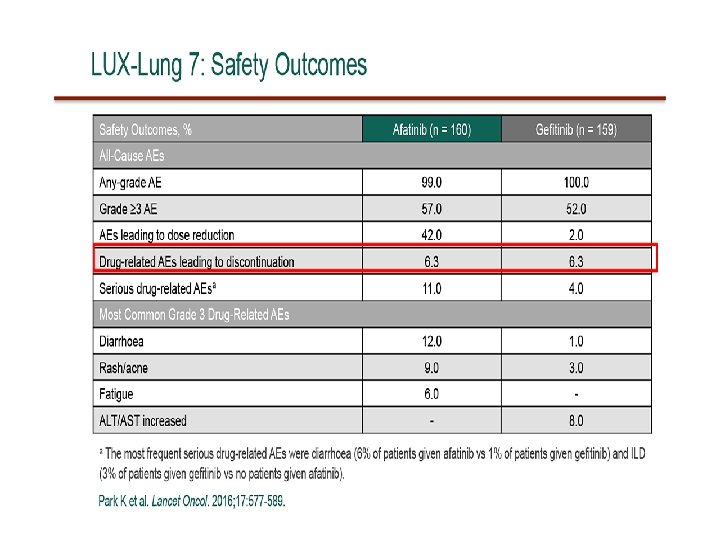
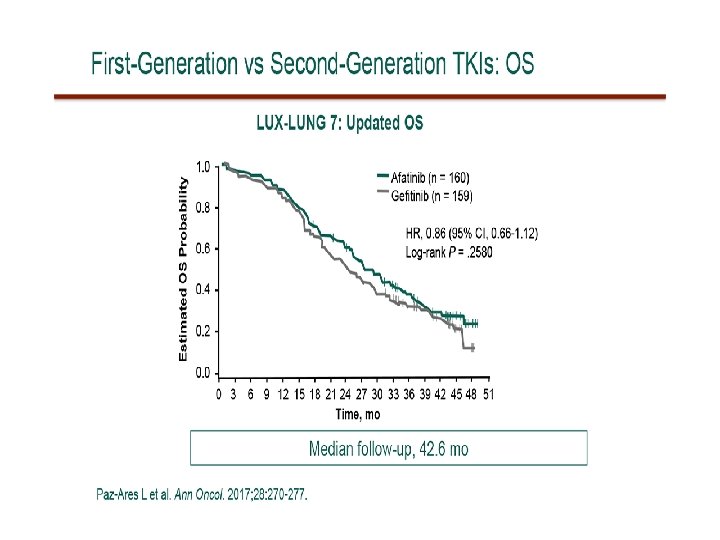
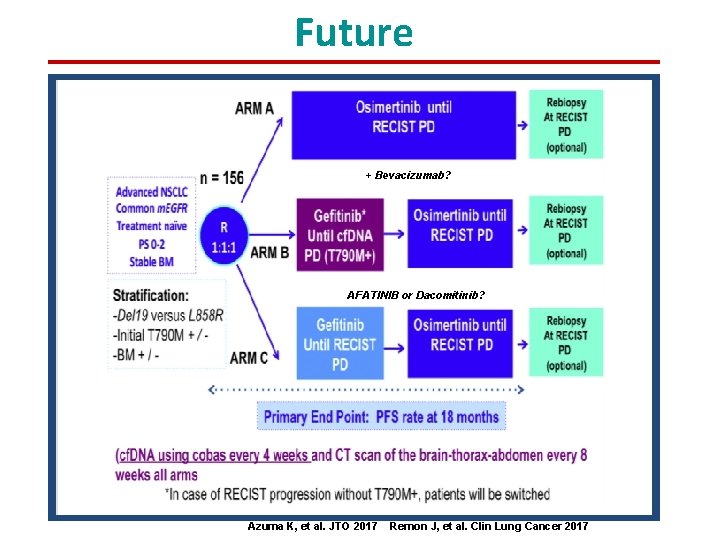
Future + Bevacizumab? AFATINIB or Dacomitinib? Azuma K, et al. JTO 2017 Remon J, et al. Clin Lung Cancer 2017
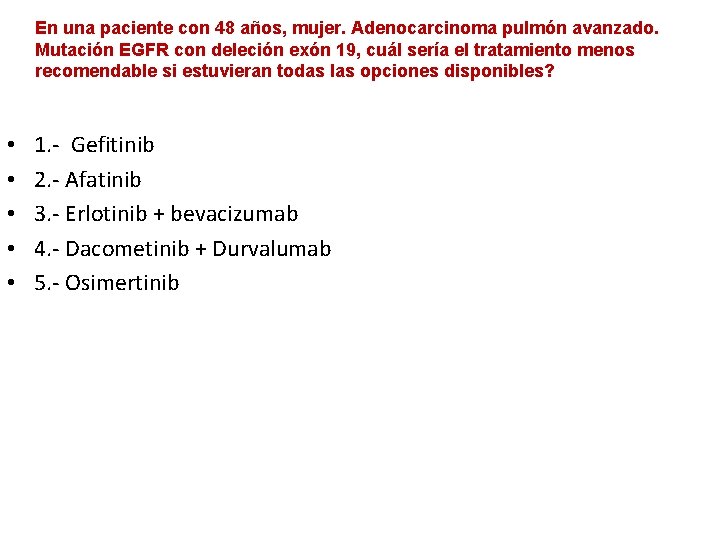
En una paciente con 48 años, mujer. Adenocarcinoma pulmón avanzado. Mutación EGFR con deleción exón 19, cuál sería el tratamiento menos recomendable si estuvieran todas las opciones disponibles? • • • 1. - Gefitinib 2. - Afatinib 3. - Erlotinib + bevacizumab 4. - Dacometinib + Durvalumab 5. - Osimertinib
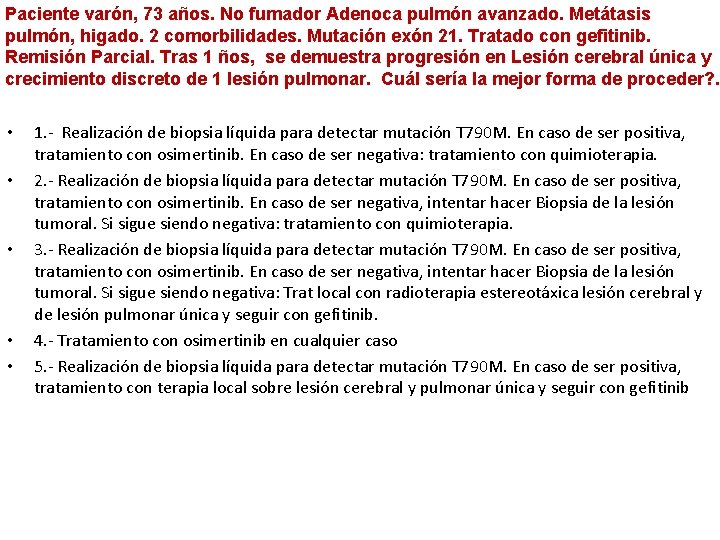
Paciente varón, 73 años. No fumador Adenoca pulmón avanzado. Metátasis pulmón, higado. 2 comorbilidades. Mutación exón 21. Tratado con gefitinib. Remisión Parcial. Tras 1 ños, se demuestra progresión en Lesión cerebral única y crecimiento discreto de 1 lesión pulmonar. Cuál sería la mejor forma de proceder? . • • • 1. - Realización de biopsia líquida para detectar mutación T 790 M. En caso de ser positiva, tratamiento con osimertinib. En caso de ser negativa: tratamiento con quimioterapia. 2. - Realización de biopsia líquida para detectar mutación T 790 M. En caso de ser positiva, tratamiento con osimertinib. En caso de ser negativa, intentar hacer Biopsia de la lesión tumoral. Si sigue siendo negativa: tratamiento con quimioterapia. 3. - Realización de biopsia líquida para detectar mutación T 790 M. En caso de ser positiva, tratamiento con osimertinib. En caso de ser negativa, intentar hacer Biopsia de la lesión tumoral. Si sigue siendo negativa: Trat local con radioterapia estereotáxica lesión cerebral y de lesión pulmonar única y seguir con gefitinib. 4. - Tratamiento con osimertinib en cualquier caso 5. - Realización de biopsia líquida para detectar mutación T 790 M. En caso de ser positiva, tratamiento con terapia local sobre lesión cerebral y pulmonar única y seguir con gefitinib