City Council Study Session St Louis Park Policing

- Slides: 43
City Council Study Session St. Louis Park Policing Model Critical Incident Planning September 25, 2017
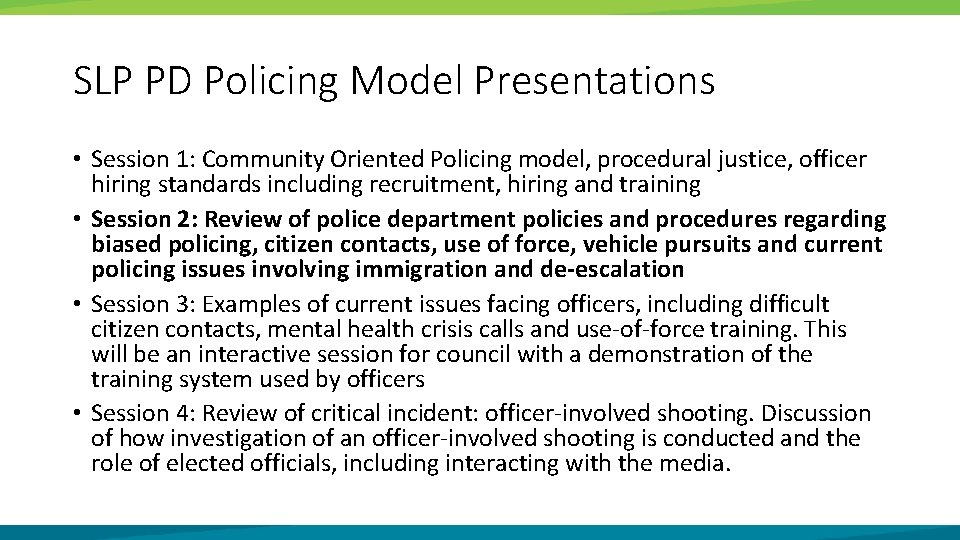
SLP PD Policing Model Presentations • Session 1: Community Oriented Policing model, procedural justice, officer hiring standards including recruitment, hiring and training • Session 2: Review of police department policies and procedures regarding biased policing, citizen contacts, use of force, vehicle pursuits and current policing issues involving immigration and de-escalation • Session 3: Examples of current issues facing officers, including difficult citizen contacts, mental health crisis calls and use-of-force training. This will be an interactive session for council with a demonstration of the training system used by officers • Session 4: Review of critical incident: officer-involved shooting. Discussion of how investigation of an officer-involved shooting is conducted and the role of elected officials, including interacting with the media.
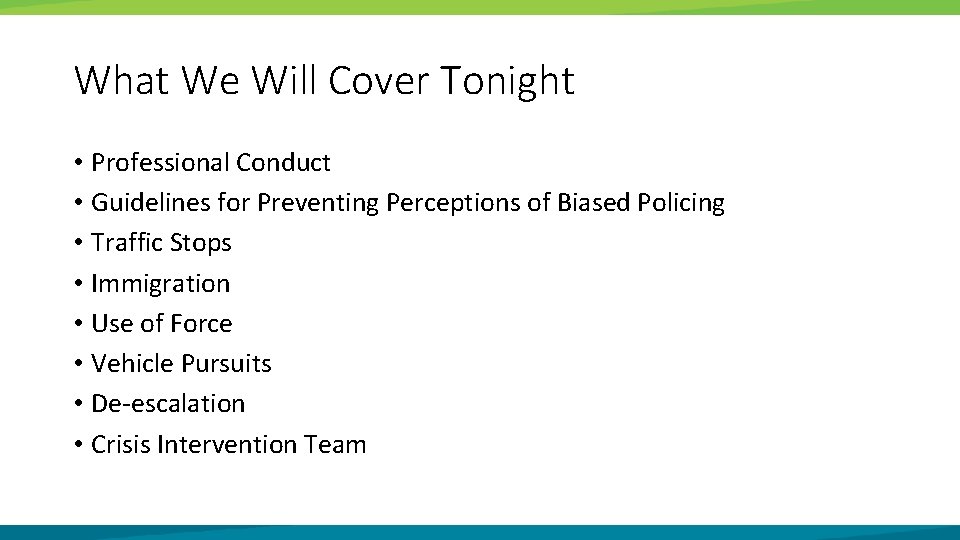
What We Will Cover Tonight • Professional Conduct • Guidelines for Preventing Perceptions of Biased Policing • Traffic Stops • Immigration • Use of Force • Vehicle Pursuits • De-escalation • Crisis Intervention Team
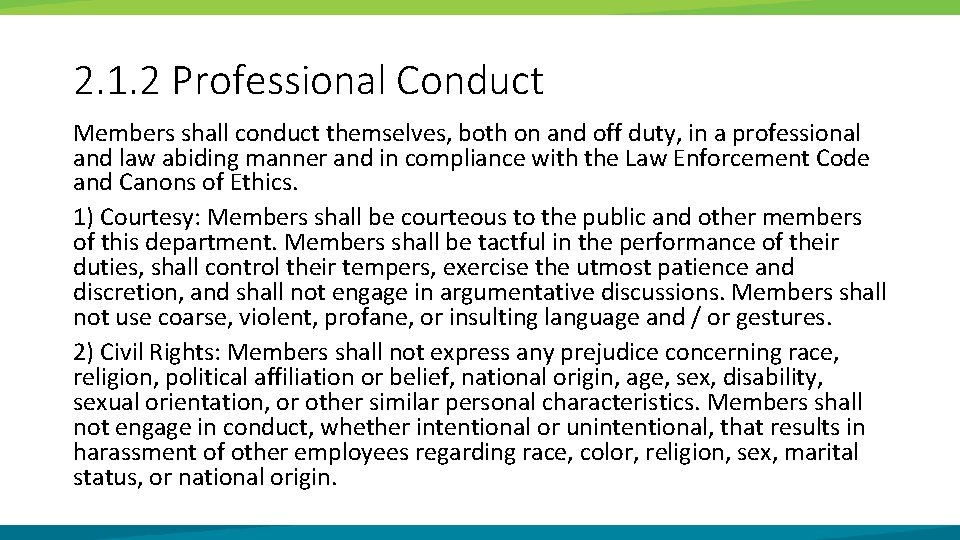
2. 1. 2 Professional Conduct Members shall conduct themselves, both on and off duty, in a professional and law abiding manner and in compliance with the Law Enforcement Code and Canons of Ethics. 1) Courtesy: Members shall be courteous to the public and other members of this department. Members shall be tactful in the performance of their duties, shall control their tempers, exercise the utmost patience and discretion, and shall not engage in argumentative discussions. Members shall not use coarse, violent, profane, or insulting language and / or gestures. 2) Civil Rights: Members shall not express any prejudice concerning race, religion, political affiliation or belief, national origin, age, sex, disability, sexual orientation, or other similar personal characteristics. Members shall not engage in conduct, whether intentional or unintentional, that results in harassment of other employees regarding race, color, religion, sex, marital status, or national origin.
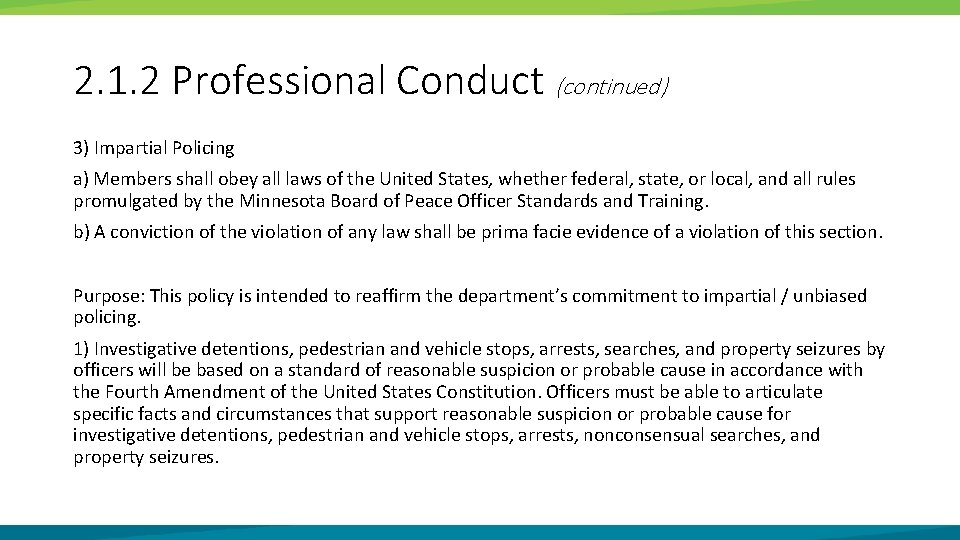
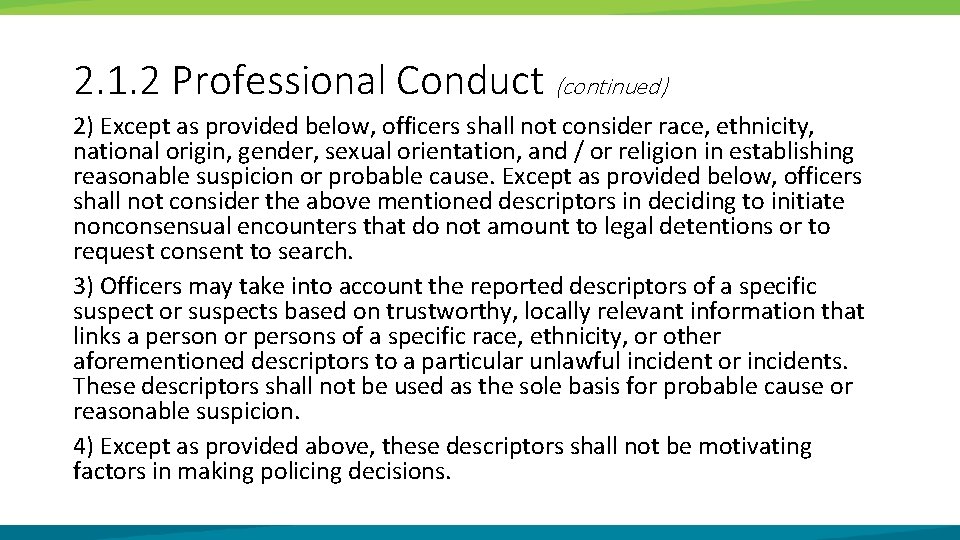
2. 1. 2 Professional Conduct (continued) 3) Impartial Policing a) Members shall obey all laws of the United States, whether federal, state, or local, and all rules promulgated by the Minnesota Board of Peace Officer Standards and Training. b) A conviction of the violation of any law shall be prima facie evidence of a violation of this section. Purpose: This policy is intended to reaffirm the department’s commitment to impartial / unbiased policing. 1) Investigative detentions, pedestrian and vehicle stops, arrests, searches, and property seizures by officers will be based on a standard of reasonable suspicion or probable cause in accordance with the Fourth Amendment of the United States Constitution. Officers must be able to articulate specific facts and circumstances that support reasonable suspicion or probable cause for investigative detentions, pedestrian and vehicle stops, arrests, nonconsensual searches, and property seizures.
2. 1. 2 Professional Conduct (continued) 2) Except as provided below, officers shall not consider race, ethnicity, national origin, gender, sexual orientation, and / or religion in establishing reasonable suspicion or probable cause. Except as provided below, officers shall not consider the above mentioned descriptors in deciding to initiate nonconsensual encounters that do not amount to legal detentions or to request consent to search. 3) Officers may take into account the reported descriptors of a specific suspect or suspects based on trustworthy, locally relevant information that links a person or persons of a specific race, ethnicity, or other aforementioned descriptors to a particular unlawful incident or incidents. These descriptors shall not be used as the sole basis for probable cause or reasonable suspicion. 4) Except as provided above, these descriptors shall not be motivating factors in making policing decisions.
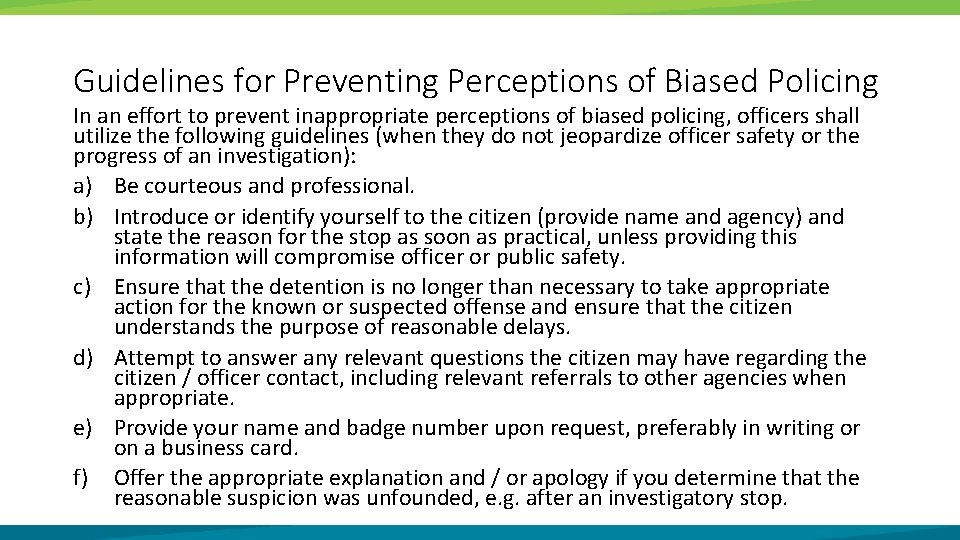
Guidelines for Preventing Perceptions of Biased Policing In an effort to prevent inappropriate perceptions of biased policing, officers shall utilize the following guidelines (when they do not jeopardize officer safety or the progress of an investigation): a) Be courteous and professional. b) Introduce or identify yourself to the citizen (provide name and agency) and state the reason for the stop as soon as practical, unless providing this information will compromise officer or public safety. c) Ensure that the detention is no longer than necessary to take appropriate action for the known or suspected offense and ensure that the citizen understands the purpose of reasonable delays. d) Attempt to answer any relevant questions the citizen may have regarding the citizen / officer contact, including relevant referrals to other agencies when appropriate. e) Provide your name and badge number upon request, preferably in writing or on a business card. f) Offer the appropriate explanation and / or apology if you determine that the reasonable suspicion was unfounded, e. g. after an investigatory stop.
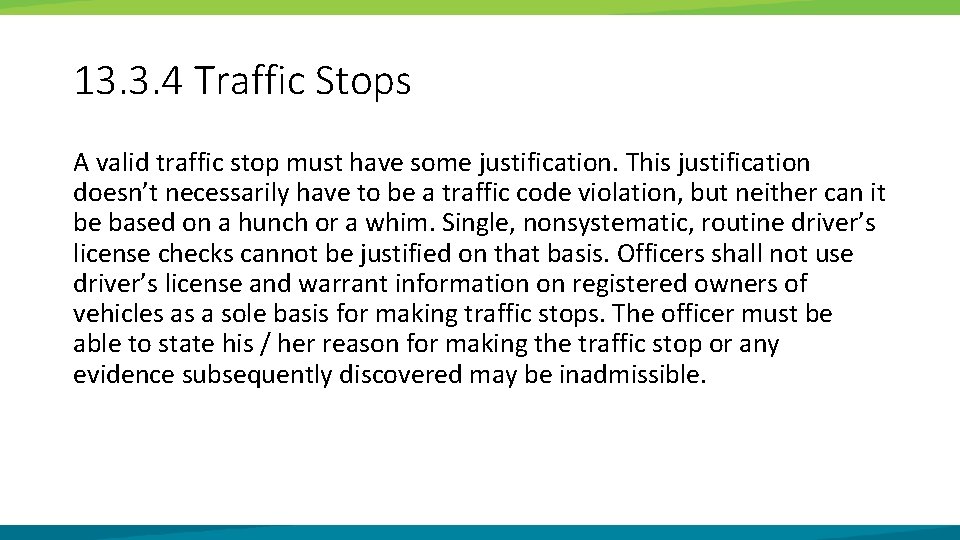
13. 3. 4 Traffic Stops A valid traffic stop must have some justification. This justification doesn’t necessarily have to be a traffic code violation, but neither can it be based on a hunch or a whim. Single, nonsystematic, routine driver’s license checks cannot be justified on that basis. Officers shall not use driver’s license and warrant information on registered owners of vehicles as a sole basis for making traffic stops. The officer must be able to state his / her reason for making the traffic stop or any evidence subsequently discovered may be inadmissible.
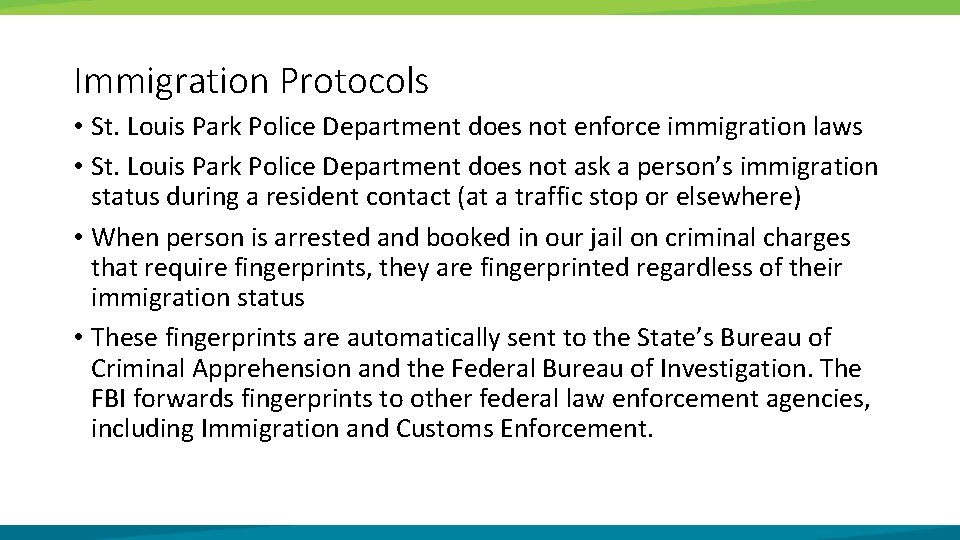
Immigration Protocols • St. Louis Park Police Department does not enforce immigration laws • St. Louis Park Police Department does not ask a person’s immigration status during a resident contact (at a traffic stop or elsewhere) • When person is arrested and booked in our jail on criminal charges that require fingerprints, they are fingerprinted regardless of their immigration status • These fingerprints are automatically sent to the State’s Bureau of Criminal Apprehension and the Federal Bureau of Investigation. The FBI forwards fingerprints to other federal law enforcement agencies, including Immigration and Customs Enforcement.
Immigration Protocols • If ICE is interested in a jail inmate, they request a notification from St. Louis Park Police Department when the inmate is set to be released • All inmates, regardless of immigration status, are released from jail at the time criminal charges are dropped or they are charged criminally and turned over to the custody of the Hennepin County Sheriff’s Office (HCSO). • St. Louis Park Police Department and the HCSO do not detain or hold jail inmates at ICE request, commonly know as a detainer. We require a warrant or judicial order.
Use of Force When an officer intentionally commits an act which will cause, or is substantially certain to, cause another to: • Sustain a harmful or offensive bodily contact OR • Fear an immediate harmful or offensive bodily contact
Levels of Force • Officer Presence • Verbal • Soft Empty Hand • Chemical/Aerosol • Hard Empty Hand • Impact Weapon • CEW/Taser • Deadly Force
Reasons to Use Force • Effect an arrest • Prevent an escape • Self defense • Protect another officer • Prevent damage to property • Quell a disturbance • Execute a warrant • Temporarily detain “Terry Stop” • Prevent self-inflicted injury • Execute and carry out a court order
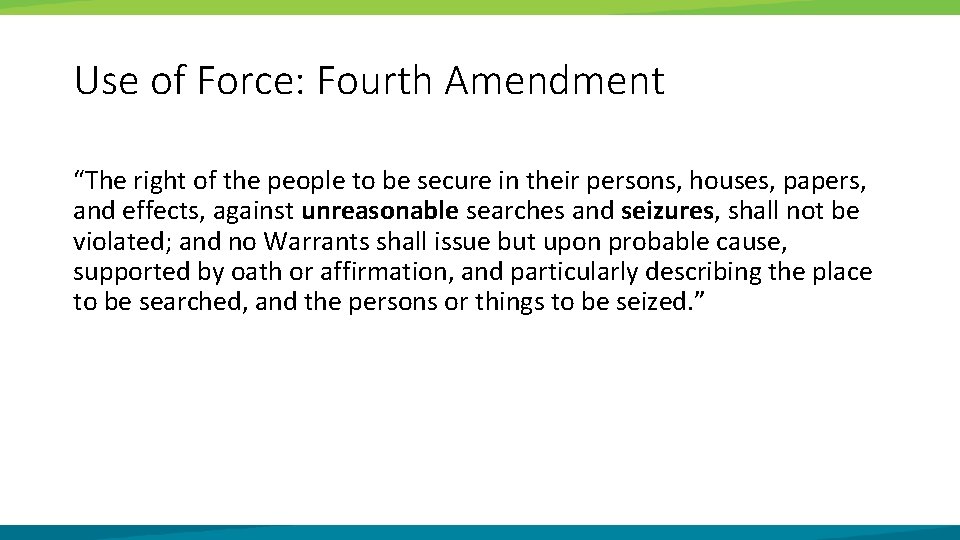
Use of Force: Fourth Amendment “The right of the people to be secure in their persons, houses, papers, and effects, against unreasonable searches and seizures, shall not be violated; and no Warrants shall issue but upon probable cause, supported by oath or affirmation, and particularly describing the place to be searched, and the persons or things to be seized. ”
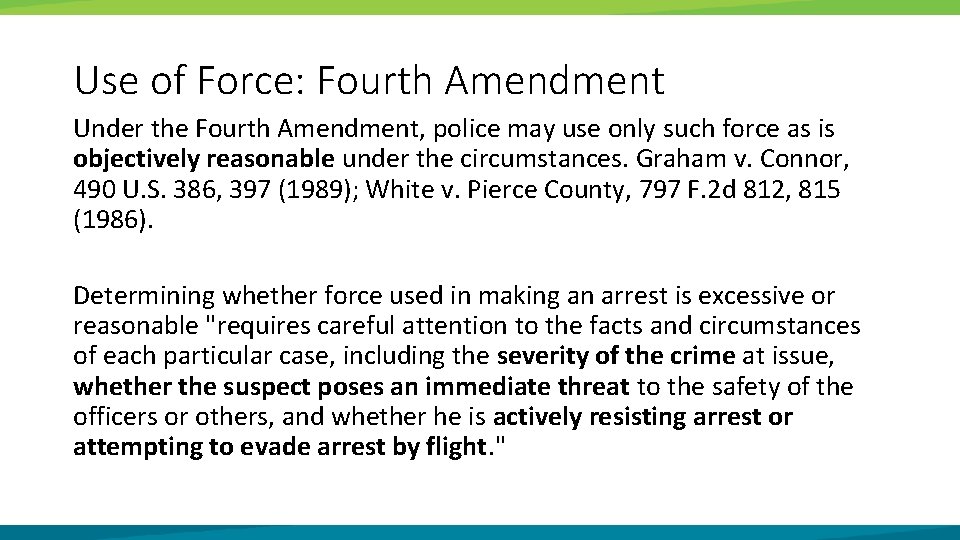
Use of Force: Fourth Amendment Under the Fourth Amendment, police may use only such force as is objectively reasonable under the circumstances. Graham v. Connor, 490 U. S. 386, 397 (1989); White v. Pierce County, 797 F. 2 d 812, 815 (1986). Determining whether force used in making an arrest is excessive or reasonable "requires careful attention to the facts and circumstances of each particular case, including the severity of the crime at issue, whether the suspect poses an immediate threat to the safety of the officers or others, and whether he is actively resisting arrest or attempting to evade arrest by flight. "
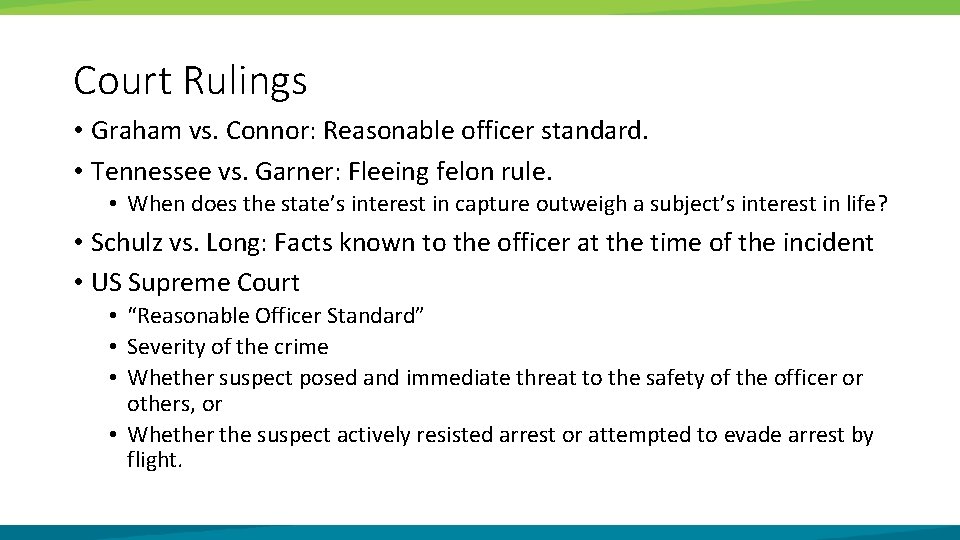
Court Rulings • Graham vs. Connor: Reasonable officer standard. • Tennessee vs. Garner: Fleeing felon rule. • When does the state’s interest in capture outweigh a subject’s interest in life? • Schulz vs. Long: Facts known to the officer at the time of the incident • US Supreme Court • “Reasonable Officer Standard” • Severity of the crime • Whether suspect posed and immediate threat to the safety of the officer or others, or • Whether the suspect actively resisted arrest or attempted to evade arrest by flight.
Federal Standard for Use of Force Graham vs. Conner The court recognized that the duty to make arrests and to conduct searches and investigatory stops carries with it the authority to REASONABLY use, or threaten to use, force.
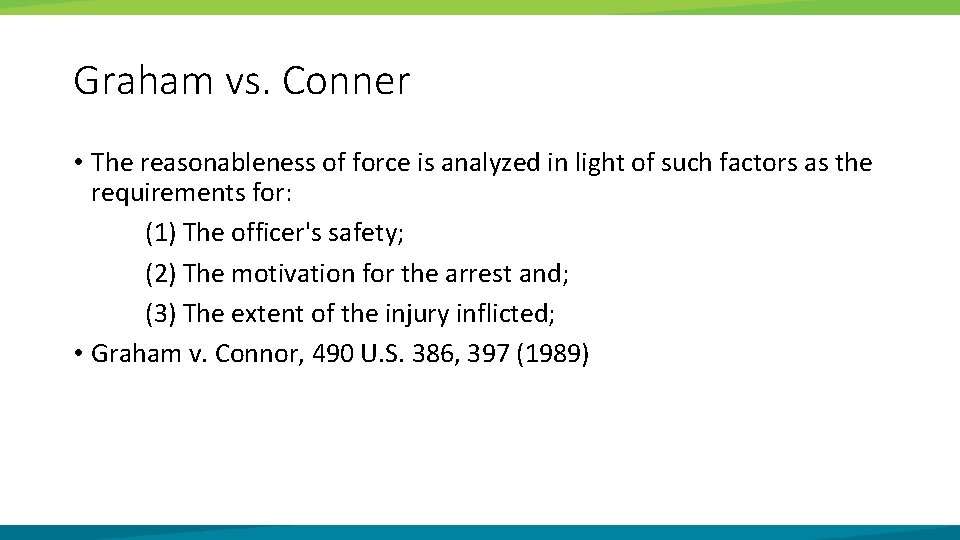
Graham vs. Conner • The reasonableness of force is analyzed in light of such factors as the requirements for: (1) The officer's safety; (2) The motivation for the arrest and; (3) The extent of the injury inflicted; • Graham v. Connor, 490 U. S. 386, 397 (1989)
Graham vs. Conner • The court identified THREE KEY FACTORS based on the actions of the subject to determine the reasonableness of use of force: • The severity of the crime • Whether the suspect posed an immediate threat to your safety • Whether the subject fled or resisted arrest
Graham vs. Conner • Force can only be used for DEFENSE or CONTROL • Every force is considered a SEIZURE Police use of force falls under the OBJECTIVE REASONABLENESS STANDARD of the Fourth Amendment.
Graham vs. Conner CRUCIAL FACTS TO BE CONSIDERED: • The information known to the officer at the time • How a reasonable officer would interpret the information • How the officer actually responded on that information THE REASONABLE OFFICER: The question is whether reasonable officer on scene, who was aware of the legal standards pertaining to force, would have thought that the force was reasonable.
Reasonableness The court also set the standard for how the judge and the jury should determine the reasonableness of the officer’s conduct. The Supreme Court has stated: The ‘reasonableness' of a particular use of force must be judged from the perspective of a reasonable officer on the scene, rather than with the 20/20 vision of hindsight. With respect to a claim of excessive force, the [ ] standard of reasonableness at the moment applies: ‘Not every push or shove, even if it may later seem unnecessary in the peace of a judge's chambers, ’ violates the Fourth Amendment. The calculus of reasonableness must embody allowance for the fact that police officers are often forced to make split-second judgments-in circumstances that are tense, uncertain, and rapidly evolving-about the amount of force that is necessary in a particular situation.
State Standard for Use of Force Minimum Restraint Allowed for Arrest (State Statute § 629. 32) • A peace officer making an arrest may not subject the person arrested to any more restraint than is necessary for the arrest and detention. When Force May Be Used to Make an Arrest (State Statute § 629. 33) • If a peace officer has informed a defendant that the officer intends to arrest the defendant, and if the defendant then flees or forcibly resists, the officer may use all necessary and lawful means to make the arrest, but may not use deadly force unless authorized to do so under (MN § 609. 066).
Authorized Use of Force Minnesota State Statue 609. 06 Subdivision 1. When authorized. Except as otherwise provided in subdivision 2, reasonable force may be used upon or toward the person of another without the other's consent when the following circumstances exist or the actor reasonably believes them to exist: (1) when used by a public officer or one assisting a public officer under the public officer's direction: (a) in effecting a lawful arrest; or (b) in the execution of legal process; or (c) in enforcing an order of the court; or (d) in executing any other duty imposed upon the public officer by law; or
Minnesota Standard of Reasonable Necessity • The officer tried techniques with lower propensities for pain or injury and the techniques did not work; or • It is reasonably apparent that lower levels of force would not work; or • A lower level of force would have exposed either yourself or others to unreasonable danger.
Department Policy Use of Non-Deadly Force: • In determining the level of force deemed reasonable, officers shall consider: • The severity of the crime; • Whether the suspect poses a threat to officer or another; and • Whether the suspect is actively resisting arrest or attempting to evade arrest.
Department Policy • General Rules Governing Use of Force: • Officers shall use the least amount of force reasonably necessary without impairing the safety of others. This shall not require officers to first attempt using types and degrees of force, which reasonably appear to be inadequate. • It shall be deemed reasonable for officers to use that type and degree of non deadly force necessary to bring a subject, whom the officer intends to arrest or capture, quickly under control. • Officers shall carry and use only approved weapons unless circumstances exist requiring the immediate use of a non approved weapon to counter a threat.
Department Policy Threatening the Use of Force: • An officer may announce to another his or her intention to use only that type and degree of force which is reasonably necessary under the circumstances. • This shall not be construed to authorize discourteous, abusive or unprofessional language.
Department Policy Reporting Requirements • An officer using deadly or non-deadly force shall, in all instances, prepare a use of force report. • Supervisors shall review all incidents involving the use of force with all officers involved and submit a separate report of the incident to the Chief of Police.
Totality of the Situation Officer/Subject Factors • Age • Gender • Size • Fitness • Skill Level • Multiple Officers • Multiple Subjects Special Circumstances • Close proximity to a weapon • Special knowledge • Injury or exhaustion • Ground Position • Disability • Imminent Danger
5. 1. 2 Use of Non Deadly Force 1) It shall be the policy of the department, unless expressly negated elsewhere, to accord its officers discretion in the use of non deadly force to the extent permitted by Minnesota State Statute § 609. 06, which permits police officers to use reasonable force: a) In effecting a lawful arrest. b) In the execution of legal process. c) In enforcing an order or the court. d) In effecting any other duty imposed on the officer by law. 2) In determining the amount, type, and level of force deemed reasonable under this provision, officers shall consider: a) The severity of the crime in issue. b) Whether the suspect poses a threat to the officer or another. c) Whether the suspect is actively resisting arrest or attempting to evade arrest by flight.
Consequences of unlawful or unreasonable use of force • Civil rights • Criminal • Licensing • Employment
MN STATE STATUTE 609. 066 AUTHORIZED USE OF DEADLY FORCE BY PEACE OFFICERS. • Subdivision 2. Use of deadly force. • Notwithstanding the provisions of section 609. 06 or 609. 065, the use of deadly force by a peace officer in the line of duty is justified only when necessary: • (1) to protect the peace officer or another from apparent death or great bodily harm; • (2) to effect the arrest or capture, or prevent the escape, of a person whom the peace officer knows or has reasonable grounds to believe has committed or attempted to commit a felony involving the use or threatened use of deadly force; or • (3) to effect the arrest or capture, or prevent the escape, of a person whom the officer knows or has reasonable grounds to believe has committed or attempted to commit a felony if the officer reasonably believes that the person will cause death or great bodily harm if the person's apprehension is delayed.
13. 1. 2 When to Initiate a Vehicle Pursuit A pursuit may be initiated when: a) State law and department policy permit the use of deadly force; and b) When there is a reasonable expectation of apprehending the suspect. 5) State law that makes fleeing a peace officer a felony is not, by itself, justification for pursuit under this policy. 6) Other factors to be considered: a) The initial decision to start a pursuit lies primarily with the officer who has initiated the vehicle stop, after considering the elements of this policy. b) These elements include, but are not limited to, whether the use of deadly force is authorized, the crime for which the suspect is wanted and the risk the pursuit poses to the community (traffic volume, pursuit area, environmental factors, and weather conditions). c) The officer must continually consider the risks created by the pursuit, as these risks change during a pursuit. d) Terminating a pursuit will be considered a decision made in the interest of public safety. At times, the termination of a pursuit will be the safest and most appropriate action to take. e) A supervisor may direct an officer to terminate a pursuit at any time.
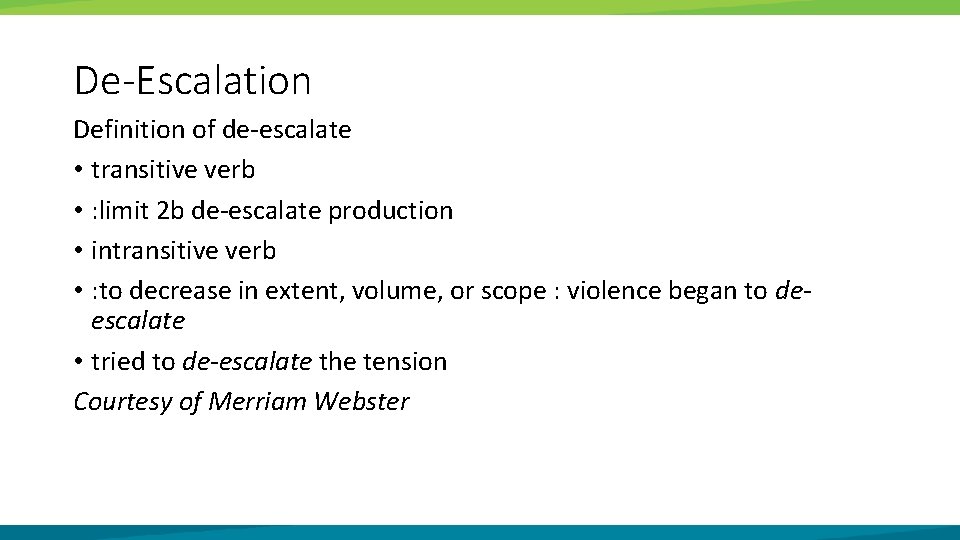
De-Escalation Definition of de-escalate • transitive verb • : limit 2 b de-escalate production • intransitive verb • : to decrease in extent, volume, or scope : violence began to deescalate • tried to de-escalate the tension Courtesy of Merriam Webster
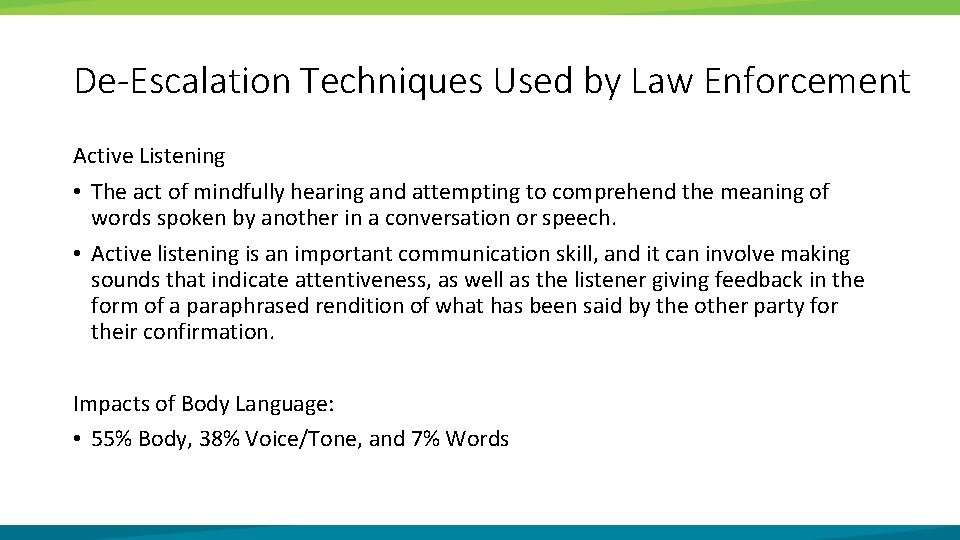
De-Escalation Techniques Used by Law Enforcement Active Listening • The act of mindfully hearing and attempting to comprehend the meaning of words spoken by another in a conversation or speech. • Active listening is an important communication skill, and it can involve making sounds that indicate attentiveness, as well as the listener giving feedback in the form of a paraphrased rendition of what has been said by the other party for their confirmation. Impacts of Body Language: • 55% Body, 38% Voice/Tone, and 7% Words
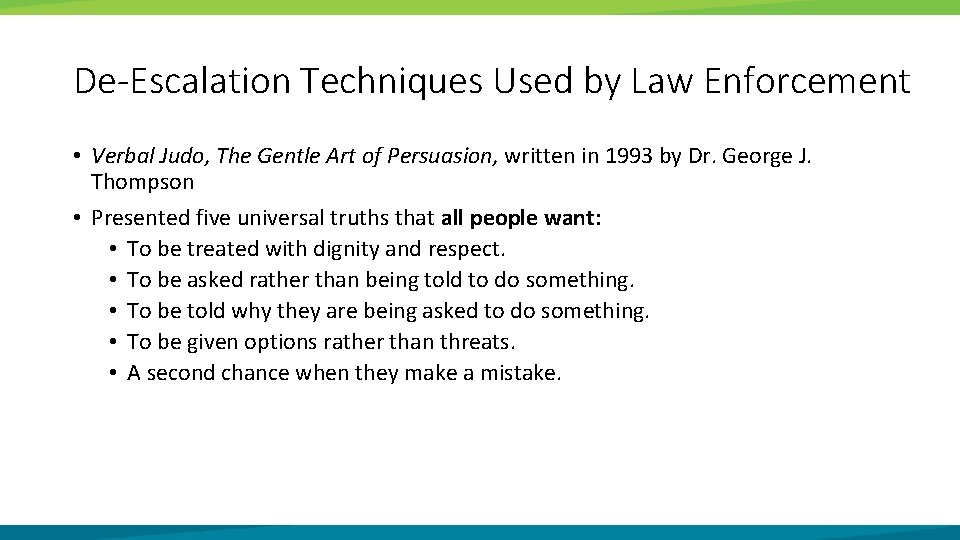
De-Escalation Techniques Used by Law Enforcement • Verbal Judo, The Gentle Art of Persuasion, written in 1993 by Dr. George J. Thompson • Presented five universal truths that all people want: • To be treated with dignity and respect. • To be asked rather than being told to do something. • To be told why they are being asked to do something. • To be given options rather than threats. • A second chance when they make a mistake.
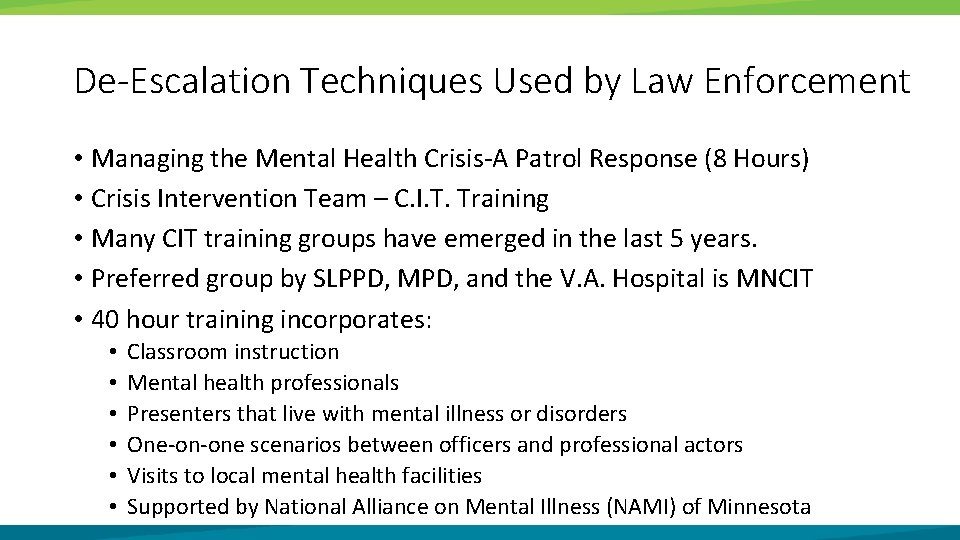
De-Escalation Techniques Used by Law Enforcement • Managing the Mental Health Crisis-A Patrol Response (8 Hours) • Crisis Intervention Team – C. I. T. Training • Many CIT training groups have emerged in the last 5 years. • Preferred group by SLPPD, MPD, and the V. A. Hospital is MNCIT • 40 hour training incorporates: • • • Classroom instruction Mental health professionals Presenters that live with mental illness or disorders One-on-one scenarios between officers and professional actors Visits to local mental health facilities Supported by National Alliance on Mental Illness (NAMI) of Minnesota
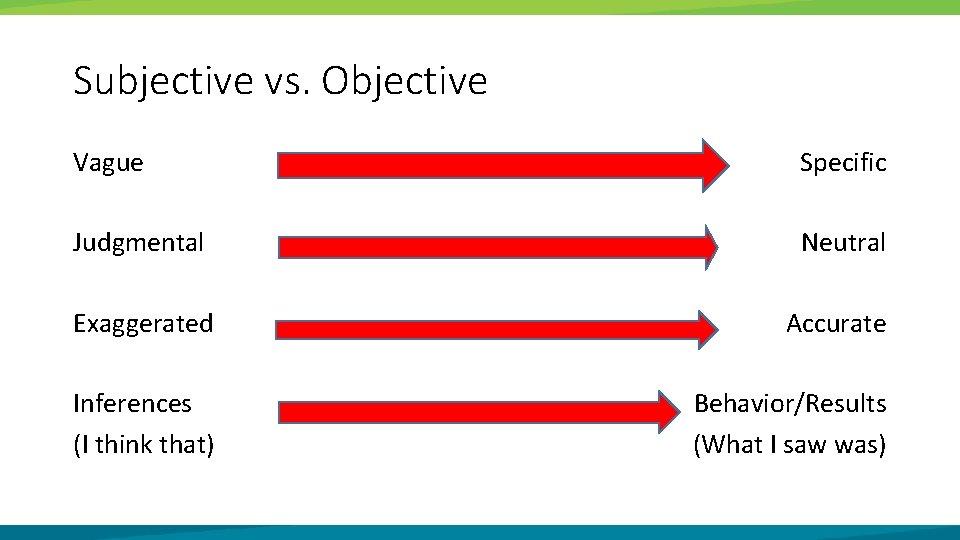
Subjective vs. Objective Vague Specific Judgmental Neutral Exaggerated Accurate Inferences (I think that) Behavior/Results (What I saw was)
C. I. T. Training: Coaching Strengths • What did you do well? • Specifically what made it go well? Improvements • What didn’t go as well as you’d hoped? • What would you do differently next time?
C. I. T. Training: Coaching • Currently 24 SLP Officers/Sgts Trained (2 More in November) • Cornerstone of Training: Officer Safety and Skills Development • Improving listening skills
Why Do We Do It? • The Minnesota Sheriff’s Association reports that as high as 50% of prisoners in Minnesota jails are mentally ill. The truth is: our criminal justice system is overrun with mentally ill people whose “offenses” could be more appropriately dealt with as symptoms of brain disorders. • It’s also true, unfortunately, that law enforcement officers have become the front line in our mental health system – often with great stress and potential danger to themselves, or to the person in mental health crisis. And as of five years ago, they were doing this with 0 -6 hours of training in mental health issues. • Supported by The National Alliance on Mental Illness (NAMI) of Minnesota.
Questions?