
Aberdeen City Council ICT Options Appraisal Report Assessing
Aberdeen City Council ICT Options Appraisal Report Assessing the options for ICT Service delivery within Aberdeen City Council December 2009 Strictly Private & Confidential Position for graphic or image Pw. C
Draft Report Table of Contents Section Page Executive Summary 3 1 Introduction 10 2 Approach 12 3 Strategy and Drivers 14 4 Current Service Baseline 20 5 Voice of the Customer 25 6 Market assessment 31 7 Leading Practice 39 8 Options Development 54 9 Options Appraisal 57 10 Risks in Partnership Options 72 11 Example Partnerships 74 12 Conclusions and Next Steps 81 ICT Options Appraisal - Aberdeen City Council Pricewaterhouse. Coopers LLP 2 Strictly Confidential December 2009
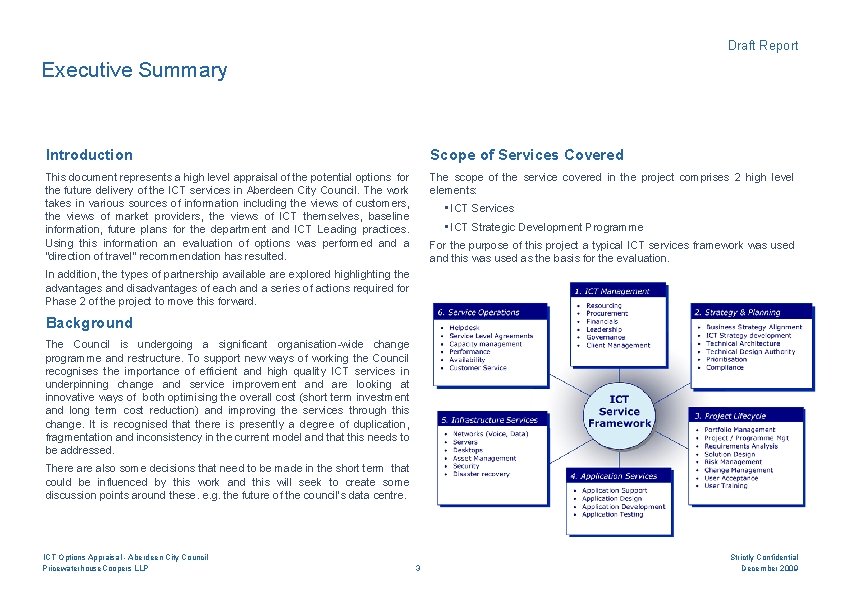
Draft Report Executive Summary Introduction Scope of Services Covered This document represents a high level appraisal of the potential options for the future delivery of the ICT services in Aberdeen City Council. The work takes in various sources of information including the views of customers, the views of market providers, the views of ICT themselves, baseline information, future plans for the department and ICT Leading practices. Using this information an evaluation of options was performed and a “direction of travel” recommendation has resulted. The scope of the service covered in the project comprises 2 high level elements: • ICT Services • ICT Strategic Development Programme For the purpose of this project a typical ICT services framework was used and this was used as the basis for the evaluation. In addition, the types of partnership available are explored highlighting the advantages and disadvantages of each and a series of actions required for Phase 2 of the project to move this forward. Background The Council is undergoing a significant organisation-wide change programme and restructure. To support new ways of working the Council recognises the importance of efficient and high quality ICT services in underpinning change and service improvement and are looking at innovative ways of both optimising the overall cost (short term investment and long term cost reduction) and improving the services through this change. It is recognised that there is presently a degree of duplication, fragmentation and inconsistency in the current model and that this needs to be addressed. There also some decisions that need to be made in the short term that could be influenced by this work and this will seek to create some discussion points around these. e. g. the future of the council’s data centre. ICT Options Appraisal - Aberdeen City Council Pricewaterhouse. Coopers LLP 3 Strictly Confidential December 2009
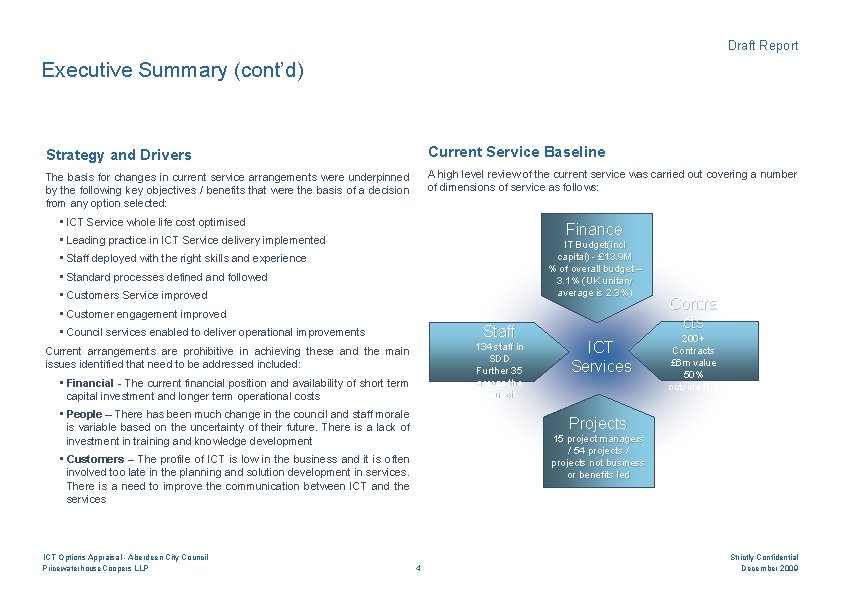
Draft Report Executive Summary (cont’d) Strategy and Drivers Current Service Baseline The basis for changes in current service arrangements were underpinned by the following key objectives / benefits that were the basis of a decision from any option selected: A high level review of the current service was carried out covering a number of dimensions of service as follows: • ICT Service whole life cost optimised Finance • Leading practice in ICT Service delivery implemented IT Budget(incl capital) - £ 13. 9 M % of overall budget – 3. 1% (UK unitary average is 2. 3%) • Staff deployed with the right skills and experience • Standard processes defined and followed • Customers Service improved • Customer engagement improved S t af f • Council services enabled to deliver operational improvements 134 staff in SDD Further 35 across the council Current arrangements are prohibitive in achieving these and the main issues identified that need to be addressed included: • Financial - The current financial position and availability of short term capital investment and longer term operational costs • People – There has been much change in the council and staff morale is variable based on the uncertainty of their future. There is a lack of investment in training and knowledge development 200+ Contracts £ 6 m value 50% outside ICT Projects 15 project managers / 54 projects / projects not business or benefits led • Customers – The profile of ICT is low in the business and it is often involved too late in the planning and solution development in services. There is a need to improve the communication between ICT and the services ICT Options Appraisal - Aberdeen City Council Pricewaterhouse. Coopers LLP ICT Services C o n t ra cts 4 Strictly Confidential December 2009
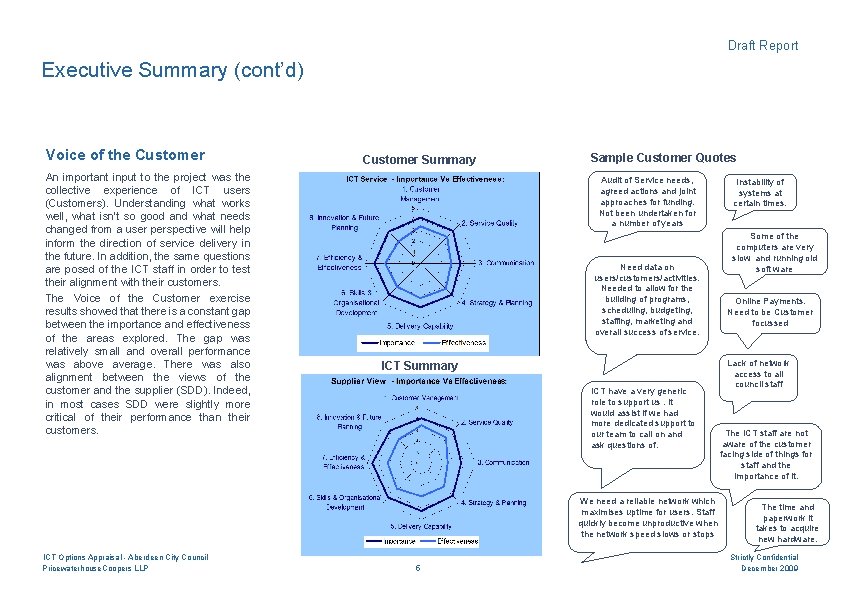
Draft Report Executive Summary (cont’d) Voice of the Customer An important input to the project was the collective experience of ICT users (Customers). Understanding what works well, what isn’t so good and what needs changed from a user perspective will help inform the direction of service delivery in the future. In addition, the same questions are posed of the ICT staff in order to test their alignment with their customers. The Voice of the Customer exercise results showed that there is a constant gap between the importance and effectiveness of the areas explored. The gap was relatively small and overall performance was above average. There was also alignment between the views of the customer and the supplier (SDD). Indeed, in most cases SDD were slightly more critical of their performance than their customers. Customer Summary Sample Customer Quotes Audit of Service needs, agreed actions and joint approaches for funding. Not been undertaken for a number of years Instability of systems at certain times. Some of the computers are very slow and running old soft ware Need data on users/customers/activities. Needed to allow for the building of programs, scheduling, budgeting, staffing, marketing and overall success of service. Online Payments. Need to be Customer focussed Lack of network access to all council staff ICT Summary ICT have a very generic role to support us. It would assist if we had more dedicated support to our team to call on and ask questions of. The ICT staff are not aware of the customer facing side of things for staff and the importance of it. We need a reliable network which maximises uptime for users. Staff quickly become unproductive when the network speed slows or stops ICT Options Appraisal - Aberdeen City Council Pricewaterhouse. Coopers LLP 5 The time and paperwork it takes to acquire new hardware. Strictly Confidential December 2009
Draft Report Executive Summary (cont’d) Most suppliers stated that they preferred an outsourcing type partnering arrangement where they have the opportunity to drive change, deliver benefits and use their cost drivers to reduce the delivery costs. e. g. moving the data centre to one of their existing sites so they can make economy of scale savings and deliver lower cost services. The majority also stated that it will take in the region of 2 years to transform to a new ICT service based on the business models identified. The first 6 months of this will be taken up by transition of service to the new partnership organisation. Half of the responses declined to comment on the potential benefits that are available as this will be based on the partnership type and the transfer of risk to the private sector. The other provided ranges from 18% to 30% as typical cost reduction against a set of similar service levels. This is obviously dependent on the current service levels in the council. Market Assessment Getting a market perspective of the potential propositions and how the market feels about the appeal of partnering with the council was tested by issuing a questionnaire to 14 potential suppliers of IT services. Six responses were received from the following organisations • Accenture • Atos Origin • Capita • Fujitsu • Serco Managing Risks - The appetite for the council to transfer risk will have an overarching influence on the success of the partnership. The balance of risks between the public and private sector will be governed by several key parameters during the procurement and transition period: • Unisys Highlights of the responses from these organisations are as follows: Scope of Supply - All suppliers at this stage stated that they would wish the scope of services to be as broad as possible. The range of services provided by suppliers varied by response. This was mainly dependent on the scope of services provided by the suppliers, some of which provide services over an above ICT services. E. g. Serco provide property services as in Glasgow and Accenture and Capita provide business process outsourcing services. For them, the wider the scope the more appealing the deal would be with more opportunity to drive benefits for the council and make money for themselves. Business Model - Each of the suppliers were asked their opinion on the types of partnership they prefer and which ones they currently have in place. The options for the ICT operating model involving an external supplier included Centres of Excellence, Joint Venture, Outsource or Shared Service. ICT Options Appraisal - Aberdeen City Council Pricewaterhouse. Coopers LLP • The clarity and demonstration of a coherent and robust strategy; • The scope of services included; • Availability and skills of Council resources to resource the programme; • Condition of legacy technology assets; • Any staff transfer and conditions of service implications, including management of any union interface, TUPE and pensions; • The contracting structure employed. The private sector will assess these parameters and make a commercial judgement on the level of risk that they will accept – the greater the management and clarity in the project the greater the risk that the private sector will accept. 6 Strictly Confidential December 2009
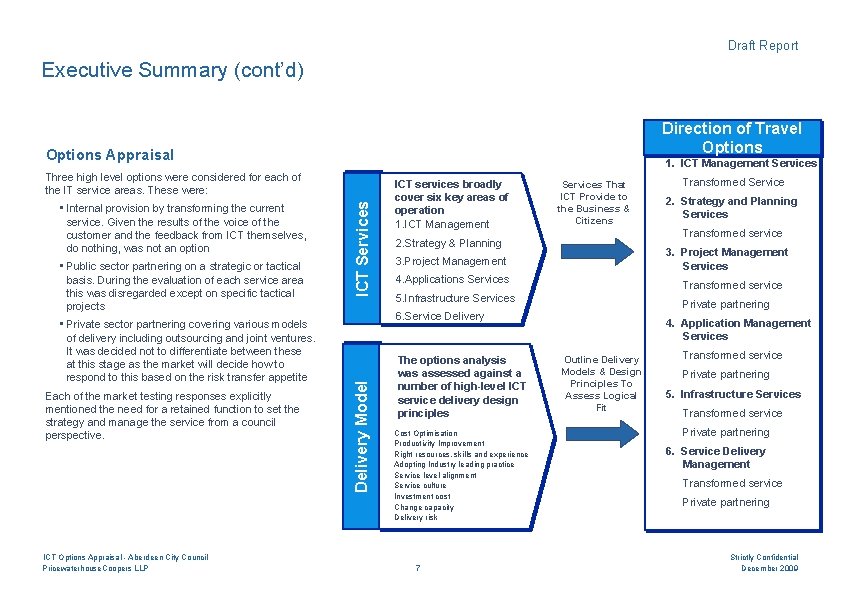
Draft Report Executive Summary (cont’d) Direction of Travel Options Appraisal 1. ICT Management Services • Public sector partnering on a strategic or tactical basis. During the evaluation of each service area this was disregarded except on specific tactical projects • Private sector partnering covering various models of delivery including outsourcing and joint ventures. It was decided not to differentiate between these at this stage as the market will decide how to respond to this based on the risk transfer appetite Each of the market testing responses explicitly mentioned the need for a retained function to set the strategy and manage the service from a council perspective. ICT Options Appraisal - Aberdeen City Council Pricewaterhouse. Coopers LLP ICT services broadly cover six key areas of operation 1. ICT Management Services That ICT Provide to the Business & Citizens 4. Applications Services Transformed service 5. Infrastructure Services Cost Optimisation Productivity Improvement Right resources, skills and experience Adopting Industry leading practice Service level alignment Service culture Investment cost Change capacity Delivery risk 7 2. Strategy and Planning Services 3. Project Management The options analysis was assessed against a number of high-level ICT service delivery design principles Transformed Service Transformed service 2. Strategy & Planning Private partnering 6. Service Delivery Model • Internal provision by transforming the current service. Given the results of the voice of the customer and the feedback from ICT themselves, do nothing, was not an option ICT Services Three high level options were considered for each of the IT service areas. These were: 4. Application Management Services Outline Delivery Models & Design Principles To Assess Logical Fit Transformed service Private partnering 5. Infrastructure Services Transformed service Private partnering 6. Service Delivery Management Transformed service Private partnering Strictly Confidential December 2009
Draft Report Executive Summary (cont’d) Whilst there are many good examples of councils that have successful external delivery partnership arrangements there are others (and there are more of these beginning to appear) that are feeling they don’t get value for money and are looking to renegotiate or terminate their service contracts. Conclusion The recommendations made during this project provide some clarity on the direction of travel recommendations and provide a route forward to take this to the next stage. Some options for future service provision have been discounted and others need explored further particularly those around transforming existing services and utilising private sector partnerships to meet the objectives. There is a danger that in keeping options open that the focus, clarity and accountability of future service delivery is effected. Partnership working with the private sector can yield significant benefits however it is important, as with any partnership, that both sides get what they need from it. There needs to be an open and honest relationship and this needs to be built, it will not just happen. Maturity and capability of retained resources will be key to the success of this and investment will be required in these staff. In proceeding with the next stage and prior to any procurement activity it is vital to explore the strategic issues further, particularly with regard to structures and staff. This will need to be carried out at senior management level. Until clarity on these areas are achieved it will be difficult to begin a procurement transaction. However, on the assumption that specific elements will be externalised to the private sector (possibilities include project delivery, applications and infrastructure) it is important to prepare information that will be required during the transaction. This will make the council take decisions associated with risks, scope and strategy that will make the procurement process clearer from the perspective of both the council and prospective suppliers. It will define the approach to people transfer and asset transfer, and use this to inform the market of the type of deal that is being offered bearing in mind the way the market could respond to various options. A business case should be developed so that a financial profile can be developed for the short and long term that allows the council to meet its objectives of service improvement and investment allowing the costs of delivery to be optimised. ICT Options Appraisal - Aberdeen City Council Pricewaterhouse. Coopers LLP 8 Strictly Confidential December 2009
Draft Report 1 - Introduction Strictly Confidential Overview and context of ICT Options Appraisal work Pw. C
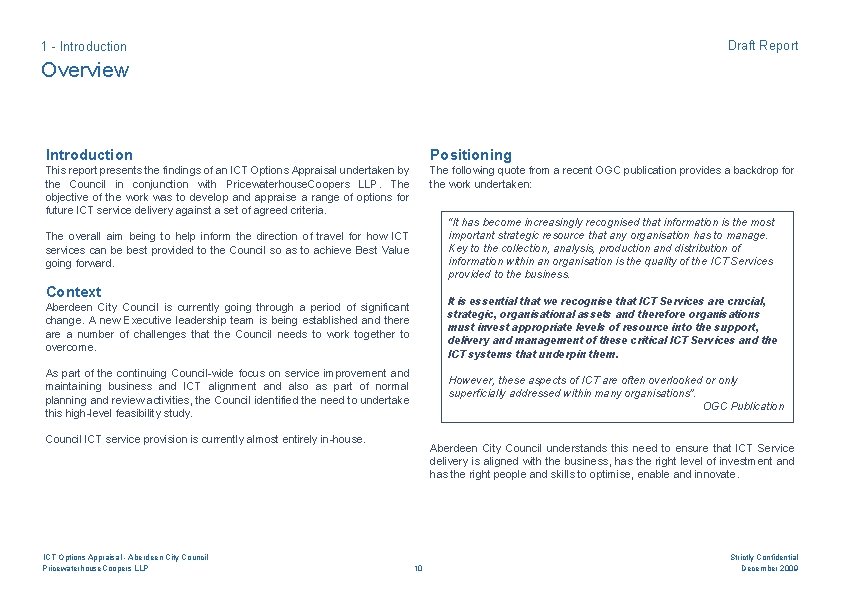
Draft Report 1 - Introduction Overview Introduction Positioning This report presents the findings of an ICT Options Appraisal undertaken by the Council in conjunction with Pricewaterhouse. Coopers LLP. The objective of the work was to develop and appraise a range of options for future ICT service delivery against a set of agreed criteria. The following quote from a recent OGC publication provides a backdrop for the work undertaken: “It has become increasingly recognised that information is the most important strategic resource that any organisation has to manage. Key to the collection, analysis, production and distribution of information within an organisation is the quality of the ICT Services provided to the business. The overall aim being to help inform the direction of travel for how ICT services can be best provided to the Council so as to achieve Best Value going forward. Context Aberdeen City Council is currently going through a period of significant change. A new Executive leadership team is being established and there a number of challenges that the Council needs to work together to overcome. It is essential that we recognise that ICT Services are crucial, strategic, organisational assets and therefore organisations must invest appropriate levels of resource into the support, delivery and management of these critical ICT Services and the ICT systems that underpin them. As part of the continuing Council-wide focus on service improvement and maintaining business and ICT alignment and also as part of normal planning and review activities, the Council identified the need to undertake this high-level feasibility study. However, these aspects of ICT are often overlooked or only superficially addressed within many organisations”. OGC Publication Council ICT service provision is currently almost entirely in-house. ICT Options Appraisal - Aberdeen City Council Pricewaterhouse. Coopers LLP Aberdeen City Council understands this need to ensure that ICT Service delivery is aligned with the business, has the right level of investment and has the right people and skills to optimise, enable and innovate. 10 Strictly Confidential December 2009
Draft Report 2 – Approach Strictly Confidential Approach taken for the development and appraisal of ICT options Pw. C
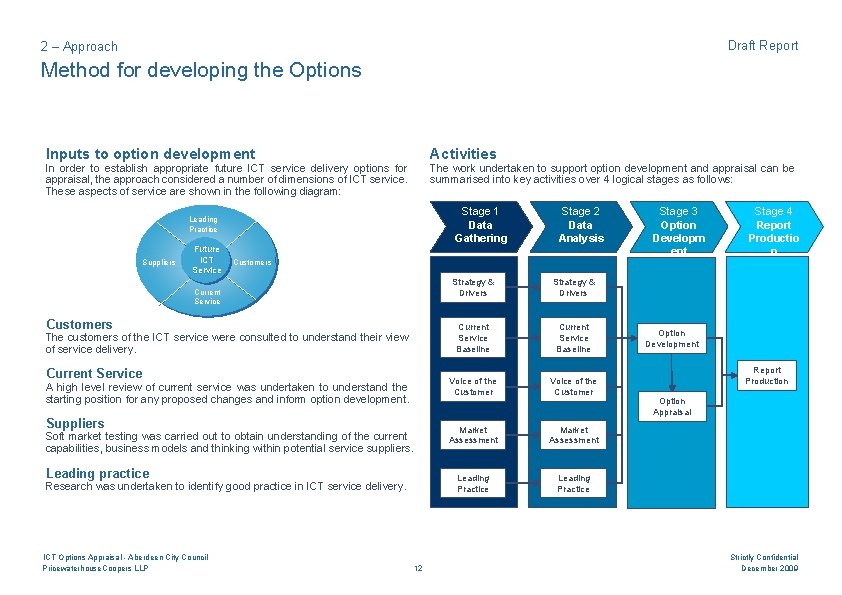
Draft Report 2 – Approach Method for developing the Options Inputs to option development Activities In order to establish appropriate future ICT service delivery options for appraisal, the approach considered a number of dimensions of ICT service. These aspects of service are shown in the following diagram: The work undertaken to support option development and appraisal can be summarised into key activities over 4 logical stages as follows: Stage 1 Data Gathering Leading Practice Suppliers Future ICT Service Customers Current Service Customers The customers of the ICT service were consulted to understand their view of service delivery. Current Service A high level review of current service was undertaken to understand the starting position for any proposed changes and inform option development. Suppliers Soft market testing was carried out to obtain understanding of the current capabilities, business models and thinking within potential service suppliers. Leading practice Research was undertaken to identify good practice in ICT service delivery. ICT Options Appraisal - Aberdeen City Council Pricewaterhouse. Coopers LLP Stage 2 Data Analysis 12 Strategy & Drivers Current Service Baseline Voice of the Customer Market Assessment Leading Practice Stage 3 Option Developm ent Stage 4 Report Productio n Option Development Report Production Option Appraisal Strictly Confidential December 2009
Draft Report 3 – Strategy & Drivers Strictly Confidential Establishing the strategic context and business drivers influencing ICT Option development Pw. C
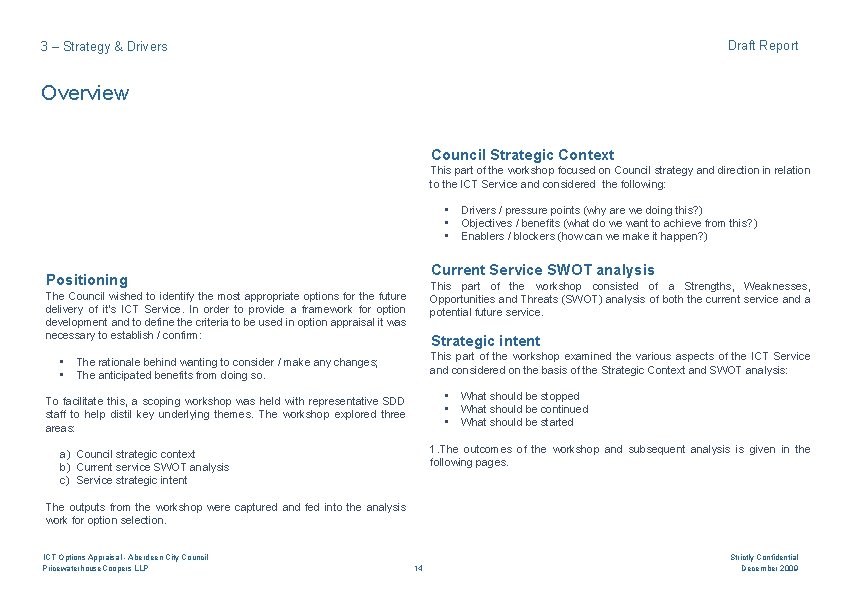
Draft Report 3 – Strategy & Drivers Overview Council Strategic Context This part of the workshop focused on Council strategy and direction in relation to the ICT Service and considered the following: • • • Current Service SWOT analysis Positioning This part of the workshop consisted of a Strengths, Weaknesses, Opportunities and Threats (SWOT) analysis of both the current service and a potential future service. The Council wished to identify the most appropriate options for the future delivery of it’s ICT Service. In order to provide a framework for option development and to define the criteria to be used in option appraisal it was necessary to establish / confirm: • • Drivers / pressure points (why are we doing this? ) Objectives / benefits (what do we want to achieve from this? ) Enablers / blockers (how can we make it happen? ) Strategic intent This part of the workshop examined the various aspects of the ICT Service and considered on the basis of the Strategic Context and SWOT analysis: The rationale behind wanting to consider / make any changes; The anticipated benefits from doing so. • • • To facilitate this, a scoping workshop was held with representative SDD staff to help distil key underlying themes. The workshop explored three areas: What should be stopped What should be continued What should be started 1. The outcomes of the workshop and subsequent analysis is given in the following pages. a) Council strategic context b) Current service SWOT analysis c) Service strategic intent The outputs from the workshop were captured and fed into the analysis work for option selection. ICT Options Appraisal - Aberdeen City Council Pricewaterhouse. Coopers LLP 14 Strictly Confidential December 2009
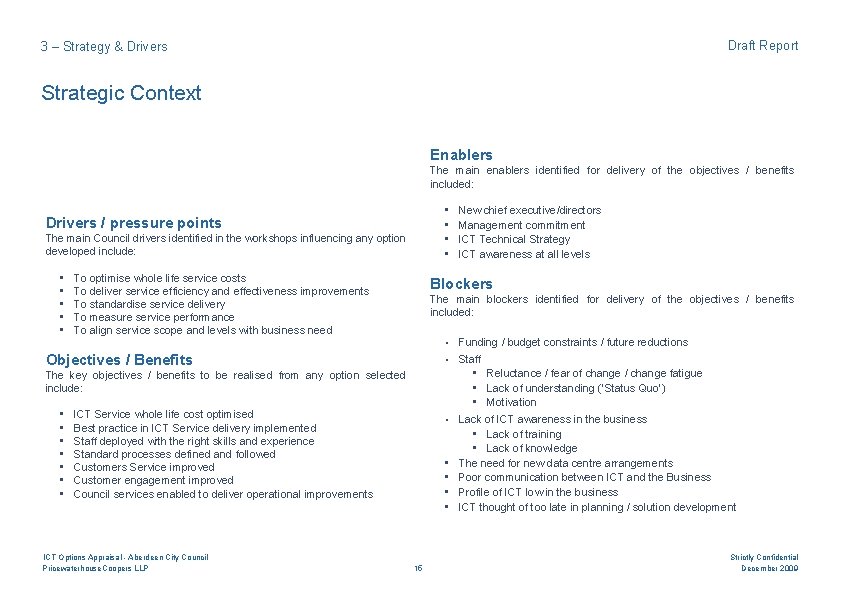
Draft Report 3 – Strategy & Drivers Strategic Context Enablers The main enablers identified for delivery of the objectives / benefits included: • • Drivers / pressure points The main Council drivers identified in the workshops influencing any option developed include: • • • To optimise whole life service costs To deliver service efficiency and effectiveness improvements To standardise service delivery To measure service performance To align service scope and levels with business need Blockers The main blockers identified for delivery of the objectives / benefits included: Objectives / Benefits • Funding / budget constraints / future reductions • Staff • Reluctance / fear of change / change fatigue • Lack of understanding (‘Status Quo’) • Motivation • Lack of ICT awareness in the business • Lack of training • Lack of knowledge The need for new data centre arrangements Poor communication between ICT and the Business Profile of ICT low in the business ICT thought of too late in planning / solution development The key objectives / benefits to be realised from any option selected include: • • ICT Service whole life cost optimised Best practice in ICT Service delivery implemented Staff deployed with the right skills and experience Standard processes defined and followed Customers Service improved Customer engagement improved Council services enabled to deliver operational improvements ICT Options Appraisal - Aberdeen City Council Pricewaterhouse. Coopers LLP New chief executive/directors Management commitment ICT Technical Strategy ICT awareness at all levels • • 15 Strictly Confidential December 2009
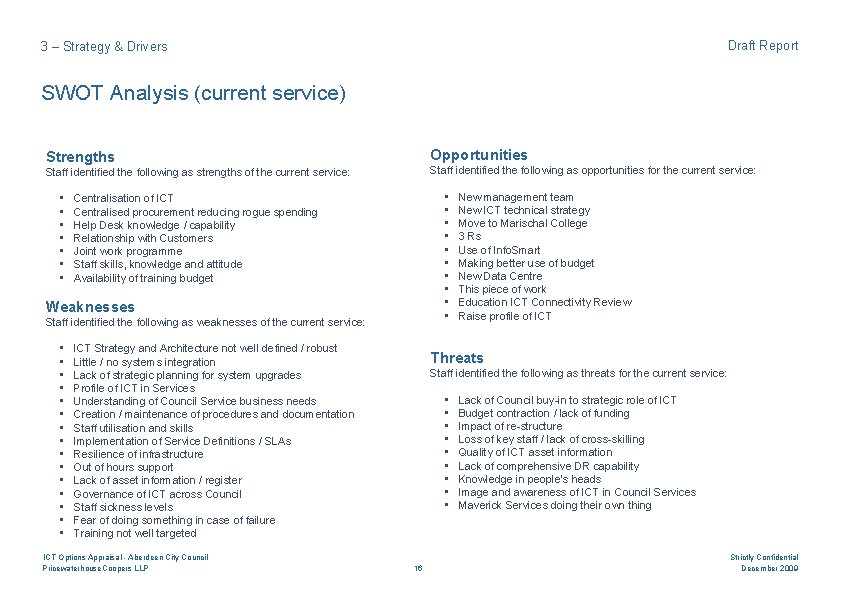
Draft Report 3 – Strategy & Drivers SWOT Analysis (current service) Opportunities Strengths Staff identified the following as opportunities for the current service: Staff identified the following as strengths of the current service: • • • • • Centralisation of ICT Centralised procurement reducing rogue spending Help Desk knowledge / capability Relationship with Customers Joint work programme Staff skills, knowledge and attitude Availability of training budget Weaknesses Staff identified the following as weaknesses of the current service: • • • • ICT Strategy and Architecture not well defined / robust Little / no systems integration Lack of strategic planning for system upgrades Profile of ICT in Services Understanding of Council Service business needs Creation / maintenance of procedures and documentation Staff utilisation and skills Implementation of Service Definitions / SLAs Resilience of infrastructure Out of hours support Lack of asset information / register Governance of ICT across Council Staff sickness levels Fear of doing something in case of failure Training not well targeted ICT Options Appraisal - Aberdeen City Council Pricewaterhouse. Coopers LLP New management team New ICT technical strategy Move to Marischal College 3 Rs Use of Info. Smart Making better use of budget New Data Centre This piece of work Education ICT Connectivity Review Raise profile of ICT Threats Staff identified the following as threats for the current service: • • • 16 Lack of Council buy-in to strategic role of ICT Budget contraction / lack of funding Impact of re-structure Loss of key staff / lack of cross-skilling Quality of ICT asset information Lack of comprehensive DR capability Knowledge in people’s heads Image and awareness of ICT in Council Services Maverick Services doing their own thing Strictly Confidential December 2009
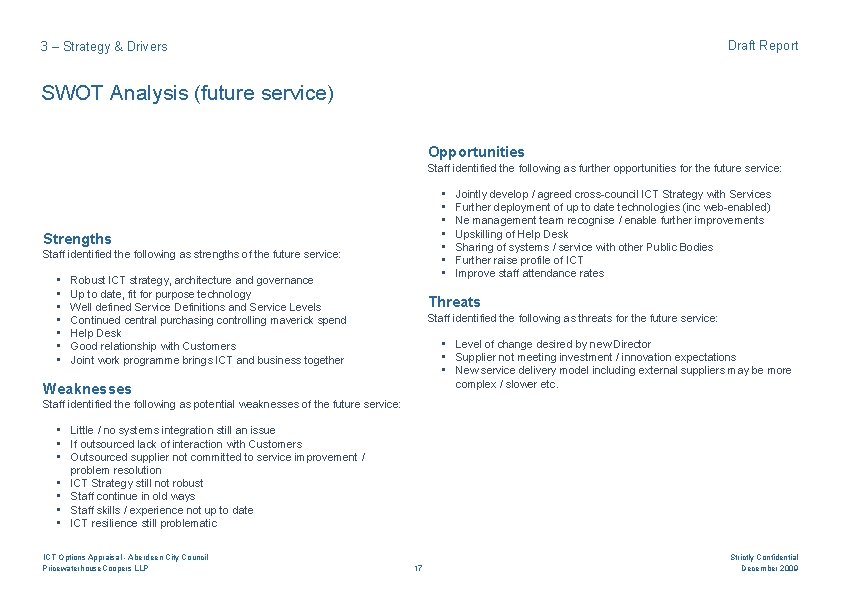
Draft Report 3 – Strategy & Drivers SWOT Analysis (future service) Opportunities Staff identified the following as further opportunities for the future service: • • Strengths Staff identified the following as strengths of the future service: • • Robust ICT strategy, architecture and governance Up to date, fit for purpose technology Well defined Service Definitions and Service Levels Continued central purchasing controlling maverick spend Help Desk Good relationship with Customers Joint work programme brings ICT and business together Jointly develop / agreed cross-council ICT Strategy with Services Further deployment of up to date technologies (inc web-enabled) Ne management team recognise / enable further improvements Upskilling of Help Desk Sharing of systems / service with other Public Bodies Further raise profile of ICT Improve staff attendance rates Threats Staff identified the following as threats for the future service: • Level of change desired by new Director • Supplier not meeting investment / innovation expectations • New service delivery model including external suppliers may be more complex / slower etc. Weaknesses Staff identified the following as potential weaknesses of the future service: • Little / no systems integration still an issue • If outsourced lack of interaction with Customers • Outsourced supplier not committed to service improvement / problem resolution • ICT Strategy still not robust • Staff continue in old ways • Staff skills / experience not up to date • ICT resilience still problematic ICT Options Appraisal - Aberdeen City Council Pricewaterhouse. Coopers LLP 17 Strictly Confidential December 2009
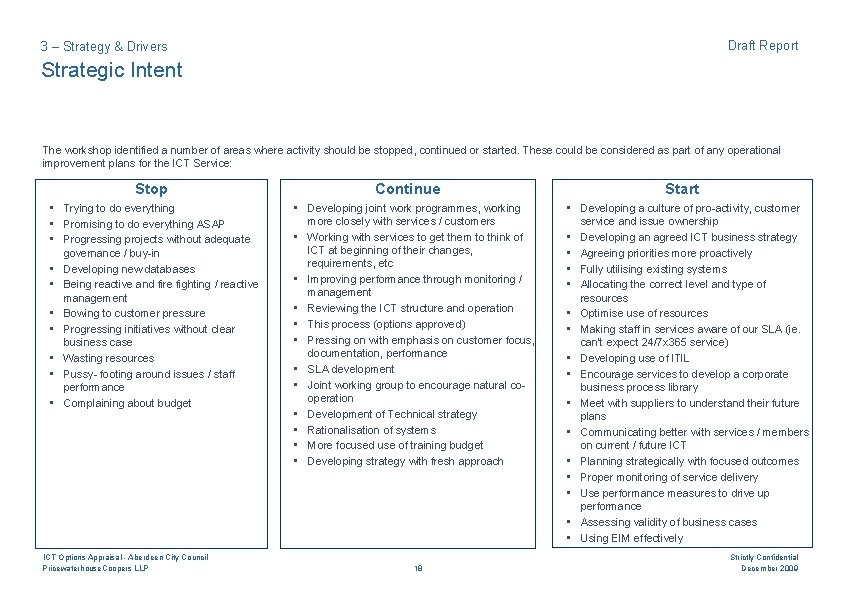
Draft Report 3 – Strategy & Drivers Strategic Intent The workshop identified a number of areas where activity should be stopped, continued or started. These could be considered as part of any operational improvement plans for the ICT Service: Stop • Trying to do everything • Promising to do everything ASAP • Progressing projects without adequate governance / buy-in • Developing new databases • Being reactive and fire fighting / reactive management • Bowing to customer pressure • Progressing initiatives without clear business case • Wasting resources • Pussy- footing around issues / staff performance • Complaining about budget ICT Options Appraisal - Aberdeen City Council Pricewaterhouse. Coopers LLP Continue • Developing joint work programmes, working more closely with services / customers • Working with services to get them to think of ICT at beginning of their changes, requirements, etc • Improving performance through monitoring / management • Reviewing the ICT structure and operation • This process (options approved) • Pressing on with emphasis on customer focus, documentation, performance • SLA development • Joint working group to encourage natural cooperation • Development of Technical strategy • Rationalisation of systems • More focused use of training budget • Developing strategy with fresh approach 18 Start • Developing a culture of pro-activity, customer service and issue ownership • Developing an agreed ICT business strategy • Agreeing priorities more proactively • Fully utilising existing systems • Allocating the correct level and type of resources • Optimise use of resources • Making staff in services aware of our SLA (ie. can't expect 24/7 x 365 service) • Developing use of ITIL • Encourage services to develop a corporate business process library • Meet with suppliers to understand their future plans • Communicating better with services / members on current / future ICT • Planning strategically with focused outcomes • Proper monitoring of service delivery • Use performance measures to drive up performance • Assessing validity of business cases • Using EIM effectively Strictly Confidential December 2009
Draft Report 4 – Current Service Baseline Strictly Confidential High level review of current service to inform future option development Pw. C
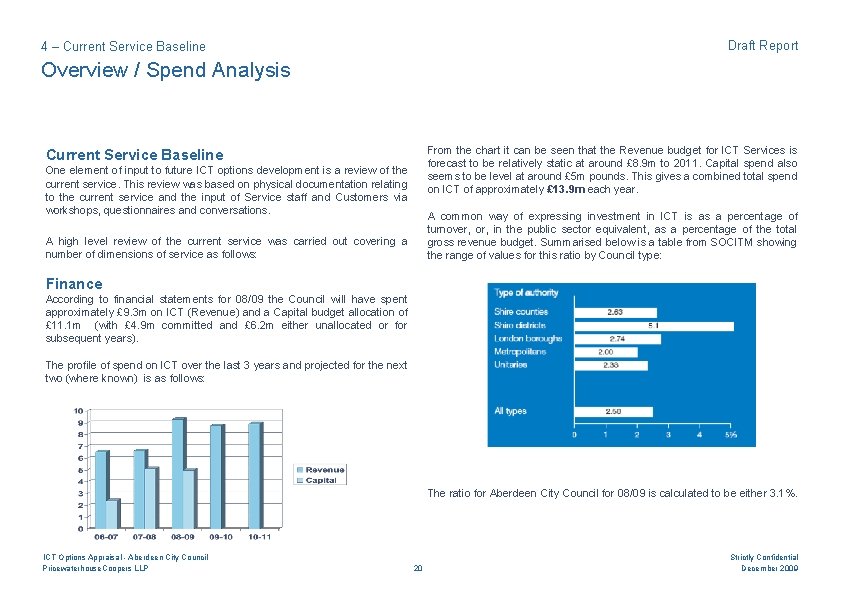
Draft Report 4 – Current Service Baseline Overview / Spend Analysis From the chart it can be seen that the Revenue budget for ICT Services is forecast to be relatively static at around £ 8. 9 m to 2011. Capital spend also seems to be level at around £ 5 m pounds. This gives a combined total spend on ICT of approximately £ 13. 9 m each year. Current Service Baseline One element of input to future ICT options development is a review of the current service. This review was based on physical documentation relating to the current service and the input of Service staff and Customers via workshops, questionnaires and conversations. A common way of expressing investment in ICT is as a percentage of turnover, or, in the public sector equivalent, as a percentage of the total gross revenue budget. Summarised below is a table from SOCITM showing the range of values for this ratio by Council type: A high level review of the current service was carried out covering a number of dimensions of service as follows: Finance According to financial statements for 08/09 the Council will have spent approximately £ 9. 3 m on ICT (Revenue) and a Capital budget allocation of £ 11. 1 m (with £ 4. 9 m committed and £ 6. 2 m either unallocated or for subsequent years). The profile of spend on ICT over the last 3 years and projected for the next two (where known) is as follows: The ratio for Aberdeen City Council for 08/09 is calculated to be either 3. 1%. ICT Options Appraisal - Aberdeen City Council Pricewaterhouse. Coopers LLP 20 Strictly Confidential December 2009
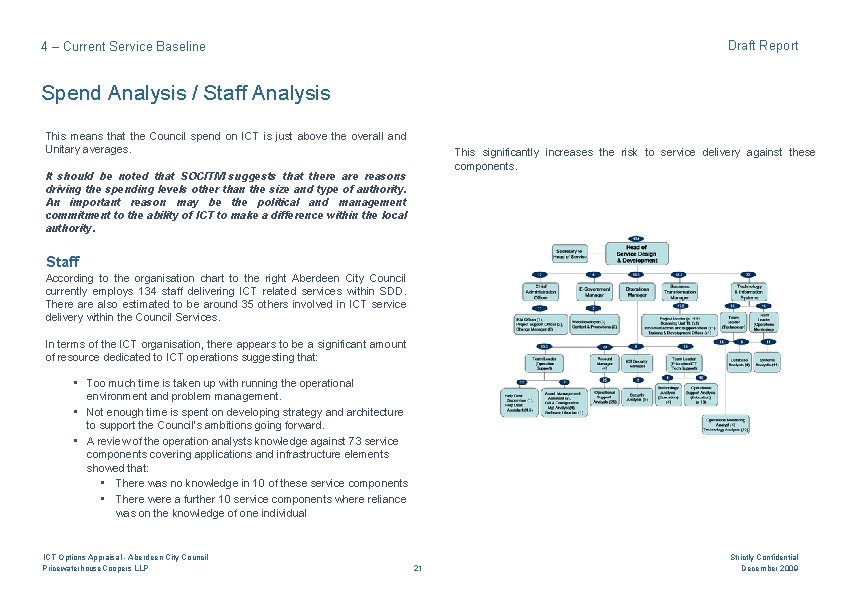
Draft Report 4 – Current Service Baseline Spend Analysis / Staff Analysis This means that the Council spend on ICT is just above the overall and Unitary averages. This significantly increases the risk to service delivery against these components. It should be noted that SOCITM suggests that there are reasons driving the spending levels other than the size and type of authority. An important reason may be the political and management commitment to the ability of ICT to make a difference within the local authority. Staff According to the organisation chart to the right Aberdeen City Council currently employs 134 staff delivering ICT related services within SDD. There also estimated to be around 35 others involved in ICT service delivery within the Council Services. In terms of the ICT organisation, there appears to be a significant amount of resource dedicated to ICT operations suggesting that: • Too much time is taken up with running the operational environment and problem management. • Not enough time is spent on developing strategy and architecture to support the Council’s ambitions going forward. • A review of the operation analysts knowledge against 73 service components covering applications and infrastructure elements showed that: • There was no knowledge in 10 of these service components • There were a further 10 service components where reliance was on the knowledge of one individual ICT Options Appraisal - Aberdeen City Council Pricewaterhouse. Coopers LLP 21 Strictly Confidential December 2009
Draft Report 4 – Current Service Baseline Processes/Technology/Facilities Processes Service Management - There are some service management processes in place, but the Council would benefit from implementation of a more formal service management regime such as that provided by ITIL. There is currently a document control procedure and an incident management procedure being developed. Although there are some aspects of the ICT Service that have definitions of the services delivered (e. g. i. World) , the majority of services provided do not have any formal definitions or SLA and there is no overall service catalogue. This means that there is no formal “contract” between the ICT Service (as supplier) and other Council Services (as customers). Although some documentation on ICT Service processes was made available during data gathering, the observations in this section are based primarily on observation / inference and may be proved inaccurate in certain areas on further investigation. Governance - Governance of the ICT Service as a strategic Council asset needs to be improved to ensure that investment and delivery are aligned with overall Council need and priorities. Strategy, Innovation and Architecture - Although some work is currently being completed in developing an ICT Technical Strategy this does not cover the governance arrangements and the operating model for ICT. This Technical IT Strategy has been developed by an external consultant and will help with the convergence of the ICT architecture by defining a future path and the role it could play in transforming the Council’s services. This strategy will require the appropriate governance arrangements to e in place to succeed. Typically, without governance there is no mechanism to ensure strategy compliance. A high level ICT Business Strategy was developed in 2008. An interim ICT Security Strategy has also been developed. Demand Management - Some demand management is carried out in the Service Management team meetings. Technology Overview The Council has a significant investment in the ICT hardware and software required to underpin its business operations. Networks and user devices are in a stable state. It is recognise that there are too many applications and this is being addressed currently. There is a requirement for investment in data centre capacity especially with the implementation of the ICT Technical Strategy and the move to thin client application provision. Programme / Project Management – There approximately 15 staff acting as project managers with currently 54 ICT related projects being worked on or planned. PRINCE 2 is the current project management methodology being used. There is no evidence of Programme management as each of these are individual projects. There is an initial project scoring mechanism used to prioritise projects. Most projects appear to be SDD led and therefore accountability for the business to deliver benefits is not at the forefront of thinking. The area with most plans appears to be around Electronic Service Delivery and the development of CRM. Covalent is used to monitor the current status of projects. ICT Options Appraisal - Aberdeen City Council Pricewaterhouse. Coopers LLP Facilities The property database held by ICT has more than 900 properties in it ranging from primary and secondary schools to libraries, leisure centres and Community Centres as well as the main Council buildings. As most ICT staff are based in the one location there is little benefit to be had in seeking to consolidate staff. There may be opportunity to consolidate infrastructure as part of the new data centre which will lead to freeing up space in some areas to make it available for other users. 22 Strictly Confidential December 2009
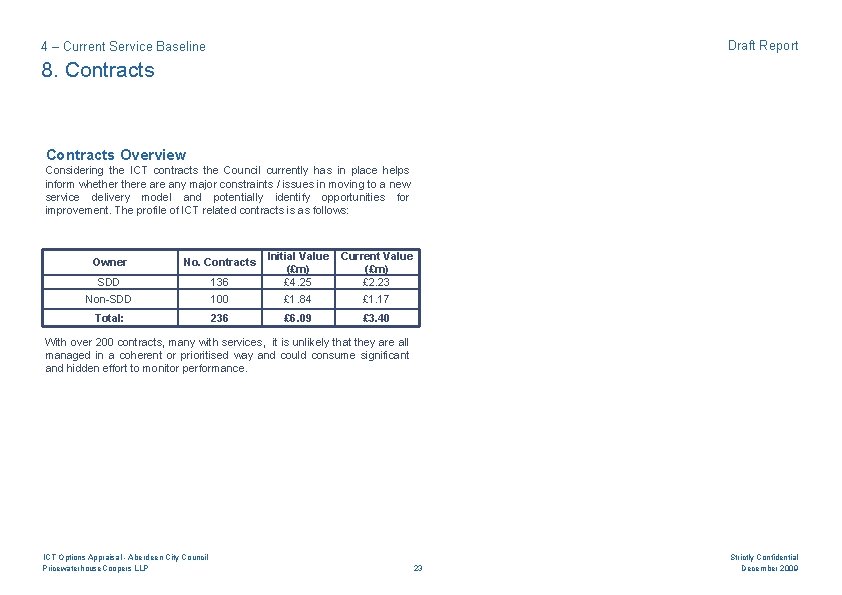
Draft Report 4 – Current Service Baseline 8. Contracts Overview Considering the ICT contracts the Council currently has in place helps inform whethere any major constraints / issues in moving to a new service delivery model and potentially identify opportunities for improvement. The profile of ICT related contracts is as follows: 136 Initial Value (£m) £ 4. 25 Current Value (£m) £ 2. 23 Non-SDD 100 £ 1. 84 £ 1. 17 Total: 236 £ 6. 09 £ 3. 40 Owner No. Contracts SDD With over 200 contracts, many with services, it is unlikely that they are all managed in a coherent or prioritised way and could consume significant and hidden effort to monitor performance. ICT Options Appraisal - Aberdeen City Council Pricewaterhouse. Coopers LLP 23 Strictly Confidential December 2009
Draft Report 5 – Voice of the Customer Strictly Confidential Assessment of ICT Service delivery from a Customer (and Supplier) viewpoint Pw. C
Draft Report 5 – Voice Of The Customer Overview Data Gathering Establishing Views of current service delivery The questionnaires were issued to a representative sample of staff from both the Supplier (SDD - 21 responses) and Customer (31 responses) communities within the Council. An important input to the analysis of ICT Service delivery is the collective experience of ICT users (Customers). Understanding what works well, what isn’t so good and what needs changed from a user perspective will help inform the direction of service delivery in the future. Questionnaire The questionnaire responses were submitted over a period of time to Pw. C. As the responses came in they were collated analysis of the gathered information was undertaken. A “Voice of the Customer” questionnaire was developed to capture the views of the Customers of ICT services and was designed in two parts: The following sections provide the results from the questionnaire. • The first part looking at an individuals role and how ICT affected them. This included opportunity to identify problem areas to see if there were any common themes. • The second part asking questions under a series of categories about current ICT service delivery and considering: - How Important the aspect of service was to the Council and; - How Effectively the aspect of service was delivered. To add a further dimension to the analysis, the questionnaire was also issued to the Supplier (ICT Service) thus providing the ability to compare and contrast the internal and external views of service delivery. ICT Options Appraisal - Aberdeen City Council Pricewaterhouse. Coopers LLP 25 Strictly Confidential December 2009
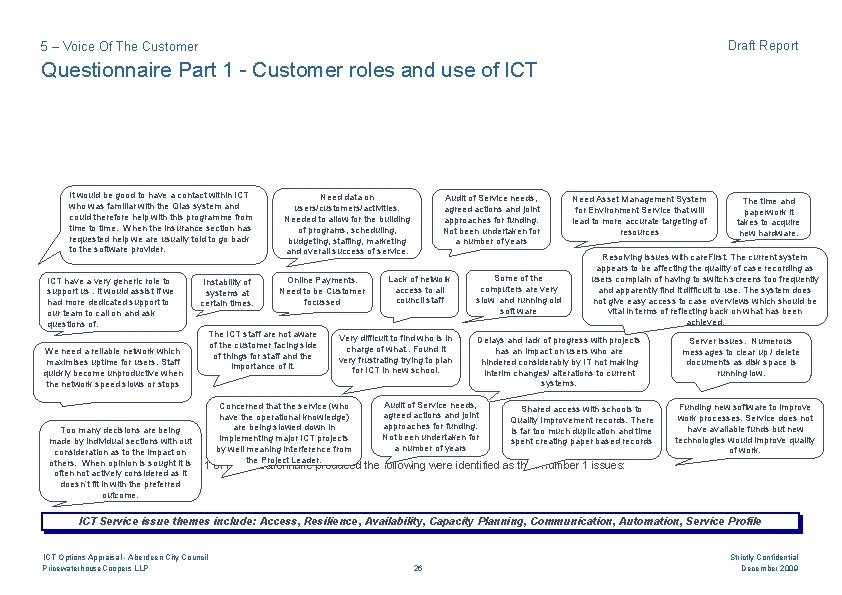
Draft Report 5 – Voice Of The Customer Questionnaire Part 1 - Customer roles and use of ICT It would be good to have a contact within ICT who was familiar with the Qlas system and could therefore help with this programme from time to time. When the insurance section has requested help we are usually told to go back to the software provider. ICT have a very generic role to support us. It would assist if we had more dedicated support to our team to call on and ask questions of. We need a reliable network which maximises uptime for users. Staff quickly become unproductive when the network speed slows or stops Instability of systems at certain times. Need data on users/customers/activities. Needed to allow for the building of programs, scheduling, budgeting, staffing, marketing and overall success of service. Online Payments. Need to be Customer focussed The ICT staff are not aware of the customer facing side of things for staff and the importance of it. Audit of Service needs, agreed actions and joint approaches for funding. Not been undertaken for a number of years Lack of network access to all council staff Very difficult to find who is in charge of what. . Found it very frustrating trying to plan for ICT in new school. Concerned that the service (who have the operational knowledge) are being slowed down in implementing major ICT projects by well meaning interference from the Project Leader. Some of the computers are very slow and running old soft ware Need Asset Management System for Environment Service that will lead to more accurate targeting of resources Resolving issues with care. First. The current system appears to be affecting the quality of case recording as users complain of having to switch screens too frequently and apparently find it difficult to use. The system does not give easy access to case overviews which should be vital in terms of reflecting back on what has been achieved. Delays and lack of progress with projects has an impact on users who are hindered considerably by IT not making interim changes/ alterations to current systems. Audit of Service needs, agreed actions and joint approaches for funding. Not been undertaken for a number of years Shared access with schools to Quality Improvement records. There is far too much duplication and time spent creating paper based records Too many decisions are being made by individual sections with out consideration as to the impact on others. When opinion is sought it is Analysis of the responses to part 1 of the Questionnaire produced the following were identified as their number 1 issues: often not actively considered as it doesn’t fit in with the preferred outcome. Main Issues The time and paperwork it takes to acquire new hardware. Server issues. Numerous messages to clear up / delete documents as disk space is running low. Funding new software to improve work processes. Service does not have available funds but new technologies would improve quality of work. ICT Service issue themes include: Access, Resilience, Availability, Capacity Planning, Communication, Automation, Service Profile ICT Options Appraisal - Aberdeen City Council Pricewaterhouse. Coopers LLP 26 Strictly Confidential December 2009
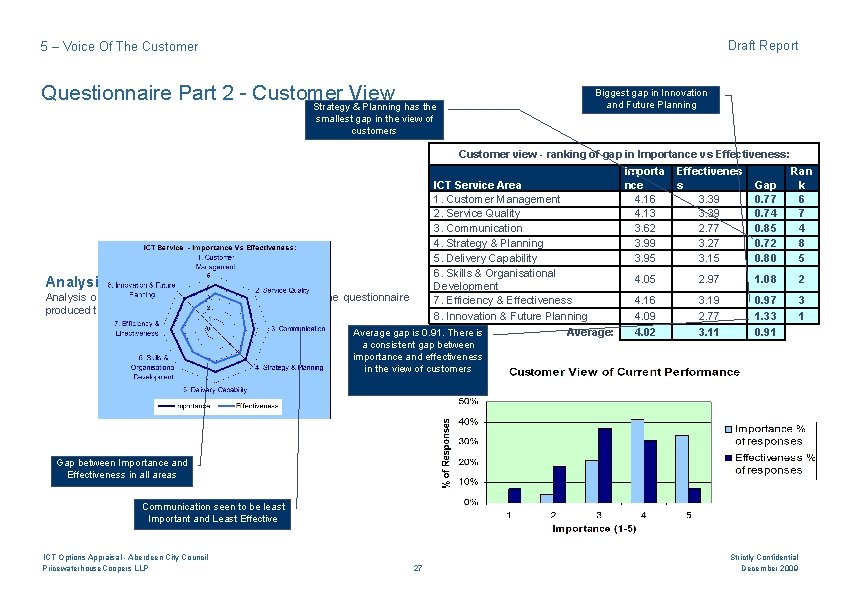
Draft Report 5 – Voice Of The Customer Questionnaire Part 2 - Customer View Strategy & Planning has the Biggest gap in Innovation and Future Planning smallest gap in the view of customers Customer view - ranking of gap in Importance vs Effectiveness: ICT Service Area 1. Customer Management 2. Service Quality 3. Communication 4. Strategy & Planning 5. Delivery Capability 6. Skills & Organisational Analysis of service Development Analysis of the Customer responses to the 2 nd part of the questionnaire 7. Efficiency & Effectiveness produced the following results: 8. Innovation & Future Planning Average gap is 0. 91. There is Average: Importa nce 4. 16 4. 13 3. 62 3. 99 3. 95 Effectivenes s 3. 39 2. 77 3. 27 3. 15 Gap 0. 77 0. 74 0. 85 0. 72 0. 80 Ran k 6 7 4 8 5 4. 05 2. 97 1. 08 2 4. 16 4. 09 4. 02 3. 19 2. 77 3. 11 0. 97 1. 33 0. 91 3 1 a consistent gap between importance and effectiveness in the view of customers Gap between Importance and Effectiveness in all areas Communication seen to be least Important and Least Effective ICT Options Appraisal - Aberdeen City Council Pricewaterhouse. Coopers LLP 27 Strictly Confidential December 2009
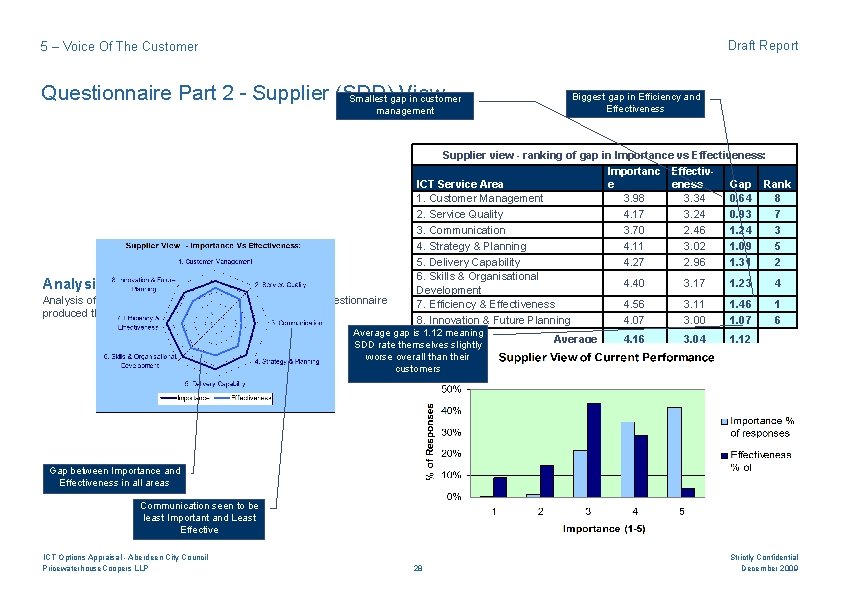
Draft Report 5 – Voice Of The Customer Questionnaire Part 2 - Supplier (SDD) View Smallest gap in customer Biggest gap in Efficiency and Effectiveness management Supplier view - ranking of gap in Importance vs Effectiveness: Analysis of Service Analysis of the Customer responses to the 2 nd part of the questionnaire produced the following results: ICT Service Area 1. Customer Management 2. Service Quality 3. Communication 4. Strategy & Planning 5. Delivery Capability 6. Skills & Organisational Development 7. Efficiency & Effectiveness 8. Innovation & Future Planning Average gap is 1. 12 meaning SDD rate themselves slightly worse overall than their customers Average Importanc Effective eness 3. 98 3. 34 4. 17 3. 24 3. 70 2. 46 4. 11 3. 02 4. 27 2. 96 Gap 0. 64 0. 93 1. 24 1. 09 1. 31 Rank 8 7 3 5 2 4. 40 3. 17 1. 23 4 4. 56 4. 07 3. 11 3. 00 1. 46 1. 07 1 6 4. 16 3. 04 1. 12 Gap between Importance and Effectiveness in all areas Communication seen to be least Important and Least Effective ICT Options Appraisal - Aberdeen City Council Pricewaterhouse. Coopers LLP 28 Strictly Confidential December 2009
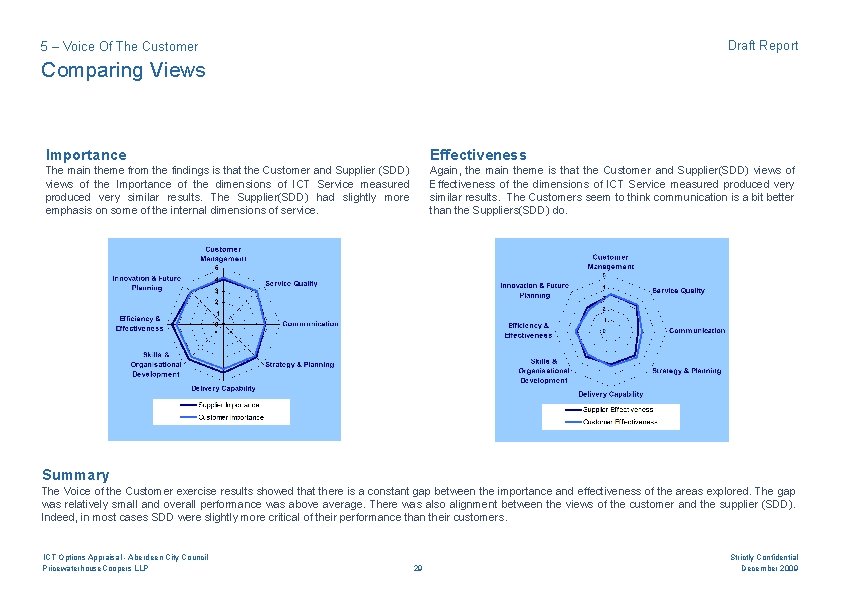
Draft Report 5 – Voice Of The Customer Comparing Views Importance Effectiveness The main theme from the findings is that the Customer and Supplier (SDD) views of the Importance of the dimensions of ICT Service measured produced very similar results. The Supplier(SDD) had slightly more emphasis on some of the internal dimensions of service. Again, the main theme is that the Customer and Supplier(SDD) views of Effectiveness of the dimensions of ICT Service measured produced very similar results. The Customers seem to think communication is a bit better than the Suppliers(SDD) do. Summary The Voice of the Customer exercise results showed that there is a constant gap between the importance and effectiveness of the areas explored. The gap was relatively small and overall performance was above average. There was also alignment between the views of the customer and the supplier (SDD). Indeed, in most cases SDD were slightly more critical of their performance than their customers. ICT Options Appraisal - Aberdeen City Council Pricewaterhouse. Coopers LLP 29 Strictly Confidential December 2009
Draft Report 6 – Market Assessment Strictly Confidential Assessment of the market place for supplying ICT Services to Aberdeen City Council Pw. C
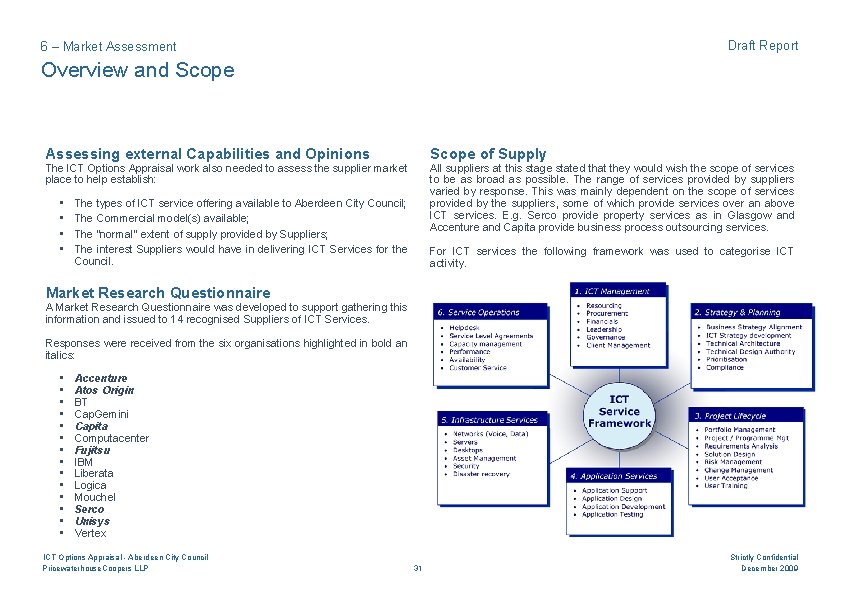
Draft Report 6 – Market Assessment Overview and Scope Assessing external Capabilities and Opinions Scope of Supply The ICT Options Appraisal work also needed to assess the supplier market place to help establish: • • All suppliers at this stage stated that they would wish the scope of services to be as broad as possible. The range of services provided by suppliers varied by response. This was mainly dependent on the scope of services provided by the suppliers, some of which provide services over an above ICT services. E. g. Serco provide property services as in Glasgow and Accenture and Capita provide business process outsourcing services. The types of ICT service offering available to Aberdeen City Council; The Commercial model(s) available; The “normal” extent of supply provided by Suppliers; The interest Suppliers would have in delivering ICT Services for the Council. For ICT services the following framework was used to categorise ICT activity. Market Research Questionnaire A Market Research Questionnaire was developed to support gathering this information and issued to 14 recognised Suppliers of ICT Services. Responses were received from the six organisations highlighted in bold an italics: • • • • Accenture Atos Origin BT Cap. Gemini Capita Computacenter Fujitsu IBM Liberata Logica Mouchel Serco Unisys Vertex ICT Options Appraisal - Aberdeen City Council Pricewaterhouse. Coopers LLP 31 Strictly Confidential December 2009
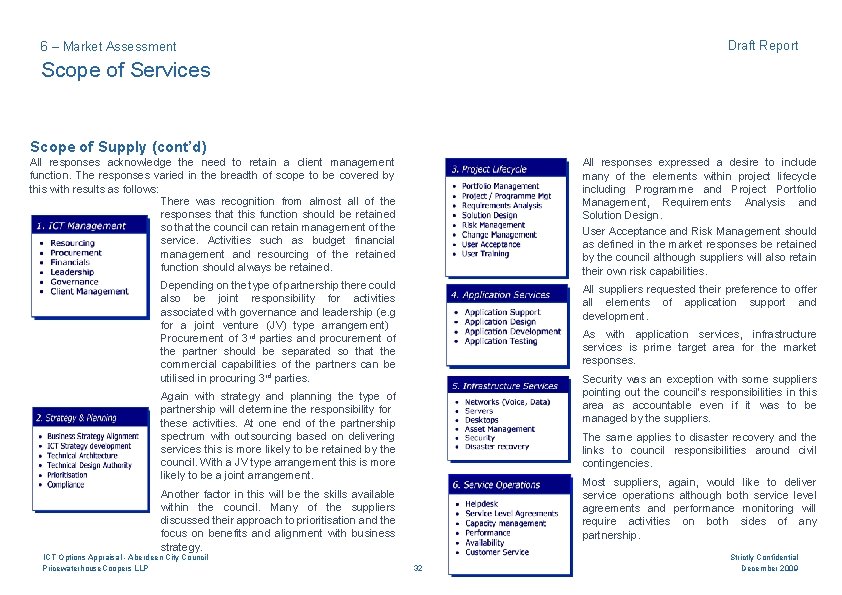
Draft Report 6 – Market Assessment Scope of Services Scope of Supply (cont’d) All responses acknowledge the need to retain a client management function. The responses varied in the breadth of scope to be covered by this with results as follows: There was recognition from almost all of the responses that this function should be retained so that the council can retain management of the service. Activities such as budget financial management and resourcing of the retained function should always be retained. All responses expressed a desire to include many of the elements within project lifecycle including Programme and Project Portfolio Management, Requirements Analysis and Solution Design. User Acceptance and Risk Management should as defined in the market responses be retained by the council although suppliers will also retain their own risk capabilities. Depending on the type of partnership there could also be joint responsibility for activities associated with governance and leadership (e. g for a joint venture (JV) type arrangement) Procurement of 3 rd parties and procurement of the partner should be separated so that the commercial capabilities of the partners can be utilised in procuring 3 rd parties. All suppliers requested their preference to offer all elements of application support and development. As with application services, infrastructure services is prime target area for the market responses. Security was an exception with some suppliers pointing out the council’s responsibilities in this area as accountable even if it was to be managed by the suppliers. Again with strategy and planning the type of partnership will determine the responsibility for these activities. At one end of the partnership spectrum with outsourcing based on delivering services this is more likely to be retained by the council. With a JV type arrangement this is more likely to be a joint arrangement. The same applies to disaster recovery and the links to council responsibilities around civil contingencies. Most suppliers, again, would like to deliver service operations although both service level agreements and performance monitoring will require activities on both sides of any partnership. Another factor in this will be the skills available within the council. Many of the suppliers discussed their approach to prioritisation and the focus on benefits and alignment with business strategy. ICT Options Appraisal - Aberdeen City Council Pricewaterhouse. Coopers LLP 32 Strictly Confidential December 2009
Draft Report 6 – Market Assessment Scope of Services / Business Model Use of subcontractors - There are no suppliers in the market that provide the scope of services set out as to be provided by partners in the scope of supply section. This was confirmed and all suppliers confirmed the use of subcontractors in delivering the services. This will be determined by their core capabilities. Scope of Supply (cont’d) Additionally, the market responses identified some further IT related services and activities as follows: • Printing Services • Configuration Management • Specifically including Education ICT • Mobiles and other non ICT related services such as Business Transformation. Time to deliver benefits – The majority of responses stated that it will take in the region of 2 years to transform to a new ICT service based on the business models identified. Transition time - Based on the services identified in the scope of supply the transition period for transferring from internal delivery to the partner is 6 months. It is also important to transition as quickly as possible so that stability in the services can be achieved. Business Model Each of the suppliers were asked their opinion on the types of partnership they prefer and which ones they currently have in place. The options for the ICT operating model involving an external supplier included Centres of Excellence, Joint Venture, Outsource or Shared Service. Potential benefits – Half of the responses declined to comment on the potential benefits that are available as this will be based on the partnership type and the transfer of risk to the private sector. The other provided ranges from 18% or 20% at the lower end and 30% at the higher end. Some suppliers stated that they had experience of all of these and in the main they preferred an outsourcing type partnering arrangement where they have the opportunity to drive change, deliver benefits and use their cost drivers to reduce the delivery costs. e. g. moving the data centre to one of their existing sites so they can make economy of scale savings and deliver lower cost services. The type of partnership can have an effect here in that if it is a straight outsource then the contract has to reflect the incentives to deliver savings and the sharing of these. A JV type relationship will retain the profits and will be paid to the partner based on the commercial arrangements of the JV. ICT Options Appraisal - Aberdeen City Council Pricewaterhouse. Coopers LLP 33 Strictly Confidential December 2009
Draft Report 6 – Market Assessment Moving to partnership working Risks of moving to partnership working The suppliers were asked their opinion on the key risks that you could face in a partnership delivery scenario. The responses can be grouped into three categories namely strategic, operational and organisational. Within this there is again a mix of short and longer term risks. • Benefits realisation – a key risk is the realisation of the business benefits. This is a significant risk to be managed to ensure that the demonstrable success of the partnership model. Operational Risks • Technology alignment – it is critical that there is a common technology footprint, based on an open integrated architecture that can maximise the economies of scale. Implementing this is a significant risk and it is vital that the system complexity is managed together with achieving the timescale deadlines that are set. Strategic risks There are significant strategic challenges in moving to a ICT partnership model and each of these challenges will be a key risk to be managed to ensure the success of the relationship: • Project Governance – the value of having a robust project governance structure cannot be underestimated. The view that getting this structure right is critical to the success of the project. • Stakeholders and sponsorship – it is essential that key Council members and officers support and own the new service and that the senior management team are seen, clearly, to be driving the programme; Organisational Risks • Strategy – a coherent strategy that is bought into is vital to achieving success. Too many projects have failed due to a lack of a coherent and realistic strategy that can be implemented given the time, financial and organisational constraints. • Optimising the IT Structure – rationalising the areas of duplication and inefficiency has been a significant area of risk in projects of this nature. Managing the risk of creating a shared infrastructure, providing a performance reporting framework are key activities in this area. • Scope – a key issue in outsourcing, or wider partnering, is that you do not outsource your problems or that you do not have any uncertainty in the scope of services you are seeking to contract out. Therefore it is essential that the Council clearly defines the scope of the services and the associated specification of requirements. For illustration a small uncertainty or latent risk in, for example an annual £ 10 million contract for 10 years, can have a massive impact ie a 5% deviation from expected performance would have a £ 5 million whole life cost. Therefore a key set of skills are required to define the scope of services and the service framework. • Staffing Transfer Risks - the partnership working approach can involve the significant movement of staff between organisations either by transfer (TUPE) or secondment. The risks associated with this include the transfer process, and questions around pensions, locations, career opportunities, security of employment, and terms and conditions. ICT Options Appraisal - Aberdeen City Council Pricewaterhouse. Coopers LLP • Creating an efficiency culture – achieving an efficiency culture is one of the keys to realising improvement of services and the realisation of business benefits, but there are major risks in managing this – the public sector environment is littered with projects that have failed due to cultural and change issues. 34 Strictly Confidential December 2009
Draft Report 6 – Market Assessment Risks of partnership working/Technology implications Risks of Partnership Working (cont’d) Conversely where risks cannot be identified and quantified sufficiently then a joint approach to managing risk should be identified and implemented. Consequently for these non-quantifiable risks under a ‘partnering agreement’ there should be joint ownership of risk and risk management plans incorporated in the project documentation. Each of these risks has long and short term implications depending on the stage of the project. Having said this a number of the risks above tend more to the longer term, and these include stakeholders and sponsorship, benefits realisation and the efficiency culture. In summary the greater clarity the Council can give to the project then the higher the level of risk that can be transferred to any partner – but realistically the Council should only transfer risk where the Partner can actively manage that risk – if not, then the risk premium charged will have a very serious impact on the value for money of any deal. Conversely a number of the risks above have a shorter term focus, ie getting the technology alignment, project governance and setting a robust strategic plan from the outset. The balance of risks between the public and private sector will be governed by several key parameters: Technology Implications • The clarity and demonstration of a coherent and robust strategy and clear evidence of buy-in to the transformation from members, senior officers and partners; Technology implications for the delivery of partnership working will touch upon a number of areas, not only in the design of the technology architecture but also in the potential implications to the council in its sourcing arrangements, ICT organisational design and the service delivery model employed to support the service users. • The scope of services included; • Availability of Council resources to properly resource the programme, who also have the commensurate skills; Key technology architecture considerations will include; • Condition of legacy technology assets; • Functionality; Creating an architecture framework able to provide the breadth • Any staff transfer and conditions of service implications, including management of any Union interface. TUPE could be a key issue in this process should staff transfer to the partner; and depth of functional requirements across the support services. Looking to leverage the existing investments where appropriate but also recognising the need to integrate against a common integration framework if simplification and standardisation of processes is to be achieved. • The contracting structure employed. The private sector will assess these parameters and make a commercial judgement on the level of risk that they will accept – the greater the management and clarity in the project the greater the risk that the private sector will accept. ICT Options Appraisal - Aberdeen City Council Pricewaterhouse. Coopers LLP • Scalability; Ensuring that the design will support the volumes and user requirements of the Council, both upwards and downwards where consolidation takes place as well as able to adopt a modular approach to increasing service capabilities. 35 Strictly Confidential December 2009
Draft Report 6 – Market Assessment Risks of partnership working/Technology implications Technology Implications (cont’d) If services are sourced externally how is first, second and third line support now structured? What implications are there to existing contracts, escalation procedures, change control and systems availability out with normal working hours? Are there broader implications to the council in how it makes provision for its Disaster Recovery and Business Continuity plans if there are underlying changes to the support and sourcing arrangements for its technology services? Key technology and support implications that again require careful consideration as part of the service redesign. • Maintainability; Implementing a technology design that is easily supported by the Council or its service partners in addition to creating a robust, reliable infrastructure design that is resilient and able to be upgraded without major service disruption. • Interoperability; Adopting a common architecture footprint with common platforms, data standards and interfaces to help the council reduce the existing system fragmentation and improve its overall ability to better interface & partner with other organisations. A potential route to consider for the council in this area would be the use of a service and systems management framework such as the IT infrastructure library model (ITIL) for option evaluation and impact assessment. By using the framework as a mechanism to support an objective maturity analysis of the council’s current capabilities the Council could quickly evaluate the feasibility of potential alternate ICT support service arrangements, their potential for service improvement and ability to support the primary objectives of your review for a standardised support service model across the Council. • Affordability; Investing in a solution design that its affordable, reduces the overall cost of ownership and ongoing running costs for the council by maximising the life & capabilities of the existing ICT systems whilst recognising the need to simplify, consolidate, retire or replace systems where appropriate. Identifying the appropriate ICT service delivery mechanisms will also have an implication on the technology design. The council will need to consider if its strategy is aligned with developing, implementing and maintaining ICT support services in-house or if alternate sourcing arrangements are more appropriate. Partnering arrangements provide flexibility in cash flow management, use of an expert resource pool and a structured service delivery model with clear performance metric’s within SLA’s and clear incentives for ongoing improvements. This is in addition to offsetting the risk of developing in-house, investing in skills as well as facilities. Technology implications in this area will also have a bearing on the ICT organisation structure and design. A move towards a hosted or outsourced delivery mechanism will require ICT to adapt and incorporate contract management and more rigorous formalised processes towards ICT performance management. ICT Options Appraisal - Aberdeen City Council Pricewaterhouse. Coopers LLP 36 Strictly Confidential December 2009
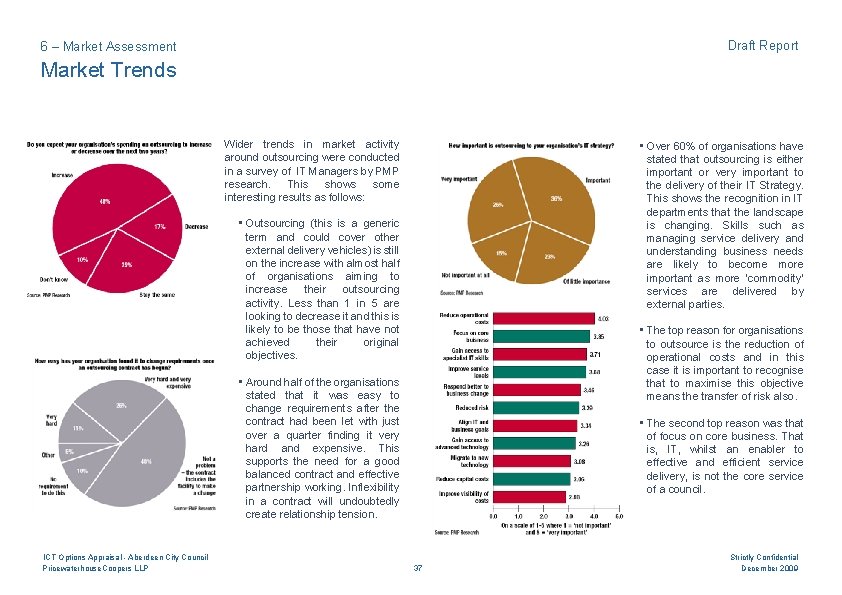
Draft Report 6 – Market Assessment Market Trends Wider trends in market activity around outsourcing were conducted in a survey of IT Managers by PMP research. This shows some interesting results as follows: • Over 60% of organisations have stated that outsourcing is either important or very important to the delivery of their IT Strategy. This shows the recognition in IT departments that the landscape is changing. Skills such as managing service delivery and understanding business needs are likely to become more important as more ‘commodity’ services are delivered by external parties. • Outsourcing (this is a generic term and could cover other external delivery vehicles) is still on the increase with almost half of organisations aiming to increase their outsourcing activity. Less than 1 in 5 are looking to decrease it and this is likely to be those that have not achieved their original objectives. • The top reason for organisations to outsource is the reduction of operational costs and in this case it is important to recognise that to maximise this objective means the transfer of risk also. • Around half of the organisations stated that it was easy to change requirements after the contract had been let with just over a quarter finding it very hard and expensive. This supports the need for a good balanced contract and effective partnership working. Inflexibility in a contract will undoubtedly create relationship tension. ICT Options Appraisal - Aberdeen City Council Pricewaterhouse. Coopers LLP • The second top reason was that of focus on core business. That is, IT, whilst an enabler to effective and efficient service delivery, is not the core service of a council. 37 Strictly Confidential December 2009
Draft Report 7 – Leading Practice Strictly Confidential Consideration of aspects of leading practice for ICT Service delivery Pw. C
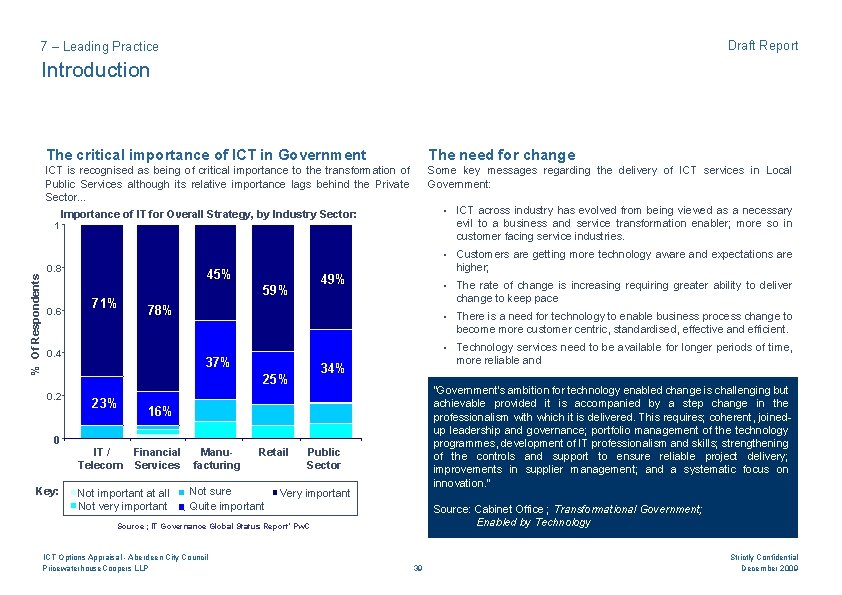
Draft Report 7 – Leading Practice Introduction The critical importance of ICT in Government The need for change ICT is recognised as being of critical importance to the transformation of Public Services although its relative importance lags behind the Private Sector… Some key messages regarding the delivery of ICT services in Local Government: Importance of IT for Overall Strategy, by Industry Sector: • ICT across industry has evolved from being viewed as a necessary evil to a business and service transformation enabler; more so in customer facing service industries. • Customers are getting more technology aware and expectations are higher; • The rate of change is increasing requiring greater ability to deliver change to keep pace • There is a need for technology to enable business process change to become more customer centric, standardised, effective and efficient. • Technology services need to be available for longer periods of time, more reliable and 1 % Of Respondents 0. 8 0. 6 45% 71% 49% 59% 78% 0. 4 37% 34% 25% 0. 2 23% “Government's ambition for technology enabled change is challenging but achievable provided it is accompanied by a step change in the professionalism with which it is delivered. This requires; coherent, joinedup leadership and governance; portfolio management of the technology programmes, development of IT professionalism and skills; strengthening of the controls and support to ensure reliable project delivery; improvements in supplier management; and a systematic focus on innovation. ” 16% 0 IT / Financial Telecom Services Key: Not important at all Not very important Manufacturing Retail Not sure Quite important Public Sector Very important Source: Cabinet Office ; Transformational Government; Enabled by Technology Source ; IT Governance Global Status Report’ Pw. C ICT Options Appraisal - Aberdeen City Council Pricewaterhouse. Coopers LLP 39 Strictly Confidential December 2009
Draft Report 8 – ICT Service Delivery Options Strictly Confidential Developing the possible Options for ICT Service Delivery at Aberdeen City Council Pw. C
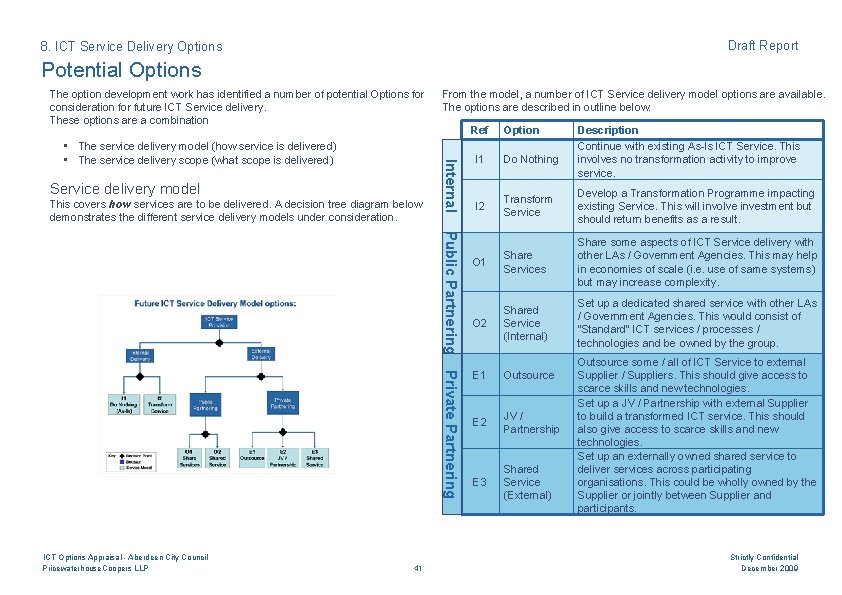
Draft Report 8. ICT Service Delivery Options Potential Options The option development work has identified a number of potential Options for consideration for future ICT Service delivery. These options are a combination Service delivery model This covers how services are to be delivered. A decision tree diagram below demonstrates the different service delivery models under consideration. Ref Internal • The service delivery model (how service is delivered) • The service delivery scope (what scope is delivered) From the model, a number of ICT Service delivery model options are available. The options are described in outline below: Public Partnering Private Partnering Option Description Continue with existing As-Is ICT Service. This involves no transformation activity to improve service. I 1 Do Nothing I 2 Transform Service Develop a Transformation Programme impacting existing Service. This will involve investment but should return benefits as a result. O 1 Share Services Share some aspects of ICT Service delivery with other LAs / Government Agencies. This may help in economies of scale (i. e. use of same systems) but may increase complexity. O 2 Shared Service (Internal) Set up a dedicated shared service with other LAs / Government Agencies. This would consist of “Standard” ICT services / processes / technologies and be owned by the group. Outsource some / all of ICT Service to external Supplier / Suppliers. This should give access to scarce skills and new technologies. Set up a JV / Partnership with external Supplier JV / to build a transformed ICT service. This should E 2 Partnership also give access to scarce skills and new technologies. Set up an externally owned shared service to Shared deliver services across participating E 3 Service organisations. This could be wholly owned by the These have been categorised in 3 possible solution as defined on the left (External) Supplier or jointly between Supplier and hand side of the table above. participants. ICT Options Appraisal - Aberdeen City Council Pricewaterhouse. Coopers LLP 41 E 1 Outsource Strictly Confidential December 2009
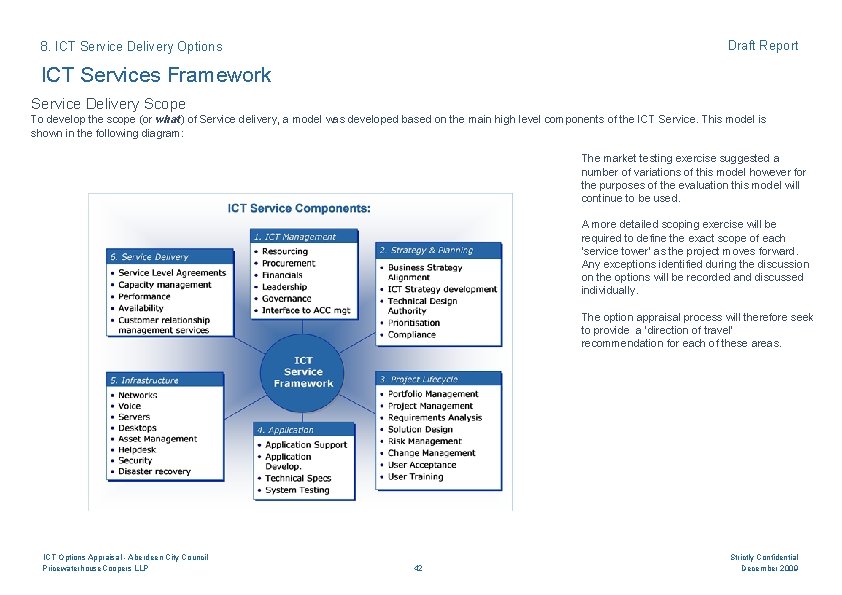
Draft Report 8. ICT Service Delivery Options ICT Services Framework Service Delivery Scope To develop the scope (or what) of Service delivery, a model was developed based on the main high level components of the ICT Service. This model is shown in the following diagram: The market testing exercise suggested a number of variations of this model however for the purposes of the evaluation this model will continue to be used. A more detailed scoping exercise will be required to define the exact scope of each ‘service tower’ as the project moves forward. Any exceptions identified during the discussion on the options will be recorded and discussed individually. The option appraisal process will therefore seek to provide a ‘direction of travel’ recommendation for each of these areas. ICT Options Appraisal - Aberdeen City Council Pricewaterhouse. Coopers LLP 42 Strictly Confidential December 2009
Draft Report 9 –Options Appraisal Strictly Confidential Assessment of the candidate options for ICT Service delivery Pw. C
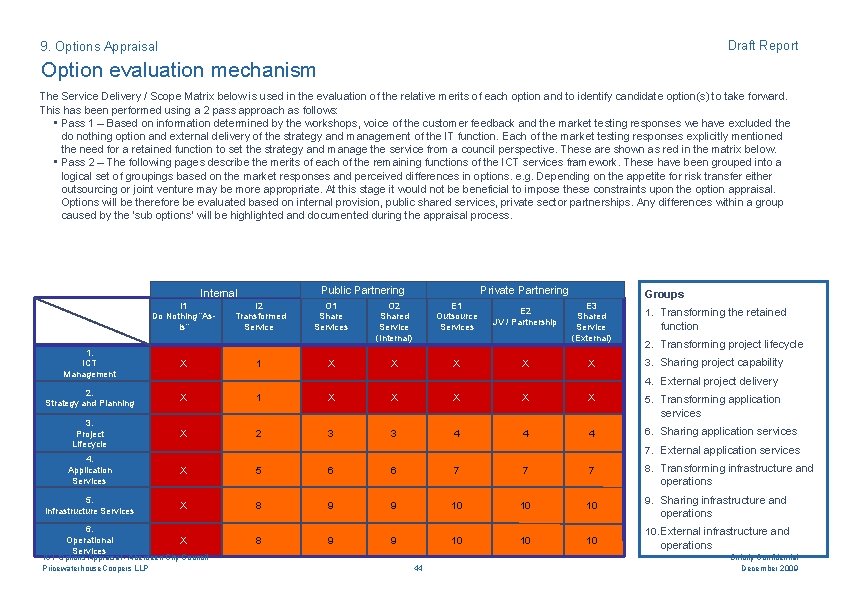
Draft Report 9. Options Appraisal Option evaluation mechanism The Service Delivery / Scope Matrix below is used in the evaluation of the relative merits of each option and to identify candidate option(s) to take forward. This has been performed using a 2 pass approach as follows: • Pass 1 – Based on information determined by the workshops, voice of the customer feedback and the market testing responses we have excluded the do nothing option and external delivery of the strategy and management of the IT function. Each of the market testing responses explicitly mentioned the need for a retained function to set the strategy and manage the service from a council perspective. These are shown as red in the matrix below. • Pass 2 – The following pages describe the merits of each of the remaining functions of the ICT services framework. These have been grouped into a logical set of groupings based on the market responses and perceived differences in options. e. g. Depending on the appetite for risk transfer either outsourcing or joint venture may be more appropriate. At this stage it would not be beneficial to impose these constraints upon the option appraisal. Options will be therefore be evaluated based on internal provision, public shared services, private sector partnerships. Any differences within a group caused by the ‘sub options’ will be highlighted and documented during the appraisal process. Public Partnering Internal I 1 Do Nothing “As. Is” I 2 Transformed Service O 1 Share Services Private Partnering O 2 Shared Service (Internal) E 1 Outsource Services X X E 2 JV / Partnership Groups E 3 Shared Service (External) 1. ICT Management X 2. Strategy and Planning X 3. Project Lifecycle X 4. Application Services X 5 6 6 7 7 7 5. Infrastructure Services X 8 9 9 10 10 10 6. Operational Services X 8 9 9 10 10 10 1 X X X 1. Transforming the retained function 2. Transforming project lifecycle 3. Sharing project capability 4. External project delivery 1 X X X 5. Transforming application services 2 3 3 4 4 4 6. Sharing application services 7. External application services ICT Options Appraisal - Aberdeen City Council Pricewaterhouse. Coopers LLP 44 8. Transforming infrastructure and operations 9. Sharing infrastructure and operations 10. External infrastructure and operations Strictly Confidential December 2009
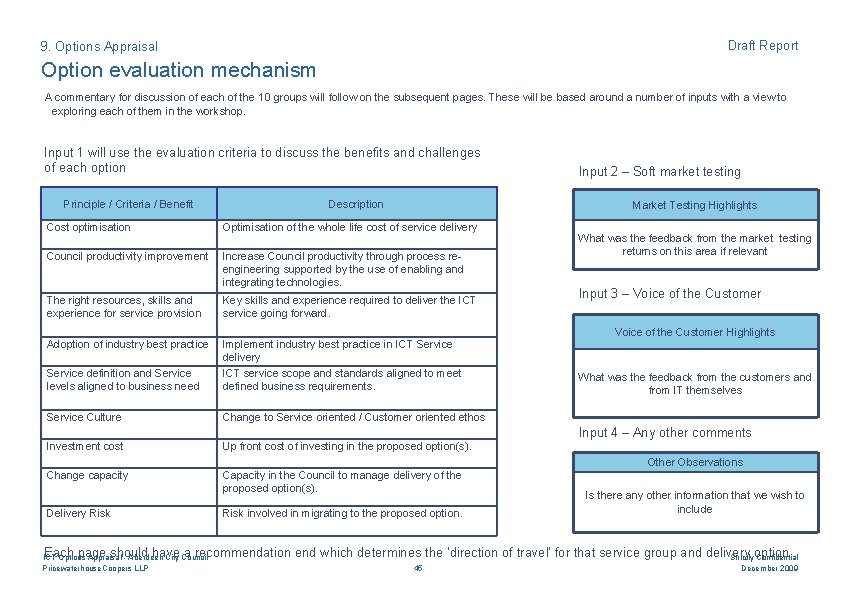
Draft Report 9. Options Appraisal Option evaluation mechanism A commentary for discussion of each of the 10 groups will follow on the subsequent pages. These will be based around a number of inputs with a view to exploring each of them in the workshop. Input 1 will use the evaluation criteria to discuss the benefits and challenges of each option Principle / Criteria / Benefit Description Input 2 – Soft market testing Market Testing Highlights Cost optimisation Optimisation of the whole life cost of service delivery Council productivity improvement Increase Council productivity through process reengineering supported by the use of enabling and integrating technologies. The right resources, skills and experience for service provision Key skills and experience required to deliver the ICT service going forward. Adoption of industry best practice Service definition and Service levels aligned to business need Implement industry best practice in ICT Service delivery ICT service scope and standards aligned to meet defined business requirements. Service Culture Change to Service oriented / Customer oriented ethos Investment cost Up front cost of investing in the proposed option(s). Change capacity Capacity in the Council to manage delivery of the proposed option(s). What was the feedback from the market testing returns on this area if relevant Input 3 – Voice of the Customer Highlights What was the feedback from the customers and from IT themselves Input 4 – Any other comments Other Observations Delivery Risk involved in migrating to the proposed option. Is there any other information that we wish to include Each page should have a recommendation end which determines the ‘direction of travel’ for that service group and delivery option Strictly Confidential ICT Options Appraisal - Aberdeen City Council Pricewaterhouse. Coopers LLP 45 December 2009
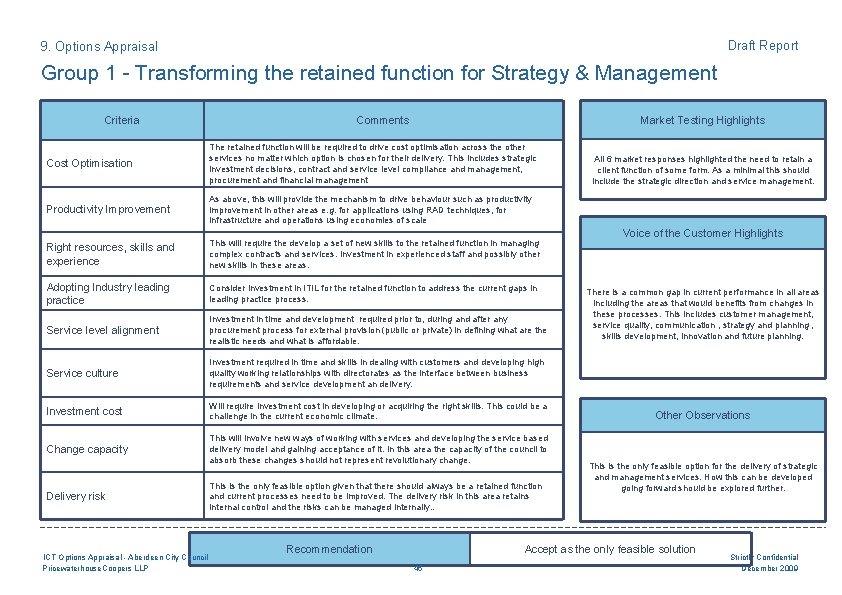
Draft Report 9. Options Appraisal Group 1 - Transforming the retained function for Strategy & Management Criteria Market Testing Highlights Comments Cost Optimisation The retained function will be required to drive cost optimisation across the other services no matter which option is chosen for their delivery. This includes strategic investment decisions, contract and service level compliance and management, procurement and financial management Productivity Improvement As above, this will provide the mechanism to drive behaviour such as productivity improvement in other areas e. g. for applications using RAD techniques, for infrastructure and operations using economies of scale Right resources, skills and experience This will require the develop a set of new skills to the retained function in managing complex contracts and services. Investment in experienced staff and possibly other new skills in these areas. Adopting Industry leading practice Consider investment in ITIL for the retained function to address the current gaps in leading practice process. Service level alignment Investment in time and development required prior to, during and after any procurement process for external provision (public or private) in defining what are the realistic needs and what is affordable. Service culture Investment required in time and skills in dealing with customers and developing high quality working relationships with directorates as the interface between business requirements and service development an delivery. Investment cost Will require investment cost in developing or acquiring the right skills. This could be a challenge in the current economic climate. Change capacity This will involve new ways of working with services and developing the service based delivery model and gaining acceptance of it. In this area the capacity of the council to absorb these changes should not represent revolutionary change. Delivery risk ICT Options Appraisal - Aberdeen City Council Pricewaterhouse. Coopers LLP This is the only feasible option given that there should always be a retained function and current processes need to be improved. The delivery risk in this area retains internal control and the risks can be managed internally. . Recommendation All 6 market responses highlighted the need to retain a client function of some form. As a minimal this should include the strategic direction and service management. Voice of the Customer Highlights There is a common gap in current performance in all areas including the areas that would benefits from changes in these processes. This includes customer management, service quality, communication , strategy and planning , skills development, innovation and future planning. Other Observations This is the only feasible option for the delivery of strategic and management services. How this can be developed going forward should be explored further. Accept as the only feasible solution 46 Strictly Confidential December 2009
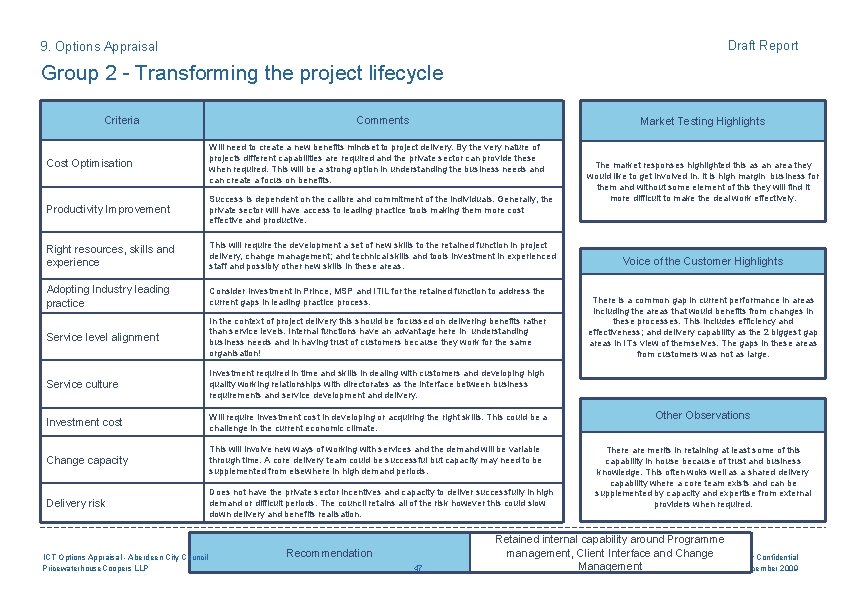
Draft Report 9. Options Appraisal Group 2 - Transforming the project lifecycle Criteria Comments Market Testing Highlights Cost Optimisation Will need to create a new benefits mindset to project delivery. By the very nature of projects different capabilities are required and the private sector can provide these when required. This will be a strong option in understanding the business needs and can create a focus on benefits. Productivity Improvement Success is dependent on the calibre and commitment of the individuals. Generally, the private sector will have access to leading practice tools making them more cost effective and productive. Right resources, skills and experience This will require the development a set of new skills to the retained function in project delivery, change management; and technical skills and tools investment in experienced staff and possibly other new skills in these areas. Adopting Industry leading practice Consider investment in Prince, MSP and ITIL for the retained function to address the current gaps in leading practice process. Service level alignment In the context of project delivery this should be focussed on delivering benefits rather than service levels. Internal functions have an advantage here in understanding business needs and in having trust of customers because they work for the same organisation! Service culture Investment required in time and skills in dealing with customers and developing high quality working relationships with directorates as the interface between business requirements and service development and delivery. Investment cost Will require investment cost in developing or acquiring the right skills. This could be a challenge in the current economic climate. Other Observations Change capacity This will involve new ways of working with services and the demand will be variable through time. A core delivery team could be successful but capacity may need to be supplemented from elsewhere in high demand periods. Delivery risk Does not have the private sector incentives and capacity to deliver successfully in high demand or difficult periods. The council retains all of the risk however this could slow down delivery and benefits realisation. There are merits in retaining at least some of this capability in house because of trust and business knowledge. This often woks well as a shared delivery capability where a core team exists and can be supplemented by capacity and expertise from external providers when required. ICT Options Appraisal - Aberdeen City Council Pricewaterhouse. Coopers LLP Recommendation 47 The market responses highlighted this as an area they would like to get involved in. It is high margin business for them and without some element of this they will find it more difficult to make the deal work effectively. Voice of the Customer Highlights There is a common gap in current performance in areas including the areas that would benefits from changes in these processes. This includes efficiency and effectiveness; and delivery capability as the 2 biggest gap areas in IT’s view of themselves. The gaps in these areas from customers was not as large. Retained internal capability around Programme management, Client Interface and Change Strictly Confidential Management December 2009
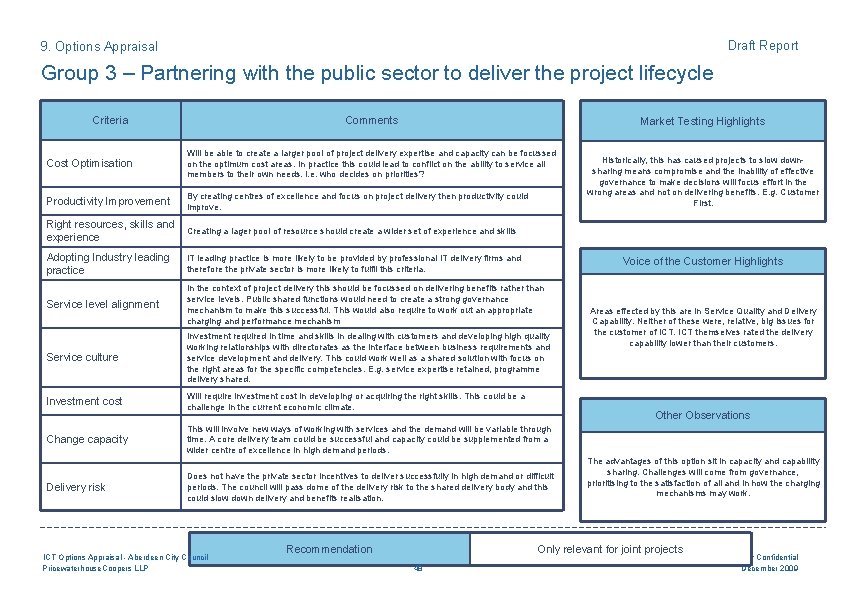
Draft Report 9. Options Appraisal Group 3 – Partnering with the public sector to deliver the project lifecycle Criteria Comments Market Testing Highlights Cost Optimisation Will be able to create a larger pool of project delivery expertise and capacity can be focussed on the optimum cost areas. In practice this could lead to conflict on the ability to service all members to their own needs. i. e. who decides on priorities? Productivity Improvement By creating centres of excellence and focus on project delivery then productivity could improve. Historically, this has caused projects to slow down- sharing means compromise and the inability of effective governance to make decisions will focus effort in the wrong areas and not on delivering benefits. E. g. Customer First. Right resources, skills and Creating a lager pool of resource should create a wider set of experience and skills experience Adopting Industry leading practice IT leading practice is more likely to be provided by professional IT delivery firms and therefore the private sector is more likely to fulfil this criteria. Service level alignment In the context of project delivery this should be focussed on delivering benefits rather than service levels. Public shared functions would need to create a strong governance mechanism to make this successful. This would also require to work out an appropriate charging and performance mechanism Service culture Investment required in time and skills in dealing with customers and developing high quality working relationships with directorates as the interface between business requirements and service development and delivery. This could work well as a shared solution with focus on the right areas for the specific competencies. E. g. service expertise retained, programme delivery shared. Investment cost Will require investment cost in developing or acquiring the right skills. This could be a challenge in the current economic climate. Voice of the Customer Highlights Other Observations Change capacity This will involve new ways of working with services and the demand will be variable through time. A core delivery team could be successful and capacity could be supplemented from a wider centre of excellence in high demand periods. Delivery risk Does not have the private sector incentives to deliver successfully in high demand or difficult periods. The council will pass dome of the delivery risk to the shared delivery body and this could slow down delivery and benefits realisation. ICT Options Appraisal - Aberdeen City Council Pricewaterhouse. Coopers LLP Recommendation Areas effected by this are in Service Quality and Delivery Capability. Neither of these were, relative, big issues for the customer of ICT themselves rated the delivery capability lower than their customers. The advantages of this option sit in capacity and capability sharing. Challenges will come from governance, prioritising to the satisfaction of all and in how the charging mechanisms may work. Only relevant for joint projects 48 Strictly Confidential December 2009
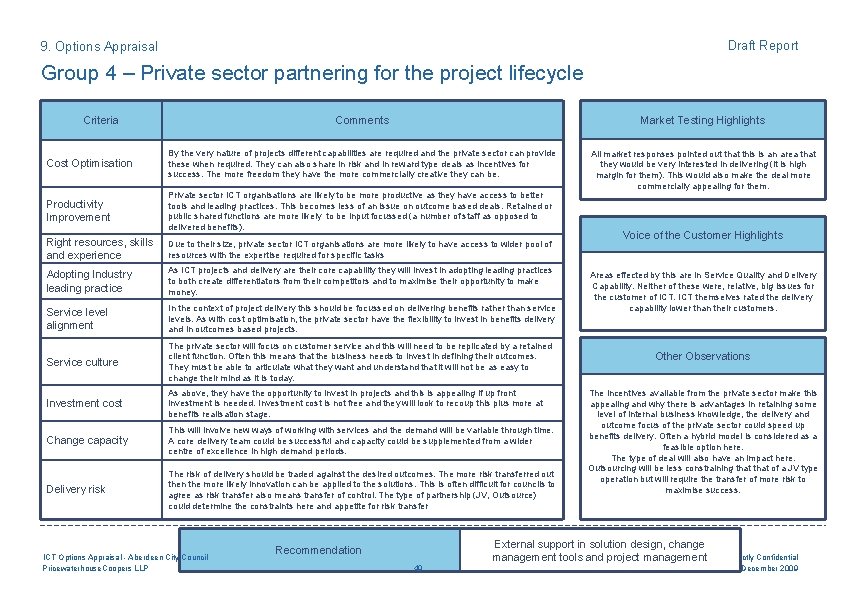
Draft Report 9. Options Appraisal Group 4 – Private sector partnering for the project lifecycle Comments Market Testing Highlights Cost Optimisation By the very nature of projects different capabilities are required and the private sector can provide these when required. They can also share in risk and in reward type deals as incentives for success. The more freedom they have the more commercially creative they can be. Productivity Improvement Private sector ICT organisations are likely to be more productive as they have access to better tools and leading practices. This becomes less of an issue on outcome based deals. Retained or public shared functions are more likely to be input focussed (a number of staff as opposed to delivered benefits). All market responses pointed out that this is an area that they would be very interested in delivering (it is high margin for them). This would also make the deal more commercially appealing for them. Right resources, skills and experience Due to their size, private sector ICT organisations are more likely to have access to wider pool of resources with the expertise required for specific tasks Adopting Industry leading practice As ICT projects and delivery are their core capability they will invest in adopting leading practices to both create differentiators from their competitors and to maximise their opportunity to make money. Service level alignment In the context of project delivery this should be focussed on delivering benefits rather than service levels. As with cost optimisation, the private sector have the flexibility to invest in benefits delivery and in outcomes based projects. Service culture The private sector will focus on customer service and this will need to be replicated by a retained client function. Often this means that the business needs to invest in defining their outcomes. They must be able to articulate what they want and understand that it will not be as easy to change their mind as it is today. Investment cost As above, they have the opportunity to invest in projects and this is appealing if up front investment is needed. Investment cost is not free and they will look to recoup this plus more at benefits realisation stage. Change capacity This will involve new ways of working with services and the demand will be variable through time. A core delivery team could be successful and capacity could be supplemented from a wider centre of excellence in high demand periods. Delivery risk The risk of delivery should be traded against the desired outcomes. The more risk transferred out then the more likely innovation can be applied to the solutions. This is often difficult for councils to agree as risk transfer also means transfer of control. The type of partnership (JV, Outsource) could determine the constraints here and appetite for risk transfer Criteria ICT Options Appraisal - Aberdeen City Council Pricewaterhouse. Coopers LLP Voice of the Customer Highlights Areas effected by this are in Service Quality and Delivery Capability. Neither of these were, relative, big issues for the customer of ICT themselves rated the delivery capability lower than their customers. Other Observations The incentives available from the private sector make this appealing and why there is advantages in retaining some level of internal business knowledge, the delivery and outcome focus of the private sector could speed up benefits delivery. Often a hybrid model is considered as a feasible option here. The type of deal will also have an impact here. Outsourcing will be less constraining that of a JV type operation but will require the transfer of more risk to maximise success. External support in solution design, change management tools and project management Recommendation 49 Strictly Confidential December 2009
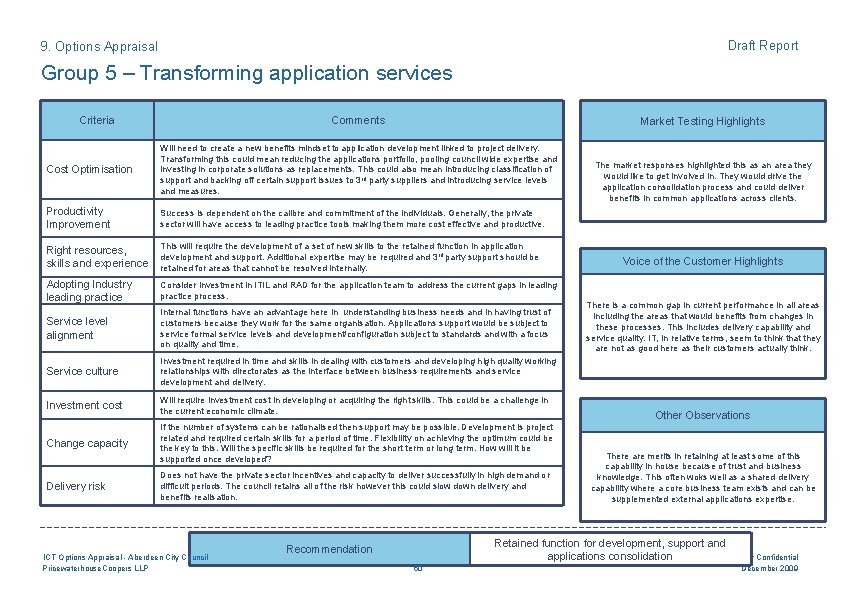
Draft Report 9. Options Appraisal Group 5 – Transforming application services Criteria Comments Market Testing Highlights Cost Optimisation Will need to create a new benefits mindset to application development linked to project delivery. Transforming this could mean reducing the applications portfolio, pooling council wide expertise and investing in corporate solutions as replacements. This could also mean introducing classification of support and backing off certain support issues to 3 rd party suppliers and introducing service levels and measures. Productivity Improvement Success is dependent on the calibre and commitment of the individuals. Generally, the private sector will have access to leading practice tools making them more cost effective and productive. Right resources, skills and experience This will require the development of a set of new skills to the retained function in application development and support. Additional expertise may be required and 3 rd party support should be retained for areas that cannot be resolved internally. Adopting Industry leading practice Consider investment in ITIL and RAD for the application team to address the current gaps in leading practice process. Service level alignment Internal functions have an advantage here in understanding business needs and in having trust of customers because they work for the same organisation. Applications support would be subject to service formal service levels and development/configuration subject to standards and with a focus on quality and time. Service culture Investment required in time and skills in dealing with customers and developing high quality working relationships with directorates as the interface between business requirements and service development and delivery. Investment cost Will require investment cost in developing or acquiring the right skills. This could be a challenge in the current economic climate. Change capacity If the number of systems can be rationalised then support may be possible. Development is project related and required certain skills for a period of time. Flexibility on achieving the optimum could be the key to this. Will the specific skills be required for the short term or long term. How will it be supported once developed? Delivery risk Does not have the private sector incentives and capacity to deliver successfully in high demand or difficult periods. The council retains all of the risk however this could slow down delivery and benefits realisation. ICT Options Appraisal - Aberdeen City Council Pricewaterhouse. Coopers LLP The market responses highlighted this as an area they would like to get involved in. They would drive the application consolidation process and could deliver benefits in common applications across clients. Voice of the Customer Highlights There is a common gap in current performance in all areas including the areas that would benefits from changes in these processes. This includes delivery capability and service quality. IT, in relative terms, seem to think that they are not as good here as their customers actually think. Other Observations There are merits in retaining at least some of this capability in house because of trust and business knowledge. This often woks well as a shared delivery capability where a core business team exists and can be supplemented external applications expertise. Retained function for development, support and applications consolidation Strictly Confidential Recommendation 50 December 2009
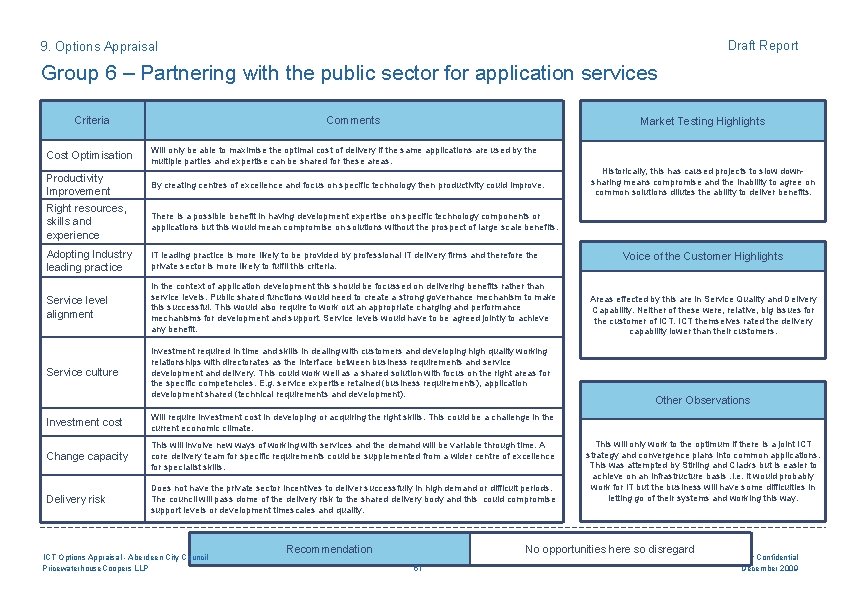
Draft Report 9. Options Appraisal Group 6 – Partnering with the public sector for application services Criteria Cost Optimisation Comments Market Testing Highlights Will only be able to maximise the optimal cost of delivery if the same applications are used by the multiple parties and expertise can be shared for these areas. Productivity Improvement By creating centres of excellence and focus on specific technology then productivity could improve. Right resources, skills and experience There is a possible benefit in having development expertise on specific technology components or applications but this would mean compromise on solutions without the prospect of large scale benefits. Adopting Industry leading practice IT leading practice is more likely to be provided by professional IT delivery firms and therefore the private sector is more likely to fulfil this criteria. Service level alignment In the context of application development this should be focussed on delivering benefits rather than service levels. Public shared functions would need to create a strong governance mechanism to make this successful. This would also require to work out an appropriate charging and performance mechanisms for development and support. Service levels would have to be agreed jointly to achieve any benefit. Service culture Investment required in time and skills in dealing with customers and developing high quality working relationships with directorates as the interface between business requirements and service development and delivery. This could work well as a shared solution with focus on the right areas for the specific competencies. E. g. service expertise retained (business requirements), application development shared (technical requirements and development). Investment cost Will require investment cost in developing or acquiring the right skills. This could be a challenge in the current economic climate. Change capacity This will involve new ways of working with services and the demand will be variable through time. A core delivery team for specific requirements could be supplemented from a wider centre of excellence for specialist skills. Delivery risk Does not have the private sector incentives to deliver successfully in high demand or difficult periods. The council will pass dome of the delivery risk to the shared delivery body and this could compromise support levels or development timescales and quality. ICT Options Appraisal - Aberdeen City Council Pricewaterhouse. Coopers LLP Recommendation Historically, this has caused projects to slow down- sharing means compromise and the inability to agree on common solutions dilutes the ability to deliver benefits. Voice of the Customer Highlights Areas effected by this are in Service Quality and Delivery Capability. Neither of these were, relative, big issues for the customer of ICT themselves rated the delivery capability lower than their customers. Other Observations This will only work to the optimum if there is a joint ICT strategy and convergence plans into common applications. This was attempted by Stirling and Clacks but is easier to achieve on an infrastructure basis. i. e. it would probably work for IT but the business will have some difficulties in letting go of their systems and working this way. No opportunities here so disregard 51 Strictly Confidential December 2009
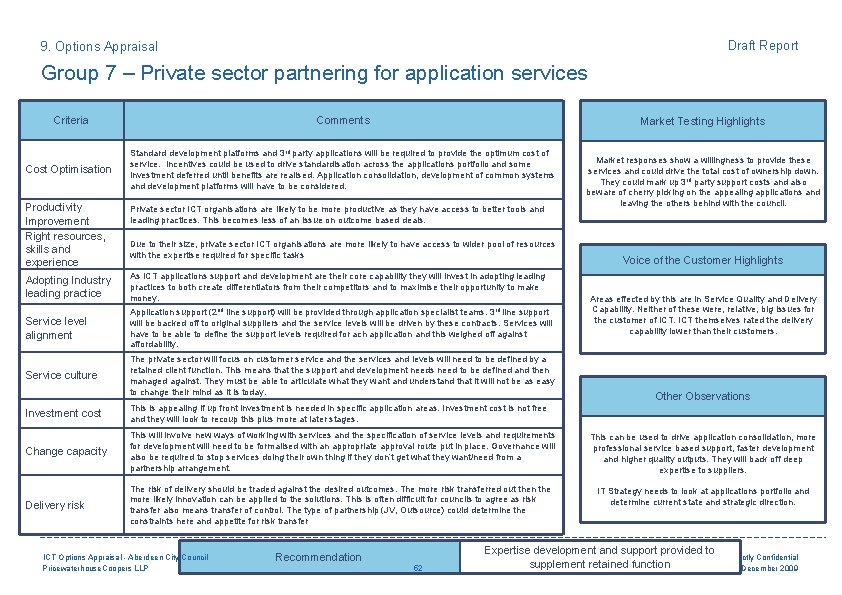
Draft Report 9. Options Appraisal Group 7 – Private sector partnering for application services Criteria Cost Optimisation Comments Market Testing Highlights Standard development platforms and 3 rd party applications will be required to provide the optimum cost of service. Incentives could be used to drive standardisation across the applications portfolio and some investment deferred until benefits are realised. Application consolidation, development of common systems and development platforms will have to be considered. Market responses show a willingness to provide these services and could drive the total cost of ownership down. They could mark up 3 rd party support costs and also beware of cherry picking on the appealing applications and leaving the others behind with the council. Productivity Improvement Right resources, skills and experience Private sector ICT organisations are likely to be more productive as they have access to better tools and leading practices. This becomes less of an issue on outcome based deals. Adopting Industry leading practice As ICT applications support and development are their core capability they will invest in adopting leading practices to both create differentiators from their competitors and to maximise their opportunity to make money. Service level alignment Application support (2 nd line support) will be provided through application specialist teams. 3 rd line support will be backed off to original suppliers and the service levels will be driven by these contracts. Services will have to be able to define the support levels required for ach application and this weighed off against affordability. Service culture The private sector will focus on customer service and the services and levels will need to be defined by a retained client function. This means that the support and development needs need to be defined and then managed against. They must be able to articulate what they want and understand that it will not be as easy to change their mind as it is today. Investment cost This is appealing if up front investment is needed in specific application areas. Investment cost is not free and they will look to recoup this plus more at later stages. Change capacity This will involve new ways of working with services and the specification of service levels and requirements for development will need to be formalised with an appropriate approval route put in place. Governance will also be required to stop services doing their own thing if they don’t get what they want/need from a partnership arrangement. This can be used to drive application consolidation, more professional service based support, faster development and higher quality outputs. They will back off deep expertise to suppliers. Delivery risk The risk of delivery should be traded against the desired outcomes. The more risk transferred out then the more likely innovation can be applied to the solutions. This is often difficult for councils to agree as risk transfer also means transfer of control. The type of partnership (JV, Outsource) could determine the constraints here and appetite for risk transfer IT Strategy needs to look at applications portfolio and determine current state and strategic direction. Due to their size, private sector ICT organisations are more likely to have access to wider pool of resources with the expertise required for specific tasks ICT Options Appraisal - Aberdeen City Council Pricewaterhouse. Coopers LLP Recommendation 52 Voice of the Customer Highlights Areas effected by this are in Service Quality and Delivery Capability. Neither of these were, relative, big issues for the customer of ICT themselves rated the delivery capability lower than their customers. Other Observations Expertise development and support provided to supplement retained function Strictly Confidential December 2009
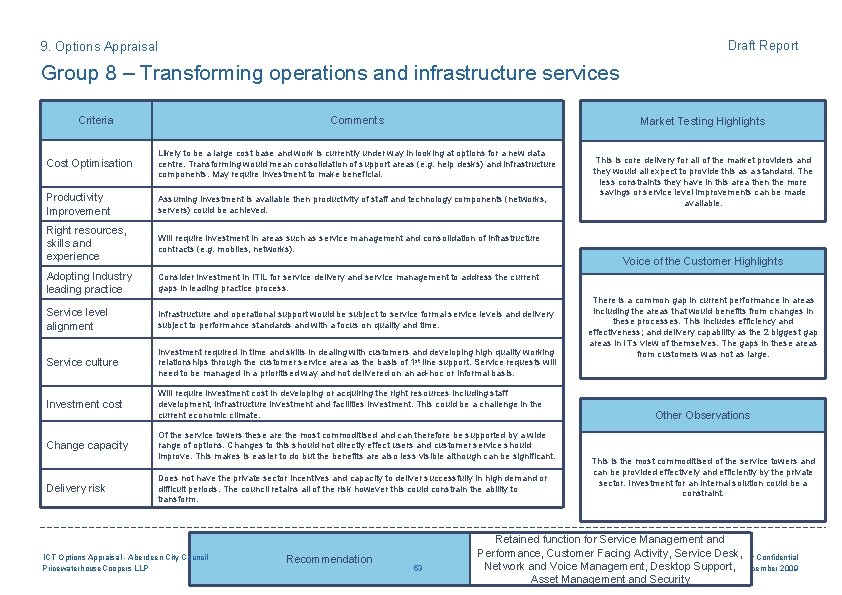
Draft Report 9. Options Appraisal Group 8 – Transforming operations and infrastructure services Criteria Comments Market Testing Highlights Cost Optimisation Likely to be a large cost base and work is currently under way in looking at options for a new data centre. Transforming would mean consolidation of support areas (e. g. help desks) and infrastructure components. May require investment to make beneficial. Productivity Improvement Assuming investment is available then productivity of staff and technology components (networks, servers) could be achieved. Right resources, skills and experience Will require investment in areas such as service management and consolidation of infrastructure contracts (e. g. mobiles, networks). Adopting Industry leading practice Consider investment in ITIL for service delivery and service management to address the current gaps in leading practice process. Service level alignment Infrastructure and operational support would be subject to service formal service levels and delivery subject to performance standards and with a focus on quality and time. Service culture Investment required in time and skills in dealing with customers and developing high quality working relationships through the customer service area as the basis of 1 st line support. Service requests will need to be managed in a prioritised way and not delivered on an ad-hoc or informal basis. Investment cost Will require investment cost in developing or acquiring the right resources including staff development, infrastructure investment and facilities investment. This could be a challenge in the current economic climate. Change capacity Of the service towers these are the most commoditised and can therefore be supported by a wide range of options. Changes to this should not directly effect users and customer service should improve. This makes is easier to do but the benefits are also less visible although can be significant. Delivery risk This is core delivery for all of the market providers and they would all expect to provide this as a standard. The less constraints they have in this area then the more savings or service level improvements can be made available. Voice of the Customer Highlights Does not have the private sector incentives and capacity to deliver successfully in high demand or difficult periods. The council retains all of the risk however this could constrain the ability to transform. ICT Options Appraisal - Aberdeen City Council Pricewaterhouse. Coopers LLP Recommendation 53 There is a common gap in current performance in areas including the areas that would benefits from changes in these processes. This includes efficiency and effectiveness; and delivery capability as the 2 biggest gap areas in IT’s view of themselves. The gaps in these areas from customers was not as large. Other Observations This is the most commoditised of the service towers and can be provided effectively and efficiently by the private sector. Investment for an internal solution could be a constraint. Retained function for Service Management and Performance, Customer Facing Activity, Service Desk, Strictly Confidential Network and Voice Management, Desktop Support, December 2009 Asset Management and Security
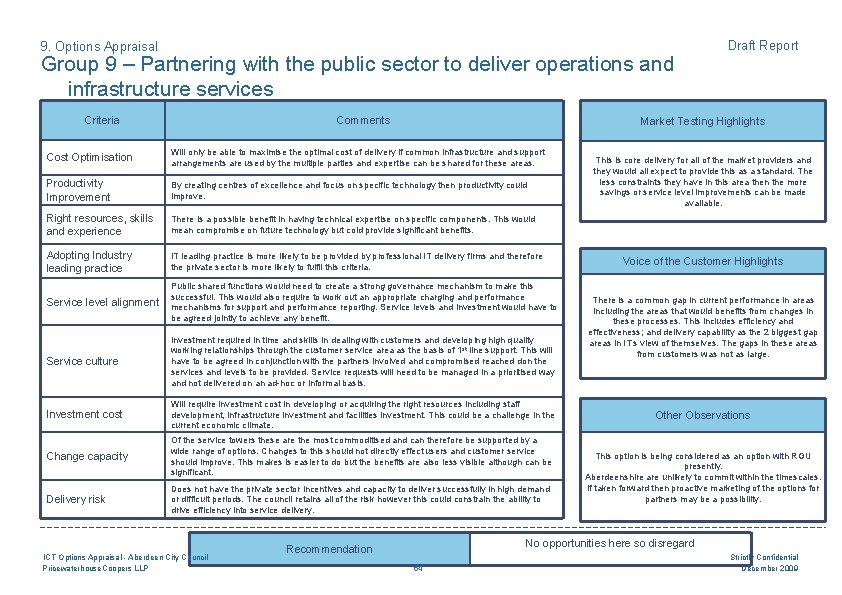
9. Options Appraisal Group 9 – Partnering with the public sector to deliver operations and infrastructure services Criteria Comments Market Testing Highlights Cost Optimisation Will only be able to maximise the optimal cost of delivery if common infrastructure and support arrangements are used by the multiple parties and expertise can be shared for these areas. Productivity Improvement By creating centres of excellence and focus on specific technology then productivity could improve. Right resources, skills and experience There is a possible benefit in having technical expertise on specific components. This would mean compromise on future technology but cold provide significant benefits. Adopting Industry leading practice IT leading practice is more likely to be provided by professional IT delivery firms and therefore the private sector is more likely to fulfil this criteria. Service level alignment Public shared functions would need to create a strong governance mechanism to make this successful. This would also require to work out an appropriate charging and performance mechanisms for support and performance reporting. Service levels and investment would have to be agreed jointly to achieve any benefit. Service culture Investment required in time and skills in dealing with customers and developing high quality working relationships through the customer service area as the basis of 1 st line support. This will have to be agreed in conjunction with the partners involved and compromised reached don the services and levels to be provided. Service requests will need to be managed in a prioritised way and not delivered on an ad-hoc or informal basis. Investment cost Will require investment cost in developing or acquiring the right resources including staff development, infrastructure investment and facilities investment. This could be a challenge in the current economic climate. Change capacity Of the service towers these are the most commoditised and can therefore be supported by a wide range of options. Changes to this should not directly effect users and customer service should improve. This makes is easier to do but the benefits are also less visible although can be significant. Delivery risk Does not have the private sector incentives and capacity to deliver successfully in high demand or difficult periods. The council retains all of the risk however this could constrain the ability to drive efficiency into service delivery. ICT Options Appraisal - Aberdeen City Council Pricewaterhouse. Coopers LLP Draft Report This is core delivery for all of the market providers and they would all expect to provide this as a standard. The less constraints they have in this area then the more savings or service level improvements can be made available. Voice of the Customer Highlights There is a common gap in current performance in areas including the areas that would benefits from changes in these processes. This includes efficiency and effectiveness; and delivery capability as the 2 biggest gap areas in IT’s view of themselves. The gaps in these areas from customers was not as large. Other Observations This option is being considered as an option with RGU presently. Aberdeenshire are unlikely to commit within the timescales. If taken forward then proactive marketing of the options for partners may be a possibility. No opportunities here so disregard Recommendation 54 Strictly Confidential December 2009
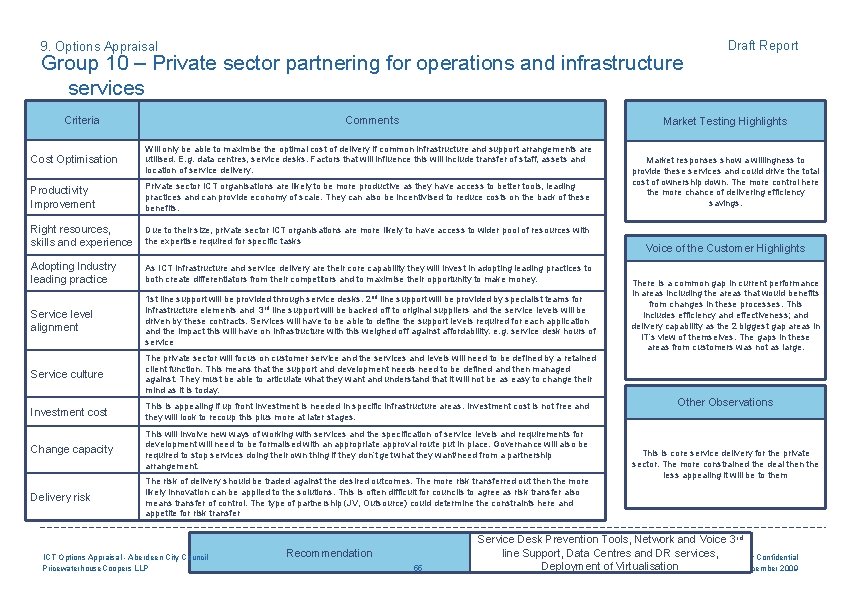
9. Options Appraisal Group 10 – Private sector partnering for operations and infrastructure services Criteria Comments Market Testing Highlights Cost Optimisation Will only be able to maximise the optimal cost of delivery if common infrastructure and support arrangements are utilised. E. g. data centres, service desks. Factors that will influence this will include transfer of staff, assets and location of service delivery. Productivity Improvement Private sector ICT organisations are likely to be more productive as they have access to better tools, leading practices and can provide economy of scale. They can also be incentivised to reduce costs on the back of these benefits. Right resources, skills and experience Due to their size, private sector ICT organisations are more likely to have access to wider pool of resources with the expertise required for specific tasks Adopting Industry leading practice As ICT infrastructure and service delivery are their core capability they will invest in adopting leading practices to both create differentiators from their competitors and to maximise their opportunity to make money. 1 st line support will be provided through service desks. 2 nd line support will be provided by specialist teams for Service level alignment infrastructure elements and 3 rd line support will be backed off to original suppliers and the service levels will be driven by these contracts. Services will have to be able to define the support levels required for each application and the impact this will have on infrastructure with this weighed off against affordability. e. g. service desk hours of service Service culture The private sector will focus on customer service and the services and levels will need to be defined by a retained client function. This means that the support and development needs need to be defined and then managed against. They must be able to articulate what they want and understand that it will not be as easy to change their mind as it is today. Investment cost This is appealing if up front investment is needed in specific infrastructure areas. Investment cost is not free and they will look to recoup this plus more at later stages. Change capacity This will involve new ways of working with services and the specification of service levels and requirements for development will need to be formalised with an appropriate approval route put in place. Governance will also be required to stop services doing their own thing if they don’t get what they want/need from a partnership arrangement. Delivery risk The risk of delivery should be traded against the desired outcomes. The more risk transferred out then the more likely innovation can be applied to the solutions. This is often difficult for councils to agree as risk transfer also means transfer of control. The type of partnership (JV, Outsource) could determine the constraints here and appetite for risk transfer ICT Options Appraisal - Aberdeen City Council Pricewaterhouse. Coopers LLP Draft Report Recommendation 55 Market responses show a willingness to provide these services and could drive the total cost of ownership down. The more control here the more chance of delivering efficiency savings. Voice of the Customer Highlights There is a common gap in current performance in areas including the areas that would benefits from changes in these processes. This includes efficiency and effectiveness; and delivery capability as the 2 biggest gap areas in IT’s view of themselves. The gaps in these areas from customers was not as large. Other Observations This is core service delivery for the private sector. The more constrained the deal then the less appealing it will be to them Service Desk Prevention Tools, Network and Voice 3 rd line Support, Data Centres and DR services, Strictly Confidential Deployment of Virtualisation December 2009
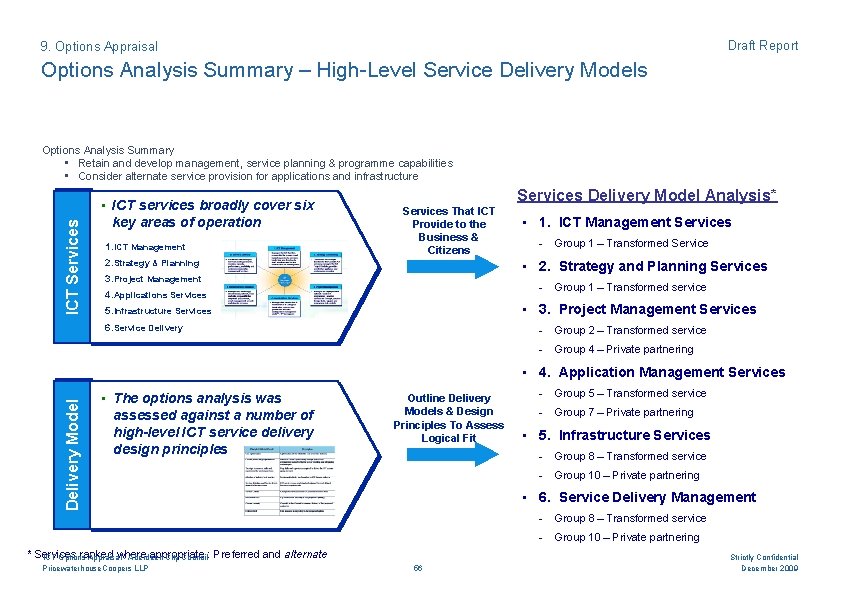
Draft Report 9. Options Appraisal Options Analysis Summary – High-Level Service Delivery Models ICT Services Options Analysis Summary • Retain and develop management, service planning & programme capabilities • Consider alternate service provision for applications and infrastructure • ICT services broadly cover six key areas of operation 1. ICT Management Services Delivery Model Analysis* Services That ICT Provide to the Business & Citizens 2. Strategy & Planning • 1. ICT Management Services - Group 1 – Transformed Service • 2. Strategy and Planning Services 3. Project Management - 4. Applications Services Group 1 – Transformed service • 3. Project Management Services 5. Infrastructure Services 6. Service Delivery - Group 2 – Transformed service - Group 4 – Private partnering Delivery Model • 4. Application Management Services • The options analysis was assessed against a number of high-level ICT service delivery design principles Outline Delivery Models & Design Principles To Assess Logical Fit Group 5 – Transformed service - Group 7 – Private partnering • 5. Infrastructure Services - Group 8 – Transformed service - Group 10 – Private partnering • 6. Service Delivery Management * Services ranked where appropriate : Preferred and alternate ICT Options Appraisal - Aberdeen City Council Pricewaterhouse. Coopers LLP - 56 - Group 8 – Transformed service - Group 10 – Private partnering Strictly Confidential December 2009
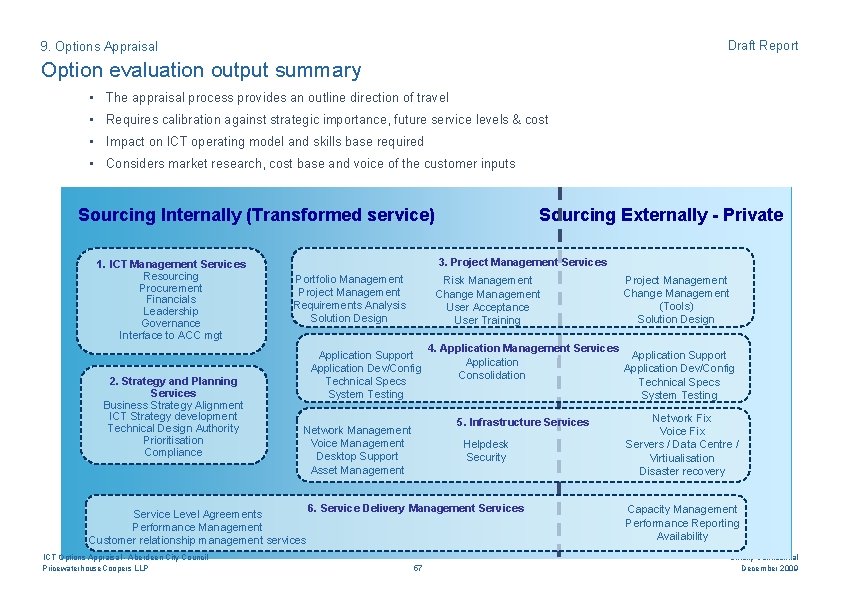
Draft Report 9. Options Appraisal Option evaluation output summary • The appraisal process provides an outline direction of travel • Requires calibration against strategic importance, future service levels & cost • Impact on ICT operating model and skills base required • Considers market research, cost base and voice of the customer inputs Sourcing Externally - Private Sourcing Internally (Transformed service) 1. ICT Management Services Resourcing Procurement Financials Leadership Governance Interface to ACC mgt 2. Strategy and Planning Services Business Strategy Alignment ICT Strategy development Technical Design Authority Prioritisation Compliance 3. Project Management Services Portfolio Management Project Management Requirements Analysis Solution Design Risk Management Change Management User Acceptance User Training Application Support Application Dev/Config Technical Specs System Testing 4. Application Management Services Application Support Application Dev/Config Consolidation Technical Specs System Testing 5. Infrastructure Services Network Management Voice Management Desktop Support Asset Management Helpdesk Security 6. Service Delivery Management Services Service Level Agreements Performance Management Customer relationship management services ICT Options Appraisal - Aberdeen City Council Pricewaterhouse. Coopers LLP 57 Project Management Change Management (Tools) Solution Design Network Fix Voice Fix Servers / Data Centre / Virtiualisation Disaster recovery Capacity Management Performance Reporting Availability Strictly Confidential December 2009
Draft Report 10 – Risks in Partnership Options Strictly Confidential Types of partnership with the pros and cons Pw. C
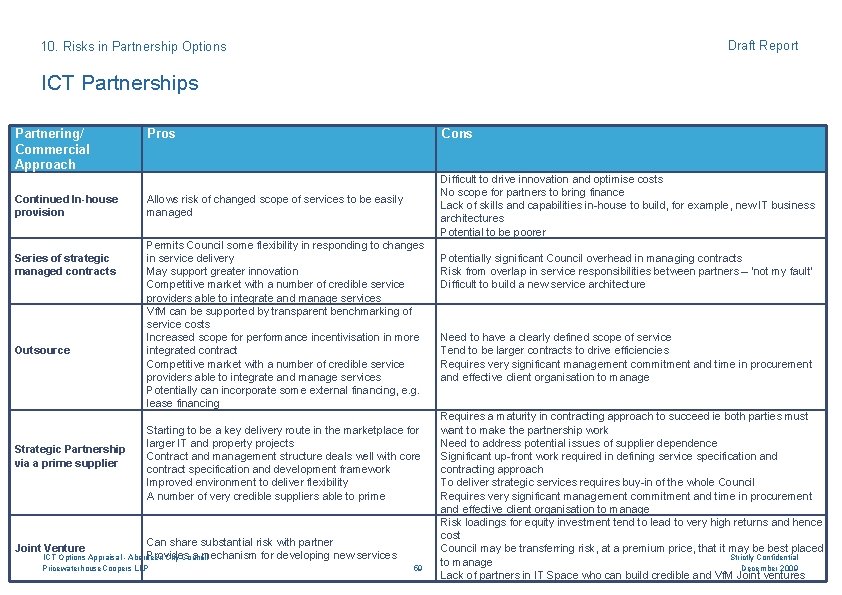
Draft Report 10. Risks in Partnership Options ICT Partnerships Partnering/ Commercial Approach Continued In-house provision Series of strategic managed contracts Outsource Strategic Partnership via a prime supplier Pros Cons Allows risk of changed scope of services to be easily managed Difficult to drive innovation and optimise costs No scope for partners to bring finance Lack of skills and capabilities in-house to build, for example, new IT business architectures Potential to be poorer Permits Council some flexibility in responding to changes in service delivery May support greater innovation Competitive market with a number of credible service providers able to integrate and manage services Vf. M can be supported by transparent benchmarking of service costs Increased scope for performance incentivisation in more integrated contract Competitive market with a number of credible service providers able to integrate and manage services Potentially can incorporate some external financing, e. g. lease financing Starting to be a key delivery route in the marketplace for larger IT and property projects Contract and management structure deals well with core contract specification and development framework Improved environment to deliver flexibility A number of very credible suppliers able to prime Can share substantial risk with partner Provides a mechanism for developing new services ICT Options Appraisal - Aberdeen City Council Joint Venture Pricewaterhouse. Coopers LLP 59 Potentially significant Council overhead in managing contracts Risk from overlap in service responsibilities between partners – ‘not my fault’ Difficult to build a new service architecture Need to have a clearly defined scope of service Tend to be larger contracts to drive efficiencies Requires very significant management commitment and time in procurement and effective client organisation to manage Requires a maturity in contracting approach to succeed ie both parties must want to make the partnership work Need to address potential issues of supplier dependence Significant up-front work required in defining service specification and contracting approach To deliver strategic services requires buy-in of the whole Council Requires very significant management commitment and time in procurement and effective client organisation to manage Risk loadings for equity investment tend to lead to very high returns and hence cost Council may be transferring risk, at a premium price, that it may be best placed Strictly Confidential to manage December 2009 Lack of partners in IT Space who can build credible and Vf. M Joint ventures
Draft Report 11 – Example Partnerships Strictly Confidential Example council partnerships covering the possible partnership types Pw. C
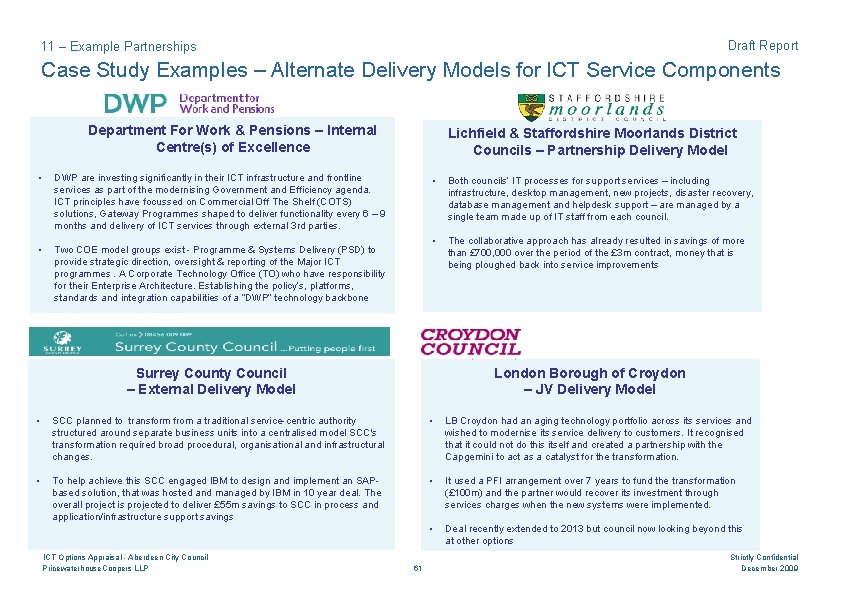
Draft Report 11 – Example Partnerships Case Study Examples – Alternate Delivery Models for ICT Service Components Department For Work & Pensions – Internal Centre(s) of Excellence • DWP are investing significantly in their ICT infrastructure and frontline services as part of the modernising Government and Efficiency agenda. ICT principles have focussed on Commercial Off The Shelf (COTS) solutions, Gateway Programmes shaped to deliver functionality every 6 – 9 months and delivery of ICT services through external 3 rd parties. • Two COE model groups exist - Programme & Systems Delivery (PSD) to provide strategic direction, oversight & reporting of the Major ICT programmes. A Corporate Technology Office (TO) who have responsibility for their Enterprise Architecture. Establishing the policy’s, platforms, standards and integration capabilities of a “DWP” technology backbone Lichfield & Staffordshire Moorlands District Councils – Partnership Delivery Model • Both councils’ IT processes for support services – including infrastructure, desktop management, new projects, disaster recovery, database management and helpdesk support – are managed by a single team made up of IT staff from each council. • The collaborative approach has already resulted in savings of more than £ 700, 000 over the period of the £ 3 m contract, money that is being ploughed back into service improvements Surrey County Council – External Delivery Model London Borough of Croydon – JV Delivery Model • SCC planned to transform from a traditional service-centric authority structured around separate business units into a centralised model SCC's transformation required broad procedural, organisational and infrastructural changes. • LB Croydon had an aging technology portfolio across its services and wished to modernise its service delivery to customers. It recognised that it could not do this itself and created a partnership with the Capgemini to act as a catalyst for the transformation. • To help achieve this SCC engaged IBM to design and implement an SAPbased solution, that was hosted and managed by IBM in 10 year deal. The overall project is projected to deliver £ 55 m savings to SCC in process and application/infrastructure support savings • It used a PFI arrangement over 7 years to fund the transformation (£ 100 m) and the partner would recover its investment through services charges when the new systems were implemented. • Deal recently extended to 2013 but council now looking beyond this at other options ICT Options Appraisal - Aberdeen City Council Pricewaterhouse. Coopers LLP 61 Strictly Confidential December 2009
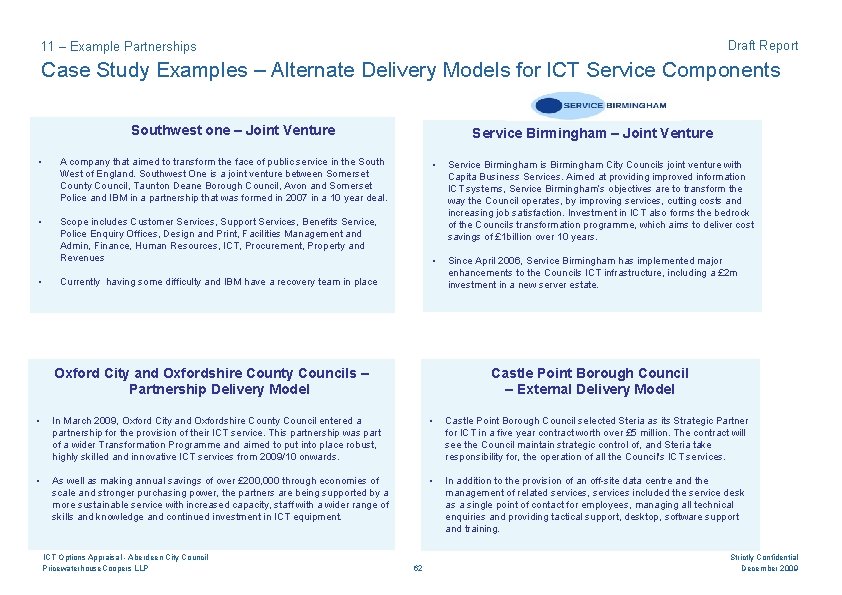
Draft Report 11 – Example Partnerships Case Study Examples – Alternate Delivery Models for ICT Service Components Southwest one – Joint Venture • A company that aimed to transform the face of public service in the South West of England. Southwest One is a joint venture between Somerset County Council, Taunton Deane Borough Council, Avon and Somerset Police and IBM in a partnership that was formed in 2007 in a 10 year deal. • Scope includes Customer Services, Support Services, Benefits Service, Police Enquiry Offices, Design and Print, Facilities Management and Admin, Finance, Human Resources, ICT, Procurement, Property and Revenues • Service Birmingham – Joint Venture • Service Birmingham is Birmingham City Councils joint venture with Capita Business Services. Aimed at providing improved information ICT systems, Service Birmingham’s objectives are to transform the way the Council operates, by improving services, cutting costs and increasing job satisfaction. Investment in ICT also forms the bedrock of the Councils transformation programme, which aims to deliver cost savings of £ 1 billion over 10 years. • Since April 2006, Service Birmingham has implemented major enhancements to the Councils ICT infrastructure, including a £ 2 m investment in a new server estate. Currently having some difficulty and IBM have a recovery team in place Oxford City and Oxfordshire County Councils – Partnership Delivery Model Castle Point Borough Council – External Delivery Model • In March 2009, Oxford City and Oxfordshire County Council entered a partnership for the provision of their ICT service. This partnership was part of a wider Transformation Programme and aimed to put into place robust, highly skilled and innovative ICT services from 2009/10 onwards. • Castle Point Borough Council selected Steria as its Strategic Partner for ICT in a five year contract worth over £ 5 million. The contract will see the Council maintain strategic control of, and Steria take responsibility for, the operation of all the Council's ICT services. • As well as making annual savings of over £ 200, 000 through economies of scale and stronger purchasing power, the partners are being supported by a more sustainable service with increased capacity, staff with a wider range of skills and knowledge and continued investment in ICT equipment. • In addition to the provision of an off-site data centre and the management of related services, services included the service desk as a single point of contact for employees, managing all technical enquiries and providing tactical support, desktop, software support and training. ICT Options Appraisal - Aberdeen City Council Pricewaterhouse. Coopers LLP 62 Strictly Confidential December 2009
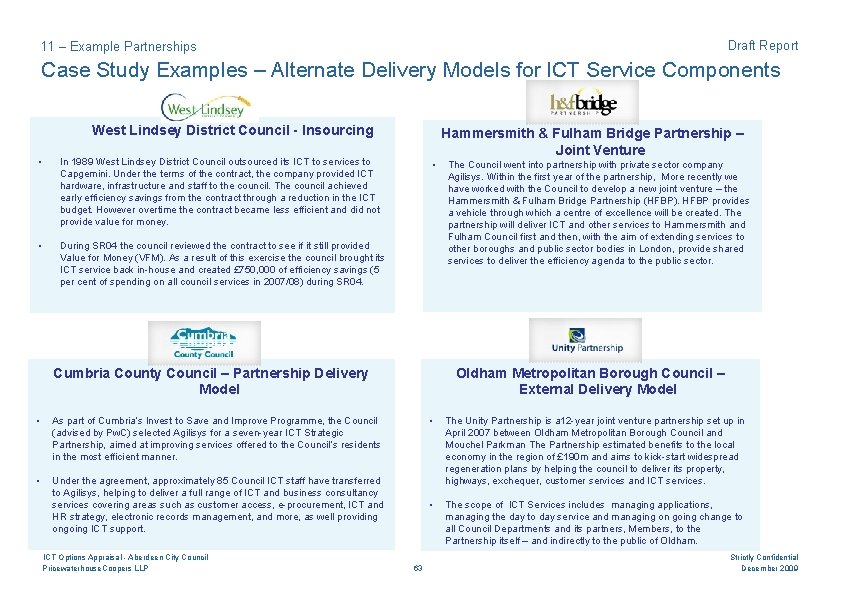
Draft Report 11 – Example Partnerships Case Study Examples – Alternate Delivery Models for ICT Service Components West Lindsey District Council - Insourcing • In 1989 West Lindsey District Council outsourced its ICT to services to Capgemini. Under the terms of the contract, the company provided ICT hardware, infrastructure and staff to the council. The council achieved early efficiency savings from the contract through a reduction in the ICT budget. However overtime the contract became less efficient and did not provide value for money. • During SR 04 the council reviewed the contract to see if it still provided Value for Money (VFM). As a result of this exercise the council brought its ICT service back in-house and created £ 750, 000 of efficiency savings (5 per cent of spending on all council services in 2007/08) during SR 04. Hammersmith & Fulham Bridge Partnership – Joint Venture • Cumbria County Council – Partnership Delivery Model • As part of Cumbria’s Invest to Save and Improve Programme, the Council (advised by Pw. C) selected Agilisys for a seven-year ICT Strategic Partnership, aimed at improving services offered to the Council’s residents in the most efficient manner. • Under the agreement, approximately 85 Council ICT staff have transferred to Agilisys, helping to deliver a full range of ICT and business consultancy services covering areas such as customer access, e-procurement, ICT and HR strategy, electronic records management, and more, as well providing ongoing ICT support. ICT Options Appraisal - Aberdeen City Council Pricewaterhouse. Coopers LLP The Council went into partnership with private sector company Agilisys. Within the first year of the partnership, More recently we have worked with the Council to develop a new joint venture – the Hammersmith & Fulham Bridge Partnership (HFBP). HFBP provides a vehicle through which a centre of excellence will be created. The partnership will deliver ICT and other services to Hammersmith and Fulham Council first and then, with the aim of extending services to other boroughs and public sector bodies in London, provide shared services to deliver the efficiency agenda to the public sector. Oldham Metropolitan Borough Council – External Delivery Model 63 • The Unity Partnership is a 12 -year joint venture partnership set up in April 2007 between Oldham Metropolitan Borough Council and Mouchel Parkman The Partnership estimated benefits to the local economy in the region of £ 190 m and aims to kick-start widespread regeneration plans by helping the council to deliver its property, highways, exchequer, customer services and ICT services. • The scope of ICT Services includes managing applications, managing the day to day service and managing on going change to all Council Departments and its partners, Members, to the Partnership itself – and indirectly to the public of Oldham. Strictly Confidential December 2009
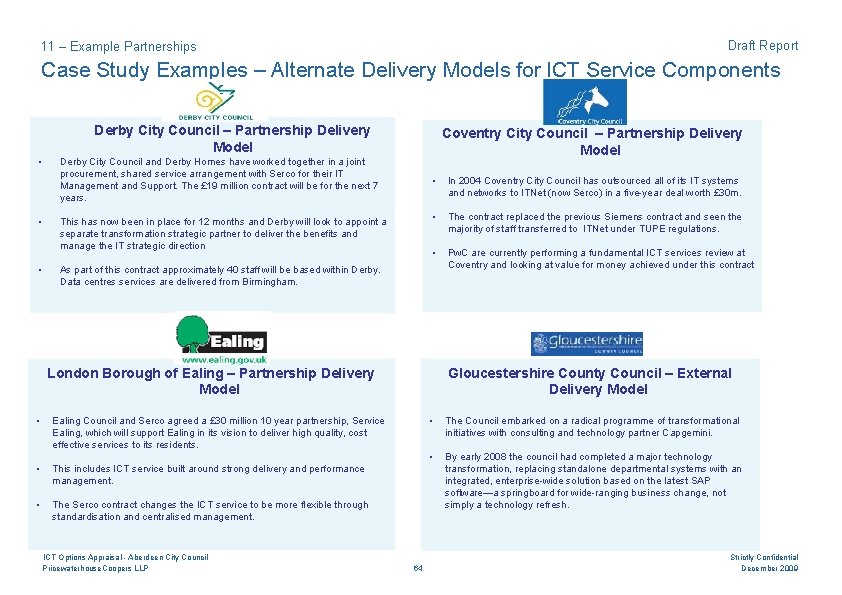
Draft Report 11 – Example Partnerships Case Study Examples – Alternate Delivery Models for ICT Service Components Derby City Council – Partnership Delivery Model • • • Coventry City Council – Partnership Delivery Model Derby City Council and Derby Homes have worked together in a joint procurement, shared service arrangement with Serco for their IT Management and Support. The £ 19 million contract will be for the next 7 years. This has now been in place for 12 months and Derby will look to appoint a separate transformation strategic partner to deliver the benefits and manage the IT strategic direction • In 2004 Coventry City Council has outsourced all of its IT systems and networks to ITNet (now Serco) in a five-year deal worth £ 30 m. • The contract replaced the previous Siemens contract and seen the majority of staff transferred to ITNet under TUPE regulations. • Pw. C are currently performing a fundamental ICT services review at Coventry and looking at value for money achieved under this contract As part of this contract approximately 40 staff will be based within Derby. Data centres services are delivered from Birmingham. London Borough of Ealing – Partnership Delivery Model • Ealing Council and Serco agreed a £ 30 million 10 year partnership, Service Ealing, which will support Ealing in its vision to deliver high quality, cost effective services to its residents. • This includes ICT service built around strong delivery and performance management. • The Serco contract changes the ICT service to be more flexible through standardisation and centralised management. ICT Options Appraisal - Aberdeen City Council Pricewaterhouse. Coopers LLP Gloucestershire County Council – External Delivery Model 64 • The Council embarked on a radical programme of transformational initiatives with consulting and technology partner Capgemini. • By early 2008 the council had completed a major technology transformation, replacing standalone departmental systems with an integrated, enterprise-wide solution based on the latest SAP software―a springboard for wide-ranging business change, not simply a technology refresh. Strictly Confidential December 2009
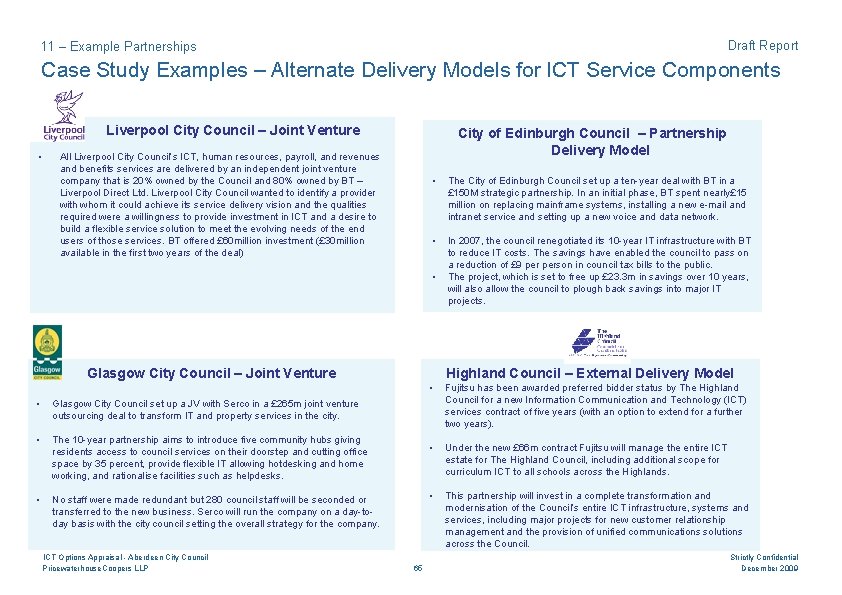
Draft Report 11 – Example Partnerships Case Study Examples – Alternate Delivery Models for ICT Service Components Liverpool City Council – Joint Venture • City of Edinburgh Council – Partnership Delivery Model All Liverpool City Council’s ICT, human resources, payroll, and revenues and benefits services are delivered by an independent joint venture company that is 20% owned by the Council and 80% owned by BT – Liverpool Direct Ltd. Liverpool City Council wanted to identify a provider with whom it could achieve its service delivery vision and the qualities required were a willingness to provide investment in ICT and a desire to build a flexible service solution to meet the evolving needs of the end users of those services. BT offered £ 60 million investment (£ 30 million available in the first two years of the deal) • The City of Edinburgh Council set up a ten-year deal with BT in a £ 150 M strategic partnership. In an initial phase, BT spent nearly£ 15 million on replacing mainframe systems, installing a new e-mail and intranet service and setting up a new voice and data network. • In 2007, the council renegotiated its 10 -year IT infrastructure with BT to reduce IT costs. The savings have enabled the council to pass on a reduction of £ 9 person in council tax bills to the public. The project, which is set to free up £ 23. 3 m in savings over 10 years, will also allow the council to plough back savings into major IT projects. • Glasgow City Council – Joint Venture • Glasgow City Council set up a JV with Serco in a £ 265 m joint venture outsourcing deal to transform IT and property services in the city. • The 10 -year partnership aims to introduce five community hubs giving residents access to council services on their doorstep and cutting office space by 35 percent, provide flexible IT allowing hotdesking and home working, and rationalise facilities such as helpdesks. • No staff were made redundant but 280 council staff will be seconded or transferred to the new business. Serco will run the company on a day-today basis with the city council setting the overall strategy for the company. ICT Options Appraisal - Aberdeen City Council Pricewaterhouse. Coopers LLP Highland Council – External Delivery Model 65 • Fujitsu has been awarded preferred bidder status by The Highland Council for a new Information Communication and Technology (ICT) services contract of five years (with an option to extend for a further two years). • Under the new £ 66 m contract Fujitsu will manage the entire ICT estate for The Highland Council, including additional scope for curriculum ICT to all schools across the Highlands. • This partnership will invest in a complete transformation and modernisation of the Council’s entire ICT infrastructure, systems and services, including major projects for new customer relationship management and the provision of unified communications solutions across the Council. Strictly Confidential December 2009
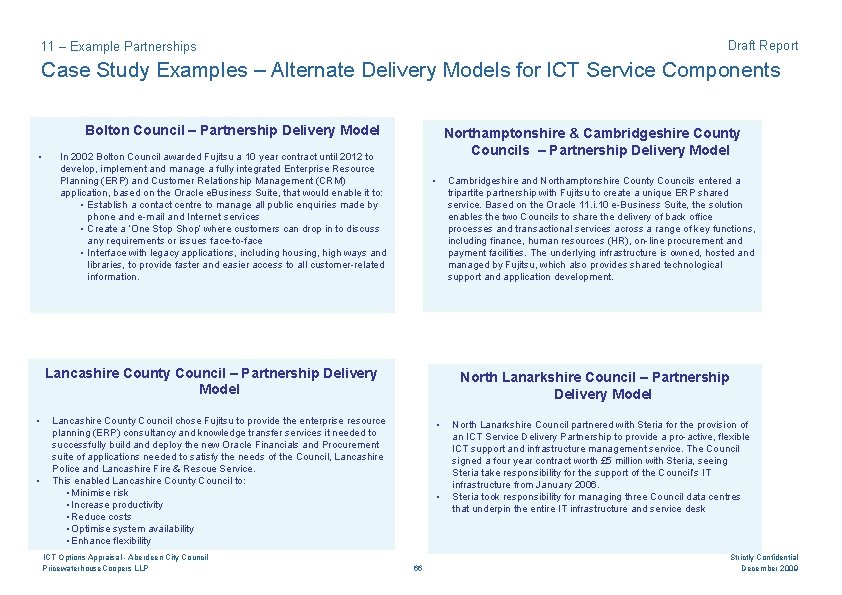
Draft Report 11 – Example Partnerships Case Study Examples – Alternate Delivery Models for ICT Service Components Bolton Council – Partnership Delivery Model • Northamptonshire & Cambridgeshire County Councils – Partnership Delivery Model In 2002 Bolton Council awarded Fujitsu a 10 year contract until 2012 to develop, implement and manage a fully integrated Enterprise Resource Planning (ERP) and Customer Relationship Management (CRM) application, based on the Oracle e. Business Suite, that would enable it to: • Establish a contact centre to manage all public enquiries made by phone and e-mail and Internet services • Create a ‘One Stop Shop’ where customers can drop in to discuss any requirements or issues face-to-face • Interface with legacy applications, including housing, high ways and libraries, to provide faster and easier access to all customer-related information. • Cambridgeshire and Northamptonshire County Councils entered a tripartite partnership with Fujitsu to create a unique ERP shared service. Based on the Oracle 11. i. 10 e-Business Suite, the solution enables the two Councils to share the delivery of back office processes and transactional services across a range of key functions, including finance, human resources (HR), on-line procurement and payment facilities. The underlying infrastructure is owned, hosted and managed by Fujitsu, which also provides shared technological support and application development. Lancashire County Council – Partnership Delivery Model • • North Lanarkshire Council – Partnership Delivery Model Lancashire County Council chose Fujitsu to provide the enterprise resource planning (ERP) consultancy and knowledge transfer services it needed to successfully build and deploy the new Oracle Financials and Procurement suite of applications needed to satisfy the needs of the Council, Lancashire Police and Lancashire Fire & Rescue Service. This enabled Lancashire County Council to: • Minimise risk • Increase productivity • Reduce costs • Optimise system availability • Enhance flexibility ICT Options Appraisal - Aberdeen City Council Pricewaterhouse. Coopers LLP • • 66 North Lanarkshire Council partnered with Steria for the provision of an ICT Service Delivery Partnership to provide a pro-active, flexible ICT support and infrastructure management service. The Council signed a four year contract worth £ 5 million with Steria, seeing Steria take responsibility for the support of the Council’s IT infrastructure from January 2006. Steria took responsibility for managing three Council data centres that underpin the entire IT infrastructure and service desk Strictly Confidential December 2009
Draft Report 12 – Conclusions and Next Steps Strictly Confidential Conclusions arrived at from the ICT Options Appraisal work Pw. C
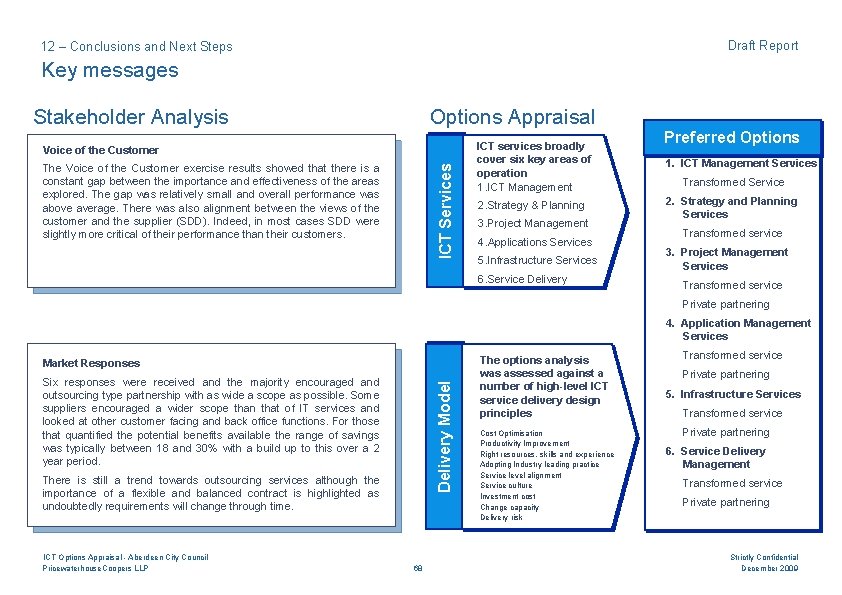
Draft Report 12 – Conclusions and Next Steps Key messages Stakeholder Analysis Options Appraisal Voice of the Customer ICT Services The Voice of the Customer exercise results showed that there is a constant gap between the importance and effectiveness of the areas explored. The gap was relatively small and overall performance was above average. There was also alignment between the views of the customer and the supplier (SDD). Indeed, in most cases SDD were slightly more critical of their performance than their customers. ICT services broadly cover six key areas of operation 1. ICT Management 2. Strategy & Planning 3. Project Management 4. Applications Services 5. Infrastructure Services 6. Service Delivery Preferred Options 1. ICT Management Services Transformed Service 2. Strategy and Planning Services Transformed service 3. Project Management Services Transformed service Private partnering 4. Application Management Services Market Responses Delivery Model Six responses were received and the majority encouraged and outsourcing type partnership with as wide a scope as possible. Some suppliers encouraged a wider scope than that of IT services and looked at other customer facing and back office functions. For those that quantified the potential benefits available the range of savings was typically between 18 and 30% with a build up to this over a 2 year period. There is still a trend towards outsourcing services although the importance of a flexible and balanced contract is highlighted as undoubtedly requirements will change through time. ICT Options Appraisal - Aberdeen City Council Pricewaterhouse. Coopers LLP 68 The options analysis was assessed against a number of high-level ICT service delivery design principles Cost Optimisation Productivity Improvement Right resources, skills and experience Adopting Industry leading practice Service level alignment Service culture Investment cost Change capacity Delivery risk Transformed service Private partnering 5. Infrastructure Services Transformed service Private partnering 6. Service Delivery Management Transformed service Private partnering Strictly Confidential December 2009
Draft Report 12 – Conclusions and Next Steps Phase 2 Activities Prior to any procurement activity it is vital to prepare information that will be required during the transaction. This will make the council take decisions associated with risks, scope and strategy that will make the procurement process clearer from the perspective of both the council and prospective suppliers. There is an existing IT Technical Strategy being finalised and this should be expanded to show the alignment to business objectives and council plan as well as addressing other areas of IT strategy as follows: The following activities should be considered for the scope of phase 2. • Performance management possibly with a balanced scorecard • • • IT Design principles The data collection of various information to allow the definition of a service catalogue defining the • Operating Model and Structure • Governance and Prioritisation • Scope of services (applications and infrastructure) • Service Levels and Performance • Applications Architecture • Current support arrangements and 3 rd party contracts • Future plans and changes in demand • Volumes • User base details • Key contacts for support With the possibility of a future transaction the scope of services and approach to risk transfer, approach to staff and asset transfer should be further explored. Finally, a business case should be developed so that a financial profile can be developed for the short and long term that allows the council to meet its objectives of service improvement and investment allowing the costs of delivery to be optimised. Further information required will cover • Current projects • Existing Policies • Assets & Locations • Staff & skills ICT Options Appraisal - Aberdeen City Council Pricewaterhouse. Coopers LLP 69 Strictly Confidential December 2009
![This report has been prepared for and only for [name of client] in accordance](http://slidetodoc.com/presentation_image_h/97841e17594748d0183a149784c7c93a/image-70.jpg "This report has been prepared for and only for [name of client] in accordance")
This report has been prepared for and only for [name of client] in accordance with the terms of our engagement letter dated [date] and for no other purpose. We do not accept or assume any liability or duty of care for any other purpose or to any other person to whom this report is shown or into whose hands it may come save where expressly agreed by our prior consent in writing. © 2009 Pricewaterhouse. Coopers LLP. All rights reserved. 'Pricewaterhouse. Coopers' refers to Pricewaterhouse. Coopers LLP (a limited liability partnership in the United Kingdom) or, as the context requires, the Pricewaterhouse. Coopers global network or other member firms of the network, each of which is a separate and independent legal entity. Pw. C
- Slides: 70